Marine Combat Correspondent

Marine Combat Correspondent: World War 2 in the Pacific
© 1999 Sam Stavisky
344 pages
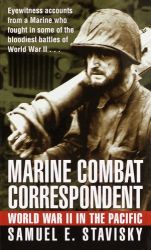
Sam Stavisky was a reporter for the Washington Post on December 7th, 1941, when he and the world bore witness to Japan’s bloody ambition to rule the Pacific. On December 8th, he attempted to join the Army to do his part against the German and Japanese empires.  Both the Army and Navy looked at Sam’s thick glasses and short stature and shook their heads, and the earnest reporter though he’d have to sit the war out – but then heard that the Marines were actively looking for journalists to send in the field. They would be real Marines,  but with a special sub-mission:   creating human-interest stories about the boys in the field to send to their folks at home, and recording for the public the stories of their sacrifice and gallantry.   Sam was soon on his way to the Pacific,  sometimes in combat and sometimes following rumors and whispers to find the real story. 

The Combat Correspondent program was completely new, with only six members at its creation:  most unit commanders had no idea what to do with their CCs, and employed them in underwhelming positions like clerks.  Sam was lucky enough to be assigned to someone more receptive, who essentially made him a roving reporter in the Pacific.  Although occasionally reeled in and assigned somewhere,  for the most part he was able to move from site to site on his own volition,  hitching rides on LSTs and following stories as he heard about them. Stories about Navy screwups or battles gone wrong wouldn’t make the censors, but Stavisky presents them here decades after the fact. Most of the stories included are about valor and resourcefulness, all censor-friendly. (Oddly, censors refused to forward one of Stavisky’s stories about an airman who surpassed Eddie Rickenbacker’s record for downed enemy fighters.)  Although often under fire (the Pacific in 1942 / 1943 didn’t have any ‘safe spaces’),   most of the combat recorded here is other people’s:  Stavisky isn’t involved in any first-wave invasions, but he does have to defend himself more than a few times and even serves as the tail gunner  in an airstrike on a Japanese supply depot. When I first encountered this book as a kid, I’d only ever read general, top-down accounts of World War 2 that were very sanitized.  Stavisky introduced me to the war as soldiers experienced it –  of desperate hours lying in mud under fire, singing bawdy songs and pinching supplies from Army depots,  of moving from camp to camp  and watching the skies above, wondering when Vals and Bettys might descend.  Re-reading it for the first time in at least sixteen years made me realize how many visceral details I’ve retained from this: the little rhymes Marines created to go long with the bugle calls (“Who’s going ashore? Who’s going ashore? Who’s got the price for a two-bit whore?”), the image of steaks served with soft-fried eggs, and of course the constant spectre of Sam’s D.I. floating in his head, admonishing him to “Cover yer ass!” whenever he’s tempted to get some shut-eye without first digging out his foxhole, or prudence is otherwise demanded.

This is a book wrapped up in nostalgia for me: were I reading it for the first time, I think I might be disappointed that Stavisky is always on the margins of major combat exercises, never directly involved the way Gene Sledge was. Still, I’d recommend it to anyone who wants to experience the Pacific front first hand, and get a taste for the many varied acts of perseverance and courage that made victory possible.

Posted in history, Reviews | Tagged , , , , , | 3 Comments

August 2022 in Review

It’s…er, been a while since I did a monthly update.

Science Survey

Doing well! The science survey for 22 is completed,  with sixteen titles fulfilling my twelve categories. I’d like to finish the year with at least 20 science titles, so we’re not done quite yet. Interestingly, this is the first year I haven’t tweaked the categories, though I am thinking about it seriously.  I want to include Oceanography in the future, but I haven’t decided if it will coexist with Geology, or  kick Thinking Scientifically out to join the second-string “Wildcard” squad. 

Added this month:
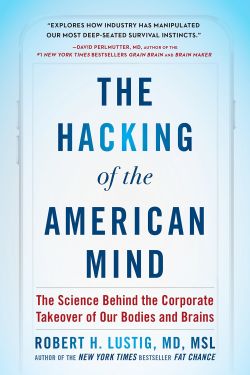
The Hacking of the American Mind, Robert Lustig (Psychology/Neurology/Cognition)
Unsettled: What Climate Science Tells Us, What It Doesn’t, and Why it Matters, Steve Koonin (Climate/Weather). Review in the works. I’m trying to look at Koonin’s sources to figure out how on the level he is.
Ocean Anatomy. Julia Rothman (Geology & Oceanography). This is a mostly-graphic introduction to the world’s oceans and their inhabitants. Presumably intended for younger readers, it nontheless had fair bit of information that was new to me, and the illustrations were charming.
Is This Wi-Fi Organic? A Guide to Spotting Misleading Science Online, Dave Farina (Thinking Scientifically)

Reading Dixie

Yeaaaah, this is…not a thing this year.  I still intend to read the rest of my library’s Rick Bragg holdings, but Pat Conroy will wait until 2023, I think.

Classics Club

I’ve read two books in eight months, which is somewhat less than ideal, shall we say? In the spring I read Gone with the Wind (timed it with tornado season because I love tempting fate), and more recently I finished The Hitchhiker’s Guide to the Galaxy.   To the few who don’t know its story, it’s about a fellow named Arthur Dent who is rescued from the destruction of Earth to make room for a space-highway by virtue of his buddy Ford Prefect, who as it turns out is an alien with a gift for hitchhiking. Absurd adventures ensue. I enjoyed it enormously at the beginning, but the longer it goes on the more my brain transforms into this chap:

I like silly — readers know how much I love P.G. Wodehouse and Lemony Snicket — but the end drifts into inanity for me.

Climbing Mount Doom:

Since March, I’ve read 13 of my TBR titles. A lot of them were ebooks, though, so the Pile of Doom that lives on my headboard bookcase has not diminished dramatically.  

New Acquisitions
I bought two science books that will be very appropriate for October,  shall we say, so – no spoilers.  I also purchased two books I read in high school: Disaster! by Dan Kurzman is a history of the San Francisco earthquake and fire; it was my introduction to the subject and one I remember fondly, so I want to revisit it. I may use it for a trilogy of books on early-20th century San Francisco, including another re-read favorite (Good Life in Hard Times) and Herbert Ashbury’s history of the SF underworld, The Barbary Coast.  The second buy was Sam Stavinsky’s Marine Combat Correspondent,   a memoir of a Post reporter turned Marine.  I’d never read a war memoir before finding this in Walmart back in 1999 or so,  and it led me to other memoirs like William Manchester’s Goodbye, Darkness. (That, in turn, led me to his The Glory and the Dream, a 1400-page history of the United States from 1932 – 1972. I read this as a ninth or tenth grader. Needless to say I was a strange child.)   Marine was one of the key books (along with Albert Marrin’s The Airman’s War) that formed my early knowledge of WW2. I’m nearly done with my re-read of it, so look for it soon.

Posted in General | Tagged , , | 7 Comments

Is This Wi-Fi Organic?

Is This Wi-Fi Organic? A Guide to Spotting Misleading Science Online
© 2021 Dave Farina
254 pages

In The Demon-Haunted World, Carl Sagan warned readers: “We live in a society exquisitely dependent on science and technology in which hardly anyone knows anything about science and technology.” Dave Farina has made it his life’s mission to remedy such wholesale ignorance, hosting a youtube channel in which he addresses popular misconceptions about the natural world. He adds to his work with Is This Wi-Fi Organic, in which primers on physics, biochemistry, and energy precede and inform take-downs of various spurious claims. Farina focuses on those with a direct bearing on human health (diet and medicine), though after the two-thirds mark he moves to the area of the obnoxious-but-not-dangerous category, the likes of astrology and such. Farina takes serious issue with the “nature good, artificial bad” conceit so ubiquitous in our culture, frequently reminding readers that nature can be capricious and destructive as easily as it can be beneficial. The author’s experience as an online educator is definitely on display here, with clear explanations and helpful illustrations; there’s also a good dash of humor, sometimes snark, when he’s addressing particularly ludicrous claims. The book is most helpful in constantly keeping readers tied to the foundation: we begin with chemistry and physics, and even as Farina builds on that to explain how cells work, or muscle tissue is created, he continually reminds readers of these processes’ ultimate electrochemical origins. Is This Wi-Fi Organic is both educational and fun, but it has its quirks. Farina’s passion for creating a scientifically literate populace is admirable but leads him to a naive technotriumphalism at times — championing a command economy and cold fusion, for instance. Farina might be served looking at a history or economics book once in a while. Despite this, I think the book is helpful as an introduction to the basic goings-on of the natural world and ourselves, especially if paired with something like A Survival Guide to the Misinformation Age, which focused more on skills on interpreting graphs, parsing statistics, etc.

Related:
The Skeptic’s Guide to the Universe: How to Know What’s Really Real in a World Increasingly Full of Fake, Steven Novella et. al. From the hosts of “The Skeptics Guide to the Universe“, a skeptical/science/geek podcast I’ve been listening to since 2006.
The Demon-Haunted World: Science as a Candle in the Dark, Carl Sagan
A Survival Guide to the Misinformation Age, David Helfand
50 Popular Beliefs that People Believe are True, Guy Harrison

Posted in Reviews, science | Tagged , , , , | 5 Comments

The Hacking of the American Mind

The Hacking of the American Mind: The Science Behind the Corporate Takeover of Our Bodies and Brains
© 2017 Robert Lustig
352 pages

Robert Lustig is an endocrinologist who gained public recognition when he delivered a lecture entitled “Sugar: the Bitter Truth”, which exposed the opioid-like effects of sugar, its saturation in the American diet, and how fructose in action resembles a toxin. I don’t remember how the timing of my watching that worked with my switching to a low-processed foods diet and subsequently losing nearly two hundred pounds, but in my subsequent health reading to understand my experiences, I began learning about metabolic syndrome, insulin resistance, and other factors that connected to Lustig’s arguments perfectly. His The Hacking of the American Mind continues his campaign against the ubiquity and deleterious effects of sugar, but broadens it to a general attack on how corporate America (except for the medical and pharmaceutical giants who only want us to be healthy, naturally) conflate pleasure and happiness, using brain chemistry to addict us to the pursuit of their products, despite the attending health costs of depression, obesity, etc. Hacking is at once wholly promising and disappointing: promising because of the importance and ambition of its subject, and disappointing for the breezy and casual style in which it is treated.

Lustig opens by differentiating between pleasure and lasting happiness,  first drawing on the observations of philosophers before switching to his own specialty.  Although wisdom traditions across the world have recognized the futility of pursuing pleasure to achieve happiness (even the Epicureans, who defined pleasure as the only good, nonetheless promoted voluntary simplicity to avoid the hedonic treadmill trap), Lustig argues that we now know the neurology underlying the pleasure/happiness distinction.  One is derived wholly from dopamine, and the other from serotonin.   Although dopamine rushes can be intense, they are  also short-lived and provide diminishing returns: to  protect the participating neural connections, the body downregulates their sensitivity. The result is that people who want to replicate the same high have to indulge in the originating behavior all the more, creating a cycle of addiction and depression.   Anything that triggers dopamine rushes can thus become addictive: food, sex,  gambling, video games, etc — and if it’s actively promoted through advertising, dopamine rewards are involved. This has become a progressive problem in industrialized nations, because dopamine triggers are increasingly cheap to come by,   allowing people to self-sabotage their mental health in the pursuit of pleasure – and physical health problems quickly follow. This is especially the case with Lustig’s bête noire, sugar:  here he recapitulates his argument against sugar, especially fructose. Although Lustig addresses other common sources of addiction and misery, particularly smartphone usage and opiods, he returns to sugar repeatedly: this is understandable given Lustig’s profession, how destructive fructose is to insulin regulation, and how ubiquitous sugar is in the American food supply. As Michael Moss documented in Salt, Sugar, Fat, sugar is abundant even in food products that aren’t ‘sweet’; it’s commonly used as a preservative and a bulkifier. Lustig’s prescription is to “connect, contribute, cope, and cook” — rapidly dialing down our consumption of social media, taking tech sabbaths and spending real time with in-the-flesh people, finding ways to volunteer and help in our local communities, and hitting multiple birds with one spatula by learning to cook. Not only will shifting to fresh foods eliminate much of the processed rubbish from our diets, but it’s a technical skill that delivers satisfaction and is a convenient way to bring people together. Few things rival the company of good friends around a dinner table, that’s for certain.

Hacking was a must-read for me because it addresses so many important issues to mental and physical health: metabolic syndrome, consumerism, and their common fuel of addiction. As much as I wanted to love the book, though, and hasten to recommend it, it’s riven with problems. Lustig is an inconsistent author, at times so breezy and quick with pop culture references as to undermine what should be a sober and earnest call to arms, and at others employing so convoluted a sentence structure that a reader has to circle the block a few times to parse what’s being said. The casualness is far more pervasive, though, which diminished the book’s credibility — especially when it marks not just style, but treatment of subjects outside biochemistry. There are outright mistakes (referring to Obamacare as something that had been done away with, referring to Trump as the first populist president, mischaracterizing agape as religious zeal) and a general cavalierness even within his stronger beat. For instance, when remarking on how cigarettes were once promoted as a curative for obesity, he treats this merely as addiction transference despite nicotine’s known effect as an appetite suppressant. As much as I loved the topic and respected Lustig’s goal (and agreed with his prescription, limited as it was), the book read as messy. It wasn’t the forceful, clear argument that the author delivered in his original “Sugar” lecture, and that the subject merited. Even so, it’s worth your time if you, like me, are concerned about how the western way of eating, and the compulsive nature of consumption (of stuff, of The News, etc), destroy people’s health.

Related:
Salt, Sugar, Fat: How the Food Giants Tricked Us, Michael Moss
Drunk Flies and Stoned Dolphins: A Trip Through the World of Animal Intoxication, One R. Pagan
Affluenza: The All-Consuming Epidemic, various
The Year of No Sugar, Eve Schaub
The Obesity Code, Jason Fung
Spark: Exercise and the Brain, Jason Ratey
Dreamland: The True Tale of America’s Opiod Epidemic, Sam Quinones
Why We Get Fat, Gary Taubes
American Mania: When More Isn’t Enough, Peter Whybrow

Posted in Reviews, science | Tagged , , , , , | 4 Comments

Ten Years of the Classics Club

The Classics Club recently celebrated its 10-year anniversary, and posed some questions to its readers. I began participating in 2015, wrapping up my first list in 2020 and starting a new one weeks later. My original plan with the Classics Club Strikes Back (my second list) was to knock it out in three years. A year and a half into CCSB, I’ve read 21 books, so it’s still possible. Given my lack of progress this year (I’ve read one title), I’ll have to come out swinging in 2023.

The Questions

When did you join the Classics Club? 

September 2015.

What is the best classic book you’ve read for the club so far? Why?

Solzhenitsyn’s Gulag Archipelago  comes to mind. It’s an amazing blend of eye-opening history, insight into human nature, and wholesale condemnation of the communist state.


What is the first classic you ever read?

As part of the Classics Club, Emma; in general, The Call of the Wild.


Which classic book inspired you the most?

It’s not from my CC lists, but Thoreau’s Walden was part of the reason I began pursuing simple living and minimalism.


What is the most challenging one you’ve ever read, or tried to read?

From this list, Catch-22; it took me four times. In high school, I tried and failed (quickly) to read Faulker’s Sound and Fury.


Favourite movie adaptation of a classic? Least favorite?
Gotta go with Gone with the Wind for a favorite; I haven’t seen many others, but I have assurances from multiple parties that the new Persuasion is terrible.


Which classic character most reminds you of yourself?

Ivan Ilyich, because we both have/had serious kidney issues. :p


Has there been a classic title you expected to dislike and ended up loving? Respecting? Appreciating?

I expected to read The Jungle with a scowl on my face the entire time, but Sinclair delivered a compelling story, for the most part — until Jurgis disappears as a character to become nothing but the passive listener of lectures on politics and economics.


Classic/s you are DEFINITELY GOING TO MAKE HAPPEN next year?

Er, the ones I don’t get to this year. I’ll say Plutarch’s Heroes because it’s very unlikely (unless I suddenly get in a Greco-Roman mood) that I’ll get to them in 2022.


Favorite memory with a classic and/or your favourite memory with The Classics Club?

Finishing War and Peace and reveling in my ability to brag about having read it. Gulag Archipelago is larger and Brothers Karamazov more complex, but they don’t have the same cachet as Tolstoy, for whatever reason.

Posted in General | Tagged , | 4 Comments

Book meme remix liberated from CK

Cyberkitten recently posted a couple of book memes, and I’m borrowing questions from both.

What’s the first book you remember reading?

The earliest reading memory I have is a Sesame Street title involving Bert, Ernie, and some monster in the closet.

Did someone read to you as a child?

Ohhh, yeah. I can remember my dad reading Tom Sawyer to me. We were a reading family.

Who is your all-time favorite book character?
Jayber Crow.

Who is your favorite author of all time? Your favorite book by them?

I’m going to say Wendell Berry and his Jayber Crow.

Has a book ever changed your life?

On multiple occasions! I did a post about that a few years ago (..er, eight years ago. Tempus fugit.). Marcus Aurelius’ Meditations is probably top of the list.

What genres do you love?
In fiction, I mostly read historical fiction, with some science fiction. In nonfiction: history and science duke it out every year. History is the reliable winner but it can never rest on its laurels. Politics and social issues bring up the second tier.

Are there any genres you dislike?
Dodgy self-help and romance.

What author (who is still living) would you dearly love to meet?
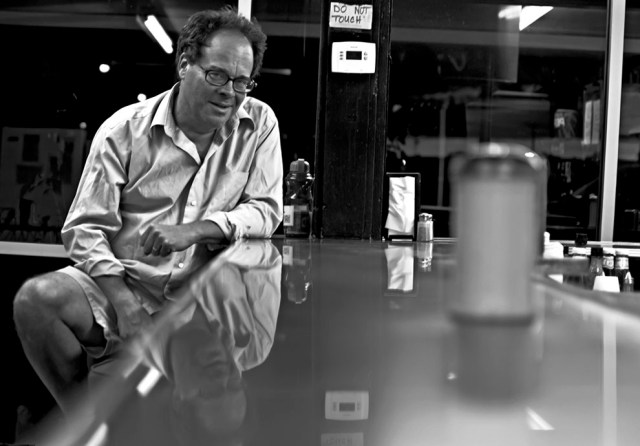
Easy easy easy. Bill Kauffman. I’d love to split a bottle of decent whiskey and tie up a bar’s best table for a few hours with him. His strong localist views, knowledge of America’s most interesting and original characters, and command of obscure American literature make him someone whose company I’d love to hang out in.

Have you ever met a (famous or semi-famous) author face to face? Where?
I ate lunch next to Jim Kunstler back in 2008. I hadn’t read any of his stuff yet, so he was spared both interrogation and adulation.

Do you prefer paperbacks or ebooks? Why?
Ebooks for most reading, physical for books that amazon might decide are thoughtcrime and try to delete.

Have you ever read a self-published book?
Via kindle, many times. My first kindle title was a minimalist youtuber’s manifesto, Disrupting the Rabblement. Niall Doherty was the name.

What book or series do you hope will be turned into a movie or TV show one day?

None of them. I don’t consider dramatizations an improvement. I’m dreading what AppleTV does to Foundation.

What attracts you to a book? The cover? Blurb? Recommendation from others?
Title, price, author, reviews.

Have you read any of the old classics? What did you think of them?
Many. It varies on the book. Some, like Gulag Archipelago, were amazing. Others, like Gibbon’s Decline and Fall, had solid writing but were not fun to read.

What is your favorite book cover?
Bill Kauffman’s Look Homeward, America comes to mind. It uses Grant Wood’s “Spring in Town”.

How many books do you read a month?
On average, 13.

What was your favorite book when you were a child?
I went through a stack of books a week as a kid, so it’s hard to say. The Call of the Wild was one I often re-read, though, along with Robinson Crusoe.

Do you like to write reviews on Amazon or Goodreads? 

I write reviews here and crosspost them to Goodreads, but sometimes I’ll post a one-liner on goodreads for books that don’t give full writeups here. 

Where do you usually discover new books? Physical bookstores? Online? Social media? 

Mostly online, using amazon’s “Related” tab, but I also make a monthly trip to Books a Million to sip coffee and photograph book covers that interest me. I look up  reviews for them and keep an eye out for used copies later in the year.

Have you ever joined a book club? 

I used to be a member of the library’s “Book Bunch”, a group that met weekly to talk about the books we were reading.  We didn’t do a common reading, but if a book was popular it would make the rounds: everyone wound up reading Where the Crawdads Sing, for instance. 

What deceased author would you have liked to meet? 

Isaac Asimov or Carl Sagan: Asimov would be more interesting on the whole, I think.  (Now, ‘deceased authors whose conversation I’d like to eavesdrop on’ would be Lewis and Tolkien!)

Think about your favorite genre. To you, which author is the master of that genre? 

For fiction, I’d say historical fiction and that means Bernard Cornwell.

Do you judge a book by its cover? Would a shoddy cover put you off? 

This is important for ebooks, because it’s a fast and dirty way to see how much effort has been put into the book. If the cover was something I could have put together in MS Paint, I may move on without looking at the book further. Bad covers are not always indicative of low-effort contents, but it’s a useful rule of thumb.

Do certain tropes attract you? For example, orphans, love triangles, anti-heroes? 

I’m attracted to stories about people who go wrong and then redeem themselves, which is probably why I love Red Dead Redemption II so much. 

Are there any books you haven’t been able to finish? Why not? 

Life is short. No time to waste on books that are badly written with subjects or stories that don’t interest me. 

Did you read books in school? Can you remember which ones? 

I always had books in my bag, beyond what we were reading for class. Gooosebumps, Boxcar Children, Animorphs, Roswell High, and California Diaries were some series I’d invariably be reading or re-reading.

Are there any books you could read over and over again and never get bored of? 

I can’t tell you how many times I’ve reread Asimov’s Black Widower stories or the first Foundation collection. The same would go for a few John Grisham titles (The Rainmaker and Last Juror), or Max Shulman’s The Many Loves of Dobie Gillis.  

What’s the last book you read? 

I just finished Imperial America, a collection of essays (1980s – 2004) from Gore Vidal. 

What’s the last book you bought? Did you buy it online or at a store? Ebook or paperback? 

An ebook called Star Trek: Agents of Influence by Dayton Ward. Every month a small number (5- 10) of Kindle/Star Trek titles are put on sale.

What book can you recommend to me? 

The Code of the Woosters, P.G. Wodehouse. You don’t know how funny English can be until you’ve experienced its treatment at the hands of Wodehouse.

When did you last visit a library? 

This morning. (I work at one.)

Has a book ever made you laugh out loud? 

Bernard Cornwell invariably does with his dialogue.

Has a book ever made you cry? 

The Pigman by Paul Zindel comes to mind, as does Redshirts by John Scalzi – not the main story, but its codas. 

What book will you read next? 

I’m currently reading The Lonely American  and The End of Gender, but both are rather serious so I may stop for something more fun.

Posted in General | Tagged | 3 Comments

Of Babylonians, demons, and bankers

Continuing in the Big Book Catchup…

Paul Kriwaczek’s Babylon: Mesopotamia and the Birth of Civilization covers Mesopotamian history from the establishment of Eridu to the rise of the  first Persian empire.  This is a survey of thousands of years of city-kingdoms battling one another for dominance, and later small kingdoms doing the same, creating complex relationships – most notably, the convoluted Assyrian-Babylonian one, as Assyria began as part of one “Babylonian” kingdom,   became distinct from it, and later came to dominate another version of Babylon before both were absorbed by the  Achaemenid Persians.  Although the narrative is quite readable, Kriwaczek does the reader no favors by frequently switching focus from macro-subjects to micro-ones: one moment we’re reading about general trends in Babylonian politics, the next we’re studying how city-state command economies compared to Soviet ones.    I’ve read surveys of this subject before (Asimov’s The Near East, Durant’s Our Oriental Heritage, etc) and was able to follow along, but I think if I were someone approaching with no background knowledge I’d still be feeling a bit lost.  I’ve another book by Kriwaczek, Searching for Zarathrusta: I imagine a more narrow focus serves him better. 

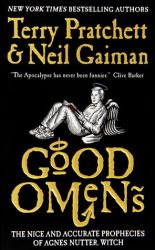
Neil Gaiman’s Good Omens is a fantasy novel about the end of things. It opens with a demon and an angel standing at the entrance to the Garden of Eden, watching the newly-evicted Adam and Eve begin to make their way east into exile. As they try to make sense of what’s happened, something of a friendship is born – and when, years later, the demon is tasked with helping bring about the End of Things,  the two both decide that they like Earth as it is and would prefer to avoid the apocalypse and all that.  It’s a comic fantasy about doomsday: I started off with the excellent audiobook and then switched to the book proper. 

The Hospital: Life, Death, and Dollars In a Small American Town by  Brian Alexander is a history of one independent hospital’s director to keep his organization free of the large hospital corporations, which would doubtlessly close and consolidate services to increase profit margins.  In addition to this local-level history, Alexander also reviews (cursorily) the change in American healthcare from mission-oriented to revenue-oriented. The book is a fairly transparent attempt to persuade readers that the United States needs a centralized health system run by those geniuses at DC (The ones who wasted twenty years in Afghanistan, tried to persuade us that cloth masks stopped viruses and that mass arson in tribute of a career criminal was good for public health)  because the current system is too complex and criminally inflated.  I don’t think anyone would dispute the miserable state of things currently, but how anyone can watch DC in action and want them to have more authority and responsibility over one’s health is breathtaking. “The government should just…do something about it” is the height of passivity, laziness, and unoriginality.


Gore Vidal’s Imperial America collects essays and interview transcripts from the author and critic. The collection appears to have been inspired by the growing war & police state of the post-9/11 period, though Vidal looks for context as far back as James Polk and the invasion of Mexico, and many pieces are from the 1980s. Vidal also comments on the mixed success of the American Republic in the 19th century, and its wholesale destruction in the 20th, wholly captured by the military-industrial complex, financial powers, and other corporate interests.  Vidal continues to be of interest because he’s not one to be boxed in:    his essays against Reagan and George W. Bush are predictable and amusing for the wrong reasons, as he seriously believes both men’s religious views might compel them to usher in the Apocalypse, but then he surprises me by taking potshots at Hamilton, Lincoln, and the FBI – the latter of which, he writes, has since its founding focused more on the regime’s political enemies rather than to the lowly likes of organized crime.  The Fibbies certainly haven’t changed.

Posted in history, Politics and Civic Interest, Reviews | Tagged , , , , , , , , | 4 Comments

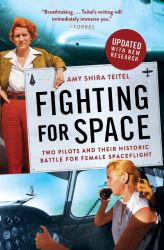
Fighting for Space

Fighting for Space: Two Pilots and their Historic Battle for Female Spaceflight
© 2020 Amy Shira Teitel
448 pages

When the age of flight arrived,   women were as eager to take to the skies as men.  Fighting for Space is a joint biography of two women, pioneers from different generations, who  created  extraordinary lives for themselves in the air, and then – as  rockets began  rising above airplanes –  wondered if they might not  be able to push the envelope further, and help put women in space.   Amy Shira Teitel (host of the uber-cool and always interesting space history channel, Vintage Space) here introduces readers to Jackie Cochrane, an entrepreneur who flew with Amalia Earhart and Chuck Yeager;  and Jerrie Cobb,   who arranged to have herself subjected to the same battery of tests as the Mercury 7,  leading the way for another twelve women to do the same – funded by Cochrane.   It’s an expanding story of  early aviation,  growing  opportunities for women in World War 2, and the determination of two women to surpass the expectations of their sex  and beat the Russians to sending a woman into space.  The subjects are admirable, their combined story compelling – but where Teitel really triumphs is creating a history that tells of their struggle without reducing it to a predictable propaganda piece. Instead, our two heroines have flaws, and even actively resent the other – and the men who ultimately frustrate  their ambitions, LBJ and Jim Webb, are  presented not as villains but as men beset with responsibilities, working to fulfill them with the limited resources at hand as best they could. 

Although both of the subjects of this book are remarkable, if I had to choose one over the other, it would have to be Jackie Cochrane. Growing up in poverty, forced to drop out of school and join the workforce before she was a proper teenager, let alone an adult, Cochrane kept her eyes open for opportunities and created a successful salon business for herself. From an early age, she had a forceful self-confidence and was unafraid to confront those who tried to take advantage of her, and business would only get better after she attracted the attention of a business tycoon, who encouraged her to pursue flying to help her grow her market. Flying became more of a joy and a challenge in itself, and she pushed herself to become not only good, but The Best — racing in airshows at a time when flying was far more dangerous than it is now, even when pilots weren’t trying to cross the country as quickly as possible under adverse conditions. Jackie’s prominence as an aviator and interest in creating an American version of the Air Transport Auxiliary (a program in England in which female pilots were used to transport planes from base to base, freeing up men for combat) made her an instrumental part of creating and directing what became the Womens Airforce Service Pilots program, better known as WASPS. After the war, she continued pushing herself as an aviator, enlisting her friend Chuck Yeager’s help to train her to fly the new jet aircraft becoming more popular. Meanwhile, a young Jerrie Cobb fell in love with flying as a teenager, and beat bushes looking for opportunities to work with planes for a living — a hard ask in the postwar years, as the market was glutted with cashiered airmen looking for jobs that could get them back in the air. When the International Geophysical Year and Sputnik propelled the United States toward creating a manned rocket program, Cobb was aggressively interested in seeing if women couldn’t make the cut, either. As it happened, the Lovelace lab was interested in the data generated from women taking the same tests as men: even if NASA wasn’t currently looking for female astronauts, it presumably would eventually. Cobb’s relentless promotion of inclusion for female pilots saw her named (by LBJ, who had made the space program his baby) as a consultant to NASA. With funding from Cochrane, other women were invited t to take the same panel of physical and psychological tests as Glenn, Grissom, and the rest of the Mercury men — though NASA was under such stress at the time to catch up and surpass the Russians that it wanted to focus on astronauts of known quantities, hence the Mercury pioneers being drawn exclusively from test pilots. After the biggest incentive for sending a woman into space — being the first to do it — was removed courtesy of Russia sending up Valentina Tereshkova — Cobb and Cochrane realized that women in space was a lost cause for now, and Cobb switched her flying zeal to doing missionary work. The United States wouldn’t send a woman into space until 1983, when Sally Ride was named to an early space shuttle mission: a year later, Kathryn Sullivan became the first woman to do a spacewalk.

Fighting for Space was the most fun I’ve had reading history in a while: admittedly, early aviation and the Mercury-Apollo era are two of those subjects I can’t read enough about, but Teitel’s research and professionalism made the book a must-recommend. The women are not made inviolate icons despite their dogged triumphs, and the men are not demonized: instead, we get a full, even history that doubles as a great story.

Related:
Fly Girls: How Five Daring Women Defied the Odds and Made Aviation History, Keith O’Brien
Through the Glass Ceiling to the Stars, Eileen Collins. Collins was an early military pilot who was barred from combat missions, but used her experience flying cargo planes to good effect in the Shuttle program. She was the first female commander of an STS mission, and many of the women that Jerrie Cobb led to be tested as prospective astronauts were there to witness her launch.
Rise of the Rocket Girls. Nathalia Holt. This title focuses on NASA’s ‘computers’, women doing the rocketry calculations that allowed the space program to develop from seized German rockets.
The Women with Silver Wings: The Inspiring True Story of the WASPS, Katherine Landeck. Cochrane has a HUGE listing in the index, as you might imagine. On my to-read list.
The Hurricane Girls, Jo Wheeler. The history of Britain’s ATA program, the inspiration for the WASPS. On my “probably to read” list. The reviews indicate it has a lot of technical errors. Cyberkitten reviewed it here.

Posted in history, Reviews | Tagged , , , , , , | 8 Comments

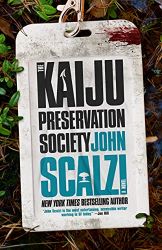
The Kaiju Preservation Society

The Kaiju Preservation Society
© 2021 John Scalzi
268 pages

“You have me monologuing, I’m guessing, to stay alive longer. Yes, I know about monologuing. I’ve watched The Incredibles.”

I don’t know what a kaiju is, but John Scalzi’s name is on the cover so, I’m sold. At least, that’s…what I thought. Turns out John Scalzi isn’t always at his John Scalziest, or perhaps I like him better when he’s not as John Scalzi-y as he is here. We open with our narrator Jamie presenting a pitch to his or her boss (I have no idea, the main character isn’t developed…at all) and promptly being fired, because said boss is a jerk. Happily Jamie receives a mysterious job offer shortly afterward, and learns about another world — a mirror Earth dominated by huge beasts who are studied and protected (from other humans) by an organization known as KPS. However, there’s an Eeeeeeeeevil Corporation out there that wants to Do Bad Things, so the brave selfless scientists and their stalwart assistants (i.e. Jamie) have to thwart their evil plan!

The characters are nonentities: the plot is about as inspired as the Disney Star Wars sequel trilogy, and the author is all-too-eager to remind us of the early days of the pandemic, when we were made subjects of house arrest (except for the politicians!). We get lots of politics — covid policy, hand wringing over The Dreaded Orange One, and references to women as “uterus owners”. I’d make a mean joke about SF writers not knowing what women are, but Scalzi’s married with a daughter, or so his bio alleges. That said, the book still manages to be entertaining: Scalzi is good at writing fun, snarky dialogue, and the entire book is about dinosaur-like creatures the size of small mountains, who have internal nuclear reactors and who are miniature ecosystems. A lot of thought was put into their world and their bodies, and it makes the story incredibly interesting despite the fact that our main character is just there to do Things for the Plot and deliver clever rejoinders in conversations. All of the other characters are there for the same reason: the only one with any personality whatsoever is the villain, and he’s boilerplate Evil Entitled Corporate Jerk. KPS manages to be both obnoxious and fun, like a friend at a party who’s had a bit much to drink but is nonetheless making the scene more bearable through their imaginative drunken ramblings.

Posted in Reviews, science fiction | Tagged , | 1 Comment

Recalled to life

Er. hi. Been a while. Today marks my partial return to work, as I’ve been readjusting to life the last few weeks. I’ve been reading steadily, but have not been home (lots of housesitting), and typing reviews on my laptop is frequently frustrating because of touchpads sending cursors hither and yon. Big hands, small keyboard — not a good fit. Now that I’m home and settling back into my old routines (including wearing pants and socks, a sad change after two months living in gym shorts and sandals), regular posting should resume. For now, an old This Week at the Library-esque wall o’ text!

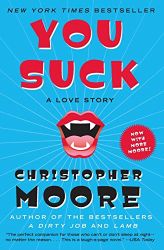
Many young people wake up with regrets after a one-night stand, but it’s a bit more extreme in Tommy’s case: his girlfriend is a vampire, and now so he is.  I stumbled upon You Suck in a secondhand bookshop, so  I didn’t realize there was a prior book in this series, one that explains why  Tommy and his undead gal pal Jody have an ancient evil vampire imprisoned in a bronze statue, as well as a bronze tortoise. In due time said vampire is inadvertently released,  and the immortal lives of our happy couple are imperiled, as well as the life of their newly acquired minion.  I’ve read Christopher Moore before and have never failed to enjoy his absurdist fantasy stories; You Suck was no exception. I may try to find other books in the series around October.

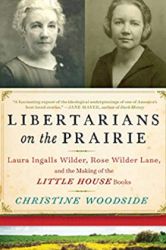
Libertarians on the Prairie dives into the working relationship between Rose Wilder Lane and her more famous mother, Laura Ingalls Wilder.  Rose was one of the ‘furies of Liberty’ mentioned in Radicals for Capitalism, along with Isabel Paterson and Ayn Rand,  as she became increasingly concerned about the state of the American republic as it was deformed by Roosevelt’s new deal and World War 2.   Libertarians opens with a biography of Laura Ingalls, whose nonfiction version of her story formed the basis for the children’s series that she would write at her daughter Rose’s urging and with her help: Rose served as typist and editor,  and regarded the stories as a way to make Americans remember who they were – inheritors of the rugged, self-sufficient pioneers, and not Old Word serfs, bowing before the State.   The book is fairly critical of Rose and labors under the strange idea that she invented the rugged-free-farmer idea.   Interestingly, she didn’t think much of Ayn Rand, regarding her fans  as pseudo-intellectuals.

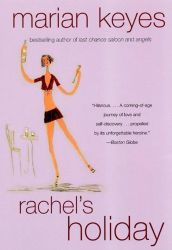
Rachel’s Holiday opens with a young woman (named Rachel, would you believe it?)  being forced by her family to attend drug rehab. She’s not an addict (she accidentally took too many valiums to counteract the too-pure cocaine she was enjoying the night previous), but she relents because rehab makes her think of saunas, gym time, and juice cleanses.  When she arrives she’s surprised to find that no one else there is an addict, either: their families were also over-reacting. She’s also dismayed to find no gym, no masseuses, and no access whatsoever to good wine.  She has to stay there at least three weeks, though, and as we spend more time with her, we realize that Rachel is an unreliable narrator who is deeply in denial about her problems. Keyes manages to keep her sympathetic  even as Rachel’s serious issues (including self-obsession, theft, and chronic lying) are exposed.  It’s a psychological story at heart with some romance.

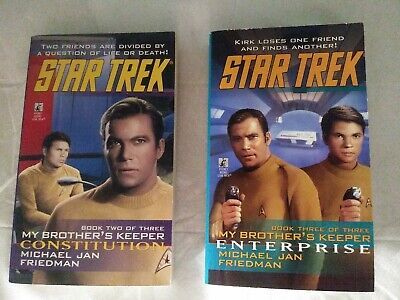
Continuing in Star Trek: My Brothers Keeper, I read the second and third volumes in the trilogy. Constitution  revisits an early Kirk & Mitchell mission in which Kirk is forced to take command and defend a world against an outside attacker with a malevolent satellite system.  We see a lot of character growth here for Kirk, as he’s forced to act more on instinct in a situation that demands quick responses.   In Enterprise, Kirk  is asked by Mitchell’s parents to deliver a eulogy at the fallen man’s funeral, Kirk wrestles with the decision to tell them the truth of their son’s death and his role in it. As part of his reflection, he looks back to another time when he thought Mitchell was dead — to a time when Enterprise was ordered by Starfleet Command to deliver a small team to a barren wasteland, where waited a Klingon cruiser. Kirk knows this is not the first time Starfleet and the Klingons have rendezvoused here, but he has never been privy to the details of these secret meetings — not even now, as captain. Disaster strikes and Kirk soon loses the Enterprise to a small band of augmented Klingons, and must work with Klingon legend-in-the-waiting Kang to free his people and eliminate a threat to the Federation. As a Star Trek novel, this is perfectly fine; it’s an enjoyable adventure with good characterization and humor. As the ending part of this trilogy, though, it suffers for want of Gary Mitchell: he recedes far into the background for most of the book. It’s essentially a Kirk and Kang struggle, with Friedman making an attempt to explain why TOS had human-like Klingons and TNG had Klingon-Klingons. Amusingly, Friedman uses genetic augmentation in the story — taking it the complete opposite direction that ST-Enterprise did.  Mitchell doesn’t play as prominent a role in the third story as one might expect, but the trilogy remains solid light-adventure Trek fun.

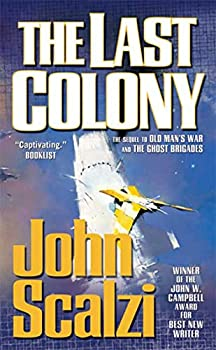
The Last Colony completes John Scalzi’s Old Man’s War series. In it, the heroes of the first two books, John Perry and Jane Sagan, are enjoying retirement on a colony world, farming and occasional settling disputes between the locals.  Perry is asked by the Colonial Defense Forces to oversee the creation of a new colony, though, at a place called Roanoke. (And suddenly, all the history majors raised their eyebrows.)  We saw in The Ghost Brigades that the CDF and the Colonial Union are not quite playing on the square; that continues here, as Jane and John and their adopted daughter are unwitting pawns in a galactic political struggle. They have to get creative to avoid being destroyed either by their own kind or an alien alliance.


And finally, at least for this Wall of Text (there are more books I need to cover), my first Gore Vidal book!  Perpetual War for Perpetual Peace, published just after 9/11 but before DC began its decades-long debacle in central Asia, destabilizing the region, creating generations of new terrorists, and enriching the arms dealers who dictate so much of DC’s foreign policy, condemns the police state that DC was already building and points to the actions of Timothy McVeigh and Osama bin Laden as reactions against a long train of abuses by DC. Vidal does not write in defense of McVeigh and bin Laden: their actions were reprehensible. To dismiss them as crazy, however, or simply Evil — as though they existed only to be comic book villains, creating chaos and sowing destruction for their own amusement — is to remain ignorant. Both men were operating from motives that can be understood — even if not agreed with. Bin Laden opposed DC treating the whole of central Asia as an area to be maneuvered and ordered about in accordance with DC’s own desires: McVeigh opposed DC’s police state and undeclared war on its own citizens, most dramatically broadcast in the Waco massacre and the murderous farce of a police action that was the assault on Ruby Ridge. Vidal is a potent critic, not simply because of his prescience, passion or prose style, but because he can’t be boxed in as an ideologue: he attacks Democrats and Republicans alike, subjects the NY Times and the Wall Street Journal to the same withering rebuke, and would not be embraced by libertarians, either, given his contempt for business mergers and the lack of a National Health Service in the US.

Posted in Reviews | Tagged , , , , , , , , , , , , , , , | 7 Comments