Years ago when I was a ‘spiritual seeker’ and consuming all manner of spiritual-religious content online, from dharma talks to Catholic apologetics and Asatru podcasts, I found some sermons and choir recordings online from a Unitarian Universalist organization. They had a performance of “God’s Promise” which I found beautiful despite not being anything approaching a believer back then. I saved it, and in time that website disappeared. I’ve been wanting to post it to youtube so people can enjoy it, so…that’s done. The photos in these are taken from my instagram, queencityson, and are mostly from spots in central Alabama. I tried to include just shots that overwhelmed me at the time. The song has been on my mind today as I reflected on the hardships, losses, triumphs, and moments of joy from the last year.
“I never did promise you crowns without trials
Food with no hard sweat, your tears without smiles
Hot sunny days without cold wintry snows
No vict’ry without fightin’, no laughs without woes
All that I promise is strength for this day
Rest for my, worker, my light on your way
I give you truth when you need it, my help from above
Well, here we are at the close of another year – and what a year it was! 2022 will be one of the more unforgettable years in my life, opening as it did with me on dialysis and the sudden death of a good friend – only to bring blessings like a kidney transplant, unexpected friendships, and a newfound sense of purpose despite ongoing challenges. “A hell of a year,” a friend of mine described it. Can’t argue there! Connected to all of this were the books, so let’s yak about that. I hope you’re not stuffed full of Christmas goodies, still, because I brought data pie as usual.
First up, some general stats. Nonfiction crushed fiction this year, with a 70/30 split. Ebooks increased their lead over for-realsies books, at 57/43. Only 34% of my books were purchased this year; 26% were library books; 20% were Kindle Unlimited titles; and the rest were previously owned, gifts, or (my favorite) “read in the store like a big ol’ cheapskate”. Next year’s mission is to drive books-purchased down further. Unfortunately, the biggest trend this year was not reviewing books: just over a fifth of the books I read in 2022 don’t have posted reviews, though a number of them have substantial drafts that just need to be finished.
In the world of Kindle, my top five most-highlighted books were:
The World-Ending Fire 87
Live Not by Lies: A Manual for Christian Dissidents, 62
The Second Mountain: The Quest for a Moral Life 60
Together: The Healing Power of Human Connection, 46
The Politically Incorrect Guide to American History, 46
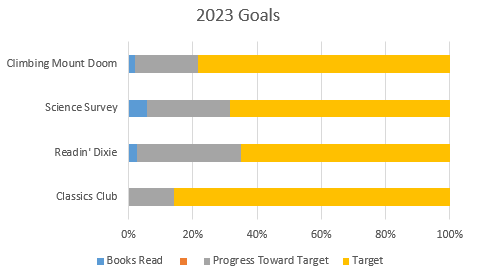
In January, I had structured goals and specific targets for the Science Survey, the Classics Club, Readin’ Dixie, and the immortal Pile of Doom. The science survey went well, each category being filled by September. I’d wanted to end up with 20 books altogether, but only managed nineteen. The rest of my challenges were a mixed bag, with only three classics read, marginal progress at best on Mount Doom, and a year-end spurt of southern literature instead of a year-long series. The fight will continue next year!
History lead the pack, as usual .My easy favorite was Bringing Columbia Home: the Untold Story of a Lost Space Shuttle and her Crew, about the recovery process following Columbia’s catastrophic reentry loss in 2003. Being someone who struggles with a lot of political jadedness, the reflex cooperation of civilians and all levels of government to find the bodies of the fallen, and piece together what had happened to America’s first space shuttle*, moved me. The Secret Life of Groceries was also excellent: I’ve read a number of similar books and it stood out among them, covering logistics and marketing as well as food production and processing. Dogfight: How Apple and Google Went to War was another memorable title, though I still disagree with the author’s premise that the two tech giants’ competition will one day end in a general monopoly.
Science had a fine year, though I was hoping to crack twenty. The best in this category was An Immense World,by Ed Yong, on how studying animal sensation can greatly expand our appreciation of this world and its wonders. I’m reminded of that line from “The Circle of Life” — there’s far too to take in here, more to find than can ever be found — because of Yong’s lesson, that animal species all have unique sense-sets and are open to and guided by experiences of the world that other species are absolutely blind to. It was an awe-some book in the literalist sense of that, because it stirred wonder in me like no science read in quite a few years. I can’t not mention the cover and title of Ms. Adventure, my geology read. Great choice on both by her marketing peeps.
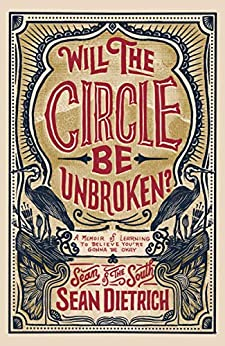
Science Fiction had a slow start, but came out firing with J.M. Berger’s Optimal and getting only better as the year wore on. Dave Eggers’ The Every was a worthy successor to his chilling satire The Circle, and every book I read by Blake Crouch was an instant favorite. Recursion, Dark Matter, and Upgradeare all top tens for the year.
Historical Fiction was good in quality, if not quantity: the star would be Ben Kane’s Richard the Lionheart trilogy. Excellent stuff! I also started a World War 2 trilogy by James Holland that I anticipate continuing in 2023.
Society and Culture had an unusually strong year, in part because I’m increasingly concerned about the disintegration of both, and certain trends have pushed me away from let-’er-be-libertarianism to a more up-men-and-to-your-posts mentality — particularly, the aggressive ‘medical correction’ of children related to transmania, and relatedly the rates of mental disease, substance abuse, and suicide in the United States. Some of the books I read along these lines wereDopesick,Irreversible Damage, Live not by Lies, Porn Generation, The End of Gender, and the Flipside of Feminism.
In Religion and Philosophy, I was delighted to make a return to Alain de Botton, whose On Love proved more relevant than I’d expected when first picking it up. Dangerous Passions, Deadly Sins was an excellent Lenten read, but the year’s favorite was How to Think Like a Roman Emperor. I also studied C.S. Lewis a bit, reading his Letters to an American Lady, and a couple of guides to his The Abolition of Man.
Politics and Civic Awareness had a good year. I enjoyed reading about the growth of people-friendly cities in the Netherlands, England, and New York City, and also read a bit in connection to my social concerns. Andy Ngo’s Unmasked, and Shellenberger’s San Fransicko were notable. The first was on the rise of antifa, and the latter on how housing and substance abuse policies in a few major metro areas not only fail, but exacerbate the problems they’re intended to address.
Other notables: in Southern Literature, I was delighted to return to Wendell Berry’s nonfiction with an excellent anthology of his work, The World-Ending Fire, and finished reading Rick Bragg’s southern stories books. OF course, I can’t close without mentioning Postcards from Ed, one of my very very favorites for the year. More Abbey inbound!
So, what’s up for next year? My standing themes/challenges will continue, of course: the Science Survey, the Classics Club, and Mount Doom. I’m also going to be doing two Big Reads this year, with the books getting the Gulag Archipelago treatment — reviews posted as I finish major milestones of the texts. The Shahnameh will be reviewed in three parts, and The Jewish Annotated New Testament will be reviewed in bits as they suggest themselves. I had planned a massive series called “A Century of Reading” in which I moved, decade by decade, through the 20th century — with nonfiction and fiction for both. I need more time to develop the books for it, though, and more importantly I need to finish Mount Doom before I buy any more bloody books!
New Year’s resolutions?
No new books until serious progress on Mount TBR is made. Yes, even $0.99 Star Trek books count. I didn’t buy any in November and December, and life went on.
Finish reviews for books that I really want to have reviews posted for.
Focus more on ‘good news’ ….or as Perry Como would advise, accentunate the positive. Relatedly, be more active about reading books I’ll disagree with, or books that humanize people (politicians) whose names cause me to spit venom.
[*] Sorry, Enterprise, you don’t count. You were an atmospheric tester only.
The Science Survey, in effect since 2017, is a structured approach to pop-science reading to maintain a broad general science & nature knowledge and avoid my tendency to run away from the more math-y subjects. I completed this year’s survey relatively early, in September, and am expecting a strong year in 2023. Preview of next year’s list to follow this afternoon..
Below are my prospects for 2023. Although I purchased some of these titles already (those with an * ), it’s rare that my prospects list and my actual list are matches for one another.
Cosmology and Astrophysics The Edge of Physics:A Journey to Earth’s Extremes to Unlock the Secrets of the Universe, Anil Ananthaswamy *
Local Astronomy Chasing New Horizons: Inside the Epic First Mission to Pluto, Alan Sterns *
Geology, Oceanography, and Natural History Waters of the World, Sarah Dry
Chemistry and Physics Calculating the Cosmos: How Mathematics Unveils the Universe, Ian Stewart *
Biology Human Errors: A Panorama of Our Glitches, Nathan Lents * The Beauty of the Beastly, Natalie Angiers * Nine Pints: A Journey through the Mysteries of Blood, Rose George* Skeleton Keys: The Secret Life of Bone, Brian Switek*
Flora and Fauna Tales from the Ant World, E.O. Wilson
Archaeology & Anthropology The Story Paradox: How Our Love of Stories Builds Societies and Tears Them Down, Jonathan Gottschall Sex at Dawn: How We Mate, Why We Stray, and What It Means for Modern Relationships, Christopher Ryan The Moral Animal, Robert Wright
Cognition, Neurology, and Psychology Conspiracy: Why the Rational Believe the Irrational, Michael Shermer This is Your Brain on Music, Daniel Levitin
Weather and Climate Air: The Restless Shaper of the World, William Bryant Logan
Ecology Where do Camels Belong? Ken Thompson
Thinking Scientifically Starry Messenger: Cosmic Perspectives on Civilization, Neil deGrasse Tyson
Wildcard (Science Biography, History of Science, Natural History, Science and Health, or Science and Society)
I didn’t discover a lot of artists in 2022, but I was utterly obsessed with one and deeply into the other. I stumbled onto Morgan Wade via Youtube and have been listening to (and talking about nonstop to the annoyance of friends & family) her for the last few months. I don’t think I can capture all of her appeal to me in one video. She’s one of the few artists for whom I want to listen to different versions of the same song by, because of the little differences in delivery. Like Tom MacDonald, she’s also someone who addresses serious issues in her songs — like substance and mental health. Going through my own dark valley in the late 2010s and surfacing from that in 2020 has made me acutely aware of how ignored these issues are in our society, so I appreciate artists who are frank about them.
Johnny called me late last night And I told Mister Walker, just go home Why do the demons in my mind Never wanna leave me alone? It’s the pistol and it’s the bottle It’s the drugs and it’s the throttle They all tell me, they’ll make me feel alive I know good and well That ain’t gonna help I’m just prayin’ I make it through the night
The other artist I enjoyed enormously this year is Lonnie Johnson, an early 20th century blues musician. While trying to find the performers for “Jet Black Blues”, I discovered that it was done by a black musician, Lonnie Johnson, playing with the white Eddie Lang (aka Blind Willie Dunn). Theirs is an interesting partnership given the times!
Beyond that, I spent a lot of 2022 listening to bands that had already spoken to me — chiefly, Sierra Ferell and her beautiful approach to old-time and country music, and Tom MacDonald’s unpredicted appeal. I don’t like rap, as a rule, but when I hear him speak I attend to what he says.
Don’t look back in sorrow Just hope you see tomorrow Those years Everyone knows Ya gotta let `em go They kinda roll by like tears Just a measure of time
You don’t think you’re a fighter But I know you are And you are a liar If you say you aren’t You don’t think that you’re worth it But I think you are
And for a final thought, I leave you Morgan Wade in cut-offs keeping time in bare feet. Holy wow. (Language warning. Also, Morgan Wade warning.)
Favorites are in bold. Updated for the last time tonight…
Movies Watched in 2022 1. Wild Target, 2010. A dark comedy about a lonely assassin who is hired to kill an attractive fraudster and thief (Emily Blunt), but who instead develops feelings for her. A fun movie all around with solid talent. Ron Weasley is also lounging around for some reason.
2. No Time for Sergeants, 1958. a comedy about an ambling country boy drafted into the US Air Force, and the inspiration for Gomer Pyle.
3. The Quiet Man, 1952. A John Wayne / Maureen O’Hara movie in which Wayne plays an American boxer who retires from the sport and returns to the home in Ireland in which he was born. He promptly annoys the local big man (who wanted to buy the home and property to expand his own) and falls in love with the big man’s sister, Mary Kate. The result is a romantic drama with abounding comedy, featuring a lot of Irish stereotypes.
4. Unstoppable, 2010. Denzel Washington, Chris Pine, Rosario Dawson. Terrific retelling of a real-life runaway train incident where a harrowing disaster is averted through the brave and creative efforts of a train crew. Working class heroes!
5. The Many Saints of Newark. 2021. Sopranoes prequel focusing on the life of Dickie Moltisanti, Christuhphuh’s dad and Tony’s main role model and inspiration for joining la cosa nostra. Superb casting, but the story had a frustrating loose end.
This trailer is misleading in that it focuses on young Tony, not Dickie, but it ends with the Sopranoes theme so it wins.
6. The Texas Chain Saw Massacre, 1974. Strange horror film about a group of teenagers who wander into a house and…er, get invited for dinner. Not something I’d watch again, but given its cult-classic status I’m glad I at least know what it’s about now.
7. This is the Last Dam Run of Likker I’ll Ever Make, 2002.Documentary celebrating the folk hero Popcorn Sutton, who brewed and sold moonshine for decades before the ATF began targeting him. He killed himself rather than submit to imprisonment at the hands of the goonie boys.
8. A Knight’s Tale, 2001. Heath Leadger stars as William Thatcher, a young knight’s apprentice who, when his lord dies unexpectedly before a joust, dons the man’s armor and uses it to create a new life for himself as Sir Ulrich von Lichtenstein. What follows is an unusual sports-comedy-romance with a soundtrack by Queen and David Bowie. Ludicrous but absolutely fun.
9. Red Dawn, 1984. Russia and Cuba launch a surprise attack on the United States, but a small group of teenagers creates their own resistance cell. Expected camp, got a surprisingly dark but very entertaining movie.
10. 21, 2008. Kevin Spacey is an MIT professor who recruits a team of math whizzes to earn money on weekends counting cards in Vegas. Loosely based on a true story. Very much a fun movie. I kept expecting Frank Underwood to erupt from Spacey’s genial professor and was not disappointed.
11. Into the Woods, 2014.A ‘medley’ of classic fairy tales spun into a musical about a childless couple, a young woman who desires to go to the prince’s festival, and a boy and his friend the cow. Absolutely brilliant music, but some of the characters were increasing unsympathetic as the story wore on, especially the Chris Pine-prince and the Baker’s wife. Lots of talent here, but my favorites were Anna Kendrick (Cinderella) and Lilla Crawford as Little Red Riding Hood. Little girl can sing!
11. Shrek: The Musical. 2008. It’s….Shrek. The musical. Impressive singing all around. The Farquaad character was Springtime for Hitler-level campy, but the actor carried the role well. Sutton Foster as Fiona and Brian d’Arcy James as Shrek were especially powerful vocalists, and I’m still wondering how they did her ogre makeup so quickly on stage. If you’re ever in a gloomy mood and don’t have the time to read Wodehouse, watch the first two minutes of Foster’s “Morning Person”. Black moods = gone!
12. Blade Runner 2049. 2017. The sequel to the original Blade Runner, featuring Ryan Gosling as a next-gen replicant who works as a bladerunner. In the process of ‘retiring’ another replicant, Gosling’s character makes an astonishing discovery that threatens to throw society into upheaval. The move is consistent with the world and aesthetics of the original, with now-defunct brands like Pan-Am still in existence. Very good.
13. The Hobbit: The Desolation of Smaug, 2013.Part two of Peter Jackson’s expansion of the Hobbit story into three movies. Features some very improbable fighting along the river, but Smaug is a fun character.
14. The Hobbit: Battle of the Five Armie, 2014.The finale of the Hobbit expansion. Nonstop fighting, so it grew bit tedious.
15. Top Gun: Maverick. 2022. The sequel to the eighties original, this follows Tom Cruise’s character Maverick as he trains a cadre of young hotshots for a brutal mission that resembles the attack run in Star Wars. Adding to the drama is the fact that one of the hotshots is Cruise’s late wingman’s son. Great action flick, with no politics or posturing: just cool Navy machines, kickass pilots, and some thrilling heroics. There’s also a P-51 Mustang!
16. Johnny English. 2003. A Rowan Atkinson-starring James Bond parody. A bit like Get Smart or The Man Who Knew Too Little. Hilarious all around.
17. The Terminal (rewatch). 2004. A touching story about a man stranded in an airport after his country falls into civil war while he’s in the air.
18. Guardians of the Galaxy. Action superhero-esque movie about a ragtag group of people who try to prevent a powerful artifact from falling into the hands of a major league baddie.
19. Rise of the Guardians. A kid’s movie about heroic fantasy figures from childhood (Santa Claus, the Tooth Fairy, etc) being threatened by a villain.
20. Willow. A light fantasy story about a Herod-like evil Queen who is prophesied to be felled by a baby girl. The girl is sent down the river a la Moses, and rescued by a farming family (led by an aspiring magician) who then have to form a little fellowship of the baby and return her to a castle far away. A young Val Kilmer appears as an action hero.
21. The Hitchhiker’s Guide to the Galaxy (2005). Stars Martin Freeman, the fellow who was in The Hobbit and The Office.
22. West Side Story, the original. A rewatch for movie. Never get tired of listening to that soundtrack or admiring Natalie Woods.
22. Top Gun. A 1986 action movie about jets, starring a young Tom Cruise and Val Kilmer. I enjoyed the music, but the story was spoiled for me by having watched Maverick.
23. Ghost Town. 2008. A film starring Ricky Gervais and Brian D’Arcy James, in which Gervais is a misanthropic dentist who has a near-death experience while under anesthia and wakes to find that he can see and hear ghosts. New York has a multitude of them with unfinished business, and they’re desperate for Gervais’ help so that they can move on. From this premise we get a rom-com, and my estimation of D’Arcy James’ acting chops continues to increase.
24. Carrie, the 1976 original with Sissy Spacek and directed by Brian dePalma. An adaptation of Stephen King’s novel. Not quite as violent as the novel, but well-acted, scored, and directed.
25. The Blair Witch Project. 1999. An innovative art-horror film from 1999 about three teenagers who go missing in the woods while investing the legend of a ghost-witch.
26. Slacker. 1989. Not sure how to sum this one up, but imagine a film where the character changes every scene. The setting is 1990 Austin, and the camera follows around a wide variety of characters and eavedrops on them and their stories before some other passerby enters the frame and we follow them, instead.
27. Pink Flamingos. 1972. This was a joke played on me by a friend who refused to say anything about the film, who insisted he wanted to see my honest, gut reaction. (It was mute horror.) Trash for trash’s sake.
27. Goodbye, Lenin! 2003. A rewatch for me, introducing someone to the work of Daniel Brühl. Goodbye is the story of the fall of East Germany, as lived through a young dissident who, despite being arrested by the DDR’s authorities, was forced to keep it ‘alive’ for his medically frail mother, creating an elaborate charade complete with fictitious East German newscasts to prevent her from knowing the DDR and her world were gone. A thought-provoking film with comedic elements.
28. The Miracle on 34th Street, 1947. The gorgeous Alabama Theater does Christmas movie showings in December, and I re-watched this movie for the first time since I was a kid. I enjoyed it enormously, from itty-bitty Natalie Wood’s already respectable acting abilities to the writing. A lot of the film’s meaning and humor was lost on me as a kid.
29. The Last Picture Show, 1971. An interesting movie following several high school kids in their last days of school. Think Dazed and Confused but set in 1950s Texas. The cultural mores are more in line with the seventies, though.
30. Mr. Right, 2015. Easily the sweetest little rom-com featuring frequent bouts of murder I’ve ever seen. Anna Kendricks, the reason I watched this movie, encounters an interesting chap in the grocery store and the two of them fall in love. Said chap is an ex-assassin who still assassins, only now he targets those who try to kill others. He’s being actively huntted by both his former assassins, who see him as a rouge, and some criminals who view him as a threat. Hilarity, adorableness, and headshots ensue Anna Kendricks is absolutely adorable.
31. My Girl, 1991.A re-watch for me, for the first time since…well, since George H.W. Bush was president. It’s set during one summer in the 1970s, in which a young girl struggles with her widow-father’s falling in love with a new woman, and another tragedy that ensues. It’s interesting to have watched this as a kid the same age as Vada and Thomas J, and now as an adult.
32. Beat the Devil, 1953. The first Bogart movie I saw and acutely disliked. Bogart plays a reluctant associate of some criminal-esque entrepreneurs who want to buy some land with uranium deposits, then sell said uranium without the British government being none the wiser. This supposedly makes them the bad guys. Bogie has an affair with some rando’s wife, his wife has an affair with said rando, and then the police arrest everyone at the end a la Monty Python. Truman Capote supposedly contributed to this.
33. Wild at Heart, Nick Cage & Willem Defoe. Nick Cage and his girlfriend road-trip across the southern US despite Cage having a bounty on his head by his girlfriend’s mother-in-law, who thinks he witnessed the murder of said girlfriend’s father, who was associated with the criminal sort. Nice music. Nick Cage is pretending to do an Elvis voice the entire time and it’s hilarious after a while. He even sings “Love me Tender”.
We can get rid of the television set. As soon as we see that the TV cord is a vacuum line, pumping life and meaning out of the household, we can unplug it. What a grand and neglected privilege it is to be shed of the glibness, the gleeful idiocy, the idiotic gravity, the unctuous or lubricious greed of those public faces and voices! And we can try to make our homes centers of attention and interest. Getting rid of the TV, we understand, is not just a practical act, but also a symbolical one: we thus turn our backs on the invitation to consume; we shut out the racket of consumption. The ensuing silence is an invitation to our homes, to our own places and lives, to come into being. And we begin to recognize a truth disguised or denied by TV and all that it speaks and stands for: no life and no place is destitute; all have possibilities of productivity and pleasure, rest and work, solitude and conviviality that belong particularly to themselves. These possibilities exist everywhere, in the country or in the city, it makes no difference. All that is necessary is the time and the inner quietness to look for them, the sense to recognize them, and the grace to welcome them. They are now most often lived out in home gardens and kitchens, libraries, and workrooms. But they are beginning to be worked out, too, in little parks, in vacant lots, in neighborhood streets. Where we live is also a place where our interest and our effort can be. But they can’t be there by the means and modes of consumption. If we consume nothing but what we buy, we are living in ‘the economy,’ in ‘television land,’ not at home. It is productivity that rights the balance, and brings us home. Any way at all of joining and using the air and light and weather of your own place – even if it is only a window box, even if it is only an opened window – is a making and a having that you cannot get from TV or government or school.
The World-Ending Fire: The Essential Wendell Berry
“If we had a motto, it might be the opposite of the one I heard in the 1960s telling us to ‘turn on, tune in, and drop out’. Our slogan could urge the world to turn off (virtual reality), tune out (advertising and materialism), and drop in (on your neighbors, to let them know it’s time to stop being lonely in America). Drop in – into something more real, more loving, than what you’re currently experiencing.”
Welcome to the liminal space between the years, as we all recover from Christmas and brace ourselves for a weekend full of fireworks. Reading activity is definitely ebbing down for me, and has been for much of December — I’ve been slowly drifting through a Wendell Berry essay collection for three weeks now! I anticipate finishing it within the next couple of days, and may add another to the stack from Christmas or my current Kindle Unlimited titles. If my brain breaks out of siesta mode before the New Year starts, I’d like to post some reviews for books I’ve read this year but not done properly. There are several titles on my Top Ten Favorite Reads list that are in that state, so I need to remedy it. The top ten will be part of a series of year-in-review posts that will include the science survey, a general recap of the year, and a list of the movies I watched this past year.
And on that subject, two books I’ve finished recently need reviewin’. First up is Wendell Berry’s How it Went: Thirteen Stories of the Port William Membership. This is Berry’s latest collection of Port William stories, centered around the character of Andy Catlett. Andy is a prominent character in the Membership stories as a whole, having another book (Remembering) devoted to his young life. How it Went spans most of Catlett’s life, opening on the young Andy ringing the dinner bell in giddy solidarity with the bells of the town, announcing the end of World War 2. This particular story throws a bucket of cold water on the reader, as Berry envisions that industrial machine that made victory possible will be turned on the American people – destroying them not in war, but in peace. Berry uses the word ‘Membership’ for Port William very deliberately, and membership is a theme in this as in all of his novels; Andy Catlett is directly dis-membered by the industrial machine when he loses his hand in one, and the people of Port William will be dis-membered as a contiguous society as tractor and mechanized farming turn a mesh of interconnected, interdependent homesteads into just a few big mules, keeping to themselves in their massive machines that insulate them from the land they’re working just as effectively as they destroy the user’s ties to his surrounding community. If that all sounds a little glum, that is the story of Port William – but it’s not a sob story. Berry always works in beauty and sorrow together; his novels leave readers sad for what was lost, but profoundly moved by what was and which might be restored, both by the subject and by his artful writing. He is a superb storyteller, as not one of his works has ever failed to touch me – in the realness of his characters, and their flaws and strengths. There’s a common theme in this of old men passing their knowledge to younger men, of those young men’s shoulders growing with responsibility and their increasing awareness that the old men are gone, and that now they are the old men, with the duty to pass on the story of Port William, and the knowledge of how to husband the land well – but reckoning, too, with the fact that there are far fewer people in the ‘new’ Port William, and that fewer still care about the place that was a membership, not merely a Census-Designated Area or the latest tract to be marked for subdivided development.
On a much different note, I also read Eight Days in the Woods: The Making of the Blair Witch Project. I watched The Blair Witch Project for the first time this past Halloween, having missed most of the media hub-bub back in the day with the exception of it inspiring a game panned by PC Gamer. To the dismay of my cinephile friends, I enjoyed BWP enormously. The sheer novelty of having the actors also be the videographers, of immersing the viewer in a story that could be real because of that production approach – the lack of ‘production’ – struck me as very cool. Imagine footage not planned to the shot by producers, but created extemporaneously by character-actors as the characters would have experienced them! BWP’s approach became ever more interesting as I began digging online for information about the film, and learned that the cast were exposed to enforced method acting: they were experiencing much of what the characters did – the treks in the rain, the overnight camping harassed by strange sounds. The line between Actor and Character was very blurry indeed. Eight Days in the Woods is a history of how several film students met and hatched an idea for the movie, one they wouldn’t begin to work on until a few years later. We’re then taken through planning, production, and release, with the most interesting part being production. The author-editor includes numerous photographs from the production period, and most interestingly the actor notes – those introducing them to their character’s basic backstory, and giving them daily notes with an outline of where they’d need to be by days end. This opens the production’s hood a little bit. The filming was done in a fairly confined park, with the exception of the Griggs House two hours north of the park. One of the more interesting revelations of this book was that the producers’ plans were for a three-phase project, resulting a documentary movie inspired by the seventies series In Search Of….. (The original time setting was also be the seventies, but that proved impractically expensive for a few broke students!) The on-the-ground footage that makes the movie now was only part of the originally planned film, which would have included interviews and analysis by researchers and experts. Budget constraints limited how much “Phase 2” filming could be done, and inspired the idea of making a film that consisted only of the disappeared students’ found footage. If you like the movie, this is definitely of interest.
It is Tuesday, isn’t it? Christmas and the holidays have me in a temporal mist. Teasing from Wendell Berry’s The World Ending Fire again, because I haven’t been reading anything else. (Definitely in siesta mode!)
As a people, we have lost sight of the profound communion – even the union – of the inner with the outer life. Confucius said: ‘If a man have not order within him / He can not spread order about him …’ Surrounded as we are by evidence of the disorders of our souls and our world, we feel the strong truth in those words as well as the possibility of healing that is in them. We see the likelihood that our surroundings, from our clothes to our countryside, are the products of our inward life – our spirit, our vision – as much as they are products of nature and work. If this is true, then we cannot live as we do and be as we would like to be. There is nothing more absurd, to give an example that is only apparently trivial, than the millions who wish to live in luxury and idleness and yet be slender and good-looking. We have millions, too, whose livelihoods, amusements, and comforts are all destructive, who nevertheless wish to live in a healthy environment; they want to run their recreational engines in clean, fresh air.
Industrialists are always ready to ignore, sell, or destroy the past in order to gain the entirely unprecedented wealth, comfort, and happiness supposedly to be found in the future. Agrarian farmers know that their very identity depends on their willingness to receive gratefully, use responsibly, and hand down intact an inheritance, both natural and cultural, from the past. Agrarians understand themselves as the users and caretakers of some things they did not make, and of some things that they cannot make.
Agrarian farmers see, accept, and live within their limits. They understand and agree to the proposition that there is ‘this much and no more.’ Everything that happens on an agrarian farm is determined or conditioned by the understanding that there is only so much land, so much water in the cistern, so much hay in the barn, so much corn in the crib, so much firewood in the shed, so much food in the cellar or freezer, so much strength in the back and arms – and no more. This is the understanding that induces thrift, family coherence, neighborliness, local economies. Within accepted limits, these virtues become necessities. The agrarian sense of abundance comes from the experienced possibility of frugality and renewal within limits. This is exactly opposite to the industrial idea that abundance comes from the violation of limits by personal mobility, extractive machinery, long-distance transport, and scientific or technological breakthroughs. If we use up the good possibilities in this place, we will import goods from some other place, or we will go to some other place. If nature releases her wealth too slowly, we will take it by force. If we make the world too toxic for honeybees, some compound brain, Monsanto perhaps, will invent tiny robots that will fly about, pollinating flowers and making honey.