
– Bradly J. Brizer, lecture
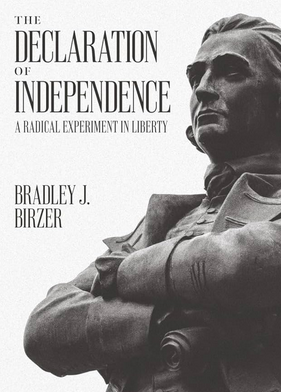
The Declaration of Independence: A Radical Exercise in Liberty is a unique work, as it is a history of how the Declaration came to be – not only politically, but philosophically. It begins as formal history, recounting the early 1770s as Parliament’s ‘long train of abuses’ began assembling itself against the American colonies. Birzer takes us through arguments and debates as the Americans speak out against abuses like the Stamp Act, the Quebec Act, and the Coercive Acts. We see them in their own words moving gradually from protesting their rights as Englishmen to protesting their natural rights as men, and then striking for Independency. That independency begins first in fact, rather than rhetoric, as various states adopted new constitutions in early ’76 which were free of England save for common law. We are privileged, via Birzer, to see voices from all sides, as he quotes from pamphleteers and essayists at length.
After studying the Declaration itself, Birzer borrows a page from Russell Kirk’s The Roots of American Order to examine the long traditions in political philosophy that led to the Declaration being written. Jefferson modestly opined that he had done nothing but capture the common thinking of the people. Through this work we can see a little of the truth in that – Birzer excerpts Dickinson, Adams, and others’ work – but one must push back against Jefferson a bit. It is one thing to summarize a people’s thinking; it is quite another to summarize it well, to capture the spirit and distill it into lightning that will continue inspiring Americans for now two and a half centuries. This is, in short, not merely a history of the document that declared American independence, but an exercise in the studia humanitatis, the classical and medieval tradition of searching for what it means to be human and to live well. This is no doubt intentional, as Birzer sees the Declaration as part of a tradition that began with Plato’s Republic and continued through Cicero’s On the Republic and Augustine’s City of God, each a reflection on how our political life is tied to our human flourishing. This ‘great conversation’ has other examples – notably, Virgil drawing on Homer for his Aeneid, and in turn inspiring The Divine Comedy. This work was both fascinating and deeply satisfying, written by a man who clearly loves his subject, and manages to be both serious and conversational.
Related:
“Can We Restore the Republic?” Dr. Brad Birzer
The Great Debate: Edmund Burke, Thomas Paine, and the Birth of Right and Left, Yuval Levin


