
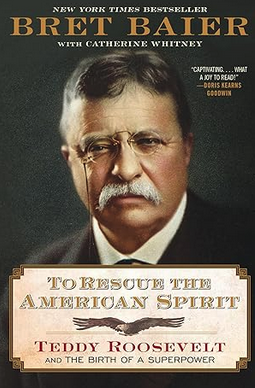
While I hadn’t planned to read Thedore Roosevelt until I’d finished off Garfield, etc, the ladyfriend bought this for me and I found it fairly absorbing – as in hey, why not spend two hours after work each day reading it before I even go inside the house? To Save the American Spirit is a narrative biography of Roosevelt that sees him as a forceful visionary, dashing into the 20th century and inspiring or dragging the American people behind him with a cry of “BULLY!”. It’s a very complimentary biography, then, but carries praise from Doris Kearns Goodwin and Walter Isaacson, both of whom have sterling reputations as biographers. Baier accomplishes what he sets out to do quite readily, I think – introduce readers to a man whose energy, optimism, and cheerful gung-ho drive can fascinate even an anti-government crank like myself.
I would’ve said even before reading this book that Thedore Roosevelt is easily one of the most memorable and interesting men to sit in the Oval Office: granted, he built the West Wing, so he did have a running start. Even as a young man who struggled with health problems and had not yer developed the physicality he was later known for – the pugilistic physique would come in time, especially after his adventures out west – Roosevelt had self-confidence enough that his university teachers would have to force him to shut up so they could properly teach their class. The older Oyster Bay Roosevelts were not interested in politics: they regarded it as beneath good breeding to engage in a field they associated with dubious political machines and the like. Roosevelt, however, was attracted to the fight: he wanted to be in the arena, and he wanted to clean it up. He made early common cause with Democrat president Grover Cleveland, a man who shared his zeal for fighting corruption and creating lasting civil service reforms. This was in a time when entire offices would be emptied out – Democrats replaced with Republicans – once a new man was in office, despite said offices not having any political roles.
Roosevelt is known for his “man in the arena” speech, – one that treats with disdain those who sit on the side and criticize, and praises instead the man or woman who jumps into the fray. Roosevelt was that kind of man: while serving as Assistant Secretary of the Navy, and working so hard that his superior was annoyed at the constant planning (plainly John Long viewed his Sec. Nav job as a kind of drowsy sinecure), Roosevelt saw what was happening in Cuba and had to throw in. He gave orders in Long’s absence, and then resigned his post to raise a regiment of Rough Riders and take part in the looming conflict between the United States and Spain as the former intervened in Spain’s fight against Cuban rebels. There, he and his men distinguished himself – Roosevelt was particularly impressed by the black and Native American soldiers he fought alongside – and he came back a hero, setting the stage for him to be tapped as Vice President. An assassin’s bullet would usher Roosevelt into the White House, where he championed a more assertive executive.
My status as ‘conservatarian’ means I frequently view with skepticism the sweeping decisions made by men like Roosevelt and his cousin Franklin – however, I can generally step into another frame and see how those with another worldview could view other men as praiseworthy. With Roosevelt, I must admit the frame is fairly large and easy to step into: as I read this, I found myself within it despite not wanting to put myself there. The late 19th century was not known for executives with a lot of personality, but Teddy had it in spades: in The Cult of the Presidency, Gene Healy accused Roosevelt of being the first celebrity executive. (It was not a compliment.) Roosevelt was perhaps the answer to a question that lingered over the American union after the Civil War: who are we? Baier compares Roosevelt to Washington and Lincoln in terms of his lingering legacy, and after reading this I can understand why. If Washington presided over the Republic’s potentially stormy start, and Lincoln maintained and consolidated the Union, Roosevelt can be seen as having driven it into a new, more confident stage. He saw an America that was destined for greatness, not just sitting under its own fig tree and not being afraid – so he charged ahead with projects like the Panama Canal and urged the rapid expansion of the Navy, while at the same time making America a diplomatic contender by helping end the Russo-Japanese war. Even knowing the course of the 20th century and appreciating that American ‘greatness’ came at the cost of DC becoming a bloated monstrosity that is more responsive to internal lobbyists and external cronies – Roosevelt’s vision is attractive. It made me think of Obama, actually: by the time he was elected, I was already too disappointed in him to vote for him (2008 remains the only presidential election I’ve not voted in), he still made me Believe. His “It was a creed…” speech is a masterstroke of rhetoric, and Roosevelt was flinging out those “Stand up and cheer” speeches constantly. If nothing else, this book really drives home how inspiring he could be.
While I want to find a more even-handed take on Roosevelt in time (something that criticizes his zeal for engaging in action that goes well beyond Constitutional or even traditional mandates), this was fun to read and gave me a general overview with which to start developing a better appreciation of ol’ TR. Whoever much I want to dislike him because of his overreach, I find it impossible not to admire him as a man.
Related:
The Old Lion, Jeff Shaara. A very celebratory novel of TR.


From what (little) I know of him, he was certainly one of the more *interesting* Presidents!
So much so that his little cousin Franklin liked to imitate him sometimes!
I think I have a book or two about Teddy on my Wish List… [muses]
Overereach in a president? Hmmm.
https://harvee44.blogspot.com/2026/06/surprises-in-my-tbr-pile-of-books-and.html