
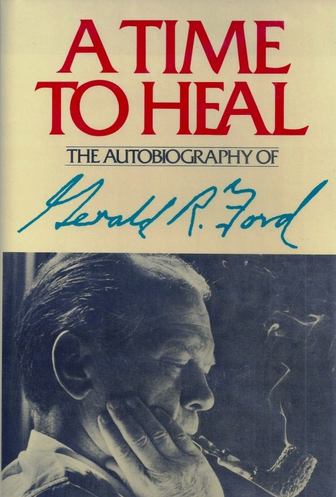
What possesses a twenty-year old to read five hundred page biography of a president he knows nothing about? Evidently, I was impressed by his speechwriting. In December 2006, President Ford died, and I was honestly grieved. In my ‘memorial’ post for him, I mentioned that I’d come across one of his speeches on AmericanRhetoric (the website responsible for my old party trick of reciting presidential speeches) and was impressed by him enough to read his autobiography. Reading it in 2005 gave me an enormous admiration for President Ford’s character, and I could not help but revisit it as part of my America @ 250 project. My fondness for Ford as a man, my appreciation for his character, has never wavered in the twenty years since though my politics have changed several times in those decades. Revisiting it on the anniversary of President Reagan’s death, I found myself appreciating this memoir of a decent man in an indecent office yet again — despite sometimes thinking the sheer amount of text could have done with some trimming.
Gerald Ford, uniquely among America’s executives, was not elected in: he was appointed as Vice President after Spiro Agnew resigned, and then succeeded within a matter of months into the presidency as Nixon’s administration began sinking beneath the drama of Watergate. Ford incorporated this into his inaugral address:
If you have not chosen me by secret ballot, neither have I gained office by any secret promises. I have not campaigned either for the Presidency or the Vice Presidency. I have not subscribed to any partisan platform. I am indebted to no man, and only to one woman — my dear wife — as I begin this very difficult job.
That is the spirit this book is written in, and it is what made Ford then and now, even when he was frankly boring me a bit with incredible detail on foreign policy decisions — who will be the new ambassador to India? As accomplished as Nixon was, there’s no doubt he was an incredibly difficult person to be around: in Kennedy and Nixon, he declared himself that his personality was awful. Jerry Ford was…completely different. He came up in Congress; his love was Congress. When he left the White House, he asked Marine One to circle not the White House, where he’d been for scarcely two years, but the Capitol. The Capitol was the same place he insisted on having his oath of office administered in; it was the place he returned to for speeches not as an executive facing off against adversaries, but a colleague who had just found himself elevated in extraordinary circumstances. In this era, Congress still worked: it made decisions that affected foreign policy and complicated domestic policy, making it difficult to be an overweening executive. Ford had an easy spirit, one that could work with others to accomplish common goals — but he’d also dig in his heels, as he did as a young man when he threatened to quit the football team (where he was fairly accomplished) if they agreed to Georgia Tech’s demands that a black player be benched during their match. While my libertarian self harrumphs at some of his policy decisions, one gets a sense from this book that he was principled but willing to be flexible: sometimes too much so, frankly, as when he wanted bans against “Saturday night special” handguns because of an uptick in handgun violence. One never doubts, however, he had the best of intentions.
I cannot honestly say this is a fair review of a presidential memoir; I read it 20 years ago and began to admire the man, and I read it again knowing far more about the background but still not able to put Ford in a box and rip into him like an opposing attorney. There is an earnestness about Gerald Ford that I love; he is clothed not with charm and flair like Kennedy, or cold cunning like Nixon. He is an everyman; he is Mr. Smith, come not just to Washington but to 1600 Pennsylvania Avenue. It is, of course, fascinating to see him as a witness to Watergate, to realize that he is not merely filling an office but is being thrown into the center of the action. In one of my recent Nixon books, I was struck by the paralysis of the RNC: Watergate started causing problems when Nixon was riding stag, without Agnew, and they couldn’t begin to start responding without having a stable veep at the helm. And the Democrats controlled Congress, so the man chosen had to be able to not only restore trust, but to work with Congress. The man and the hour had met. While that future veep gets deep into details on policy, it’s still fun to be in the room when history is being made– when he’s trying to figure out how to deal with China, with Russia, with the ailing economy.(I was happy to learn from this that Nixon admitted his wage and price controls were a mistake: it would’ve been better if Nixon or Ford had said that not only did they make things worse, but they were a gross overreach of the executive into matters that a Constitutional government has no place in addressing.) We get a sense of the man thrown into responsibility, and then — given how closely responsibility is linked to meaning — finding he loves the job too much to not fight for it. He was succeeded by Jimmy Carter, another very decent man who — like Ford — was not unfit for the office because of intelligence, but simply because the Oval Office is most effective when someone Machiavellian is wearing its ring. It’s sad, but — I fear — true. I was happy to revisit this, especially for the letter Ford wrote one of his sons who was entering adulthood: one of the quotes from that I often think of. It’s not pithy; it’s not sexy. It’s functional, and sincere. It is Jerry Ford. Would that his spirit lived more fully in DC today.
“You must realize that on the road of life, there will be disappointments, and that the best way to avoid another is to plan better and work harder.”
I have not sought this enormous responsibility, but I will not shirk it. Those who nominated and confirmed me as Vice President were my friends and are my friends. They were of both parties, elected by all the people and acting under the Constitution in their name. It is only fitting then that I should pledge to them and to you that I will be the President of all the people.
Coming up: I’m practically at the end of Kennedy and Nixon and will post a review this weekend; I’m close to the end of SHELLI: R-Evolution. I’d ordered Vendetta, a look at RFK and Jimmy Hoffa’s relationship, but the supplier cancelled. Possibly for the best. I now have two books written by Nixon.
Send help.
Also, I will read a proper Ford biography before this project is over: while I do trust Jerry to speak for himself, I also want an outside view.
ALSO: this is read 76 for the year. Ford was president during the 1976 Bicentennial. Totally an accident..
“Let us pray here in the Old North Church tonight that those who follow one hundred or two hundred years from now and may look back at us and say: We were a society which combined reason with liberty and hope with freedom. May it be said above all: We kept the faith, freedom flourished, liberty lived. These are the abiding principles of our past and greatest promise of our future.”
– President Gerald R. Ford, Bicentennial address. 1976.
Modern America: k
Modern America: lol


You are SO putting my Presidential ‘reading’ to shame….. [lol]
I’ve been doing it since I was 19 or so…lots of practice!
Pingback: Jimmy | Reading Freely