
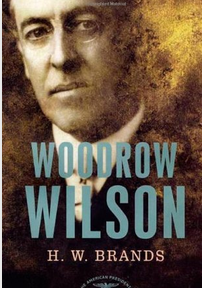
Does Woodrow Wilson deserve more than a two-hundred-page biography? Given his historic impact, yes. Am I gracious enough to grant him one? That remains to be seen. Do I really want to spend hours of my life reading about the man who won reelection under the slogan “He Kept Us Out of the War,” only to lead the United States into that very war, and then prosecute Americans for speaking against it? Who jailed political opponents and shuttered newspapers? Do I want to spend several hundred pages trying to find the human being behind the president who expanded segregation throughout the federal civil service? Not particularly. There is nothing I like about him; even his idealism, expressed in pretty words and inspiring lofty thoughts, they are but a resounding gong or a clanging cymbal when set against the man’s overweening pride and profound outrages committed against Constitutionalism. So, H.W. Brands, do your best.
As this is part of The American Presidents series, edited by Schleisinger Jr, it’s a quick read. I could have finished it days ago, but I don’t like Wilson and I’ve been finding RFK, Nixon, LBJ, and Eisenhower more interesting to read about. Brands is impressively impartial, trying to take Wilson’s idealism seriously while at the same time not ignoring the civil liberties travesties committed during his administration. While Wilson allegedly altered course on entering the war because the Germans were set to resume unrestricted submarine warfare — endangering the lives of Americans who decided that taking a pleasure cruise through a war zone is a grand idea — Brands also includes the more realistic pressure-point — the economy. American banks were loaning money to all the European powers for their war efforts, but because England and France were more readily accessible, much more American money was sunk into the Entente cause: if they failed, the American economy could be thrown into upheaval. When I asked about this aspect of the war back in college, my professor/mentor told me I was too cynical for my own good, but now I have Brands at my back. I’ve never read about the peace process before, so I was surprised to learn that Wilson was viewed as a bit of an interloper for participating directly, and his position — that the American people were overwhelmingly for his measures, aside from a few morons whose future gibbets would scrape the sky (his words) — was undermined by the Republicans sweeping Congress. The book ends, of course, with his debilitating stroke and the very curious role played by his wife in ‘helping administer’ the nation, as well as a reflection on Wilson’s legacy has risen and fallen over the last century — reaching a zenith in the post-WW2 era when the United States did what he wanted and assumed a dominant role on the world stage.
In the end, Brand suggests that Wilson died too late: had the stroke that enfeebled him killed him, he might have been remembered as a hero, a martyr even — but the actions of the federal government during his weak years helped poison his legacy, as did a growing conviction that American involvement in the war had profited no one but the defense contractors and other businesses who benefited from Wilson closing his eyes to labors’ demands. This proved a more interesting book than I expected, though if I read another Wilson title I don’t think it will be this year: I suspect the Truman-Nixon bloc is going to continue consuming my attention.
Quotations
“The Democrats will be very likely to abuse power if they get it,”[Wilson] predicted. “Men are greedy fellows as a rule.”
“Whether you did little or much,” Wilson answered, in what McCombs characterized as a haughty tone of voice, “remember that God ordained that I should be the next president of the United States. Neither you nor any other mortal or mortals could have prevented that.”
Mere mortals wrestled with doubt and confusion, but the self-assured Wilson possessed, to judge by his manner, a direct line to heaven. He wouldn’t have put it quite that way, but he did think God was usually on his side, and the alliance afforded him a moral serenity few could match.
The growth in federal power, however, had a darker side—the side Wilson had feared before taking office. Even as the CPI rallied Americans behind the war effort, the Justice Department hounded those who wouldn’t come along. The Sedition Act of 1918 prohibited “disloyal, profane, scurrilous, or abusive language about the form of government of the United States, or the uniform of the Army or Navy,” as well as any language that tended to bring the government or the military “into contempt, scorn, contumely, or disrepute.”¹⁵
As the sedition law and its companion, the 1917 Espionage Act, were eagerly enforced by Attorney General Gregory and his successor, A. Mitchell Palmer, the measures effectively stifled questioning of the wisdom of the war or the high-mindedness of American leaders. The socialist and labor leader Eugene Debs, for one, was arrested for opposing the draft and spent the duration of the war (and beyond) in federal prison. Radical unionists of the Industrial Workers of the World were jailed, and many of them were deported. To assist in this regimentation, the Justice Department enlisted the quasi-official American Protective League, whose 250,000 members spied on their neighbors and reported any activity deemed insufficiently enthusiastic regarding the war.
When Orlando laid claim to the Adriatic port of Fiume on grounds that the language, population, and culture of the city were overwhelmingly Italian, Wilson put him off with a joke: “I hope you won’t press that point with respect to New York City, or you might feel like claiming a sizable piece of Manhattan Island.”
You cannot throw off the habits of society immediately any more than you can throw off the habits of the individual immediately. They must be slowly got rid of, or, rather, they
must be slowly altered.” Waxing metaphoric, he said, “You cannot in human experience rush into the light. You have to go through the twilight into the broadening day before the noon comes and the full sun is upon the landscape.”No one wanted to accept responsibility for the debacle that the war had become in the popular mind. When Wilson died, Americans mourned him respectfully for a moment, then made him a scapegoat for their collective disillusionment. Journalists and historians reexamined the American intervention in the world war and accounted it fool’s game. “We have been played for a bunch of suckers,” wrote Harry Elmer Barnes in a widely endorsed indictment of Wilson’s wartime diplomacy.


Sorry, I kept picturing that book cover with a volleyball instead of his face 😀
That would’ve been a fun alt-cover to include as a joke, like what I did with the Israel/Iran history…
And I see you have a little friend on devilreads! Awwwwwww, so cute 😉
Hah! Too bad the little strumpet has been leaving the same comment on other reviewers’ walls.
Hahahaha, yeah, it was so obvious it was either a bot or something similar. well, one more reason to keep things exclusive there 🙂
I have a few books on Wilson in my Wish List… ONE day, maybe…. [lol]
Which ones? I’d shopped around for something outside this series but not seen anything particularly compelling.
American Midnight: The Great War, a Violent Peace, and Democracy’s Forgotten Crisis by Adam Hochschild
Savage Peace: Hope and Fear in America, 1919 by Ann Hagedorn
I thought that I had more……. [muses]
The Hochschild book has been on my radar before — I liked his work on the anti-war movement during WW1.
I’m looking forward to reading that one. Its in a pile of my books…. somewhere…..
Pingback: Benjamin “I’m More than the Guy Between Cleveland Terms” Harrison | Reading Freely