
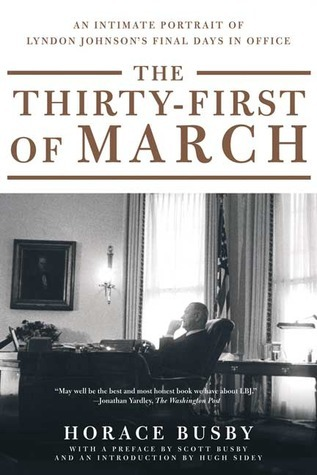
I begin the first of presumably several books on LBJ by peering into his office as he made the decision to not run for office again in 1968. The door is opened by Horace Busby, a newspaperman-turned-speechwriter and confidant for LBJ, who began work on his memoirs but died with them unfinished. His son published them years after Busby’s death. This was an interesting little book, which was published in a half-complete but throroughly readable form. The partial memoir recounts how Busby came to join Johnson’s staff, and more entertainingly how he began to grow used to LBJ the man: the future president was every inch The Character when he was a representative as he later became as master of the Senate and then president. The content passes through the better part of 20 years at a very shallow cruise, and then we find ourselves with Johnson as vice president, then president, facing JFK’s death and then the prospect of running the country. LBJ’s slow decision to not run for president again in 1968 consumes the last third of the book, and it’s a decision Busby was intimately involved in. One of his roles appears to have been a counselor of sort: while Johnson’s other “boys” had definite work to do (creating policy, reaching out to allies, etc), Busby was someone for Johnson to talk to and bounce ideas off of — as well as receive honest opinions. Even when LBJ was being withdrawn and moody, he liked to ask Busby into his office to talk — and sometimes forced Busby to hang out with him until he’d fallen asleep. While readers who are unfamiliar with the late 1960s are going to be a little confused (Why is LBJ resigning?), having circled LBJ for weeks now in my 1960s history and presidential reading project, I liked starting to draw close to LBJ at last. He’s one of my least favorite presidents (rivaling only Wilson), but he was a tremendously interesting and complex man — disgusting at times, but sincere in his desire to help the least of these. This little book left me very interested to learn more despite my long disdain for him.
Quotations
Since morning, you would have been at the side of the most powerful man in the world, listening as he talked of prime ministers and kings, of senators and congressmen, of preachers and charlatans; of war and peace, of live dreams and dead hopes; of happy times past and other times ahead; and of the proper size for cuff links, of the respective merits of various hair tonics, of the price of sirloin as opposed to club steak. But when you reached your own house and your wife awakened to ask what you and the president had been doing all day, you could answer only “Nothing” and fall off to sleep. The Sunday shift was over.
“People are good,” he said. “What the average folks want is very simple: peace, a roof over their heads, food on their tables, milk for their babies, a good job at good wages, a doctor when they need him, an education for their kids, a little something to live on when they’re old, and a nice funeral when they die.”
I commented that this would be difficult to write in a campaign speech, and he shook his head in amusement. “You’re thinking like a public relations man,” he explained. “No good political speech comes out of a typewriter. It has to come from the heart.”
I had known Lyndon Baines Johnson for almost sixteen years: as congressman, senator, majority leader, and vice president. Over that span, I had liked him and disliked him; respected him and disrespected him; at times thought his public performances magnificent and at other times thought his private preoccupations monumentally boring. I had traveled with him, campaigned with him, laughed with him, worried with him, shared with him moments both of the greatest consequence and of complete unimportance. I knew him better than I wanted to know any man. But on the night of November 22, 1963, waiting for him to arrive at The Elms, I was not waiting for any man I had ever known; I was waiting for the President of the United States.
“I get the best minds in Washington together,” he went on angrily, “and what do they come up with? Vomit. Fifty pages of vomit.”
“You must never forget that fellow out in Omaha or Indianapolis or Denver. He has a wife going into the hospital for a cancer operation, a daughter he’s trying to put through school, a boy on his way to Vietnam, car payments to meet, insurance premiums due, a mortgage hanging over his head, and his mother needing to go into a nursing home. When that fellow looks at the White House, he thinks the man there has it made, has everything in the world—and he’s right. All my troubles put together aren’t as big for a president as that little fellow’s troubles are for him. We have to remember that. We have to remember that here in this house”—he slapped his palm firmly against the arm of his chair—“no man who sits here can ever afford to think of himself first.”
On most speeches I wrote slowly or, to be exact, rewrote again and again, often completing the text only minutes before it was to be read. Once, in fact, Lyndon Johnson began reading a speech to the Senate before I had completed the last pages.
A strong January wind blew his hair and the cold must have been severe, but he continued standing on the ramp, his eyes searching the horizon of a lifetime that he was leaving behind. The face on the television screens became intensely private. It was the face of another Lyndon Johnson, one whom I would never know.


