
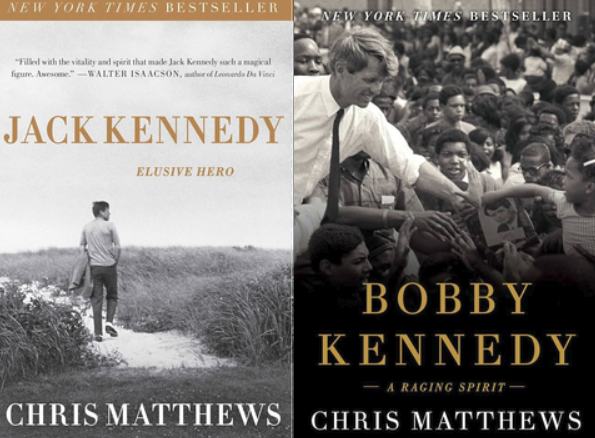
“You and those Kennedys!” exclaimed the waitress at my usual lunch spot when she walked by to see me deeply invested in yet another title about the Brothers K. I must admit, becoming obsessed with the Kennedy men was not something I thought would mark the summer. While I have one more book in the Kennedy set (Vendetta, about RFK’s war against Jimmy Hoffa), reading these two Chris Matthews tributes pushes me close to feeling ‘finished’ with JFK for the time being.
I refer to these as tributes rather than biographies because the author, Chris Matthews, is definitely ‘on board’. The opening of JFK: Elusive Hero entails Matthews’ early obsession with politics, and his feeling distraught that his man Nixon had lost against this Kennedy guy. Matthews, however, soon found himself enchanted by Kennedy; he would even wind up working in JFK’s Peace Corps. Matthews himself seems to have undergone much the same transformation as another reporter he mentions, who asked to be taken off the RFK beat because, as he admitted, “I think I’m falling in love with this guy!” Their assassinations, of course, are part of their mythic legacy; we’ll never know what might’ve become of the New Frontier, and can only see the two men in a cloud of vision and what-might-have-beens.
Digging into books like these, though, has made me aware of how personally compelling both men were. While they’re remembered as liberal icons, the truth is more complex and interesting. They were, for instance, hardened cold warriors: while RFK had softened a little by 1968 (trying to talk to a young leftist group to understand them, only to be spit on), they were resolutely anti-Communist. JFK is known for his stands against Khrushchev, but RFK worked for Joe McCarthy during the red-hunter’s rise to fame and then infamy. While RFK left McCarthy’s office before the end – viewing his office as increasingly irresponsible – the Kennedys and McCarthy were close enough that RFK attended both Joe’s funeral and the burial itself.
Although I view his numerous affairs, including when his wife was heavily pregnant and in need of his support, as despicable, it was hard to not see the other sides of Jack Kennedy in Elusive Hero and other books. Kennedy took history and its lessons seriously; he loved reading history, enjoyed writing it, and when he faced off against Khrushchev he did so wanting to apply the wisdom he’d learned – like trying to understand an event from the other guy’s perspective, and anticipate what decisions his own might force the other guy to make. There was a balancing act between needing to show resolve and needing to not force Khrushchev into a corner.
Admirable, too, is Kennedy’s resilience. Before this Kennedy summer I’d heard that Kennedy had back problems; I didn’t realize that he’d spent large parts of his childhood on his sickbed from scarlet fever and other diseases, and that his ‘back pain’ was so crippling that he had to resort to crutches and even contemplate life in a wheelchair. (Matthews’ books also show the tender side of Nixon in connection to this – not only was Nixon in distress when he heard JFK was in a coma and might not live, but when he was vice president he offered JFK the use of his office in the Senate so Kennedy didn’t have to traipse across the entire building.) He came close to death several times and often worked in pain, but for whatever reason – perhaps knowing his father would never tolerate it, perhaps believing he had responsibilities that outweighed his misery – Kennedy kept on striving, not sinking into self-pity and despair. Chronic illnesses can open wide that particular door.
While my appreciation of JFK was ambiguous before the summer, my appraisal of RFK was far more hostile. This is, as I’ve admitted before, partially for stupid reasons: I was obsessed with Frank Sinatra twenty years ago, and RFK essentially ended the Kennedy-Sinatra friendship. In behalf of Ol’ Blue Eyes, I’ve nursed a grudge against RFK for years. I was also highly influenced by the movie Hoffa in which the smug richie-rich boy goes against the working-class hero Jimmy Hoffa and gets berated by Hoffa in one glorious scene. (“You don’t impress me, and yer office don’t impress me, and yer family don’t impress me. I don’t need a hundred thousand dollars and my brudder elected president to WOP YOUR –”) In my early Kennedy reading, I frequently saw this disliked RFK – who held on to grudges, who acted like a stiff-necked jerk, etc – and enjoyed the reinforcement of my own prejudices. However, real people are not caricatures, and Bobby, too, had different aspects. I kept noticing those, too, especially in Raging Spirit.
I was, of course, fascinated to learn that RFK was a hardline anti-communist, an attitude that’s always attractive to a libertarian such as myself. One prominent theme of Raging Spirit is that RFK was at his heart of hearts a moralist – a strict moralist. Unlike Kennedy, whose Catholicism was so poor his wife commented on it, RFK was very faithful and understood the world in clear, black and white lines. This is presumably why he doesn’t appear to have shared his brother and father’s proclivities for chasing anything in a dress, and why he went after Hoffa and other corrupt union bosses. RFK wasn’t born a politician: while he never got into World War 2 properly, he had the constitution of a fighting executive. He liked making decisions, liked building an organization and putting it to work, and didn’t mind if people thought he was a jerk.
It was after JFK was shot that something changed. The loss of his brother meant the loss of purpose, but it also meant that his feelings about morality no longer had to play second fiddle to the need to support Jack. RFK increasingly became marked by not moderation, but idealism – rising to criticize the ongoing waste that was the Vietnam War, and then becoming increasingly concerned with both Civil Rights and poverty. A son of privilege traveled in the ghettos, migrant camps, and Appalachian mining towns and transformed himself into a near prophet – but, as one Civil Rights activist cautioned him, ‘prophets get shot’.
I truly enjoyed reading Matthews’ books on the Kennedys, beginning with Kennedy and Nixon and this pair of biographies on the brothers. While he’s more of a journalist doing history than a full biographer, the fact that he was writing about two men whose memory had shaped his life and inspired him for decades made the story of the Kennedy brothers even more compelling. Matthews’ Kennedy and Nixon is a large part of why I became interested in Kennedy to begin with. Seeing him through the eyes of a man who had opposed him politically more than once, yet genuinely admired him, made Kennedy seem more human and interesting than mythic. Tt was fitting, then, to wrap up with Matthews.
Coming up: I’m a third of the way through One of Us (Tricky Dick is back!), and I began a Sarah Ruden title about language and beauty in the Bible. President-wise, I am trying to decide if I want to tackle Truman, Eisenhower, or LBJ next. I have books chosen for the former two but find the prospect of a proper LBJ biography daunting. All the really reputable stuff is multi-volume.


You and those Kennedys, indeed!!! [LOL]
And to think I hadn’t read a thing on them before this year!