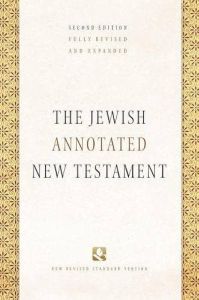
The Jewish Annotated New Testament

© 2011, 2nd edition 2017
ed. Amy-Jill Levine
856 pages

(Yes, this book is why I’ve been so quiet the last two weeks.)

The relationship between Christianity and Judaism has fascinated me ever since I bolted from the Pentecostalism in which I was raised, and began rebuilding my worldview from the ground up, investigating the bones of religions and philosophies to figure out where the truth was. While listening to Jewish lectures at simpletoremember, I was struck by how very different the Judaism expressed there was from the background of the Gospels, particularly in the role of Satan — who leaps from being a mere accuser of humanity to being the Archfiend, the would-be rival to the Almighty in that blank page between Malachi and Matthew. Over the years, I’ve read various books exploring the eruption of Christianity from first-century Judaism, and have eyed this volume (owned by my several priest friends) covetously for a decade. Now, I’ve finally tackled it and and am happy to report that it’s a worthy resource for understanding the world in which the New Testament came into being, and for appreciating the intertangled evolution of both Judaism and Christianity.

The work is divided into two parts: the New Testament itself, subdivided into the Gospels, the Epistles, and Revelation, each with an introductory essay; and then the contextual essays following Revelation. As annotated would indicate, though, there are also in-text comments throughout, spotlighting a custom, a translation, a moment unique to a particular Gospel, etc. These are especially interesting in Revelation, given its fantastic imagery and numerology. These aren’t merely a line or two, though, but often run for several paragraphs –as when the authors analyze the use of “Sanhendrin”, or comment on themes that a particular Gospel is marked by. These comments frequently link to the essays that constitute the bulk of the JANT’s unique content. The essays are substantial, addressing everything from the backgrounds of the New Testament (Jewish life in the first century, the political situation with Rome, the varied manifestations of Jewish thought and belief) to the relationship between Jewish thought & art to the Christian civilization in which most Jews lived within through the 20th century. There are a great multitude of topics within, which would appeal to readers with varying interests. One essay concerns Philo, for instance, a Jewish philosopher whose tripartite view of Deity presaged the Trinity. Some essays would be at home in any study Bible, like the background pieces or the study of how the Jewish and Christian communities came at establishing their respective canons. Interestingly, some of authors often refer to The Old Testament, not because they are Christian but to differentiate the Hebrew scriptures-as-canonized-by-Christians from the Hebrew-scriptures-as-canonized-by-modern-Jews. The Ortho-Catholic tradition includes Jewish texts that are not written in Hebrew, for instance, and which were later dropped by rabbinic Judaism and most Protestants — though most of the latter were just shuffling along in Luther’s footsteps, and he wanted to drop even more of the New Testament than that. Other essays are more concerned with the New Testament within the Jewish tradition — connecting the parables to examples used in midrash interpretation of the law, as well as the way Jews have varied in their approaches to Jesus and Mary over the years: in the medieval era, we can find both insulting nicknames adopted to refer to Jesus, Mary, and Peter while at the same time the use Christian imagery in Jewish art. I wonder if Chaim Potok was aware of that when creating his Asher Lev.

This is a deep book, one that I’ve read slowly over the course of eight months but even still don’t feel as though I’ve done more than broken the surface on. I anticipate returning to it again and again, especially the essays. Although I’ve read into the background of the New Testament before, I still found much of value here, particularly in the book’s general demonstration that first-century Judaism was less a formal, organized Religion and more of a religious culture, with a variety of sects with different emphases — and likewise Christianity, given that the Dead Sea Scrolls and Nag Hammadi texts are brought in for more context. The Sadducees, for instance, were oriented toward worship and the Temple; the Pharisees were oriented more towards the Torah, and the interpretation and adherence to thereof, and more closely connected to post-Temple rabbi-led Judaism than Temple Judaism. The authors argue that Christianity and Judaism was we know it both emerged from this variety of Jewish thought, and are effectively sister religions — a conviction shared by many Christian authorities today, who regard Judaism as an elder brother.

Again, this is a very worthy book for students of the Bible, Judaism, and Christianity, and in the future I want to try the Jewish Annotated Apocrypha and The Jewish Study Bible, all part of this same series. There are a couple of things I’d quibble with in this (one author attributes the Great Schism to arguments over whether the Eucharist used unleavened bread or not — the biggest issue was papal authority, made most salient during the filoque controversy), but those are minor details.

Some quotes:

The New Testament refers to Jesus as “rabbi,” transliterating the Hebrew title into Greek and defining it as “teacher” (Jn 1.38; 20.16). Ironically, this makes Jesus the earliest attested person in literature to bear the title “Rabbi.”

All this “Mary-naming” suggests that these are real, first-century Marys. An author who is writing fiction, and who wants to create memorable characters, would have chosen a variety of names for the heroes and heroines. However, as epigraphic and additional literary evidence suggests, in Jewish society at the time a quarter of the female population bore the name Mary.

[quoting Albert Schweitzer] “But it was not only each epoch that found its reflection in Jesus; each individual created Jesus in accordance with his own character. There is no historical task which so reveals a man’s true self as the writing of a Life of Jesus.” Many of the early historians Schweitzer studied were liberal Protestants, and their reconstructions of Jesus tended to portray him as a liberal Protestant. Along the way, they also “de-Judaized” Jesus, stripping him of his Jewish identity and context.

This type of liturgy was unique to the ancient world. No such form of worship featuring the recitation and study of a sacred text by an entire community on a regular basis was in evidence at this time; we know only of certain mystery cults in the Hellenistic-Roman world that produced sacred texts, which were read on occasion, and then only to initiates. The self-laudatory tone of the Jewish sources in this respect may well reflect their authors’ desire to trumpet this unique form of worship.

One prominent rabbi from the second century believed that crucifixion nails might be worn on the Sabbath (and by implication at all other times), because they were believed to have healing power. Others questioned the value of this remedy and branded it idolatrous (Heb darkhei ha-Emori, lit., “the practices of the Amorites”; cf. the discussion in m. Shabb. 6.10). The power of such nails is known from non-Jewish sources as well, and one could imagine that such nails would have been a sought-after commodity.

The process of translating Jesus’ Jewish–identified Aramaic into Greek sometimes extends to an erasing of Jesus’ Jewish context. Thus, while Jn 1.38 refers to Jesus as “Rabbi” (followed by a parenthetical explanation, “which translated means Teacher”), nearly everywhere else in the New Testament Jesus is addressed with Greek terms that obscure his Jewish identity. In Mt 9.20, when the woman with a bloody discharge comes up behind Jesus and touches the “hem of his garment” (KJV) or “the edge of his cloak” (NIV) [Gk tou kraspedou tou himatiou autou], she is touching his tsitsit, the ritual fringes mandated in Num 15.38 and Deut 22.12, which is similarly (mis)translated in the Septuagint as kraspedon, meaning hem, edge, or border.

Related:
The Misunderstood Jew: The Scandal of the Jewish Jesus, Amy-Jill Levine
Between the Testaments, D.H. Russell
Jesus and the Jewish Roots of the Eucharist, Brad Pitre
The Crucified Rabbi: Judaism and the Origin of Catholic Christianity, Taylor Marshall
Posted in Classics and Literary, General, Religion and Philosophy, Reviews | Tagged , , , , , | 12 Comments

Wednesday Prompt: Legends and Tales

Today’s prompt from Long and Short Reviews is “Favorite Legend or Fairytale”. Without a doubt, mine is Robin Hood. Perhaps because when I was a kid, I watched the Disney version of the story, in which Robin appeared as a dashing fox facing off against the patently terrible King John and his henchmen like Sir Hiss. The music of that movie still plays in my head, ooh de lally, ooh de lally, golly what a day. Robin Hood had immediately appeal for a kid like me who spent his spring breaks and summers (and any time he wasn’t boxed up inside) running around in the woods and swamps. The idea of living in the woods with a bunch of friends, shooting bows and having a perpetual campout, still appeals to me. Maybe that’s the reason I like Red Dead Redemption II so much, since that’s exactly what the main character does — complete with robbing corporate tycoons who run roughshod over native Americans and freeholders. I’ve seen most Robin Hood movies, but Men in Tights has particular charms — Cary Elwes, Richard Lewis, and Sir Patrick Stewart’s acting among them. I’ve also read several books related to Robin Hood (one a study of the legends, the rest re-tellings) over the years here.

Posted in General | Tagged , | 8 Comments

Top Ten Favorite Character Relationships

Today’s TTT is “Top Ten Favorite Character Relationships”. Similar ground to 2011’s “Best Duos”. First up, though, a tease:

“Hemmer, we’re in a place where basic physical laws can’t be trusted, and random things are failing on Enterprise. You’re sure the transporter is the right choice?”

Star Trek Strange New Worlds: The High Country

(1) Sharpe and Harper, from the Sharpe books by Bernard Cornwell. Great dialogue is one of Cornwell’s strengths, and invariably Sharpe and Harper’s exchanges are part of the laughs. These two began as belligerents and then became fast friends, near brothers.

(2) Harry, Ron, and Hermione. I came to the HP books late, beginning in 2007, but was won over completely by The Philosopher’s Stone, especially when Rowling informs us:

Because there are somethings you can’t go through in life and not become friends, and knocking out a twelve-foot mountain troll is one of them

(3) Captain Picard and T’Ressa Chen, Star Trek relaunch books. Introduced in Greater than the Sum by Christopher L. Bennett. Chen is a half-Vulcan officer who rejects that heritage completely, preferring to identity as a professional smartass: despite her frequent sass, Picard immediately spots her potential and becomes something of a longsuffering father figure/mentor to her. It’s a bit like the Picard/Ro Laren dynamic, but without Ro’s chip on the shoulder. Chen is a ball to read.

(4) Macro and Cato, Simon Scarrow’s Eagle series. They’re something of a trope, the grizzled old enlisted man and his trainee-turned-superior, a fresh-faced youth who matures in both age and command in the early Empire.

(5) Jeeves and Wooster, of course!

It seems to me, Jeeves, that the ceremony may be one fraught with considerable interest.”
“Yes, sir.”
“What, in your opinion, will the harvest be?”
“One finds it difficult to hazard a conjecture, sir.”
“You mean imagination boggles?”
“Yes, sir.”
I inspected my imagination. He was right. It boggled.

(6) Aslan and…well, anybody — but especially Lucy and Edmund.

(7) Dagny Taggert and Hank Rearden. These two were an interesting pair — united in their outrage that the businesses they’d built were being compromised and taken over by parasites in the government, but divided in how to respond to that.

(8) Elsa and Loreda. This mother/daughter dynamic is key to The Four Winds, and is the base of much of its drama. It’s agonizing at times: I despised Loreda for much of the book.

(9) The Old Man and the Boy, Robert Ruark. I’m not sure how much of Ruark’s Old Man & Boy stories are factual and fiction, but I love reading them. The Old Man is a fount of wisdom and laughs, intentional or otherwise. (“Set yourself down. I aim to declaim.”)

(10) Jack and Tollers. Okay, neither of them are fictional characters, but their friendship is one of my favorite things to read about.

Posted in General | Tagged , | 12 Comments

Star Trek Day: May the Spock Be With You

Today is Star Trek day, which I’m pretty sure is something Paramount made up to compete with May the Fourth. I’ve been a Trekkie since a trampoline accident landed me in a hospital for three weeks and I suddenly got to watch TV — and discovered the original series. (I also saw The Next Generation, whic personally offended me as a seven year old because who were these people? It said ‘Star Trek’, but there was a bald guy and some dude wearing a hair barrette on his face….) Anyway, to celebrate I am going to share ten bits of Star Trek medium that come to mind. Absolutely random.

In the bad ol’ days of dial-up, I downloaded this. Do you have any idea how long that took?
I also downloaded this, long with Dark Materia’s “Picard Song” and “Frame of Mind”. This was before ‘remix’ was really a thing. Pretty sure the explosion sound effect is taken from the classic DOS game Skyroads.

I am Worf, son of Mogh! NONE of you are worthy of my blood or my life —
But I will stand for you.
The character of Vic Fontaine, and particularly this song, is why I bought a Frank Sinatra album in 2004 and it’s why I remain a fan of classic pop/swing/big band to this day. Listen to Avery Brooks SING!
Star Trek has introduced me to SO much music — opera, folk, big band — and this is a favorite scene from Deep Space Nine. It introduced me to “Jerusalem”.
Yes, the Klingon K-Pop band in “Subspace Rhapsody” was fun. But THIS……THIS is awesome.

This is and forever shall remain one of the most beautiful scenes in all of Star Trek to me. A formerly mute woman begins to sing with her friends, with improvisation. It was scenes like this made my soul leap for joy, scenes like this that are utterly absent from Disco and Picard but so abundant in Strange New Worlds. If your attention span has been Twitterpated, the really good stuff starts at 1:33. (You should work on the attention span thing, though.)
Okay, they’re not all music. This is from STAR TREK BORG, an FMV game that was extremely immersive. The player is thrown back into time, to Wolf 359, and attempts to save his father from being killed. A mix of storytelling and puzzle-solving. This was later followed by STAR TREK KLINGON, which I did not play but LOVE some of the scenes from. If nothing else, this game is a 2 hour experience with John de Lancie. That’s worth experiencing it alone.
Star Trek and baseball. Ya gotta love it.

“You are attempting to manufacture a triumph where non exists.”
“To manufactured triumphs!
“HEAR HEAR!”
Back to music, a favorite scene from TNG. This is from “Lessons”, but it incorporates important aspects of “The Inner Light”. Beautiful music and a rare moment of Picard sharing his soul with someone else.

Can’t not give Strange New Words some love, which has reignited my love for Trek after 20 years trying to keep the faith.

The Starship Enterprise feels ELECTRIFIED
I’m so proud to be your captain!

{..}

MORE SINGING! MORE VOICES!

HAIL THE KLINGONS!

I could post more, but — as I said, this is just ten random things that come to mind.

Posted in General | Tagged | 5 Comments

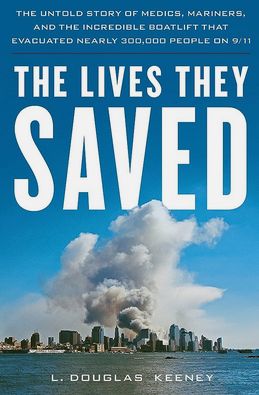
The Lives They Saved

© 2021
264 pages

“Look for the helpers”, Mr Rogers advised children who were frightened by disaster. L. Douglas Keeney here offers a spyglass to readers. Instead of fixating on the flaming towers, the clouds of smoke filled with dust, jet engine fumes, and god-knows-what-else, he directs our attention to the waters around Manhattan, where the largest evacuation in human history was happening, largely ad-hoc. There was no FEMA plan for “Civilian-Led Evacuation of Manhattan”: emergency services plans for treating disasters at the WTC complex largely fell apart when the debris from the Towers covered roads. Keeney tells — or rather, allows the participants to tell — the story of how that boatlift happened, of how NYPD’s marine units, the Coast Guard, private ferries, tugboats, pleasure craft, etc all began casting their eyes toward the seawall and moving to help those they could. This is not a book exclusively about the boat evacuation, though: more broadly it’s about first responders, of people who were on the scene when the horror began to unfold, who responded immediately. We find firefighters and medics eating their breakfast abandoning their plates and moving toward the inferno to save who they could, the medics creating on-the-ground triage centers in lower Manhattan before 2 WTC’s collapse made the entire area a dangerous hellscape. The boat evacuation began unplanned — first responders realized the fastest way to get the gravely injured to hospitals was to get across the Hudson into New Jersey — and was later given the heft of government support when the towers had both fallen and all ships in the harbor asked to participate. A great multitude were already. Although there are many scenes of horror and tragedy here — do not read this with lunch — the great theme is ordinary human heroism, of people triumphing over their fear and their pain to do What Needs to Be Done. Disasters created by the worse demons of our nature often bring out the better angels — and The Lives they Saved is filled with such angels. One caveat: this book needed some sharper editing. There’s some serious misorganization toward the end, and a lot of repeated facts — some in paragraphs that follow one another. The spotlight on ordinary greatness, however, and the introduction of parts of the disaster I’ve not encountered before, still makes this an easy recommendation. Comparable titles are The Only Plane in the Sky, the best oral history of 9/11 imaginable, and Touching History, the story of the day as experienced by airmen and the airlines themselves.

Highlights:

She didn’t need to be told it was bad—the visible carnage said all that—but how bad was it? How close had the victims been to the impact zone? She wanted to understand the situation. “They brought us to a guy burned from head to toe. I said to him, ‘I know this is going to be a strange question, but I have to know what’s going on in those buildings. For everybody’s safety, can you please just tell me where you were.’ He looked at me and said, ‘I was in the basement of the North Tower.’ I said, ‘My God, these people are coming out from the basement. What is going on in that building?’

Unlike the jetliner that hit the North Tower, which hit it square in the middle, United 175 hit off center, near the edge of the South Tower, which allowed more energy to pass through the building and more debris and burning fuel to surge out into the sky on the opposite side. “(I) could feel the heat from the explosion through the glass in our windows,” said a witness. To give some perspective, he added that his offices were nowhere near the South Tower. “Our offices are about 10 blocks from the Trade Center site.

HROUGHOUT THE DAY, ACROSS THE CITY, THE WELL OF GOOD SAMARITANS ran deep, the unsung acts of kindness too frequent to count. The owners of a corner hot dog stand stood their ground even as frightened people swept past them. No doubt they were just as scared as anyone, and they were certainly covered with as much sweat and dust, but they had their carts and their carts were filled with bottled water and soda and, what with the attacks and the collapses and the injuries, maybe that was just what someone needed. So they stood by their cart leaning into the crowds and handing out a can of soda here and there as if they were a relief station alongside a marathon. One survivor ran past them and saw what they were doing, and it hit him, the kindness of it all standing in such sharp contrast the horror of the attack.

The boat captains went back too, men and women not paid to run toward a calamity, not hardened by years of dealing with emergencies. “We knew we had to go back, but we didn’t know what was going to happen to us,” said Jim Peresi. “We were hearing that there were four planes still in the air. We heard they just hit the Pentagon. You know, you don’t know what to expect. We’re figuring [the terrorists are] coming back up here so, yeah, going up [to Manhattan to take on passengers], you didn’t know if you were coming back. You didn’t know. That’s probably the hardest part about it.” “We were afraid, but we were not afraid,” said EMT Immaculada Gattas, Division 6, FDNY, putting it into her own words. “We never thought about dying, we only thought about helping other people.”

“The response was incredible,” said Coast Guard Rear Admiral Richard Bennis, who at the time was USCG Captain of the Port. “Every single vessel in the Port of New York responded to Lower Manhattan. All you could see was vessels streaming into the harbor … every fast ferry, every tugboat, the pilot boats, the Army Corps of Engineers boats, Coast Guard boats—every able boat in the harbor responded to Lower Manhattan.”1 During World War II a total of 338,226 soldiers were evacuated by boat from Dunkirk, France. In New York, 272,539 were evacuated by boat from Manhattan.2 Dunkirk took nine days, May 26 through June 4, 1940. The boat lift of Manhattan took less than 12 hours. The boat lift of Manhattan was thus the largest single-day boat lift in recorded history.3 The tugs, emergency patrol boats, dinner cruise boats, Randive, the Corps of Engineers, Circle Line, and New York Waterways Spirit—all of them came to the assistance of a paralyzed city.

One of the bosses said, ‘these baloney sandwiches in this box over here, don’t eat those, they’ll make you cry.’ So, I think, ‘they’ll make me cry? What are they spicy or something?’ He just shook his head and walked away.” Puzzled by that, the firefighter reached in and pulled out a brown paper bag and looked inside. “[I] opened the flap and there’s a little crayon picture of a rainbow and flower and ‘we love you’ written in crayon. So, I open the bag up and there’s two peanut butter and jelly sandwiches in there and another little note from a girl named Megan and a girl named Melissa. [It says] ‘We love you firemen. Keep up the good work.’ [There was] like a little drawing of a stick figure and the Trade Center and a flower. On the back of the note it said, ‘Made with love from the Coman Hill Elementary School Kindergarten Class.’ We’re sitting there, grown firemen, rough, tough guys getting chocked up and teary eyed over a frickin’ peanut butter and jelly sandwich.”

Posted in Reviews | Tagged , , , , | 3 Comments

Top Ten Tuesday: Surprises and Spells

Today’s Top Ten Tuesday is books that surprised us. First up. a tease from Jim Butcher’s Storm Front.

I had several enchanted items around—or half-enchanted items, anyway. Carrying out a full enchantment is expensive and time-consuming, and I just couldn’t afford to do it very much. We blue-collar wizards just have to sling a few spells out where we can and hope they don’t go stale at the wrong time.

Storm Front

“Our bodies are programmed to consumne fat and sugars because they’re rare in nature. In the same way, we’re biologically programmed to be attentive to things that stimulate: content that is gross, violent, and sexual, and that gossip which is humiliating, embarrassing, or offensive. If we’re not careful, we’re going to develop the psychological equivalent of obesiety. We’ll find ourselves consuming content that is least beneficial for ourselves or society as a whole.” – Danah Boyd, 2009 speech.

Quoted in The Filter Bubble

(1) The Jungle, Upton Sinclair. I knew going in that this was a novel written for overtly political reasons, so I figured it would on the poorer side. To my surprise, Jurgis was a commandingly sympathetic character, and the novel didn’t disintegrate until the last third of the book where he essentially disappears, supplanted by political speeches.

(2) The Four Winds, Kristin Hannah. I had some notion of Hannah as a romance author, so I was expecting to find this mildly interesting for the setting and then skim past the Fifty Shades stuff. To my surprise, history and character drama take center stage here, and the character drama has almost nothing to do with romance.

(3) & (4) Rachel’s Holiday and The Sleeping Beauty. These were both lent to me by my then-lady friend shortly before I had my transplant. The latter was a fantasy novel set in a realm where literary tropes — The Tradition — actively shape the lives of people, who if they meet certain attributes will recreate stories from legend. Surprisingly fun. Rachel’s Holiday was more serious, and involved a narrator who was in denial about her substance abuse problem. It proved to be one of 2022’s more memorable reads.

(5) The Hidden Life of Trees, Peter Wohlleben. I expected this to be interesting: I didn’t expect it to be one of my favorite science books ever.

(6) The Second Sleep, Robert Harris. Not having read anything about this, I began it absolutely believing it was set in medieval England. It proved instead to be set in the far future, where civilization has collapsed and has rebuilt to a psuedo-medieval level.

(7) Into the Black. What I expected: a history of the space shuttle’s creation. What I was surprised by: the Air Force actively expected to create its own space programmed centered around a Manned Observation Laboratory, and recruited its own version of the Mercury 7 — the “Magnificent Eight” — which would have included the first black astronaut had he not died in ’67.

(8) Ain’t My America, Bill Kauffman. Coming of age in the neocon ascendancy, I took for granted that one party was more married to aggressive foreign intervention than the other, but I was quickly disabused of that notion, both by the supposedly peaceful party’s continuing interventions after 2008, and by discovering Bill’s book here, which demonstrated that the other party was the most anti-intervention voice prior to its takeover by the military-industrial complex, something Murray Rothbard documented in another book.

(9) The Invisible Heart: An Economic Romance, Russ Roberts. An economist and a English teacher form an unlikely attachment, but their interest in one another is tested by their differing political views I’d just started listening to Roberts’ “EconTalk” podcast as part of a project to get the perspectives of various professionals (lawyers, doctors, and economists) on issues of the day, and gotten interest in reading Roberts as a result. Although at the time I was opposed to Roberts’ economic views on moral grounds, listening to him and reading this book made me realize we were on the same page in regards to desiring human flourishing. Indeed, Roberts’ podcast these days is more about the meaningful life than economic analysis.

(10) The Death and Life of Great American Cities, Jane Jacobs. A single sentence in this book caused a political paradigm shift for me. It’s one of those “This book is so impactful I can’t review it properly” books.

Posted in General | Tagged , | 8 Comments

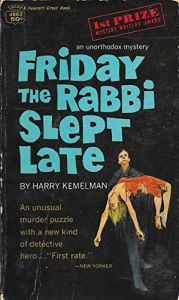
Friday the Rabbi Slept Late

“an unorthodox mystery”
© 1964
235 pages

The small Massachusetts village of Barnard’s Crossing is shaken when the body of a young woman is found lying behind a garden wall, and no one more than Rabbi David Small — because the woman’s purse was in his car, parked nearby at the Temple where he’d been appreciating some new books. Naturally the police have questions, and so do the members of the rabbi’s congregation, who were preparing to review their new rabbi’s contract for the next year. Fortunately, this is a small town: personalities are largely known, as are potential motives — and if they’re not obvious, they can be sussed out. Both for professional and personal reasons, the rabbi puts his powers of discernment and argument to work, using his rapport with the police chief to help figure out the truth. Friday the Rabbi Slept Late is a village mystery, run by connection, conversation, and petty motives — but is made all the more interesting by the seriousness with which Jewish wisdom and Talmudic argument is brought to bear. As a fan of village stories (the Mitford series, Berry’s Port Williams books, even John Grisham’s Clanton tales), this was right up my alley, especially given the apparent similarity between this and GKC’s Father Brown mysteries. Although the books presume some basic familiarity with Judaism from the reader, they also appear to be written for a non-Jewish audience, as Small frequently has to explain differences between Jewish religious culture (particularly, the role of a rabbi) and Catholic and Protestant culture. These range from the trivial (“Rabbis aren’t Catholic, we can marry”) to the more serious, like discussions about virtue and theodicy. The book is very much a product of the early sixties, from the constant smoking to the casual use of ‘broads’ to describe women. Some of the men are such overt pigs that I suspect Kemelman was writing to mock them. The reader can solve the mystery, since it’s based not on forensics but on human nature — I’d pinned the culprit early on, but wasn’t sure of the exact chain of events that lead to the crime. This was a delightful little discovery for me, and I’ll continue the series as I progress more on Mount TBR.

Some higlights:

“What’s going on?” he asked. “Is it a private argument, or can anyone join? I’ll bet they could hear you guys down the block.”

“Dear Mrs. Small, I’m not disagreeing with you. But we live in the world. This is what the world wants now in a rabbi, so this is what a rabbi has to be.”
“David will change the world, Mr. Wasserman, before the world will change my David.”

“Then why bother to be good?” asked Mrs. Lanigan.
“Because virtue really does carry its own reward and evil its own punishment. Because evil is always essentially small and petty and mean and depraved, and in a limited life it represents a portion wasted, misused, and that can never be regained.”

Posted in Reviews | Tagged , , , , | 3 Comments

August 2023 in Review

August is one of the few months of the year where I don’t mind if it passes too quickly. In the Gulf Coast, it’s a month for holing up inside and giving thanks for freon and electricity. The unexpected presidents obsession from July bled well over into August, but things soon livened up. It was a good month for the ol’ TBR ascent, with numerous titles going down for the count. To reach my goal before the year’s end, I need to be reading 6.66 books per month (it really is Mount Doom!), and so far I’m averaging 5.75. The biggest news this month, though, is that I began grad school classes for an MLS (focusing on digital management), which is why I have a few more “pending reviews” than usual. I’ve been pretty good about that this year.

Climbing Mount Doom:
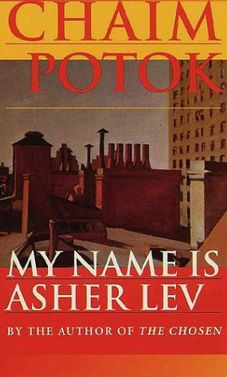
My Name is Asher Lev, Chaim Potok
Skeleton Keys: The Secret Life of Bone, Brian Switek
Night Witches: A Novel of World War 2, Kathryn Lasky
The Dumbest Generation: How the Digital Age Stupefies Young Americans and Jeopardizes our Future, Mark Bauerlein (will be short rounded with another)
The Day of Atonement, David Liss
The Four Winds, Kristin Hannah
The Parasitic Mind: How Infectious Ideas are Killing Common Sense, Gad Saad (review pending)

Classics Club Strikes Back:
My Name is Asher Lev, Chaim Potok

Readin’ Dixie:
Started reading The Mind of the South.

The Big Reads:
I am really close to finishing The Jewish Annotated New Testament. Tried to finish it yesterday but didn’t quite make it.

Coming up in September:
I haven’t read any Star Trek in over a year (seriously, early August 2022), so I need to remedy that. Maybe I’ll do something around “Star Trek Day”, which is Sept 8. Will definitely finished off JANT .

Posted in General | Tagged | Leave a comment

My Name is Asher Lev

© 1972 Chaim Potok
372 pages

How to describe My Name is Asher Lev? The book opens with Asher himself describing himself as an apostate, a traitor, a mocker — and yet the reader will find no cruel intentions here, only a young man struggling with feelings and attempting to give them form. Young Asher is the son of an important man in the Ladover Hasidic community, the right hand of the rebbe of a worldwide movement. He is the heir expectant, and despite his faithfulness to his father’s ways, young Asher has no interest in schooling, yeshiva or otherwise. Hee is drawn to art, pulled by it despite the protestations of his parents and the mocking of those around him — mesmerized by another tradition he is repeatedly warned against, enraptured by images forbidden to him and which cause confusion and pain to those around him. This is an extraordinary novel, one that dwells on both the struggle of a young man to find his own identity apart from his parents, of being understood by them despite being distinct, and at the same time an exploration of the power of art.

The story takes place from the late fifties to the sixties, ending not long after JFK is shot in Dallas in 1963. Like Potok’s protagonist in The Chosen and The Promise, young Asher is born with a place already established for him: he is to absorb the traditions of his people, watch his father studiously, and assume his elder’s position when the time comes. But Asher, growing up and seeing how heavy his father’s mantle of responsibility lies not merely on him but his mother — who is often sick with worry for her husband’s sake, as he travels abroad in Russia and other places hateful of Jews, and who works to keep the family fed during these long seperations — is moved by the intensity of their feelings and seeks to capture them on paper and canvas. He is discouraged repeatedly, but reveals an enviable talent that others around him feed, and soon art commands him to rebel. He ditches school and wanders into museums, studying the paintings there that strike him, and attempting to copy them in his sketchbook. To make images as as an Orthodox Jew is one thing, but some of the paintings he copies (learning forms, shading, perspective, etc), some of the subjects that fascinate him, are scandalous to his father and to their entire community. What kind of Jew is obsessed by the Crucifixion of a man whose name is not even permitted in the Lev home? As Asher’s father takes him further and further afield, Asher has more liberty to pursue that which calls him, and as he comes of age he is fast surpassing even his mentors.

It’s a beautiful drama Potok creates here, a young man trying to capture feelings that overwhelm him, using his family’s pain to create art that astounds the world while at the same time causing even more sorrow to them that love him — for they want to understand him and his art, and yet they don’t, and they are terrified that the dark and intense imagery Asher often uses comes not from Above, but from The Other Side. Despite their alarm, they do their utmost to be patient with him — and the rebbe, who knows the way through this tension is not to resist the art but to embrace and try to use it, even more so. On Potok On Potok drives Asher, his family, and the reader, witnessing increasing maturity born of main and struggle until we reach the culmination. It’s neither happy nor tragic, but markedly appropriate.

“It’s not a pretty world, Papa.’
‘I’ve noticed,’ my father said softly.”

I looked at my right hand, the hand with which I painted. There was power in that hand. Power to create and destroy. Power to bring pleasure and pain. Power to amuse and horrify. There was in that hand the demonic and the divine at one and the same time.

Posted in Classics and Literary, Reviews | Tagged , , , , , , , , | 4 Comments

Star Trek Strange New Worlds Season II

No, Strange New Worlds is not a book. It is, in fact, a TV show. But I pay the bills ’round these parts, so I reckon’ I’ll write about what I want. The long dead period of onscreen Trek was not made better for me by the Abrams verse and early offerings like Dicovery and Discovery, but then came Strange New Worlds and I fell in love with onscreen Trek again. I watched season 1 in 2022 with wonder and rapture, and I’ve just finished watching season 2 and am offering spoiler-free reactions. In general, this was a stellar season, and I am genuinely impressed by the creativity, the fanboy flourishes, and the balanced attention on each character. I genuinely can’t pick favorites among the SNW crew, Pike aside. La’an is the character I’m watching most carefully now given her development this season.

S201: “The Broken Circle”. Chief La’an Noonien Singh, who took a departure to take care of a young girl the Enterprise crew rescued from some hellish aliens in season 1, sends a distress call to the Enterprise. She’s out in the boonies — boonies controlled by the Klingons despite not being part of the Empire — and has discovered a plot to reignite the bloody war between the Federation and the Klingons. Solid intrigue and action.

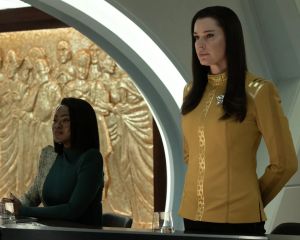
S202: “Ad Aspera ad Astra”. The first of season 2’s “The One Where ____________”, deliberately channeling show-types reused in the previous serials, this is “The One with the Courtroom Drama”. At the close of season 1, First Officer Commander Una (aka Number One, from “The Cage”) was arrested and accused of being genetically modified. “Ad Aspera” sees her defended by a civil rights attorney, exploring the limits of the law. There’s a twist in the midst, and the episode leads to an emotional connection later in the series.

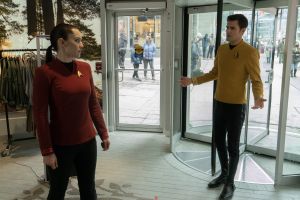
“New to revolving doors, are we?”
“I’m FROM SPACE.”

S203: “Tomorrow and Tomorrow and Tomorrow”: Security Chief Singh randomly encounters a dying man in a corridor, and he thrusts a device into her hands that throws her into an altered timeline. She and the alter-Kirk (who is the captain of the United Earth Ship Enterprise in this timeline) investigate and are thrown further back into time, to …..Canada. Exciting, funny, and moving towards the end. Solid emotional drama when Singh realizes the nature of the timeline’s alteration. Could possibly be regarded as SNW’s “The One Where They Visit Present Day Earth For Some Reason” episode, like scattered episodes of TOS, DS9, and VOY.

S204: “Among the Lotus Eaters”: Enterprise discovers evidence of cultural contamination on Rigel 7 and investigates, but both the ship and landing party are effected by radiation that wipes their memories. Has one wondering how they’re going to get out of this, but the ending gives Erica Oretgas (she flies the ship) a nice moment.

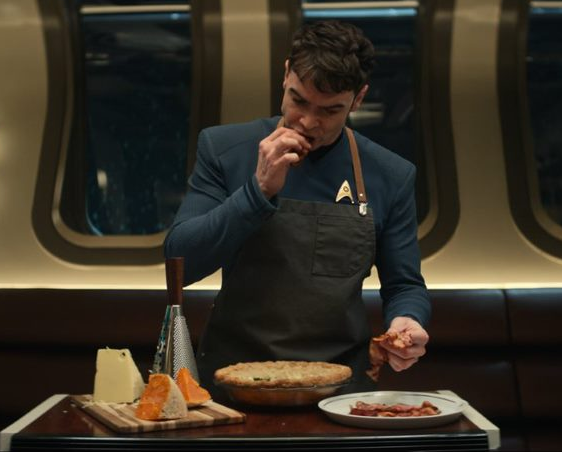
“Smoky and salty and sweet and soft and crispy all at the same time! I MUST HAVE MORE!”

S205: “Charades”. Here we move to brilliance. Spock is involved in an accident, and mysterious aliens ‘fix’ him by…..removing his Vulcan DNA, so we get to see Ethan Peck playing a version of Spock that has his memories and learned habits, but who is wholly subject to human senses and whims. It’s thoroughly hilarious, especially after he discovers bacon, but made tense by Spock having to take part in a Vulcan ceremony that will decide his future marriage to T’Pring.

S206: “Lost in Translation”. A Uhura episode that’s very “Devil in the Dark”, shall we say? Also features Jim Kirk, who is serving aboard the Farragut, and acting as his captain’s liason aboard the Enterprise. Classic Trek mystery, and George Kirk gets a rare moment to shine.

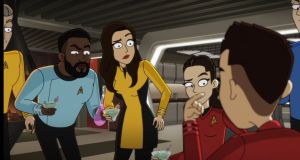
S207: “Those Old Scientists”. The long-awaited Lower Decks | Strange New Worlds crossover. After salivating over the idea that he’s standing where Spock once stood, Ensign Brad Boimler accidentally engages (well, technically Rutherford did) a long-dormant portal that spits him from the 24th century into the 23rd, from cartoon Trek into real Trek, landing in front of Captain Pike, Spock, and Commander Una. Although Boimler tries to behave, the manic energy and — shall we say poor disicpline? — of the Cerritos crew come out in a big way, especially after Mariner tries to come to Boimler’s rescue. It’s hilarius seeing Cerritos antics on the same stage as serious-intense Strange New World writing. I enjoy Lower Decks, making this rival “Charades” as a runner up favorite. There’s a lot of intermixing of Lower Decks and SNW here, so that the show opens with the Lower Decks title sequence, but using Enterprise instead of Cerritos, and ends with a LD-animation scene of the SNW crew.

S208: “Under Cloak of War”. The arrival of a Klingon ambassador to the ship forces Dr. M’Benga and Nurse Chapel to confront their trauma from the Klingon war. Definite shades of “The Siege of AR-558”, “It’s Only a Paper Moon”, and a dash of “The Wounded” — that O’Brien scene, anyway.

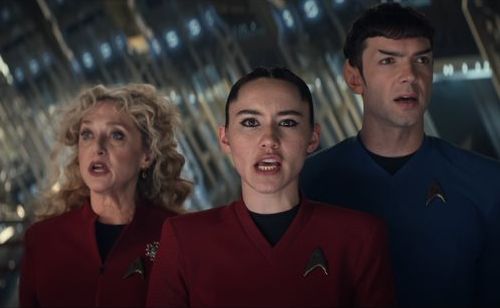
S209: “Subspace Rhapsody”. IT’S A STAR TREK MUSICAL EPISODE. IT’S SO GOOD. WATCH IT MULTIPLE TIMES.

S210: “Hegemony” One villain Strange New Worlds has given new life to is the Gorn, who are no longer just lizard-monsters but Predator-like horrifying antagonists who reduce intelligent viewers into teeny tiny little mice-mammals, nervously snatching snake eggs and looking everywhere for imminent scaly death. “Hegemony” opens with an independent-but-Fed aligned colony being invaded by the Gorn, and the Enterprise has personal stakes in going against Starfleet orders because both Nurse Chapel and Pike’s captain-girlfriend were on the ground when things went sideways. Stirring end to the season.

Posted in General | Tagged , , | 4 Comments