Starter Villain

Charlie is a sacked journalist struggling to get by with a substitute teacher’s salary, and dreams of maybe owning the neighborhood pub one day if he can ever get approval for a loan that uses his father’s house as the collateral. That’s the only good thing going for him, that house: if all else goes wrong, he still has a place to live. Then, walking home from attending his uncle’s funeral (where he had to stop people from trying to stab the body, for some reason), it blew up. Fortunately, his uncle’s former assistant has a solution: follow his cat. Follow his cat?

Charlie’s uncle, it turns out, was a supervillain. Not the kind with a cool uniform and a nemesis, not even a platypus wearing a hat. He and his colleagues (Evil League of Evil, anyone?) are more like dark venture capitalists or tech bros who are leaning into the whole Machiavellian manipulation of society thing. Charlie learns that since the Evil League of Evil is nepotistic, he’s just inherited his uncle’s authority, responsibility, holdings — and rivals. Fortunately, he now has a volcanic island superlair with genetically augmented dolphins and cats. The former are on strike (and hilariously vulgar), but since Charlie is new their leader Dark Flipper might give him a chance to prove himself before doing anything. Unfortunately, Charlie’s uncle’s rivals know he is fresh on the job, and vulnerable: they claim Uncle Jake owed them money, and being villains they’re perfectly willing to kill/dismember/etc Charlie to get what they want. Unfortunately for them, before being a struggling substitute he was a business journalist, and he smells something fishy that’s not the dolphin’s lunch. Enter schemes and machinations all made possible by sentient typing cats.

Starter Villain is a comedy action-thriller that has a lot of fun with supervillain tropes. I was amused to read in Covert that many young Mafia members try to educated themselves on how to be the Mafia by watching films like The Godfather: here, we find a cabal of tech-biz criminals taking clues from James Bond movies, at least to a point. Charlie’s uncle was fiscally responsible and didn’t bothered with a multi-million dollar war room. The greatest appeal for the reader is the humor inherent in Charlie exploring this premise, as he is half-amused and half-horrified at his uncle’s previously hidden life. As he gets deeper in, though, there’s a plot that involves a secret warehouse full of plunder.

I experienced this via audiobook, happily giving my money to Amazon for the pleasure of listening to Wil Wheaton perform for 8+ hours. I was never an Audible member until I tried his take on Redshirts during a free trial, and I was so blown away by his performance there and in Ready Player One that I actively look for new work by him. He lives up to his usual high standards here, helping sell the humor: sometimes when he performed lines, there was so much ‘Wil-on-the-verge-of-laughing’ that I wasn’t sure if it was the character or the narrator so amused by the writing that he couldn’t restrain himself. It was Wheaton that pushed this into the utterly enjoyable category for me. The worldbuilding was good, and other parts of the book perfectly fine. Where it failed for me was satire against tech-bros and the like: frankly, Dave Eggers’ dark and absurd take on these tech heads in The Circle and The Every makes Scalzi’s attempts at mocking them look positively unimaginative by comparison. Still, it’s much better than The Kaiju Preservation Society, which had a shadow of a main character and a plot so simplistic that the book was saved only by the really interesting worldbuilding. Starter Villain is much better by comparison, and Wheaton pushes it into the solidly memorable territory, from the Russian accents to his doing extremely vulgar dolphins.
Posted in Reviews, science fiction | Tagged , , , | 2 Comments

The rise of digital cryptography & the dark web

Short rounds time!

First up, a surprisingly serious and detailed history of digital cryptography from Steven Levy. The previous books I’ve read by Levy have also been tech histories, but How Google Works and his Apple-related titles had a strong fanboy vibe to them, whereas this one is level headed. Unless you’re a crypto-anarchist or a cryptographic developer yourself, perhaps it’s difficult to get extremely excited about encryption methods and patent fights. The book begins with the contribution of Whit Diffie, who came of age fascinated by encryption but who was frustrated by the state throwing up an effective firewall against any information about cryptography disseminating outside the Borglike box that is the NSA’s headquarters. His single-minded obsession led to him traveling the United States looking for obscure books and papers, and from this self-assembled education came a novel idea that still undergirds encryption today. Diffie’s is only one piece of the story, though, as Levy also tracks the work of men who figured out how to make Diffie’s principle actually happen, and the way publicly-available encryption software (essential as the information age grew to encompass more and more of society) overcame the NSA’s attempts to block it — which sometimes meant deciding that getting a product out there was more important than monetizing it, as when the first iteration of PGP software was released for free so it could hit the market and be replicated open-source style before Joe Biden’s anti-cryptography bill made it through Congress. (Another unexpected presence: Carl Sagan, who is arrested with one of the book’s subjects at a protest.) Although this encryption is crucial to the workings of the internet — it’s what allows for online commerce, for one thing — I must admit the book itself doesn’t have the broader appeal of his later works, in part because it is detailed and serious, and about something that’s more abstract and technical than many people are comfortable tackling.

Relatedly, I read a paper called “From Crossbows to Cryptography“, a 1987 essay/article in which Chuck Hammill argued that technology offered weapons to take liberty from the state. Technology is an equalizer, he wrote: just as crossbows allowed untrained peasants to dispatched heavily armed knights, so can modern tech help us avoid tyranny. I’m not sure what he had in mind in ’87, and unfortunately I can’t find much else about him. I’ve seen/heard this paper mentioned in discussions on the Tor browser, blockchain tech, and the like but in his day the internet was very different — the graphical and wide-open World Wide Web didn’t yet exist. The only example he mentions is people swapping information back and forth. Of course, the ability to communicate is important (people used cassette tapes to foment revolution in Iran!), but I’m curious as to his full thoughts on the subject. Timothy May’s “Crypto Anarchist Manifesto” is a related document — a brief few paragraphs about the promise of cryptography and the arguments the state will bring against it. Interestingly, he predicts the emergence of markets like those which can be accessed via Tor.

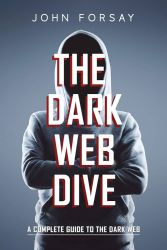
And speaking of the devil, I recently read Dark Web Dive, which is a brief (100 page or so) introduction to the Dark Web. Forsay begins with the basics, explaining the distinction between the surface web (anything you can access from a basic web search), the deep web (which is online, but needs passwords to access), and the dark web, which is part of the internet but requires special programs and protocols to navigate. For a practical example: the interior of a post office is surface web, the interior of a post office box is deep web, and the dark web is more like knowing there’s a guy across the street who, if you use the right code phrase, will set you up with your contraband of choice. The author discusses how users find their way on the dark web (sometimes using surface web directories that compile lists of known darkweb addresses) and conduct business. He also shares horror stories from the dark web as a way of illustrating how much of it is mythologized (some stories are 1980s Satanic panic caliber), and then comments on genuine dangers before sharing information on how to access it via Tor. Amusingly, his instructions for Windows machines entail encrypting their entire drive first, launching a virtual machine and installing an operating system on it, installing Tor on said VM, installing a VPN on said VM, and then — finally — installing Tor. Perhaps his intent is to scare people fromHe frequently emphasizes the need to use a VPN prior to launching Tor, since some ISPs regard a Tor connection as a red flag. I’ve heard arguments against it, however, alleging that mixing them creates new vulnerabilities. (There’s also the fact that VPNs and the Tor network, since they’re indirect connections, load more slowly. Combining the two sounds like trying to re-experience the days of 28k dial up connections, personally.

Related stuff coming up — The People vs Tech, which was thought provoking, and The Filter Bubble, which I read two weeks ago but haven’t posted anything yet on.

Posted in history, Reviews | Tagged , , , , | 4 Comments

Wednesday blogging prompt: beating bad moods

Today’s blogging prompt from Long and Short Reviews is, “What do you do to shake off a bad mood?” That varies a bit on the mood itself — I need to be around friends to dispel some moods, but I need to avoid people in others — but a ready antidote to most is found in Latin. “Solvitur ambulando!” It is solved by walking. Whether angry, sad, lonely, anxious, whatever, I’ve found relief in a brisk walk. Sometimes I also go for rides and listen to music, and on the same roads I like to walk and cycle on — quiet county lanes that haven’t been repaved since Carter was in office, past cows and horses and creeks. I have a go-to list of movies to watch when I’m feeling sick or low (including Groundhog Day, The Philadelphia Story, and A Series of Unfortunate Events), and sometimes booting up a game and causing chaos also works. There’s nothing quite like an open bar brawl in Red Dead Redemption 2 to put me to rights.

Posted in General | Tagged | 8 Comments

Teaser Tuesday: The digital Knockturn Ally

So, is Tor the Dark Web and Dark Web Tor? Absolutely not. Tor is only one network that exists in the Dark Web. There are others, such as Hornet, Freenet, and I2P, which we’ll discuss later on in the book.

The Dark Web Dive

Interesting! I’ve always heard ‘other browsers’ mentioned as far as accessing the dark web, but never looked into what the browsers and the networks they permit entry into constituted.

Today’s TTT is minor characters we wish had gotten their own book. We did this list back in 2011, so I’m going to spotlight books on my Kindle Unlimited shelf.

(1) Algorithms to Live By, Brian Christian and Tom Griffiths. Haven’t taken a look at it yet, just curious.

(2) The Dark Web Dive: A Complete Guide to The Dark Web. One topic we’re discussing in my SLIS class is the dark web. I’m reading this both out of personal curiosity and so I have a book to cite.

(3) Short Stories by Jesus: The Enigmatic Parables of a Controversial Rabbi, Amy-Jill Levine.

(4) The Shephard of Hermas. An early Christian text mentioned by content in The Jewish Annontated New Testament.

(5) Thinking, Fast and Slow. Daniel Kahneman. Another “let’s have a look” book.

(6) On Reading Well: Finding the Good Life through Great Books, Karen Swallow Prior and Leland Ryken

(7) In the Company of Trees: Honoring Our Connection to the Sacred Power, Beauty, and Wisdom of Trees, Andrea Sarubbi Fereshteh

(8) The Discarded Image: An Introduction to Medieval and Renaissance Literature, C.S. Lewis

(9) Angle of Repose, Wallace Stegner

(10) The Decadent Society: How We Become Victims of Our Own Success, Ross Douthat

Posted in General | Tagged , | 8 Comments

Inside the Chaotic Rise of YouTube

Do you remember the first YouTube video you watched? Mine was a fifteen-second clip of a guy doing a skateboarding trick, embedded in a blog post. The men who initially coded YouTube used Flash, which allowed videos to be played from other websites, giving the new website a critical advantage against other websites also exploring the possibilities of video hosting. Like, Comment, and Subscribe is a history of YouTube’s first fifteen years, one that focuses on business, with society and culture present but distinctly in the backseat. Because Google acquired YouTube so early in its life, the tension between the two marks most of the book, YouTube playing the creative young punk and Google the responsible adult who has to pay bills and fend off lawyers. I found it largely fascinating reading, from the early revelation that one founder saw YouTube as a possible dating website, to the perennial struggles of content moderation — both the question of what should be moderated, and how that should be accomplished. The book focuses more on business and technology as it goes, possibly because the torrent of content grew too voluminous to say anything meaningful about; this and the author’s predictable and unimaginative takes on The Issues of the Day progressively dampened the fun.

The beginning of the book is especially interesting: I was coming of age just as YouTube started, so a visit to its early years is saturated with nostalgia, for that time in tech in general and for the state of the website at that time. I remember using it in college to watch comedians and movies, but also enjoying the growing world of ‘original content’. YouTube began with a team that actively combed the website looking for fun videos to feature, long before The Algorithms became our lords and masters. Although the YouTube people were concerned about copyright issues from the start — concerned about the fire they’d draw, not so much keeping more pennies from piling up in Warner Bros or Disney’s pockets — not until they were purchased by Google (which had actual money to seize in a verdict) did any legal issues really surface. What would have happened to YouTube on its own is a story for some alternate timeline, but in ours Google was able to create a system to automatically identify music and video offenses, and would triumph in a lawsuit levied by Viacom. Although the website’s original creators viewed it as a creative exercise in democracy — all the content would be created by ordinary people for ordinary people — Google needed all those servers and bandwidth to pay for itself, and as the years passed things changed, especially after its own version of Moneyball came into play. Video clicks didn’t matter: what mattered was watchtime, because videos that kept eyeballs on them increased ad revenue, and changes were made that crippled the approach of many creators who posted shorter videos. Whereas ten minutes had been the maximum upload, it now became the minimum to get into profitable ad brackets. Over time, Google would face so many issues with advertisers complaining about the videos their ads were appended to that it began restricting the videos that could be monetized. Another common theme of the book is content moderation, as Google uses both human and AI to remove pornography, calls to violence, etc. This has posed constant difficulties, both technical and policy-wise. How does one differentiate fictional violence from real violence, for instance, especially when the automatic system can’t even tell the difference between Call of Duty and actual war footage? Policy wise, there were other issues: a filmed event might be offensive and inflammatory (bin Laden calling for war, for instance), but wasn’t there a case to be made for preserving events that shaped history? Google likes to shield itself with The Algorithms as much as possible, asserting that it doesn’t go around personally meddling in affairs: it simply puts its systems to work observing and enforcing the rules. Of course, those rules were written by its people to begin with.

I largely enjoyed Like, Comment, and Subscribe, although the author’s political fixations make the book almost amusing partisan at times. Need to talk about the filter effect and radicalization? Of course it’s the Other Side’s problem. We read of birthers but not truthers, of conservative anti-government types but never antifa or the mobs literally burning down cities, that kind of thing. Bergen makes no attempt whatsoever to go beyond strawmen, making him guilty of the very thing he’s pontificating about, as well as less credible as an author. Fortunately for him, the subject is interesting in itself — the under the hood look at how YouTube operates, and the rise and fall of various YouTube personalities. I’m amused by how many Youtube obsessions I was or remain oblivious to: I never heard of Pewdiepie before a year or so ago, for instance, and I would be happily unaware of ‘mukbang’ if I didn’t work at a public library where I actually see people watching it. Like, Share, and Subscribe is a generally enjoyable book, especially for those like myself who have a love/hate relationship with Google. There’s a reason I write on WordPress and not blogger these days…

Wong, a seasoned attorney who rarely got frazzled, read the email from Thailand’s Ministry of Information in late 2006 and assumed it was a fake. It came, strangely, from a Yahoo email address. But Wong quickly confirmed its authenticity and read it again: Thailand had listed twenty YouTube videos that insulted its king, a criminal offense under the nation’s lèse-majesté law.

Tim Wu, a Columbia law professor, offered a different formulation on Google’s rising power as primary gatekeeper and moderator of speech around the world. “To love Google, you have to be a little bit of a monarchist,” he told the newspaper. “You have to have faith in the way people traditionally felt about the king.”

Like other Google brass, he didn’t excel in the softer skills. Once, before a call with a prominent business partner, Kamangar asked a deputy, “What’s the emotion I need to convey?

How had Google dodged political fire? For one, the company spent $17 million in 2017 lobbying Washington, D.C., more than any other corporation. A Googler offered another explanation by way of an old joke about two hikers encountering a bear: One of them starts sprinting, while the other bends down to tighten his laces. What gives? asks the sprinter. I don’t need to outrun the bear, the shoe tier explains. I only have to outrun you. Mercifully for Google, its hiking companion, Facebook, was spectacularly clumsy.

Posted in Reviews | Tagged , , , , , | 8 Comments

Flags of our Fathers

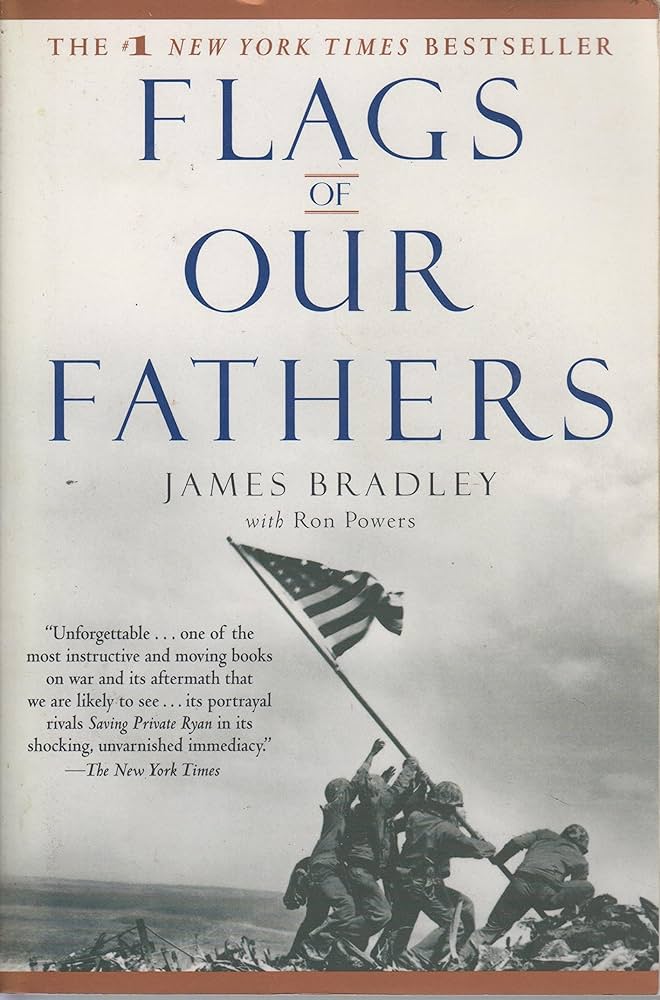
More Marines were killed in the first four days of the Battle of Iwo Jima than perished in Guadacanal over the course of five months, and the battle accounts for over a third of Marine casualties sustained in the entire Pacific War. The horror of those days cannot be readily imagined by anyone who was not there, and neither photos of Iwo then or now give a clear idea to the landscape of death that waited for the Marines who landed. James Bradley’s father was one of those men who landed and survived — a Navy corpsman, who had a part in the war’s most famous photograph, who nonetheless spoke nothing of the war to his family after his return. Flags of our Fathers is his son’s attempt to understand the journey that brought “Doc” Bradley and those five other men to Iwo, and the hell they endured there. It is eye-opening, both as an exposure of the ravages of the battle, and delving into the origin of the war’s most iconic image.

I was aware of the broad outlines of Iwo Jima — the island’s shape, its seizure ‘s strategic importance to a planned-for assault on the Japanese mainland, and to a smaller degree the death toll — but Bradley’s account draws on letters and interviews to confront the horror more directly. It’s not as graphic as a direct combatant memoir (With the Old Breed come to mind), but it’s sufficient to shock an unprepared reader. The book focuses on the men themselves, five Marines and one Navy corpsman. The most interesting me was Ira Hayes, the leftmost man in the photo who is reaching for the large flagpole but not quite reaching it: he was a Pima native from Arizona known for his reticence, and the first native American paratrooper. Tragically, although he survived the battle physically, he suffered enormously from mental and emotional trauma, and died early. Although I knew the flag in the famous photo was the second flag erected stop Mount Suribachi, I’d never read the story of the first, smaller flag. Incredibly, despite the bloodshed of the first four days, despite the fact that most of the island was still held by the Japanese, a small patrol was able to ascend the mountain and plant the flag without incident. Admittedly, they did preemptively chuck grenades into every cave or opening they encountered on the way up, but Marines who later encamped on top of the mountain could hear Japanese forces underneath them, committing suicide. They would later find hundreds of bodies. An officer requested that the first flag be replaced by a larger one so that everyone on the island could see that the high ground had been taken, and several photographers tagged along and captured not only The Photo, but video as well — and the video makes it clear how staggeringly lucky Rosenthal was to get that shot: it was a split-second fluke. If this was conveyed to the newspapermen, they didn’t pay the least attention — instead, creating a dramatic story in which American forces fought their way up the mountain, dodging Japanese grenades and raising the flag amid a storm of fire and banzai screams. The photograph was conveyed over radiophone to the States, where it immediately went the 1940s version of “viral” — making the top of the fold everywhere, and seized on immediately as an iconic of American heroism. The flagraisers who made it off the island (only half) were tapped as national heroes, to their bewilderment. It was seen as a moment of triumph even though mot of the island was still controlled by the Japanese, and that many, many deaths were yet to come…including three of the men in that photo.

Related:
With the Old Breed at Peleliu and Okinawa, Gene Sledge
Marine Combat Correspondent, Sam Stavisky
Goodbye, Darkness: A Memoir of the Pacific, William Manchester. Read this 20+ years ago in middle school, going to re-read it before the year’s end. I remember parts of the book and it’s unlike anything I’ve read since.

Posted in history, Reviews | Tagged , , , , , | 4 Comments

The Autobiography of Cap’n Kate

© 2021 Una McCormack, Audible presentation read by Kate Mulgrew
8 hrs 21 minutes

I haven’t read any of the Autobiography books that Star Trek has been putting out in recent years, but when I spotted that Kate Mulgrew did the Audible version of this, I had to give it a try. I consistently enjoyed her character on Voyager, especially when she was with Jeri Ryan or Robert Picardo, the show’s other acting standouts, and developed an affection for the character thanks in part to my high school obsession with Star Trek Voyager: Elite Force. She’s the only captain I have a pet nickname for, so take that as you will. The book’s first half covers Janeway’s life prior to taking command of Voyager, and the second half covers some of Voyager‘s more controversial moments from Janeway’s perspective — here she defends her decision to destroy the Caretaker’s array, for instance, and offers insight into how Voyager’s story progressed. She views the betrayal of Seska, for instance, as tragic but ultimately good, prompting the other Maquis to recoil in horror and rally around the flag of Janeway, Voyager, and even Starfleet. The Voyager bit is shallower than expected, though, given how much happened that should deeply shape the character. The whole “Janeway and Chakotay trapped together maybe forever on a planet and developing Feelings” thing? It’s over like a shot, as if it had no more significance than an unexpected airport layover, and no mention made of any emotions, subtext or otherwise, beyond her suspicion that Chakotay would have been perfectly happy to have remained stranded. Mulgrew’s voice and presentation go a long way to adding emotional heft that would not delivered by the text itself. I don’t know how the development of Janeway’s early life lines up with that which was developed in Mosaic, an early Voyager novel that featured Janeway’s past, but I enjoyed learning about Janeway’s early fascination with flight & the stars, and her being primed by a Starfleet family to want to seek a career in the service. There’s nothing beyond Endgame, so if you’re looking for the Janeway recounting of Nemesis, you’re out in the Badlands with no shields. My favorite thread in the book was Janeway’s close relationship with Admiral Paris, which leads to her meeting young Tom and eventually becoming her mentor’s son’s mentor. Her evolving relationship with Tuvok is also great interest, as when they initially meet he reprimands the young lieutenant for failing to observe proper security protocols. One thing that was jarring to me was that I had the impression from the show that Janeway wanted to be a scientist, and then later became interested in command — but here she’s gung ho for command from the very beginning, taking classes in it at the Academy, and the science department is merely where she begins. Personally, I enjoyed The Autobiography, but in large part because it meant listening to Kate Mulgrew for eight hours: I suspect I’d be panning this a bit had I merely gone from the text itself.

Posted in Reviews | Tagged , , , | 4 Comments

Fall TBR

Today’s Top Ten Tuesday is books on our autumn to-be-read lists. I’m going to mix mine up between challenge reads & just for run reads. But first, the Tuesday Tease!

One way to steal from people is to distract them from what you’re doing. A safer way is to bore them. Then they’ll distract themselves. Leave financial stuff to the experts. Leave it to your financial advisor, your asset manager. Leave it to BlackRock, Davos, the credentialed DEI and ESG experts; they’ve given one another certificates that they’re experts. But the acronyms you ignore eventually find their way into your life. You wake up one day and find yourself at the beck and call of strange ideas, and you don’t know where they came from or what they mean, only that you’re required to pretend you believe them with all your heart.

Capitalist Punishment: How Wall Street is Using Your Money to Create a Country You Didn’t Vote For. Vivek Ramaswamy

And now, books I intend to read this fall!

(1) Astounding: John W. Campbell, Isaac Asimov, Robert A. Heinlein, L. Ron Hubbard, and the Golden Age of Science Fiction. One of my Mount Doom reward books. Hoping October will see some SF.

(2) Will Storr vs. The Supernatural: One Man’s Search for the Truth About Ghosts, Will Storr. It’s somewhere within Mount Doom at this point.

(3) The Outlaw Ocean: Journeys Across the Last Untamed Frontier, Ian Urbina.

(4) The Shahnameh. Starting it, anyway.

(5) Grooming, Gossip, and the Evolution of Language, Robin Dunbar. If I don’t save it for next year’s science survey, anyway. Oh, and speaking of —

(6) and (7) The Moral Animal and The Sun in the Church, two science reads on Mount Doom. I’ve started reading The Moral Animal.

(8) and (9) Neuromancer, William Gibson and The Shockwave Rider, John Brunner. Two SF titles in my CC-II list.

(10) Live, From New York! An Uncensored History of Saturday Night Live, Tom Shales and John Andrew Miller.

Posted in General | Tagged , | 15 Comments

Living Memory

“What is it with you Enterprise guys? You always have to be at the center of everything, don’t you?”

When Starfleet begins analyzing a series of disruptive and potentially dangerous flares in space, Commander Pavel Chekov realizes there’s a pattern: these flares mostly in places visited by the Enterprise on its five-year mission, albiet in reverse order — and the one exception is a place visited by Uhura. As more flares happen, one in the middle of a city, a death toll begins and Starfleet fixes an accusatory gaze toward the former comms officer whose personal memories were erased by the NOMAD probe, who can recall nothing about her leaves from this time to contribute to the mystery or defend herself. But she’s not alone: the Enterprise crew, despite being on different ships and assignments, rally like the family they are. Admiral Kirk, meanwhile, has a bit of a problem, as a pilot program he endorsed to incorporate a group of young people bred for war into Starfleet (teaching them the ways of peace and Shakespeare-quoting) is causing some strife and a wee bit of murder — and worse, he and Bones are smitten with the same woman, a vocal opponent of the program. Oh, the drama.

Whenever I return to the original series, it tends to be for particular episodes — “Arena”, “Balance of Terror”, etc, and so I’d forgotten about the whole “Space probe tries to exterminate everyone on Enterprise” plot that also caused Uhura’s memories to be wiped…at least, until next week’s episode. Living Memory explains how Uhura bounced back so quickly, using one Federation member planet’s mind-structuring technology to restore her technical/explicit skills — but not her actual memories. Uhura and friends begin exploring Uhura’s past, talking to her family and friends from her Academy days to learn what project she might have been working on so devotedly, and this forces Uhura to face parts of her past she was previously willing to pretend didn’t exist. Although the Uhura A-plot is the novel’s strength and great attraction, the moral issues posed by the Warborne group were interesting, especially given that Bennett does not create simple antagonists or characters, but allows the argument to become truly complex and fascinating to the reader to consider.

Bennett is a Trek author who reliably delivers good reads, and this was another solid one. Motion Picture era books are relatively rare, so I was glad to dig into this one and see the Enterprise crew just as they were beginning careers apart from the salad days of their five-year mission.

Highlights:

“Some officers pride themselves on punctuality,” Kirk said. “You should try it sometime.”
“Ha, ha. If I have to be insulted, I’ll just go find Spock so I can get it from an expert.”

“Resisting temptation means nothing if the temptation is not present. The one time they were offered a justification, they took it.”
“After resisting it as long as they could.”
“True resistance does not yield.”

“I will not dignify that sophomoric insinuation with a reply.”
“Sophomoric is next year. I’m just freshmanic.” He shrugged. “And if I flunk my exams, I’ll be freshmanic-depressive.”

“We have believed ourselves to have no leads before. Further investigation has produced new ones.”
“Which have all gone nowhere.”
“That is not predictive of future outcomes.” She laughed. “You know, Doctor McCoy is wrong. Your logic can be very comforting at times.”

Sulu had smiled. “ ‘It is a capital mistake to theorize before one has data. Insensibly one begins to twist facts to suit theories, instead of theories to suit facts.’ ” He had shrugged at her stare. “Captain Spock likes to quote Sherlock Holmes.”

Let’s just say that spending time with Jim and Spock tends to get a fellow thrown in an inordinate number of prison cells. I guess some of that rubbed off on you too.”

McCoy reached over and touched her hand. “You want to believe in everyone. It’s a wonderful quality. But it means you’re bound to be disappointed sometimes.” After a moment, she pursed her lips and tilted her head.
“Well, I guess you’re right. For instance, I believed you’d be a better cook than this.” He feigned offense.
“My dear lady, I am a doctor, not a restaurateur.”

It proved what Surak had taught: No life was incidental. The death of a foot soldier or an innocent bystander could have consequences greater than the death of a king or a general, for all lives were interconnected in intricate and unpredictable ways.

Related:
Bennett’s annotations at his website Written Worlds

Posted in Reviews | Tagged , , , | Leave a comment

The High Country

© 2023 John Jackson Miller
384 pages

All Chris Pike wanted to do was take a gander at a strange planet from Enterprise’s new shuttle, Eratosthenes. But then the laws of physics went AWOL, and he’s woken up to find himself living in…eh, the Old West? Well, beats waking up partially melded into a tree or half-covered in lava that’s quickly cooling into rock like the rest of his team. The High Country is Strange New World’s debut novel, authored by the very capable John Jackson Miller, who delivered the excellent Enterprise-focused Enterprise War. It features a shuttle crew encountering a planet around which the laws of physics take a holiday crashing onto said planet, escaping via transporter but wildly seperated from one another. They find a world which is both familiar and alien — very much like the Old West, but going off script in certain….important ways. As in, there are aliens…..and no one finds that remarkable.

The High Country is an unusual Trek novel, separating our main characters from the tech that dominates so much of Trek. Captain Pike, Commander Una, Lieutenant Spock, and Cadet Uhura find themselves on a world where electronic technology doesn’t function at all, and even steam engines are regarded as suspect by the authorities. The Enterprise was compromised in its initial attempt to recover the crew, meaning Pike & co are on their own…though Starfleet ingenuity being what it is, the E is not merely a background player. Pike, Uhura, and Una — stranded from one another — discover different parts of the planet’s story as they try to get their bearings. There’s a strong tie-in to the Enterprise episode “North Star”, but the planet’s unique history creates an altogether different story, but I’ll not drift into spoiler territory. Suffice it to say that the stasis that prevails on this planet is not entirely natural. High Country has fine characterization: Miller captures the voices of Pike, Uhura and co quite well, to the strength of these characters we get a story of exploration — scientific, natural, cultural, political, in a world that constantly defies expectations. It’s a western! ….with aliens. But wait, there are also artifacts arranged in a geometric array that allow for crosscontinential communication, and…airships operated by….wizards?

It’s been over a year since I read any Trek lit, and was this a great way to return. Strange New Worlds has me absolutely obsessed, and John Jackson Miller is starting to become one of my favorite Trek authors despite the fact that he cheats on Trek with Star Wars. (See Kenobi, his…Star Wars western.) This proved a solid story, with interesting worldbuilding and a personal connection for Pike after one of the residents proves to be someone he knew in his youth, when she taught him to ride horses at a Luddite colony. I wish Spock had a steadier presence in the novel: he disappears for most of the novel after his intro chapter, and while he comes back strong in the last third, it’s definitely the Pike & Una show to begin with, with Uhura playing an increasingly important role until the climax. Spock, however, has no shortage of novels, so it’s a minor flaw. More importantly, Miller gives this a solid finish in the Star Trek spirit, as he did in The Enterprise War.

And to close, in keeping with the theme of Star Trek Western, here’s Sir Patrick Stewart singing cowboy classics.

Highlights:

“So they didn’t rematerialize.”
“Which I might conclude, if the transporter logs could be relied upon. As there is a chance that our own receiver failed before it could receive confirmation, from a mathematical perspective I would describe them as potential people.” That set off a buzz in the room.
“Schrödinger’s crew,” Erica Ortegas muttered.

“Is that all you have? The system failed, and you can’t explain why, so it’s out of your hands?”
“Yes.”
“That sounds like passing the buck.”
“If that expression means that I’m running away screaming from responsibility for this mess, then I plead guilty.” Hemmer shuddered. “When physics goes on strike, you might as well send me to my quarters with the day off.”

“People weren’t meant to mill in the winter. That’s why the brook freezes.” Garr looked to the ruins and spat in disgust. “There’s a hundred eighty days in a year, and you can’t expect them all to be the same. I wouldn’t want to live in a world where you had to do everything all the time.”

“Some lessons gotta be taught over and over.”

Spock’s arrival on Epheska, days earlier, had left something to be desired. Nearly drowning had little to recommend it.

“Is the tailgate another kind of gait?” Spock asked.
“I’ll ask you not to confuse my lieutenant,” Pike said. “He’s still working on ‘riding shotgun.’ ”

Posted in Reviews, science fiction | Tagged , , , | 5 Comments