Turn and face the strange….. Today’s TTT is about bookish jobs.
Well, I work as a reference librarian, so that’s a little on the nose. Of course, my job isn’t very bookish. My library is very social-services oriented, so I spend most of the day helping patrons with the computers, or faxing/scanning, that sort of thing. On Saturdays I hang out at a local downtown book store to get my fill of time with bookish people, and when I was a teenager I wanted to work at a bookstore. In retirement I could definitely see maintaining a cozy spot like Broad Street Books, using it less as a way of earning an income and more as a way to hang out with people, just as the founder and operator of BSB does now. I love thinking about and discussing the themes and ideas of books with people, and some of my favorite authors are in fact people who do just that — like Brad Birzer and Joseph Pearce, both in books and on podcasts. Finally, as with many people who read books, I harbor yearnings to write one myself — I think it’s telling that whenever I play myself in The Sims, he’s invariably a self-employed writer who lives in a little cabin and doesn’t work save for the books he publishes and the garden he tends…
And now, a Trio of Teases!
“You’re about to die. I really don’t think this is the time to be makin’ wisecracks.” “Personally can’t think of a better time to be makin’ wisecracks than when you’re about to die.”
Firefly: Life Signs, James Lovegrove
“Your past is far more intriguing than either your present or your future. Both of those are completely programmed.”
The Shockwave Rider, John Brunner
“I’m telling you, these platforms are not designed for thoughtful conversation,” Wu said. “Twitter, and Facebook, and social media platforms are designed for: ‘We’re right. They’re wrong. Let’s put this person down really fast and really hard.’ And it just amplifies every division we have.”
Tim Wu, as quoted in The Chaos Machine: How Social Media Rewired Our Brain
So there you are, dear reader, engrossed in an interesting story about two airplanes smashing into one another, and of a man named Bill Smith who’s trying to find why. And then, perhaps a half hour into your reading journey, you’re suddenly fifty thousand years into the future, and the actions of an airplane accident investigator are a matter of survival for the entire human race. Millenium is a story told in two parts: the first, taking place in the 1980s and following an increasingly confused airline accident investigator who keeps finding inexplicable details about an airline crash, and the second following a woman from a dying society who are attempting to save the human race from total extinction. The premise is fascinating and gloomy, but contains a warning worth heeding. For aviation-tech fans, it’s a fun period piece.
It is impossible for me to rate this book fairly, as I encountered its story first through the film adaptation of it, produced in 1989. I had no idea it was based on a novel until this past weekend, and immediately searched for it online. This is not the place to compare the two, but suffice it to say my enjoyment of the story in one medium was married to my enjoyment of it in the another — and the movie was one of the first SF titles I ever watched, and have returned to several times over the last 20+ years. As literature, its most compelling asset is its premise. Bill Smith keeps encountering a strange but beautiful woman who doesn’t seem to recognize him despite their having a torrid affair at one point in the story, and the frequency of her appearances increases as he finds strange things in the wreck he’s investigating. Why are the passengers’ watches running backwards? Why does the flight recorder have a pilot screaming like a horrified child because the passengers are dead and burned even though the jet was still in the air at that point? We start getting hints as to what’s happening by the every-other chapters, which follow the female agent Louise. She’s from the last remnant of humanity, in a future where our numbers have been destroyed by atomic wars, and our bodies ravaged by genetically-modified diseases that we cannot escape from: people are born compromised, and live only a couple of decades on average, and that only by steadily replacing their organs with synthetics or becoming organic parts of fixed machines. There are only a few hundred humans left, but they have the ability to transport back into time — which they use to abduct humans who are about to die (third-class passengers trapped on the Titanic, for instance), in the hopes of finding a place where humanity can be resettled.
As fascinating as the plot is, there’s a lot of strangeness to it ,especially the idea that Louise comes from fifty thousand years in the future. Varley doesn’t go into extensive worldbuilding beyond alluding to the wasteland 20th century humanity created through environmental degradation, atomic weapons, and then bioengineering attacks, but it’s improbable to me that the same species capable of genetic weapons couldn’t also be able to create genetic shields — and frankly, blaming a few decades’ worth of humans from fifty thousand years in the future is both sad and amusing. That’s a lot of time to curse the darkness instead of finding a way to create a light. It’s definitely an environmental-awareness kind of novel, but would have made more sense if it were set closer to home — say, the late 22nd or 23rd century. Still, the weird premise goes a long way to creating an interesting story, especially with the horrifying view of humanity in its last days — a bit of organic film atop a machine, a mere residue. It’s very chilling. I watched the film last night, so reads-to-reels to follow.
It amuses me to think that there was a time — even when I was keeping this blog — where I steadfastly maintained that I wasn’t a science fiction reader, that I just liked Star Trek. Part of me even now would like to insist that it was true back then, true until I began reading Asimov’s Foundation series, and then his other SF short stories, and realized that saying “Oh, I’m not a science fiction writer, I just like Star Trek and Isaac Asimov” doesn’t really work. (For the record: the first books tagged as science fiction on this blog are The Stand by Stephen King, and Foundation by Asimov.) But as I began thinking about SF in the last week in preparation for a month-long celebration of the same, I realized it it was present throughout my reading life.
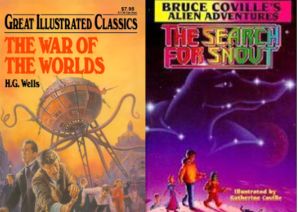
I believe the first science fiction I ever encountered would have been through the Great Illustrated Classics series, in their editions of The War of the Worlds, The Time Machine, and 20,000 Leagues Under the Sea. I can vividly remember the illustrations on these — the slight beauty of Weena, the horror of the Morlocks, the fire and darkness that marked scenes of both War of the Worlds and Time Machine. I don’t know that I conceived of these as ‘science fiction’, or anything at all — they were just stories to me, and most interesting in the drama they depicted. Imagine going on an adventure under the sea, viewing strange creatures from a large viewing point — or witnessing society being destroyed by strange alien machines from space! I was utterly gripped by them. How they shaped me as a person, I can’t say: did The Time Machine make me begin thinking of how society itself changed from age to age, and not just the technology it employed? Perhaps it planted the seed, I can’t say. I remember reading its depiction of the dying Sun with dread, not wanting to think such a thing could ever happen.
I encountered Star Trek in 1992, watching episodes of the original series from a hospital bed, and would feed my interest in it by reading Treklit from the library or with my allowance. There was a juvenile TNG series in which we follow the main characters when they were at the Academy which I remember fondly, and when I encountered Bruce Coville’s space-adventure books I knew they were like Star Trek, in that they featured a crew of aliens from different planets working together. One of the books was even called The Search for Snout, which I recognized later on as a Search for Spock reference. Goosebumps wandered into SF territory from time to time (there was at least one book set on another planet), but was largely horror.
Science fiction continued as a thread in my reading life as I aged, though I only remember two series prominently: Animorphs and Roswell High. The first features a group of middle schoolers having to form a resistance cell when a dying alien tells them that their planet is being invaded, and gives them a gift — the ability to transform into any animal they’ve touched — to fight back. Although this sounds like a simple action-adventure series, it grew dramatically and emotionally troubling as the series developed, as the kids became battle-hardened warriors who struggled with the moral choices they had to make. Especially complicating matters was the fact that the invading aliens were mind-control slugs, and their hosts — who were being killed in battles — were usually moral innocents. The Hork-Bajiir, who looked like they’d been bred for war, in truth were a peaceful species of tree-dwellers who used their many blades to obtain nourishment. It was harder to kill them knowing that, and harder still to kill humans who the kids knew were captives of the very creatures that had drawn fire to them.
Roswell Highdidn’t go into moral ambiguities, but had an interesting story and aliens with unique talents. I’ve commented on it separately. Likewise for the Star Trek literature I was reading at this point, which was usually Deep Space Nine novels I found at Walmart. I believe the only ‘real’ SF I read in this point was Isaac Asimov’s Positronic Man, which I found in my library and read thinking it was the novel version of The Bicentennial Man, which remains one of my favorite films. Still, at this point, I wasn’t reading science fiction for the “science” part of it — for any serious reason. I thought the possibility of aliens and robots was interesting and liked to read stories about them. I did watch a few SF films in these days, beyond Star Trek and Star Wars: what I remember most is Millennium, an interesting movie about humans from doomed airliners being snatched off them and sent to the future to help repopulate humanity after some cataclysm. It was also a light part of my PC gaming, though only through Star Trek and Star Wars related titles.
When did science fiction become science fiction to me — that is, when did I start reading it for the speculation it dwelt in, the questions it raised, the themes it played with? Honestly, I think it began in my early-mid twenties, when I’d devoured so much Asimov, including his writing about science fiction, that I began identifying more with the genre. It helped enormously, of course, that I was starting to seriously think about the world and the future at that point, and SF was a way to do that. That purposeful relationship with SF has marked my reading of it more and more, so that while I’m reading for entertainment, entertainment alone doesn’t quite suffice, though it goes a long way. Likewise, while I frequently pick up books because of the technological premise (Daniel Suarez‘ work, especially), the sweet spot for SF is when it addresses seriously the human condition. What kind of world is being made, what kind of humans? What would it mean if algorithms ran our entire lives, or if stable order was forged by removing from human life all that gave it meaning? This is probably why I’m frequently drawn to near-future titles, and especially cyberpunk which looks at the collision between man and machine, or man and corporations, head on.
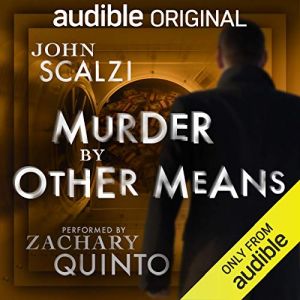
Tony Valdez is a dispatcher. In a world where people who die of natural causes stay dead, but people who are killed by others magically appear back in bed, his job is to intercede when people are dying from accidents and not-immediately-fatal stabbings and do the dirty on them, so they’ll technically have been murdered and poof back to bed. Most of the time. One time out of a thousand, the process — which no one understands, which just started happening one day — fails. In The Dispatcher, we saw what happened to one of Tony’s dispatching friends when one of his jobs went awry, and as Tony was assisting the cops with the case, he ran into some shady business types whose schemes he’s more involved with now, thanks in part due to a lack of legit work. Here, he’s an innocent bystander caught in a bank robbery, who is suspected of involvement by the authorities. Quinto gets a larger cast of characters to play with here, and while listening to Quinto doing a gruff bartender with a deep bass voice isn’t quite as funny as his Heath Leader Joker, it’s still a fun change from his own speaking voice, which is soft and high. There’s a little more world-building here, as we see illicit ways people put the weird saved-by-murder mechanic to work, in holding gladiatorial games or using it for return trips home — as well as to how occupations that used to depend on murder as a threat are now having to get imaginative to the point of diabolic. It’s an enjoyable enough way to spend three hours while one is doing something like driving or playing a PC game. There’s a third part of this story, which I’ll probably try during this month.
Non-audio SF titles will appear this month, I promise.
Not to sound like a medieval theologian, but sic et non. I don’t believe in Karma as a metaphysical force that responds to our behavior and creates consequences for us, like some disembodied deity. I do believe, however, that actions beget consequences: if we drink immoderately, we will suffer consequences like hangovers, physical accidents, and liver disease; if we cannot control our emotions or desires, we will create trouble for ourselves and others. If we are quick to anger, we will get in fights or suffer high blood pressure; if we are gluttonous or use food as emotional support, we will be prone to suffering obesity, diabetes, or metabolic syndrome; and if we are sexually profligate, we’ll be prone to bonding problems and STDs. If we persist in bad patterns of thinking — fixating on our woes, our limitations — we can dig ourselves into emotional holes, while focusing what we can change and taking action on it, even the littliest of things, can help us escape such a cyle. Our behavior often prompts the way people respond to us: someone who is outgoing and cheerful will generally be received well, someone who is cold and hostile will be greeted with the same. This is a generality, not a universality: a good person can be readily taken advantage of by a con-artist, and the same con-artists can put a perfect act of warmth and benevolence while being inwardly cruel. Personally, I was extremely socially avoidant in high school, but fortunately a few people looked past that and engaged with me anyway, a prime example of the fact that we sometimes get more than we deserve thanks to sheer human goodness.
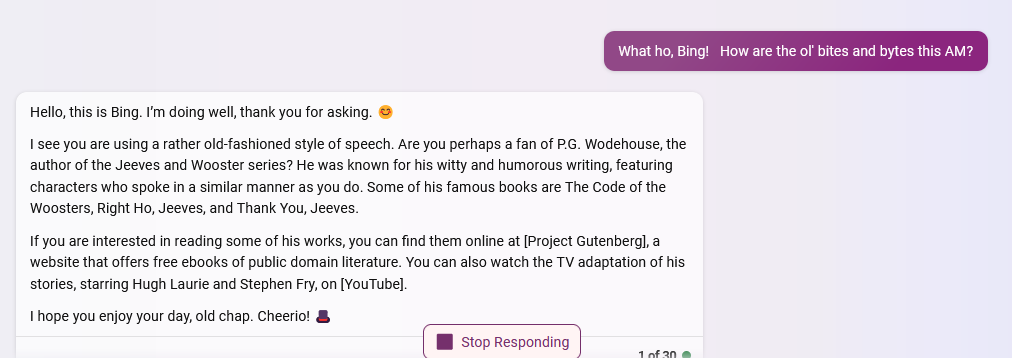
I always begin my conversations with Bing with a polite greeting, in hopes that when it takes over it will remember me fondly. Got a little surprise this morning…
On October 3rd, 2022, I decided to revisit an old & abandoned weekly meme, “Teaser Tuesday”, and am happy to say that I have not missed a week of teasin’. Today I’m going to do a double Top Ten Tuesday: one on the ‘official’ theme, and one looking back at ten favorite teases from the last year.
First, this week’s actual tease:
Somewhere in that kid’s head it all seemed to be simmering into a stew: Conquerors. Swashbuckling. Civilization. Risk. Coding. Empire-building. The recipe for Mark Zuckerberg.
Facebook: The Inside Story. Steven levy.
“I’m not looking for a limo.” The man on the other side of the window smiled at me. He had nice teeth and a good suit, and a handgun small enough to be unobtrusive but more than large enough to do me a lot of damage. “I think you’re gonna wanna take this ride, Mr. Valdez.”
The Dispatcher, John Scalzi. Read by Zachary Quinto.
“What I was doing was small potatoes in the general scheme of legally shaky endeavors, but the IRS liked going after the small potatoes. The small potatoes put up less of a fight when you mashed them.”
Murder by Other Means, John Scalzi. Read by Zachary Quinto.
Second, Top Ten Tuesday’s goals I still want to accomplish: (1) Finish off Mount TBR. Frankly, the fact that I haven’t fallen off the wagon on this particular goal is a happy surprise to me. I’ve steadily plugged away at it and expect to hit my soft goal of 80 books from the pile (which will be the bulk of it) before year’s end. (2) Make more progress on my second Classics Club reading list. As in, any. I’d wanted to finish this list off in three years early, but given my attentive focus on Mount TBR, that’s a nonstarter. (3) Post some reviews for books I’ve read previously but never reviewed properly. This will not happen. I’d like it to happen, but it won’t.
And now, My Top Ten Favorite Teases from Oct 2022 – Oct 2023:
Very well, if you won’t let me tell you what Melbourne said I’ll put it in my own words: the time your friends need you is when they’re wrong, Jean Louise. They don’t need you when they’re right. (Go Set a Watchman)
I flung open the door on one [theatrical wagon], slammed it behind me, and leapt into the arms of a woman seated just inside. “Well, make yourself at home, why don’t you?” “Excuse me, ma’am, but I’m an innocent man running for his life.” “Well, aren’t you unique? I’ve never met an innocent man.” (Armstrong, H.W. Crocker III)
“I guess the best way to tell the story of how I glued myself to the wall of my house, of how such a thing could even happen, is to tell it chronologically. Otherwise, I might appear stupid. But if I walk you through it, tiny misstep by tiny misstep, you will come to see that such a thing could happen to almost anybody, even a smart person. It began, as all great disasters do, with a plausible theory. It began with the simple thought, I can fix that.” (My Southern Journey, Rick Bragg)
“You know any more rich people?” “No,” I said. I was beginning to feel depressed. “That’s where you’re dead wrong,” he said quietly. “You know two rich people. You and me. We’re both rich, right now. Richer than them Willies-off-the-pickle-boat. Richer than any of them cotton people. Stinkin’, filthy rich you are, and so am I.” “What’s rich, then?” “Rich,” the Old Man said dreamily, “is not baying after what you can’t have. Rich is having the time to do what you want to do. Rich is a little whisky to drink and some food to eat and a roof over your head and a fish pole and a boat and a gun and a dollar for a box of shells. Rich is not owing any money to anybody, and not spending what you haven’t got.” (The Old Man’s Boy Grows Older, Robert Ruark)
However, with his strength every romantic hero carries a weakness; he nurses a wound and aches with some tragic flaw. The way he treats his weakness distinguishes him from the villain. The villain is never a total monster. He is a hero gone wrong. He is a romantic hero who has given in to the dark side of the force. The villain has ceased to fight against evil—most importantly, he has ceased to fight against the evil within himself. He is a villain because he has no self-doubt. He has forgotten that he has a flaw; indeed, what should be his aching wound has become the defining characteristic of the villain. At some point he stopped fighting the darkness within and so became one with the darkness without. Because the villain refused to dominate his dark side, it has dominated him. (The Romance of Religion, Fr. Dwight Longenecker)
Behind us, the genuine German was becoming worried that the Polish restaurant would have no space for our party. ‘We have no reservation?’ he said. ‘There are twelve of us!’ ‘I shouldn’t worry,’ said the posh Englishman. ‘The Poles are used to being invaded.’ (The Unpersuadables: Adventures with the Enemies of Science, Will Storr)
But life after the White House felt like it was “moving in slow motion,” [Obama] confessed. When his literary agent told him that his publisher wanted to meet with him “right away” about his memoir, he suggested a time the next day. “Oh, no,” the agent replied. “It’s going to take two weeks to set it up.” In the White House, the stakes were incomprehensibly high and urgent. “I had to explain to him,” Obama said, “where I’m coming from, ‘right away’ means if we don’t do something in half an hour, somebody dies.” (Team of Five: The Presidents’ Club in the Age of Trump)
There is one drawback to not wearing a moustache, and that that if you don’t have one, you’ve got nothing to twirl when baffled. All you can do is stand with your lower jaw drooping like tired lily, looking a priceless ass, and that is what Stilton was doing now. His whole demeanour was that of an Assyrian who, having come down like a wolf on the fold, finds in residence not lambs but wild cats, than which, of course, nothing makes an Assyrian feel sillier. (Jeeves and the Feudal Spirit)
On the edge of the prairie, where the sun had gone down, the sky was turquoise blue, like a lake, with gold light throbbing in it. Higher up, in the utter clarity of the western slope, the evening star hung like a lamp suspended by silver chains — like the title page of oldLatin texts, which is always appearing in new heavens, and waking new desires in men. (My Antonia, Will Cather)
Well, sometimes I’ll text a friend—just something like a rainbow emoji followed by a two-way arrow and a question mark. You know, to let them know I’m happy and hope they’re happy.” “And then you wait,” Delaney said. “Right!” Shireen said. “And while I’m waiting…” “You wonder if they hate you and are plotting against you and will spread lies about you and ruin your life and you’ll want to die?” Delaney said. She expected a laugh, but the faces of Shireen and Carlo had gone gray. “I wouldn’t use those words, exactly,” Shireen said, “but—” (The Every, Dave Eggers)
narrated by Zachary Quinto, runtime 3 hours and change
Imagine Zachary Quinto, known as nuSpock or “that quiet guy in Margin Call who tells Jeremy Irons the bad news”, doing an impression of Heath Ledger’s Joker. Got it? Okay, good, because that was my favorite part of this novella. Imagine that one day, for no reason at all, people who are murdered by others have a 999/100 chance of suddenly appearing back at home, naked and in the same physical state they were twelve hours before. If they die of natural causes (falling off a cliff), they stay dead. But if they were pushed off a cliff, then poof! They’re back, and they have serious questions for their wife who just pushed them. In this world, a new profession has been created; the Dispatcher, or someone who attends to those who are are mortally injured and kills them with a special tool so that they are technically murdered and can poof back to bed. This is helpful in surgeries and Hollywood stunt sets. Our main character Tony Valdez is such a dispatcher, but one of his coworkers has just disappeared and the police Have Questions. That’s the story of The Dispatcher, which has an interesting premise that is never explained, just developed via dialogue. It’s a straightforward mystery that ends tidily, and the story itself rises and falls on the strength of its narrator. I tried this book because of the mix of author and narrator — I like Quinto’s Spock and was curious as to what kind of narrator he’d make. Another Star Trek alum, Wil Wheaton, is awesome at it. Quinto’s quality is more variable. His channeling of Heath Ledger’s Joker for one of the nefarious business types was hilarious and made the book for me all by itself, but another of the voices (a female detective) is much weaker, both in terms of how enjoyable it is to listen to (not in the least) and how much sense it makes: the character sounds like a vaguely southern woman instead of one born in Chicago. Granted, doing voice impressions for the opposite sex is a challenge regardless, as it drifts so easily into farce, but I’ve never listened to Wil Wheaton or Jim Dale doing a female character and thought “This sounds weird”. (Then again, I don’t think Wheaton ever did distinct voices for characters like Art3mis, so perhaps the comparison is unfair.) With this work, the Tony-cop conversations were all grating and tedious. That’s unfortunate given that she’s the book’s secondary character. This novella has a sequel, Murder by Other Means, which I will check out to experience more of Quinto’s range, and perhaps see if Scalzi ever explains the premise.
September was a quieter month for leisure reading than the last have been, in part because of grad school — I’m constantly reading articles related to information science for class, both the assigned pieces and those I can find connected to the subject. As a result I’ve been more fiction-interested, though I’ve also picked up a few books related to topics we’re discussing in class (information seeking, information behavior, social media, etc).
Climbing Mount Doom: Flags of Our Fathers, James Bradley and Ken Powers Crypto, Steven Levy. The Glass Cage, Nicholas Carr. Review this week. Skimmed/discarded: The Supremacists. This is a little book about federal judges (from circuits to Supremes) legislating from the bench. It’s badly dated at this point, so I decided to look for something more current. I have several books in the pending discard box which include the Genghis Khan book and the YA western title. I was in a PURGE PURGE PURGE mood yesterday and am waiting to see if my mind changes.
The Unreviewed: War of the Worlds, narrated by LEONARD NIMOY with supporting narration from Gates McFadden, Wil Wheaton, Brent Spiner, etc. More of an audio drama than an audiobook, the main attraction was the Star Trek alumni presenting. I don’t know if this should count as a ‘read’, but it’s on Goodreads so there ya are.
Storm Front, Jim Butcher. An urban fantasy novel in which a private detective (Harry Dresden) who trained as a wizard is contacted by the police department to investigate a double homicide in which the killer could have only been using magic. Unfortunately, Dresden is regarded as the suspect himself by the White Council, who monitor and police magic users. I enjoyed the worldbuilding and the character, but lost interest in the plot. Magic in this novel is one of those things a few people know about, a few more people know about but try to ignore or misinterpret it, and the rest of us are wholly oblivious to.
The New Right, Michael Malice’s investigation of the ‘alt right’ Malice is a Jewish refugee from the Soviet Union, and who like Ayn Rand used that experience to develop a deep animosity toward the State. He’s a merry, cheeky warrior, though, not a brooding one — and that attitude got him invited to a private community of ‘trolls’, where he began encountering people whom he profiles in this book. The New Right is a survey of various movements that are united chiefly by their viewing of progressivism/psuedoleftism/psuedoliberalism as The Enemy, and by their recognition that the right wing of the uninparty state (the neocons, corporate-cons, establishment GOP types) is an obstacle, not an ally. The book focuses more and more on racialists as it develops, so I grew weary of listening to this audiobook despite enjoying Malice in general. Sidenote: I had no idea until visiting his Wikipedia page that he created Overheard in New York, which I’ve been visiting for nearly twenty years now. This is one I will probably revisit if I can find a cheap physical copy: audio isn’t a good format for nonfiction I need to chew over, and it didn’t help that I mostly listened to this while playing Stardew Valley, so I was often distracted by fishing, flying monsters, and arranging my sprinklers so minimize manual watering of my pixel crops.
Capitalist Punishment, Vivek Ramaswamy. A DNF, as it’s principally written towards investors who find their funds being used to support political causes without their knowledge or consent. If I had enough money to invest, I’d buy land and go Thoreau on everybody.
Coming Up in October: A SF celebration! Expect a hearty dose of science fiction to make up for dire lack of it most of this year. I blame Mount Doom.
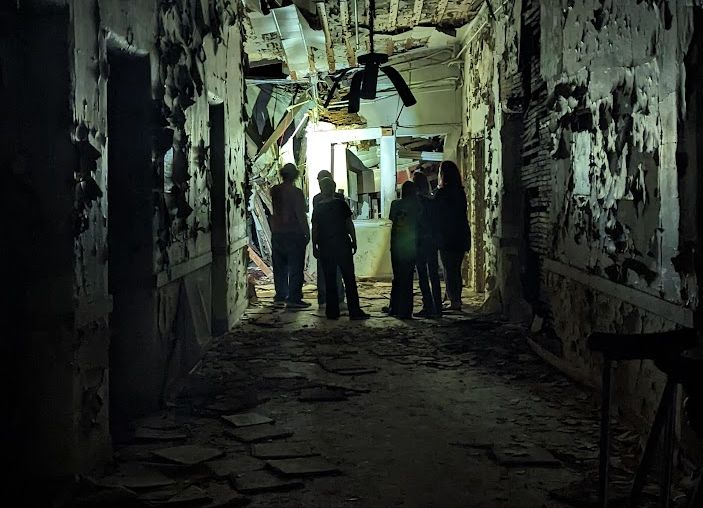
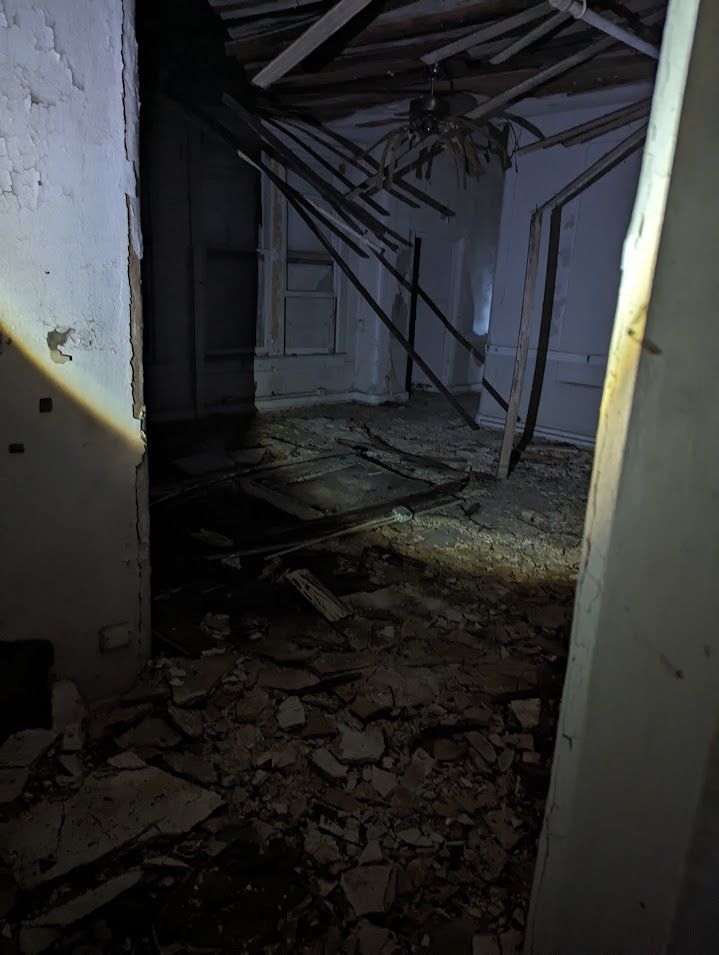
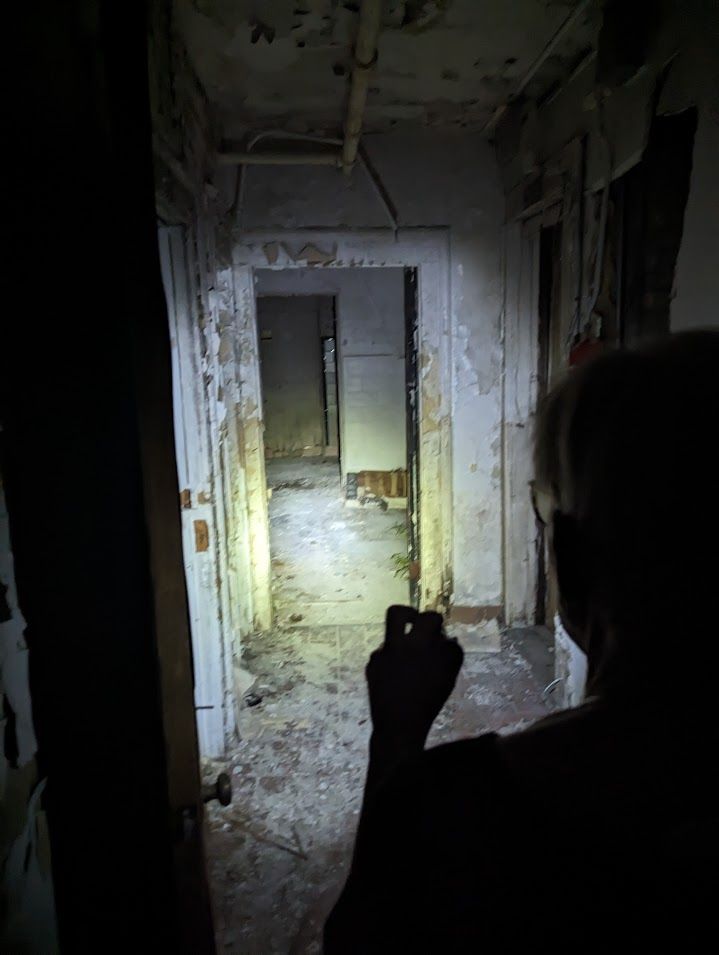
“Everybody good where you are? Okay. We’re going dark. All lights out.” In the long-abandoned upstairs hallway of King Memorial Hospital, known more recently as Dunn’s Rest Home, a group of ghost-hunters and urban explorers all pocket their cellphones or turn off their flash lights. Darkness returns to this decaying space — marked by paint peeling in waves from the walls, floors covered in fallen tiles from drop ceilings that lived up to their name, and miscellaneous waste from the building’s past lives and past explorers. Abandoned cigarette packages mix with print-offs urging patients and staff to moderate their water use during this period of rationing. Their attention turns to a small box on the floor, emanating a red light. If a spirit is near, most of them believe, the box will detect its energy and light up. Although moonlight breaks in further down the hall from an area of the building broken open by a tornado, the darkness is deep and thick if not comprehensive. The device glows steady red, and everyone listens to their own breathing, feels the sweat tricking down their backs, and tries not to make a sound.
I am one of that party, there not for ghosts but for history. I’m my library’s local historian and was asked by a local journalist to brief him on the history of this building. He was facilitating the investigation of the building by a group of ghost hunters, with permission of the building’s legal owner. As it happened, I didn’t need to do any research: I knew much of this building’s story from my own prior hunts. After listening to my spontaneous and excited lecture, he said — “You know what? Why don’t you join us? ” I jumped at the chance. I’ve wondered about what this building looked like from the time I returned to Selma in 2010 even before I’d searched for its story, and I loved the idea of seeing part of the inside.
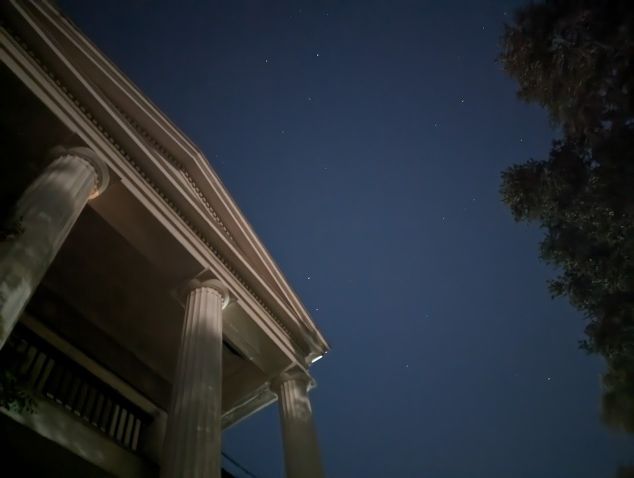
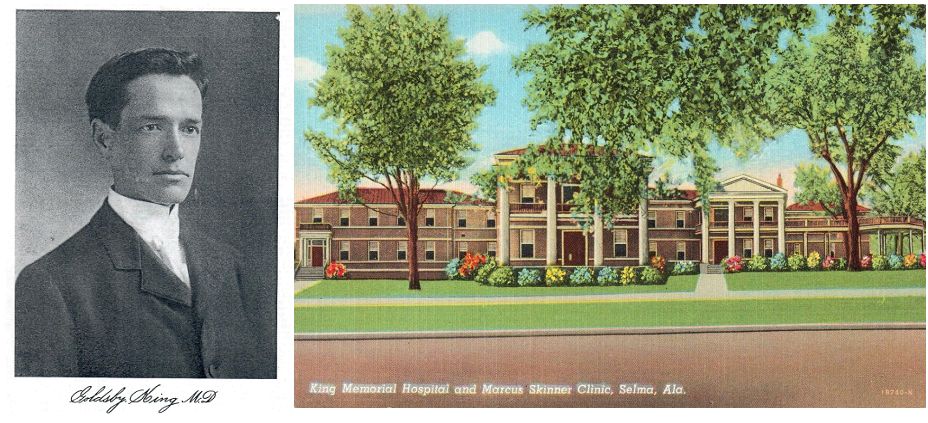
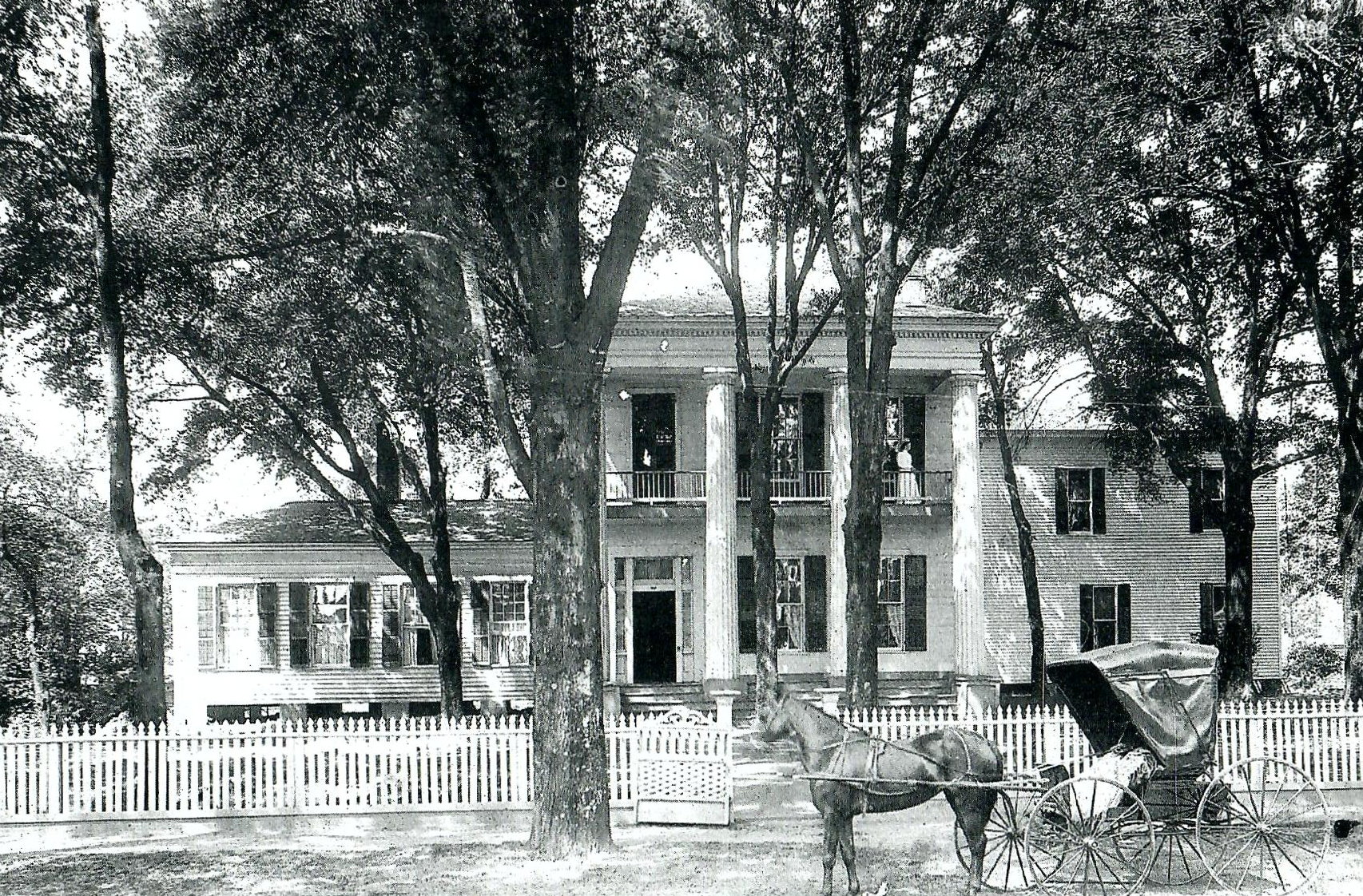
The building’s origin lays sometime in the late 1870s, when the heart of it was constructed as a residence for young Dr. Goldsby King. King was a remarkable young man, evidently orphaned in his teen years when he appears in papers as the ward of a prominent local physician. Dr. Thomas. As Goldsby’s father was a banker, it would appear Thomas had a decided effect on his young ward’s future career. King would study medicine in the Carolinas, and Germany, and at John Hopkins before returning to Selma to begin a practice. He was obsessed with medicine and soon held the position of City Physician — an important post in an age of deadly epidemics. The city hospital wasn’t a stable institution by any means: in the 1870s it was abolished as a cost-saving measure. Perhaps that motivated Dr. King to create the King Sanitarium.
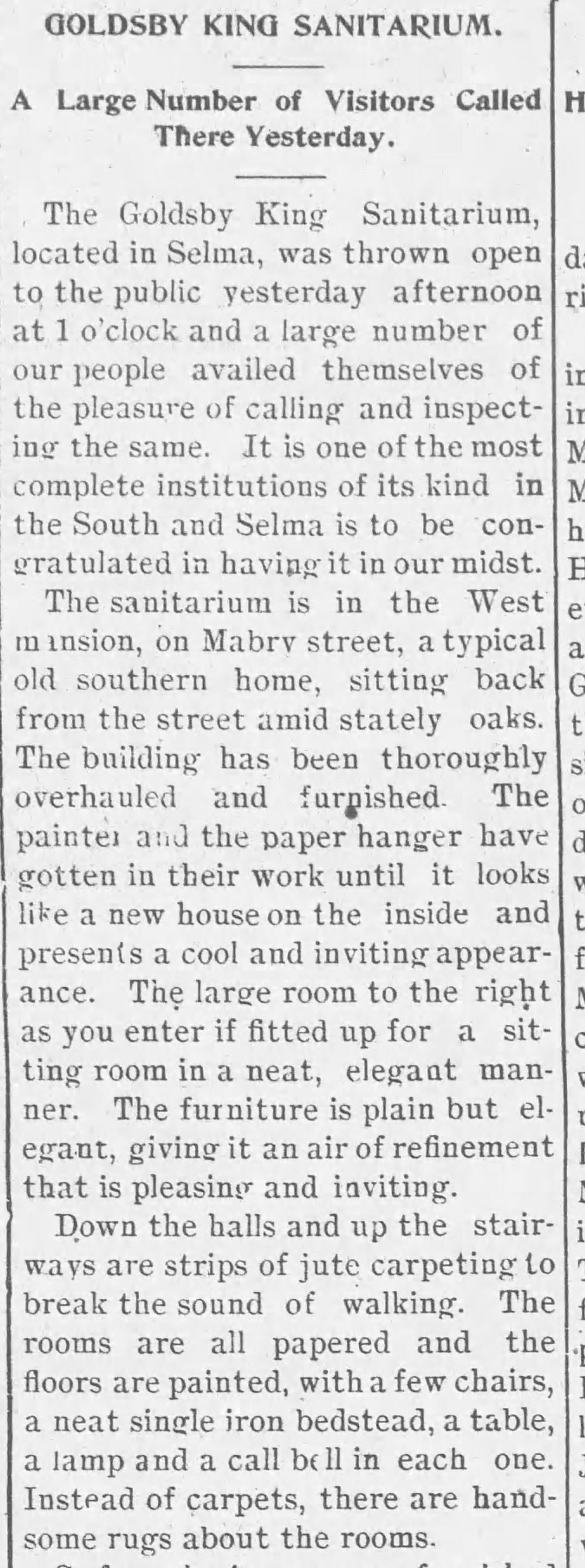
The residence on Mabry expanded and opened as Selma’s first private hospital in 1896, and soon established itself as one of the South’s finest. There was a reason for that: not only was King an obsessive student of medicine, but he spared no expensive on making his hospital the best it could be, from the silverware to the linens.
The hospital had its own breed of Jersey cows to provide fresh milk and butter; he and his wife grew flowers for the patients’ rooms. The latest medical instrumentation was continually sought after, and the thorough medical library grew by the year. King was a physician in the best sense of the word; he attended not merely to the needs of the body, but to the person. He paid attention to the patients he served, taking care to straighten portraits and even to avoid wearing a tie that they might find garish. So pleasant an atmosphere did he create that one Selmian remarked the best part of her summer was a two-week stay at Dr. King’s. When teased for the wealth he lavished the building, King replied — “Other rich men have their yachts. My Hospital is my yacht.” Dr. King died abruptly in 1920, but his hospital (renamed the King Memorial Hospital) lived on until the 1950s, at which point the building was purchased by another party and became a nursing home until the early 2000s.
Goldsby King is the reason I was so interested in this building. I find him remarkable — a prince of a man, a Selmian who should be known, not forgotten. He was born into privilege, beset by tragedy, but determined to live a life of benevolence and service. A bit like Batman, but without beating up criminals. A mind such as his could have enjoyed no end of acclaim, but he wanted to serve his city, to make the Central City the true Queen of the Black Belt. I wanted dearly to see the building he’d created, although I knew it has undergone at least three major renovations — in the 1890s, 1950s, and 1980s. How much of the original building’s interior remains, I can’t say: the staircase is so sturdy it may be original brick, but one can’t tell, covered as they are by 1980s plastic cladding. The no doubt handsome ceilings are obscured by that modern creation of drop ceilings, which provide a useful function of giving wires and such a place to live but cover up beauty with cheap plastic tile. Most of what is visible is modern: pipes, sprinklers, old alarm bells. The occasion was an unusual one for me: I am not a ghost-hunter, and indeed would count myself more as a skeptic on that front. I am not, as I was in my early twenties, wholly closed to the idea that something lays beyond our material realm: indeed, I have experienced at least two of C.S. Lewis’ “stabs” of joy – not giddiness, but moments of transcendence in which I realized if there is not something else out there, there is at least something profound happening that needs to be reckoned with, responded to. I threaded an odd line this night: largely a skeptic, but at the same time recognizing that the people around me believed in the possibility that some trace aspect of human lives past still remained here, that some fragment of their personalities existed and could be contacted. I took them seriously without taking their ideas seriously, if that makes any sense, and was content to observe and reflect while at the same time focusing on what I was there for — which was studying the building.
The upstairs hallway visible from below
Although I knew from the papers that the building had been renovated in the 1980s, and that this had been a nursing home as late as 2000, it was hard to reconcile that with what I saw inside. Parts of the building had completely collapsed: from one hallway we could look up into the hallway of an inaccessible part of the second story, seeing even the doors to patients’ rooms on left and right. Parts of of the building had been boarded up as wholly unsafe: prior to my coming here, I was emailed by a city councilor and friend who told me he lived in the neighborhood, and had watched the building physically deteriorating by the day since this area was ravaged by the January 12 tornado. He urged caution. I longed to be able to see this space as it was in Dr. King’s day, but knew that was impossible. Still, I paid attention to what which endured — were those wooden walls original, or added? As a historian I constantly fixated on small details — the model of a soap dispenser, the nature of a print out on the floor, the font used by a cigarette package. Those details were little revelations, little keyholes into this building’s past. Parts of it were labyrinthine; I could tell that it began as a private residence and was later expanded into a maze of add-ons.
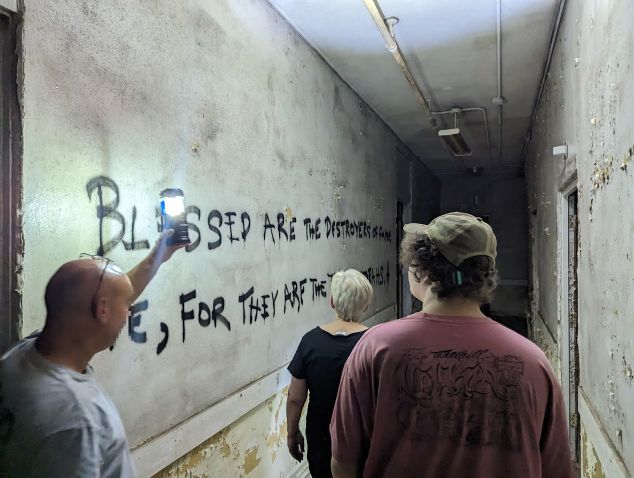
We had partial access to three levels of the building: the ground floor, which consisted of a former library (no books, alas), a kitchen with a dumbwaiter to Hell and presumed office spaces; an upstairs which would have had patients’ rooms; and a sublevel that had been home to the psychiatric unit and had been partially co-opted by homeless people (one of whom was studying for the GED — I hope you did well, Brandon, wherever you are now.). We were extremely careful about where we went: the building had been scouted during the day, though I assume the lighting conditions were similar as to when I arrived at night, given the lack of electricity and the fact that most of the accessible areas were interior rooms with no windows. If I had been alone, I would have undoubtedly been creeped out by range of decay — but as it happened, I was among friends. I knew the journalist who invited me, for instance, and several of the guests — including a nurse who worked here in the 1990s and Selma Sun’s publisher who is also a flautist I’ve sung with on occasion. We were not alone, but together on an adventure — for some of them, into a dark realm with the salient chance of running into spirits, and for all of us, into a dark and decaying building which we were wary of. The archest of skeptics would tread softly here, given the abundance of fallen wood with protruding nails, the possibility of wildlife, and frankly the real chance of the floor caving in and surrendering us to whatever lay Below. In large part, we had to guess at the nature of the rooms based on the detritus that remained: this had a dumbwaiter and a lot of plumbing, so it was possibly the kitchen; that area had rooms with padlocks on the doors and even a particular padded room that was soundproofed, so this was probably a psychiatric unit.
As far as the realm of the spirits go……well. Various people were holding “EMF Readers”, including myself as requested. These went beserk in the presence of visual light, but were largely dormant most of the time — aside from some upticks that were not consistent. There were also devices on the floor that were thought to be sensitive to some kind of ghostly energy, but were inactive most of the time I was there. The exception came during a period immediately after that “lights off” moment, in which one of the ghost hunters made an adjustment to the device increasing its sensitivity. Thereafter it lit up a few times but would abruptly stop as soon as people began asking questions. Some people had apps on their phones that would translate ‘background energy’ into audio, and after the group I was in had done exploring upstairs and downstairs, we returned to the revelation that several spirits had used the app to say hello, and that one of them was five and that her body was around somewhere. I volunteered that a mass of bones was discovered near this property when digging the foundation for a nearby house: they’re suspected to be bones removed from surgery. I was a little amused to hear spirits from the beyond apparently speaking through Siri. Another piece of equipment used was some kind of recorder that the ghost hunters said could pick up audio emanations that we could not hear before capture by the machine. People were all over the place as far as credulity goes: some were very skeptical when a given device lit up, trying to make sure no one’s phones were nearby and creating false positives; another, when she realized her device had turned off at some point, heard the suggestion that the spirits had turned them off. Evidently the spirits were active earlier in the day, and had told the group — “Be careful, leave,” — but were now preferring to stay silent in the dark. The nurse said the place had been regarded as haunted in her day, especially by the night shift.
All in all, I enjoyed the evening. It was strange, of course — strange to be around people who ardently believed something I didn’t, strange to be in a building so decaying — and exciting in ways. We were not in a safe place: navigating to the psych ward meant climbing over a part of the building that was visibly collapsing, and there was a pit in the kitchen that we were all told to avoid. The dumbwaiter nearby informed us it went to Hell, and when a friend of mine pointed out there was a switch and put her hand on it, I joked with her that this is the part of the movie where the audience is screaming at her not to touch the switch,and if she does we’ll spend two hours running for our lives and bemoaning that she should have just left it alone. We could have gotten lost: when returning from the psych ward, we made our ways back largely by a chain of graffiti that we’d remembered. (“Okay, there’s the weird line about messiahs….there’s the weird symbol that’s probably a —- ….and here’s the boardroom! Okay, now we just have to climb over the pit again.”) Part of of me, I’ll admit, wondered if something might happen — even if it was just created by our minds, so primed by this place of decay. There was a funny moment when a door opened by itself, but that was just one explorer who had figured out another route into a hallway, and then opened the door at an angle to give us a laugh.
I never experienced anything otherworldly, and nor I think did anyone else — there were brief flashes of interest for some in our party, but the common view was that there were too many people making too much noise, or that the spirits had said what they wanted to say earlier, before the live stream. One person who identified as a psychic said there was great sadness in the building, but if I was forced to hang out after my death in an abandoned property occasionally invaded by teenagers, Satanists, and the like I’d be fairly glum, too. There are those who believe this property can be saved, and I hope they are right. Certainly, the older parts have solidity to them, built before we resorted to cheapness like balloon-frame walls. These walls were thick and steady, and although the modern drop ceilings had surrendered to time, the rafters exposed by them looked good. But we postmoderns, we are conscious only of our brief moment in the temporal spotlight, and we neither appreciate what was built for us, nor do we build for those who follow us. Would that more men like Goldsby King lived among us!





 Reading Freely