Astounding

© 2018
544 pages

I don’t remember why I picked up “Foundation” back in 2008, but it would be the beginning of an obsession with Asimov that saw me reading collection after collection of his stories from the 1930s – 1960s, finding greater and greater interest in Asimov’s partially biographical forwards to each story that formed my understanding of modern SF’s beginnings — and for Asimov, the story always began with his reading pulp fiction stories from his father’s candy shop and working up the nerve to walk into the editor of Astounding Stories‘s office and submit his own first effort. Astounding takes readers into that office, being largely a biography of John W. Campbell, married to a partial history of the field of science fiction which he shaped. Although it sometimes meanders off course, through either tangents or gossip, the book as a whole is a fascinating look back at SF in its formative period as a popular product.

The early 20th century was marked by the arrival of mass man and the mass market, creating spectator sports, the penny press, and pulp fiction alike. Although early ‘science fiction’ tales were merely other pulp fiction tropes transposed into new settings, when aspiring physics researcher-turned-magazine editor John W. Campbell took over Astounding Stories, he brought with him a desire to be taken more seriously which formed his approach to choosing stories and cultivating authors who would establish science fiction as something distinct — a unique offering that would shine a light into the future. As such, he incorporated editorials and nonfiction content into the issues. Previous editors had begun moving in this direction, but Campbell was a forceful personality who actively fed his authors suggestions and served as a mentor to the youngest of them, like Isaac Asimov. Asimov’s “Nightfall” was the result of one of Campbell’s suggestion, and remains one of his best-known stories. More people were beginning to look at SF in this period, as modernity’s snowball effect was becoming noticeable among the public, who were seeing speculation in the wildest stories of the imagination become reality in mushroom clouds and rocket liftoffs. Nevala-Lee focuses on Campbell’s general editor role, but continually works in Campbell’s relationship to three of his most prominent authors (Asimov, Heinlein, and Hubbard), and addresses their work to varying degrees Hubbard is better known now as the creator of the bullyboy Scientology cult, and unfortunately given Campbell’s fascination with the ‘promise of Dianetics’, whole chapters are devoted to Hubbard while Asimov and Heinlein have to settle for running guest appearances. The ‘unfortunately’ is experience not just by readers of this biography, but by readers of Astounding back in the day, who were disappointed to see so many stories about ‘psionics’ dominating each issue, instead of the more hard-science offerings Campbell had been known for. Nevala-Lee frequently strays from his subject, frequently drifting into gossip: I have no interest in sex lives of Heinlein and Asimov, and these gratuitous details have no bearing on what the men wrote — a case could be made for Heinlein, I suppose, given that he explored sexual expression in some of his stories, but that’s not how the details are incorporated here. The interesting evolution of Heinlein from someone who voted for Eugene Debs into the author of Starship Troopers and The Moon is a Harsh Mistress is not explored, but written off as the influence of Heinlein’s wife Virginia, and Asimov’s serious thinking about science fiction — its stages of development, from idle Mars adventures to serious examinations of how technology would transform society — are similarly ignored, despite their relevance. We do, however, get informed that Asimov grew from an awkward lover into a charming dirtyish old man with a penchant for bottom-pinching. These have nothing to do with the subject and seem more a way for the author to score cheap shots against men who should have known better but are not around to defend themselves. Interestingly, though, despite harboring the prejudices of his day, Campbell was perfectly willing to publish female authors — something the author mentions but does not expand on.

I enjoyed Astounding for the most part, having almost no familiarity with Campbell at all, and not enough to mention re: Heinlein. I enjoyed getting to know them a little, and as someone who has read nearly a hundred works by Asimov, including his autobiographies, rubbing shoulders with him was a delight as always. I’m so used to think of him as the old man with flaring lambchops and a bolo tie that seeing him in photos and the text here as young and unsure of himself was a nice change of pace. I disliked the parts on Hubbard, dianetics, and Campbell’s psychic obsession enormously, but count that as my very healthy prejudice toward Hubbard’s cult. Readers going in should know that Campbell’s role in shaping science fiction is more the subject than science fiction himself.

Posted in history, Reviews, science fiction | Tagged , , , , , | 5 Comments

The Heinlein Interview

I am closing in on the end of Astounding, which bills itself as a history of golden-age SF, and so far the most interesting aspect of it was the largely-uncommented-on political history of Robert Heinlein. We meet him as an enthusiast of Eugene Debs, encounter him later as among the crowds cheering FDR’s train as it passed, and say goodbye to him as an archly libertarian cold-warrior. Of course, that latter description is interesting and conflicted in and of itself: the Cold War not only expanded the state, but completely destroyed opposition to the state’s power and ambition, turning the traditional check against it (non-interventionist conservatism) into the neocon movement that gave us the GOP until the late 2000s. I began fishing about for a Heinlein biography that might shed some light on the situation. While it’s not a biography — it’s a lengthy interview bookended with Schulman’s reviews of Heinlein’s books — it made for interesting reading, given both my interest in SF and in the school of thought that Heinlein and Schulman both described to, to varying degrees. (Schulman, it should be remembered, wrote Alongside Night, in which a countereconomic anarcho-capitalist society establishes itself underground as the state economy smothers itself with inflation and diktats.)

Schulman is himself an unusual figure, as he describes three authors as those he revers above all others, who continually vie for his soul: Ayn Rand, C.S. Lewis, and Robert Heinlein. I suspect Lewis would be astonished to be sorted in such company , but that’s the marvelous complexity of the human mind for you. (And who am I to judge, with my Russell Kirk and Rand volumes on the same shelf as Howard Zinn?) As the interview develops, we get a sense that Heinlein, while sure in his convictions, nevertheless loved conflicting views: he subscribed to magazines which made various competing arguments, and while he was a staunch advocate of individual privacy and free enterprise (“The justification of free enterprise is that it’s free.”), he nevertheless appears to view something like the state as inevitable because of the “bully boys”. If I understand this view correctly, it means that, given the tribal/gang-oriented nature of H. sapiens, there will always be groups establishing a territory and imposing order on it, whether that take the form of an urban street gang or a state that defuses most resistance to it by tokens of democratic participation. Heinlein offers to Schulman that the Earth is a tough neighborhood and that humans who have survived this long only got that way being tough themselves — mean, tough, and nasty. While he doesn’t believe that excuses people being jerks in everyday society, I suspect he’d take a very dim view to cities allowing gangs of hoodlums to raid stores with impunity, or the violently mental ill to take over entire city streets.

I can’t comment on the book reviews because I’ve read so little Heinlein; The Moon is a Harsh Mistress and Starship Troopers. Heinlein’s commitment to writing different stories, though, no novel like another, makes me want to dive more into his works.

Higlights:

Heinlein, through Dr. Samuel Russell in Have Space Suit—Will Travel, said, “There is no such thing as luck. There is only adequate or inadequate preparation to cope with a statistical universe.”

“We got this way—we got where we are—over the course of a long stretch of evolution, by being survivor types in a very tough jungle. And from all I’ve seen of the human race so far, they’re still that; mean, tough, and nasty. I do not mean that as a derogatory remark, either; I think that’s what it takes to survive. That doesn’t mean you have to be mean, tough, and nasty in your daily behavior. In other words I am not a pacifist, and I do not think the human animal is put together so he can be a pacifist and still survive.”

SCHULMAN: Wouldn’t you say—at least about anarchists—that this statement is irrelevant because anarchists don’t even want protection ‘from’ the state, they want protection against it?”
HEINLEIN: Now. Neil. You have in there an assumption contrary to fact. And that is that there is such a thing as anarchists which agree on any one thing. [Laughter] There are as many sorts of anarchism as there are anarchists and you sure as hell know it by now!

Incidentally, I’m delighted to have both magazines in the house as I frequently find something in each of them that disagrees with my own point of view. It does me no good to read something that agrees with my own point of view. I want to read something that disagrees with my own point of view, follow me? SCHULMAN: Okay. HEINLEIN: You can’t learn from a man who agrees with you.

SCHULMAN: This is a point Dr. [Murray] Rothbard makes frequently. He says we already have international anarchy; why not just decentralize down to the individual level? HEINLEIN: Because along comes the bully boys. And if the bully boys band together then the people who simply want to be left along have to band together.

HEINLEIN: [Isaac Asimov’s] stuff is always stimulating even when you don’t agree with it. Perhaps even most so when you disagree with it.

Posted in Reviews | Tagged , , , , , | 10 Comments

Moriarty, Consulting Criminal and Scroogled

Short rounds! One short story by Cory Doctorow and three short stories by Andy Weir.

The first, Scroogled, is a very short story, just hitting 20 pages. Written in the mid-2000s, when Google was beginning its transformation from Mew to Mewtwo (or from cool website to frightening tech giant), it depicts the consequences of Google pursuing a contract from the state to handle first customs, and then internal security more broadly. The main character, a former employee of Google, opens the tale running afoul of the new Department of Homeland Security because the ads his Google profile is receiving are alarming to the g-men — involving shrooms and rocketry. This is the result of a recent agreement forged between Google and the state, that in exchange for not having to constantly answer requests for core user data, Google is offering metadata (ad information, in this case) to them to browse freely. Anyone who has ever participated in NaNoWriMo is going to be in serious trouble. (Just check the ‘weird things you’ve had to Google‘ thread there.) The main character has a friend at Google who has created a tool to clean up profiles, but things don’t go to plan. The book is technically dated at this point, but the main issue is still — even more so — salient. In 2005, Google had access to its users’ search history and email: shortly after this was published it acquired YouTube, and given how much time people spend on that platform, it’s no doubt developed a very good notion of who someone is.For laughs or terror, check out your Google ad center and see what kind of person Google thinks you are. They don’t show nearly the detail they used to, but there are some basic demographic profiles they guess at users being in, with varying success. (Google thinks I’m married, for instance.) The story is driven by its premise, not its characters.

Andy Weir’s James Moriarty, Consulting Criminal, on the other hand, puts its titular character front and center. You’re there for him, although a book about a Sherlock-type detective who assists criminals would be interesting in its own right. I listened to this on Audiobook, and the narrator Graeme Malcolm excels both in general narration and in voicing Moriarty. (Devout Sherlockians may dispute this based on other Moriartys they’ve seen, but I only have Star Trek TNG‘s to go by.) I enjoyed three stories well enough, but they’re almost all discussion oriented, and the most saliently enjoyable aspect was the narration. Moriarty isn’t developed much as a character.

Posted in Reviews, science fiction | Tagged , , , , , , , | 1 Comment

Tis time for teasing tuesday

American eccentrics are great. They’re more sincere, unabashed and convinced in their madness than any other eccentrics in the world. And they say hilarious things like, ‘Rule number one is don’t freak out.’

They have two cars, two teenage sons, designer stools by their breakfast bar, ‘girl scout cookies’ arranged neatly on a plate and between twenty and thirty bodies buried in their front garden, according to legal depositions from local farmers who once worked the land.

Will Storr vs the Supernatural

Today’s TTT is books with weather events in the title or cover. I thought I wouldn’t come up with anything for this, but wowzers are there a lot of books with “storm” in them.

Historical Fiction:
Eagles in the Storm, Ben Kane. Second in his Roman series, following the aftermath of the Battle of the Teutoberg forest
Warriors of the Storm, Bernard Cornwell. Anglo-Saxon merrie-making, by which I mean scheming and stabbin
The Final Storm, Jeff Shaara. Disappointing Pacific War novel.
The Four Winds, Kristin Hannah. A novel of the Dust Bowl.

History
Isaac’s Storm, Erik Larsen. On early meterology and the Galveston hurricane
Eye of the Storm: Inside City Hall during Katrina
Hurricane Katrina through the Eyes of Storm Chasers
Storm of Steel, Ernst Junger. WW1 memoir & reflection
A Furious Sky: A Five Hundred Year History of American Hurricanes, Eric Jay Dolin
The Worst Hard Time, a history of the Dust Bowl

Science
18 Miles: The Epic Drama of our Atmosphere
The Weather Machine: How We See into the Future

Science Fiction
Children of the Storm, Kirsten Beyer. Voyager mixes it up with an alien species even the Borg took damage from

Regular Ol’ Fiction
Camino Winds, John Grisham. A murder-mystery in a hurricane’s aftermath

Posted in General | Tagged , | 8 Comments

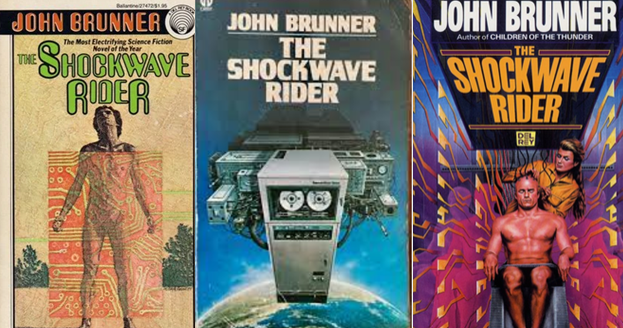
The Shockwave Rider

© 1975 John Brunner
288 pages

Nick Haflinger is a man of many names and identities, on the run from what passes for the government these days. With so much of the population constantly on the move, existing more in the plugged-in virtual realm than in reality — and with reality itself so flexible, people abandoning jobs and spouses and children in the blink of an eye when the whim strikes them — it’s hard to maintain order. Even so, Haflinger, a rebel, will find ways to attract trouble to him. No matter how many times he transforms his identity, his prodigious gifts at manipulating networks draw attention. Shockwave Rider is an exceptionally interesting novel, notable chiefly for its imagination: how, in 1975, did someone realize how radically disruptive networked computers would be to society? How did Brunner think up computer viruses, even coining the word ‘worm’ to refer to one?

The Shockwave Rider is a chaotic novel, frequently switching viewpoints and temporal frames even when its main character is not himself becoming different people. This is presumably deliberate, given that Brunner was writing inspired by the ideas of Future Shock and trying to convey a world even more in flux than our own: while we are on a runaway train called liquid modernity, the upset is worse in Brunner’s future dystopia, where a natural disaster has destroyed much of southern California, and entire populations are constantly on the move, chasing jobs or moving at whim. Society is severely unstable at every level: even families are not real units, since parents swap kids and spouses with as much thought as we do dishes at a restaurant — and readers are given the impression that most people deal with this through sedatives. The main character takes things even more seriously, frequently changing himself to escape the law or to gain access to networks that would otherwise be closed to him. Despite his technical talents, he encounters a young woman who sees through his psuedo-identities, into the man he really is. He’s disarmed by her, and their meeting will usher in a plot of tech-adventure and Nick’s finally taking a stand, instead of fleeing.

The Shockwave Rider is a difficult book to recommend — not because it’s bad, but because it’s somewhat esoteric. In its time, it was enormously far-seeing and experimental, and its artist’s vision makes it doubly interesting to those who take SF seriously, particularly the effects of the digital world on human civilization. Frankly. one reason I’m drawn to cyberpunk (and Shockwave Rider is the granddaddy of that genre) is because I believe whatever the perks, the disruptive energy of the digital revolution, coupled with human instincts that we have a marginal ability to control even under the best of circumstances, will ultimately lead us into nightmarish futures like that of Brave New World‘s — and BNW is arguably on the better end of human futures, since at least there most people are content. They are content because they have been severed from all that makes living real and worthwhile, but they’re not acutely miserable like the people we see in Shockwave Rider. This is definitely an ideas kind of book, and if you think seriously about the world we are creating for ourselves, about the effect the digital has on the real, you will enjoy it. If you’re going into it purely for a plot, though, you may be disappointed. There’s a plot there, but the delivery is rather disorienting — and that’s done pointedly, I think.

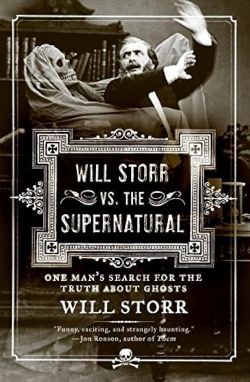
Coming up: I’m working on The Chaos Machine, and will be beginning The Neuromancer. Also reading Will Storr vs the Supernatural: One Man’s Search for the Truth about Ghosts. Storr’s Adventures with the Enemies of Science will be on my top ten list at the end of the year, I’m sure, and it’s an appropriate time of year to delve into a journalist’s hanging-around with ghost hunters.

Highlights:
“There’s a lot of brave new misery in our brave new world.”

“Take no thought for the morrow; that’s your privilege. But don’t complain
if when it gets here you’re off guard.”

“One might as well claim that the tide which rubs pebbles smooth on a
beach is doing the pebbles a service because being round is prettier than being
jagged. It’s of no concern to a pebble what shape it is. But it’s very important
to a person. And every surge of your tide is reducing the variety of shapes a
human being can adopt.”

“There was exactly one power base available to sustain the old style of government,”
Nick grunted. “Organized crime.”

Posted in Reviews, science fiction | Tagged , , | 6 Comments

FEED IT BOOKS AND MAKE IT GO AWAY

Posted in General | Tagged | 4 Comments

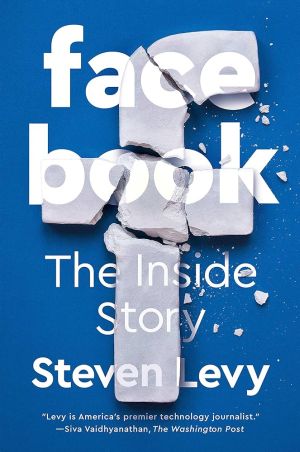
Facebook

© Steven Levy
592 pages

“Look at us,” my buddy chuckled. It was the halfway point of a 3-hour night class, and we’d been given a fifteen minute break to hydrate, caffeinate, and evacuate. Four people immediately flowed into the student common area and occupied the computers there, and all four of us were signing into facebook. It was 2007, and facebook was still in its innocent ascendancy, not yet a household world — but before long, I’d be installing browser extensions to cripple the website’s ability to track me online and regarding it as a necessary evil at best. Facebook’s growth from a Harvard-based social networking website into a global platform for consumerism, meme culture, political turmoil, shopping, etc is covered ably and soberly here by Steven Levy. Levy a veteran tech historian whose post at Wired gave him long exposure to both Mark Zuckerberg and his chief operating officer, Sheryl Sandburg, allowing him to ask questions of the Zuck that other reporters might have been shot down for. Here we witness an interesting project morph first into something with genuine commercial potential, and then into a global and pervasive digital power that is and continues to transform the world, offline and on, and Levy smartly weaves together technical, personal, business, and political threads for an altogether compelling and largely balanced story.

Despite its current importance, I can’t remember when I first heard of facebook: I know I couldn’t register for it, since my community college didn’t have student email back then, and potential users needed a .edu address. But who needed it? I had MySpace, with its blogs, customizable home pages, and ability to inflict music on anyone who visited your page. And yet a year and a half later, it wasn’t MySpace we college students were checking compulsively. Facebook was the latest creation of young Mark Zuckerberg, our contemporary, who grew up with a tech-friendly father and who was constantly creating software on his own time — including a program called Synapse, which used a person’s winamp playlists and playtime to guess what what songs a person wanted to listen to next. Another program allowed students to see which classes their friends were enrolled in, and gave Zuckerberg his first look into how hungry people were for information about their friends, leading him to another project that would become Facebook. The skewed version of events portrayed in The Social Network, based on the one-sided Accidental Billionaires, makes for a fun story, but is off the mark.

Levy covers facebook’s rapid expansion in the era of “move fast and break things”, as it was driven largely by engineering and the desire for growth, and dominated by a group of socially awkward young men captivated by what their new software toy could do and what it might become. Astonishingly, new hires were expected to commit code changes within their first few days at the website, a way of promoting new ideas. (One wonders how many newbie code changes were simply repairs to problems created by previous newbie code changes!) Fortunately for them and their bank accounts, as the company grew it brought in people with actual business experience — chiefly, Sheryl Sandberg, who became The Adult in the Room and gave facebook a less chaotic organizational atmosphere. The history of these years is something of a walk down memory lane for me, making me remember how the site used to be: I can remember the absolute contempt we had for the Newsfeed when it dropped, and the weird years when it seemed like facebook was trying to incorporate messy customization aspects of MySpace. Facebook’s approach was “Do this and see how it lands — if there’s an issue, we’ll remove it, maybe apologize, and throw something else out there”. A big example of this was Beacon, which allowed facebook to plant its flag all over the internet and made it possible for users to share their web activity with their friends — sometimes without meaning to, as when one man’s surprise engagement was ruined when his facebook profile announced that he’d just purchased a ring. His intended was dismayed that he’d bought it on sale. What is love if not going stupidly into debt for shiny rocks?

Facebook got better and better at optimizing the website to attract people’s eyes to it and keep them there, which was good for its ad-oriented business, but also worked towards its mission of ‘bringing people together’. As the 2010s passed middle age, though, the platform that was so great for selling things and bringing people together proved that it was also a great machine for selling….well, everything else, including politics and disinformation. Zuckerberg and co also realized that “bringing people together” can look like a mob burning things down or a conspiracy-theory echo chamber just as easily as it can be a kumbaya circle. In terms of content moderation, it often found itself in the same pickle as YouTube: there were so many people creating so much content at once that responding to everything was impossible, Europe’s demands that it remove offensive posts within 24 hours notwithstanding. There were the same gray areas: is quoting a celebrity saying something vile as bad as saying something vile? Does the historic significance of a nude child running away a burning village scrub away the fact that it’s a photo of a child? Facebook’s obsession with bringing everyone together meant the darker parts of internet culture, like the shock-trolls of 4chan and the like, were suddenly exposed to the innocent and unsavvy, leading to perfectly innocuous soccer moms falling for Qanon theories. Even as it tries to impose order despite its preference for free speech, facebook catches fire from both sides — from one, if it doesn’t do anything, and from another it’s viewed as impartial. It definitely grew more partisan during the coronamania period, but that’s not covered here.

Facebook: the Inside Story is a solid history of a significant period of the digital world’s life, one that doesn’t shy away from facebook’s mistakes and vulnerabilities but which acknowledges that the company is trying to rein in the Gollum of its own creation. A few more books in this vein are coming — The People vs Tech, The Chaos Machine, and antisocial media among `em.

Related:
If you don’t like facebook building an ad profile about you based on your web traffic, consider using the Facebook container extension for Mozilla Firefox, and the Disconnect extension for any browser.

Posted in history, Reviews | Tagged , , , , | 3 Comments

You weren’t born to pay bills and die

[Grandpa]’d say, “You weren’t born, to just pay bills and die”
You weren’t born to just pay bills and die
Alls you need is a dog, a shack, a crick in the back
And a good woman, oh Lord
You don’t need that rich man’s gold
Posted in General | Leave a comment

Long and Short reviews prompt: creative costumes!

Today’s blogging prompt was ‘most creative costume I’ve worn’, which…erm, should be easy. I’ve only ever gone to two Halloween parties. In one (2019) I dressed as Walter from The Big Lebowski. Tres interesting, since I had an excuse to quote The Big Lebowski all night. (“You want a toe? There are ways, man, you don’t even want to know. Believe me. I can get you a toe by three o’clock, with nail polish.”) Last year, I dressed as a monk. The Walter costume was both less ornate but more involved in creating: I had to get a bandanna, the shades, and a vest. (Oddly enough, I already had dog-tags: when visiting the USS Kidd one of the souveniers was customized tags.) My godsister who throws Halloween parties has moved to another city, though, so I don’t think I’ll be going to one this year. If I am, I’ll put one of my Bass Pro caps and a longneck (ice cold) beer and announce that I’m Luke Combs. (Or, reprise the monk but drop the cross and pretend I’m a Sith lord.)


“DUDE, THE CHINAMAN IS NOT THE ISSUE HERE — OVER THE LINE!!!!! —- THE CHINAMAN IS NOT THE ISSUE HERE! I’m talking about DRAWING A LINE IN THE SAND, DUDE, ACROSS THIS LINE YOU DO NOT — also, Dude, Chinaman is not the preferred nomenclature. Asian-American, please.”
Posted in General | Tagged | 7 Comments

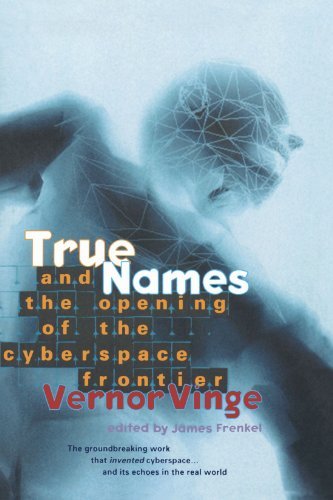
True Names and the Opening of the Cyberspace Frontier

Original story © 1981 Vernon Vinge
True Names collected into anthology with essays on cryptography 2001

How would you imagine the Internet in 1981? “What a silly question”, say you, “The Internet didn’t exist in 1981! ” Despite this, several authors in the seventies and eighties nonetheless imagined ‘cyberspace’, or as it’s known here, ‘the Other Plane’. Vernor Vinge imagines that other plane as a fantasy realm, in which hackers are warlocks, databases appear as lakes and swamps (literal data lakes!), and security protocols appear as forest sprites. Very little of True Names occurs in ‘meatspace’ (as we called it in the ’90s), instead taking place in a digital realm of mountains, dark forests, and castles built upon clouds of code. When it begins, our main character Mr. Slippery (his rather pedestrian nom de guerre) is picked up by the police in the real world, and ordered on pain of his True Name being leaked — being doxxed, in other words – to spy on his coven, his tightknit community of hackers. There’s trouble brewing: some arch-hacker known as the Mailman is expanding his reach into more and more networks, and is rumored to be behind a recent coup in South America. Could it be possible that digital potentates now have the ability to exercise — and hold — power in the real world? Slips, as he’s known to his friends, shares his predicament with his online BFF Ethyrina, and together the two use an old ARPAnet connection to begin investigating more broadly, risking the wrath of both the Mailman and the feds. Exciting and imaginative, I find it baffling I’ve never heard of this title before.

Twenty years later, to celebrate its anniversary, “True Names” appeared as the center of anthology of works celebrating its vision and persistence relevance. The world wide web had begun fully flowering then, even altering the economy as a dot com bubble appeared and popped, and it was beginning to change from the province of tech geeks into the all-pervasive infrastructure it is today. Most of the essays focus on theme of cryptography: as one of the obsessive concerns of True Names were the warlocks concealing their identities (and the plot turned on their discovering the identity of the Mailman, which — well, no spoilers, but Vinge was pushing into territory we’re still exploring today), so the resonance is understandable. The essays have instant appeal for me given their psuedo-datedness (I love watching videos from the 1990s about the Information Superhighway), but they’re not actually that dated: when Tim May wrote about the need for technological means to conduct anonymous commerce, I could only think of bitcoin and the variety of escrow services used on the dark net. May and authors are empathetic that true privacy, true crypto-tools, must not have a back door accessible by the government — not just to protect individuals from a nosy and aggressive state, but to protect individuals from government incompetence. Carve a back door into the wall, and no matter how strong the door is, the integrity and strength of the wall themselves are diminished. One essay printed in the physical collection is deliberately withheld from the ebook version by request of the author, Richard Stallman — whose “Right to Read” commented on how governments and corporations could use hardware and software to track reading and frustrate readers’ abilities to share, on pain of imprisonment and hefty fines.

I will be reading more of Mr. Vinge! Next up is either Facebook: the Inside Story or The Shockwave Rider.

Posted in Reviews, science fiction | Tagged | 11 Comments