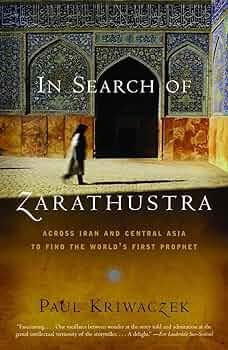
Today is the Feast of the Epiphany, in which Christians celebrate the arrival of the Magi to Bethlehem. It is fitting, then, on this day about wise men of the east following stars, to take a look at at a Persian whose own view of the heavens has influenced at least three major world religions. Zarathustra or (Hellenized, Zoroaster) is a name I’ve been bumping into for twenty years, in my efforts to understand the evolution of Judaism and Christianity; when I saw that the author of a history about Babylon had done on the famed ‘prophet’, I was eager to read it. I was expecting a history of what Zoroastrianism is and how it influenced other religions — particularly Judaism, Christianity, and Islam, with their shared vision of a Messiah at the end of history. It is, sort of, but not as organized or formal as all that: Kriwaczek instead mixes history, tourism, religious exploration, and literary analysis to follow not only the way Zoroastrian beliefs and praxis still exist under a Muslim or Eastern Orthodox skin in parts of eastern Europe and Central Asia, but how various religions and philosophies that drew from Zoroastrianism (Gnosticism and Manicheanism, especially) shaped history across Eurasia. As a study into the complexity of religions and cultures, it’s absolutely fascinating, seeing how much intermixing there is between cultures — and remixing, in the case of the Roman adoption of the Iranian Mithras cult. Kriwaczek suggests that Mithras was a figure in primitive Iranian mythology who, at the development of Zoroastrianism, was elevated to be a figurehead or liaison between the ‘good’ deity of Zoroastrianism, Ahura Mazda, and the people. Unfortunately, Kriwaczek does not assay Zoroastrianism itself: the lay reader will get the idea that it was archly dualistic, with a Good Deity and a Bad Deity fighting, and that light (and especially fire) and spirit were associated with the Good Deity while the Bad Deity was associated with darkness and things of the world. There is, however, no real detail on practices, theology, etc. What I was most curious about was Zoroastrianism’s potential effect on Judaism and Christianity, turning the quality-control inspector of Judaism[*] into the Archfiend, the antagonist of God who hates him and all his works — but that isn’t address beyond exploring various Christian heresies that took their inspiration from Zoroaster’s arch-dualism. Happily, Kriawczek does spend time dwelling on Apocalypticism, which is still part of Judaism, Christianity, and Islam today — though it is central to Christianity, of course, given that Christians believe Jesus to be the Messiah who heralds the End of Days and triumphs in the last epic battle between Good and Evil.
Although this is a bit scattershot, rather like his Babylon, I enjoyed it enormously, in part because the huge mosaic of humanity that encompasses, and the thread uniting such a variety of beliefs and practices.
Highlights:
For the Iranian world has had to suffer foreign conquest on all too many occasions: Alexander, Genghis, the armies of Islam, Tamerlaine, Babur. One after another they came, they saw, they conquered and they destroyed. Everywhere throughout the country, the ruins left by successive invasions still dot hillsides and valley floors: castles whose entire garrisons were put to the sword; townships abandoned and never resettled; walled villages of sun-dried brick, forever bereft of population and slowly crumbling back to the dust from which they were built. And each time Iranian civilisation and culture discovered a way of surviving, of rising again from the flames like a phoenix, of clothing its old ways in new clothes.
“My Iranian companion tried to bend the truth a little: ‘I am from the Ministry of Antiquities in Tehran,’ he said grandly, waving a grubby scrap of paper in front of the man’s nose. ‘Oh no you’re not,’ said the man with total conviction. My companion was rather taken aback. ‘Why do you say that?’ ‘No government official from Tehran ever got up so early in the morning.'”
[*] A Jewish website that I read 15+ years ago but cannot find now used the character of “Mr. Slugworth” from Willy Wonka and the Chocolate Factory as an illustration of Satan’s role in Judaism. In that movie, a man who identifies as Willy Wonka’s rival but who is in fact an employee of Wonka tests the children visiting the Chocolate Factory by bribing them, asking them to filch an Everlasting Gobstopper so his company can reproduce it. All but Charlie fail.
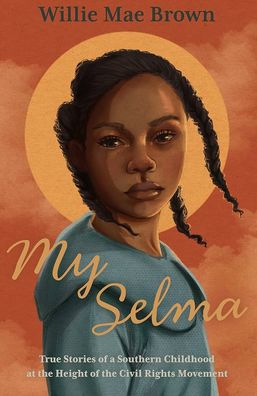
Willie Mae Brown was a child during the Civil Rights movement, which reached its high point in 1965, with the Selma to Montgomery march that resulted in the Civil Rights bill of 1965, with great assistance from the local sheriff and state troopers who gave the movement a media spectacle when it attacked the first march down Highway 80, resulting in “Bloody Sunday“. Willie Mae was not involved in the movement, being too young, but she offers here reminiscences of growing up in town during the sixties. I’ve read two other Selma memoirs during this time — one of young boy growing up in Selmont prior to the march, and of another who was an adult pharmacist working downtown. The opening chapter is a emotionally impactful and florid invocation of what growing up a young girl in the segregated south was like, complete with a description of the March 7 attack which she was absent at, and which veers into the realm of fancy, inventing dogs and robed Klansmen roaming the streets. (There were no dogs, the city authorities had as much tolerance for Klansmen as they did Yankees, and I’ve never heard or read of of Klan activity within Selma in this period or in the 1870s despite actively searching for it.) The memoir improves much as she moves to her own life, describing how her parents saved up enough money to move into a ‘white’ area of town: her father ‘Dah’ worked for the railroad and their family appears to have been relatively well to do, owning land and a rental property.
Since I knew she wasn’t involved in the movement, I read this principally for the same reason I read Ordinary Average Guy,about growing up in a trailer park in this same period: the little details of life in those days fascinate me and provide a richer view of the town that was than the politically-oriented histories. The most interesting stuff is the unexpected, like Brown recalling a neighbor woman skeeting a bit of breastmilk onto the floor before feeding a child to “calm the haint”. The majority of the book is simply these recollections of childhood, with drama between siblings and cousins happening concurrently with occasional glimpses of the casual inhumanity of the racial order — a time when the sheriff’s deputies were perfectly fine beating on the door in the middle of the night to effectively demand her father’s hunting dogs to enlist in a manhunt. Being a child who lives her life within Selma’s black community, Willie Mae is largely sheltered — but she does run into racial antagonism herself, when she begins working for a white woman who asks her for help bringing laundry into a laundromat, not thinking about the fact the laundromat owner is a hateful ass who has no compunction against hurling racial abuse at a child. The woman is embarrassed and shamed at her own naivete, and bawled out by Willie Mae’s mother as well. The timeline is a little questionable since the mood being invoked is always one of January – March 1965’s political activism and racial tension constant, with no clear idea as to when these things are happening. This is made worse to frequent mentions to “coloreds being killed”, which – well, has little connection to what was going on in Selma. The only black person killed in those months was Jimmie Lee Jackson, shot in Marion, another county over — though his death partially inspired the Selma march, so it is worth mentioning. The only man killed in Selma, in fact, was a white minister named James Reeb who was accosted and beaten, and then — oddly, very oddly – taken to Birmingham instead to Good Samaritan (the ‘black’ hospital) or the Baptist or Vaughan hospitals in Selma. (Even Montgomery would have been a better option than Birmingham, nearly two hours away!) Towards the end, young Willie Mae gets a glimpse of ‘Kang’, and sees the crowds gathering outside of Brown Chapel. Wrapping up, I’m not sure what to think of the book: it’s certainly well-written, prose wise, and I suppose if you were absolutely ignorant about racial relations in the 1960s it would be eye-opening. The book make depressingly clear to me how prejudice begets prejudice — Willie Mae and her contemporaries have the same contempt for poor white ‘crackers’ that the latter have for them, regardless of their actions — the only difference being these two communities of prejudice being that poor blacks weren’t in a position to participant in bullying. Power or no power, though, racism poisons the soul, and it’s sad to see this made manifest but not reflected on.
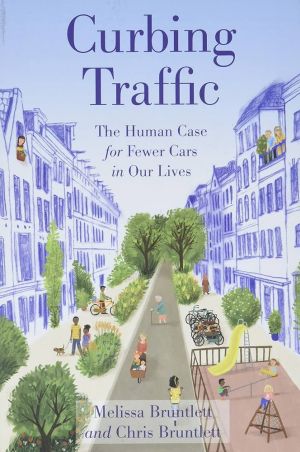
A few years ago, Chris and Melissa Bruntlett moved from Vancouver to Delft, and wrote a book (Building the Cycling City) on how Dutch city design not only facilitates, but encourages, cycling as a primary of transportation. Having explained how, Curbing Traffic delves into the why, combining critiques of what car-oriented design costs people and cities with personal experiences from living in Delft. Although flecked with some oddities, the book does a good job of collecting and distilling insights from different quarters into a overarching argument for restoring people and not machines to the masters of our city streets.
The book opens with a recollection of the Bruntletts’ move to the Netherlands, which they’d undertaken because while Vancouver had been fine for a young couple having fun, once children entered the picture they knew they wanted to raise them somewhere else, a place where kids could really flourish — a place they already admired. The Netherlands’ emphasis on people over cars is more than dedicated, sheltered bike lanes: there exists an entire organized approach to humane design, beginning with a hierarchy of different road/street types with different design principles, ranging from an auto-oriented outer ring road to interior ‘living streets’ that are effectively auto-free, save for those belonging to residents, and the street itself regarded primarily as an area for play and socialization. The Dutch incorporate different paving materials like cobblestones to communicate to drivers that they’re in a special zone, and even beyond these Delft’s streets make clear that people are king: instead of sidewalks abruptly ending at traffic sewers and forcing pedestrians to scamper across with beg buttons, street crossings are at the same level as the sidewalks and cars must slow to gently roll over them.
Why all this is done is the main subject of the book, and the Bruntletts explore the question via both studies and their personal experiences. A city in which the residents move about primarily via walking, cycling, or public transit is a healthier city — not only because physical activity is salutatory to brain and body alike, but because noise pollution and emissions have a grinding, noxious effect. Even longterm residents of cities who think they are ‘used’ to the city’s background noise experience deleterious effects, as their bodes respond with chronic high levels of stress hormones and elevated blood pressure. When cars are marginalized, everyone benefits — but especially the young and old. The Bruntletts moved to Delft so their children could be more free, but even they were surprised by how quickly their kids embraced their newfound independence: they were soon making their own schedules, meeting with friends, taking care of errands, and living life on two wheels without having to dominate mom and dad’s life as chauffeur. This is liberating not only for the kids, but for the parents, especially mothers who are invariably primary caregivers. The Bruntletts also spotlight how Dutch cities allow the elderly to maintain their independence as well, even if they become physically disabled and need to rely on scooters & wheelchairs. Environmental aspects are also covered, of course: not only the obvious matters subjects like emissions, but the material costs of cars versus say, bicycles, and the hazards created by cities covered in asphalt — particularly noxious rainwater runoff. They also dip into more obscure factors, like how auto orientation diminishes people’s connections to their fellow citizens and to the fabric of the city itself.Ultimately, this car-marginalized design allows people to be people — to be independent regardless of age or ability, to have easy access to a variety of goods and services regardless of where they are in the city, to mingle with their fellow man and enjoy the good life together.
There are some quirks, of course: the chapter on “The Feminist City” addresses the positive aspects of people-oriented design for women and refers to other cities as ‘patriarchal’, which…doesn’t make any sense: something can be hostile to women’s interest without favoring male interests. Frankly, irrelevant identity politics pops up here quite a bit, like the risible declaration that pedestrian accidents worldwide chiefly affect ‘people of color’. Well, if we’re using that stupidly contemptible expression to refer to people who aren’t ethnically European, and we consider the fact that most people are not, in fact, European, then the statement is meaningless. Despite this silliness, most of the book deals with facts rather than the talking points of the day, and does a nice job of corralling all the pertinent aspects. The big limitation of the book is its applicability to other cities, particularly those that have followed the postwar North American model. Transit and cycles don’t scale well to sprawl, meaning these lessons can only be integrated into existing cities with the right density, or (more easily but less preferably) into new developments.
Highlights:
The point of ‘resilience thinking’ is not to overhaul the entire system, but to introduce multiple stable regimes. Not to transform into something else, but to become more transformable, and find somewhere inbetween as a ‘new normal’.
Considering that I’m about to finish my first read for 2024, it’s high time for looking back on the past year and all that. At the close of 2023, I had three goals: to finish off Mount Doom, make solid progress on the Classics Club II, and focus on more ‘good news’. I didn’t completely level Doom, but I met my primary goal of reading or discarding 80 books . Classics Club work was tolerable, and I’m not sure about the ‘good news’. I did read a lot about baseball and did a presidential series that re-humanized presidents of the 20th century who I otherwise tend to reduce to their loathsome policy decisions, so that’s something.
So, big picture, how’s the year look? Physical books, after flagging ebooks for the last couple of years, bounded back to account for just half of my reading (50.25%) — no doubt helped by my year-long assault on Mount Doom, with added support from my Blast from the Past 90s kidlit spree. I suspect ebooks will mount a counter offensive next year. Nonfiction gave fiction its usual beating, with a 65/35 split. The year’s most interesting trend, I think, was the sudden eruption of audiobook titles: I’ve read the odd audiobook in years past, but this year they accounted for nearly ten percent of my reading! Now, what were some of my most-highlighted Kindle titles?
I am not happy that 20% of my reading was new purchases, but a lot of that was the Blast from the Past 1990s kidlit series, so it’s not terrible. I certainly made heavy use of my Kindle/Audible subscriptions, though I will probably discontinue both in the coming year. And now, the recap subject by subject, with this year’s top ten in bold.
History — well, you know the story. History never needs any help to dominate my reading, but received it anyway this year through a spring and summer baseball obsession, an autumn presidential fixation, and my recurring themes of Read of England and Space Camp. Favorites in this category were The Glory of their Times,which featured actual audio interviews from baseball’s golden age; Faces Along the Bar, a social history of workingmen’s saloons; The Lives They Saved, on the ‘boats’ of 9/11 and early responders on the ground; Amy Shira Teitel’s Breaking the Chains of Gravity, on space-oriented aviation and early rocketry before the Space Race started. Mike Collins’ Carrying the Fire is now the astronaut memoir mark to beat.
Politics and Civic Interest had a healthy year, mostly thanks to that presidential streak. I started off with Adventures with Ed, followed by a lot of presidential reading, and then shifting into effects of social media and big tech on politics — particularly mental health and polarization. The Chaos Machine lead the way there. On the presidents, I especially enjoyed Team of Five, The Residence, and First in Line — the first on how former presidents work together to assist their successors; the second, a look at the White House’s staff and what light they shed on executive families; and the last on vice presidents.
Historical fiction had a year that was OK by the numbers (just managed an average of one a month), but quite good in terms of quality. Not only did I continue and finish James Holland’s “Sharpe’s World War 2”-esque series featuring a West Country sniper named Jack Tanner, but I finally tried and was blown away by The Four Winds. I also revisited a couple of old favorites, David Liss and Simon Scarrow.
Science fiction didn’t even exist until the second half of the year, and as penance I devoted October’s reading to it, with a special focus on early computer-oriented and cyberpunk novels from the seventies and eighties. While Neuromancer and Shockwave Rider were unforgettable, my favorite from that month was True Names: it helps that it was a straightforward story without the structural quirks of both Gibson and Brunner’s work. My favorite for the year, though, would be Daniel Suarez’s Influx. No real surprise there: I’ve yet to read a Suarez title that didn’t rock my world.I also visited a few Star Trek titles, with Greg Cox’s Child of Two Worldsbeing a favorite: it’s set on Pike’s Enterprise, but has no SNW connection.
Moving on to General Fiction. While almost all of my fiction reading can usually be dumped into either historical or science fiction, this year I had a lot of variety and explored some new-to-me genres like western and urban fantasy. I also continued reading Sean Dietrich, a southern humorist whose speciality is books that are the equivalent of stick-to-the-ribs comfort food. Rhett C. Bruno’s “Black Badge” books were unexpectedly absorbing, combining a western with supernatural elements. I found them because the Audible narrator, Roger Clark, is the voice and physical model for Arthur Morgan in RDR2. A Man Called Ove by Fredrick Backman was a favorite.
Religion and Philosophy definitely had an off year, despite my reading The Jewish Annotated New Testament for most of it. Outside of that, I enjoyed Paul Among the People,which introduced me to Sarah Ruden, and made it plain that Paul considered in his time was far more humane than modern Christians (who see him through a glass, darkly) appreciate.
In the area of Society and Culture, I introduced myself to Jon Ronson via his Adventures with Extremists, and delighted in a book I discovered via substack, Feminism against Progress
Technology and Society got a little love this year with some help from my going back to grad school: there’s a lot of overlap here with other categories, but both The People vs Tech and The Chaos Machine are worth mentioning.
So, what’s next in 2024? I have a few ideas brewing now that Mount Doom is no longer the forbidding presence it once was, but January will be a set-aside “fun month”. After that I’ll move into more structure: in addition to my standing challenges of the Classics Club, Science Survey, and Reading Dixie, I’m also hoping to check out parts of Europe that I usually miss (Iberia and eastern Europe, specifically), and revisiting southeast Asia. “A World of Cities” , which I was thinking about as a theme for 2022, will almost certainly be realized this year, as now I have access to oodles of urbanism-related books.
Today’s treble-T is top ten reads of 2023. But first, these important messages from Teaser Tuesday:
“Your order, sir?” “What?” I looked up and remembered where I was. “Sorry. I was watching two people break into my home.” “So….a dozen assorted donuts to go?”
“You ACTUALLY called it a MacGuffin?” “It is what it is.” “Except it’s not an imaginary plot device! It’s a REAL THING!”
Travel by Bullet, John Scalzi
Even with high expectations, the first few weeks were nothing short of a revelation for our family; each day discovering the immense joys of living in a city that treated cars as guests, rather than guests of honor. Suddenly, we found ourselves living in an environment where we could hear again. Having been accustomed to the prevalence of engines, we had forgotten the sounds that give life to a city: people talking, birds singing, bells ringing, and music playing.
Curbing Traffic: The Human Case for Fewer Cars in our Lives, Chris and Melissa Bruntlett
I’ve never been one for chasing the latest and greatest games and platforms, preferring instead to find games that I can spend a lot of time with. Case in point: I played The Sims 2 from 2004 to 2018 (when a sale finally convinced me to give The Sims 4 a shot), and still boot up the original Mafia (2002) at least once a week, usually so I can play 1930s cabbie while listening to a podcast. For the last few years, my mainstays have been The Sims 4 and Red Dead Redemption II. The Sims 4 is more of a “give hands something to do while listening to podcasts”, though I do share ‘stories’ at The Sims forum. These two games largely maintained their lock on my time, aside from occasional diversions like an October play-through of Red Dead Redemption: Undead Nightmare and a December visit to Mafia II, which I enjoy doing during that season because it opens in a wintry version of New York with Bing Crosby singing Christmas songs. I experimented with a few newer games: I played the demo of Old World and picked up Humankind when it was dirt-cheap, but despite my interests in them, at the end of the day they’re more mentally involved than I want when I’m in a gaming mood. It’s the same reason I have yet to finish a game of Civilization VI: it’s narrated by Sean Bean, it looks gorgeous, but there’s too many numbers. When I’m in a gaming mood, I want to relax — doing things like fishing for cartoon bass, running around the Skeld trying to do chores and not to get murdered by a shapeshifting alien, or getting into drunken punchups. I did get passionate about one new-to-me game, though: Stardew Valley.
It was probably CallMeKevin who whetted my interest in this game, though I was already primed by being a fan of Farming Simulator 2019 and the nostalgia-inducing graphics. I began playing this in July, and — I’m sorry, I need to check my crab pots, and it’s Abigail’s birthday so I need to go give her a pumpkin, and — aw, man, I forgot about the cranberry patch I have on the other side of the property, I’d better go harvest those first. Oh, look, blackberries! And more blackberries! And more blackberries! ……what I was I doing again? SDV is easily one of the top five most addictive games I’ve ever tried. It hits multiple sweet spots for me — the art, the lovely music, the cozy village life, and the elaborate farming system. There’s also the variety of activity, from fishing to exploring dungeons full of dangerous creatures (the Skull Caverns are aptly named) and rich minerals. It’s frankly amazing that a game created by one person — art, scripting, music — can be this good, but it is, and has a huge player community nearly ten years after release. It’s reasonably good to listen to podcasts with, especially when I’m doing something like fishing or watering. Amusingly, Sims 4 has been incorporating more farming and crafting elements in deference to the popularity of games like SDV and Animal Crossing, and I’ve been muddling the two myself, plopping down SDV villagers from the gallery as townies in my Sims 4 saves, and listening to the SDV soundtrack while playing the game.
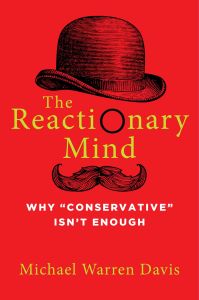
I’ve written The Reactionary Mind assuming that only men will read it. Most women have more sense than to pick up a book with a picture of a bowler hat and a monocle on the cover.
Arise, you consumers, from your slumber – arise, ye impoverished of purpose! Michael Penn Warren here picks up his pen in defense of medieval civilization, self-reliance, Luddism, and letter-writing. He bids the reader smash his cellphone and turn again to creating and producing, rather than consuming – to minding one’s own business and one’s garden. It is a fascinating, mirthful book that frequently provoked me to arguing with it, but always pulled me in further.
If Warren’s is a reactionary mind, what is it reacting against? Not much, just the last five hundred years or so of western history. He opens the book by inviting us to consider the medieval era, but without Victorian arrogance – to see its virtues as well as its limitations. Consider, he says, that people spent their lives outside working in the open air, mastering an array of challenging but often satisfying skills. People were tightly bound to one another and their places: their lives centered around a village church that sees them born, wed, and returned to eternity. Above the sea of clean air was the grand gallery of the Milky Way, with nary a light to spoil the view. Is that view highly romanticized? Yes, admits Warren, but so is our notion of progress: human nature remains as it was, but modern work is a drudge that many despise, we spend the majority of our days away from those we love, our homes are nothing but boxes to store the stuff we’ve bought trading our lives away, our minds are constantly bombarded with ads and notifications and never allowed to rest or focus – and our doctors’ bills and suicide rates testify to the degree to which modernity has impoverished us. The serf had little and was grateful for it: we live amid such abundance that we undermine ourselves body and soul, living in ungratefulness and addling our minds and often destroying our bodies with easy pleasures. The essential difference between the medieval world and our own is that the medieval serf and all those above him on the feudal hierarchy lived a life in scale with human needs, and saturated with a faith that taught temperance to the powerful and grace to the suffering. Warren writes in defense of the medieval not to argue for the restoration of feudalism, but to point that that there was Something pre-industrial life had which we do not possess, Something we have let go of and misplaced in our grasping after Mammon.
The second part of Warren’s book, elaborating on Why Conservatism Isn’t Enough, bids the reader to realize our problems cannot be solved politically, because the core problems are not political. They have more to do with the way we see the world, and the way we act personally build society based on that view – and the universal view of industrial nations is that we exist to produce and consume, to get and spend. For the last few decades, for instance, Warren writes that parties alleging to be conservative have embraced and endorsed the forces corroding what’s left of our social fabric: materialism, consumerism, the idolization of the Individual past any limit of reason. The medieval Christian viewed himself as a creature made in the image of God, and his life was centered on his role as a worshiping co-creator, tending the garden and raising a family. If we are to find lasting satisfaction and meaning, if we are to avoid laying waste to all our powers, Warren bids us re-orient our lives. We must rebel against modernity – not by raising an army and leveling the factories and data centers, but by refusing to become creatures in modernity’s image. Secede from “shallow, rotten, bourgeois culture”, he urges – and help create a sane, humane counterculture. On the individual level, Warren urges readers to drop out of the frantic meaningless of life, adopting techno-minimalism and practicing patient arts like letter-writing, pipe-smoking, and especially gardening – the latter crucially important. Gardening is not only a way to become more self-reliant, Warren writes, but keeps us in connection with creation. Readers who are familiar with Wendell Berry, GK Chesterton, Wilhelm Ropke, or E.F. Schumacher will spot their influences in Warren’s arguments and in his vision for a more humane society. Frankly, this section could have used more expansion.
The Reactionary Mind is not a book for everyone, admittedly. There are many who are perfectly comfortable in the 21st century’s status quo, and Warren does not offer comfort. He tells the reader directly that they’re being called to a more demanding way of living. Cooking for oneself takes more time and attention than picking up a packaged salad in Walmart; a letter requires more attentiveness and physical discipline than a text. But, that demanding way of life brings its rewards, as does taking on responsibilities: there is meaning and joy to be found in being a ‘hero in the strife’.
Related: “Common Man“, Michael Warren Davis’ substack. Davis also appeared on Pints with Aquinas, talking for two hours on his involvement with the occult and his narrow escape from it. Very emotional interview, and informative as he comments the varieties of Satanism. Crunchy Cons, Rob Dreher. On conservatives who are more like Joel Salatin and Wendell Berry and less like the GOP. Alan Harrelson is a character. He’s a professor of southern folk music who talks like a Pentecostal preacher, who recently converted to the Catholic church and has a channel where he smokes a pipe (he has a pipe room) and talks about things.
I finished this year’s science survey early in the year — very early, in May — and ended up with 18 titles in total, which was below the 20 I’d hoped for. Taking a look at “Predicting….Science Survey 2023“, I see I used 7 of the titles I’d anticipated using, which is better than my usual average.
2023 was a big year in movies for me, partially because of losing the Harmony Club: I still hang out with one of the guys, but since we’re in a private apartment instead of a bar/clubhouse open to random dropbys and tourists, now we do movie nights. I watched 67 movies in 2023, of varying quality and origin. In chronological order, with favorites in bold, with my immediate reaction/summaries following:
Dazed and Confused. A tribute to the seventies, following the day of high school and a party thereof. Great music. Matthew McConaughay.
Hairspray, a 2nd John Waters film that I was lured into watching on the promise that I’d like the music. Yes, yes I did. The movie itself was quite interesting, being inspired by The Buddy Deane Show, a 1950s teenage dance thing.
The Girl Can’t Help It. My introduction to Jayne Mansfield, who plays the girlfriend of an aging mobster who wants to get married, but since he can’t marry just anyone, he wants to make her a successful movie star so his other mob buddies don’t rib him for marrying beneath him.
Five Easy Pieces. An odd movie following Jack Nicholson, who appears to be an oil rigger but who is actually a child of privilege.
Falling Down, 1993. Kirk Douglas plays a frustrated man who slips over the edge and tries to get ‘home’ to his ex-wife and child, taking out his frustrations with modernity along the way. Instant favorite, and one to rewatch.
Saturday Night Fever. If there was a plot, I didn’t pay attention to it. Lots of entertaining dancing and music, and that’s what I signed on for. I fell asleep toward the end.
The Long Trailer, Rickie and Lucy buy a house-trailer and try to drive across the mountains. Drama and hilarity ensue.
Clerks II. Randall and Dante are working at Mooby’s (a restaurant chain belonging to a Disneyesque megacorporation whose boardmembers two errant angels assassinated in Dogma), Jay and Silent Bob are doing their thing outside (selling unlicensed natural pharmaceuticals), and Dante is on the verge of getting married and getting a real job. But then, Rosario Dawson dances to the Jackson 5’s ‘ABC” and things go awry.
Clerks III. Can’t say much without spoiling Clerks II, but suffice it to say Randall has a heart attack and realizes he should really be doing something with his life other than watching movies and hazing customers as at a c-store, and decides to make a movie. The movie…is Clerks. However, as amusing and meta as that sounds, it proves to have serious emotional drama to it when it connects to the events of Clerks II and the in-between.
The Evil Dead. Six kids airbnb a cabin in the woods and it turns out they really should have checked the owner reviews. Very effective horror movie. The character who survives is not the character I would have picked going in .
Muholland Drive. I…don’t know what to tell you. It begins with a woman surviving a hit and a car crash and limping her way into a residence, where she’s discovered the next day by another woman moving in. Things get progressively weirder and the only reason I kept watching is because Laura Elena Harring is very striking. Possibly replaces The Tenant as the weirdest movie I’ve ever seen, in part because The Tenant has a story one can follow.
Nashville.Country music, relationship drama, and politics. Mmmmm-mmm.
The Pink Panther (2005). One of my favorite mindless comedies, starring Steve Martin and Beyonce. Martin is Inspector Closeau, a bumbling nonentity who is tasked with solving a crime before an international audience (and distracting the public) so his boss can actually solve the crime without attention. Lots of physical humor, absurd acting & lines, etc. A re-watch for me after a long week.
The Pink Panther II. Another rewatch, this time with a larger ensemble cast. Entertaining enough but not a patch on the original. One of Closeau’s rivals & teammates, Alfred Molina, is worth watching, but there’s a decided poverty of Beyonce.
Mr. Right, Anna Kendricks. Watched for Anna Kendricks. Anna stumbles upon her boyfriend doing the tango with another woman and has a meltdown, but then meets a clown-assassin. It’s hilarious and it has Anna Kendricks.
Cry-Baby, 1990. Another John Waters film, this one resembling a low-budget Grease. The nice square/soc girl fall and the drape/greaser boy fall for each other. The soundtrack has a lot of rockabilly, and has cameos from Iggy Pop and David “Yes, Ozzie and Harriet’s Son, David” Nelson.
Undercover Brother. A man stuck in 1970s funkytown puts his fly skills to work to combat the declining influence of black culture, caused directly by The Man. A spy movie parody, I suppose? Good music, some entertaining scenes, some eye candy. Not one I’d rewatch.
The New Guy. More funk! The story of a high school loser (who is in a “awkward white kids playing funk” band), humiliated on the first day of his senior year, ending up in juvie where he meets someone who inspires him to reinvent himself – sort of like Grease 2, but without the immediate romance. Taking his new persona to a new school, the zero becomes a hero – but the charade is challenged when his old school and new meet on the field of (football) battle.
A Man Called Otto. Based on the Swedish novel, Otto is about a widower named (spoiler alert) Otto whose punctiliousness and despair at the world has led him to trying to destroy himself. Connections with new neighbors keep preventing this.
Bruce Almighty. Jim Carrey plays a generally good reporter with a strong selfish streak who is given some of God’s powers for a few weeks and learns to love Jennifer Anniston. No one should need God’s powers to love Jennifer Anniston’s character in this. Another rewatch.
Animal House. A party-house frat goes to war against the WASP frat. Lots of comedy. I was distracted by Mozart and the detective from The Mask both playing frat brothers.
Pitch Perfect. Anna Kendricks plays a reluctant college girl who joins an all-female a capella group after being stalked in a shower by one of its members, and her creative remixing helps take the girls all the way.
The Untouchables. Robert de Niro plays Al Capone in this 1920s cop drama about young Elliot Ness (Kevin Cosner) and his gruff Irish mentor Sean O’Connery’s attempt to take down the king of Cicero. I found it very difficult to root for revenuers (at least until the baseball bat scene), but good overall. My third Brian de Palma film, following Scarface and Carrie.
Stranger than Paradise, 1984. An interesting film directed by Jim Jarmusch, shot in black and white and consisting of 67 shots in which the camera is still. If that sounds minimalist, the plot is even more so: essentially, a poker hustler is asked to host his immigrant cousin Ava (arriving from Hungary) for a few days. He resents her at first, but grows fond of her – enough that when he and his buddy have to leave town after being exposed at a poker match, they decide to visit her in Cleveland, and then the three of them go to Florida.
The Lion, the Witch, and the Wardrobe, 2005. A largely faithful adaptation of Lewis’ fantasy novel, in which a group of brothers and sisters sent into the country to get away from the German bombing of London discover a wardrobe that takes them into a magical land, where they encounter cruelty and nobility and adventure. Douglas Gresham had some oversight here, so I am not surprised that it mostly stuck to the text. Great voice talent, especially Liam Neeson as Aslan & Dawn French as Mrs. Beaver.
Uncle Buck, 1989. When a young mother’s father is hospitalized in the middle of the night, she’s hard-pressed for a babysitter and has to bring in her husband’s slacker brother, Buck. A rewatch for me, and as fun as I remember it – -though watching it as someone close to Buck’s age is an altogether different experience than watching this as a kid!
Stand by Me, 1985. A coming of age story about four young boys who hike into the woods trying to find the body of a kid their age who had gone missing. Interesting relationship between Will and Gordie, reminiscent of Ben Affleck and Matt Damon’s characters in Good Will Hunting – in that the ‘dumb, tough’ friend is extremely supportive of his friend’s intellectual/creative gifts and urges him to look for a life beyond where they grew up. There’s a lot of emotion in the boys’ relationships, which is unusual – I don’t know of many movies in which children, especially boys, get their souls plumbed the way we see here.
Hook, 1991. 20+ years after Peter Pan fell in love with the Wendy-lady’s granddaughter and decided to grow up so he could marry her, Captain Hook kidnaps Pan’s kids to force an epic final duel between himself and Pan the Man. Unfortunately, Peter has forgotten everything – including his identity. As wonderful as I remember. (“Dark and sinister man, have at thee!”)
Liar, Liar. 1997. Jim Carrey plays a divorced lawyer whose obsession with work (and his lack of scruples in succeeding there) so often disappoint his son that said son makes a birthday wish that dad can’t lie for 24 hours. Still funny after all these years. (“I JUST WANT TO GET FROM MY CAR TO THE OFFICE WITHOUT BEING CONFRONTED BY THE DECAY OF WESTERN SOCIETY!!”)
Mon Oncle, 1958. An interesting French film about a young boy being raised in a brutalistic modern house by materialistic parents, who much prefers time spent with his uncle, a shabby-looking chap who is obviously enjoying life, cycling through the old town of a French city. Loved the “modernity is inhumane” theme, as we frequently switch between the flawed but lovely to the perfect, clean, and brutal.
Duel, 1971. Spielberg’s first film, a kind of horror film in which an American businessman is stalked by a homicidal truck(er?).
The Social Network, 2010. A partisan movie about the rise of facebook. Enjoyable acting – I’ll never complain about anything Rashida Jones appears in – and I dug the look back at mid/late 2000s tech.
Shampoo, 1975. This was sold to me as being ‘a great period piece’. Filmed in ‘75, set during the ‘68 election campaign. A male hairdresser with three paramours is trying to get money to open his own shop. My buddy and I were both underwhelmed: halfway through my friend commented that the film was a lot less interesting than he remembered. It was Carrie Fisher’s first non-TV movie, and she appears much younger than in Star Wars despite there only being two years’ difference . (She was 19 in Shampoo, and 21 in Star Wars.)
Black Test Car, 1962. A Japanese film about corporate espionage, in which one man (Asahina) has a crisis of confidence. Although he begins the film so dedicated to his Corporation that he’s willing to ask his girlfriend to seduce a rival for information, as the trade/espionage war grows deeper stakes he’s forced to choose what really matters: profit or honor?
Women on the Verge of a Nervous Breakdown, 1988. An unforgettable Spanish film about a woman who has just been unceremoniously ghosted by her steady fella and has something critical she needs to tell him, while at the same time his ex-wife who fooled her way out of a looney bin is now hunting for him with dos pistoles, annnnd the woman’s best friend is panicking because she was dating a terrorist without knowing, and now she fears the police will pick her up as an accomplice. WONDERFUL use of color in the backgrounds, costumes, and props.
Annie Hall, 1977. Woody Allen has relationship problems. Christopher Walken and Jeff Godlum appear.
Monsieur Hulot’s Holiday. 1955. A French proto-Mr Bean goes on vacation. Hijinks ensue. Nice music but preferred Mon Oncle. Same core character, though.
Breathless, 1960. A French New Wave film starring some dude alongside Jean Seberg, who plays the dude’s American girlfriend. The dude is French and a petty gangster who models his tough-guy persona after Bogie’s Sam Spade, but in reality he’s just scum in a suit with enough charisma to seduce the character played by Seberg. I enjoyed this chiefly for the music and for my introduction to Seberg.
The Exorcist, 1982. A young girl is possessed by a demon, and we watch in horror as her body comes progressively more grotesque. When medical science throws up its arms, the priests are called in. This is definitely one of the most disturbing movies I’ve ever watched.
The Women, 1939. I kept falling asleep during this one. Women talking about relationships and divorce for two hours.
American Graffiti, 1978. It’s like Dazed and Confused, but set in the 1960s. GREAT soundtrack, solid acting from Richard Dreyfuss and co. Enjoyed seeing Harrison Ford as a singing hick with a penchant for drag-racing.
Mr. Holland’s Opus, 1995. I’ve been wanting to watch this for ages, and knew I’d love it because I’ve watched clips from it on youtube so often. MHO begins with an aspiring composer taking a gig as a high school music teacher to keep bologna in the fridge while he’s pursuing his dreams. Instead, he finds Time and Responsibilities growing around him, in addition to the enormous challenge of raising a son who is hearing impaired. The challenge is both practical and emotional, as Mr. Holland is at a loss with how to relate to someone who can’t hear the music that so possesses his own soul. Very emotionally-laden film that ends with an appropriate crescendo.
The Incredibles, 2004. In a world where superheroes have been made to retire by the government, an enterprising superhero turned supervillain creates a robotic monster so he can swoop in and save the day.
Playtime, 1967. My third Jacques Tati movie, and also featuring Mssr Hulot – though he plays a relatively minor role in this movie. As with the other Tati movie, there’s not a strict plot, but things happen and we observe them with merriment. In this one. Hulot arrives at an ultramodern office building for an appointment with someone, but in investigating a curious room he finds himself trapped on an elevator and soon thoroughly lost. As with Mon Oncle, there’s a strong reflection on the inhumanity of ‘modernity’ – glass, steel, and chrome dominate the scene, as do switches, harsh buzzes, and strange gurgling sounds. A nearby restaurant has also been renovated – so close to opening night that workers are scrambling to get their tools out of the way of the first customers – and it is here that humanity breaks through. As one thing after another goes wrong at the hotel, opening night turns into a fiasco – but it’s the kind of fiasco This American Life did an episode on, the kind that’s failing so spectacularly that it’s actually enjoyable.
Umbrellas of Cherbourg, 1964. A beautiful French musical about young love, heartbreak, and human resilience. Everything is sung.
Yesterday, 2019. A struggling singer-songwriter is hit by a bus and wakes up in a world in which the Beatles didn’t exist. Though performing their music shoots him into fame, he struggles with being a fraud and his feelings for those whom he left behind. Lovely film.
Bringing up Baby, 1938. Kathryn Hepburn steals Cary Grant’s golf ball. A leopard becomes involved.
Eagle Shooting Heroes, 1993. Quote me, 30 minutes in: “Is this a movie or an acid trip?”. It’s a spoof of kung-fu movies. There’s magic and floating heads and fetch quests. Subtitles don’t make it any less bizaare.
The Long Goodbye, 1973. A ‘modernized’ version of the Raymond Chandler story in which the main character played by Elliot Gould acts like a Chandler detective from the ‘30s, out of place in ‘73. Eh.
Beyond Valley of the Dolls, 1970. An all-girl rock group goes to LA to try and hit the big time, and they do by attracting the attention of some creep who one of the girls finds attractive, for some reason. The girls fall into the party life and leave their old manager (who looks like Greg Brady but with eyeliner) heartbroken and vulnerable to a man-eating ex-porn star. Then there’s….mass murder, apparently inspired by the Manson murders which involved someone who featured in the original Valley of the Dolls. Its’ a weird movie. The music and slang are fun, (“This is my happening and it freaks me out!”) and because of the director all of the female characters are bombshells, but frankly it’s obscene.
The Founder, 2016. A story about the origin and expansion of McDonalds, fueled by Ray Croc. I think he’s meant to be the villain. Great acting, loved the classic cars. Nick Offerman’s presence is an automatic 4 stars. Michael Keaton is also a dashed good Ray Croc.
The Last Detail, 1973. Jack Nicholson is a Shore Patrol Navy man sent on an escort mission: he and another fellow have to escort a prisoner to prison. Said prisoner is being sent away for eight years largely for BS reasons, and Jack and the boys have a wild weekend together.
Sean Bean on Waterloo, 2015. This isn’t really a movie, but a two-part miniseries in which Sean Bean (who played rifleman Richard Sharpe in a Napoleonic war series) tours the battleground at Waterloo, handles and fires real arms from the day (yes, including the Baker rifle – not a replica) and studies aspects of the battle in detail with experts – how the sludgy ground made moving artillery a challenge, the effect of black powder muskets firing en masse, etc. Soldiers’ memoirs play a heavy role in the retelling.
Manhattan, 1979. Woody Allen has relationship problems. Diane Keaton and Ernest Hemingway’s granddaughter appear, but not the Twin Towers. WHERE ARE THE TWIN TOWERS, WOODY? THEY WERE OPENED IN 1973.
The Glamourous World of the Hotel Adlon, 1996. Interesting oral history of a prestige hotel that once stood in Berlin, near the Brandenberg Gate. It was destroyed in ‘45 and later ‘rebuilt’.
Traffic (1971). Mssr Hulot works for a French auto manufacturer and is in charge of getting the “Camper Car” to an auto show in Amsterdam. Things go…..awry.
Written on the Wind (1956). Rock Hudson is a working-class boy turned geology specialist who owes his success, in part, to growing up with his boss’s son and being mentored by said boss – so much so that he’s practically a member of the family, which is unfortunate because the boss’s daughter really wants Rock Hudson to be her hubby, despite the whole “I Love you like a brother” thing and the fact that she’s a loose cannon. A very loose cannon. She’s loose is what I’m saying. Anyhoo, Rock Hudson introduces Bacall to the boss’s son, who is on the wagon fighting secret demons, and presently the sister’s bitterness over Rock not returning her affections turns into her spreading rumors that Rock and Bacall are getting to know one another in the biblical way. Very much the soap opera but I’ll watch anything with Bacall in it after witnessing her in The Big Sleep.
American Boy: A Profile of Steven Prince (1978). A documentary shot by Martin Scorcerse about…one of his friends, a roadie/backstage craftsman in the entertainment industry who has a gift for telling stories.
Italianamerican (1974). Martin Scorcese points a camera at his parents and listens to them tell stories and fuss over how to properly make Italian sauce for about an hour. Entertaining, and Mrs Scorcese would later appear in Goodfellas as…an Italian mother.
Toby Dammit (1968). Um….an English actor struggling with depression and alcoholism, haunted by tempting images of the Devil as a young girl inviting him to play ball with her, is asked to come to Rome for a film. Very odd visuals and a depressing/disturbing film on the whole.
Kingfish (1995): A drama based on the life of Governor Huey P Long of Louisiana, a left-wing populist who attacked Big Money and was shot for his trouble. An authoritarian, but a little part of me can’t help but admire him. Features cameos from at least two ST TNG actors, Brent Spiner and Bob Gunton. My favorite line: “God won’t take ol’ Huey. The Lord hisself don’t want to be demoted.”
All the King’s Men, (1949). A dramatization of the book, based on the rise and fall of Huey P. Long. Far more sympathetic than Goodman.
A Hard Day’s Night, (1964). I think there is a plot about the Beatles trying to make it to a concert without being mobbed by screaming girls who are writhing in ecstasy at the mere sight of these mop-tops, and preventing Paul’s “grandfather” from getting into mischief. I was mostly watching for the music, of course, though it was strange to see John Lennon at this phase, with shorter hair and without his glasses: my mental image of Lennon is always the “Jesus” look.
All the King’s Men, (2006). I expected to pan this, but Sean Penn is rather good – and the rest of the cast are no slouches. Anthony Hopkins plays Judge Irwin, for instance, and Jim Gandolfini plays a good Tiny Duffy despite the weirdness of his Joisey-on-da-Mississippi accent.
The Rules of the Game, (1939). French film about…a lot of love affairs colliding at a country party. There’s a scene that’s basically a snuff sequence of quail and rabbits dying for the entertainment of rich people whose idea of ‘hunting’ is ‘standing around in one spot until peasants scare the animals towards them, and then shoot’. The action climaxes with a hilarious party scene in which one man is chasing another with a gun, shooting wildly in a mansion, while some guests applaud the ‘entertainment’ and the others surrender en masse. The French, surrender?! It’s unthink- (glances at film release date)…ehm, nevermind.
Asteroid City, (2023). A….film within a film. Hard to explain. Visually VERY interesting, and loaded with stars. Scarlett Johannson plays a big part, though I didn’t recognize her because my Scarlett Johannson looks like Scarlett circa Lost in Translation. She does not look like a 39 year old capital-A adult, which she is in this. (I also didn’t recognize Margeret Robbie, but to be fair I’ve only seen her in Wolf of Wall Street.) Most of the movie is set during the movie-within-a-movie, which is about a small desert town like Winslow becoming quarantined when there’s a mass alien sighting at its only noteworthy attraction, the Crater. There’s also black and white bits that frame the filming of this movie, in which people like Brian Cranston and Edward Norton appear.
Man on Wire (2008). A documentary of Phillipe Petit, who with a group of friends sneaked into the top floors of the World Trade Center towers, fastened a cable between them overnight (with guylines), and then in the misty morning not only walked across the cable but performed there for 45 minutes . Wonderful mix of period video, music, and dramatization.
The French Dispatch, (2021). An interesting film about an American newspaper in France, in which its various columns are elaborated on in short films, concluding in the death of the editor, Bill Murray. I’m pretty sure I also saw Edward Norton and The Fonz at some point. Visually, very interesting, and I liked some of the short films.





 Reading Freely