Today is Father’s Day in the United States, and to celebrate I’d like to share a father and son duet from Johnny and Nick Clegg. Johnny Clegg was a groundbreaking musician who, in apartheid South Africa, creating several illegal mixed-race bands in the 1980s. I encountered his music via George of the Jungle (I watched the credits for the first time ever because I wanted to know who did that song) and was able to explore it via limew- um, The Internet in the 2000s. One of his pieces was sung for his little boy, Jesse. Now, Jesse has followed his father’s footsteps and is a singer himself, and right before Johnny died of cancer they did a duet together. Since I’ve been following Johnny for twenty years, it’s one of the most beautiful things on youtube in my opinion.
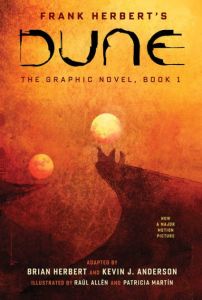
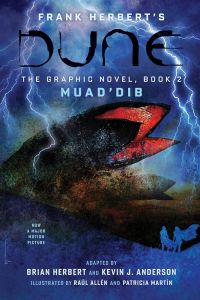
Purists may give me the stink-eye, but when I spotted these in our new acquisitions in the children’s department, I snatched them right up. I aim to read Dune this year, and I figured a graphic novel version might break the ice, so to speak. I’ve done similar with other works: watching a movie version of Sense and Sensibility to get me through the novel, and reading The Aeneid for Boys and Girlsbefore reading the epic poem, listening to an oral version of the Epic of Gilgamesh before reading the text. Because I haven’t read the Real Novel yet, I can’t speak to how faithfully they adapt Herbert’s work. Given that the adapters are Herbert’s son and another novelist who has collaborated with The Son of Herbert on Dune novels, though, my guess is they’re as faithful as fans could desire.
Volume I introduces us to the main story: in some distant star empire, the Emperor has abruptly given the House Atreides, led by Duke Leto, the desert planet Arrakiss. This world barren and hostile to life but contains ‘spice’, which is apparently very valuable. (We learn why as the book develops.) This is not the boon it seems, because the planet was previously under the dominion of Atreides’ rival, the House Harkonnes, and they’re evidently not the Queensbury Rules types. No one from Atreides is excited about leaving their world to live in a desert fortress surrounded by massive sand worms with suitable appetites, and living in a place ridden with booby traps and schemes. To make matters more complicated, there’s a level of anticipation that’s somewhere in the metaphysical realm — there’s talk of prophecy and of a figure referred to as the mahdi or messiah, and some of that anticipation is around the Duke Leto’s own son, Paul. In volume I, we witness Atreides’ assume control of their new realm and begin taking their bearings, but then Harkonnes’ schemes go into effect.
Volume II begins with young Paul and his mother the Lady Jessica trapped in the desert, a place where no human should want to be. Not only is it so inhospitable that humans have to wear special suits so as not to have their body moisture wicked away, but dangerous life-forms are as common as water is not. Betrayed, Paul and Jessica seek help from the “Fremen”, the indigenous humans of Arakkis who have adapted themselves to its hostile climes. Although the Fremen are initially wary, they’re impressed by Paul and Jessica’s cunning survival so far, and the two are able to win the regard of the tribe and earn a place among them. Connected to the mythology of the books, though, there are larger roles to be assumed, and the book ends with quite the cliffhanger.
When I started reading Dune last year, I felt a bit overwhelmed with the odd vocabulary and the fact that I was being dropped into the middle of things without any of that convenient Star Wars type prelude that catches readers up on the taxation of trade routes and such. Here, although those still applied, they were a lot easier to digest — possibly because of visual cues, possibly through repetition. I was pulled into the story easily here, and enjoyed the art style which plays a lot with the lighting and tone. The characters are all sdistiguishable, and in the larger crowd scenes there’s a good bit of variety. The art is most striking in big action scenes, especially during sandworm attacks, does a good job of conveying the vastness and harshness of Arakkis. Although the third and concluding volume of this is coming up in July, I’m going to try tackling the book again before this, and I’m excited about finally getting to see the Dune movie released a few years ago.
War. War never changes. Oh, the execution of it changes — spears become rifles, scouts on fast horses are replaced by drones and mining photos for GPS data — but the horror of it remains, as does certain truths like the difficulties inherent in asymmetrical warfare. China laughed at DC for virtually destroying itself in the Forever War, the mideast quagmire that consumed its men, material, and goodwill across the world for over twenty years — but now it’s created its own mess by invading the United States. Now it hasn’t even moved past the Rockies, and Los Angeles is the center of an insurgency draining China’s men and material away. Tiger Chair is a short story that takes the form of a letter written by a suicidal soldier who has been part of the invasion since the beginning — landing in the first wave, back before the Americans figured out how to disrupt the deadly drone swarms that killed so many of the defenders– who now believes the cause is lost. He desperately wants for the Party to acknowledge the facts and end this debacle before China repeats DC’s mistake and commits to a fool’s errand in which sons grow up to fight alongside their fathers. The war is already destroying its soldiers even of the battlefield, as demoralized they’re beginning soft mutinies by sabotaging their own equipment and injuring themselves to escape duty. Through the narrator’s mournful recollection of the war’s history, we explore different future military technologies, and how they are being thwarted by unpredictable means, generated by a creativity born of desperation. Some of these are uniquely tied to Los Angeles and the Hollywood background, with vocal training and prosthetics being used to frustrate social tracking and control mechanisms the Party is attempting to employ. Another element that Brooks explores is cultural differences and their consequences for occupation: the narrator is aghast at how ferociously Chinese-Americans are resisting their liberating brothers, finding their defiance both reprehensible and demoralizing, and addresses his frustration that the PLA’s heavy top-down control and overreliance on AI are preventing field officers from making creative snap decisions — and the Americans are using this to their advantage, using protocol against the invading army. Although this is a short piece (50 pages), I was fascinated by the tech being employed and thought the premise extremely interesting. It appears that a Party invasion of Taiwan turned into World War Three, with a general Asian front and some action in Africa as well. Brooks wrote World War Z. Available on KU.
Highlights:
Why can’t we learn from America’s mistakes? Americans have. They’ve used the blood of their fallen to write an entirely new rule book for warfare. And rule one is as old as Vietnam: simplicity can defeat technology.
We coerced the fickle Hollywood “in crowd” to turn their backs on their former hero, the Dalai Lama. We manipulated movies—and moviemakers—to portray us only in a positive light. I still think about my information operations course at Shijiazhuang, when Professor Tan showed us the 1984 movie Red Dawn and explained that, for the 2012 remake, the cowardly, moneygrubbing producers changed America’s new invaders from us to the North Koreans. I’ll never forget Tan’s words: “Our greatest weapon is their own greed.”
To follow doctrine is to spread the blame, but bucking it means owning the consequences. Can you see why no mid-grade or even senior officer has ever stood up to Jiang Ziya? Can you see why today turned out the way it did?
Our men are the greatest human beings our country has ever produced: smart, brave, and stronger than I’ll ever be. I let eight of them die today, and I don’t know how to help the survivors carry the loss.
Did our generation’s Deng attack Taiwan to distract us from the plague and recession and all the unrest they were causing? Is history repeating itself on two levels? Doesn’t our escalation into another world war mirror the beginning of the first one? A local spat that spun out of control? And didn’t that war stop only when soldiers turned on the leaders who started it?
Which serves our country more? Fighting its war, or fighting to stop it?
Today’s a day for sharing the books we’d really love to own. But first, teases!
Pondering the implications of a red-hot cowpat landing on my head, I felt a surge of unease and retraced my steps. I hadn’t gone far when a massive discharge from this crater assailed the spot where I had been standing. Before there was time to reflect, an explosion from another crater propelled rocks high overhead, which buzzed as they picked up speed on descent. Feeling increasingly like a target in a shooting gallery, I called it a day and hiked back to the village. (Mountains of Fire: The Menace, Meaning, and Magic of Volcanos)
But if you decide to read further, please know that I wouldn’t put you in such a precarious predicament if I didn’t feel it was absolutely necessary. This is not an impulsive act. For months I’ve struggled with the decision to write about what’s really happening over here. Scrolling back through our digital correspondence, I can still see the invisible gaps, the moments where I wanted to include so much more, and I remember why I talked myself out of it. (Tiger Chair, Max Brooks)
“The point they’re making,” Mosscap said, pointing a metal finger at the screen, “is that complex intelligence and self-awareness arise out of an external need. A social need, an environmental need, whichever. Something pushed those creatures into needing to be more clever.” Its eyes glowed more brightly. “So, what sort of need pushed us robots into waking up?” Dex opened their mouth, then closed it. “Can I go pee before we have this conversation?” (Prayer for the Crown-Shy, Becky Chambers)
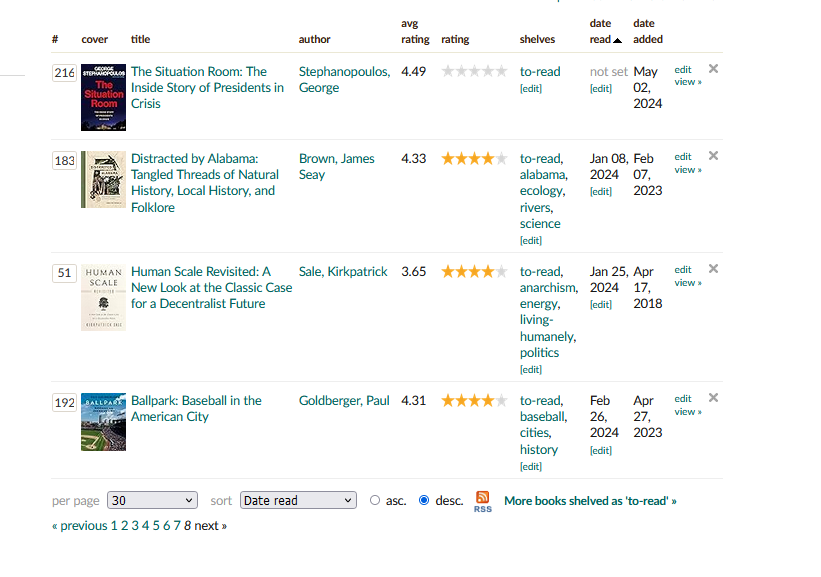
For the list, I’m going to look at recent additions to my Goodreads want-to-read-list which is now, worryingly, over 200 titles.
Huh. I’ve actually read the last three titles on it. That’s a…good sign, I think.
(1) The Situation Room: The Inside Story of Presidents in Crisis, George Stephanopoulous.
(2) Magic Pill: The Extraordinary Benefits and Disturbing Risks of the New Weight Loss Drugs, Johann Hari. I’m on the “lifestyle, not maintenance meds” approach to healthcare but am curious.
(3) The Year of Living Constitutionally, A.J. Jacobs. Given that the Constitution was intended to apply to the national government, not the States and certainly not to individuals, this makes my radar only because I’ve enjoyed A.J. Jacobs’ other experiments so much.
(4) Becoming C.S. Lewis: A Biography of Young Jack. Harry Lee Poe.
(5) Camino Ghosts, John Grisham. Although Grisham has gotten very lazy the last twenty years, the Camino Island setting is an interesting diversion. I’ve been in the area it was inspired by (Amelia Island, near Jacksonville & St. Augustine), so I have an especial interest in his books set there.
(6) Life on the Rocks: Building a Future for Coral Reefs, Juli Berwald
(7) The Anxious Generation: How the Great Rewiring of Childhood is Causing an Epidemic of MEntal Illness, Johnathan Haidt. One of my favorite authors on a topic I’ve been concerned about since touchphones became a thing. I still remember being disturbed at a deep level by an article in Newsweek or something similar fifteen years ago that featured a picture of a toddler completely absorbed by a tablet.
(8) The Enchantments of Mammon: How Capitalism Became the Religion of Modernity, Eugene McCarraher, because I’m a really awkward libertarian who actively dislikes consumerism & materialism.
(9) Most Blessed of the Patriarchs: Thomas Jefferson and the Empire of the Imagination, Annette Gordon-Reed
(10) Reading Dangerously: The Subversive Power of Literature, Azar Nafisi. This one hasn’t technically made my Goodreds TBR list because I only heard about it yesterday, but I’ve read most of her previous work save for that Nabokov title that was just translated last year.
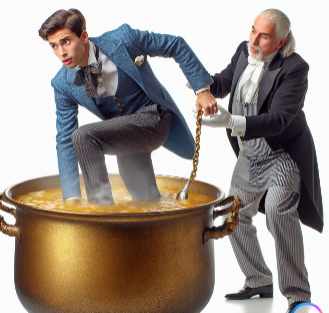
“Rum thing, Jeeves, I seem to have gotten myself in the soup again!” “You do have a singular talent for it, sir..”
(2) Any Jeeves & Wooster story. Props to Cyberkitten, who alone guessed this one! There’s no story about Bertie falling into a well: the general idea in the picture is that a butler is helping his young ward out of a problem he’s got himself into!
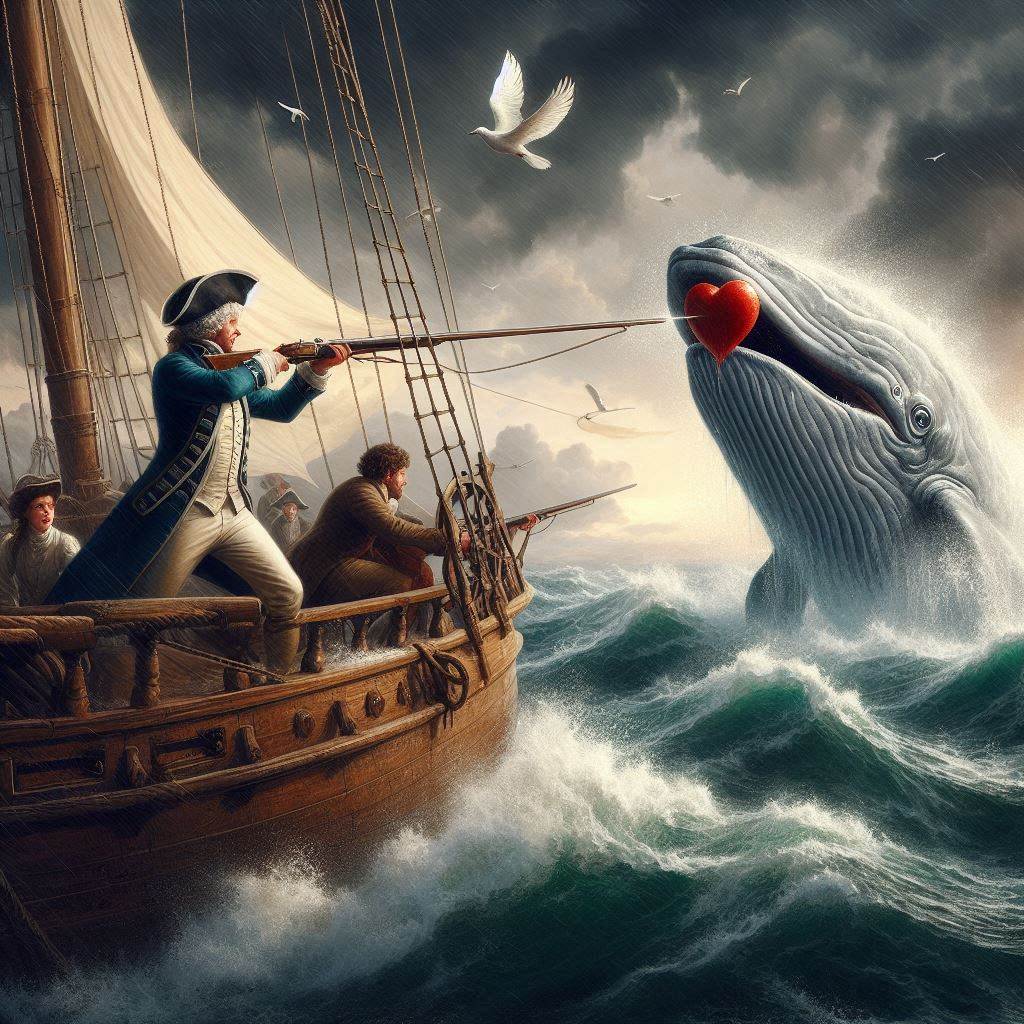
“And he piled upon the whale’s white hump, the sum of all the rage and hate felt by his whole race. If his chest had been a cannon, he would have shot his heart upon it….”
(3) Moby-Dick, or The Whale, Herman Melville. This one was so obvious. I should have done something like a man shooting his heart on a harpoon or something. Everybody got it.
(4) Lord of the Flies. The conch may have been overkill. Everyone got it.
(5) A Thousand and One Tales / Arabian Nights, etc. I asked Bing for a medieval Persian couple sitting in a richly appointed room, with the woman being very animated telling stories. I asked for pictures above her head drawn from stories, like dragons and castles. I was thinking of the way The Sims 4depicts kids or adults using their imagination, but Bing went a different direction. Pretty much everyone got this one as well.
(7) The Canterbury Tales! I asked for a group of medieval people, ranging from peasants to nuns to knights, walking together through a rural countryside of wheat and cattle. They were supposed to be talking and listening to one another. Bing supplied….a lot of cows.
(8) John Steinbeck’s The Pearl. A little abstract, but I asked for a Mexican fisherman having his home destroyed by a big black sphere. (I wasn’t getting good results with pearl.) The best guess for this one came from Marian, who had Steinbeck vibes.
“Magic 8 Ball, will my Pearl of the World fetch a good price at the market?” Magic Pearl: OUTLOOK NOT SO GOOD
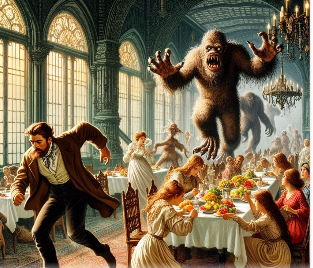
(9) The Time Machine, H.G. Wells. A bit misleading in that The Traveler went forward, not back in time, but I’d hoped the steampunk “time machine” and the nattily dressed Traveler would do the trick.
“Huh, I didn’t know H.G. Wells wrote King Kong…”
(10) A Connecticut Yankee in King Arthur’s Court. I asked for a revolutionary war soldier (“Yankee”) standing in a medieval courtyard in front of a king and wizard, and pointing at a sun in eclipse. In Twain’s novel, the the Yankee’s knowledge of eclipse dates allowed him to escape being executed.
(11) The Odyessey. Odysseus, still in his disguise, is confronting Penelope. In the story, she mentions his bed being removed and he declares that impossible because the bedpost was a living tree trunk — hence the important detail of the tree limbs.
(12)Before the Coffee Gets Cold. Key details: sad woman in white dress reading a book with coffee. This one had two successful guesses, from Davida Chazan and WordsandPeace.
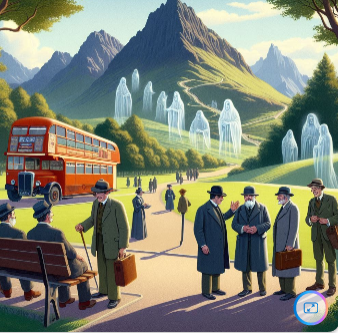
(13) The Great Divorce. C.S. Lewis. My prompt was supposed to be for a wide shot, with a grey sad city on the left, and a happy golden city on a mountain on the far right. Below the mountain there was supposed to be a bus stop with people arguing. I didn’t think anyone would get this one, so props to WordsandPeace and Marian for seeing it!
I…don’t know that this is any better.
(14) Tom Sawyer. Tom and Becky Thatcher are exploring the cave.
(15) This was meant to be Neuromancer. I even told Bing to make the sky the color of a tv set to a dead channel. Congrats to Cyberkitten for being the only participant to spot this one, which was evidently very confusable with Ready Player One. I probably should have played with the prompt some more, but the Sprawl is a difficult concept to capture. Of course, I had CK in mind when I included this one, heh. Let’s try again:
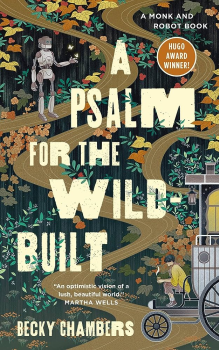
Last week I finished A Prayer for the Crown-Shy, the second in the Monk and Robot duology. In the first book, A Psalm for the Wild-Built, we were introduced to the Monk, Dex, who journeyed into the wilderness looking for purpose. Dex found instead a robot, Mosscap, whose kind withdrew from human society centuries ago but now wanting to find out how the humans were getting on. Our travelers made an agreement: Mosscap would guide Dex to a ruined monastery that the latter felt drawn to, and in turn Dex would be Mosscap’s guide into human civilization. Crown Shy continues that story, following the two as they travel through various human communities and try to answer Mosscap’s question: What do humans need? This is a question Dex is still personally dealing with, grasping for purpose but finding nothing beyond this unexpected friendship and tour of the human lands. The philosophical conversation begun in the last novel continues here, with some brief looks into what human society is like. We are introduced to the currency of ‘pebs’, which reminded me strongly of the ‘obs’ of The Great Explosion: they’re not monetary units, but a way of quantifying and tracking how much a given person is contributing to those around them. The currency is thus fundamentally community-oriented. When Dex visits family, we see that open polyamory is the norm, which I personally doubt would be stable over the long term — there’s a reason it is vanishingly rare in human history. Although I enjoyed the characters and world of this book as much as the previous title, it was something of a disappointment because our look into human societies was so brief. It did teach me the word crown-shy, though, which describes the way trees limit their canopy growth so as not to crowd into their neighbors. Given the ecological aim of these novels — the way they’re depicting a human society that’s settled into smaller and sustainable ways of being — it was an appropriate image!
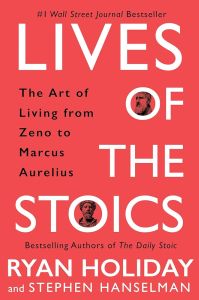
Some seventeen years ago I discovered The Meditations of Marcus Aurelius and the Discourses and Handbook of Epictetus. Neither men meant to publish these: the first was a private diary that was publically shared after the Emperor’s death, the second two were produced by a follower of Epictetus who converted his notes taken during discussions and lectures into more formal texts. That followers and admirers of these men went to these efforts to pass on their principles and teachings says much about the quality of the men and what they professed. In Lives of the Stoics, we meet both men again, but in the context of their community, as this series of biographical sketches also tracks the evolution of Stoicism from its beginnings with Zeno and Chrysippus, with a focus on individual virtue, to its growth as a publically-minded philosophy as advocated by Seneca and embodied by Marcus Aurelius. I’ve previously read Holiday and have avoided him since, regarding him as the Joel Osteen of Stoicism. This book appeared in my library’s bookstore, though, and given my interest in learning about Stoics beyond those I’ve read books by, I decided to give it a try. Although there’s still a life-coach vibe here, and Holiday plays to the reader’s existing pretensions rather than challenging them, I enjoyed this more than anticipated — in large part because so many of the names were unfamiliar to me, despite having read broadly into Stoic writings.
Lives of the Stoics follows the model of Plutarch’s Lives, offering a brief biography of each man (and one lone woman) and stressing the lessons to be learned from them. Because the biographies are meant to be inspiring — presenting us with a standard to attain to — there’s a background level of narrative flourish, shall we say, that turns stories into facts and casts each man in as warm and favorable a light to the reader as possible. As mentioned in the introduction, the first half of the book nicely demonstrates Stoicism’s early evolution from one focused on an individual becoming a sage, to a philosophy that also emphasized man’s inbuilt responsibility and integration with his community, —oikeiôsis, or as Wendell Berry might put it, “membership”. The version of Stoicism that Holiday preaches here, via the biographies, is a simplified one that emphasizes the dichtomy of control, alongside individual integrity and duty. The latter two are interwined, as a great many of the figures in this book’s second half are executed by Nero for refusing to go along with his programs. They include, at long last, Seneca — who entered public service as a tutor to young Nero, who was distracted by his study of philosophy by worldly responsibilities and riches, who withdrew from them only to still find himself marked for death by the emperor. Another man here who does not cut so fine a figure is Cicero, who studied Stoicism and whose writings help convey it to succeeding generations, but who never fully took its lessons to heart and stood silently by as Caesar destroyed what was left of the old Republic. The men (and woman) in this group were very much a community, with few isolated individuals: in the beginning, there’s a steady progression of teachers who train their successors, and in latter half we realize Rome was swimming in Stoics, from slaves like Epictetus to men so connected with the Judeo-Claudian line that Nero exiled and then killed them to prevent challenges to his regime. These men knew each other, were part of one another’s lives: Musonius Rufus followed one fellow Stoic into exile, for instance, and another killed by Nero was an associate of Seneca’s — and Seneca’s writings in the library of Nero’s secretary may have exposed Epictetus to Stoicism, while Hadrian and Rusticus’ interest in Epictetus exposed Marcus Aurelius. Holiday tries hard to connect the lessons of these men to examples that contemporary readers might be more familiar with — using a quote from East of Eden to illustrate Cleanthes’ appreciation of manual labor, for instance, or comparing Seneca and a modern general who served a president he didn’t especially like, but felt needed his contribution.
While I wouldn’t recommend this for someone looking to be exposed to Stoicism, if one is already interested in and familiar with its core concepts, then Lives shows us how philosophy may look in practice — from men and women making choices out of principle, not self-interest, to their enduring hardship and staring death squarely in the face, laughing at poverty and approbation at the same time. I enjoyed meeting this range of characters, especially those who I’ve read but know nothing of (Rufus), or simply ‘spending time’ with men like Cicero, whom I like despite their weaknesses. As a longtime student of the Porch, I was fascinated by some of the figures in its early history, whose lives and thinking had more overlap with the Epicureans and Cynics than the more sharply defined Stoicism of later years.
Coming up: I’m beginning a NetGalley ARC called Lawless Republic: Cicero and the Fall of Rome, as well as continuing in a book on volcanos. Review for A Prayer for the Crown Shy is also coming.
Quotes:
Perhaps [Epictetus] so landed with Marcus Aurelius because they were both dealt hard hands by fate. It is a striking contrast, an emperor and a slave sharing and following the same philosophy, the latter figure greatly influencing the latter, but it is not a contradiction — nor would it have seemed odd to the ancients. It’s only in our modern reactionary, divisive focus on ‘privilege’ that we have forgotten how much we all have in common as human beings, how we all stand equally naked and defenseless against fate whether we possess worldly power or not.
Mosscap pointed. “Crown shyness is so striking, don’t you think?” Dex had no idea what Mosscap meant. “Sorry, what’s striking?” “Stop,” Mosscap said. “Look.” Dex sighed, but they hit the brakes, put their feet on the paving below, and looked up. Mosscap continued to point, tracing lines in the air. “Look at the treetops,” it said. “What do you notice?” “Uh,” Dex said. They frowned, not knowing what Mosscap was getting at. There were branches, obviously, and leaves, and … “Oh. Oh, they’re…” They fell quiet as their perspective of the surrounding landscape shifted in a way they’d never unsee.
Despite their number and close proximity, none of the treetops were touching one another. It was as though someone had taken an eraser and run it cleanly through the canopy, transforming each tree into its own small island contained within a definitive border of blue sky. The effect reminded Dex of puzzle pieces laid out on the table, each in their own place yet still unconnected. It wasn’t that the trees were unhealthy or their foliage sparse. On the contrary, every tree was lush and full, bursting with green life. Yet somehow, in the absence of contact, they knew exactly where to stop growing outward so that they might give their neighbors space to thrive.
“How…” Dex began to ask. “No one knows,” Mosscap said. “At least, not to my knowledge. Some say it’s to minimize competition. Others think it’s to prevent the spread of disease. But as to how the trees know when to hold themselves back, I don’t know. It’s a mystery.”
What do people need? Dex is a garden monk who should, by all accounts, enjoy a perfectly happy life. Health, a meaningful job, people who love them — what’s missing? Dex doesn’t know. After departing from the monastery to pursue a slightly different, if adjacent vocation — that of tea monk, offering herbal tea and a listening ear to those who are stressed or in need of trouble, Dex continues to wrestle with a feeling of emptiness and disatisfication. As invigorating as the new challenge is, it’s still not quite enough — and so, Dex sets out past the limits of human civilization, venturing into the wilderness to see if they might hear the crickets cry. Even knowing the dangers that are out there — bears, river wolves, disasters — Dex has an urge to move forward. The push into the wild results in Dex being greeted by an robot which calls itself Mosscap, and Mosscap is also looking for an answer. Centuries ago, robot intelligences chose to withdraw from human society, but they have remained curious about their creators — and Mosscap has volunteered to go to the humans and see how they’re getting on. Dex reluctantly agrees to guide Mosscap through human society, but only if Mosscap will take Dex deeper into the wilderness, to an abandoned hermitage that was the site of the last recorded cricket chirps. Psalm for the Wild-Bult is an interesting kind of science fiction, as it’s essentially an extended conversation about existentialism in a solarpunk context. The worldbuilding is compelling in its own right, as we’re offered a vision of a human society that has found a way to live in harmonious comfort with Nature, and has done for for at least centuries. That steady-state has led to frustration for some, like Dex, whose inexplicable distress at the start of the novel testifies to the truth that both Captain Kirk (“This Side of Paradise”) and Carl Sagan observed: we are homo viator, man on a journey — forever striving, exploring. Plotwise, this is not a grand story: it’s simply a monk and a robot traveling and talking. I happen to have a hearty appetite for this kind of introspective discussion (there’s a reason Alain de Botton is one of my very favorite authors, and why I’ve watched My Dinner with Andre), so between that and the solarpunk setting I was delighted with this.
Highlights:
“So, the paradox is that the ecosystem as a whole needs its participants to act with restraint in order to avoid collapse, but the participants themselves have no inbuilt mechanism to encourage such behavior.” “Other than fear.” “Other than fear, which is a feeling you want to avoid or stop at all costs.”
“Do you not find consciousness alone to be the most exhilarating thing? Here we are, in this incomprehensibly large universe, on this one tiny moon around this one incidental planet, and in all the time this entire scenario has existed, every component has been recycled over and over and over again into infinitely incredible configurations, and sometimes, those configurations are special enough to be able to see the world around them. You and I—we’re just atoms that arranged themselves the right way, and we can understand that about ourselves. Is that not amazing?”
“We’re machines, and machines are objects. Objects are its.” “I’d say you’re more than just an object,” Dex said. The robot looked a touch offended. “I would never call you just an animal, Sibling Dex.” It turned its gaze to the road, head held high. “We don’t have to fall into the same category to be of equal value.”
You keep asking why your work is not enough, and I don’t know how to answer that, because it is enough to exist in the world and marvel at it.”
Today is the 80th anniversary of D-Day, in which Americans, Brits, and Canadians landed on the beaches of Normandy and opened the Second Front and began reclaiming Europe from Nazism the cost of their lives. Death to tyrants. Here’s FDR, announcing the news to America:
“Almighty God: Our sons, pride of our Nation, this day have set upon a mighty endeavor, a struggle to preserve our Republic, our religion, and our civilization, and to set free a suffering humanity.
“Lead them straight and true; give strength to their arms, stoutness to their hearts, steadfastness in their faith.
“They will need Thy blessings. Their road will be long and hard. For the enemy is strong. He may hurl back our forces. Success may not come with rushing speed, but we shall return again and again; and we know that by Thy grace, and by the righteousness of our cause, our sons will triumph.
“They will be sore tried, by night and by day, without rest-until the victory is won. The darkness will be rent by noise and flame. Men’s souls will be shaken with the violences of war.
“For these men are lately drawn from the ways of peace. They fight not for the lust of conquest. They fight to end conquest. They fight to liberate. They fight to let justice arise, and tolerance and good will among all Thy people. They yearn but for the end of battle, for their return to the haven of home.
“Some will never return. Embrace these, Father, and receive them, Thy heroic servants, into Thy kingdom.
“And for us at home — fathers, mothers, children, wives, sisters, and brothers of brave men overseas — whose thoughts and prayers are ever with them — help us, Almighty God, to rededicate ourselves in renewed faith in Thee in this hour of great sacrifice.
“Many people have urged that I call the Nation into a single day of special prayer. But because the road is long and the desire is great, I ask that our people devote themselves in a continuance of prayer. As we rise to each new day, and again when each day is spent, let words of prayer be on our lips, invoking Thy help to our efforts.
“Give us strength, too — strength in our daily tasks, to redouble the contributions we make in the physical and the material support of our armed forces.
“And let our hearts be stout, to wait out the long travail, to bear sorrows that may come, to impart our courage unto our sons wheresoever they may be.
“And, O Lord, give us Faith. Give us Faith in Thee; Faith in our sons; Faith in each other; Faith in our united crusade. Let not the keenness of our spirit ever be dulled. Let not the impacts of temporary events, of temporal matters of but fleeting moment let not these deter us in our unconquerable purpose.
“With Thy blessing, we shall prevail over the unholy forces of our enemy. Help us to conquer the apostles of greed and racial arrogancies. Lead us to the saving of our country, and with our sister Nations into a world unity that will spell a sure peace a peace invulnerable to the schemings of unworthy men. And a peace that will let all of men live in freedom, reaping the just rewards of their honest toil.
“Thy will be done, Almighty God.
Amen.”
“This is New York, NBC newsroom again. Men and women of the United States, this is a momentous hour in world history: this is the invasion of Hitler’s Europe, the zero hour of the Second Front. The men of General Dwight Eisenhower are leaving their landing barges , fighting their way up the beaches, into the fortress of Nazi Europe. They are moving in from the sea to attack the enemy under a mammoth cloud of fighter planes, under a ceiling of screaming shells from Allied warships. The first new flashes do not say, but a large portion of this assault is believed to be in the hands of American men. They are making this attack side by side with the British Tommies who were bombed and blasted out of Europe at Dunkirk. Now, at this hour, they are bombing and blasting their way back again. This is the EUROPEAN FRONT, once again being established in fire and blood.”