
256 pages
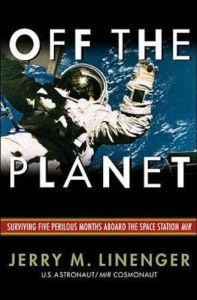
When Jerry Linenger first boarded the Space Station Mir for a five-month stint working with Russia’s finest, the master alarm was blaring. It was a sign of things to come. The aging space station had been continually modified and jury-rigged since its launch and looked nothing like the schematics Linenger was compelled to study in Star City, Russia, and was so unstable that constant user intervention was required to keep it in orbit. Linenger was so used to hearing the master alarm after only a month on board, that when a massive fire that burned so hot Mir itself was melting broke out, he wasn’t disturbed until he saw an entire passageway covered in dark smoke. Off the Planet is one extremely qualified American astronaut’s account of his and several cosmonaut’s months of living in one long emergency. The author is an uber-overachiever — a flight surgeon who trains with Navy SEALS and then becomes an astronaut – -but he’s likable for all that, and writes at a unique time, before the International Space Station became a joint project but when NASA was actively attempting to prepare for sustained cooperation with its former rival.
The mid-late nineties when Linenger was active was an interesting time in NASA’s history: the Shuttle program had recovered from the shock of Challenger and was once again becoming routine, though its work on the International Space Station had not yet begun: the first module would not be launched until 1998, by Russia. Such an undertaking required extensive preparation, and the United States had far less experience in space station operations than Russia: NASA’s two Skylab experiments had been smaller operations, created by using the hull of a Saturn tank. As Linenger quickly learned, living for months aboard a space station required an entirely different temperament than working in active spacecraft like shuttles. Linenger and other astronauts who took turns on Mir (working along with two cosmonauts) were given a crash course in both Russian and the technical specs of Soyuz, Progress, and Mir – – though in the latter case, Linenger found that the station had changed so much that the preparation was useless. Mir in 1997 was…a mess. A literal mess, filled with floating wires, cables, and used containers, despite continuing efforts to evacuate out trash. The onboard systems frequently failed, so inter-station communication was patchy and station-to-ground comms were even worse — and the crew often had to work every day wearing masks to prevent breathing in fumes and metallic particles. Worse yet, Russian ground control was extremely prone to micromanagement, and would often send up new orders on the fly. Linenger and his Russian colleagues were astounded to see the Progress craft that was meant to be burning up in the atmosphere (with their trash) returning to Mir: ground control had decided to test a new docking method without warning, Nevermind that Mir‘s cameras weren’t functioning and that they had no ability to guide the docking, not being able to see a thing. The Progress craft only narrowly missed Mir, and at the speed it was traveling it would have certainly killed the men aboard. Astonishingly, NASA was never informed of any of this, only told that the docking was ‘cancelled’. (Russia also downplayed the massive fire that could have destroyed the station earlier, one that resulted from the O2 containers the men were forced to rely on because of constantly failing environmental systems.) Months later, the experiment was re-attempted and the Progress M-34 did collide with Mir, plowing into the Spektr module and damaging it, a solar panel, and destabilizing Mir as a whole.
When Lineger returned to Earth, he reported being glad he had taken on the challenge, but didn’t enjoy it in the least. Living aboard Mir was five months of continual crisis management and never-ending work: he was even the subject of sleep experiments so that one way or another, he was delivering data 24/7. Off the Planet was enormously educational for me, knowing little about Mir: I was distantly aware of the Shuttle-Mir project, but didn’t know that NASA partially funded Mir modules to keep the Russian space program afloat in orbit. As dangerous and frustrating as Linenger and the other crew’s (American and Russian) jobs were here, I’m glad they stuck it out: learning how to work with one another’s equipment (and manage one another’s bureaucrats) was a necessary part of getting the International Space Station off the ground. If you’re a space fiend, Off the Planet marks itself as a book to find, not only for being a rare look at the Shuttle-Mir project, but also given the author’s unique perspective as a flight surgeon who was distinctly aware of the effects prolonged zero-G was having on his body.


