
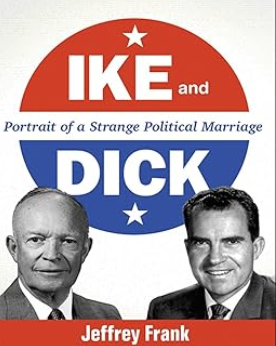
I increasingly find Richard Nixon a fascinating personality, and stumbled onto this while looking for Nixon books: I’ve been reading it along with Being Nixon the last week or so. Ike and Dick focuses on the relationship between these two men, who were very dissimilar but nontheless became running mates in two elections. The book does not stop with the end of Eisenhower’s term in office, but rather continues on until after the general’s passing. Theirs was an interesting relationship: Nixon was an accomplished, ambitious, and talented rising star, but he had limits Eisenhower was aware of, and so was treated cautiously for years. Nixon, who first looked at the General with the fawning respect of a younger officer to a senior one, quickly realized that good ol’ Ike had a cold, manipulative side. This is an interesting look at a pivotal political and personal relationship.
Dwight Eisenhower could have run for either party in the 1950s and won: the fact that he chose to run as a Republican annoyed Harry Truman greatly and put him into a position to mentor up-and-comers like Richard Nixon. Nixon had already made his bones as a legislator, and attained some national prominent as the man who took down Alger Hiss, accused of being a Soviet spy and convicted of perjury given that charges of treason were already passed the statute of limitations. A hard-working, well-spoken red-hunter was just the ticket in 1952. While Nixon was very much a political creature in terms of thinking about policy, in interpreting how parties and interests might be affected by this action or even a word or gesture, he was not skilled in personal engagement. He was shy, often formal or awkward, and didn’t seem to know how to coordinate his hands and his mouth during a speech. Eisenhower struggled to bond with him over activities like fly-fishing, and when Nixon was accused of using campaign donations for office use (the horrors!), Eisenhower seemed open to dropping him from the ticket altogether. The ‘fund affair’ appears to have defined their relationship fairly well, at least until the late 1960s: Eisenhower was a commanding general and administrator who saw Nixon as a tool fit for some purposes and not for others, at least at first, and he was happy to use said tool and then put it away. (One use: Nixon was very good in foreign policy, so he traveled in the president’s stead.) Nixon, who took things very seriously, was hurt by this — but he was a man who had a talent for turning pain and setback into a reason to make a comeback, if only for spite. Eventually, the two men did become more like friends, though Nixon never became the fisherman or golfer Ike would have preferred. That friendship continues until Eisenhower’s death, by which point he was signing his letters to Nixon with “Ike” — not a name Nixon ever felt comfortable using around Eisenhower. The last sections of an enfeebled Eisenhower waving a flag while well-wishers played favorite music from the hospital parking lot, and Nixon weeping at the news that his commander and mentor had passed, are fairly poignant.
I’m currently overdosing on RN at the moment, being nearly through with Being Nixon and re-listening to his post-presidency memoir, In the Arena, but I enjoyed this volume among them for the unique context. We often regard Nixon as a man alone, but here he grows in relationship with another singular personality and we get to see him as an earnest protege, a partner, and friend. It also shed light on a lot of Nixon’s other often overlooked aspects — his Quaker-derived racial sensibilities, for instance, that led to him become friends of a sort with Martin Luther King Jr. There’s more Nixon coming — I should finish Being Nixon tonight, and this weekend I’m expecting a book on Nixon and Kennedy’s relationship to arrive in the mail.
Quotations
“Well why do we fight Communism in the first place? Because Communism threatens freedom and when we use unfair methods for fighting Communists, we help to destroy freedom ourself . . . And when through carelessness you lump the innocent and the guilty together, what you do is give the guilty a chance to pull the cloak of innocence around themselves.” Nixon, speech against McCarthy
Eisenhower kept acting as if a decision to intervene was in the process of being formed, but, as Nixon intuited, he was only going through the motions of making up his mind during hours of National Security Council meetings when he’d go around a long octagonal table asking for comment while he doodled—sometimes fiercely, often producing perfectly proportioned drawings of cups in saucers, and sometimes the faces of the participants, and occasionally poking his pencil through the paper.
“Does the man think of nothing else but politics?!” – Eisenhower on Nixon
“If Richard Nixon is not sincere, he is the most dangerous man in America.” – MLK Jr
Shortly after one-thirty, he was informed by his military aide, Brigadier General Robert Schulz, that President Kennedy had been shot. There was still something about General Eisenhower, now seventy-three, that made people turn to him for reassurance. A reporter asked, “General, will the nation be all right in the months ahead?”
On his seventy-eighth birthday, October 14, the Army band stood below his third-floor window and for fifteen minutes played some of his favorite tunes, including “The Yellow Rose of Texas” and “The Caissons Go Rolling Along.” When they got to “The Beer Barrel Polka,” Ike came to the window and kept time with a tiny flag that had five white stars on a dark background; it was the first time in six months that the public could see the general, who now weighed 148 pounds, and, as it turned out, it was the last time. All of this—the music and the sight and sound of people cheering—was enough to make him dab his eyes with a handkerchief.
He returned to New York on the weekend before the inaugural—January 20 fell on a Monday—and on that Sunday, Eisenhower telephoned. It was, he told Nixon, his last chance to say, “Hi, Dick!” After that, it was going to be “Mr. President.”


