Deck Z

(Don’t worry, I only read two of these.) Captain Smith is preparing for his triumphant final voyage, captaining the Titanic in her first trip across the Atlantic. Unfortunately for him, those nasty Germans are going to muck things up. Smith is blissfully unaware that one of his passengers, Dr. Weiss, is an epidemiologist who has been studying a vicious new plague in Wu- um, China somewhere — that turns its victims into absolute monsters, cannibals who reek of decay. Dr. Weiss wants to find a cure, but he’s recently realize that Imperial Germany has this neat idea of starting a general war in Europe (because they’re the baddies, and surprise invasion is such what one does), and they want to weaponize this awful new virus (“Toxic”) to cripple the Russians and prevent any messy second fronts from breaking out. Dr. Weiss has a sample of the Toxic to test for antidotes, but he can’t do it in a Europe filled with German agents, so he’s hoping for a fresh start in America. Unfortunately for him — and most of the passenger of the Titanic — an Evil German Agent is following him, and — during the ship’s progress — will attack Dr. Weiss and turn the Titanic into the set of The Walking Dead: Lost at Sea.

Although the basic premise is the same as Titanic with Zombies, this is very much its own story, and much closer to “horror-like SF” than fantasy-horror. Unlike TwZ, this is not a replay of the movie, but dominated by mostly new characters — especially Dr. Weiss and his sidekick, a tomboy named Lou(ise) who wants to grow up to be a frog-studying scientist. Dr. Weiss, Captain Smith, and Thomas Andrews are the chief stars, spending most of the novel being action heroes while Bruce Ismay is a blithering idiot on the bridge, at one point destroying the phone so he can countermand Smith’s orders and get the Titanic to New York early. The Titanic crew are mostly vague background, so Officer Lightoller doesn’t get his chance to be rambo the way he did in Titanic with Zombies. Although the Germans are a caricature villain, this was a much stronger novel all around — with a more original execution of the premise, and better writing and characters in general — than TwZ. Personally, my favorite part was Captain Smith suddenly having a history that involved Afghanistan, leading to him having a sword dubbed Kabul that he uses to smite the zombie hordes — side by side of a German scientist with a sword-stick. Great fun, especially Lou who lights up most every scene she’s in. And yes, the Titanic still does the whole “side-swipe the iceberg and go down” thing, although again I’m compelled to wonder about what difference the zombie apocalypse made in the survivor numbers: here, the virus mutates and becomes far more virulent.

Related:
Titanic with Zombies
World War Z
Night of the Living Trekkies

Highlights:

“I’m going to study frogs. Once we save some money.”
“A scientist, eh?” Weiss said with approval. “They allow girls to be scientists in Iowa?” Lou’s eyes narrowed. “The best scientists in Iowa are women.”

“Duty comes before my safety or yours. You’re givin’ into fear,” Smith said firmly. “Don’t be afraid of the fire, Thomas. Otherwise you’ll miss the chance to be forged in it.”

“Run, Captain,” hollered Andrews. “Never!” growled Smith. Finally, the blade slipped free.

Posted in Reviews, science fiction | Tagged , , , | 3 Comments

Titanic with Zombies

A young woman boards the Royal Mail Ship Titanic, bound for America, idly scratching her neck. She’s been bitten, but she doesn’t know what by. And there was a strange man with a syringe… As the Titanic steams ahead towards its doom, the lads of the White Star Line will soon have another problem on their hands: an appalling outbreak of madness and cannibalism When the young woman collapses on the boat deck, she’s taken to a medbay — but despite being declared ‘dead’, she revives like a bad economic theory and begins gnawing on the medical staff. The White Star’s finest are baffled, and try to contain the Afflicted, but since that wouldn’t be much of a novel there’s a mistake made, an escape effected, and soon Second Officer Charlies Lightoller (“Lights”) is grimly stalking the corridors doing his best Left for Dead run. (At least, between efforts to light his pipe which borders on a running joke.)

This is an odd little story, a mix of historical fiction and horror that manages to be almost comic in its juxtaposition of zombies and the Titanic. The Big Serious Historical Events are still happening in the background, though Lights and another officer are down attacking well-dressed zombie hordes with Webley pistols and fire axes when the ship has its lethal sideswipe with the iceberg, and though they’re distantly aware something serious happened — especially Lights, who gets trapped in a room by a mob of zombies and has to make an escape through the rapidly rising and extremely cold north Atlantic water now filling the deck — they don’t learn of how truly doomed they are until they escape back to the boat deck. I wondered if perhaps the number of people being eaten or zombified meant that more people would be able to escape to the boats (there being less competition) , but the fact that zombie bites took a bit to manifest into full sickness meant that normal-looking people could turn undead, so those in the boats are even more paranoid. The growing epidemic which is filling the corridors with bones and blood also forces Captain Smith to keep the steam engines moving at full blast, in hopes of arriving in New York and finding medical help or more armed men, so there’s even less reaction time to the spotting of the berg than in real life. A lot of dialogue, personality, and scenes appear to have been borrowed from the James Cameron movie, Titanic: Margaret’s Brown appeal to her lifeboat neighbors is nearly word for word as the movie (as I remember it, anyway), and the scene of Thomas Andrews standing at the fireplace in the smoking lounge and then slowly turning is repeated here, only for horror effect: the poor engineer has been bitten is about to fall into the madness. Although my Titanic buff self noticed some historical irregularities (Smith having all four iceberg warnings when only two made it to the board, staff members and Ismay having posession of one of the others) this is Titanic with Zombies, so …strict attention to detail need not apply.

This is a curious book, fun in its way: I don’t know how other serious Titanic buffs would like it, perhaps thinking it a mockery, but I enjoyed it for its goofiness. Given that Lights is a slight hero of mine — he survived the sinking and later participated in the Dunkirk boatlift using his personal sailboat — I also liked seeing him in action hero mode here. I discovered that “Tiitanic but with Zombies” is something of a micro-genre on Aamzon, and have — since I finished this Friday lunch — read another, one that was far more serious.

If you don’t know Lights, this is his portrayal in the Cameron movie, but BE AWARE the movie defames his character: the actor ad-libbed a line that makes him come off rather badly.

Posted in Reviews | Tagged , | 8 Comments

The Story of a Brother Whose Nose Was not Broken and Deserved to Be So

Jack just won the lottery. He should be thrilled. Ecstatic! He’s a millionaire, twice over! Or…whatever he has left after His Majesty’s Revenue and Customs has their way with the check. Problem is, he’s going through a divorce. A freelance English-as-a-second-language teacher may not have to worry about being looted by his ex-wife (what’s she going to take, his bicycle? His forty-year old sedan?), but he has no intentions of letting her take him for hundreds of thousands of pounds. They’ve only been married for a few months, for pete’s sake, and he suspects she was just using him for a work visa. He could try to hide it from her, but she knows perfectly well he always plays the lottery and always uses the same numbers. And she bloody called him right after the numbers were announced, so he knows she knows. So, Jack decides to lie: he forgot to pick up his ticket this week. Of all the luck, right? Only Cindy’s not falling for it, and when Jack confesses to his brother Rich what he’s trying to do, he unwittingly confesses this to Cindy’s new lover, because Rich now knows Cindy in the Biblical way and is breaking numerous rules of the Bro Code and even more rules of Levicitus. Fortunately for Jack and Rich’s relationship, Jack loses the ticket and gets distracted by a new relationship, infatuated by some woman who backed into his new car and destroyed its back end. All’s well that ends with no homicide, right? Only Cindy is looking into ways of claiming the winning on her own, and the ticket is not quite lost. Someone else has got it.

I chiefly read this because I’d just read a Tom Alan and wanted to try another of his works. They’re quite different, aside from the constant political references: The Last App was relatively serious, concerned with a question of how tech changes our lives, while this is is more of a…sitcom episode with gobs of slang and drama. In 17 years of reading in public, I’ll venture to say I’ve never read a book more full of slang, and that’s counting P.G. Wodehouse’s ideolect that saturates every page of a Jeeves and Wooster novel. (Thank you, Anthony Esolen, for that word.) Most of it’s British, but since Cindy is Australian there’s a lot of Australian slang as well and it confuses everyone. Basically, Jack has won the lottery, he wants to hide it from his ex-wife who is boinking his brother, but he’s lost the ticket and doesn’t care because he’s fallen in love with Millie, but then the ticket’s found and it somehow threatens every single relationship until it doesn’t and everyone winds up happy, even that cheating cow Cindy and Rich, the loathesome brother who needs his nose bent.

The novel was…engaging, easy to read, but I didn’t like most of the characters and I really wanted Cindy and Rich to be left at least mildly unhappy and they weren’t. Sure, there’s a happyish ending, but people who cheat on other people should get some comeuppance, not their own happyish ending.This novel is funny, but frustrating, because no one but Jack feels the least remorse about their actions.

Oh, and Jack’s last name is Pott. Jack Pott. Get it? Now I’m off to a weekend in Florida of staring at (potential) tropical storms and Navy airplanes. Oh, and hopefully Spanish artifacts if any have survived.

Highlights:

Ananya Banerjee bustles out from the back, hands flapping, hips threatening the unsteady stacks of chewing gum and football stickers. Cindy steps forward, her gap year in Barcelona has given her a Latin tic of bestowing kisses on people she barely knows, or has only just met, but she pauses – as does Ananya, as if she’s suddenly realised that she’s an Indian shopkeeper who’s spent years trying to learn how to behave with traditional British reserve. The moment is lost, and they stand looking each other up and down, like they’re inspecting fridges in an electrical shop.

When he’s had a think: he got drunk the night he won, not that he remembers it well, but he’s got the evidence of the state of his sweatshirt and chinos and six empty San Miguel bottles. So, where might he have hidden the ticket when in a drunken stupor? You know, not his usual places, but drunken-stupor places…?

The bed was the smallest double imaginable; the mattress was the sort of bit of foam you’d find on a cheap sun lounger in a run-down hotel in Lowestoft. It sagged so spectacularly it was probably marketed as a hammock.

We didn’t argue much – Cindy was too good at it. I remember one tiff; I rather unwisely accused her of always wanting to have the last word. And that was the last word in that conversation. She drained her glass, stood up, walked out of the restaurant, leaving me with two-thirds of a pizza, and the last word. Not that it felt much of a triumph as she proved me wrong, winning the argument with silence and an empty chair.

“He wants to marry his Sheila; he’ll have to pay up or this Sheila ain’t gonna give him an easy Tammy Wynette.’
‘A what?’ Rich’s heard Jack complain about Cindy’s incomprehensible Australianisms. He’s not sure she’s even speaking English any longer.
‘D-I-V-O-R-C-E,’ she spells out for him, twanging her voice like a steel guitar. ‘Keep up, Rich-a-roo.’

“But look, you and Cind! Congratulations! Would never have seen that coming. How is she? Sorry we didn’t make it for the wedding, we wanted to, but there was no way.’
‘No problem, Cindy’s fine…[….] The thing is…’ Jack takes a breath. ‘The thing is – we’re not together anymore. She moved out about five months ago; we’ve agreed to divorce.”

Posted in Reviews | Tagged , | 4 Comments

The Last App

If there was an app that could crunch all the numbers of your medical history, diet, lifestyle, etc, and predict how many days you have to live — would you try it? The Last App opens with that premise, featuring an aging and set-in-his-ways doctor celebrating his birthday by buying one of the “LifeTime” devices to decide whether or not he should retire or keep working a few more years. More to the point, he’s also bought his family devices, including little eleven-year-old Will, his great-grandson. When Mick’s status as the first British customer of LifeTime turns him into a spokesman, the family’s life is changed — and some of its members endangered.

I was all-in on this book from the beginning: I loved the main character from the start, an obdurate old fogey who had never gotten on board with the 21st century and took delight in the little pleasures of life like golf, whiskey (pretty sure this book was sponsored by Bushnell’s), and good cigars. Mick is the paterfamilias of his clan, and loves treating the kids to a weekend feast. They’re not sure what to make of his sudden embrace of the newest gadget, and even more surprised when he realizes he can make the projected life expectancy go up by changing his diet, lifestyle, and habits. Out with whisky and cigars, in with powerwalking and quinoa! Mick becomes a minor celebrity in Norfolk, and the LifeTime company seizes on the opportunity to make him their shining poster boy — bringing the family along for the ride. Meanwhile, Mick’s son-in-law Andy works for LifeTime( and was pressured into selling him the devices), and his stock is soaring — but he’ll learn the company has some shady secrets and little compunction about protecting them.

Although this is…..very technically SF, it’s more of a general thriller with a slight SF finish: this kind of data-crunching software is probably available today, though in not so easy a package: I haven’t gone in for the whole fitness-tech craze like many people, so I don’t know how sophisticated they are. My last phone and its health app insisted they could detect my pulse, BP, and O2 content, and that was ten years ago. What pushes the book more into SF territory is the “LifeBuddy”, an integrated subdetermal chip and display that constantly analyze diet, exercise, etc, to provide minute-by-minute recommendations and LifeTime projection. It can also scan the QR codes of food products to determine their general healthiness, and their specific healthiness for the user’s particular needs — you may need more potassium right now, but not so much tomorrow — and oh, look. LifeTime’s health food line is optimized for your needs!

The above may have made this sound technical, but it’s much more of a family and crime thriller than any Crichton-esque dive into tech. I’d say it’s very accessible to the average reader, and it touches on matters that are already affecting us today — like the faith invested in big data’s algorithms and predictions, not counting for data that may be compromised or polluted. In Mick’s case, the LifeTime predictions for his entire family were made by him filling out surveys about their medical histories and diets — not something he’d necessarily be expert on, especially seeing as the reader and his family can tell he’s starting to lose his memory. I can’t fathom a company making serious health claims on that basis, and I’m sure Britain has something like HIPPA that would prevent outside access to Mick’s family’s medical records — he couldn’t sign off on releasing them! Alan also has a few political axes to grind, as he constantly takes potshots at British PMs and the privatization of the NHS: oddly in this book the UK has joined the United States as ‘an associate state’, but all it appears to mean in terms of the book’s plot is open borders between the home country and her most obstinate offspring: the action is constantly shifting between Utah and Norfolk, England.

I found this quite fun in general, and have already checked out another title by the author.

Highlights:

A touch of eccentricity is best achieved by not worrying about what other people think.

Mick sails serenely on, the Titanic out of Southampton dock.

He marvels at how much of his wall space is taken up by books and music; it’s like a Bayeux tapestry of his life. No wonder Paula’s and Steve’s places are so drab and empty-looking, what with their Kindlings and Eye-Pobs – his memories are there in front of him every day.

You know,’ he continues, dropping the book next to his other to-be-reads and slumping back into his armchair, staring at the ceiling like he’s forgotten she’s there in the room with him, ‘there are moments when I read a particular sentence or paragraph, that I can feel, I can really experience where I was, who I was with, when I first read it. It’s like the words are stored in my brain somewhere, and the rereading of them accesses that little box and opens it. But it’s not just the words that are inside; it’s everything else that was going on at the time. I read some of Catcher last week and suddenly I remembered Bill Bailey, I was sharing a flat with him at the time, and I could smell the curry he used to cook. I almost went out into the kitchen to check I hadn’t left something on, burning. Isn’t that remarkable?’

‘When the world is destroyed, it will be destroyed not by its madmen but by the sanity of its experts and the superior ignorance of its bureaucrats…’ —John le Carré, The Russia House

‘No worries,’ says the medic who’s making the closest examination. ‘Were you planning a home delivery?’
‘No,’ says Paula, hesitantly.
‘Well, you’re having one,’ she replies. ‘All hands on deck, please. Warm water, towels, chop chop!’

Related:
The Patient will See You Now, Greg Topol. On med-tech shifting power into citizens’ hands.
Optimal, J.M. Berger
The Circle, Dave Eggers

Posted in Reviews, science fiction | Tagged , , , , , | 4 Comments

Flash Back

Sam is a cybersecurity expert in the employ of DARPA, who discovers an envelope marked with a general’s name sitting on his dresser. Spooked by the idea of someone invading his home, Sam delivers the envelope to his higher-up and — within the week — finds himself sitting in a conference room. He’s being invited to join a top secret project…or leave DARPA altogether. With no real choice in the matter, and very curious as to what was in that envelope — Sam agrees. He soon learns that DARPA has been investigating the prospects of time travel, and the contents of that envelope were greatly helpful in locking in a few missing pieces. Soon a machine is ready for testing. China may be the world’s leading superpower and sole possessor of nuclear weapons, but now Uncle Sam has time on his side. The result is an interesting alt-history SF novel with some weaknesses, but generally enjoyable.

The book has the fun twist of beginning in the middle of things without the characters realizing it: the reader will almost immediately pick up on the fact that this isn’t our reality, and suspect that DC has not quite stolen the time-march on China as it thinks it has. Soon enough, Sam and his coworkers also realize something is off, as they begin investigating a series of murders clustered in the 1940s that derailed the American nuclear program. Is it possible that China has a time machine and has been manipulating events in the past? After an exploratory jaunt to 1942 Chicago, DARPA forms a military contingent to begin investigating possible incursions, but things get increasingly complicated as future-China begins countermeasures. It started to reminded me a bit of the plot-chaos of the Red Alert games, the first of which begins with a time-travel assassination of Hitler, and every succeeding game happening because of time-travel efforts to undermine the effects of the preceding games, ultimately leading to robot bears and George Takei as emperor of Japan.

Story-wise, it was certainly compelling: I began reading at lunch and continued after work, finishing the novel in the same day I began it. The premise alone made things fun, as did — for me — the constant study of his worldbuilding and efforts to understand what was leading to what. This is one of my favorite part of alt-history novels, sussing out the different changes. In this case, I suspect the author was a little negligent, as the world of the novel is our world but with China being the only ones having nuclear arms: this leads to odd things like the Green Zone existing in Afghanistan, which seems at odds with the other worldbuilding. If China is the sole superpower, I can’t imagine it being happy with Americans invading Central Asia — and frankly, if China is the sole superpower, that should have consequences for both Russia and American involvement in say, Afghanistan, and all the sorry fruit it bore, especially bin Laden. The writing was fairly servicable, if tending to tell more than show. I can see trying the other novels in this series, especially as this was a debut novel and the author’s craft may improve with ‘time’. (Ho-ho.)

Achievement Unlocked! Science Fiction Book Bingo Entry, “Strange New Worlds: A Title With Under 1000 Goodreads Ratings”.

Related:
The Accidental Time Machine, Joe Haldeman
Recursion, Blake Crouch

Posted in Reviews, science fiction | Tagged , | 8 Comments

WWW Wednesday

WHAT have you just finished reading? Flash Back, an alt-history/SF novel about the discovery of time travel and nation-states’ attempt to change the 20th century. Amusingly, I just found it yesterday via Athena @ One Reading Nurse’s TTT post. Review to be posted today. Unless you count the odd graphic novel I found on StackExchange while googling “alternate history World Trade Tower” , in which a woman goes back in time to save the people in the Twin Towers, but ….winds up distracting everyone with her ipad. Unfortunately it gets into Truther arguments, but I was surprised to learn how many Congress-people were aware of an active aviation threat in September. No idea what its formal title is.

…..focus, guys…..

WHAT are you reading now? Oh, I’m just casually looking at books, haven’t started seriously dating anyone. Need to finish several titles — Princess of Mars, Mountains of Fire, Fires of Vesuvius, not to mention The Anxious Generation. TAG especially so because its one I wanted to read for months, but it’s ..grim.

WHAT are you reading next? Science fiction was supposed to be the focus this month, so more of that! Still haven’t forgotten about returning to Chambers, but I also spotted an interesting title called Repeat about a man who keeps waking up and having to live his life again from a certain spot, only with every successive restart he’s slightly older. (That came up when I was idly googling for Trade Tower alt-histories, somehow.)

Posted in General | Tagged , | 7 Comments

Various & Sundry Tuesday Memes

First, the Tuesday Tease!

There is the classic Germany of poets and thinkers – ‘Dichter und Denker’ – Goethe, Schiller, Kant and Beethoven, of liberal parliaments and democratic constitutions, of heroic Christians and gentlemanly officers. But there is also the older, darker Germany, reaching far back to the deep forests across the Rhine and the Teutonic tribes which resisted the Romans so savagely and successfully. In modern times this is the Germany of ‘Richter und Henker’ – judges and hangmen, of Prussian militarism, Hitler and Himmler, Auschwitz and the SS … and of the Freikorps. (Hitler’s Heralds. May sit on review until October for a series of reviews about interwar Germany.)

(1) Snape, Snape, Sev-er-us Snape. Mostly.

For those poor unfortunate souls who didn’t recognize the reference

(2) Edward, The Lion, the Witch, and the Wardrobe. Aslan is a better man than me, I’ll tell you.

(3) That one fellow in Dune who I won’t mention for spoilers.

(4) Humpfrey in The Sea Wolf. This is a more unusual example because Humpfrey wasn’t villainous, just useless.

(5) Amir, The Kite Runner.

I can’t think of more right off hand (I’m in grad school, brain resources are reallocated at the moment), so I’m going to switch to another meme found on BookForager via WordsandPeace, called “The Last Books I…”

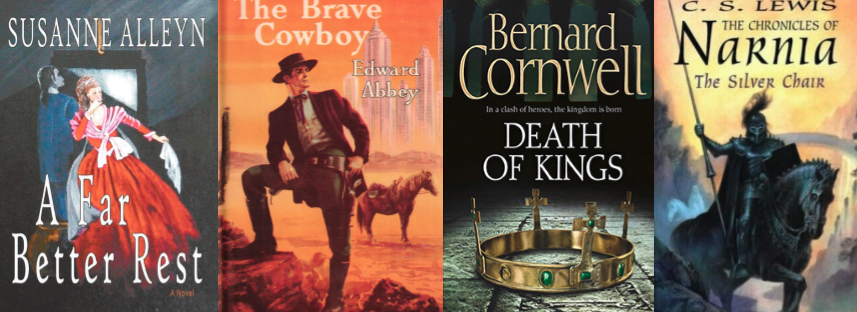
(6) Sydney Carton, Tale of Two Cities and A Far Better Rest.

The Last Book I Bought:

First into Nagasaki, George Weller. The memoirs of a reporter who snuck into southern Japan just days after the bombing of Nagasaki, when reporters were still barred from.

The Last Book I Was Given:

The Practice of the Presence of God, Father Lawrence.

The Last Book I Gave to Someone Else

The Awakening of Miss Prim, Natalia Sanmartin Fenollera

The Last Book I Started

Hitler’s Heralds: The Story of the Freikorps, Nigel Jones.

The Last Book I finished:

Kinfolk, Sean Dietrich.

The Last Book I Rated Five Stars

Kinfolk again.

The Last Book I Rated Two Stars

Video Game of the Year, Jordan Minor. A history of video games that largely ignores PC games, giving Half Life and Civilization massive disservice.

The Last Book I DNF’d

Casual Farming, sort of. I checked it out on KU but didn’t get into it. I don’t know if that counts! (It’s like someone wrote a novel based on games like Harvest Moon or StarDew Valley. I love SDV but this one wasn’t doing it for me. I’ll probably give it another shot.

The Last Book I listened To:

Technically I’ve been listening to Red Dead History, an analysis of how Red Dead Redemption II potrays the west, but the last book I finished listening to was Brent Spiner’s Fan Fiction, a fictional exaggeration about his being stalked by a fan and wooed by two twins. It was an audio drama more of an audiobook, with TNG stars like Patrick Stewart and LeVar Burton delivering their own lines.

Posted in General | Tagged , | 7 Comments

The Book Thief

Ever read a book narrated by Death? I have, sort of, only Death didn’t know he was Death. He accidentally walked into the job, but that’s another story. But this is a book narrated about Death proper, and he’ll have plenty to talk about because it’s set in Germany, on the eve of the Second World War. A young girl has just witnessed her brother unexpectedly die as her impoverished mother is surrendering her to foster care, and is forced to grow accustomed to life in a new family & place. The place is Himmel Street, a poor neighborhood in a suburb of Munich, and despite the persistent threat of poverty, Liesel will indeed find friendship and meaning — though, in her case the latter takes the form of a habit of book stealing. The Book Thief is an unusual and compelling story of friendship and the transformative potential of literature and words, set amid the outbreak of World War 2 and the beginnings of the Holocaust/Shoah.

The Book Thief has a curious structure, with frequent asides from the narrator — comments, art, definitions — and lots of overt spoiling of future events, mostly people dying. Of course, given the narrator and setting, it’s easy to assume some of the main characters will die, but we don’t know who. Even with that hanging ominously in the corner of the mind’s eye, the story is compelling and lovely: Liesel’s foster parents are two very different people, and love her in different ways (Papa is much easier to like than his wife), and they both display moral courage as Hitler’s hateful policies become visible on the streets of their city. Liesel’s friendship with a neighbor, young Rudy, is also fun: he dreams of being as fast as Jesse Owens and flirt-fights constantly with her. A key part of the novel is the family offering shelter to a young man whose father served with Papa in the Great War: Max is Jewish, and needs to hide from the state. Although this puts everyone at risk, Papa’s debt to his late comrade, as well as his immutable decency, make this hiding a moral necessity. Max and Liesel bond over books, and it is that love which saves Liesel in the end when carpet-bombing finds her town.

This is a story both sad and sweet: unforgettable, to say the least.

Highlights:

Clearly,” said Arthur, “you’re an idiot—but you’re our kind of idiot. Come on.” They were in.

“When death captures me,” the boy vowed, “he will feel my fist on his face.”

“I am stupid,” Hans Hubermann told his foster daughter. “And kind. Which makes the biggest idiot in the world.”

His soul sat up. It met me. Those kinds of souls always do—the best ones. The ones who rise up and say, “I know who you are and I am ready. Not that I want to go, of course, but I will come.” Those souls are always light because more of them have been put out. More of them have already found their way to other places. This one was sent out by the breath of an accordion, the odd taste of champagne in summer, and the art of promise-keeping.

I am haunted by humans.

Related:
The Hiding Place, Corrie ten Boom
Bomber, Len Deighton. A novel about a bombing run over a fiction village in Germany. Lauded for its technical accuracy.

Posted in historical fiction, Reviews | Tagged , , , , | 12 Comments

Kinfolk

It’s the early seventies. Come to rural Park, Alabama, a town that don’t have much goin’ on except its occasional American Legion meetings, a place that ain’t even on most maps. There’s a fella, Nub, and everyone knows he’s the town drunk who don’t mean no harm except sometimes he does silly things like mooning the cameras and peeing in pools and other stuff that makes him feel stupid when he wakes up in jail the next morning. That’s ok, though. Nub ain’t bad, he’s only bein’ hisself. He’s a good musician, can play anything with strings, but he hasn’t been doing it much lately. He’s got an ex-wife who kept him away from his daughter, a daughter who don’t realize he was an absentee father for reasons beyond his ability to change, and a powerful thirst. Nub ain’t too much satisfied with life lately, and when he’s hospitalized for running full-speed into a water tower (it’s a long story) and then roomin’ with a young teenager who keeps singin’, he finds himself inexplicably interested in her life. His timin’ is nice, because her mama just shot herself and now young Minnie’s got nobody interested in her. That especially includes the society jerk who sweet-talked her into intimacy and then left her in the family way. (That means with a baby.) There is her daddy, but he’s hidin’ in the woods from the law, and from some serious criminals he used to run around with. Kinfolk is a tragic, sweet story about family: those we’re born into, those we choose. Both of its principal characters are haunted by their parents’ suicide, and them that know Sean’s backstory will see his pain written into their lives, as will they see his wife’s own cancer scare written into the life of another character. And then, there’s gangsters who like burnin’ down houses and such if all that ordinary human drama ain’t enough for you.

I have only known Sean Dietrich as an author for barely a year and a half now, but I follow his substack and I’ve read most everything he’s written because he manages to find grace in the worst tragedies. That’s a recurring theme in in what he writes — on substack, in his novels, and in his newspaper columns. It’s especially true in this work, which presents an array of characters who are almost confusing in their abundance until they begin settling down into one another’s lives. Sean is sweet and insightful, a potent combination that means I keep buying his books to give to other people as Christmas gifts. I first encountered this side of Dietrich through is The Incredible Winston Browne, and it it’s strong here. We’re set in the small town of Park, Alabama, or — judging by Nub’s botched paint job on the water tower, Papk. There’s Nub, of course, the town drunk who makes ends meet by doing odd jobs for the city: his daughter Emily, a socialite widow who has breast cancer only no one can know it; Leigh-Anne, the barkeep down at the Legion who’s actually an AA member; Minnie, an orphan of a woman who killed herself and a career criminal; and Shug, the aforementioned criminal who nobody knows is hidin’ in the woods and attracting all manner of adverse attention to poor Minnie; and a few others. Their lives all grow together into a compelling story that ends in Dietrich’s signature mix of joy amid sorrow. It’s a good read — I began it at lunch and continued obsessively once I was off work — and depicts flawed people finding one another and growing together despite their weaknesses, simply because they are willing to put aside ego and pragmatism and just do what feels like it needs doin’. One attraction of the novel is that everyone’s flawed, most everyone knows it, but people generally love each other just the same: Emily knows her dad has his problems, but when he begins trying to be worth a damn, she resists her hope only to a point for surrendering to the hope that he might grow beyond his past limitations. And people do change — we change each other. That’s a central lesson, here.

Anyway, I liked it.

(This entire review is written under the premise, “What if Sean Dietrich Wrote A Book Review?”)

Some quotes and highlights:

“Is this the same man who once danced on the bar wearing a lampshade as a hat?”
“I never did that.” She just looked at him.
“It was a cardboard box,” he said. “Not a lampshade.”

“Benny,” said Nub. “Don’t take this the wrong way, but you’re kind of embarrassing me.”
“Thanks. That means a lot coming from a professional.”

“I’m just trying to act right; that’s all I can do. Act. I think I’ve finally learned that you can’t think your way into the right action but you can act your way into the right thinking”

Even in dire circumstances when it would have served him better to be disingenuous, Nub Taylor was sincere. His greatest quality, however, was that he had the audacity to be himself, for better or worse. Something she could never do. She was too busy being other people.

“Well, I didn’t want her first meal in this house to be pork and beans with ketchup.” “That’s not fair. We were going to have Hamburger Helper.”

“You mean you ain’t going to drink no more?”
“I mean I’m taking it one day at a time.”
“But if you don’t drink no more, then how come you got beer in your refrigerator?” “Hard to say goodbye.”
“And you got a lot of whiskey under your kitchen sink too.”
“What are you, the Southern Baptist Convention?”

It was a sacred melody of the heart. A human being spends most of his or her life hiding behind things, hiding behind their own words, pretending to feel ways they don’t really feel, trying to convince themselves that everything is okay. But if you want to know what’s truly on someone’s mind, what’s eating them inside, you pay attention to what they sing about. The truth always comes out in music.

“But you know what?” Nub went on. “I’ll get over my embarrassment. Because if there’s one thing I’ve learned, it’s that you can’t save your ass and your face at the same time.”

The two deputies looked at each other. “Anything you can tell us might be helpful,” said Burke.
“Okay. Deer mice are the most common mammal in North America.”

But then, life was full of overlooked miracles. And miracles never happen the way you expect them to. They are softer than a baby’s breath. They are, at times, as noticeable as a ladybug. A miracle is not a big thing. A miracle is millions and millions of small things working together. But then, this didn’t matter. Not really. Because Minnie had come to believe that life was not about finding miracles, or happiness, or success, or purpose, nor was it about avoiding disappointment. It was about finding people. People are what make life worth it. People are the buried treasure. People who understand you. People who will bleed with you. People who make your life richer. Your people. Your kinfolk.

Music:

There’s a lot of old-time country and southern gospel tunes sung in this book, so here you go for flavor:

Roy Acuff (and cheating a bit with June Carter)

And Hank, of course. The legend.
Posted in Reviews | Tagged , , , , | 6 Comments

WWW Wednesday

WHAT are you reading now? The Book Thief, Markus Zusak. Needed a print book to read at lunch (I hate staring at my phone like everyone else) and after tackling Mount TBR I’ve precious few left. This proved absorbing.

WHAT have you recently read? Kinfolk, Sean Dietrich. Lovely small-town southern story set in the 1970s.

WHAT are you reading next? I really need to finish either of my volcanos books. Or A Princess of Mars. Yes, really, One Science Fiction Book Bingo category is ‘a book more than 100 years old’, and I’ve read most of the classics like Wells and Verne and Shelley already.

Posted in General | Tagged , | 5 Comments