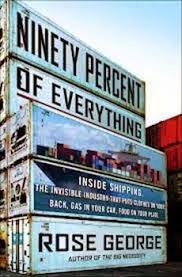
Ninety Percent of Everything

Ninety Percent of Everything:  Inside Shipping, the Invisible Industry That Puts Clothes on Your Back, Gas in Your Car, and Food on Your Plate.
© 2013 Rose George
287 pages

UK Title: Deep Sea and Foreign Going: Inside Shipping […]


What is 1300 feet long, travels the distance to the Moon nearly annually, and is nigh-invisible? The answer is any container ship, fleets of which convey the overwhelming majority of all goods traded between cities and continents, but which most people never think about.  This may be so because so few people work in modern sea-shipping, or because in the age of terrorism ports are severed from the cities they serve, blocked away by miles of walls and checkpoints.  In Ninety Percent of Everything, journalist Helen George spends several months aboard a ship owned by Maersk, a Danish commercial giant,  meeting the men and women who keep the fleets float in an effort to understand their experience and the importance of the shipping enterprise in the 21st century.

Like the containers the ships are filled with, Ninety Percent is a glorious grab-bag of topics; a little history, a little science, a little travel, a little military action on the high seas.  The Maersk Kendal, George’s home for most of the trip, is lead by Captain Glenn, a man who lived through the revolution in shipping that followed “the Box”, or the advent of containerization. Once a young seaman on a tramp steamer that moved from port to port, picking up small articles,  he witnessed the death of old harbors that were closed to make room for the far larger equipment needed to handle the containers. He is a romantic figure who can navigate the seven seas on a sextant alone, even if the march of time has forced him to spend his days a wheelhouse that resembles a computer lab.  Steaming from city to city, through monsoons and canals, ships like his can arrive in a harbor and completely turn over hundreds or thousands of containers in less than 24 hours  before departing into the night. 


The seamen’s experience remains as it has for thousands of years — lonely, dangerous, and often boring.  The views from the ship are of nothing but a long expanse of boxes piled another, and the work is similarly dull for most,  constantly cleaning and painting the ship, or tending the house-sized engine.  Most sailors come from developing countries the world over, and especially from the Philippines since their ability to speak English is prized. Dismal and unnoted as the work is, like most jobs it’s better than starving. As the captain of the Kendal laments, even today when the fast container ships have reduced the globe from the world to a village, their crews are treated like the ‘mere scum of the earth’.  Ms. George  also includes a segment spent on a military vessel hunting Somalian pirates (taking a decidedly unromantic attitude towards the sea-going thugs who are the object of so much fascination by the western press), and visits a portside organization that does its best to ameliorate the condition of the sailors, offering them counseling and sending them goods from home.  Although the book concerns modern shipping, George keeps it grounded in history as she can, retelling the story of World War 2’s merchant marine sailors who endured the same danger for the same purpose as the Navy, but with little honor or compensation rendered.  One positive aspect of the sailors’ experience is their time spent in the company of the sea’s abundance of life, especially dolphins 


Ninety Percent of Everything succeeds in going aboard the massive machine that is a container ship and giving its lifeless expanse of hull and rows of containers a human face;  for all the automation, the sealanes still remain the province of sailors who have brain enough to engineer solutions against fickle winds and waves. While George doesn’t spend a great deal of time about the mechanics of shipping (nor should she, seeing how that territory was well done in The Box),  her account of the human side makes for fantastic reading. Her Yorkshire ancestors would surely be pleased. 


Posted in Reviews | Tagged , , , , , , , , , | 4 Comments

Teaser Tuesday (20 May)

     “Sometimes all a reader can do is sit back and watch the words go by:

The same arrested relay of emulative métis underlies Oydessean architectural theory. For in the female invention ‘of making threats adhere to one another’ is also the beginning of architecture. The Vitruvian myth of aboriginal architects ‘imitating’ the weaving and daubing of birds’ nests continues a widespread aetiology. (A.L.T. Bergen, ‘The (Re)Marriage of Penelope and Odysseus: Architecture Gender Philosophy, A Homeric Dialogue’ in The Ages of Homer, J.B. Carter and S.P. Morris, eds. [Austin, 1995], p. 210)

     It is hard to know whether we are reading about Homer or poring over the Time-Life series on home remodeling.”

p. 138, Who Killed Homer? The Demise of Classical Education and the Recovery of Greek Wisdom, Victor Davis Hanson and John Heath

Posted in quotations | Tagged , | 4 Comments

The Last Patriot

The Last Terrorist
© 2008 Brad Thor
352 pages
The Last Patriottakes a modern covert-cops thriller and combines it with The DaVinci Code, though the sinister establishment being threatened by some archaeological find is not the Church of Rome, but global Islam.  The novel opens with a car bomb exploding in Paris, its target an American historian in the employ of the US president.  “President Rutledge” hopes to shake Islam at its base by revealing the Last Revelation of Muhammad, for which the prophet was supposedly assassinated.  The nature of that revelation is evidently seriously enough  that angry Muslim villains employ a US secret agent turned terrorist to kill anyone who might know about it. Unfortunately for him, Rutledge has a whole band of terrist-fightin’ secret agent men of his own, and they go ‘round and ‘round throughout the novel killing people until the final reveal.

Although I’d hoped for an exciting military or political thriller set in the mid-east, most of the action takes place in either Paris or D.C. The fantastic plot beggars belief, between the amount of clues tied up in Thomas Jefferson’s architectural work, and all of the characters seriously believing that a document changing their beliefs about the Koran would diminish global terrorism. The story climaxes at Jefferson’s privately-designed estate, where clues in its design lead to the location of the final revelation’s hiding place, National Treasure-like. The stuttering hostility toward Islam doesn’t help, with the general avowing that global Islam is the worst thing ever being occasionally disrupted by characters blandly mentioning that it’s radical Islam they hate, not Islam in general). Aside from the technology and some of the American characters, there’s not a lot of believably here: Left Behind had more credible Muslims.   I’m not entirely sure what the title even has to do with the plot; it seems a generic America vs Evil Muslims tale with some Founding Father resonance thrown in. 
Posted in Reviews | Tagged , | Leave a comment

The White War

 The White War: Life and Death on the Italian Front, 1915-1919
©  Mark Thompson
488 pages


By 1915, what began as a conflict between Austria and Serbia had broadened into the Great War, whose largest contenders were not parties to the initial dispute. The war became truly global as countries the world over joined the Allies or the Central Powers, using the struggle to pursue their own ends; such was the case with Japan, which declared war on Germany not to avenge Belgium, but to snatch up  the Kaiser’s Asian colonies.  Closer to the heart of the battle was Italy’s role in the fray; although the recently-unified kingdom began 1914 in a defensive alliance with both Austria and Germany,  it delayed entry while it considered better alternatives. Finally deciding that reclaiming more of its ‘historic’ territory from its border was better than attacking France for no reason at all, Italy entered into the war in the early summer of its second year. So began five years of tragedy, creating a victory as sad as any loss. Such is the story of The White War, which is excellent even though disheartening.

            I have previously regarded the butchery of the Somme as the Great War’s most depressing moment, but it now has a rival, for the Italian front reads like one long prolonged experience of the Somme. The star and culprit of the show is General Cadorna, a man who was invested with considerable power and claimed even more as the war progressed, who launched ten successive attempts at the same Austrian lines over the course of two years with precious little to show for his efforts. Despite enjoying considerable advantages in men and material, the Italian army under Cardona’s command gave new meaning to SNAFU, never learning to adapt to the new style of warfare, not even incorporating lessons from its allies on the western front.  So extraordinarily bad is Cardona at waging war that the Austrian army, in other accounts and fronts lampooned for its own failures, appears focused, potent, and grimly efficient by comparison.  Only when the Austrians launch an attack that destroys all of the blood-won progress of the three years preceding, and even threaten Venice, is Cardona sacked and the Italian army saved.  Reorganizing and pushing forward, the Italians won their greatest victories only when peace talks  were already in progress, and the terms being penciled in – but even then, Italy’s redemption was squandered by its own leaders’ politicking,  For all of its millions lost, Italy ended the war despised by Europe and already at daggers with its new neighbors, the Slavic nations.

It’s a sad, frustrating story, but a story easy to experience as delivered by Mark Thompson. He’s more personable than scholarly, sometimes relaxing into a present-tense narrative of the war that would no doubt annoy history professors insisting on a more objective and consistent residence in the past tense.  Italy makes for a fascinating front, as the mountains and hills between it and the Austro-Hungarian border are far different terrain than the plains of Flanders field.  The text is supplemented by maps that make the difficult terrain’s role easier to see, but The White War is more than combat. Beginning with Italy’s extensive diplomatic dickering,   it pauses from the action throughout to offer looks at the home front, or other aspects of the Italian experience. These excerpts reveal the relatively new nation fracturing under the stress of war, stress made worse by Cadorna’s heavy-handed approach. It’s an old joke that “beatings will continue until morale improves”, but such was Cardorna’s practice;  outraged by the lack of disincline among the army, he reinstituted the Roman practice of decimation (deliberating killing every tenth man in a unit to punish it), treated prisoners as traitors, and punished even civilians for being less than enthusiastic about the war.

The White War commends itself to those interested in learning about the Italian experience, even if that experience showcases the most frustrating and horrific aspects of the conflict. 


Posted in history, Reviews | Tagged , , , , , | 3 Comments

Human Scale

Human Scale
© 1980 Kirkpatrick Sale
500 pages      

      Human Scale is an ambitious assault on big business, big government — the very concept of Bigness. Opening with biology, Kirkpatrick Sale first establishes his basic operating principle:  for everything, there is a limit to its size beyond which it cannot grow without being compromised. In its opening third, Human Scale addresses the problems inherent in large, complex systems, then follows that with sections on how society, economy, and politics might function more effectively if scaled down.  On the hefty side itself, Human Scale impresses with its thoroughness; a kindred spirit to E.F. Schumacher’s small is beautiful,  the book has largely stood the test of time in putting forth a case for decentralized politics, appropriate technology,  organic locally grown agriculture, and cities and buildings built to the human scale.  Sale creates a synthesis from topics as varying as demographics and aesthetics.. It is at times dated, at least in its optimistic projections for solar energy efficiency.  On the whole, however, it offers insight into government dysfunction and widespread social problems, along with ways people can work to effect change themselves. It is almost an anarchist how-to, a review of ways people can reclaim their lives against the power of centralization, and its enduring relevance is proven in the multitude of authors still advancing its ideas, a number that includes Bill McKibben and Wendell Berry.

Posted in Reviews, Society and Culture | Tagged , , , , , , , , , , , , , , , | 2 Comments

This week: commerce, trade, and shipping

This past week at the library I’ve been mostly reading into commerce and trade, and reviews are posted or will be for all except for Point of Purchase, a “history of how shopping changed America”.  This was a history of American shopping, largely, with some attempt to read meaning into browsing and acquisition;  Consumers’ Republic did that better.  My most recent read was Ninety Percent of Everything, a library book I imagine I’ll end up buying since I dropped it onto a rain-soaked pavement and then splashed coffee onto it for good measure. I wouldn’t mind owning it, as it made for a fantastic read. At least I didn’t overturn an entire glass of milk onto it as in eighth  grade, when I utterly ruined a copy of For Whom the Bell Tolls.  I’m not usually this abusive to books, honest.

Currently I’m engrossed in The White War, a history of the Italo-Austrian front of the Great War. It’s quite impressive so far. Next in the Great War books will be one on airplanes or ships, I think, and then I’ll examine the Eastern Front. Those interested in the war may find a recently-created Twitter handle of note; “RealTimeWW1” will be posting ‘news articles’ from the war. Presently the fighting hasn’t broken out yet. There were a couple of WW1 books on NetGalleys I was hoping to read, but I’m told the advanced review copies are reserved for English-types. Alas. (It’s been ages since I read anything from NetGalleys; the last might have well been To End All Wars, on anti-war action in England during the conflict.)

Reviews are  in the works for for Human Scale and Away Down South. 

Books in the “News”
Today’s Econtalk podcast features an interview with Chuck Marohn, author of “Building Strong Towns“.  Considering that I listen to both of their shows weekly, today’s is a special delight. 
The most recent episode of AstronomyCast features an interview with Phil Plait on the topic, “The Universe is Trying to Kill You”. Dr. Plait draws from his book, Death from the Skies. 
Posted in Reviews | Tagged , , | 2 Comments

A Splendid Exchange

A Splendid Exchange: How Trade Shaped the World
© 2009 David Bernstein
496 pages


  History oft moves with the caravans and trade fleets, and its journeys along the routes  of the past and present are given a storied account in A Splendid Exchange. Beginning in ancient Sumer and moving forward to the present day, David Bernstein demonstrates how the lust for goods from afar has linked cities and states together, and driven them apart. The narrative corners nearly every corner of the globe, Antarctica excepting, and ripens into a tentative argument for free trade, though its author isn’t too insistent. Bernstein brings a lot to the table; he’s a personable author, sometimes wandering off on side-roads but for never too long, and usually delivering something valuable to the reader as a reward for gamely enduring:  understanding of how air compressors work, for instance, or what is meant by the economic phrase, comparative advantage.  He creates in A Splendid Exchange  a marvelously varied history book, following the tale of  trade through city-states to nation-empires, from the middle east to South America — but as varied as it is, no matter the diversity of goods being traded or fought over, the narrative flows seamlessly aside from a jump in the 20th century.  Those goods range from the exotic to the mundane;  table elements we now take for granted have had far more interesting past lives. Readers may well know that sugar, spice, and all things nice are everything little girls are made of – but they’re also the stuff of world empires and bitter grudges. 
The importance of trade routes affirms the importance of geography; many of the straits endlessly fought over throughout the book remain heavily in use today, underscoring the relevance of the various trading empires’ rise and fall.  The same trading routes the Dutch and Portuguese  shot their hearts out as cannons attempting to secure are the ones we employ to transport oil, no mere luxury. Our entire global economy is lubricated by trade, which is why Bernstein cautiously presents arguments for freeing it up, with caveats.  A Splendid Exchange strikes me as popular history at its finest; varied but cohesive, fun to read but intelligently argued and obviously relevant to our contemporary experience. 


Related:

Posted in history, Reviews | Tagged , , , , , , , , , , , , | 2 Comments

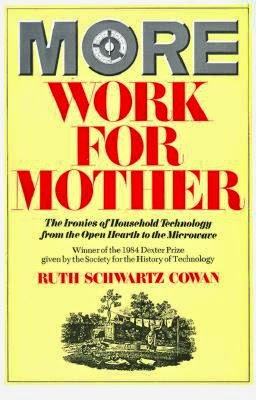
More Work for Mother

More Work for Mother: the Ironies of American Housework

© 1985 Ruth Cowan           
288 pages


       Throughout the 20thcentury,  households were transformed by a new abundance of labor-saving devices, from washing machines to toaster ovens, and processed goods that reduced housewives’ workloads, leaving them free to learn trades and professions of their own and fully participate in the modern world.  But in the second decade of the 21st century, American women are just as  chore-taxed as ever, lamenting of the ‘second shift’ that awaits them upon arriving home. Despite the many machines now investing our homes,  most of the work still has to be done by hand, for Parkinson’s Law holds true there as well as anywhere  else: work expands to fill the time available for its completion. In More Work for Mother, author Ruth Cowan demonstrates how gadgets and goods created new work while eliminating others, and argues that women will not be free from drudgery until housework is freed from the realm of ‘femininity’ to the point that men won’t feel emasculated by laundry.

            The devices and goods of the 19thand 20th century – refrigerators, washing machines, microwaves,  convenient bags of flour, even more convenient no-bake cheesecake mixes, even more convenient instant cereal —  did indeed reduce a lot of labor. In fact, for men they reduced virtually all household work.  More Work for Other opens with a history of housework. Although modern readers might  be aware that women’s traditional role was in the home, men’s traditional role was in the home, as well;  prior to industrialism, men didn’t pack a lunch pail and disappear into the country for a day at work. The home and the work of most families were intimately connected,  typically inseparable. Women may have baked bread, but it was men who gathered and ground it;  women may have washed clothes, but men chopped the wood and let children lug in the water.  But while men’s roles in the household largely vanished, women found that work remained constant.  The availability of affordable clothing reduced the need for sewing and repairing, but increased the burden of laundry, and standards of cleanliness climbed as the ability to clean increased. Laundry and scrubbing agents meant that minor stains could no longer be tolerated, necessitating near-daily cleaning regimens.  And those new labor-saving devices were often fragile things, needing frequent cleaning to avoid their works being gummed up.  Additionally, for middle class or wealthier women, the availability of do-it-yourself machines meant that retaining maids and other servants was a sinful waste – never mind that doing it themselves meant more hours of their own time spent doing the labor, regardless of advertisers’ claims of quick ease-of-use.   There  were options that might have truly revolutionized household chores –  commercial kitchens with thrice-daily delivery,  commercial laundries, cooperatives, apartment hotels – but most fell by the wayside, either because of cultural imperatives or because of market forces.  
         Although not as sweeping as Susan Strasser’s Never Done,  what’s lost in extensive narrative is replaced by more serious analysis and an abundance of good points made. Cowan notes, for instance, that the increase of standardized products destroyed easy class differences:  while in the mid-19th century a street urchin and the scion of a wealthy businessman would look as different as night and day just judging from their clothes’ cleanliness, today both could wear the same products, and the fact that vitually all homes have water and heating means that no one is denied the ability to shower every day.  The interior of homes, too, are far closer than they once were; the absence of gadgets and electricity might have once marked a hovel, but these days not even campers will tolerate going without a refrigerator.  Her driving point is that the fact that homes are now filled with gadgets and manufactured articles doesn’t mean that homes are no longer productive; mothers are still ‘producing’ clean bathrooms, fed children,  and presentable clothing. If the labor women perform was priced as though they were in the open market, people would never assume homemaking to be unproductive. Ultimately, Cowan believes women will be freed from drudgery only when we relax fanatic standards regarding cleanliness and the housework that remains is stripped, through cultural or technological means, of its traditionally female association so that men will pitch in more.  If that argument, made in 1985, has lost some of its edge in a 21st century peopled by “Mr.Moms” , most of the work has not.


Posted in history, Reviews | Tagged , , , , , , , , | Leave a comment

Progress so far, and another announcement

Four months into my “Great War” yearly theme, I’ve managed to stay true to my intention of reading one book a month on it.  Only two of the books so far have come from my original list,  as I supplemented them with a novel set in the colonial war in Africa and Louisa Thomas’s Conscience.  I made an attempt at Under Fire, but found the translation difficult going. I may try again, as I’ve intended to read the book for years.   In spite of being technically on track, I’m not particularly satisfied with my progress so far because I’ve not covered any serious new territory. There’s still eight months left, though, and my next couple of reads will more sharply focused.

  1. The First World War, John Keegan
  2. La Feu (Under Fire), Henri Barbusse
  3. The Great War in Modern Memory, Paul Fussell
  4. The Great War at Sea, Richard Hough
  5. To Crown the Waves: The Great Navies of the First World War, ed. Vincent O’Hara et al
  6. Wipers: A Soldier’s Tale from the Great War, Jeff Simmons
  7. Forgotten Voices of the Great War, Max Arthur
  8. The Eastern Front, Norman Stone
  9. Rites of Spring: the Great War  and the Birth of the Modern Age, Modris Eksteins
  10. World War 1 Companion, Mathias Strohn, editor.
  11. Collision of Empires, Prit Buttar
  12. Silent Night,  Stanley Weintraub
+  An Ice Cream War, William Boyd
+ Conscience, Louisa Thomas

I realized recently that I have ten titles, purchased over the last few years, that I’ve not yet read. Since ten is a number that commands respect, I’ve decided to impose a moratorium on myself. No more acquisitions until those ten are read or until they spontaneously combust.

    1. Power, Inc; David Rothkopf
    2. Antifragile, Nassim Nicholas Taleb
    3. The Vikings, Robert Ferguson
    4. Small-Mart Revolution, Michael Shuman
    5. The World Until Yesterday, Jared Diamond
    6. Fighting Traffic: the Dawn of the Motor Age in the American City, Peter Norton
    7. Earth, Richard Fortey
    8. Age of Empathy, Frans de Waal
    9. Galileo’s Finger, Peter Atkins
    10. Star Trek the Fall: Revelation and Dust, David Mack
     I’ll still be patronizing my library, and heavily, I just won’t be buying anything. Technically I have a lot more unread purchased books, but several dozen Trek paperbacks purchased in a box for $10 four years ago doesn’t quite count.  My aim is to clear this to-be-read list in a few months, but considering how many library books  I can distract myself with, I may not accomplish anything other than saving money. Only time will tell! 
    Posted in General | Tagged , | 10 Comments

    Conscience

    Conscience: Two Pacifists, Two Soldiers, One Family
    © 2012 Louisa Thomas
    336 pages

    How does a pious young Presbyterian minister become a six-time candidate for the Socialist party? Such is the story of Conscience,  the story of Norman Thomas and his younger brother Evan, who would go to seminary as conventional Presbyterians and emerge radicals whose faith  found truer expression in political idealism than Christian worship. The promised tension between brothers is wholly overstated, as Conscience concerns Norman and Evan’s struggle to find a way to live as authentic Christians in a world of violence and poverty.  Unable to accept religious claims on their face, and deeply unhappy with the response of Christians in general to the problems of the world around them — platitudes and minor alms for the poor, enthusiastic support for the horror of the Great War — both grew further from Christianity and more politically radical as the years wore on.  Although both eventually become ardent pacifists,  to the discomfort of their family  and institutions which bore them,  in each political activism takes different forms. Young Evan’s zeal took hold early,  his high, strident ideals are so resolute he can make no concessions anywhere, and develops something of a martyrdom complex as a conscientious objector. Norman’s own radicalism was slower to ripen; as pastor of a church with a growing family, he sought to effect  change through the political system rather than his brother’s active protests.

    The piquancy of Conscience is how the brothers came to their respective positions, considering their very conventional background; their family was stolidly middle class and the boys were elevated into the elite Princeton University and its social clubs through their own scholarship.  This was an era of tremendous social and political upheaval, a time in which comfortable politics-as-usual was giving way to demands for action by the populists and progressives.  Louisa Thomas well delivers a sense of the changing spirit of the times, its energy impacting the lives of all who are involved. She draws largely on letters within the family, a feat made easy by merit of her being Norman Thomas’s great-granddaughter. She is thus tender to her subjects, though it would be hard not to be considering their commitment to justice and peace; Norman is especially sympathetic, not being quite so much the puritan,  and torn between old loyalties (to his mentor, Woodrow Wilson, who ran on an anti-war campaign and then locked up people like Evan for protesting when he joined in) and new expressions of old values.   Conscience is thus a fascinating look into the souls of two young men during one of the west’s darkest moments.

    Posted in Reviews | Tagged , , , , | 1 Comment