The Eagle’s Conquest

The Eagle’s Conquest
© 2002 Simon Scarrow
320 pages


In Under the Eagle,  Simon Scarrow introduced readers to two legionnaires:  Macro, a grizzled veteran, and Cato, a young bookish sort straight from Rome , a boy made an officer  because of his father’s influence. No one though Cato would make it as a soldier, let alone as a leader of men, but in Germania and the beginning of the invasion of Britain he proved himself. Now the Romans are moving further inland, where some scattered tribes are uniting under  the Catuvellauni banner, whose leader intends to crush the small but stubborn invasion force.  In The Eagle’s Conquest,  Rome struggles to make a decisive strike against the barbarian horde,  even as our two officers find evidence that points toward someone within Rome working to undermine the invasion. Worse yet, the Emperor is coming to take personal charge of the campaign, and Rome’s enemies may find the murky bogs and chaotic wilderness of Britain an ideal spot to induce a little regime change.  As the plot thickens, Rome’s forces crashes through thickets and wade through bogs, constantly fighting the natives and hovering on the verge of utter fatigue.   Rome’s goal is to crush the opposing army outright, as other as-yet neutral tribes may join if the legions falter; their opponent, however, stays on the run and likes to rest near terrain that puts paid to any ideas about maintaining any kind of troop cohesion.  Cato continues to mature as a man, taking command of his entire cohort during an especially frantic bit of fighting and  vying with a personal enemy within the ranks, one who costs him dearly. Humor abounds, more in the dialogue than with physical humor this time, and the author unintentionally adds to this by writing the invading Romans in his own vernacular. It’s “bloody hell” this, and “jolly good” that,   as our Roman chaps brave painted stinking hordes,   a landscape not kind to invading armies, and the fickleness of woman.  The book ends with one word – “Boudica” – that promises all kinds of fun to come.  
Posted in historical fiction, Reviews | Tagged , , , , , , | 4 Comments

Here be Dragons


Here be Dragons

© 1985 Sharon Penman
700 pages             


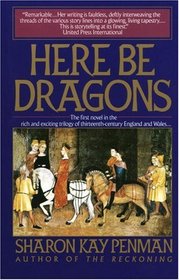
 Here Be Dragons takes readers to the Welsh Marches in 13th century England. King John, remembered for losing England’s ancestral holdings in France and being gelded by his own barons via the Great Charter , reigns. His struggles with the powers of Europe are not limited to the Continent, however, for restive Wales is far from defeated. The Welsh stand apart,  increasingly united under one very savvy and battle-hardened prince, and not even the marriage of John’s daughter to said prince will neutralize them.  Although this is first in a trilogy about the feuding brothers of the prince, Here be Dragons is wholly dominated by the relationship between King John,  Llewyln of Wales, and Joanna – the woman who stood between them.  John’s illegitimate daughter and Llewyln’s unpopular Norman wife, Joanna will spent decades trying to keep the peace between the two in a feud that becomes increasingly bitter. The appeal of the novel is the balancing act she plays between two more or less sympathetic men in opposition, though both have faults and John is far harder to redeem. (Such a feat is made possibly only by having a narrator who sees him as kindly father who rescues her from impoverished bastardy.)  After John’s demise, the similarly acrimonious relationship between Joanna, her eldest stepson Gruffydd, and her natural son Dafvdd,  rises to the top.  It’s a basic case of sibling rivalry, with Gruffydd loathing his half-Norman half-brother and fearing that the influence of  the “Norman witch” will lead young Dafydd to usurp him as the heir apparent.   The writing consists largely of characters talking or arguing, interspersed with bits of historic and cultural background information filling in gaps.  There’s more nonfictional narrative than fictional, but Joanna’s ordeal – and the spotlight on Wales’ powers —   help overcome that, at least for the first five hundred pages. (After that the arguments and mini-lectures on Welsh history grow wearisome, but happily there’s a late-game catastrophic failure of moral judgment to infuse some drama into the plot.)  For the reader who doesn’t mind a novel that’s half nonfiction, Here be Dragons offers a rare look at the Plantagenet from both inside and out.
Posted in historical fiction, Reviews | Tagged , , , , | 2 Comments

Ornament of the World

Ornament of the World: How Muslims, Jews, and Christians Created a Culture of Tolerance in Medieval Spain
© 2002 Maria Rose Menocal
315 pages


  Ornament of the World is the story of a unique civilization in medieval Europe, one which ultimately disintegrated but left a hopeful legacy. For hundreds of years, Europe hosted a distinctly Islamic polity: Andalusia, the last stand of the Umayyads. The inheritors of Muhammad’s empire, they were driven out by a palace coup and reestablished themselves across the Mediterranean, building a glorious realm of their own.  They brought the best of an ascendant civilization and combined it with the remnants of the classical world; theirs was a world of fusion which allowed not only Muslims, but Christians and Jews to flourish and contribute as well. Ornament covers a thousand years of Spanish history, mixing literature, art, and politics to deliver with flourish the story of a lost but golden age.  Though heavily romanticized, the author’s  lovestruck tone makes it an enticing introduction to medieval Spain.

 In subject and intent, Ornament is quite similar to A Vanished World, but much tidier. It begins, for instance,  with the rise of Islam, and from there moves forward in the time-honored chronological fashion. Following the death of Muhammad, leadership of the Islamic polity fell to a series of caliphs, one of whom – Ali – was especially consequential. Under his reign, the Umayyad caliphate,  Islam expanded in leaps and bounds. Success ever breeds resentment, however and Ali found himself murdered along with much of his family. A minor relation fled to Spain and there begins the story of Andalusia. Amid the first Muslim civil war, however, the princeling didn’t come alone. He and his followers found Iberia ripe for the picking,  and in a matter of time had conquered most of the peninsula.  “Woe to the vanquished!” was not the case, however, as the resident Christian and Jewish populations found themselves officially protected by the new state- – for a small consideration, of course.  Al-andalusia and its capital of Cordoba would go so resplendent that a later successor would presume to claim himself the Caliph, the princeps of Islam..  Islamic politics would be their undoing however; another faction would rebel against the reigning Abassids and make their stronghold in Tunis, just a stone’s throw from Iberia.  When the Umayyads later sought help from the north African Muslims against the resurgent Christians, their allies found their Spanish brethren much too decadent and proceeded to wreck and take over the place, Fourth Crusade style.
The loss of unity following the Umayyads did not destroy the creative culture they established, however; instead, leading city-states competed to out-do the other to restore that glory, just as after the fall of Rome states like Venice, Genoa, and Florence competed against the other. While the Italians engaged in petty wars and magnificent frescoes, the Moors engaged in petty wars and mesmerizing poetry.  Menocal has done prior work on Arabic literature, so not surprisingly language, prose, and verse receive a lot of attention.  The emphasis on literature extends to the Christians and Jews;  Hebrew adopted elements of Arabic verse and flourished in its own right. This was a period of intercultural collaboration;  in Toledo, for instance, Arabic and Jewish scholars worked on translating Aristotelian texts, which then drifted into Europe, replete with commentaries. Just as Muslim mosques and fortresses in Iberia began with Roman bones — so did resurgent Christian powers adopt elements of Arabic architecture, even in areas where the Umayyads and their successors never reigned.  Eventually the Castille-Aragon alliance would overwhelm the predominately Moorish south, effecting the Reconquest
Ornament compares well to its sister-rival, Vanished World;  for instance, the Muslim sack of Compostela,  which appeared rather randomly in Vanished, features here as part of the Umayyads’s  Iberian downfall.The same general who leads a military coup against them also attacked the Christian shrine. This same episode also accounts for the contrasting versions of St. James – one meek and mild, the other the Muslim-slayer.  After his shrine was desecrated and his pilgrims murdered, the peaceful James returned to have his revenge. Hell hath no fury like a saint scorned!  This covers nearly a thousand years of history in a mere three hundred pages, though, and a lot of that is taken up with swooning over literature and poetry;  this is utterly enjoyable, of course, but it does meant that the political sketch is an outline at best, so this is by no means a complete story. It is a loving tribute to the life of art and philosophy that found a home in Islamic Spain, however.

Posted in history, Reviews | Tagged , , , , , , | 2 Comments

The Quartet

The Quartet: Orchestrating the Second American Revolution, 1783 – 1789
© 2015 Joseph Ellis
320 pages


How many men does it take to make a revolution? The American Revolution is usually taken to include the rising animus against the political authority of Great Britain,  a desire for independence, and the war against Britain itself. The revolution did not create an independent American nation, however; it created thirteen. United in common cause against the armies of Parliament, peacetime threatened to cause dissolution. The liabilities of the Articles of Confederation, and the threat of the American seaboard becoming some Italian-like quilt of squabbling chiefdoms,,   prompted some of the states’ leading lights to vie not only for stronger ties between  the states, but for the creation of a more cohesive nation.  In The Quartet,  veteran Revolution historian Joseph Ellis examines the role of four particular men in effecting a transformational shift in American politics, forging a new American nation out of thirteen. What they created was only the beginning of that union, but it was enough. Here delivered is a history of the Constitutional convention, told through the men who made it so.

Argue as we may over the question of where sovereignty ultimately lies – with the States, or with the national government —   prior to the Constitution no one doubted that the states were sovereign. The Articles of Confederation, written to facilitate the war effort between the colonies-turned-states, gave the central authority virtually no muscle.  Genuine authority lay in the States and their respective armies, which frustrated to no end those tasked with the confederation’s  responsibilities.  Roger Morrison, for instance, initially tasked with getting the fledgling republic’s financial house in order, found virtually no support. The States balked at the smallest contributions, either from short-sighted shrewdness or long-term paranoia.   The states’ refusal to help with national provisions,  even to pay the soldiers who carried the hope of the rebellion on their shoulders,  nearly lead to a militia coup. Only the charisma of George Washington prevented matters from taking a tragic turn;  it would not be the last time his shoulders bore the weight of the American enterprise. .John Jay was likewise frustrated trying to arrange treaties, as the States insisted on making their own. Europe gazed across the Atlantic and viewed the new project with derision,  almost taking bets on when the states would go their own way.
The Articles were failing to make the American project a go,  but this was an age of ambitious and remarkably intelligent men willingly to be bold with their and other people’s fortunes. Having taken readers through the stresspoints of the Articles, Ellis shifts to the effort that Madison and Hamilton spearheaded to call a convention to amend the Articles, a convention that replace them altogether. This took some doing; many Americans were quite happy with an impotent central government. Virginians didn’t want to be saddled with other states’ debts, and Rhode Island didn’t want New York and other large states pushing it around. Any effort to strengthen an outside authority — a foreign power — smacked of tyranny.  Hamilton, Jay, and company were looking ahead, however; they saw that the world’s future lay in the  American frontier, and the states needed to work together if that was to be taken advantage of. At the first attempt in Annapolis to gather a convention, most of the states were no-shows.  But Washington himself supported the cause, and Madison came to the second convention prepared to argue the case for a Constitution. Washington was the trump card, the demigod who imbued the cause with moral authority; he even circulated the odd letter to lend active support. Madison stayed on the floor throughout the constitutional process, and afterwards he and Hamilton — with a little help from John Jay — took up the pen to argue for its ratification in New York. Washington remained vital to the constitutional cause even after it was written, signed, and ratified; if the nation’s first president were anyone but — if the electors faltered and put an anti-federalist anywhere near the executive seat — all efforts might be forfeit.   Here Hamilton plays another part, influencing the election to ensure that John Adams didn’t come close to threatening Washington’s victory.  Eventually the Federalists would be routed in what Thomas Jefferson referred to as ‘the second American revolution’ — his election — by then the course of the nation was set. 
The Quartet is classic Ellis, seeing history as made by the actions of individual actors, not the inevitable outcome of enormous socio-economic reactions. Ellis’ creates an intimate history, one ruled by personal relationships; one chapter called “The Courting” speaks of Washington’s seduction and consummation by Jay and Madison into the nationalist cause.  While the four aren’t as tightly-knitted together as the title suggests (“orchestrating” the revolution as if they were a conspiracy with an intricate plan),  their unity at an opportune moment caused a sea change in American political history.  Though favoring the Federalist cause, Ellis doesn’t too much overplay his hand: he points out for instance that the Federalist Papers only have limited use, being the propaganda work of the nation’s most avowed nationalists, and written for a particular New York audience.  His emphasis on relationships does prompt a misread of Madison’s character:  while prior to the Revolution, Madison argued for the Federalists and a national union; afterwards he was the darling of the Democratic-Republican cause against Federalism. Ellis sees this as entirely the result of Jefferson returning to America and Madison abandoning his ideas to support his mentor, as if Madison wasn’t capable of having nuanced political sensibilities that supported a golden mean between centralization and anarchy.  These are slight quibbles, however; Ellis has yet again produced an enthralling political drama, perfect for a quick dip into Revolutionary history. 
Related:
Madison and the Making of America, Kevin Gutzman, focusing entirely on this Constitutional Convention where Madison played center stage.
Founding Brothers,  Joseph Ellis.   Of all the Ellis I’ve read, this places the most emphasis on political relationships. 
Posted in Politics and Civic Interest, Reviews | Tagged , , , , | 3 Comments

The Spice Route

The Spice Route
© 2005 John Keay
308 pages

Spock was right. Having a thing is often not as pleasant as wanting a thing. It is not logical, but it is often true. Such was the case with the spice trade, which so tantalized the west that it spurred on a new epoch in human history and fell victim to its own success. For centuries, spices tantalized civilizations across the Old  World, uniting them in pursuit. Romans wrote with alarm about the mound of gold and silver being lost to the east in the pursuit of clouds of incense and strange-tasting food. For the west, mystery was a key component in their appeal; they always arrived via streams of middle-men, and no one seemed to know they were were ultimately sourced.  (Their guesses based on hearsay could run wild, like Herodotus’ Histories. ) Although none of the pined-for substances mace, cinnamon, etc) had preservative powers,  they did add subtle and exotic tastes to food that made them attractive even to China, closer to the source.  Keay fellows galleys, cogs, and carracks across the seas and through time, beginning with the Roman Empire and moving through medieval conflicts between Christian and Muslim traders before ultimately arriving in the globalized world that the spice trade helped create.

The spice trade’s history is worth considering because of its legacy; its traffic was more than mere goods and services. They were utter obsessions to both the European and Arab worlds, and the drive to find them — to control them, even – spurred on the Age of Discovery and the beginning of a global economy. Because of the antagonism between the Christo-Islamic political spheres  Europeans embarked on great adventures to find quicker and better sea routes to the ‘spice islands’; they engaged in brutal wars, both against on another and whatever poor souls lay in their way. (Hungry, desperate men with guns don’t make for ideal guests, let alone neighbors.)  Eventually Europe would win control of spice route trade points from the Arab world, and conquer the spice sources directly. The competition was such —  first between Spain and Portugal, and then even more furiously between English and Dutch trading companies —  that the spice trade fell victim of its own success. So many ships were traveling from Europe to the indies — around Africa, around the Americas, through the Red Sea and Persian Gulf — that markets were glutted. A warehouse in England might have a half-decade worth of surplus peppercorn, and this in the age of Sail!   The wooden road that now linked Europe, Asian, and American shores brought much more with than spices: it brought competition. Spices now had to contend with regular supplies of coffee, chocolate, chili peppers, tea, sugar — an entire banquet of new and exotic tastes. The mysterious allure of spices had been lost in discovery,  and now they were an old pleasure fading against new possibilities, both in Europe and in Asia.  Just as the spice trade united the classical world,  Islam, China, and renaissance Europe through the ages,  its pursuit led to an Earth increasingly united in trade. The age of Discovery came not from scientific or religious idealism, but sheer appetite.

Keay uses his prior research into China and India here to good effect, drawing on Roman, Arabic, and Asian primary sources to delve into the Mediterranean powers’ search for those goods from afar. Although this is a text heavy with details, they don’t weight down the narrative too much. The only real limitation of the book is the complete lack of maps, which is problematic considering how large a role geography plays here.   I largely read this to introduce myself to Keay’s writings, and will definitely try more of his histories.

Related:
A Splendid Exchange: How Trade Shaped the World, David Bernstein
1493, Charles Mann

Posted in history, Reviews | Tagged , , , , , , , , , , , | 1 Comment

Philosophy for Life and Other Dangerous Situations

Philosophy for Life and Other Dangerous Situations
© 2013 Jules Evans
320 pages
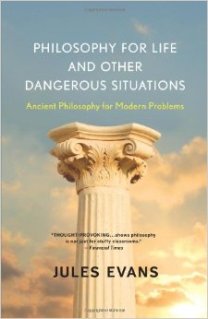

 For most, philosophy is a subject that screams impotent academic prattle, the practice of strange individuals who are clearly paid too much to gaze into their navels and pontificate on the Meaning of Lint.  That reputation is a modern one, achieved only in the last century, for most of western history philosophy was the common fount of all knowledge and artistic endeavor. It guided not only men’s thoughts about how the world was, but how they should act within it.  The streets of ancient Athens were alive with debate on how man should live.  Philosophers’ answers were not uniform;  names mentioned together in survey courses now, then disagreed with one another vehemently. In Philosophy for Life and Other Dangerous Situations, author Jules Evans introduces the principles and practices of several Greek schools which, while at loggerheads on many issues, were united by some core convictions: namely, that the world was rational, that man could be happy within it, and that he could use his rationality to achieve that happiness.

Evans covers a wide variety of Greek schools, some more than others.  The schools are sampled in one-chapter lessons, and the author presents them as though the reader is visiting a day-seminar. (Lunch,  naturally, is taken with the Epicureans.)  Some schools of thought receive more attention than others; the Stoics, for instance, run across three chapters in the early morning, with Epictetus, Musonius Rufus, and Seneca all providing distinct skills.  Some of the lessons provide mental tricks, like using mottoes to remember principles.  Underlying many of the schools, however, is the principle of mindfulness.  A dark night of the soul brought Evans to Athens in the first place;  in a period of crisis, he was introduced to therapeutic techniques borrowed from Stoicism. Learning to be aware of his emotions, to realize he had the ability to step away from them, allowed Evans to climb out of a mental pit. He developed mental habits like auditing his thoughts and learned to stop dwelling on the negative. Our misery is often self-inflicted;  as Marcus Aurelius wrote, we are more troubled by our reactions about things than the things in themselves. Although Epicureanism has a much different basis than Stoicism, both work to effect a calm, contented mental state amid life’s troubles. Stoicism is martial and trains the soul to be immune to the worse that may come, at its most intense calling for a person to retreat into a citadel of the mind. Epicureanism calls for a retreat, too, a kind of detachment from the cares of the world; but instead of being impervious to all care and stolidly devoted to the pursuit of virtue, the Epicurean seeks to focus on a few key ingredients:  community, self-reliance, and mindful simplicity.  The true Epicurean seeks to be the master of pleasure, by downshifting his expectations so as to manufacture a feast out of a little cup of cheese.  The pervasive theme throughout is mindfulness, even extending to the final chapter on dying well. Though moderns close our eyes to Charon, pushing off our arrival at his boat through medicine and miracle-working machines, death is inescapable. The boatman waits for us all; we must truly seize the day.

Philosophy for Life is an important book to consider, for the problems it sought to remedy are universal. Misfortune and unhappiness did not vanish simply because we are ‘modern’;  knowledge and technology have not conquered the human heart.  When we are inundated  with material wealth – literal lifetimes of entertainment at our fingertips, grocery stores and online markets offering goods to feed every taste and appetite — we stand in danger of being overwhelmed and addicted, constantly chasing after new and increasingly intense hits, like a victim of drugs. Epicurus has the answer. Similarly, as our brain misfires trying to make sense of the world,  imposing purpose when there is none — growing wrathful at a car that pulls out in front of us as if they meant to frustrate our travel — the Stoa stands as a relief. Similarly, when the news is so utterly discouraging, constantly placing the worse of our behavior on display, it is helpful to follow Plutarch’s example and deliberately consider the lives of the good and the heroic; to take inspiration from their example.

There are limits to Philosophy for Life, chiefly in its emphasis on the individual as the sole actor in achieving his happiness.  The Stoics believe that people were members of a community; not simply individual units within a collective, but members— distinct, purposeful in relation to one another. The Epicureans, too, stressed the need for companionship.  These suggest that there is wisdom in traditions like Buddhism and Christianity which stress the need to die to the self, rather than ruled by it;  we live not just for ourselves.  This aside, however, the variety of thought, and the satisfying practicality of it all, recommend Evans to readers interested in living wisely.

Related:

Posted in Reviews | Tagged , , , , , | 4 Comments

2015 Reading Challenge Progress

Considering that two-thirds of the year is now spent, how’s that 2015 reading challenge coming?  As introduced earlier in the year, it’s a literary scavenger hunt: 52 books in 52 weeks.  I’ve taken care of most of the list, with just a few categories remaining.

  • A classic romance (anything by Jane Austen)
  • A book with nonhuman characters (The Lion, the Witch, and the Wardrobe?)
  • A popular author’s first book (Carrie, Stephen King)
  • A book from an author who love that you’ve not yet read (anything by Asimov or Wendell Berry)
  • A Pulitzer-Prize winning book (The Prize or Rousseau and Revolution
  • A book on the bottom of your to-read list (pos. We Who Dared Say No to War)
  • A book your mom loves (TBD)
  • A book more than 100 years old (any classic,)
  • A book you were supposed to read in school but didn’t (Grendel
  • A book with antonyms in the title (really tempted to do War and Peace just to say I did it)
  • A trilogy (Star Trek series)
  • A book from your childhood (anything)
  • A book with maa-agic (The Two Towers)
  • A graphic novel (V for Vendetta
  • A book you own but haven’t read (..so many choices)
  • A book set during Christmas  (TBD)
  • A book written by author with your initials (Here There be Dragons, Sharon Penman)
  • A banned book (so many choices)
  • A book based on, or turned into, a TV show (TBD)

…okay, that’s more than I thought.  As you can see,  I have ideas for most of of them. Unfortunately, some of the ideas are monstrous. Either one of the Pulitzer suggestions could be used as a weapon.  Four months and twenty-one books left, along with my usual addictions (trains!) to feed….I’d better get to work!

Posted in General | 2 Comments

Sword of the Angles

Leofric: Sword of the Angles
© 2015 S. J. Arnott
412 pages


The days are dark for Angeln. Surrounded by enemies and increasingly depopulated as her people flee to more peaceful fields in Britain, her king has seen fit to enlist one-time enemies as allies against the Danes.  The outlook for Leofric is especially grim; his father is missing on campaign,  and himself so sickly that his grave has already been dug.  When the entire folk gathers at the king’s city as a show of force to convince the Danes to keep their distance, matters grow far worse. A personal  grudge leads to a bloodfeud, and Leofric finds himself kinless, destitute, and declared outlaw. His village burned, he must flee to the wilderness and find refuge among others left for dead. In time the sickly boy will find the courage and strength needed to claim vengeance for his murdered uncle and restore his family’s lands. 

Leofric: Sword of the Angles is a hero’s-journey story set in dark-age Europe, at a time when Rome is dead but not buried, an age where the woods are dark and deep and home to monsters that require Beowulfs to slay them.  War looms, though the combat of Leofric is almost strictly personal, limited to Leofric and a companion or two fleeing, fighting, or ambushing those who will not be happy until the young man is dead.  Although the author acknowledges in his notes section that information on the Angles prior to their arrival in Britain is hard to come by, gaps are readily filled in by borrowing cultural references to the Franks and other Germanic tribes, and what details are available are worked in craftily; there is no awkward lecturing here, only a man pursuing his fate against a host of trouble. Some pieces of narrative are particularly mesmerizing, like the moment when Leofric’s “dragon” awakes. This is his blood-heat, a surge of adrenaline and battle rage that allows him evade death and turn it on his enemies.  Although he triumphs in part by the end, some unfinished business –an enemy who escaped to Britain  — begs for a sequel, and so do I. Considering that Bernard Cornwell’s Uhtred is on death’s door these days (hovering about in the doorframe, actually),  I would welcome more Leofric! 

Related:
Bernard Cornwell’s Saxon Stories, especially #3, Lords of the North

Posted in historical fiction, Reviews | Tagged , , , | 6 Comments

Tevye’s Daughters

Tevye and his Seven Daughters
© 1894 Sholom Aleichem
300 pages

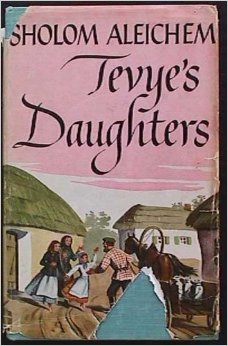
Consider the question: is it possible to enjoy a book while having music from a movie it inspired playing incessantly in your head every time a page is turned? Well, more or less. This is has been my experience with Tevye’s Daughters, a collection of short stories by Sholom Aleichem (aleichem shalom!), the basis of Fiddler on the Roof.    The stories are not all part of the same narrative; those told by Tevye the Dairyman,  Fiddler‘s star, comprise only a fraction of the book. The rest have other narrators, most anonymous, but all Jews living in Tsarist Russia.  There is humor here, some of it dark. Most of the entertainment value is derived from the narrators’ collective gift of gab. In one, “The Man from Buenos Aires” the story consists of a businessman rambling on about his financial prowess (and his modesty). Page after page this goes on until our narrator is about to disembark when he finally asks: what is it it you do? The businessman’s reply is “Well, I don’t sell prayer books, that’s for sure!”.  There’s no conventional drama-conflict-resolution scheme to these stories, and the point of quite a few slipped me entirely. The writing, though, just drew me in, and I suppose it was helped by the Russian setting, which is completely new to me. Tevye is utterly lovable, though being a man of the musical made me fond of him from the start.  Like the movie-musical,  Tevye’s Daughters drifts toward the sad, ending with the expulsion of the Jews from Russia. There is a bright light at the end, however, when Tevye is restored to one of his daughters. Altogether the stories were charming enough that I’m glad I took a chance on ordering through interlibrary loan.

Originally written in Yiddish, this translation retained enough to require a glossary in the back.

Posted in Reviews | Tagged , , , , | 3 Comments

The Devil Knows Latin

The Devil Knows Latin: Why America Needs the Classical Tradition
© 1999 E. Christian Kopf
327 pages

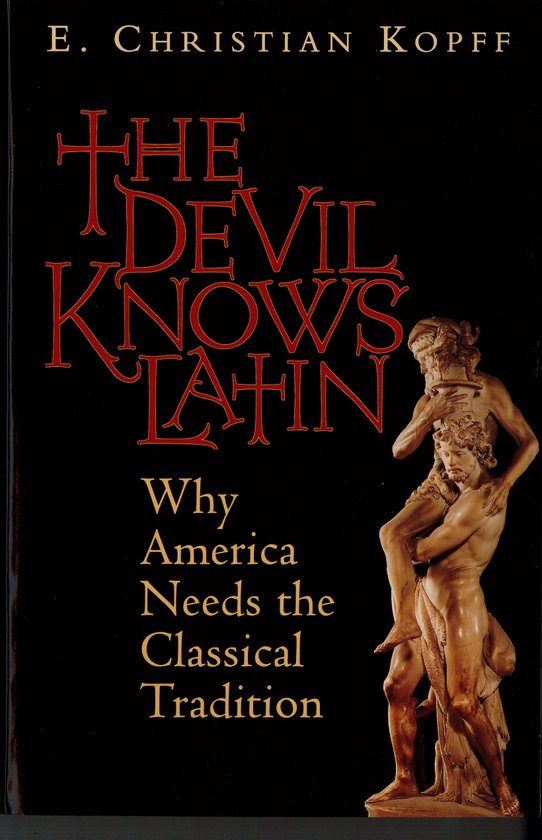
Earlier in the week I read The Devil Knows Latin, which like Who Killed Homer? contends for the value of a classical education to western civilization.  His argument, appropriately enough, is trinitarian; he argues on behalf of tradition itself, argues for the classics’ place as the bedrock of the western tradition, and argues for Latin and Greek’s importance in imbibing the west’s heritage most fully.  Kopf is a partisan of the west who regards attempts at emphasizing multiculturalism in education as dodgy; not because other cultures don’t have value, but because they cannot be appreciated piecemeal.  A cultural tradition is, like a great house or a city, a thing built across the ages by succeeding generations; the work laid down by the dead is used and advanced by the living; each piece connects to the other. One generation of Greeks makes written stories out of another’s myths;  Shakespeare takes those stories and makes them the background for his own; even a ‘modern’  mind like Freud uses Greek mythic language to communicate his ideas. Attempting to teach culture through random stories from across the world would be tantamount to constructing a house by grabbing diverse elements — a Japanese roof, Igloo walls, French doors — and pushing them all together.  It doesn’t work, and nor does modern western education work in presenting children with a slate of wholly seperate subjects without connection to one another. Kopf’s understanding of education is more integral; for him, subjects should be learned together, like Roman schoolboys learning philosophy or history as they translate or read Latin in their mastery of it.

Regrettably, Kopff doesn’t dwell on the Greek worldview the way Hanson does, though a conviction that education is less accumulating facts and more the cultivation of an individual undergrids his perspective.  The book doesn’t have the cohesion its author admires; between an essay on the importance of language and several fascinating pieces of movie and literary criticism lays an argument for protective tariffs.. This is really more a collection of articles, linked by highbrow cultural defense.  If The Devil Knows Latin succeeds, it is in its first argument for culture, specifically the fact that culture is not a thing in itself, with its own life, but something which depends on the living to preserve and build upon.  Russell Kirk made an identical argument in America’s British Culture, where he sweetened the pot by  contending  that  the classical tradition was one that Americans of all ethnicities and religions could use to bind one another together, instead of falling apart in cultural balkanization. Though I’m an ardent lover of the classical tradition, for me The Devil Knows Latin will be more memorable for the movie reviews.  Hanson’s work, which predated this by a year, is much superior.

For the curious:  the title is taken from the story of a bishop who insisted a child be baptized in Latin instead of English, because “the baby doesn’t know English and the Devil knows Latin.”

Related:
Who Killed Homer? The Demise of Classical Education, Victor Davis Hanson
The Roots of American Order and America’s British Culture, Russell Kirk. Both not only include reviews of the west’s classical heritage, but stress the importance of cultural continuity.

Posted in Reviews | Tagged , , | 5 Comments