Vanished World

A Vanished World: Christians, Muslims, and Jews in Medieval Spain
© 2005 Chris Lowney
320 pages

Vanished World sets medieval  Spain before the reader with the warning; we may be blessed or cursed by emulating its example. The Iberian peninsula is the very perimeter of western Europe, within a stone’s throw of both the vast continent of Africa and the looming expanse of the Atlantic. Despite its apparent remoteness, Iberia was throughout the ages in the very thick of the action —  the pitch wherin civilizations clashed. In an earlier age, Rome and Carthage sparred; a thousand years later,  Visigoths and Muslims fought.  The invasion of Spain in 711 by the Umayyad caliphate made the former province of the Romans, then yet another ruin ruled by nominally Christian barbarians, into an outpost of a far larger, far more sophisticated civilization, where it enjoyed a golden age that was for Europe a preview of the Renaissance and enlightenment.  Here the gifts of the Greeks were preserved and built on; here  both Islam and Rabbinic Judaism grew in new directions.  Vanished World is a brief  and romantic history of medieval Spain, one brimming with hope that we can all just get along.

Until the triumph of Ferdinand and Isabella, who united their kingdoms and created a state commanding the peninsula, Iberia was home to a multitude of peoples and minor states. While many were drawn by commercial cross-traffic, others came to carve out kingdoms, like the Visigoths and their successors from Africa, the Umayyads. Iberia was fractured and destitute, lingering in a winter of civilization that was chased away by an eastern wind. Unlike the barely literate Goths,  the Muslim invaders were part of a vibrant, culturally rich civilization on the ascendant. Sweeping over the peninsula, they infused it with new life, creating a social order that allowed their new subjects to participate in it.  Although the calpihate would falter after the death of its leader, breaking into squabbling branches that were brushed aside by a Castillian comeback,  it reigned for several hundred years and created an environment that brought the best of human passion, creativity, and intelligence to the surface.  After an introduction which establishes an outline of Spain’s political history.  most of the book is given over to sections which explore different aspects of the civilization that prevailed between the fall of the Goths and the rise of Castille.  These include chapters on the growth of science, as Muslim and Jewish scholars built upon Greek knowledge and advanced it considerably, as well as some on religious revolution; the Judeo-Muslim mystical traditions both flourished in the Iberian setting. Downey’s vision for the book is made apparent in contrasting several pairs of legends. The patron saint of Spain. St. James, was remembered alternatively as either a humble and kind apostle who spread the Gospel to the furthest reaches of the continent, or as Santiago the Muslim-Slayer, who was said to have appeared and led a Christian army to victory. A similar contrast is offered by the Song of Roland, depicting Charlemagne as a Christian warrior fighting the fiendish Muslims, and the story of El Cid, who found honor and friendship among the ranks of both.   Christian and Muslim need not spar, Downey writes, offering various examples of cross-cultural pollination and episodes of historical cooperation, as when Christian and Muslim powers joined together to fight…other Muslim powers. 
Although the subject is fascinating and I wanted badly to like it, in truth the book is limited. Downey is a very casualhistorian,  chatty and informal.  That can work to a degree, but sometimes retards a reader’s ability to take the text seriously. Assuming one is completely oblivious to intellectual life in the medieval epoch, Vanished World will be quite exciting. Personally, Spangenburg and Moser’s history of science covered this ground too well for me to take much here, though I did find the bits about Sufism and Kabbalah of interest.  The history is also heavily sanitized in view of Downey’s objection. It’s a laudable goal, of course, and he does mention a few trifling incidents of unpleasantness, but haranguing Christians for the Crusades is hardly fair when no mention of the Battle of Tours is made.   Sixty years after the conquest of Spain by Moorish armies, the Umayyads advanced on France itself, meeting defeat scarcely 150 miles from Paris.  Humans will never cease to war with one another, though, regardless of religion; Christians may fight Muslims, but as this and countless other books demonstrate, they will happily dig into one another as well. We’re a hot-blooded species given to destruction.  That considering, it’s nice to review the many ways we are capable of working together, as Downey does here,  touching on science, art, medicine, and even the invention of cowboys.                

Look for a future comparison to Ornament of the World: How Muslims, Jews, and Christians Created a Culture of Tolerance in Medieval Spain


Posted in history, Reviews | Tagged , , , , , , | Leave a comment

Top Ten Authors I’ve Read the Most Of

This week the Broke and the Bookish are asking people who their most-read authors are.

1. Isaac Asimov 

It’s been a while since I read the dear doctor here, but after discovering his fiction in 2007 I went a little mad. Now I have an entire bookcase of short stories, essays, and novels by him. Shelfari says I’ve read fifty-seven titles by him, and I own a few dozen I’ve not even touched yet.  He’s appeared on the blog 63 times.

2. John Grisham

Guilty pleasure here, obviously.  I’ve read all of Grisham’s adult fiction.

3. R.L. Stine

How much Stine have I read? Good lord, who could count? I’ve read all of Goosebumps, all of Goosebumps Millennium, all of Nightmares on Fear Street, and  far too many Fear Street novels.  It’s probably close to a hundred. For the inexplicable few who have never heard of Goosebumps, it was a series of fantasy-horror novels for children, always with twist endings at the end of every chapter and book.

4. Gertrude Chandler Warner

Technically, I suppose I haven’t read as much of Warner as I think I did. She only penned the first dozen or so of Boxcar Children novels, after which point the children became something like cartoon strip characters: static figures against a changing background, always solving mysteries.  That went on for 70+ books or so.

5. Beverly Cleary

My first favorite author, who penned the Henry Huggins series. Okay, that’s probably better known as the Beezus and Ramona series,but the first book of hers I read was about Henry and his lost dog, Ribsy.

6. Bernard Cornwell

My favorite author of historical fiction, a man who has taken me into the Napoelonic Wars a few dozen times. We’ve also visited the Viking era extensively.  He’s appeared on this blog…44 times, second only to Asimov.

7. Harry Turtledove

I have subjected myself to Turtledove almost forty times, going by Shelfari, which is sad.

8. Jeff Shaara

The only thing this man has written that I haven’t read is his last Civil War book, which opens with the burning of Atlanta. Things just go downhill from there, really, and so I stopped. The Shaara style is to take the reader into the mind of the men who lived history; their thoughts are part of the narrative. It works wonderfully, but I didn’t want to be in Sherman’s head.

9. Steven Saylor

Saylor writes detective mysteries set in the Roman Republic,  and has created a couple of epic novels I rather enjoyed.

10. K.A. Applegate


I didn’t quite finish the Animorphs series, but I think I made it about 50+ books. They were published around the millennium, and were about six kids fighting an alien conspiracy by morphing into animals.  It sound kiddy, but the series grew dark as the tweens came of age as hardened warriors.

.

Honorable Mentions
Wendell Berry, whose entire bibliography I aim to read.
Lemony Snicket…counting the entire Series of Unfortunate Events.
 Spangenburg and Moser, the authors of a series of scientific history books
Frances and Joseph Gies, medieval historians who specialize in social history
Will  and Ariel Durant, of the Story of Civilization series.

Posted in General | Tagged , , | 8 Comments

Cod

Cod: A Biography of a Fish that Changed the World
© 1997 Mark Kurlansky
294 pages

In Salt: A World History, Mark Kurlansky detailed the surprisingly impactful career of a table condiment on human history. The importance of salted fish, both as food and as an industry, popped up again and again, not surprising given that five years earlier Kurlansky had penned an entire book on cod. For coastal peoples, fishing is more than a leisure sport done at the river; it is the sustenance of life itself, the foundation of regional economies.  North Atlantic cod have been especially important in this regard, keeping food on the table in England, Spain, Iceland, and New England.  Town seals featured the codfish prominently; in Boston, an artifical one hung from the rafters of city hall.  In the mid-20th century, several European powers engaged in “cod wars” in which their commerical and quasi-military coast guards grappled with one another, ramming their ships and cutting trawl lines.  They were fighting not just to ensure that their respective nations got a good piece of the cod pie, but that the pie would be there in the future. This history of cod has an ecological point, for man’s rapacious appetitite and creative gift for fashioning technology to maximize yields has frequently driven populations into peril.    Cod demonstates the problem of the commons, in which resources held in public are abused and exhausted; not until nations began aggressively quartering off sections of the ocean and fighting off the competition were populations of the fish possible to measure and protect.  Despite moratoriums and restrictive quotas, the codfish have not rebounded as quickly as expected;  their future seems to lie in ‘farms’ (like catfish ponds), a somewhat depressing spectre.

Related:
Russ Roberts of EconTalk interviewed the CEO of a seafood restaurant enterprise this past Monday, discussing the problems of the fish industry today.  He followed it today with a podcast on the oyster business. (Roberts has also interviewed people about the potato chip and bottled milk businesses.)

Posted in history, Reviews | Tagged , , , , , | 5 Comments

10 Don’ts On Your Digital Devices

10 Don’ts On Your Digital Devices
© 2015 Eric Rzesut, Daniel Bachrach
180 pages

Networked computers are no longer the hulking monsters of the 1970s,  only found in  industrial and military installations. In the second decade of the 21st century, they are as common as phones — in fact, for many of us, they are our phones.  Their ubiquity allows us to connect all the various aspects of our lives to an infinite degree; we can do taxes or engage in research while traveling,  stream lectures during exercise,  and lose ourselves in TriviaCrack while on dates that aren’t going so well.  But the pervasive natures of web-connected devices doesn’t  just create space  for leisure, education, and personal work, however:  it’s also an opportunity for parties interested in accessing and exploiting our personal data — businesses,  criminals, and the government. In Ten Don’ts On Your Digital Devices, Eric Rzesut and Daniel Bachrach offer a crash course in basic digitial security, one which fairly well covers the basics for people who never realized that the same smartphones which allow  them access to a world of information also expose them to a world of quicksand, disasters, and predators.

 This is a technological briefing that doesn’t get too technical, allowing even the most tech-oblivious to get a handle on the new territory they’re covering.  Some lessons are utterly basic, like remembering that phones, tablets, and laptops can now contain information just as sensitive as that found in a wallet of credit cards and government identities, and should be guarded with the same ferocity.  Others pass along information gained only by experience, like learning to detect phishing attacks — emails disguised as legitimate correspondence containing innocent-looking links that lead one’s digitial information to being plundered.  Even the paranoid, myself included, may find updated threat information here: I wasn’t aware that some phones are enabled by the manufacturer to automatically connect to whatever wireless networks are in the area, exposing unwitting users who check their bank statements on the phone without realizing it’s switched to Johnny Ne’er-do-Well’s network instead of their service provider’s. Ever section includes a basic review of the issue, followed by suggestions. Some are behavior-related (as in, “Don’t pay your credit card bill on a McDonalds wifi connection”,  but some list alternatives and relevant tools.   Short but full of useful information, Ten Don’t’s is a good review of basic personal digital security that offers a lot of suggestions for people who want to tread more carefully.

Related:
Internet Police: How Crime Went Online (and the Police Followed), Nate Anderson
@ war: the military-internet complex, Shane Harris

Posted in Reviews | Tagged , , , , , , | 1 Comment

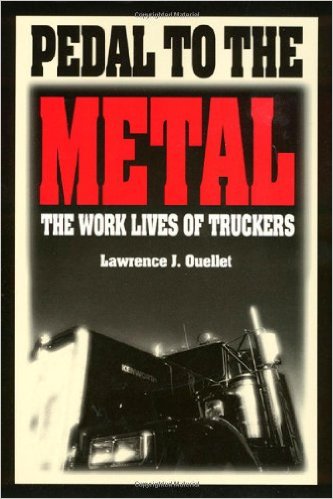
Pedal to the Metal

Petal to the Metal: The Work Lives of Truckers
© 1994 Lawrence Ouelett
247 pages

ICC is a-checkin’ on down the line
I’m a little overweight, and my logbook’s way behind
But nothin’ bothers me tonight, I can dodge all the scales all right


Six days on the road, and I’m gonna make it home tonight. 
(“Six Days on the Road”, Dave Dudley)

Whatever images spring to mind at the mention of “sociology professor”, that of a long-haired truck driver probably isn’t one of them. Yet Lawrence Ouellet was, before becoming an academic,  a genuine working man – a soldier, a telephone lineman, and most notably a trucker. In Pedal to the Metal, two of his dissimilar passions meet. Drawing on his experience at three different small contractors, and referencing a range of social theorists including Thorstein Veblen,   the book not only delivers a sense of what it is like to be truck driver, but explores the truckers’ motives in connection with deeper economic principles.  Ouellet takes readers on a ridealong at each subject company, sharing both his and his coworkers’ experiences and thoughts about their work, detailing  the job’s particularities.

 The book develops toward a section on the difference between extrinsic and intrinsic awards, with Ouellet concluding that different aspects of the work appeal to different men. Those who are merely workers – men who exchange their time for money and take little pleasure in the job itself –  don’t mind routine and value jobs mostly for comfortable pay.   On the other end of the scale are ‘super truckers’ who are primarily attracted to the job because of mythic appeal; they enjoy playing the part of the outlaw, the rugged man who dominates a vast machine and spends his days trekking across the country,  tackling mountains and evading the law.  These men prefer to work at companies where destinations are highly variable, allowing for constant challenges that demand the best rigs money can buy – and who often express their pride in what they do by sinking their own money into customizing trucks further.   Ouellet sees most truck drivers as being attracted to the work because of its mystique, though over time they drift toward the conventional because of the demands of family. No young father wants his glimpses of his children to be limited to once-a-month layovers.  Trucking as a lifestyle defies the tendencies of capitalisim (in the author’s view) to reduce men to mere economic units.It’s a criticism shared in spirit by Wendell Berry, who scorns ‘employees’ – men with no real connection to the work beyond pay. Ouelett’s is certainly no mere prole, for near the book’s end he recounts the pains and glories of trucking with passion that makes plain his genuine love for it.

Pedal to the Metal has much to recommend it for anyone remotely interested in trucking, both as a career choice and as one of the most important elements of all economies regardless of scale.  It certainly has no rival in giving readers both insight into the everyday work, coupled with a study of sociological probing into the values of the men attracted to it. Its only real disadvantage is its publication date; based on research done in the 1970s and 1980s,  modern truckers work under far more technological scrutiny and regulatory restraint. Men who pride themselves on taking a load of petroleum up and down mountains without incident, who through experience gain the wisdom to choose superior routes, are now reduced to being monitored constantly, their location and speed within a search query’s tap by the home office.  The men in this study who despised the notion of being company men, of allowing the boss to get the better of them, would no doubt chafe under the constant eye of conditions today -. Trucking may yet one day be the sole domain of “company men”, shuttling back and forth on preset routes, and taking little pleasure from operating under the steady LED eyes of the machine. If nothing else, Pedal  will bring back to mind the days when truckers were truly cowboys of the highway.

Posted in Reviews | Tagged , , , , | 4 Comments

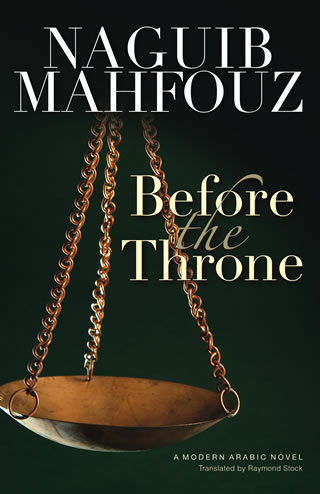
Before the Throne

Before the Throne: A Modern Arabic Novel
© 1982 Naguib Mafouz, trans. 2008 Raymond Stock
128 pages

In ancient Egyptian mythology, the souls of the dead were weighed before the gods. In Before the Throne, the dead pharaohs, generals, leaders, and dictator-presidents of Egypt process before the heavenly court, where the great lord of their ancestors, Osiris, sits waiting to judge them.  Even as Egypt is conquered and her people forget the gods, Osiris and his divine family maintain a watchful eye on the Land of the Nile, whose people are theirs.  Originally written in Arabic in the 1980s,   Before the Throne is a history of an ancient people, who have endured much but have finally regained independence, told through a fantastical trial.

Some sixty men and women are brought before Osiris’s throne, and at first their judgments follow a fairly predictable formula:  Thoth, the court reporter, offers a brief recap of the individual’s life, followed by the defendant asserting his merits. Osiris is rarely impressed, cross-examining to the point of grilling his mortal subject, while his sister-wife Isis plays the part of public defender, offering grounds for mercy. Most of the time the subject in question is allowed — if grudgingly — admittance to glory, while some are cast into purgatory and a rare few into Hell itself.  As more pharaohs pass muster, however, they become active spectators to successive trials; great pharaohs bemoan their descendants’ stupidity in losing hard-won gains, or exult in their successors’ steadfast defense of Egypt’s people against a multitude of greater empires, fighting to their last.  The ranks of the judged include noble pharaohs and revolutionaries alike, and they bicker with one another and the defendants. Akhenaten, for instance, noted for turning away from Egyptian mythology in favor of a new monotheism, is written as  single-minded religious fanatic who is profoundly unhappy with every leader who follows until he sees in the rise of Islam the fulfillment of his own vision.  After the Persian conquest, when Egyptians endure many centuries of foreign rule,  individuals who fought for Egypt as Egypt are singled for scrutiny; the gods acknowledge limits to their sovereignty, as they begin wishing leaders success in their Christian and Islamic trials.  They are Egypt’s gods, even if Egypt has become the domain of another  deity.

Translated from the Arabic,  this is a most curious book. There is virtually no awkwardness in the translation, although each rulers’ time is so short that few have personality. The few who do (Akhenaten ) gain it only by complaining in every trial, least until Osiris demands that they behave. The fact that Mahfouz is writing for a predominately Muslim audience while wanting to connect to the gods of Egypt’s past reveals itself in the complete lack of concern on the god’s part about Akhenaten’s revelation, and the fact that they acknowledge their children have become the wards of the Abrahamic faiths.  Judging by the book’s conclusion, in which some of the major subjects implore Egyptians to learn the lessons of their lives — lessons like the importance of justice, of fighting for Egypt as a thing itself distinct  from the Arab people or from global Islam, of revolution as a progressive force to realize the nation’s potential —  Magfouz wrote to offer encouragement in a time when Egypt was struggling to find its place in the “modern” middle east, finally governing itself again and trying to contend against powers like the United States as unrest was sweeping the middle east. The book’s published translation so soon after the Arab spring, in which again the land was given with chaos, is a most appropriate season for looking back at the leaders of the past, both noble monarchs and revolutionary leaders of the people, and examining where they failed and where they prospered.

Posted in General | Tagged , , , | Leave a comment

The Great Cities in History

The Great Cities in History
© 2009 ed. John Julius Norwich
302 pages

            The Great Cities in History takes readers on a literary world tour, traveling through space and time to visit the greatest political bodies in history.  Civilization is nothing if not the ‘culture of cities, and here we experience its hotspots.  Historian John Julius Norwich and a host of other historians deliver celebratory treatments of cities within their realm of expertise, covering six continents and lauding every place from the ancient to the modern.  Here are the locus points of empires, world-spanning religions,  and prosperous commercial enterprises  This is a work of historical tourism; the authors are sharing each site and its community’s story with us in the way that a tour guide might. Most of the cities are still occupied in the present day, but the challenges mentioned are limited to environmental degradation.  The text is lavishly decorated with hundreds of illustrations, including full-page photographs, art reprints that show scenes of local culture, and photos of surviving artifacts (in the case of extinct cities).  The cities are organized on the basis of when they achieved their greatest historical impact, so we begin with Uruk and end with cities that appear to be leading the way into the future, like Shanghai and New York. Some cities merit multiple mentions; Constantinople reappears as Istanbul, Rome and London  pop up twice, and Mexico City questionably qualifies given its siting upon the also-covered Tenochtitlan.  The near east and the adjacent Mediterranean world predominate, of course.  The dozens of sections are organized by timeframe, but not linked together with a common narrative; some authors focus onl y on their city’s greatest moment, while others track to the current day. They make for fun reading, however, least for those with even the slightest appreciation for history. Modern readers accustomed to the world being divided up by nation states, drawing great boxes around swathes of earth and claiming them as their own,  should find a renewed appreciation here for the fact that human history has been dominated not by kings and abstract empires, but physical polities defined by stone walls.   Great Cities is a treasure to look at and makes for excellent light historical reading.


Posted in history, Reviews | Tagged , , , , , , , | 1 Comment

The Space Between Us

The Space Between Us
© 2007 Thrity Umrigar
321 pages

“A hard land, yes, full of mountains, but toughness has its own beauty.” p. 200

The Space Between Us is a modern Indian tragedy, told through the plight of two women who guide their families alone,  fighting despair and deceit.  Serabai and Bhima have spent much of their lives together, witnessing and consoling one another through crisis after crisis, but they remain alienated from the other by class — for Bhima is Serabai’s servant. Nothing illustrates their distance like the news that each is expecting a new grandchild; for Sera,  such a birth is a source of energy and excitement. For Bhima, it is the fount of despair.  Abandoned in life by her husband,  robbed of her children by disease, she has fallen from a modest apartment into the slums and sacrificed everything in the hope that her granddaughter Maya would succeed in college and go on to a comfortable life. Now that hope has fallen away,  and the aging grandmother must continue to bear the burden alone, caring for a pregnant college dropout.  As Bhima  struggles against physical exhaustion, poverty, and now a deep despair of the soul, Sera attempts to help her even while hindered by timidity in the face of customs of caste. This is not simply a story of the present, however, as much is delivered through the two women’s reminiscences, stories from the past that add enormous meaning to their present struggles. As the past is unearthed, the reader who is drawn in by the enchanting prose is staggered by a final revelation that destroys what little hope and peace the characters have.  Umrigar has a talent for  throwing readers  not only into the desperate poverty of the Bombay slums, but into a dark night of the soul.  As past and present dance with one another, Bhima is steadily crushed, tortured as though she were thrown upon a medieval rack. The one consolation in this story is that she does not give up; her head is bloodied, but unbowed. It is a grim novel,  however, in which the high point is that the main character doesn’t commit suicide.

Related:

  • A Man in Full,  Tom Wolfe, in which another impoverished parent is ground beneath the heel of life, pushed beyond endurance, and finds some inner strength. 
Posted in Reviews | Tagged , | Leave a comment

Travelin’ man

Hello again, dear readers! I’ve been on a mini-vacation this past weekend, staying with my sister’s in-laws in Atlanta and watching the Atlanta Braves take on the Chicago Cubs.  The game itself was a sleepy affair, with little hitting and  only two accidental runs in the third and fourth innings.  It was a weekend of good company and zero responsibilities, however,  and not until the ride home did I retreat into reading.

 I knocked off Pandora’s Lunchbox, a bit of food-journalism in the style of Fast Food Nation that documents how pervasively preservatives are used in our food, even food that seems pure and wholesome.  I may give it a more detailed review, but it’s not on the level of Schlosser’s aforementioned work or Salt, Sugar, Fat, a somewhat more recent work.  If you don’t think much about food, it’s certainly enough to make grocery aisles loom like a carnival of horrors.  Fans of Food Inc, Fast Food Nation, and related works will find the ground familiar.  Another book I finished before the mini-vacation was Kevin Gutzman’s James Madison and the Making of America, a biography of Madison that focuses on his years as a member of the Constitutional congress and within the Executive branch.   Although Madison is known as the father of the Constitution, Gutzman work shows how every clause was the productive of multiplie personalities, all arguing with one another, and that the end result was a product Madison was reluctant to accept responsibility for. Despite his later alignment with the Republicans,  Madison began as a nationalist who wanted a stronger central union. It was enjoyable enough, but between lectures and books I overdid revolution and the Constitution.

Since returning from vacation I’ve started John Julius Norwich’s Great Cities in History, which I love. It’s a beautiful book,  covered in photos of art and of cityscapes,  delivering history from around the world. It’s one of those pieces that people stop and admire if they spot it. Look for it soon. After that, the fun will continue!

Posted in history, Reviews | Tagged , , , | Leave a comment

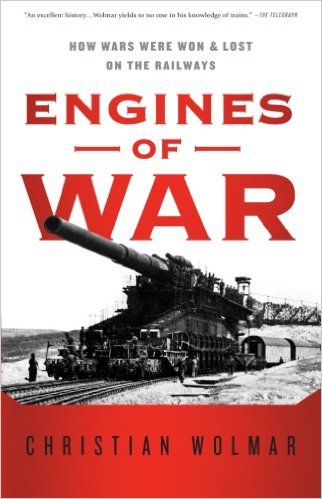
Engines of War

Engines of War: How Wars Were Won and Lost on the Railways
368 pages
© 2010 Christian Wolmar

An army marches on its stomach, but for a hundred years it rode to victory only on the rails.  It was Napoleon who observed the importance of supplies the military,  and well he should know, for the nigh-twenty years of wars he raged on the European continent were the last major conflict prior to the advent of rails. In Engines of War, veteran railway historian Christian Wolmar addresses how trains transformed war,  allowing for greater conflicts to be sustained over a wider front, and often serving as the locus of conflicts themselves.  Although the American Civil War and the Great War feature most prominently, Wolmar also dwells on the Boer and Russo-Japanese wars, and includes many minor episodes which are fascinating. Who knew, for instance, the role of railroads in the Arab revolt from Ottoman rule?

The most important aspect of the railroads to war, of course, is logistics — the transport of men and material to the battle, including food, ammunition, and forage. Mankind has waged war against itself since human history began, but not until the industrial age did he do it on so terrible a scale. Wars between ancient empires — the Roman and Carthaginian, for instance — might last decades, but these lengthy conflicts did not tax their nations they way they do now for most of the 20th century.  Battles were comparatively much smaller, and more seasonal. Invading armies relied on raiding hostile territory to supply themselves, and as professional armies were rare, generally consisting of private subjects whose labor was needed back at home.  Rail lines made projecting and sustaining a force in the field far easier — as they did early in Crimea, allowing Britain to sustain a siege halfway across the world.  Or, take Sherman’s famed march to the sea, for instance, his bloody chevauchée from Atlanta to the southeast coast of Georgia. Despite a reputation for feeding his troops off the land, his initial push was fueled by a rail-fed stockpile.. The incorporation of railroads allowed for intense strategic planning: the Schlieffen Plan, Germany’s strategy for a quick resolution to the Great War,  was essentially a train timetable. Despite how quickly trains could deliver men to the front, however, Wolmar maintains that the rails favored defensive warfare more than the offensive. Any advance made by an invading army would take them into territory with sabotaged infrastructure, often incompatible with the invaders’ systems.

The rail lines could also be used as weapons themselves; carrying artillery or serving as mobile gunships. Armored cars first appeared in the Boer war, and were used to suppress insurrection in vital areas.  The importance of defending the rails, even with trains themselves, is made obvious by the Arab revolt from Ottoman rule. The Ottomans created a rail line stretching down the Arabian peninsula to allow pilgrims on the hajj to more easily reach Mecca, but during the revolt it was subjected to such chronic attack that  the troops which depended on it for supplies were forced to surrender.  Other methods of attacking rails were less successful:  airplane-born bombs, for instance, were rarely accurate enough to touch down on so narrow a line drawn on the landscape.  Even  when lines were rendered inert, every military of the period created divisions which specialized in rail repair.  Germany was especially diligent about maintaining large stockpiles of extra rail supplies, to allow for nigh-instantaneous repair. Only when its entire war effort was failing did the rail lines finally collapse.  In his other works, Wolmar analyzes the comparative advantages of government and private management of rail systems; here the insistence on efficiency takes on a more awkward tone when it results in more prolonged wars and the horror of the holocaust.

Despite their importance for nearly a century,   so linked to the projection of power that their construction could spark wars (as between Russia and Japan in 1905), even a rail enthusaist like Wolmar has to admit the age of the train is past, militarily speaking.  The nature of war itself has changed.. We are as unlikely to see massed armies butchering each other with Maxims and artillery as we are to see cavalrymen running about with sabers in the next war.  This is the age of cruise missiles, drones, and small groups of soldiers deployed in surgical strikes by helicopters.  Even in larger operations, troop transports that can transverse alien territory are more efficient than building even the light strategic rail of the Second World War.

Engines of War is an altogether fascinating book, revealing how  the vital necessity of rail lines during wars not only altered weapons and strategy, but changed both the role of the government and the behavior of the rail lines in peacetime.

Posted in General | Tagged , , , , , , , , , | 3 Comments