The Wheels of Chance

The Wheels of Chance: A Bicycling Idyll
© 1896 H.G. Wells
193 pages

What an odd little story! Begin with one J. Hoopdriver, a draper’s assistant who lives for nothing but spare opportunities to ride his bicycle — or rather, to crash repeatedly on his bicycle, banging up his legs but still delighting in sheer momentum. Mr. Hoopdriver, at the novel’s beginning, is finally embarking on his yearly vacation: a cycling tour in England. Immediately he spies a beautiful woman, crashes dramatically, and earns her pity and his own chagrin. He chances to see her again, later on, and this time in the company of another fellow who claims to be her brother. His love-sickness not withstanding, Hoopdriver can tell that something’s amiss, especially after the “brother” accuses Hoopdriver of being a detective. Delighted at having a game to play, Hoopdriver pursues the odd couple, eventually changing roles to that of a clumsy knight- errant once he and the woman (Jessie) realize the other chap is a genuine cad. Jessie’s intention was to Be Her Own Woman, but her first ally turned out to be a manipulative fink. Eventually the gig is up for everyone, but Hoopdrive ends the tale most invigorated, having gone on a quest and discovered a friend who could put a little steel in his soul and allow him to dream of doing greater things with his life.

Although the story is nearly inconsequential, there’s much charm. Wells’ writing is often fun (one passage remarks that while Hoopdriver was in the throes of indecision, gravitation was hard at work and thus the man found himself on the ground with a bleeding shin, still wondering what to do), and sometimes beautiful, as when he’s describing the landscape or the dreams of these two. Still, there were two reasons I picked this book up: bicycles and H.G. Wells — and that, in the end, was the reason I finished it.  If nothing else this is literature from bicycling’s first bloom of mass popularity.

Related:
Bicycles: The History,  David Herlihy

H.G. Wells and his wife Jane Wells

Posted in Reviews | Tagged , , , | 5 Comments

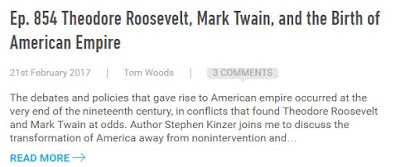
Podcast of the Week: Stephen Kinzer discusses TR, Mark Twain, and American Empire

On Tuesday, author Stephen Kinzer appeared on the Tom Woods show to discuss his new book, The True Flag.  This piece takes as its subject the fierce debate on then-nascent American imperialism — genuine debate in that Kinzer begins with chronicling Congress’ 32-day debate on the American acquisition of the Philippines, which started on the same day as the opening session of the American Anti-Imperialist League. The heart of the debate is this: how can a democratic republic formed on the basis of consent by the governed  initiate and persist in policies that involve controlling countries against their will?  Kinzer has written such books as All the Shah’s Men: An American Coup, Overthrow, and a look at Turkey as it stands between worlds.   The Anti-Imperialist League’s most famous member was Mark Twain (see Weapons of Satire for Twain’s anti-imperial writings), though it also included men like Andrew Carnegie and Samuel Gompers.  Kindred books: Bill Kauffman’s Ain’t My America, and Tom Woods’ own anthology, We Who Dared Say No to War

Before yesterday, I’d planned to spotlight Econtalk’s recent interview on the book Narconomics: How to Run a Drug Cartel. 

Posted in General | Tagged , | Leave a comment

Reading All Around the World?

A few days ago I caught wind of a project that took me aback with its ambition. Several blogs/readers, including Cleopatra of the  Classical Carousel, are attempting read books from across the world, either fiction or nonfiction. This is being hosted by Howling Frog and Chapter Adventures. I found it intriguing because I’m engaged in that sort of reading, myself; last year I did an extended series in middle-east history, and this year I’m turning to Asia. Following that I’ve been playing with the idea of a split year in the “global south”,  spending six months in Africa and then six months in South America. Another project I’ve had in mind is a “Eurotour” in which I read my way through Europe, beginning in Portugal and trekking all the way to the Balkans.   Considering I’ll be reading across the globe anyway, I might as well do it in company, rather as I’m doing with the Classics Club. Like the classics club this would be a long-term project.    While nothing is finalized, consider this a “toe in the water” sort of move on my part, a declaration of interest..

Posted in Reviews | Tagged | 3 Comments

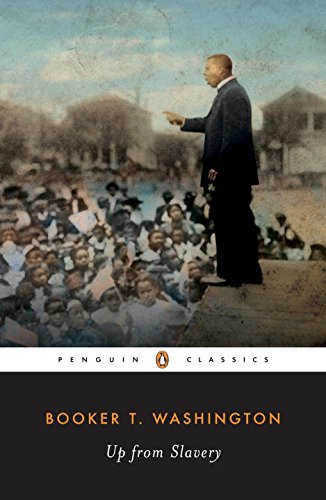
Up from Slavery

Up From Slavery
© 1901 Booker T. Washington
332 pages

Up from Slavery is an hopeful reflection by Booker T. Washington on the future of black Americans and the American nation, as he reflects on the thirty-odd years since the abolition of slavery at the time of his writing.  But this is no mere memoir of slavery and reconstruction, for Washington’s life as a teacher and founder of the Tuskegee Institute gives him a perspective on education; particularly, what sort of education most befits the cultivation of liberated men and women.  Washington’s ideal education, put into practice at the Tuskegee Institute, is ‘holistic’ in that it places as much value on the practical — trade skills, agriculture — as it does book learning. It is moral and social, teaching self-ownership and self-sacrifice,   Although Washington craved knowing how to read even as a child, and his drive for self-improvement was such that he worked his way across a span of a hundred miles to attend school at the Hampton Institute,  he did not see book-learning as a magical solution to the problems of his fellow freedmen.  Some had taken earnestly to the veneer of education, but shared the same disdain towards work that had poisoned the plantation elite.  When he was asked to head the fledgling school for blacks anxious to  uplift themselves, he stressed the dignity of labor, the sense of ownership; he joined students in creating bricks, hewing wood, building the physical structure  of the school.  In this same vein, their practical skills built themselves, gave them the realization that they were capable of producing a good work that they and others could use and value. It is on that foundation that book-learning can rest, and so his students followed a Benedictine schedule of “pray and work”, or in his case “study, work, and pray” — occupied from 5:30 ’til 10:00 pm.

Washington was a surprising author in many ways — opening this memoir up with a joke, and offering insights that I would have never expected. For instance, his writing indicates not a trace of hostility towards the old elite, but rather pity and sympathy ;  his time spent among the wealthy and ‘noble’, in both America and in England, squelched any notion of viewing them as the enemy.  (If the reader wants to be cynical, he can conclude that Washington is dwelling most on those people like Carnegie who wanted to do some good with their wealth, and putting out of mind the less noble-minded.)   I didn’t expect Washington to be as wary of reconstruction as he indicated; he voices suspicion that blacks placed into electoral office were being put there simply out of vengeance against the old aristocrats, and that this would create more racial strife.   On first reading, the Booker T. Washington of Up from Slavery reads rather like saint, a Gandhi-esque figure who endures all things because he hopes and works towards the redemption and progress of all humanity.  I suspect I should read more about Washington to get a better view of the man, but I’m highly partial to his worldview here,  his disdain for the multitude in the cities who “live by their wits” and who would have profited themselves more had they grown up on the land,   living with both body and mind.  His optimism was, alas, misplaced in some respects as the Klan — which he dismisses as a dead thing which no one would tolerate ‘now’ — was reborn with greater power in the 1920s.   His fear that looking to the government for every thing would create a new servility has unfortunately been realized…not just in blacks, but in all of us.   Even so, if illiterate slaves like Frederick Douglass and Booker T Washington could  in their respective youths realize a hunger to conduct themselves like men, sovereign actors in their own lives, there’s hope for us all.

Posted in Reviews | Tagged , , , , , | 8 Comments

Drone

Drone
©  2013
432 pages

In El Paso, Texas, the raging narco-wars between drug trafficking gangs in Mexico has bled over into American streets — claiming the life of the American president’s son.  Having run on a platform of balancing the budget and reversing foreign-policy foul-ups that have lost countless American lives and money overseas, President Meyers nevertheless realizes something has to be done. After diplomatic and above-board covert ops fail to produce results, she turns to an ex-CIA spook named Pearce, who is now the head of a private military contractor that specializes in combat drones. His deadly campaign against one drug cartel will stir up a hornet’s nest of woes, because several factions within Mexico are being manipulated by an Iranian who is involved in a multinational conspiracy.  More an intelligent technothriller than a Duke Nukem action-American novel, Drone offers speculation as to how drones might be employed — and legally justified — in the near future.  Drones are depicted here not just providing recon and a platform to launch missiles, but sniping targets using facial-recognition software.  Maden’s presidential figure is an interesting character, a populist who achieved office by running against her own party and vowing to end endless foreign wars;  she struggles to keep her desire for justice and order in line with a firm commitment to Constitutional government.  A downside of the novel, but a necessary part of its drama, was the domestic chaos that erupts from Meyer’s  new policies toward Mexico. After the narco-gangs strike back and the border is functionally militarized,  the media casts Meyers as an anti-Mexican tyrant, creating ‘a day without immigrant’ labor strikes, etc.  Maden has a good mind for the diverse kind of political chaos imaginable in the United States today, but — alas for those of us who read this presently — that sort of chaos is going on now, so it’s not enjoyable in the least to read about.   Everyone in this novel has a little schmutz on their face, including the principled executive who can only take the least-worst option of a list of bad choices.

Posted in Reviews | Tagged , , , , , | 3 Comments

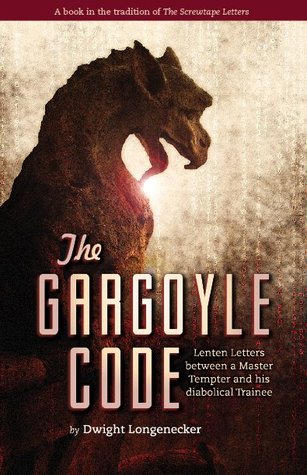
The Gargoyle Code

The Gargoyle Code: Lenten Dispatches Between a Master Dementor and his Diabolical Trainee
© 2009 Dwight Longenecker
103  pages

The Gargoyle Code is a modern sequel-in-spirit  of C.S. Lewis’ much-lauded classic, The Screwtape Letters, in which a senior demon mentors a junior demon in the fine art of spiritual sabotage. Longenecker departs from a strict duplication of Lewis’ style by having the senior demon (Slubgrip) change apprentices halfway through, and a flurry of letters to other demons – coordinating attacks and conspiring against one another – are also included. At first I liked the evidence of demonic infighting as an example of evil will oft evil mar (Slubgrip flatters a fellow demon in one letter, then derides their character when writing to others), but the amount of demonic politicking is such that it consumes a third of the book. It became more distracting than helpful, though others have found it funny.

Still, Lewis’ marvelous subtlety is repeated here in good form. One of my favorite passages from the Screwtape Letters involved a demon using church attendance to weaken his client’s spirituality, by having him think about the moral frailties of his fellow parishioners, self-righteously fuming over their hypocrisy. Here, the senior demon uses a similar approach by having his conservative Catholic target constantly think about how awful ‘reform’ liturgy is, how the wondrous hymns of old have been replaced by happy-clappy praise music, etc. Subtle manipulation is the name of the game: it’s no good to have a target simply fall into sin, for abrupt attacks tend to backfire. The target will be so ashamed of themselves they may literally repent and start avoiding avenues of temptation. Slow and steady is the goal – erode the connections people make between their lives and what is taught, then tempt them. The best of worlds is a subject who goes to church faithfully, but has religion so compartmentalized in his mind that it only exists on Sundays; otherwise he follows his every whim, and is forever guarded against any soul-searching by the comforting notion that he goes to church, so of course he’s OK.

While it doesn’t eclipse The Screwtape Letters, Code was written as book to read during Lent, each letter or ‘text’ being spaced out among the forty days, and so is perfect for that season.

Posted in Reviews | Tagged , , | 5 Comments

Two voices, two centuries, one timeless truth

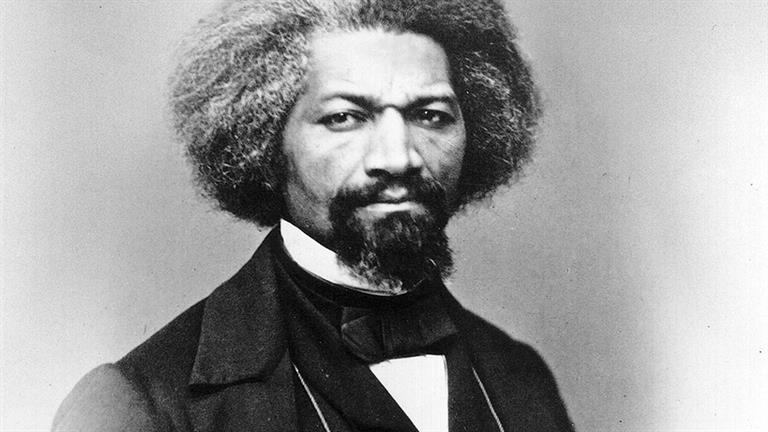
At once time Mr. Douglass was travelling in the state of Pennsylvania, and was forced, on account of his colour, to ride in the baggage-car, in spite of the fact that he had paid the same price for his passage that the other passengers had paid. When some of the white passengers went into the baggage-car to console Mr. Douglass, and one of them said to him: “I am sorry, Mr. Douglass, that you have been degraded in this manner,” Mr. Douglass straightened himself up on the box upon which he was sitting and replied: “They cannot degrade Frederick Douglass. The soul that is within me no man can degrade. I am not the one that is being degraded on account of his treatment, but those who are inflicting it upon me.”

p. 100, Up from Slavery, Booker T. Washington

[…] when I was being stripped and searched, I decided it was best to treat my captors like the weather. A storm can cause you problems,  and sometimes those problems can be humiliating. But the storm itself doesn’t humiliate you. 

Once I understood this, I realized that nothing they did could humiliate me. I could only humiliate myself — by doing something I might be ashamed of. During my first few days in Lefortovo I repeated this principle over and over until it was part of me: Nothing they do can humiliate me. I alone can humiliate myself. Once I had absorbed that idea, nothing — not searches, not punishments, and, five years later, not even several attempts to force-feed me through the rectum during an extended hunger strike — could deprive me of my self-respect.

p. 8, Fear no Evil. Natan Sharansky

Posted in quotations, Reviews | Tagged | Leave a comment

10,000 Sing "Ode to Joy"

How incredible this is to watch; the look on the conductor’s face is utter rapture.  While this video has nothing to do with books, aside from the complementary nature of literature and the other arts, including music, it was too glorious — exquisite, even — not to share.
Posted in General | Tagged | 4 Comments

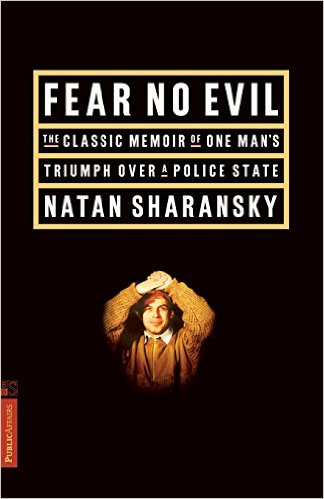
Fear No Evil

Fear No Evil: 
© 1988 Natan Sharansky
437  pages

Fear No Evil chronicles one man’s psychological war against the KGB and the entire Gulag system. Born a Jewish subject of the Soviet Union, Natan Sharansky wanted nothing more than to emigrate peacefully to Israel, along with his fiancé. Forcefully denied exit, Sharansky became an advocate for other ‘refusniks’, and a human rights activist in general, within the Soviet Union. Denounced as a traitorous spy in the employ of the Americans, Sharansky was arrested and thrown into the prison system of the Soviets, subjected to long periods of isolation and physical destitution which was moderated only by the Soviets’ desire to appear to be behaving. This is not a mere prison memoir, however, detailing the abuses of the Soviet state. Instead, Sharansky takes us through his campaign to maintain his character despite being in the clutches of a system that was designed precisely to erode or demolish individual spirits, leaving nothing but the New Soviet Man – an institutionalized zek, a placid cow who existed to be milked and slaughtered as the State wished.

From the beginning, Sharansky approached the KGB and the Soviet state strategically. Even while fighting against them, he did so completely in the open. He maintains that he concealed nothing, met with no one secretly, never once scurried in the dark like a criminal who had something to hid. He was a man, speaking ‘truth to power’ like a man (to borrow from King). While in interrogations, he listened between the lines, attempting to discern what sort of case they were trying to build against him. While the KGB sought to alienate him, he spent his prison hours revisiting every moment of his life, swaddling the memories of loved ones around him to remind him constantly of what he was fighting for. If the KGB wanted to divorce him from his Jewish heritage, he would be the best Jew he could by praying constantly and learning Hebrew – despite not being observant in the least in the outside world. If they wanted to threaten him with death, he would bring the subject so much that the word lost its sting. At every step, he engaged in noncooperation. He mocked the KGB relentlessly, spending day after day in solitary confinement. When threatened with the loss of ‘privileges’ for not cooperating, he deliberately broke rules to ensure that his happiness and peace of mind were never predicated on what the KGB could offer him, or could do to him. From the beginning he maintained that nothing they could do could humiliate him: only he could humiliate himself. Though he never once references Greek philosophy, Sharansky lived as a Stoic in the same way that James Stockdale did while similarly imprisoned. He used his mind to defend his character, his very person, from being broken and cast in an inferior mold.

Fear no Evil is an incredible and commendable chronicle of a man conducting himself brilliantly, who faced a system built on inhumanity and emerged triumphant. This is excellent stuff — Arete in action.

I think it’s high time I hunted down a copy of Gulag Archipelago

Posted in Reviews | Tagged , , , | 5 Comments

Podcast of the Week: Conflicting Visions

On Monday, historian and author Tom Woods discussed the premise of Thomas Sowell’s book A Conflict of Visions.    According to their discussion, Sowell maintains that there are two main political convicions: an unrestrained vision of man and a restrained vision.   The unrestrained vision believes that man and society are infinitely malleable and can be worked to perfection. The restrained view, in contrast, holds that a person at birth  is finite — agreeable to a certain amount of molding, capable of a certain level of growth, but never perfectible. In an interesting digression, Woods and Malice quickly drifted into a discussion on how Alexander Hamilton and Thomas Jefferson fit into this scheme.  (The two authors have previously debated the merits of Hamilton; Woods contends he is a skunk, and Malice maintains the opposite.)    Hamilton, Jefferson, and even Adams are to my mind personalities who do not fit easily into any dichotomy:  Jefferson was indisputably  a romantic about human nature, yet he still had agrarian and decentralist reservations;  for all of Adams’ wary conservatism, his moral vision made him more consistently anti-slavery than the liberty-loving Jefferson;  and Hamilton managed to argue for both a strong executive and a government that had built-in quarantines for corruption,  since a certain amount was inevitable.  Towards the end they make the point that a truly liberal and self-deterministic society would allow for both visions to exist simultaneously:  that is, San Francisco can transform itself into a commune if it wants or California into an imitation of a European social democracy, but Texas remains free to be a Randian paradise. People voluntarily give up liberties all the time in the pursuit of more meaningful goals; the problem is if we use the State to strip people of liberties by attempting to order their life for them. 
I found the discussion most interesting because in the last decade or so, I’ve personally transitioned from the unrestrained view to the restrained, my long study of history and society having convinced me of the limits of human nature and the difficulty of controlling things external to us. I covered that transition more at length in my essay “Accidentally Evil: Considering Libertarianism“.   However, I don’t think the dichtomy is a left/right thing: George Bush’s attempt to remold the middle east in the style of a western democracy looks plainly like an unrestrained vision at work, and I think anarcho-capitalists are just as optimistic. Woods and Malice don’t go into that aspect, unfortunately.
Here is the climax of my essay mentioned previously, if you are curious:

Without realizing it, studying the history of these subjects lured me into the dark side: the Other Libertarianism. The American libertarianism. The market-obsessed libertarianism.  When I studied urban planning, I came to realize how the government promotes city-destroying urban sprawl through zoning codes and highway and housing subsidies. When studying food, I grew disgruntled after realizing how successful regulations and subsidies are to letting corporate giants monopolize farming and make it an industrial enterprise, reliant on disaster-inviting monocultures and cheap oil that destroys the land.  Every field I studied attentively,  I found regulation in the way. I was a big fan of regulation: I viewed big business with fear and wanted a government that would keep a pistol pointed in its face all the time. I wanted the lion of the market to be chained and caged. But now I was seeing instances of it hurting people — and not just getting in the way of productive endeavors, but promoting power accretion. At first, I merely winced — oh, here’s bad regulation, we should remove it and make new regulation, regulation that will be good — but as I continued to run into those bits of bad regulation, I realized they were popping up with unfortunate regularity. They weren’t exceptions to the rule; they were the rule, an example of what happens when we ignore the limits of our knowledge and assume we can make things so by legislative fiat. I believe these community-destroying forces of sprawl and big business would hoist themselves on their own petards were they not on the life-support of public funding. 

Though I’ve begun to appreciate the market as a means of sorting things out, I’m only slightly evil.  I do not believe the chief end of man is self-satisfaction, or that money is the measure of  a good life. My roots remain in simple living and the  cultivation in myself the best fruits of the human condition.

Posted in Politics and Civic Interest | Tagged , , , | 2 Comments