Flying high in rockets and opiods

Well, folks, Christmas is over, and so is 2018 — almost.  Below are the final comments or reviews for 2018: Dreamland and Rocket Girls,   two very different histories. One is inspiring, the other….so very not.
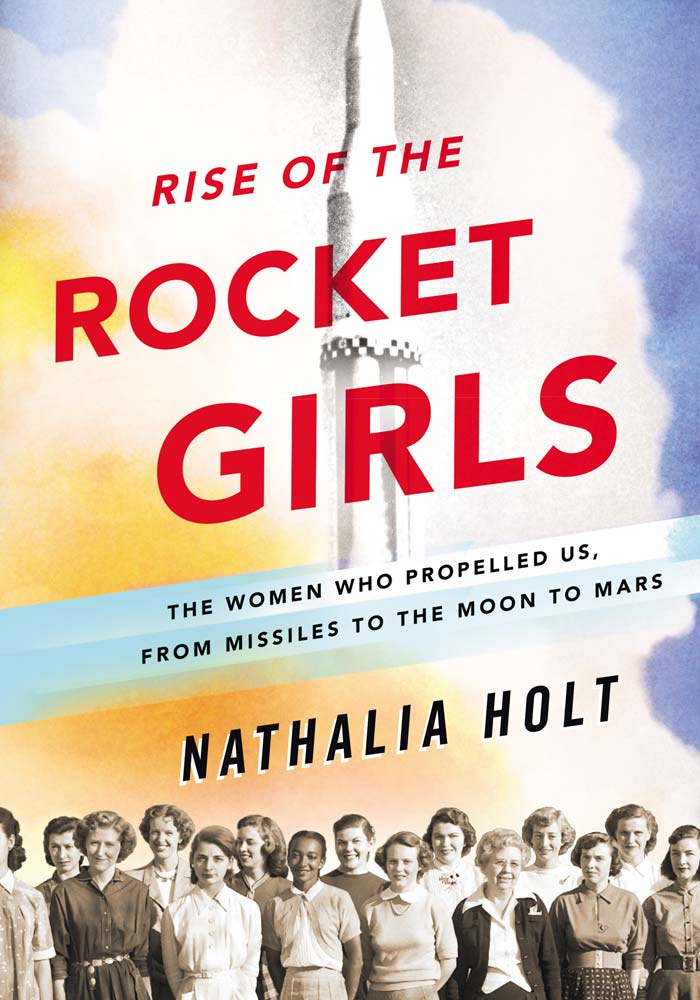
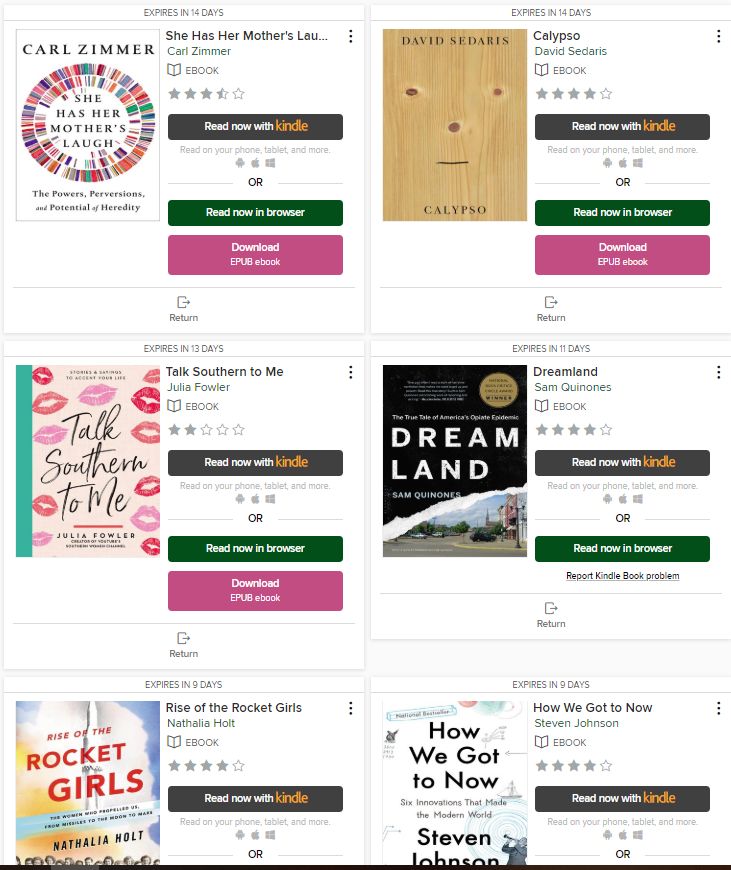
First up, Rocket Girls!  Call to mind the space race, and very likely the people who come to mind are German scientists and lantern-jawed American airmen, the right-stuff hotshots who explored beyond the atmosphere.  The story of American rocketry begins before the sixties, however, and from the beginning it involved both sexes. In Rocket Girls we visit the early days of rocketry, even during World War 2.  This is really a history of the Jet Propulsion Laboratory, of its inception and early work, as told through serial biographies. Well over a dozen women’s contributions are chronicled here,  and they include a Chinese dissident and the first African-American hired to a technical position at the JPL.   Although the women’s work in computing trajectories, and working out by hand how different materials and propellant mixes might chance results is increasingly supplanted by IBM’s computers,  I really enjoyed the extensive on-the-ground history of the JPL. The amount of work that went into every launch  — of everything from antiaircraft missiles to probe launches — is awe-inspiring, and the July lunar landing seems even more incredible.
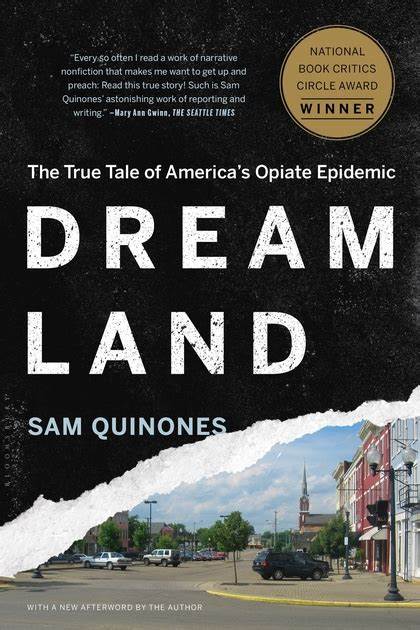
Not quite as uplifting but lamentably important is  Dreamland, a history of the opiod crises in America.  The historical narrative considers two stories that converge into one. The first is the rise of a black tar heroin distribution network in the United States, in which a small village in Mexico revolutionized drug marketing to make buying safe, easy, and satisfying – at least until the high wore off. The second story is the rise of prescription opiods in the United States, as aggressive marketing to local general practitioner  wore down decades of reluctant to freely prescribe strong pain medications for fear of addiction.  Spurred by a small study whose import was amplified far beyond reality to think that opiods could never become addictive so long as they were being used for physical pain,  optimistic physicians and ambitious pharmaceuticals undermined the previously existing framework for addressing pain and replace it with it with pills. Use pills, and if they don’t work, use more pills.   When medical patients became addicts and their doctors became concerned,  the addicts were able to get their fix from the new  heroin distributors, the “Xalisco Boys” as the author calls them.  All they had to do was call a number and meet a car at a given location, and they were in business.  The prescription pills also became big business in themselves on the black market, creating pill mills so openly phoney that they operated out of portable trailers and subscribed OxyContin to lines of hundreds.   The two narratives interlace together incredibly well, and as sad a history as this is, it bears considering.   There’s also a bit of philosophy in the title and the deliery; Quinones opens with an attractive look at an Ohio town’s pool and community center, a place called Dreamland, where the people of the town came together and shared their lives — as children they played in the pool, as teens they necked in the high grass, and as adults they came with their kids to experience the wading pool all over again. But then another dreamland, a private one where people dropped out of life and hid themselves in their rooms, lost in their own drug-addled minds, took over. Although the destruction of that Ohio town’s park had more to do with economics than drugs,  it’s a very effective image.

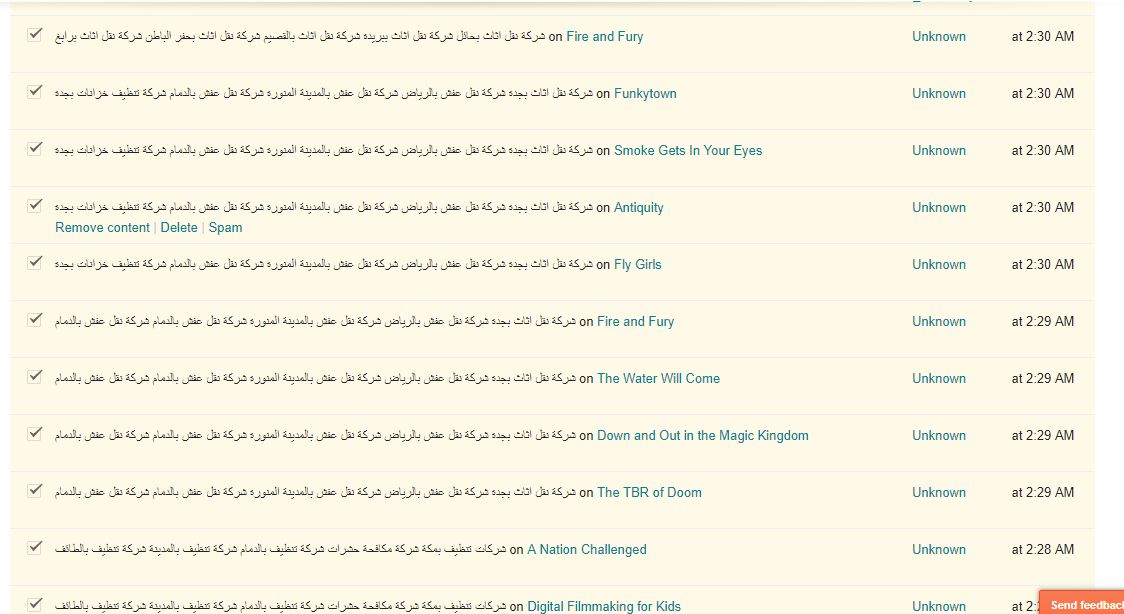
That wraps 2018 up;  later this week I’ll do a best-of-posting and share some data pie.  I’ve got a couple of books at the ready, but don’t imagine I’ll be finishing either one up before tonight.    Because of another outburst of spam (all in Arabic or Farsi, which is…interesting.), I’ve had to impose moderation, but I’ll check on a daily basis, and this explosion of nonsense ever ebbs I’ll turn the moderation off.
Posted in history, Reviews | Tagged , , , , , , , | 6 Comments

So I uh, may have to turn those captchas on….

Lot more of those overnight, too. At least blogger lets me mass-delete!

Posted in General | 9 Comments

The Reckoning

The Reckoning
© 2018 John Grisham
432 pages

On an otherwise unremarkable autumn morning in rural Mississippi,  an idolized war hero traveled from his farm into town, visited the preacher, and shot him. The sheriffs found the shooter patiently waiting for them on his front porch, where he offered neither resistance nor explanation.  The entire town is dumbfounded to see two of its favorite sons turn on one another so inexplicably, and in a way that will destroy the families as the criminal trial and then a wrongful death trial wear on.  The trials here are quick and brutal; instead, the meat of The Reckoning lies in an account of the Bataan Death March and the plight of two children whose lives and homes are destroyed by their parents’ decisions.

Say what you will about The Reckoning, but it’s decidedly different from anything else Grisham has written, set completely in the 1940s and featuring an aspect of the Pacific War (American resistance in the Philippines to Japanese occupation) few will be familiar with.  The first third of the novel addresses the immediate consequences of the preacher-killing, before shifting several years prior, to tell the story of a country farmer turned jungle commando, who barely survived the Bataan death march and escaped to take up with American and Filipino soldiers in the mountains who were engaged in guerilla warfare against the Japanese occupational forces.  The novel then shifts back to the aftermath of the killing and the trials, which….is about as uplifting as reading about the Japanese torturing and starving thousands of men after Bataan. That bit in the middle about the resistance was nice, though.

I can’t deny that I enjoyed reading The Reckoning — I only received it Christmas morning and now write this  less than 24 hours later,  like a few other Grisham reads over the years.  The first two thirds are unexpected, and with all the Faulkner references (characters are constantly reading him, and the writer himself appears as a minor character) I thought Grisham might produce a completely unexpected conclusion. Why did the hero shoot the preacher?  Was this the hero’s way of immolating himself for not living up to his own legend, and taking another secret ne’er do well with him?  Was the preacher a Japanese sympathizer?  In the end it comes down to a very old story, which is unsatisfying given how depressing the novel was as it reached the conclusion. 

While I was appropriately intrigued and riveted by The Reckoning, it’s mostly melancholy.

Posted in historical fiction, Reviews | Tagged , , | 6 Comments

Short rounds: of southern accents and cancerous snapping turtles

I’ve a free moment between family gatherings and outings, so here’s a short rounds post on Talk Southern to Me, as well as David Sedaris’ new book Calypso.

First up, Talk Southern To Me.   As mentioned a few days ago,  I was interested in the book because its author produces a series on YouTube called “Sh%t Southern Women Say”.  Talk Southern to Me is similar, a bit of southern culture and humor, which has chapters on southern manners and culture but is mostly about language; every chapter closes with sayings related to it, and what’s not covered there is included in a list of words and their translation at the end. Southerners have a distinct family of dialects, whether we’re from the country-club-and-family-money society, or the trailers, muddin’, or outlaw-country side of the woods. Southerners, of course, will see themselves and their families in every chapter, and — depending on how many Yanks they count in their circle of friends — may be startled to learn that more of their use of language is distinctly southern than they thought. (Expressions like “He used to could”, which a Michigan friend of mine of mine was baffled about, are an example.)   Although Fowler is very general at times, I love discovering southern creators who are enthusiastic about preserving the distinct culture of the South in a positive, fun way, instead of edging into prickly defensiveness. Particularly amusing was the section that potent expression, “Bless your/her/his/their heart”,  can be used for everything from sincere sympathy to a manners-approved method of gossiping.

David Sedaris, for those who don’t know, is an American-born humorist whose essays and short fiction usually evoke a strong sense of pathos, often being unbelievably personal, so much so that discomfort turns to giggles.  Sedaris is an acquired taste, I think, as if a reader is introduced to him in the wrong way they might be left thinking “Why would anyone read him?”. He has a strong taste for the odd and unusual, and enjoys derailing social scripts by  asking taxi drivers about local cockfighting laws, or inquiring of supermarket clerks if they have any godchildren. His latest collections of musings, Calypso, seems to be inspired by the onset of old age, as he and his siblings cope with not only the decline of their once-formidable father (who now needs constant care and is alarmingly pleasant to be around,  a distinct change from his forbidding childhood presence), and the suicide of their sister Tiffany.  David himself had a momentary scare with cancer, but the tumor was easily isolated and removable, and he happily fed it to snapping turtles after finding a doctor who was willing to do the operation for him and give him the tumor. Apparently it’s illegal for surgeons to give people anything that comes out of them during surgery (presumably C-section babies are an exemption).   Sedaris had hoped to feed the tumor to a snapping turtle which had a cancerous growth on its head (his favorite turtle), but the cheeky reptile disappeared during the winter.  I enjoyed Calypso well enough, but I’m probably too young to appreciate it in full given the general theme.   My favorite Sedaris story remains “Six to Eight Black Men“, his rendering of Christmas in the Netherlands.

Oh, and apparently the Southern Women Channel just posted a new episode not a month ago to celebrate the end of hurricane season:

“Lord, I hope it don’t flood the Wal-Mart.”
“Didje git your milk and bread?”
“Fill up the tub so we can flush the commode!”
“Bless her heart, she’s wearin’ white rain boots after Labor Day.”
“Pray for me, I gotta tell my husband they postponed deer season.” 

Posted in Reviews | Tagged , , | 4 Comments

Seeing Further

Seeing Further: The Story of Science, Discovery, and the Genius of the Royal Society
© 2010 Bill Bryson
512 pages


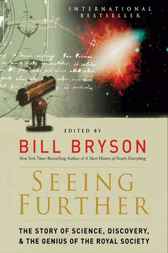
Although Bill Bryson is  chiefly known for his humorous travelogues, he has been known to venture into other nonfiction at times, and in fact the first science book I ever read for fun outside of high school was his A Short History of Nearly Everything.   I wasn’t too surprised, then, to see his name on a history of the Royal Society.  What did come as a surprise was the tenor of the contents, because Bryson was the editor here rather than the author, and the contributing scientists deliver a far more thoughtful history than I’d anticipated, one that’s almost introspective.  Rather than a straightforward chronicle of discoveries made and lines of thought pursued year by year,  the essays are more  thematic, emphasizing  through moments and movements  the evolution of natural philosophy and the development of a distinct discipline which rebuilt the world. (The history of the Royal Society itself appears at the beginning of the book, then the individuals and their contributions take over.  One of the earliest essays, dwelling on the rise of scientific materialism,  argues that the greatest disruption to traditional thought was the idea that the entire cosmos was made of the same material thing, that the stars had fallen from a heavenly realm and were instead pedestrian, subject to the same laws as apples and the dead leaves of autumn. In the monist world, where was the otherworldly?  Another explores the tension between logic-driven natural philosophers and experiential ones in the late medieval period, whose work would eventually dovetail together. It’s not all introspection, as chapters on the important of mathematics (undergirding science) and engineering (applying science) bring us out of the clouds and closer to earth.  

Posted in Reviews, science | Tagged , , | 2 Comments

All of my holds came in at once.

I had a bunch of holds set up at the library, and thought they were fairly staggered — I was 4th on one list, 8th on another, etc.  Instead, all of them were fulfilled within a few days of each other. I’m….glad I have a long weekend coming up!

About the lipstick cover:  the book is produced by the same ladies who do Sh%t Southern Women Say,   which I just love. They sound exactly like my family, especially the red-head… Julia Fowler! 
Posted in General | 5 Comments

Insanely Great

Insanely Great: The Life and Times of Macintosh, The Computer That Changed Everything
© 1994, 2000 Steven Levy
304 pages

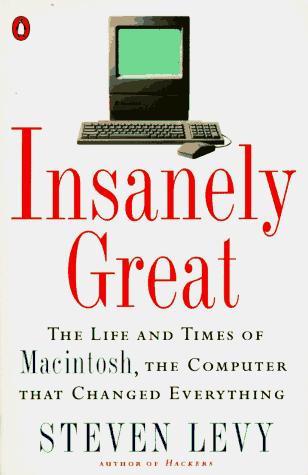
Apple Computers had already made its mark before 1984, by pioneering personal computers long before IBM entered the consumer market.  In January 1984, it hoped to make a larger one — to make a dent in history.   So it did…just not quite the way its creators intended. Insanely Great chronicles the history and influence of the Macintosh computer,  which became the company’s chief product before its wildfire consumer products of the 2000s. Originally written in Apple’s lost years when it hemorrhaged talent and could not find a stable hand at the rudder,  it includes an afterward on the recent turn of Jobs.  It’s a history that doubles as a labor of love, because it has a biographical thread concerning Levy himself — a man grudgingly seduced by computers. who was so enamored with the promise of the Macintosh that he bought on on release.

Although Jobs would later shanghai the project, the Macintosh originated in the person of Jef Raskin, who wanted to create an extremely cheap but versatile computer, an electronic Swiss Army Knife,  that would be easy for first time users to pick up, with an intuitive interface. While it wouldn’t boast any specs worth mentioning, it would have simple tools that ordinary people would find useful, like a word processor.   Raskin wanted to push this computer into the familiar realm of home appliances:  when computers became like phones and calculators, he thought, then they would have arrived. After working with the Lisa project, Apple’s first attempt at creating a machine with a GUI which proved to be an extremely expensive dud, Steve Jobs drifted into the Macintosh room and was seized by its potential.  Jobs would take over the team and make the Mac far beefier than Raskin ever intended, eventually, and his obsession with perfecting every detail meant that for all its expanded capacity, the Mac was under-powered for much of its basic operations.  Maintaining a glowing screen full of images, and drawing each bit of text effectively as an image, was asking a lot of 128K memory. And it wasn’t going to be like an Apple II, either; users couldn’t just open up the hood and add to the Mac’s hardware.  (The Mac team snuck around on the side and allowed for the ability to do a little memory expansion, since they knew — Jobs not withstanding — the Mac was going to need more as soon as consumers started playing with it.)

Perhaps the Mac was a little too user-friendly.  Although those who tried it loved the operating system, many looked past it. It wasn’t a serious machine; it looked like a toy.  Apple II and IBM machines which still ran the DOS system may have required getting used to typing in computer commands,  but they had a well-established library of software, including the business applications people were mostly relying on computers for. Mac was still developing its own, with the help of Microsoft.  Microsoft would use its experience with Macintosh’s graphical user interface to develop Windows, though this was not a simple care of Microsoft taking Apple’s idea: the pioneers there were Xerox, and  several  GUI systems were in development in the mid 1980s.  Although the little Macintosh would take over the company — via Jobs, who diverted more resources into it away from the Apple II line, which also had the GUI by now — and still lives in Apple in name (its current computers are much more like the Macintosh than the moddable Apple II, and have the same working-out-of-the-box approach), Levy admits that its greatest success was achieved by leading to Windows, which took a commanding lead over OSes to the point that prior to Chromebooks, it had an effective monopoly.

Although Insanely Great is sometimes more of a tribute than a serious history, I enjoyed the look at history it offers, both into the Lisa and Macintosh project, and the bit of biography: given that Levy is definitely a tech enthusaist, I was astonished to learn that he had once been anti-computers, and only when he was asked to do Hackers was he won over.  He shared Job’s hatred and distrust of IBM, and  for him seduction by the Macintosh was his entry into the world of computers. Therein lies his affection, for the little machine. which literally changed his life.

For a more balanced perspective, I would recommend this video in which an Apple fan argues that the Macintosh was a mistake, and that Jobs hobbled the performance of Apple II’s GUI model (GS) to promote the technically inferior yet more expensive Macintosh instead.  It’s 8 minutes.  For a look at the “other side”,  there’s also a video on YouTube of someone unboxing a new 1984 IBM-AT.  That one is much longer, but I was surprised at the amount of software setup required just to get it started, and it helped me  appreciate the “turn on…..ready” approach of the Mac.

Posted in history, Reviews | Tagged , , , , | 3 Comments

Science Report Card 2018

The last couple of years I’ve imposed a little order on my science reading, forcing myself to read across fields more deliberately; so far I’ve enjoyed it and will continue the structure in the future. I just finished the last entry on the list, Seeing Further, and will be posting comments in the next few days.  I’m in good shape to start next year’s,  as I already have four titles waiting to be read and ideas for several others.

Cosmology and Astrophysics
Hubble: Window on the Universe, Gwyneth Snow. I didn’t give full comments on this one because it’s mostly exceptional for its bounty of full-page photos from the Hubble telescope. The contents are the sort of thing you’d read in a book version of Sagan’s Cosmos: the lifespans of stars, the structure of galaxies, and the ins and outs of our local neighborhood.

Local Astronomy
First Light, Richard Preston. This was…also one I didn’t comment on, partially because it was weird.  Centered on the Hale telescope in the Palomar mountains, its story of scientific research often pretends to be a novel and switches back and forth between decades.  It wasn’t an approach that proved winning for me.

Geology
The Ends of the World: Volcanic Apocalypses, Lethal Oceans, and Our Quest to Understand Earth’s Past Mass Extinctions, Peter Brannen.

Chemistry and Physics
Stuff Matters:  Exploring the Marvelous Materials That Shape Our Man-Made World, Mark Miodownik. Fun microhistory.

Biology
Gut: The Inside Story of Our Body’s Most Underrated Organ, Giulia Enders

Flora and Fauna
The Truth About Nature,  Stacey Torno and Ken Keller

Anthropology
The Invaders: How Humans and their Dogs Drove Neanderthals to Extinction, Pat Shipman

Neurology and Psychology
This Is Your Brain on Parasites,  Kathleen McAuliffe

Weather and Climate
The Water Will Come:  Rising Seas, Sinking Cities, and the Remaking of the Civilized World, Jeff Goodell

History of Science
Seeing Further: The Story of Science and the Royal Society,  edited by Bill Bryson

Science and Society
A Crack In Creation:  Gene Editing and the Unthinkable Power to Control Evolution,  Jennifer Doudna

Thinking Scientifically
50 Popular Beliefs That People Think Are True,  Guy  Harrison

Posted in General, science | Tagged , | 8 Comments

Minimalism

Minimalism: The Path to an Organized, Stress-free and Decluttered Life
pub. Gwyneth Snow, 2017
207 pages

Although I associate minimalism with the mindset of people on YouTube who own less than a hundred things, or live out of a 2-liter backpack, the minimalism in this book is a far more approachable form. The first half of the book takes a look at home organization and decluttering before focusing on the personal side of minimalism — like the insight it can offer to our relationships.  The essence of the book’s message is this: figure out what things and what people in your life truly bring happiness, and let go of everything else.  Although the message of this is similar to Spark Joy, a popular work on decluttering,  Minimalism distinguishes itself from other books on decluttering and simple living  by examining the origins of minimalism proper in art, later expanding on them in a section on interior decorating, and referencing principles of yoga.   I found the work most valuable for its decluttering tips on cleaning kitchens, closets, and so on. In the last few months I’ve drastically reduced the amount of clothes I bother with (limiting myself to whatever fits in the closet and my dresser),  donating boxes of read-once-and-never-again books to Goodwill, and eying my DVD albums with a glint in my eye. The author doesn’t address books and such,  beyond suggesting readers switch to ebooks, so the application there was limited for me.  However,  the price can’t be beat….it’s being offered for $0.00.
Posted in Reviews | Tagged | 10 Comments

The One Device

The One Device: A Secret History of the iPhone
pub. 2017 Brian Merchant
416 pages

Love them or hate them, smartphones have revolutionized society like few other inventions. Entire sectors of the economy now exist which wouldn’t be there had they had not been invented, and barring  some kind of global collapse it’s unlikely their influence will fade anytime soon.  The One Device: A Secret History of the iPhone reviews not just how a computer company decided to gamble on making what would become the best-selling consumer device ever, but investigates how the various technologies which make it possible came into being, and how everything was finally put together. Merchant illustrates that a lot of key elements were already in existence and argues that Apple’s success was putting them together at the right time,  building on to them, and adopting to market pressures in a few key areas (grudgingly allowing for third-party apps, for instance).  It’s faintly anti-Steve Jobs, for as much as it quotes from Isaacson’s biography it also relegates Jobs himself to the background, choosing to focus instead on the inventors, tinkerers, programmers, and engineers whose ideas and grueling work made the device possible.

Unless you’re a fan of retrotech videos like myself,  you’ll probably be surprised to learn that the idea of smartphones predates Apple, and that the first was made by Apple’s hated foe, IBM — Big Blue itself.  IBM’s “Simon”, however, was before its time, with a battery life of a single hour. Other technologies which were later incorporated also had their genesis in a place other than Apple’s R&D department.  Merchant suggests that many technologies have a long stewing period before they’re truly ready for work. In the mid 2000s,  Apple was at a place where they were looking for an edge. Jobs’ experiment in remaking Apple products as a linked digital hub –the iMac and iPod linked together with iTunes, for instance — was a great success,, but he anticipated iPods being undercut in the future by cell phones and wanted address the problem by turning the iPod in to a phone.  The shuffle wheel, as useful as it was for scrolling through music, was poorly suited for dialing phone number. However, a team working on a tablet computer were onto something with touchscreens, and  Jobs’ focus on the phone project was such that the tablet, the “iPad”, was shelved until a little later.  The phone didn’t meet immediate success, however: Merchant reminds readers that the original only had three apps that weren’t Apple products, all from Google,  and there was no App store. It took increasing pressure from people hacking into their iphones to allow for third-party programs to force Apple’s hand.  It was immediately advertised as an essential feature of the phone in Apple advertisements, and Merchant suggests that the phone would have never taken off (given its price) were it not for the store.

The One Device blends technical research and business history,  and at times its level of detail may cool the interest of a casual reader.  Merchant is generally more personable than technical,  with the exception of the chapter on the iPhone’s processor, and the subjects covered are diverse — everything from software to mining to business deals.  There’s a lot of surprising content in here, too, so if you’ve an interest in popular tech,  The One Device will probably be of interest.

Posted in history, Reviews | Tagged , , , , | 6 Comments