Freedom, Culture, and the Modern Negation of Both

From Anthony Esolen’s “Culture? What Culture”, a speech I heard on Youtube and began to transcribe until I did a google search and realized he’s already posted the full text of it.  The speech is rather long and begins by revisiting an obscure English play.  I’m a great fan of Esolen’s oratory, though  mere text does not convey his voice.

We have just endured the great quadrennial national exam. Neither one of the major candidates referred to the wisdom of the Constitution. Neither one reminded us of what our revered statesmen once said and did. The so-called conservative did not broach the shrewd pessimism of John Adams; the leftist did not turn one page of the pamphlets of Tom Paine. Just as we have lost a sense of the holy, so have we lost our national and cultural memories, for without reverence the past is but a burden of irrelevant particularities, which historians may study if they so choose, but which most of us will cheerfully ignore. And that amnesia is one of the conditions of enslavement. For just as our apparent freedom from worship helps to enslave us to the State and its tentacles in mass entertainment, mass education, and mass technology—since there will be no Sunday against which to judge the everlasting Mondays of modern life—so our apparent freedom from memory only enslaves us to manipulation by what I call the Anticulture, the infantile fads we take in helplessly from our keepers in the media and the schools. A man worshiping God on a Sunday with his brothers in a tumbledown chapel is free, receiving the gift of the world, and giving praise freely in return. A man commemorating the birthday of Stonewall Jackson is free, receiving his heritage in gratitude, and passing it along in turn as a gift to his children.

But when I am in an airport, that most harried image of the eternal tarmac of Hell, crowded without community, noisy without celebration, technologically sophisticated without beauty, and see people engaged in loud conversations not with one another but with a business partner in Chicago or a spouse and children far away, I see not freedom but confinement. And above them all, as if to remind us of our unhappy state, blare the everlasting televisions, telling us What Has Just Happened and What it Means, and preventing us from ever experiencing a moment not of loneliness but of solitude, not of idleness but of peace. It too is a tool of the Anticulture. For culture by its nature is conservative. It remembers, it reveres, it gives thanks, and it cherishes. A farmer tilling the land his father tilled, whistling an air from of old, in the shadow of the church where his people heard the word of God and let it take root in their hearts—that is a man of culture. He might live only fifty years, but he lives them in an expanse of centuries; indeed, under the eye of eternity. How thin and paltry our four score and ten seem by comparison! For we are imprisoned in irreverence. Our preachers are neither the birds nor the old pastor peering over Holy Writ, but the nagging, needling, desire-pricking, noisome voice of the mass educator, or of the headline, or of the television, which could never have won our attention without encouraging in us amnesia, indifference, petulance, and scorn, all destroyers of culture.

Posted in quotations | Tagged , , | 6 Comments

A Crack in Creation

A Crack in Creation:  Gene Editing and the Unthinkable Power to Control Evolution
© 2017 Jennifer Doudna and Sam Sternberg

“No longer at the mercy of the reptile brain, we can change ourselves. Think of the possibilities.” – Carl Sagan

A few years ago I tuned into the middle of a science-news podcast and encountered a panel of otherwise sensible people caught up in an enthusiastic conversation about…crisper? Crisper drawers?  I’d missed something.

What I’d missed was a story about CRISPR, a gene-editing tool with enormous and explosive potential for  medicine and agriculture.  The outgrowth of attempts to use bacteria as microsurgeons,  CRISPR allows for fine-tuned genetic manipulation with reproducable results.  The first half of A Crack in Creation delivers the story of how CRISPR as a tool was discovered, and this history of scientific investigation is followed by the author’s thoughts on the implications. While optimistic about the tool’s applications for agriculture and medicine,   she admits that the potential for abuse in modifying the human genome itself is high.

Humans have been manipulating domesticated populations’ genomes for millennia, of course, but with clumsier methods:   finding animals with expressed traits we favor, and breeding them while taking the rest home to cook.  We have toyed with forcing mutations with chemical and radioactive agents, but the results thereof are unpredictable.  Now,  nearly two decades into the 21st century,  we have the ability to make fine-tuned adjustments, with applications both serious and trivial.  An internal biological weapon used to disarm viruses  and effect cellular repair can instead be used as a tool to remove  and supply whatever genes we desire.

  We’ve already created mosquito populations which have been stripped of the ability to propagate malaria, and — depending on trials and the weight of government oversight —  may use pigs to grow human organs for use in transplants.   As Doudna warns, however,   modifying humans — modifying ourselves — takes us into an area fraught with ethical quandaries.    She speculates that we may wish to discriminate between germ cells (sperm and egg cells, which would be capable of reproducing whatever edits we make) and somatic cells, which constitute the rest of the body.  Unless, of course, eugenics makes a comeback and we decide to create a race of supermen, a la Khan Noonian Singh. Then, germ cells would be fair game. (Okay, the bit about Khan is just me. As one of the principle discoverers of CRISPR, Doudna is seriously concerned about the ethical implications, to the point that she’s had a literal dream about Hitler contacting her with an interest in learning how to use CRISPR.)

Although I’m still trying to understand the mechanics of it (as much as I like biology, genetics is a definite weak point for me),  the potential for this excites me. Medicine is going to go very interesting places in the decades to come.

Posted in Reviews, science | Tagged , , , , , | 9 Comments

Top Ten Tuesday: Best Books of 2018, So Far

This week’s Top Ten Tuesday, hosted by the Artsy Reader Girl, is the best books we’ve read in 2018.

In order of my reading them…

  1. Star Trek the Fall: Ceremony of Losses, David Mack
  2. Poetry Night at the Ballpark, Bill Kauffman
  3. Fares, Please! A Popular History of Trolleys, Horsecars, Streetcars,Buses, Elevateds, and Subways, John Anderson Miller
  4. Fool’s Errand: Time to End the War in Afghanistan, Scott Horton
  5. Verbal Judo: The Art of Persuasion, George Thompson
  6. A Time Traveler’s Guide to Medieval England, Ian Mortimer
  7. How Adam Smith Can Change Your Life, Russ Roberts
  8. Exploding the Phone: The Teenagers and Outlaws Who Hacked Ma Bell, Phil Lapsley
  9. Ready Player One, Ernest Cline
  10. Little Brother,  Corey Doctorow
About the books:
Star Trek: Ceremony of Losses  is only part of a series, but features compelling moral drama about a doctor who does the right thing when his government  is being manipulative.
Poetry Night at the Ballpark is a collection of miscellany by a favorite author. I likened it to encountering him at a bar and then having a long, fascinating conversation about a variety of things.
Fares, Please! really speaks for itself. It’s a fun history of public transportation.
Fool’s Errand is a critical history of the Afghanistan war that stirs the water and asks why the hell Americans aren’t more pissed off at the constant bloodshed and waste of this war.  Ooh, did Queen Elizabeth just tweet something passive aggressive about her new daughter in law?  War? What war?
Verbal Judo is a pocket guide to nonviolent communication  and conflict deescalation.  Useful stuff if you work with the public.
A Time Traveler’s Guide to Medieval History was a fun social history of medieval England.
How Adam Smith Can Change Your Mind  interprets Adam Smith’s poorly-known Theory of Moral Sentiments,  to explore the meaning of life in being loved and being lovely.
Exploding the Phone reviews the phone-hacking scene of the fifties to the eighties, when computers made it more difficult and became objects of hacking interest themselves.
Ready Player One is…awesome.
Little Brother  takes the surveillance state, a kid, and a user’s guide to cybersecurity and mixes them together for a YA techno thriller that not only argues for privacy, but gives readers the tools to achieve it against the government’s designs.  That’s my kind of self-government. 
Posted in General | Tagged | 13 Comments

Of Neanderthals and dogs and extinction level events

Time for science short rounds!

Last week I read The Invaders,  a much-anticipated work about how dogs gave humans a competitive edge over their neanderthal cousins. This brief book posits that human beings function like invasive species, and after establishing a few housekeeping facts (the background of climate change, the available evidence for judging human / neanderthal populations and their diets) argues that humans and Neanderthals were competing for the same space in some regions of the globe, rather like wolves and coyotes, and that humans drove neanderthals out because of their advanced tool usage and domestication of wolves. While Neanderthals did use tools and traps, discovered tools to date suggest that the Neanderthals were more ambush predators, hiding and taking their quarry in close quarters. We sapiens used more ranged weapons like thrown spears. The wolf-dogs enter the book’s argument relatively late in the game (~ 50 pages from the book’s end), so this is chiefly a work about sapiens v neanderthal competition is therefore a book more of interest to those curious about ancestral man than his ancestral best friend.

Additionally, I finished listening to What If? Serious Scientific Answers to Absurd Questions, penned by the author of XKCD and read by Wil Wheaton. If you’ve never encountered XKCD before, you probably don’t spend a lot of time on the internet.  It’s a webcomic of “romance,sarcasm, math, and language.”   I can’t vouch for the romance bit, but science and math humor are a constant.  That’s the same of What If? in which the author uses his legit-science background to respond to outlandish questions submitted to his website. What if the Earth suddenly stopped rotating? What if we could drain the oceans? What if everyone was gathered in one spot and jumped at the same time?  Although none of these scenarios are remotely possible,  Munroe disregards this and puts math — and humor — to work  exploring the possibilities.  Naturally,  geek references abound. (River Tam of Firefly is consistently quoted as an expert on how fast it takes to drain a human body of all its blood, assuming adequate suction). Wil Wheaton is golden in his delivery, barely hiding his humor at times when Munroe’s writing is tongue in cheek. There’s an entire chapter on the positive effects of the sun  suddenly not working.   If you’re into science, What If? is great fun. 


Posted in Reviews, science | Tagged , , , | 5 Comments

How the Post Office Created America

How the Post Office Created America:  A History
© 2016 Winifred Gallagher
336 pages

Once the conduit of revolution, then a mainstay of communities both rural and urban, the post office has fallen on rough times as of late.   Amid speculation that its services may be ended altogether, Winifried Gallagher offers a praiseful history of the US postal service, arguing that it helped the colonies establish independence and a national identity, preserved it as its citizens expanded west, and advanced the American dream by opening itself to women and ethnic minorities earlier than any other branch of the federal leviathan.  How the Post Office Created America  delivers a social history of the United States, centered on the post office but not limited to it, Gallagher also explores how the postal service influenced American culture, from  encouraging a republic of letter-writers to the inclusion of Mr. McFeely of Mr. Roger’s Neighborhood. (Kidding about that last one. In a grievious oversight, the author neglects to so much as mention the much-loved postman.)

The story begins with Ben Franklin and Benjamin Rush, who believed that a good postal service was essential to the republican experiment.   A republic needed informed citizens; informed citizens needed ready information. In those days that meant newspapers, and their circulation was promoted by heavily subsidized rates. How subsidized? In a day when a letter cost $0.50 to make it from New York to New Orleans, a newspaper could make the same trip for $0.015.   In days before telegraphs, let alone telephones and the internet,  the mail service was a vital part of everyday life. Alexis de Tocqueville marveled that even in the frontier, rural villages received mail at least once a week.

Gallagher largely focused on the 19th century, that fascinating period in which the early republic transformed  and filled an entire continent. In its beginnings, the postal service consisted of men on horseback, delivering saddlebags to general stores where the proprietor was also the local postmaster.   A century later,  the postal service had massive infrastructure and had literally redrawn the political map, as homes were given distinct addresses and later ZIP codes to allow for efficient and accurate delivery. Gallagher marks key points in the postal service’s evolution,  from the adoption of rural and city free delivery to the implementation of stamps. The postal service’s  pricing scheme inadvertently promoted both cheap paperbacks (they could be shipped as periodicals) and the first reams of junk mail.  The early embrace of the railroad system created a golden age for the post office, and the trains themselves offered the unique ability to sort mail in the process of transportation.  The postal service effectively subsidized the creation of American commercial aviation,  as all of the early airlines relied on mail contracts to establish themselves to the point that they could build passenger service.  As the 19th century gave way to the 20th, the post office became more professional in its organization;  early administrations used it to reward their friends, giving away pork positions to their cronies, but the “spoils” system was largely dismantled in favor of a more meritocratic one, with post office employees required to sit for a civil service examination.

As American society became more technologically complex, with sophisticated transportation and communication networks, the postal service’s   prominence faded. Early on, Americans debating the nature of the post office decided that while it wasn’t a business that had to support itself solely on its income, it did need to support itself as much as possible while at the same time being supported enough by the public to keep pace with rural expansion. In the 20th century,  with the country fully developed and competing networks now in existence, the debate over its future and nature resurfaced.  The hybrid public-private elements of the office created conflicts of interest:   if the institution was expected to support itself like a business, it was only fair that it be allowed the same freedom of action as other businesses, like expanding its services. At the same time, it was hardly proper for a publicly-funded entity to go into competition against private citizens by offering commercial photocopying and banking.  Gallagher notes that the post office has been increasingly weakened by recession and constrained by Congress , to the point that it seems to be headed for insolvency. She urges readers to take stock of the post office’s long, pivotal role in American history and urge their local congresscritter  to take action.

While I strongly doubt the post office will disappear,  business as usual certainly can’t last for long.  The volume of mail sent by Americans continues to fall by the year,  especially  lucrative first class mail.  Parcel delivery is up, as the private  shippers sometimes use the USPS as their last-leg for home deliveries, but that’s only a small contribution to the bottom line.  At any rate, How the Post Office Created America is a fun social history, albeit one written by someone who is not a historian but  who seems to write pop-nonfiction.  That’s not a criticism — I’m a generalist myself, and have to appreciate someone whose books cover attention, the post office, the power of place,  houses, God, heredity,  novelty,  and purses. 

Related “Making of America”-esque books:
The Victorian Internet: The Remarkable Story of the Telegraph, Tom Standage
Empires of Light:  Edison, Tesla, Westinghouse, and the Race to Electrify the World,  Jill Jonnes
The Great Railroad Revolution, Christian Wolmar

Related:
Stagecoach: Wells Fargo and the American West,  Phillip Fradkin. Wells Fargo established itself as a rival against the postal service, which struggled in a way to achieve fast service between California and the eastern US.

Posted in history, Reviews | Tagged , , | 4 Comments

Related Videos: How To Watch TV News

A few years ago I watched an eerie compilation of local newscasters from around the United States all reading the same exact script.  I don’t think this is the same video, but it has the same creep-inducing effect.

A comedian-singer named Remy produced a mocking take on televised news (with CNN  as its specific target)  that highlights the inanity of the 24/7 news cycle, with its barrage of unrelated topics and superficial treatment.

Journalist:   What I mean  is / while we’re reading these trivial mysteries/ People are dying, we’re losing our liberty / They’re inside our — what?! Isn’t that banned?
Anchor: Inside our hardware. I understand! Well, they could be inside your phone at this very moment /
Journalist: Yes!
Anchor:  — Pokemon! This town’s p-
Journalist: NO!

Posted in General | 5 Comments

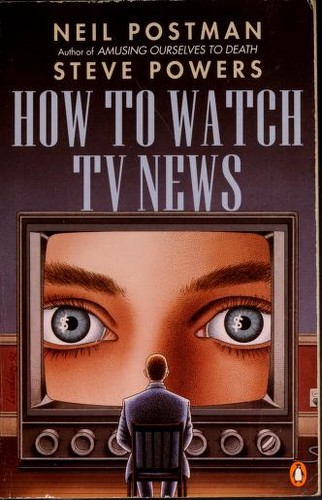
How To Watch TV News

How to Watch TV New
© 1992 Neil Postman, Steve Powers
192 pages (2008 edition)

Don’t.

Well, that was easy.  From television insider Steve Powers and technological critic Neil Postman comes this slim book, How To Watch Television News, which explains how televised news is produced and scrutinizes the platform’s ability to deliver seriously useful information.  Although  this is not a takedown of television news — at the end they merely encouraged readers to reduce their TV news consumption by a third —   it doesn’t foster trust in the medium.   Powers’ insight reveals an industry which scrambles to stay ahead of the latest developments, seizing on whatever is most likely to keep eyes on the screen and keep the ratings high.    Most readers are aware, of course, that television news programs play to the ratings:  no serious journalist would focus their attention on the goings-on of celebrities otherwise.  What we might fail to appreciate, however, is how carefully orchestrated television shows are, from the music chosen to the arrangement of news sequences,  designed to draw viewers in and keep them fixated.  Because of the pace, the need to keep as many viewers’ attention as possible,  and the amount of production work required to put each show together, serious journalistic pieces are impossible for something as small as the nightly news, whether it’s a half-hour local news spot or an hour-long nationwide show.  To truly evaluate what’s happening in the world, Postman and Powers maintain, we need print media — stories that allow us to consider ideas at length, not merely be distracted by them as objects on the screen.  If readers were to reflect on the news and the commericals which it actually serves, they might see through the illusion — and see that just as a mouthwash commericial is more about social acceptnance than mouthwash, a news show is more of a show than the actual news.

Despite its multitude of references to the eighties, How to Watch TV News is far from outdated. Powers’ 2008 revision updated some references and tech, but Postman’s contributions are timeless. Some of them will be familiar to anyone who has read Postman before, from his view that different technologies foster different beliefs, to the belief that television has trivialized and eroded culture in general.  How To Watch Television News is less about television, however, and more about news, the barrage of facts we’re told are important. Postman and Powers help us to look for the stage behind the story: why are these facts being presented,   what judgments are we expected to accept in viewing them? In giving recommendations to the reader, however, Postman urges readers to realize they don’t have to have an opinion about everything.  This has never been more relevant than today, when  the social media cloud that we’re all forced to live in – -because it rains on those of us who don’t use it, when people insist on talking about what they’re tweeting or reading — constantly pushes us to react to everything as if it were important. We are still a nation — and now a globe — amused to death, frazzled by distraction.

Also from Neil Postman:
Technopoly: The Surrender of Culture to Technology
Amusing Ourselves to Death: Public Discourse in the Age of Show Business 
The Disappearance of Childhood
Building a Bridge to the 18th Century

Posted in Reviews | Tagged , , , | Leave a comment

The survivor

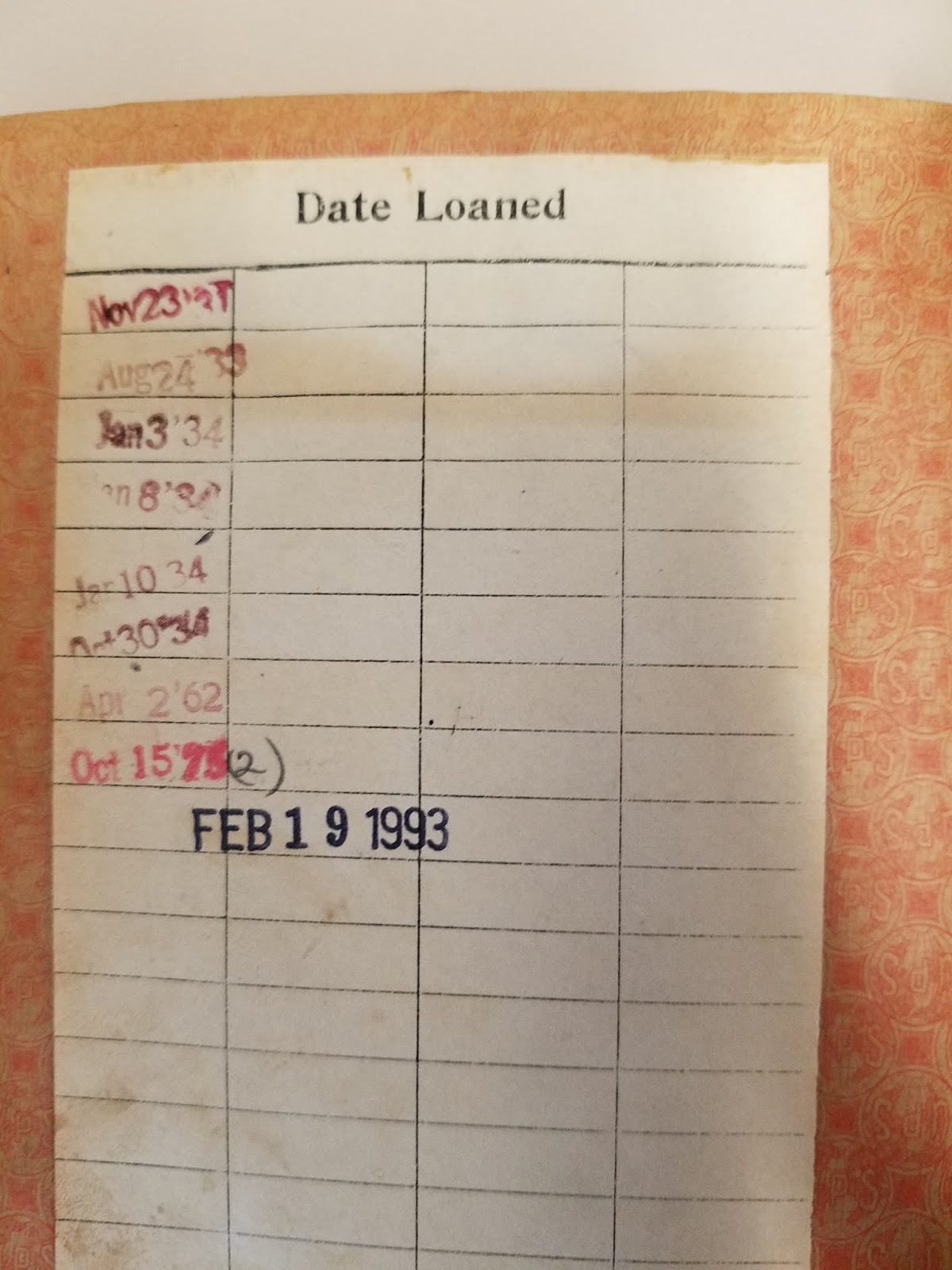
When I visit towns I like to poke around their libraries, and I recently discovered a book in a public library — city undisclosed for the book’s protection — which  astonished me. It’s hard to make out from this graphic, but the first due date stamped is November 23, 1931..  That wouldn’t be unusual for a university library, where great swathes of the collection sit undisturbed for eons, their treasure of 1930s farm reports unvisited, but for a public library where books are constantly being destroyed or declared missing by patrons, it’s kind of incredible.   The book in question, for those curious, is Michael and his Lost Angel, a play.  Many of the books in this section also hadn’t moved since the 1970s, despite frequent and steady borrowing throughout the forties, fifties, and sixties. It’s as if the people in the town decided, in the 1970s, to give up on reading and watch Family Feud instead. 
Let’s  see an eBook file last that long without its data being corrupted! 
Posted in General | 7 Comments

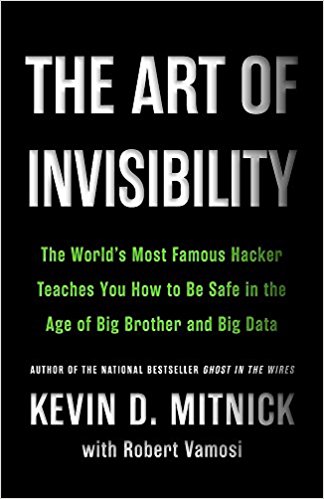
The Art of Invisibility

The Art of Invisibility: The World’s Most Famous Hacker Teaches You How to Be Safe in the Age of Big Brother and Big Data
© 2017 Kevin Mitnick
320 pages

So, you want to be invisible online? Great. All you’ll need is three separate computers — one for your top secret business, one for your banking, and one for your everyday use; a few new email addresses,  a handful of burner phones, a large pile of cash to buy gift cards and electronics without leaving a credit trace, a slightly larger pile if you intend on paying strangers to buy said cards and electronics for you,  an ability to habitually lie, and the concentration of a criminal mastermind to remember which accounts you’re using on which computer so you never accidentally blend your Top Secret identity with your real one. Child’s play.

Kevin Mitnick knows a thing  or two about the necessity and the difficulty of staying invisible. He spent two and a half years as a fugitive from the FBI, wanted for hacking, unauthorized access, and wire fraud. These days he works as a security consultant,  and in The Art of Invisibility he provides a point-by-point tour of the surveillance web created by the internet and telecommunications infrastructure. There are also specialized chapters on surveillance in the workplace, and maintaining privacy while traveling abroad.  Mitnick’s survey and advice have at least two audiences:  most of the book can be appreciated by a technologically savvy and privacy-minded individual who wants to know more, while a smaller but not insignificant portion of the book, somewhere between 30 and 40 percent,  would be of interest to the truly paranoid.

Although Mitnick does cover material would be a given to those with an interest in security —  don’t use public WIFI networks for banking or other sensitive business, even if they’re password-protected, that kind of thing — most of his information is less elementary. He’s thorough, explaining how tools like email and hardware encryption work,  where they’re vulnerable, and why they’re useful.   The Tor browser  is a mainstay of recommendation, as it allows users to be relatively anonymous and evade filters that restrict access in territories controlled by authoritarian states like China by redirecting the user’s activity across a series of nodes. The nodes chosen are random, and it’s possible to encounter a node controlled by surveying authorities. If a person uses Tor on the same computer and accesses the same accounts as they normally do, however, then if they’re under active surveillance by someone their token efforts at anonymity are for naught.  People in witness protection can’t go to family reunions, and those who want remain invisible can’t muddle their identities together. If you want to have an email account and use Tor,  Mitnick advises, then use Tor and create a new email account. The same concept applies across communication technologies: Mitnick was caught in the 1990s because despite using multiple cell phones, he was using them in the same location (a motel room), and thereby connecting to the same cell tower every single time — allowing  the FBI to collaborate with the local telecom to get a fix on their man.

The Art of Invisibility is far more comprehensive and helpful than Mitnick’s previous books on intrusion and social engineering.  Mitnick offers his exhaustive tour of vulnerabilities not to scare readers into retreating to a monastery, but to point out — this is what you’re up against, this is what you can do about it, this is where you’ll still be weak. Like a security consultant’s tour of your home, The Art of Invisibility shakes expectations, and disturbs the illusion of safety — while at the same timeVanishingly few people are capable of taking all of Mitnick’s advice: even he doesn’t. He leaves the decision to the reader how best to integrate this information with their own practices. Everyone can benefit from better cyber-security hygiene, even if it’s something as basic as keeping your cellphone locked, running adblock to disable malicious scripts on websites,  and keeping SmartTvs that never stop listening to you out of your house.

Related:

Posted in Reviews | Tagged , , , | 4 Comments

Forgotten Founders

America’s Forgotten Founders
© 2011 ed. Gary Gregg II
185 pages

After reading several thoughtful full-length biographies in this series, I expected the same quality in miniature from this collection. That is not the case at all; after a lengthy opening essay on what constitutes a founding father, and why some are forgotten and others not, the reader is treated to ten brief articles about revolutionary-area personalities. Some of these men are unequivocally  not forgotten, like Patrick Henry and Thomas Paine. A few others are more obscure, but the information included here is so slight that one could just as well read any entry in a biographical dictionary about them. I liked the organization of each article: a biographical sketch, an outline of their chief contributions, and an excerpt of their writing. There’s just not enough content here. One gentleman’s writing excerpt is the Preamble of the Constitution. The full-length volumes in this series, particularly American Cicero and The Cost of Liberty are much more helpful.

The men considered:  James Wilson, George Mason, Gouverneur Morris, John Jay, Roger Sherman, John Marshall, John Dickinson, Tom Paine, Patrick Henry, and John Witherspoon. According to the introduction, many names were submitted and considered, but the editor chose the names which were suggested most often. The native American and female contributors teased at in the introduction don’t actually get sketches.

Posted in history, Reviews | Tagged , , , | 10 Comments