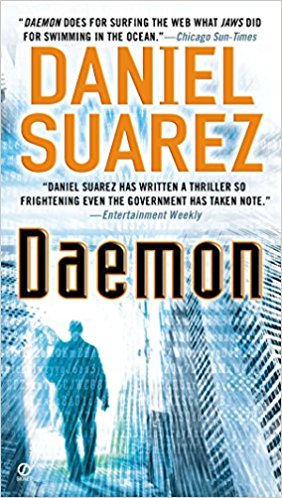
Daemon

 Daemon
© 2006 Daniel Suarez
444 pages
SO YOU SAY YOU WANT A REVOLUTION
YES NO

When a incomparable programming genius known for his immersive games and uncanny AI dies, his greatest creation awakes.  A sophisticated program running in the background begins putting into action a plan that will remain unknown to the reader throughout most of the novel, hidden except for when its actions result in death or global panic.  So begins a technological thriller, featuring a faceless enemy which grows more daunting by the moment as it steadily increases its power, imposing a new technological order over a world that has grown too complex for its own good. The world is to be reprogrammed, and resistance is futile.

The kernel of Daemon’s story is that a doomed genius (Matthew Sobol) once courted by the NSA created a program which scanned the news for announcement of his death, and then began a hostile takeover of anything powered by silicon chips. Effecting the deaths of opponents, recruiting human agents through a video game, taking over computerized systems and using their resources for its own expansion, it lurks in the background  except for when it issues press releases to manipulate public reaction. The Daemon’s greatest strength is that it is a distributed program, a global botnet;  it has no master server to destroy, no switch which can be thrown. The Daemon is autonomous, persistent, and pervasive. When it sends instructions to its human agents through wireless headsets, it concentrates its demands for action into YES/NO prompts. While Sobol presumably could have created an AI that can parse spoken sentences, the nature of this machine-human communication makes the Dameon seem like an alien intelligence, instead of a naughty instance of Alexa.

As the story progresses, readers encounter a pair of battered men who are trying to unravel the Daemon and expose it, as well as a few individuals who come agents of the Daemon.  The Daemon entices them in different ways, each according to their ambitions:  a sociopathic identity thief finds his calling in enlisting to the machine’s service  as its greatest champion, the  Sauron to its Morgoth (or the Saruman to its Sauron, but without the initial resistance), and a criminal is given freedom, and a frustrated TV tabloid reporter is given the chance to become a Serious Journalist.  All they have to do is listen to the remorseless voice in their head and follow its instructions. The Daemon’s ability to manipulate systems grows throughout the novel, to the point where it controls physical infrastructure producing autonomous weaponized vehicles.

I had no idea that this book was written in 2006, as the amount of now mundane electronic control within it is perfectly in sync with our own world. The only clue that this novel had a few years on it was the Daemon’s inability to parse complete sentences, but as mentioned that actually helped reinforced the Daemon’s other-ness.  Daemon is an unnerving thriller, one capable of unsettling the reader with the kind of world we’re headed into, in which authentic freedom and privacy are as impossible as Triceratops flank steaks.  As successful a thriller as it is, Daemon also succeeds in raising questions about how politics, society, and the economy will be transformed by ubiquitous networking;  although it only offers a glimpse into early disruption,  one can’t help but think that the present state of affairs will be as alien in a century as early 19th century agrarian society is to our own.

Sidenote:  Sobol was known for a World War 2 shooter and a game in which one opens the gates of hell. Sounds kiiiiiiiiiinda like Wolfenstein 3D and Doom.  Considering that Sobol’s company was named CyberStorm, I wonder if he was inspired by John Romero — cocreator of the two programs mentioned above, and founder of a company called Ion Storm. (See Masters of Doom).

Posted in Reviews, science fiction | Tagged , , , , | 12 Comments

Top Ten Tuesday: Summer TBR

This week, the Artsy Reader Girl inquires: whaddya reading at the beach? Or this summer, anyway.  This was to have gone up yesterday, but what’s 24 hours between friends?

1. Something in American lit, because I’m…a little behind on my Classics Club participation, and I like to do something to celebrate Independence Day. I’ll probably finish The Sun Also Rises, which I’ve been grudgingly picking my way through.

2. The Invaders, some speculative anthropological history that posits the Neanderthals fell because we had man’s best friend and they didn’t.

3. How to Watch TV News, Neil Postman. I ordered the “updated” version of 2008, with a supplement by another author.

4. The Grid: The Fraying Wires Between Americans and Our Energy Future . At the beginning of the year I posted a list of ten titles I hoped to read in 2018, and the rest were finished by April.

5. The Essential Russell Kirk.  Kirk is an extraordinary author, who I first read in disagreement but quickly realized had an intelligent, principled perspective that I could learn from even if I remained unconvinced.

6. The Moral Animal: Why We Are, the Way We Are: The New Science of Evolutionary Psychology. Robert Wright.

7. How the Post Office Created America, Winifred Gallagher. This one is intended as one of my ‘celebrating America’ books, set for around Independence Day.

8. Seeing Further: The Story of Science and the Royal Society, Bill Bryson. History of science and Bill Bryson? Say no more.

9. Forgotten Founders, ed. Gary L. Gregg II, Mark David Hall. Biographical articles about long-forgotten founding figures of the former federation (sorry),  including women and at least one native American.  Also Indendence Day reading, but continuing in a series that I’ve been reading the last few Independence Days. Full works in this series have included: American Cicero, Forgotten Founder & Drunken Prophet The Cost of Liberty, and (almost) Founding Federalist.  I didn’t finish that last one last year because I was reading too much about the Constitutional Convention all at once.

10. The Network: The Battle for the Airwaves and the Birth of the Communications Age, Scott Woolley. 

Posted in General | 3 Comments

Fire and Blood

Fire and Blood: A History of Mexico
 © 1973 T.R. Fehrenbach
675 pages

Fire and Blood is an epic history of Mexico, one that begins at the dawn of time and takes its time moving on.  Case in point: the 20th century is addressed in the last 10% of the book.   If nothing else, Fehrenbach should be lauded for a historical survey that focuses more on the past rather than the recently-expired present.  Fire and Blood is dauntingly comprehensive, taking no shortcuts; not only are the cultures of the Aztecs and Maya plumbed, but when the 16th century arrives Fehrenbach pauses to render a history of the Spanish empire, and readers are continually fed with changes on its evolution as they affect Mexico.  The arrival of the Spanish is a pivotal moment,  as they destroyed the old tribal order — and imperial order, while easy to declare, was  harder to realize.  A dominant theme within the book is a search for Mexican identity, and it begins with the Spanish disruption.  Spanish authorities organized their new domain into a multitude of racial castes, with varying privileges and duties depending on whether one was a Spaniard born in Spain, a Spaniard born on the peninsula, or racially mixed in some way. Over time, and especially after the Spanish empire collapsed of its own corruption with Napoleonic assistance,  the mixed Spanish-and-Native population was dominant,  but even so Mexico still writhed trying to create social, economic, and political order for itself. Some wanted a republic, some a monarchy; some wanted to destroy the Church utterly, some to embrace it.  Struggles over land a la the brothers Gracchai also drove politics.  All this turmoil tended to produce autocratic leaders, not principled democrats,  and even once democracy had established itself one political party held sway.

Prose-wise, Fire and Blood is approachable history; the history itself, however, as the title indicates, is harsh, unforgiving, and often violent.  It took me several weeks to finish, with frequent breaks,  because the constant strife seemed relentless.  The content an style make this a valuable resource for those interested in learning about the roots of Mexican culture, however.

Posted in history, Reviews | Tagged , , , , , , | 6 Comments

The Switch

The Switch
© 2017 Joseph Finder
384 pages

Picture this. You’re a senatorial aide whose boss is technologically illiterate enough to be dangerous. The senator’s MacBook, containing information that was never supposed to leave the Senate offices,  has been inadvertently switched with someone else’s at an airport security checkpoint.  The guy who mistook the senator’s MacBook for his knows something is screwy, because when you tried to get it back you pretended to be someone else. Your  clumsy attempt to hire an bagman from the Dark Net backfired when the target got nervous and ran over your employee.   Now you’re thinking this hapless owner of a failing coffee company is some sort of criminal mastermind, and he thinks he’s being targeted by some cold-blooded Agent Smith type at Fort Meade.  In reality, you’re both goofballs not taken seriously by their wives and bosses,  who have manged to turn an innocent mistake into a light action thriller which is accidentally funny, despite pitting secret government goons on opposing sides trying to kill a nice buffoon of a main character.

The Switch  is…extremely light reading — basically,  what might happen if James Patterson tried a novel with cybersecurity and surveillance themes. I  was often entertained by it, sometimes in ways not intended by the author.  I would probably try the author again to see if  the quality varies, but only for the mental equivalent of a lazy morning on the couch.  I like the general premise of this novel, but the execution was often bizaare: one journalist character claims to have gotten Hillary Clinton’s oatmeal cookie recipe from their whistleblower dropbox, and an NSA character refers to a flashdrive as something like a thingamabob. He was wearing cowboy boots and flannel at the time.  I only got through that scene by pretending the NSA guy was playing some bizarre mind game with the main character that required him to pretend to be an insidious country bumpkin who can also delete all of your from Google, Facebook,  and even your favorite craft beer website. (I’d wager a bottle of IPA that Finder has watched The Net at some point and thought it was worth borrowing liberally from.)

In short, The Switch is kind of like the Rush Hour movies — kind of preposterous, but entertaining.

Posted in Reviews | Tagged | 4 Comments

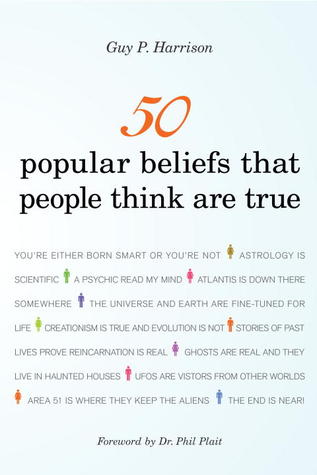
50 Popular Beliefs That People Think Are True

50 Popular Beliefs That People Think Are True
© 2011 Guy Harrison
458 pages

“Just because it’s vivid, detailed, and expressed with confidence and emotion…doesn’t mean it’s true.”

Chances are you know someone who harbors what you know to be irrational beliefs, and chances are they hold the same opinion about you. It isn’t easy to stay sober with a monkey brain trying to impose order on the chaos of life,  sometimes mesmerizing itself with its own fiction.  50 Popular Beliefs consists of an introduction, fifty brief essays debunking various icons of culture from ghosts to horoscopes, and a conclusion.  Those who count themselves skeptics already will find no surprises, and should not anticipate anything that will add greatly to their own knowledge, like The Demon Haunted World or Why People Believe Weird Things. This is straightforward debunking, along with some information on how we are so easy to fool — especially when we’re fooling ourselves. The ideal audience is people who regard themselves as well-informed and appropriately skeptical, but who are exposed to some ideas so often that they’re wanting confirmation that yes, horoscopes really are BS.

While many of the essays address areas of constant skeptic scorn — astrology, homeopathy, ancient aliens, Area 51,  Holocaust denial —  Guy Harrison also covers matters that aren’t low-hanging fruit, like the value of television and the dimensions of race. He explores race as a concept, then some stereotypes about it in regards to sports and intelligence. The pieces have a strong personal flavor, as Harrison uses his own experiences to try to understand those of others, and he attempts to experiment directly when he can. For instance, in the chapter on psychics he successfully cold-reads someone, and in the chapter on faith healing he attends a Benny Hinn performance. The pieces are sometimes too short to do their topic service, which I think will expose them to “what about” rebuttals as believers present similar convictions from a slightly different angle  Not every article has the same length, however;  Harrison is partcularly passionate about the veracity of the Moon landings and that essays goes on for a bit rebutting the various arguments for their being a fraud.

The most valuable part of 50 Beliefs, personally, are its resources for extended reading. I saw more than a few titles in here which I’d either long forgotten about or had never heard of at all.  Harrison has written more in this genre, but I’m more interested in Brian Dunning’s new book dissecting conspiracies or The Skeptic’s Guide to the Universe’s  October release of a book using their name.

Posted in Reviews, science | Tagged , | 14 Comments

Brinkmanship

Star Trek Typhon Pact: Brinksmanship
© 2012 Una McCormack
352 pages

Who’s up for the Cuban Missile Crisis….in spaaaaaaace? When an otherwise friendly nation on the borders of the Federation and two of its allies signs a treaty with a hostile power, allowing them bases for repair and refueling along the Federation border,  Starfleet is understandably concerned — and doubly so when news arrives that a fleet is enroute to supply the bases for their new tenants, carrying chemicals that could be used in biogenic warfare attacks on the Federation. While the USS Enterprise speeds to meet with the Space Cubans to work the diplomatic angle, the USS Aventime is dispatched to do a little friendly snooping near the proposed base nearest the Federation border.   When the Cardassians — who, along with the Ferengi are the other two threatened allies —  arrive ready for war, and the Space Cubans catch wind of possible spies inserted in their country, events begin to spiral out of control, heading towards a war that no one wants but no one seemingly can avoid.  But the drama unfolding in open view is only the smoke and mirrors for another maneuver,  one that is using parties on both sides.

I bought this book a couple of years back,  intrigued by the possible historical parallels and interested in a book which includes both Picard and Dax.   The primary appeal of the book is learning about the Tzenkethi, who along with the Breen were pretty much black holes before the Typhon Pact series began. Romulans, we know, love, and fear;  while the Gorn and Tholians can be wrapped up in primal fears about reptiles and insects, respectively.   The Tzenkethi are presented as a very stable, very hierarchical society who have a natural affinity for the Space Cubans, another stable and hierarchical society.  The Tzenkethi view the Federation as some kind of chaos monster, however, the epitome of their every social fear:  it’s all argument,  class-and-racial intermixing, cats and dogs living together, mass hysteria!  Who can tell what they’ll do, what new planet will sudden fall under their spell?

Having read beyond this series, I knew that no epic war between the Federation and the Typhon Pact broke out, so the drama was largely dampened for me. I assumed the drama would keep ramping up until something happened out of left field to defuse things,  and that’s more or less what happens. Still, it’s nice to see Picard being the commanding diplomat again, and I’ll never say no to a story with Ezri Dax and her ship,  in part because the Relaunch developed her in such a commendable way — turning the awkward 20-something shrink of 2000 into the Captain on the Bridge, and in part because the Aventine looks much different than the other Starfleet ships and I ‘m ever curious about it.

Posted in Reviews | Tagged , , , | 5 Comments

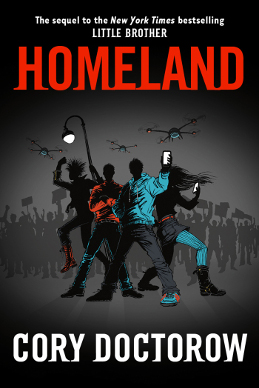
Homeland

Homeland
© 2013 Corey Doctorow
400 pages

Two years ago, an innocent teenager was swept up on the streets and thrown into a blacksite prison run by the Department of Homeland Security. Initially a suspect for being near the scene of an explosion, Marcus Yallow’s refusal to unlock his phone or give DHS his access codes for his computer and email made him an object of special abuse for the people running this illicit site — and their abuse turned him into a revolutionary, determined to  throw a light on government malfeasance and restore privacy through technological and political means.   Now Marcus is approached by an old ally under tense circumstances, and handed a drive that contains a key unlocking 4 gigs of explosive information  — information that she wants shared if she happens to disappear.   Her paranoid proves to have been justified, and Marcus finds himself with a choice.  What dark secrets are buried in those 810,000 files — and what will happen when &; if he lets them lose on the internet?

Since the events of Little Brother,  martial law in San Francisco is over, but the city is still deteriorating. Unemployment, foreclosures, and bankruptcy plague the city,  even affecting Marcus’ own parents.  His new job  as the resident tech guru for an independent political candidate is one of the few bright areas on the horizon, but being linked to some new WikilLeaks-style dump might spell the end of that. Homeland addresses most of the same issues as Little Brother in the same way,  including the passages where Marcus explains his security precautions to the reader — how he partitions a drive, creates virtual machines to run programs without exposing his files,  that sort of thing. The greatest difference between Little Brother and Homeland is that in in the first book, Marcus  believes the problem can be solved politically, that the wrong people are in office. In Homeland, however, Marcus has seen the “good” president since elected prove himself an ally, not an enemy, of the surveillance & police state.  Although Marcus never in as dire straights as the first book — despite being  kidnapped by goons once, arrested once, and nearly stampeded several times as he participants in an Occupy San Francisco protest that grows ever-bigger by the day — this is still a thriller, one with some interesting side trails like the Burning Man event and a guest appearance by Wil Wheaton. As with Little Brother, the book has a couple of essays at the back — this time on the importance of activism, and for the same reason that Marcus continues struggling even though there’s no winning. To do nothing is to cede the field to complete subjugation and defeat.

If someone were curious about this series, reading only Little Brother would be safe. Homeland does teach its readers to put not their trust in princes, a lesson anyone should take to heart.  I’m personally ten years sober from believing in any politicians. There are a few I admire — chiefly, Rand Paul, who doesn’t just criticize FISA and unlawful drone assassinations, but has actively filibustered against them — but even if he were put into the office of president I would expect him to be immediately warped by it.

Posted in Reviews, science fiction | Tagged , | 3 Comments

Rebel Dawn

Star Wars Han Solo Trilogy Vol III: Rebel Dawn
© 1998 A.C. Crispin
400 pages

Rebel Dawn is the final volume in the “Han Solo” trilogy, a volume that stands more as an immediate prequel to the original Star Wars movie than a novel solely about Han.    At its beginning, Solo is on top of the world;  his new ship has him ahead of the other smugglers,  he can’t walk into a room without gathering female attention, and he’s raking in the cash. At its end, Solo has  been betrayed and unwittingly duped, made into an outcast with a bounty on his head, desperate for anything that will pay off his enemies and keep him alive.   And in the middle…well, that’s mostly someone else’s story.   Rebel Dawn takes side trails in previous novels and brings them front and center here – -chiefly,   competition between two major Hutt clans that threatens to turn into civil war, and Han’s old flame uniting disparate groups into one Rebellion — one whose seed money can be had by sacking the place where she was once a slave, the place where she and Solo’s love was as they fought an insidious slave racket, one that used ecstatic drugs and religion to keep captives working of their own free will.  But Brea loves the fight more than she loves Han, and that will put him into a seedy cantina looking for fares.

Rebel Dawn conlcudes a series which is mostly light-adventure, not to be taken too seriously. The writing definitely had weaknesses in the form of awkward dialogue.  I enjoyed the character of Brea — Han’s old flame and the leader of the rebellion — the most, and Crispin’s treatment of the Hutts and Boba Fett were also appealing.  Imagine Jabba the Hutt as a sympathetic character!

Posted in Reviews | Tagged | 2 Comments

The Hutt Gambit

The Han Solo Trilogy, Vol II: The Hutt Gambit
© 1997 A.C. Crispin
352 pages

At the end of The Paradise Snare, Han Solo was a heartbroken man moving on with his life, doing his best to forget  about the woman who left him with a “Dear John” letter as he entered the pilot academy and the service of the Empire.  As The Hutt Gambit opens, readers realize how short-lived both Solo’s tenure in the Imperial Navy and his determination to avoid romantic entanglements were: not only has he been cashiered from the service and blacklisted from commercial piloting, but he can’t move to a planet without falling in love again.  Turning again to that faithful standby, a life of crime, Solo begins working for the Hutts and acquiring the money and reputation he needs to make it as as first-rate smuggler. Too bad the Empire has decided to slag his and other smugglers’ favorite retreat, Nar Shadaa.   The Hutt Gambit serves a steady course of light action-adventure that builds Solo’s character, introducing him to Jabba, Lando, the Falcon, and even Boba Fett, and ends with a desperate attempt by the smugglers to stave off an Imperial attack fleet. Fortunately it’s one of older ships, left by a man who is both hesitant to commit genocide and very susceptible to bribes.  I thought the ending was contrived, to say the least, but enjoyed the characterization given to both the Hutts and Boba Fett, who — in a nod to Return to the Jedi — does a low pass over the Sarlaac pit while visiting Tatooine, unwittingly walking over his own grave.

Posted in Reviews | Tagged | 4 Comments

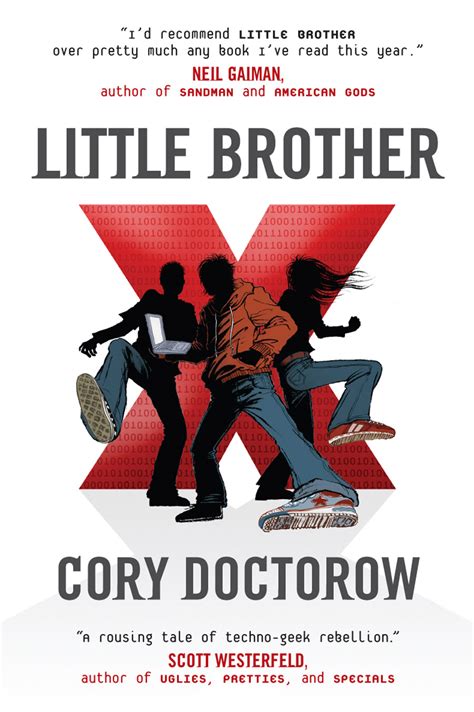
Little Brother

Little Brother
© 2008 Corey Doctorow
380 pages

Following the destruction of the Bay Bridge in San Francisco, a nightmare begins for a high school student who is scooped up by police in the aftermath. Not only has one of his friends been seriously wounded, but Marcus’  presence near the bridge and his suspicious computer equipment make him a person of interest to the authorities, doubly so when he refuses to unlock or decrypt his devices and information for them.  If he’s innocent, he has nothing to hide, right? But Marcus has been rebelling before this,  mostly to elude his school’s draconian security measures. and his initial stubbornness turns into revolutionary resolve when he realizes  that the authorities are not merely mistaken: they are malevolent. He seems doomed in the police state that San Francisco has become overnight, where the demonization of any dissent alienates Marcus from his family and friends,  but there are other allies waiting in the wings, and they and his own resolve will spur him on.

So begins Little Brother, a man vs state story that combines the alienation and surveillance of 1984 with modern cybersecurity tools.  At its best, Little Brother is a technologically savvy thriller,  a defiant championing of civil liberties amid the war on terror,  and a call to arms to readers to get serious about learning to defend themselves against abuse.  This continues after the novel: there are several essays included after the story on the nature of security. At its worst,  the arguments are one-sided, with only one attempt at mutual understanding.  The security apparatus of the State is so extensive, however – both in the story in real life – that I can’t seriously begrudge Doctorow just wanting to fire up righteous indignation.  Easily my favorite aspect of Little Brother was the pervasive cybersecurity information: Marcus doesn’t just do things, but as a narrator he’s conscious that he’s speaking to an audience, and explains how encryption or whatever is he’s doing at the moment works.  Winston’s intelligence as cyberpunk rebel extends not only to tech, but to the nature of resistance: he realizes that certain tactics will only strengthen the government’s hand against him, so the trick is to find ways to keep them off balance — sometimes by appearing to retreat.

Little Brother is an exceptional read, a smart thriller that takes its teen readers seriously. If you are concerned about the status of civil liberties across the world, the surveillance state,  or curious about how tech can both amplify and mitigate the problem, it’s one to take a look at.

The story’s use of a couple of young dissidents who fall in love underground reminded me strongly of a song called “By Morning” by folk-punk songwriter Evan Greer. He wrote it in tribute to several young people who were imprisoned on charges of terrorism for  harassing an animal testing lab. The song begins at 1:15.

And if they come for us by morning, with that “knock knock” on the door —
I’ll hold you a little closer as they reach the second floor
And if I have to give my name, know I won’t be giving yours
I’ll run my hands through your hair, say it’s them that’s really scared
Because they know love is stronger than their bars can ever be.


Related:

  • 1984, George Orwell. Little Brother is commonly referred to as “1984 for the 21st century”, which is a gross exaggeration. Even so, Little Brother makes numerous hat-tips to Orwell’s dystopia beyond the surveilliance state:  one of Marcus’ online pseudonyms is pronounced “Winston”, for instance. 
  • No Place to Hide, Glenn Greenwald The story  of Edward Snowden and the surveillance apparatus of the NSA. 


Posted in Politics and Civic Interest, Reviews, science fiction | Tagged , , , , , | 6 Comments