Replay

Replay: The History of Video Games
© 2010 Tristian Donovan
501 pages

Video games emerged in the late 20th century as a completely novel form of entertainment.  Replay recounts the history of how programming experiments and text-based adventures were transformed first into a new hobby with widespread juvenile appeal, then a serious platform for storytelling, and then ..became ubiquitous.

This Replay is comprehensive, covering consoles, arcade machines, and home computers; it is also international, examining games/platform developments in Japan, Korea, Russia, France, and England. Donovan moves chronologically through the development of early computers and game programs associated with them,  their spinoff invention of gaming consoles, and the establishment of video games as art and entertainment. By the early nineties, video games encompassed such a wide variety of genres that the author examines the development of different genres — role-playing games, first-person shooters,  simulations, etc —  as they emerged and grew popular. He pays special attention to particular machines and games that transformed the industry —   Ultima and GTA3,  the Atari and the Wii, and also includes information on business rivalries (Nintendo v Sega) and the drama of software firms falling out with one another. It culminates with the arrival of games on smartphones, though that era — the current one — is only introduced, not delved into itself. Many more games and platforms are addressed in the book, of course, and it is appended with an extensive list of influential titles.

While Replay is a straightforward history of how the software and hardware developed,  it also steps back and looks at the larger picture, pointing out how the games grew with their users: successive platforms advertised themselves to teenagers and adults, trying to shed the image of videogames as merely for kids.  Gaming in general has gone back and forth on plot vs action:   while one might dismiss DOOM and Wolfstenstein 3D as primitive shoot-em-ups  that were later surpassed by shooters with more developed plots, like Half-Life,  in reality DOOM’s designers  were rejecting a tendency in earlier games to take themselves too seriously by returning to sheer, unbridled action. DOOM guy  didn’t have a personality: he existed to mow down demons from hell. Users also grew with their games: part of the interest for game designers was that they could rewire players brains by putting them into positions and confronting them with choices that they would never encounter in their real lives.  Will Wright, for instance, co-founded a company whose original intent was educational games — but he did so through “software toys”, games that were fun, but also taught players how intricate systems like an antbed or a city functioned.  Wright’s company promoted a feature of PC games that made them especially popular: customization.   DOOM allowed players to create their own maps, but even before The Sims had shipped, Maxis had already made tools available for people to create their own clothing, wallpaper, and floors in the game. Later the game was opened to custom objects (for the homeowner who wants a decorative cannon, say), and both the original game and all of its successors have promoted user-created content through their Sims Exchanges. Customization isn’t merely about expanding the game:  as a teen, I marveled at the stories of people who became interested 3D modeling because of their tinkering with The Sims mods or crafting Civilization III units.  Donovan mentions that games have also become the stuff of independent creative ventures: people use video taken from gameplay to create stories, and function as “actors” in the game to get the shots they need.

While its subject is games, Replay is fairly serious about the subject — it’s not a “fun” read like Masters of Doom, but those who have a real interest in games as an industry and hobby will appreciate its heft. I noticed minor errors sprinkled in (a reference to “Richard” Heinlein as a prominent SF author, say), but nothing too substantial.

Related:
Masters of Doom, David Kushner

Posted in history, Reviews | Tagged , | 5 Comments

Ready Player One

Ready Player One
© 2011 Ernest Cline
354 pages
Audible presentation read by Wil Wheaton,
runtime 15 hr 46 min

Who knew that School House Rock could save the world?  When an eccentric genius dies and leaves a will laden with eighties pop culture references, the entire world is called to an epic adventure. The mission: to find an Easter Egg within his creation, the world’s most popular massively multiplayer experience, the Oasis. Completing the quest — deciphering clues to find keys that will lead to other clues and finally to the prize itself — will earn the winner half a trillion dollars as well as control over the game itself.   The premise is intriguing; the execution is a glorious triumph of geek culture starring a poor orphan who unwittingly becomes a global hero.

We enter a future where the ‘real world’ is increasingly dismal, decaying under  a Great Recession that has lasted decades, largely fueled by…the lack of fuel, because the oil age is over. Poverty and overpopulation are both extreme,  forcing people to live in cobbled-together skyscrapers made of stacks of trailers. That’s where our main character Wade Watts is from.  But there is an escape — the Oasis, a kind of communal holodeck in which different planets allow people to have adventures in different kinds of worlds: there are fantasy environments for swords-and-potions questing as well as science fiction ones in which players might do their adventures from the Starship Enterprise. Wade, for instance,  goes by the Oasis name of Parzival and does his questing in either an X-Wing or Serenity. There are user-created worlds, too: imagine the Oasis not only as a mass gameworld, but one like the internet which is constantly being expanded by its users.  People lose themselves in it utterly through haptic suits that allow them to ‘experience’ what they’re seeing in-game; one character doesn’t leave his real-world apartment for over six months, because he doesn’t have to. He can order real-world food delivery through the Oasis.

Although there is appeal in seeing the technological developments of this world, Ready Player One’s attractive genius lays in the sheer abundance of geekery. It’s incredible that so many references to various classic video games, eighties movies and music, and science fiction can be worked into to so small a book without becoming distracting, but it somehow works. One minute players are dancing to eighties music, the next they’re being assaulted by a hit squad with laser weapons and then rescued by a wizard named Og the Great and Powerful. This book isn’t just fun: if you’re a gamer who also shares some of the creator’s interests (and they are many), it’s a ball.   The quest’s actual demands and latent demands are both incredible:  not only does a player have spend years watching eighties movies, listening to music, and playing games like Zork , but in the actual quest they might be called on to  navigate through a TRS-180, then jump through a movie poster and play the lead role in Wargames, reciting every line perfectly.  And the author isn’t just dealing with the top-heavy cream of geekery,  Star Trek geeks and LOTR readers:  his references are obscure. At one point a character searches a house for boxes of Captain Crunch to blow the toy whistle buried inside at the exact pitch used by John Draper to fool AT&T’s phone system into doing his bidding. There’s even a School House Rock moment, in which singing the opening bars of the song is crucial. (If you’re unfamiliar with SHR, check Youtube. It’s basically the series that taught me the Preamble and what a preposition is.)

Beyond this, Ready Player One is also a tightly plotted adventure novel. The main character is not alone with his friends in seeking the Egg: a powerfully evil corporation is also in the hunt, using all of its resources to bribe and threaten players into helping them, and their malicious will isn’t just effected in-game. The main character spends half the novel in hiding after an attempt on his life,  at its darkest point — when the corporation is seemingly at the threshold of winning — he has to execute a real-world plan to stop them from taking over.  Throughout the book, Klein subtly plays with the fact that the Oasis is both attractive and insidious: it offers players unlimited experiences at the cost of their real-world lives, a fact not lost on the characters. Doubtless many readers of the novel will share that experience, in part, having spent hours in virtual environments with friends, so much so that the game map seems to be a physical place in our minds. (Andy Weir, author of The Martian, wrote a short story called “Lacero” based on RPO’s Oasis, and wells more on the insidious aspect.)

Although I’m admittedly an ideal audience for this book —  the only references that went by me were the anime/manga/Transformer ones —   I’ve rarely been as enthralled by a novel as I have been with this one. This is definitely one to buy so I can re-read!

A note on the audiobook:  you get to hear Wil Wheaton refer to himself as “an old geezer”.  Wheaton is as usual a solid voice actor, and his presence adds geek appeal to a novel already brimming over with it. The only hitch is that some things don’t lend themselves well to being read, like chatlogs or a scoreboard.

Related:
Night of the Living Trekkies, Kevin Anderson.
Redshirts,  John Scalzi. Read by Wil Wheaton.
Masters of Doom, David Kushner.  Read by Wil Wheaton.

Posted in Reviews, science fiction | Tagged , , , , | 16 Comments

The Paradise Snare

The Han Solo Trilogy: The Paradise Snare
© 1997 A.C. Crispin
338 pages

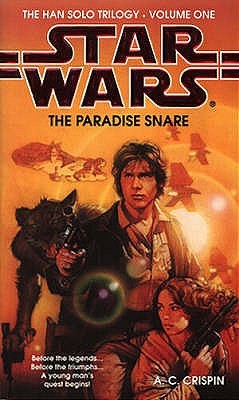
Han Solo easily has the most personality of any of the original trilogy’s characters, but where did he come from? A.C. Crispin’s Solo Trilogy was the first to try and answer that question. The Paradise Snare opens on a young orphan impressed into a gang, who has been brought up hustling and conning wealthy marks — but longs to escape, and be a pilot.  Just getting away from the gang is a great challenge, and there’s no easy path forward. Solo seems to jump from the frying pan into the fire into a swollen pit of molten lava,  eventually angering even the Hutts. Happily A Paradise Snare is Solo’s book, with no early appearances of other major characters — and Solo himself is a work in progress. The Paradise Snare takes a hopeful young escapee and throws him around like a rag doll until the more cynical gunslinger of A New Hope seems to taking shape before us. Crispin’s approach in working Solo gives readers an idea as to why Solo is so easy with Wookiees, and why he is loathe to trust others — especially a woman who’s he’s falling for.  The Paradise Snare is a solid first step in the trilogy.

Interestingly, Crispin also wrote a background novel for the character of Sarek, from Star Trek TOS and The Next Generation.

Posted in Reviews | Tagged | 5 Comments

9 Dragons

9 Dragons
© 2009 Michael Connelly
544 pages

Harry Bosch doesn’t know who they are.  He doesn’t know what they want.  If they’re looking for ransom,  he doesn’t have money, but he does have is a very particular set of skills, acquired over a long career, skills that make him a nightmare for people who might have abducted his daughter to threaten him away from a case involving a Hong Kong gang.  If they don’t let his daughter go, he will look for them, he will find them,  and he will kill them. And he’ll still close his case, because that’s what Harry Bosch does.  He takes down baddies and then he sits in the dark and listens to jazz.

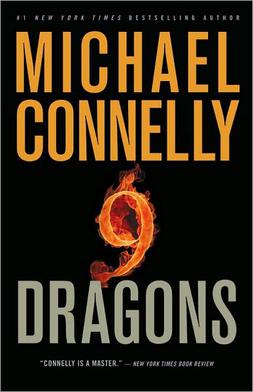
9 Dragons is an unusual Harry Bosch novel in that it begins as a police procedural before quickly becoming an international action-adventure thriller. Usually, Harry is dealing with pedestrian scum of the earth — rapists, robbers, etc —  but this time his investigation of an apparent robbery and homicide turns him on to a Chinese gang, one that imperils his ex-wife and daughter living in Hong Kong. He’s definitely out of his element, away from his usual resources and forced to rely on people he would otherwise distrust: like an Asian Gang Unit cop who talks too much and  his ex-wife’s mysterious Chinese valet.  Although the book is bookended as a procedural, with respect paid to the chain of evidence, laws, that sort of thing, the great in-between is a rip-roaring  manhunt as Bosch tears through Hong Kong’s underbelly looking for his daughter — and adding to the pile of bodies he finds with his own freshly-minted ones. It really isn’t smart to kidnap a street detective’s daughter and try to sell her for organs, it really isn’t.

I enjoyed 9 Dragons well enough as the action thriller it was,  especially with the little cameo played by Mickey Haller (Connelly’s other novel series character), but the intrigue of the initial case was quickly sidelined by the action itself. Still, Connelly kept my attention, and it can’t be said that he gave Bosch a quick and easy shoot `em up solution:   Bosch has to surrender his pound of flesh before all is said and done.  The greatest appeal of this novel for me — as someone who always imagines Liam Neeson in the role of Bosch — was the ability to quote Taken while reading it.

Harry Bosch. He likes brooding, jazz, and fighting with FBI agents over jurisdiction. 

Posted in Reviews | Tagged , , , | 2 Comments

How Microsoft’s Mogul Reinvented an Industry

Gates: How Microsoft’s Mogul Reinvented an Industry-and Made Himself the Richest Man in America
© 1994 Stephen Manes and Paul Andrews
560 pages


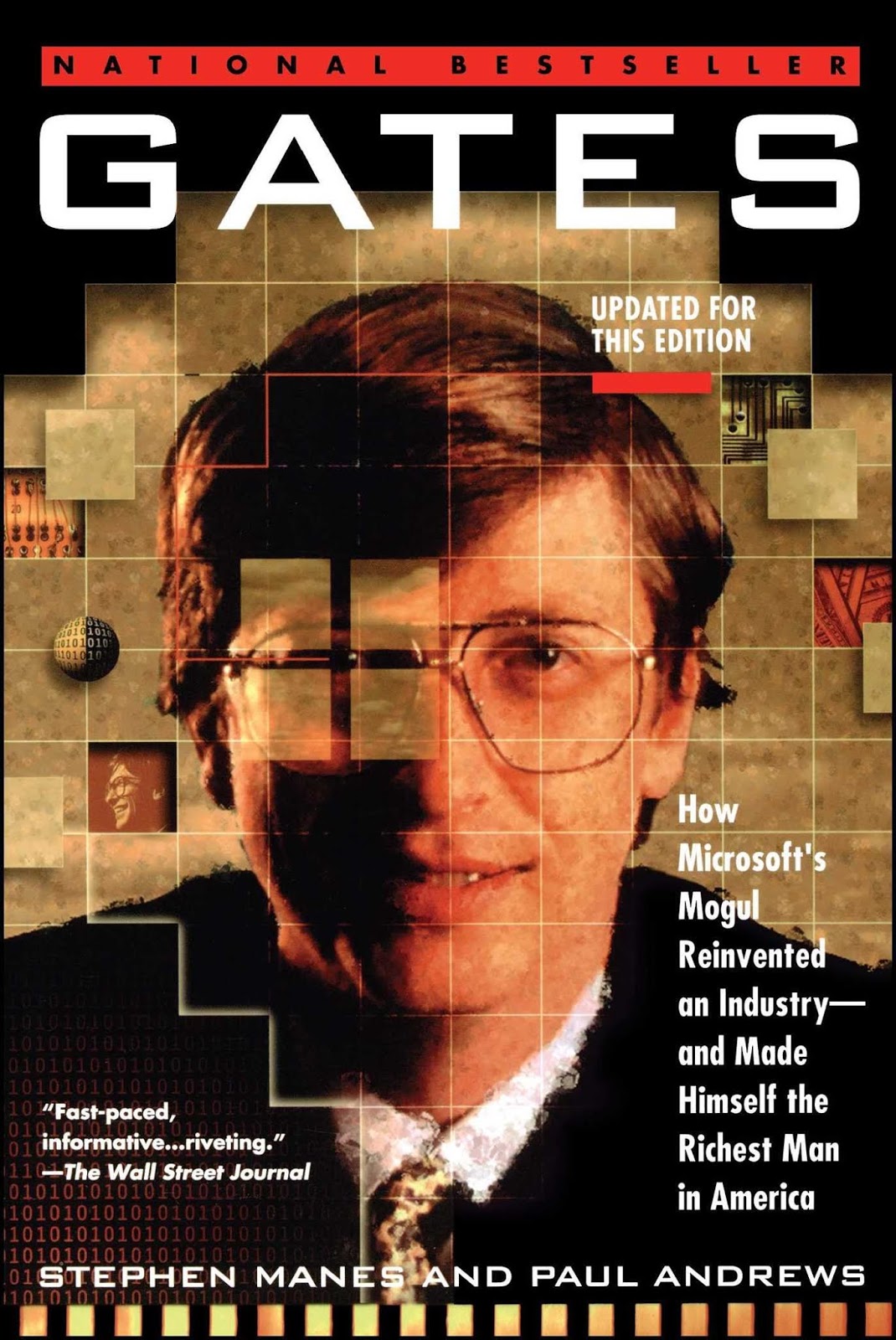
I recently watched Pirates of Silicon Valley, a questionably-acted movie based on the rise of  Bill Gates and Steve Jobs, and found myself curious about the facts. Did a young Bill Gates really race bulldozers and ram his buddy’s sportscar?   Gates is an astonishingly detailed biography of not just Gates himself, but of the computer industry as it developed throughout the seventies, eighties, and early nineties. The book culminates with the release of the then-revolutionary Windows 95, an OS that merited even Rachel and Chandler from Friends pitching it.  The evolution of computing hardware and software overshadow Gates himself, not surprising given that developing software was his singular obsession from high school on.   This mix of biography and technical history makes itself more attractive as computer history than personal, but it still presents a more interesting Gates than “Brilliant, Nerdy Billionare”.  He really did race bulldozers, and they weren’t his.

Gates is not a rags to riches stories, as young William Gates started off fairly comfortably: his parents sent him to a private school that exposed its older students to computer programming, and one of Gates’ classmates there would become his partner in founding Microsoft later on — Paul Allen. Both were enthusiastic members of a student club called the Lakeside Programmers Group,  who were allowed free computer time — back when computer users could be billed on how many seconds of computer processing they used —  in  exchange for helping debug programs and and machines.   Being both self-confident teens and curious about what they could do, Gates and his friends also found ways to cheat the billing cycle outside their arrangement — and when Gates took on the challenge of creating student schedules,  he somehow found himself the only boy in a class otherwise filled with girls.

Even before they were out of high school, Gates and Allen were making a name for themselves as programmers, and exploring the possibilities of this for their future. Their first huge coup was writing a language to use with the first consumer-marketed microcomputer, the Altair.  The Altair was amazing popular considering it had to be assembled, component by component, by the buyer, and that the finished product was initially only capable of blinking its lights. Programming was done not with a keyboard, but by flipping toggle switches.   Although Gates and Allen did attempt building their own computer, one pitched at municipal governments for managing traffic,  their talents lay in software.  Gates was both obsessive and aggressive:  he had no objections to working eighty hours a week trying to iron out bugs, and expected that from whomever he hired later on.  Gates hated to lose, and if that meant selling products he hadn’t even built yet– hadn’t even planned yet —  to prevent someone else from making the pitch, he would.  (Hence the reason for those eighty hour workweeks..)  Gates’ success came not just from his gifts with programming language, but because he and his partners were so intent on making sales: one of Gates’ tricks was to use one product to sell another.  His dream was a computer in every home, on every desk, running Microsoft software. It didn’t matter who the manufacturer was: Microsoft did work for both IBM and Apple, as well as smaller computer companies which have fallen away, and Gates’ goal was to create a hardware ecosystem where everyone was using a common software, with the effect that devices would be cross-compatible.  A monitor made by one manufacturer — IBM, say — would be compatible with a computer made by another firm, like Hewlett Packard.

Gates  delves into an astonishing amount of detail both on the technical hurdles and on the business deals that Gates made: there’s an entire chapter on a font battle with Adobe, for instance.  Readers do see the man behind the machine, however: Gates the crazy-competitive, Gates the parsimonous executive who regarded hotel rooms and first class as decadent,  Gates the teenage millionare, Gates the spectacularly reckless driver, Gates the bellicose boss who liked people who stood up and yelled right back at him.    Although Gates is not necessarily the ideal book for someone merely curious about the man, its depth of technical and business history would recommend to those interested in the  microcomputer revolution.  Oh, and the bulldozers? Gates literally saw them sitting in a rural construction yard, discovered the keys were in them, and decided to figure out how they worked. Then he and a buddy drove them around and raced, because that’s what you do when you’re twenty and it’s 3 am.

Related:
Pirates of Silicon Valley, trailer below
CYBERPUNK: Outlaws and Hackers on the Computer Frontier

“I got the loot, STEVE!”
Posted in history, Reviews | Tagged , , , , , , | 8 Comments

Stuff Matters

Stuff Matters: Exploring the Marvelous Materials That Shape Our Man-Made World
© 2014 Mark Miodownik
272 pages

Stuff Matters begins with a photo of the authorhaving coffee on the roof of his London flat, the table before him scattered with papers and the unremarkable clutter of everyday life.  That clutter, however, is composed of stuff that makes modern life unimaginable without it.  Stuff Matters scrutinizes each object in turn, and is thus a bundle of microhistories with  strong scientific undercurrent.  Mark Miodownik combines a history of how a material like porcelain came into being with an analysis of why they work — why glass is transparent, why stainless steel can effectively repair itself,  how prosthetics can fool the body into thinking they’re just part of the gang.  Miodownik often adds a personal touch, as he has a genuine obsession with materials science: if he’s stabbed or thrown through a window, his first thoughts are about the feel and wonder of the materials he’s passing through (or which are passing through him).   He would share Carl Sagan’s conviction that the beauty of a living thing — in Miodownik’s case, just a thing — is not the atoms that go into it, but the way they’re put together.  After all, diamonds and graphite have the same atomic core, being made of pure carbon, but they’re fundamentally different substances because of the way their carbon atoms are connected. 

Posted in Reviews, science | Tagged , , | 5 Comments

Exploding the Phone

Exploding the Phone: The Untold Story of the Teenagers and Outlaws who Hacked Ma Bell
© Phil Lapsley 2013
416 pages

WANTED HARVARD MIT Fine Arts no. 13 notebook. (121 pages) & 40 page reply K.K. & C.R. plus 2,800; battery; m.f. El presidente no esta aqui asora, que lastima. B. David Box 11595 St. Louis, MO 63105.
[…]
Locke sat back. Someone had put a cryptic ad in the newspaper. He’d responded. They sent him a letter. In mirror writing. In Russian. In 1967. During the cold war.
Spy ring.
It just didn’t get much cooler than this.

Book preview, available on WIRED.com, and on Kindle.

Exploding the Phone opens with a cryptic ad in a campus newspaper, one that swells with intrigue as a bored college student responds to the ad and receives an ominous message in return, penned in code.   The code only heightens both the student and the readers’ interest, and lures him and us into  the exciting world of….playing with the telephone.  Who knew the dial tone had mysteries to uncover, let alone ones that would lead to FBI investigations and multi-million dollar infrastructure shakeups?  Well, not me!  Easily the most memorable revelation of reading CYBERPUNKS last year was that once upon a time,  teenagers and tech heads were utterly fascinated by the telephone network, and poured hours of their time into exploring its innards and fabricating devices to manipulate it from payphones. Katie Hafner’s work on the ‘outlaws’ of the electronic frontier quickly saw these phone phreaks move to computers, but Exploding the Phones is a fuller history of the phone-hacking heyday, the sixties and early seventies.

Before transistors were commonly used in AT&T’s network,  the components of it — the phones switchboards, etc — communicated to one another using a language of tones. This language was independently deciphered by teenagers and young people across the United States, many of them blind.  People found they could manipulate the system by whistling at the right pitch (2600 hz), or using toy whistles and recording tones. Some groups found each another, most notably a group of Harvard students who created a ‘blue box’ to navigate through the phone system. While this phone manipulation could allow people to make free phone calls, the early ‘phone phreaks’ had no one  to call.  The phone system was a world to explore, and those who mastered it could take pride in the doing of it.  Experienced phone freaks — later known as phone “phreaks” after Esquire magazine discovered them —  often knew more about what the telephone system was capable of than the engineers themselves, as one named “Captain Crunch” demonstrated when he used an auditing system on one side of the country’s network to listen in on FBI lines on the other side of the country.  (Helpful hint: if you’re being investigated by the FBI, you really shouldn’t tap their phones. They respond poorly to that.)

Although the phreaks’ accomplishments were largely built on their own intelligence, passion, and time sunk into exploration and tinkering, they were aided considerably by AT&T.  “Ma Bell” then owned a legal monopoly on all telecommunications within the United States, and because of its frequent interactions with the government, it developed extensive documentation for every part of its system. It even issued instructions for sweeping the floors! Its technical manuals often found their way into the hands of phreaks —  some of whom dug in dumpsters to find them.  Other technical volumes found their way into university libraries, which is why many of the early phreakers were college students.  Before AT&T realized people were manipulating their system and began policing it more closely, bored AT&T operators and technicians often volunteered information to the ‘kids’ who were interested. Using tech journals and information gained from workers,  phreakers were often able to pretend to be technicians troubleshooting the network, and relied on internal operators to help them navigate through.

Not everyone was interested in simply exploring the network, however.  Some saw a  buck to be made in fabricating and selling  equipment that allowed technologically-uninterested people to cheat the phone company, and others — like Abbie Hoffman — saw a revolution.  To some in the 1960s anticulture,  IBM, AT&T, and DC were all  different heads on the same beast. Cheating AT&T’s  long distance charges would deprive DC of tax income, which would, like, end the war in Vietnam, man.   The early phreakers disliked the idea of making money off it, but as network manipulation became more broadly known,  whatever control they had of the knowledge escaped. Hollywood celebrities were being charged with phone toll fraud on a regular basis, and AT&T was doing its utmost to end the party. Not only did it ratchet up the number of people it prosecuted for fraud, but once transistors arrived, AT&T was able to start building a more secure infrastructure.  Around the time same, computers arrived on the scene,  and the same minds and personalities that were capable of tinkering and obsessing with the phone network were attracted to  this new world.   (The greatest example of this would be Steve Wozniak and Steve Jobs, both of whom made money selling blue boxes and who later became leading forces in the microcomputer revolution.  Kevin Mitnick and Susan “Thunder” were another two phone phreakers turned computer hackers, detailed in CYBERPUNKS.)

Exploding the Phones was a great read for me, building on that spark of wonder — teens used to hack TELEPHONES? —  and putting it together with a lot of business, social, and legal history as the phreaking culture developed in full, and both the FBI and AT&T worked to respond to it. The author sometimes slips into a chatty, personal voice, but nothing about the book seems sloppy — it is in fact extensively documented.  I was captivated, not only by this tour of an America in transition, but of the odd personalities who explored it first.

Related
Cyberpunks

Posted in history, Reviews | Tagged , | 9 Comments

The Ministry of Guidance Invites You Not To Stay

The Ministry of Guidance Invites You Not to Stay
© 2010 Hooman Majd
272 pages

Hooman Majd left Iran for the first time as a young boy, barely eight months old, and when his own son was eight months old, Majd returned. He returned with an American wife in tow,  and with more than a little trepidation. Majd was no stranger to Iran: he did grow up there, leaving for good only in 1979, and since then he’d visited many times in his capacity as a journalist. His familial ties with reformists in Iran, and his less-than-complimentary remarks on the government there, made him an object of concern to the state authorities.  Nevertheless, they allowed him to live again in Iran, this time for a year, so that his young boy could experience his familial homeland.  The Ministry of Guidance Invites You Not to Stay  records that year, as Majd digests the current state of Iran and the world.  It is not a travel memoir or a cultural journey, though elements of both are present. Instead, this amusingly-titled book is largely driven by Majd wrestling with his Iranian identity: is it still home, despite the changes since his youth and his long years living as an American abroad?

Short answer…yes. Mostly.  The longer answer is that while Majd is disturbed by the growth of a soft security state in Iran, distressed by the overcrowding and pollution in Tehran,  and unsettled by the apathy of the rising generation,  Iran is the irreplaceable land of his childhood, and one that accepted his wife and child with complete hospitality.  His young son was fawned over by strangers in the street, so much so that it disturbed his New York wife Karri. (Why did they want to take photos?)   Karri’s stumbling Farsi was accepted and aided with stumbling English by shopkeepers and cab drivers, none of whom gave her the kind of grief they gave Majd over fair prices.   Although wealth for some in Iran is growing, decades of sanctions from the west have throttled opportunities for the young,  but instead of exploding in furore many have lapsed into fatalism. Some of that fatalism is inimically Persian, Majd allows;   even its practice of Islam, Shi’ism, is fatalistic in that it expects and sanctifies defeat and martyrdom. In his conversations with Iranians young and old, at parties and in private quarters with no bugged phones,  Majd records a lot of disgruntlement about the government’s thought-and-morals police (the “Ministry of Guidance”), but people’s specific problems with the government are confused and divided.  Many don’t like the present state of affairs, but they can’t agree on what  to do about it, or what goal they should arrive for. Even the arch-reformist Mohammad Khatami admits that Iran can’t simply import the morals and politics of the west:  liberal democracy has to grafted into Persian culture, not replace it.,  When Majd decides to end his year-long stay back in Tehran, it is with a mixture of sadness and hope that he looks back on the country of his birth.

The Ministry of Guidance Invites You Not To Stay’s  recollection of everyday experiences, cut with Majd’s internal wrestling over his identity,  may not make it attractive to readers who want to learn about contemporary Iran in broad strokes; The Ayatollah Begs to Differ is more amenable to that goal.   If the reader is interested in every day life in Tehran, however, or a dual citizen’s view about Iranian-American relations and Iran’s promise, it’s quick reading.

Posted in Reviews | Tagged , | 4 Comments

Alone

Alone: Britain, Churchill, and Dunkirk: Defeat Into Victory
© 2017 Michael Korda
544 pages

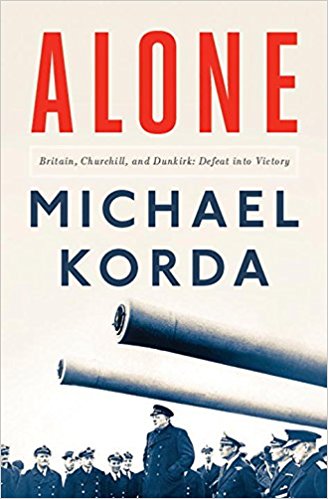
Judging by most World War 2 histories, the war only heats up once Hitler’s rapid takeover of northern and western Europe is accomplished in the spring of 1940, and England is left facing a continent controlled by two execrable men and Mussolini.  The fall of the low countries and the fighting retreat of the Allied army happen so quickly that they’re dispatched almost as a prologue to the greater drama. Alone takes that prologue as its subject, opening at Munich and moving quickly to the invasion of Poland and the state of war which followed.  Readers witness stiff desire not to fight again quickly replaced by a mixture of chivalrous indignation and less chivalrous resignation, as England again dispatches her army to Europe to check the German advance, standing alongside the even more resigned French. Here too are chronicled the desperate struggles by the Dutch and Belgian armies, who though colossally outmatched, refuse to yield .  The finish, of course, is the  great drama of Dunkirk, where the men of the British expeditionary force are surrounded by  the German advance, but escape to safety by means of a fleet of civilian ships, a brilliant of example of England expecting every man to do his duty — even men out of uniform.  Korda notes that the triumphant escape of Dunkirk sometimes overshadows the sheer awfulness of getting there and enduring it: some regiments lost as many as two-thirds of their men, and the beach itself was a spectacle from Dante, filled with burning debris, scattered bodies, and the stench of both.  Alone is a personal history as well,  as a very young Michael Korda was just old enough to realize  something bad was happening; the Korda family’s involvement in British and later American film industry adds an interesting flair to a more familiar subject.   Korda  strikes a good balance between narrative and detail, and includes a generous amount of in-text illustrations of personalities and movements. 

Related:

To end, a quote from one of Churchill’s addresses:

“…and I made it perfectly clear then that whatever happened in France would make no difference to the resolve of Britain and the British Empire to fight on, if necessary for years, if necessary alone.

We have before us an ordeal of the most grievous kind. We have before us many, many long months of struggle and of suffering. You ask, what is our policy? I will say: It is to wage war, by sea, land, and air, with all our might and with all the strength that God can give us; to wage war against a monstrous tyranny never surpassed in the dark, lamentable catalogue of human crime. That is our policy. You ask, what is our aim? I can answer in one word: It is victory, victory at all costs, victory in spite of all terror, victory, however long and hard the road may be.”

Posted in history, Reviews | Tagged , , | 8 Comments

Yesterday’s News: Shrinkwrapped Sunbather

“It takes a lot of sand to wear this costume, which is 80 per cent cellophane. The other 10 percent is bathing suit. It’s the newest fad at Malibu beach, playspot of the Hollywood film colony. June Clyde is shown here is a cellophane wrapper keeping her schoolgirl complexion nice and fresh. Under the cellophane, so they say, the skin receives all the benefits of ultra-violent sun, producing tan without sunburn. Save the surface and you save all!”

From an April 1932 newspaper.

Posted in General | Tagged | 5 Comments