Mirrors of the Unseen

Mirrors of the UnseenJourneys in Iran
© 2006 Jason Elliot
432 pages
Readers uninterested in the origins and history of Islamic art, metaphysics, or pigeons, should skip to the next chapter, here.
In the late nineties, before Afghanistan was rendered more chaotic and dangerous than usual, Jason Elliot visited the country and was moved by it. Building on the success of that trip,  he looked over the border to Iran, a nation derided by the Afganis as full of sandwich-eating women, and decided to travel throughout it, as well. Mirrors of the Unseen collects the experiences of several trips made by Elliot throughout Iran, visiting it again and again as the seasons changed. What did not change was the ready willingness of Iranians to receive him  — and ply him a surprising amount of spirits.    Elliot’s interest in Iran is more cultural and historical than political, and as time passes he transforms from interviewing tourist to a man on pilgrimage, one with Iran’s architectural wonders as its goal, working in historical recaps along the way, telling of the rise and fall of empires as he gazes at their ruins and proud reminders. He is particularly struck by the  predominant role of gardens in Persian culture and art, one that predates views of Heaven as a paradisaical garden. (Not by accident is the German title of this book Persia: God’s Forgotten Garden.)   Elliot is sensitive about architecture in that it seems to affect him deeply, taking over his mind. Discussions with friends and discourses on Sassanian history fade into the background when Elliot takes in the fullness of a bazaar or mosque and begins to wax lyrical about plazas and windows.  He is self-conscious about some of his obsessions — several chapters see him poring over historic maps and making measurements to figure out why a particular building isn’t lined up the way symmetry  suggests it should — to the point that he includes at least one disclaimer.    Of more general interest are Elliot’s many conversations with Iranians of various ethnic groups; he never fails to find a friendly host wherever he travels, and those who do not have concealed stocks of ardent spirits have opium pipes.  (Similarly,  no one Elliot meets observes the laws against foreign television stations, but it’s possible that the people most eager to host an Englishman were the most dubious about the currently-reigning politics.)   The Iranians featured here range from poor cab drivers to horse ranchers,   and unless they’re selling something  they’re extremely generous with their time and resources. 
Although the aesthetic tangents might throw some readers off, I personally enjoyed this curious mix of travel memoir, history, and architectural commentary. 
Posted in Reviews | Tagged , , , | 4 Comments

California Dreamin’

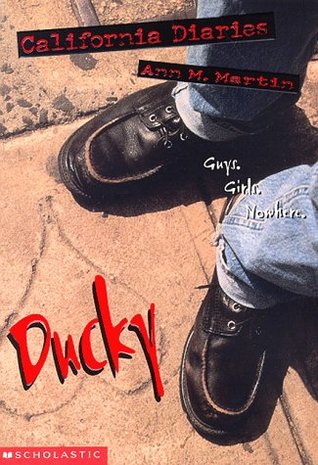
At some point in 1997 I saw this cover in a now-defunct WaldenBooks and was intrigued, both by the shoes and that oddly simple title: “DUCKY”.    The book was a fictional diary, rendered in a font-like handwriting, and it was part of a series of  journals by five fictional kids — four 8th grade girls and one 10th-grade guy —  that I would become so enamored with that I finally developed a journal-writing habit of my own,  though there have been serious lapses since college. The series is special enough to me that it has survived, along with Roswell High, as part of my collection when the other books of my youth — Goosebumps, Animorphs, Wishbone, the Boxcar Children books — have passed away as donations or gifts .

The series begins when the eighth grade class of Vista  is moved to the high school building of their school to account for a surge in enrollment. Although middle school is already a time of transition, the kids’ exposure to so many older, near-adult students accelerates their own development as they encounter new influences.  Each of the teens brings their own private struggles with them, but they experience things together as well.

The characters, introduced as I met them:

  • Christopher “Ducky” McRae is a sixteen year old who is introduced to the other four when he rescues them from a massive hazing incident. Ducky lives with his college-age brother, as their parents are archaeologists who both work overseas. Unique in being both older and the only guy, Ducky faces stresses in his older friendships (one best friend has become a jerk, the other is depressive and suicidal) and the oddity of becoming the older-brother figure to four girls, all of whom he gets along with better than his peers.  Ducky has a particular bond with…
  • Sunny Winslow used to live up to her name, but her family is in the midst of a prolonged crisis. While Sunny’s mom battles lung cancer and her dad juggles both that and the renovation of the family business, Sunny feels both ignored and over-burdened, expected to pull  adult-sized weight at home.  Desperate for escape and attention, she indulges in irresponsible and often reckless behavior. 
  • Maggie Blume, on the other hand, is the epitome of the tightly-wound overachiever, one whose obsession with being The Perfect Student, The Perfect Daughter, etc, drives her toward anorexia even as her mother is sinking into alcoholism. 
  • Her best friend Amalia Vargas offers Maggie a little relief by helping her land a role as the lead singer in a garage band called VANISH, but Amalia has an abusive ex-boyfriend turned stalker.  
  • First in the series, Dawn Schaefer is the ‘centered’ character, the one who is most conscious of the changes she and her friends are going through as old friends fall away and new ones are discovered. Her ‘issue’ seems fairly mundane at first — she has a stepmother she’s not comfortable with — but her bond with Sunny’s mother, combined with Sunny’s increasing turmoil as she wrestles with fear and her mother’s very-possible death,  cause a lot of turbulence between Dawn and Sunny as the series progresses. Dawn is also a link to a previous series under Martin’s name, The Babysitters Club

Each character’s “handwriting” is rendered in unique fonts, and each have distinctive ways of writing — Ducky writes his in the second-person perspective,  Amalia writes into her book as if she were talking to someone named “Nbook”,  and Maggie — the perfectionist —  types hers, although readers still see her handwriting when she drafts and revises poems and song lyrics.  (She has  a line in the picture above, “I think the word is ‘pretentious'”.  Maggie isn’t the only one whose creative talents are part of the journal: Amalia is an aspiring graphic artist and often illustrates scenes from her life.    The series of fifteen books takes us through each person’s journals three times,  beginning with Dawn, ending with Ducky, and then wrapping around again.  (It’s not a bizarre coincidence that all five characters keep journals: their school requires it of students beginning in elementary classes.)  The above picture is unusual in that it puts several characters’ handwriting in the same book:  Ducky is driving to the beach and the girls are scribbling their greetings in his notebook. Only Amalia is missing, because ’72 Buicks only have so much room.  Each of the fifteen diaries covers roughly a month or so.

While I’ll be reading the series this next week, I won’t be doing reviews for the books in part because they’re so little (100 pages each, or thereabouts), I may muse a bit at the end on how the story has aged.

Posted in Reviews | Tagged | 4 Comments

Ta’arof on Reddit

I recently shared a book called The Ayatollah Begs to Differ which covered the Iranian culture of hospitality. Oddly enough the same subject came on reddit, so I share it below for the curious. Click on the picture to expand..

Posted in Reviews | Tagged | 4 Comments

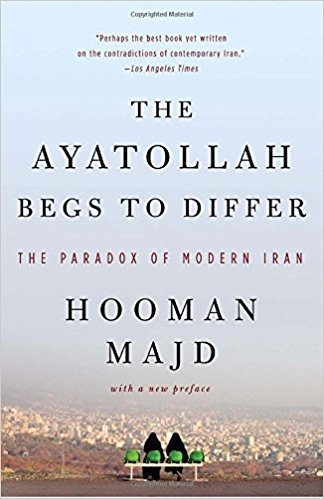
The Ayatollah Begs to Differ

The Ayatollah Begs to Differ: The Paradox of Modern Iran
288 pages
© 2008 Hooman Majd

Whatever nebulous conception most Americans have of the Middle East, Iran should stand apart. Not because it is currently DC’s designated enemy,  but because Iran is different. Its people are not Arabs,  the state religion is a markedly different of Islam than that practiced and promoted by its Sunni neighbors, and its political constitution is its own, a curious fusion of theocracy and democracy which was self-invented.  The Ayatollah Begs to Differ profiles Iran as a nation of paradox, a place increasingly secular but ruled by clerics, driven by both aggressive insistence on its rights and an internal ritual of utter deference and hospitality.

When I began reading this over the weekend, it wasn’t in anticipation of the House of Saud’s business partner in the White House stirring foreign policy turds. Bush’s obsession with Iran, and Obama’s later difficulty in coming to a concordance with them, made me increasingly curious and even fascinated by the land formerly known as Persia.  Hooman Majd mentions here that Persia was formally dropped in the 1930s in favor of the older Iran, both to invoke a glorious ancient past and to buff over the inglorious recent past, when old Persia was an increasingly bedraggled object in a tug of war between Russia and the United Kingdom.  Iran’s foreign policy is driven primarily by a need for self-protection, from both its Arab neighbors  and from interference from farther points.  The two often intersect, as when the United States abetted Saddam Hussein’s eight year war against Iran.

Foreign policy is only a small part in this guide, however. Majid is Iranian-American, but not the kind who bemoans that Iran is not more like Europe and the United States. He has close ties with a former president of Iran, the reformer Mohammad Khatami, and his father was a leading cleric. His warm regard for Iran is not predicated on what it can do differently, but what it has done already and can mature. The Ayatollah Begs to Differ includes some of the usual “experiencing Iran” chapters, like his Ashura experience in Qom and anecdotes about  traffic and family life, as well as unique interviews with friends of his in Iran — like the aforementioned minister Khatami.  Majd’s book is draws on time spent in Iran just as  Khatami’s administration was being replaced by the more strident one of Mamoud Ahmadinejad, whose aggressive posture against the west over nuclear development was cheered by many in Iran who thought their country was the whipping boy of the international community.  Majd is not a fan of Ahmadinejad, however,  despite his sympathy for Ahmadinejad’s working class supporters. One worrisome aspect of Ahmadinejad for Majd is the man’s fervent religiosity; he is not merely observant, but anticipates the imminent end of the world and is willing to talk about it, much to the dismay of the leading clerics who do not believe theology and eschatology are the province of the uninitiated.

Although I’ve read a fair few books on modern Iran in the last few years,  even so The Ayatollah Begs to Differ offered a lot of insight. I’ve read previously how common exterior walls are in Iranian residential architecture, for instance,  keeping outsiders firmly at bay — but Majd writes that the law also respects this boundary, and that Iranians tolerate so much social policing in the community because they are largely left alone inside their own homes.  Majd’s extensive chapter on Iranian ritual ta’arof was both amusing and informative; I’ve encountered numerous world-travel memoirs that marveled at Iranian hospitality. Although this strikes me as attractive to a small degree, the way its expressed by Majd seemed exasperatingly drawn out.  Taking a cab involves an endless spiel of “How much do I owe?”, “No, sir, I am your humble servant this was my honor, please go”, “No, I insist I pay, how much?”, “God forbid sir, it was nothing”, etc. Eventually the bow-haggling stops and honest money changes hands.  Majd also notes that while the language is outwardly deferential,  this ritual of civility is also competitive, and practitioners of the ‘dark’ ta’arof like to reduce their rival to begging them to accept the money or the favor.

Slightly more colorful 1st edition cover:

Related:

Posted in Reviews | Tagged , | 10 Comments

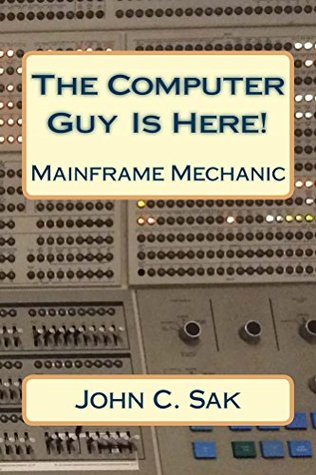
Tales from a Mainframe Mechanic

The Computer Guy Is Here! Mainframe Mechanic
© 2018 John Sak
201 pages

When John Sak began his training with IBM as a young college drop out, instructors informed his class that the only constant they could expect from their careers was change. Their jobs would probably not exist before they retired. Sak entered the field when mechanical tabulating machines with some electrical work were giving way to electronic computing units, and ‘continuing ed’ would be a staple of his career at IBM as computers, printers, and computer-driven devices continued to advance. By the time he retired, smaller desktop computers were supplanting the closet towers and basement behemoths. The mainframes Sak and company serviced, of course, were not simply larger and slower versions of PC towers. Although by the end of his career many devices accepted instructions via keyboards and the like , as a younger engineer instructions were fed into computers via stacks of punched IBM cards, with the patterns giving the machine different instructions. Refer to a disk drive today and most may think of a DVD tray, but the unit covered here is the size of a washing machine.

The book is a memoir rather than a personal history, but Sak’s stories cover the many various aspects of field engineers’ work and the IBM culture. Saks and his colleagues weren’t just repairmen, called out to replace or fix faulty mechanisms; they also analyzed new equipment in the field and compared notes to determine if there was a design flaw that could be corrected, or weaknesses which could be improved. This memoir of life as an IBM field engineer combines a few profiles of odd characters with accounts of diagnosing problems, along the way explaining how older room-sized devices operated. (One model, only discontinued in 2005, ran for just over 40 feet and was devoted to letter-sorting.)

Computing has had an amazing history so far, and I greatly appreciated Sak’s account of its boom years — forgiving the primitive cover.

Posted in history, Reviews | Tagged , , , | 12 Comments

Tales from a Techie

Tales from a Techie: Funny Real Life Stories from Tech Support
© 2014 Matt Garrett
250 pages

I’ve been reading tech support horror stories since I was first online in 1997, from Rinkworks’ “Computer Stupidities” to Reddit’s “TalesfromTechSupport” subreddit. On a whim I searched Amazon to see if there were any books in that vein and saw this one on Kindle Unlimited, so I read it through. It’s a quick read, written in a conversational tone, and is amusing from time to time. Tech support stories mix technical curiosity (learning about older systems or picking up troubleshooting procedures) with a good dose of schadenfreude in general. Here the appeal is almost all schadenfreude, as most of the issues are things like spilling coffee into keyboards, dropping ipads into bathtubs, and rescuing computers from gobs of malicious software acquired on websites of ill repute. The problems recorded here aren’t technically interesting, so the appeal is in commiserating with someone who is forced to spend his days pointing out to people that computers need to be plugged in to work. One unintended but amusing element of the book is that Garrett uses the same two pseudonyms for all of his male and female clients (“Bill” and “Claire”), to the effect that he seems to work for two extraordinarily incompetent and slightly schizophrenic people.

Posted in Reviews | Tagged | 12 Comments

Short rounds: things that are not Star Trek, like North Koreans and Aeneas

Believe it or not, I have been reading books without a Star Trek label appended to them this week. Just recently I finished off Don’t Go There, a short collection of travel pieces that interested me with its mention of visits to Turkey,  Chernobyl, and North Korea.    The actual collection contains these along with trips to Israel, Ghana,  China, and a few other places deemed ‘interesting’. The first piece, a visit to Istanbul that threw the writer and his girlfriend unwittingly into street protests and clouds of tear gas, sets the stage:  the narrator has no idea what he’s doing or why, and seems to stumble into catastrophes just to get a good story to write about.   None  of Fletcher’s trips had any reason or planning to them, most developed miserable complications, and when his girlfriend threatens to leave him, the reader must be sympathetic.  If one endures his laughable ignorance in visiting places like Jerusalem (he is annoyed by religious people and religious references, which would be akin to going to DC when one hates politics), and similar episodes, eventually he ends up in North Korea. It’s about what you’d expect, but he comes away believing the hostages of Kim are not as brainwashed as is commonly held, and that they would be more expressive if they could get away with it.

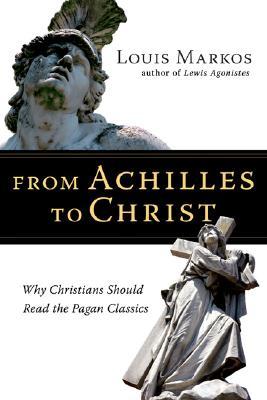
My other read during the last few weeks has been a volume called From Achilles to Christ: Why Christians Should Read the Pagan Classics.    Markos opens the book with a remonstrance against the Protestant attitude that anything that predated Christ, or anything outside the Bible, is value-less.  Although a Protestant himself, he regards the Catholic church favorably for its integration of the classic western tradition into its own tradition, in effect building upon and continuing the queries of Aristotle and Plato into the nature of the cosmos, ethics, beauty, etc.  Markos’ conviction is the same of CS Lewis’  as expressed in The Abolition of Man, namely that while Christianity is the ultimate truth,  basic truths are also available in other traditions.  The aim of Markos in this volume is to see the truths which the Greco-Roman myths express about the nature of man and meaning. He then guides the reader through the works of Homer, selected works by Greek playwrights and historians, and ends with the Aeneid.    As someone who has been removed from Western Literature I and II for far too long,  I was interested in this chiefly as an accessible  look at Greek literature, a reminder of its stories and writers.  Markos reflects on the themes present in literature, like the struggle between familial duties and loyalty to the polis.  Because the Greek dramatic tradition is in fact a tradition, Markos notes how  differently the same myths might be use by different authors, and examines how the Aeneid is a deliberate Roman tribute to the Illiad and Odyessey,  using its structure, locales, and  elements.  It was not a Latinized copy of the Greek epic, however, but one written with Rome’s own history in mind — and not ancient, but recent, as Aeneas’ story can be read as a tribute to Augustus’ victory over  Marc Anthony and Cleopatra.  Markos also connects the classical heritage to Christianity when he can, argue at times that the Greeks are foreshadowing the advent of Christ.  This is similar to Luc Ferry’s approach in Wisdom from the Myths, in which he argues that the Greek myths and plays constitute a coherent worldview — a Stoic one.   Markos isn’t as insistent as Ferry, however, and the core of the book is merely in seeing what truths the old stories still tell us about ourselves and our relationships to our own polis and the cosmos.

Posted in Reviews | Tagged , , , , , , , | 2 Comments

Yesterday’s News

Recently I had occasion to review the front pages of virtually all of 1918, or at least from January to late September. I didn’t find what I was looking for, in part because the Great War consumed the papers, but I did see a few things of interest that I wanted to share.

This headline is a lot less interesting when you learn that Cyclops is the name of a ship.

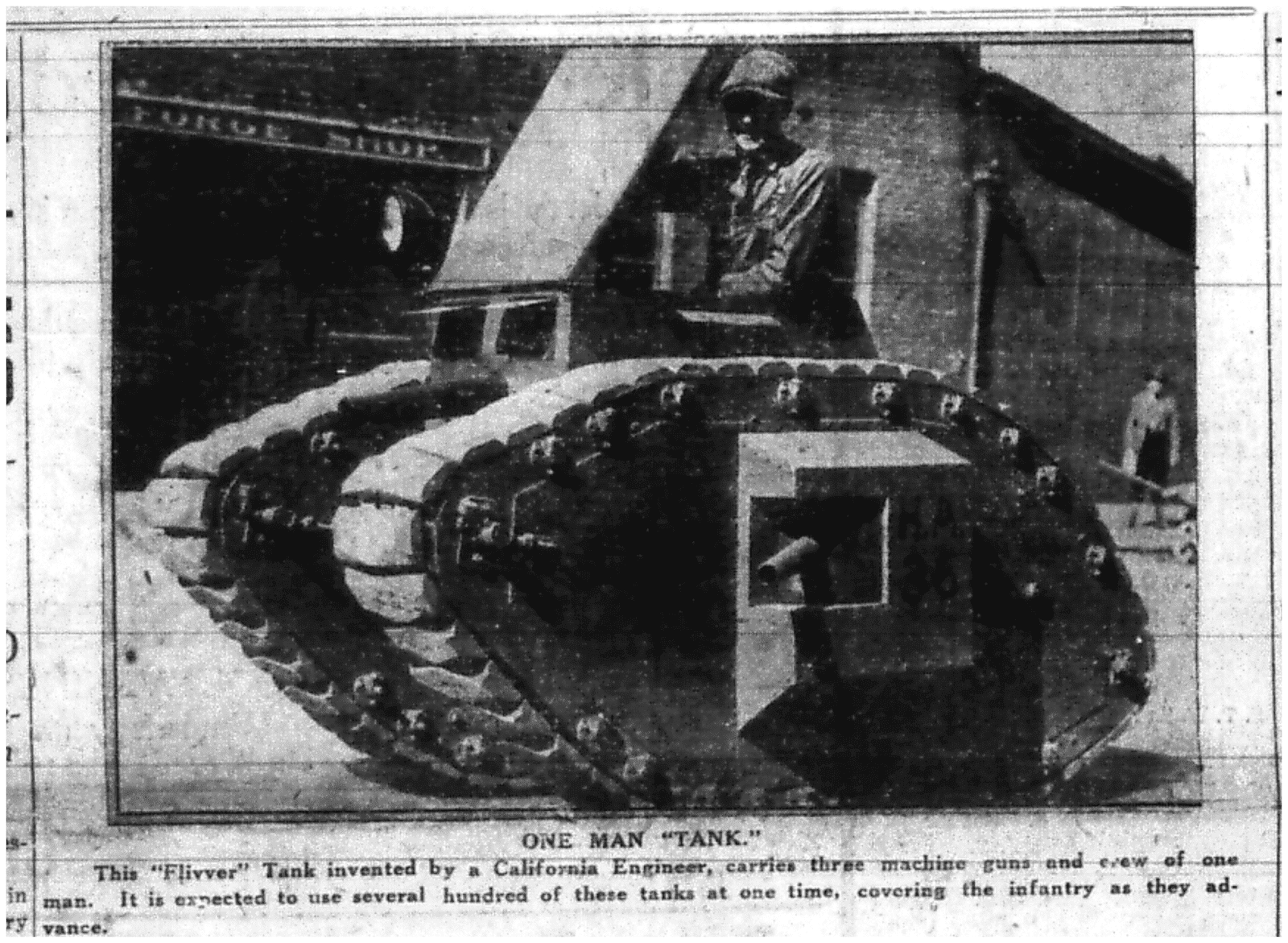
The Little Tank That Could

Oh, I bet they’ll “take care” of the Pacific. It’s getting them to leave it alone that will be the problem.

I love puns based on alarmingly racist yet technically innovative epic films!

Somehow I doubt that this will be a reasonable and fact-based biopic. The Academy of Music, the oddly-named theater downtown, ran new shows seemingly every day in the period I searched. Admittedly, this is 1918 and production/postproduction time aren’t nearly as elaborate as they are today.  Take a look at  another:

Aw, remember the days when DC asked Americans for money instead of just taking it  or printing more? 

Trenton redux!

The Spring or Ludendorf Offensive. Reading the papers through from January to late September I was struck by how knife’s-edge the war seemed to be, with panicked reports that the French were in retreat posted side by side with adverts to buy liberty bonds or else subject your children to the Kaiser’s will. By the summer, however, the influx of so many American troops (visible by the reporting) seems to turn the side, not that the liberty bond ads ever noticed.

Because the Bolshies won we now refer to this as the Allied invasion of Russia, but back then the Allies were merely “lending” troops to “Russia”, or whatever constituted Russia in the civil war period.

My pal Klaus is certainly not a spy. He’s just an amateur signals enthusiast. The pickelhaub is a little odd, though, especially at the pool.

You thought working in customer service was bad? Wait until you’re declared the government’sproperty and sent off to fight!

And just as a curiosity:

Posted in Reviews | Tagged | 4 Comments

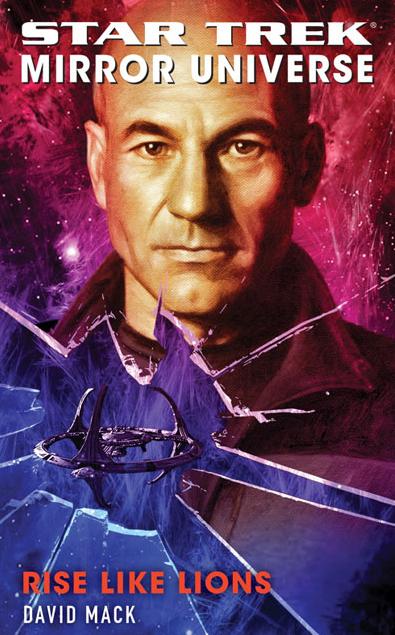
Rise Like Lions

Star Trek Mirror Universe: Rise Like Lions
© 2011 David Mack
352 pages

“That’s what passes for good news, now? We have a good chance of not dying if we crawl into a hole and keep our heads down? I’d hoped we’d have higher standards by now.”
 “We play the cards we’re dealt,” Eddington said. “The real question is: What are we going to do next?

Rise Like Lions is the triumphant conclusion of the Mirror Universe lit series, opening with a catastrophic defeat for the Rebellion that sees the seemingly victorious Alliance undermined by its success. As the rebellion retreats to shelter what’s left of its men and material, the Klingons and Cardassians’ pride drives them to internecine war, and a long-dead emperor’s secret project to build a new Republic activates. Although the Rebellion receives new life by unifying with a slave revolt from the Romulans and is further strengthened by Spock’s  version of the Foundation,  its leaders remain  divided and can only be saved by…Luc Picard, tomb raider turned  George Washington in Space.  Although readers may object to a few deus ex machina moments, overall Mack’s redemption of the mirror universe is a terrific action novel that redeems the mirror universe.

Star Trek stands apart from most SF series in its unyielding optimism about the nature of man and the future,  which is part of why the Mirror Universe has had such a lingering attraction for trek writers since — allowing them to write our familiar characters as weak and corruptible instead of icons of Federation goodness. Even so, in Trek good wins out:  Rise Like Lions not only features a Miles O’Brien who would prefer to exile himself from power rather than behave like his enemy, but continues to uplift a former tomb raider to make him a model hero.  The soul-deadening violence and general viciousness of the MU stories in general here fast give away to familiar patterns, heroes resisting the darkness and making it flee from them.  A new way is being forged from the wilderness of violence and waste. There are a few epic battles here, all edge-of-the-seat events, although towards the end it becomes apparent that Spock’s secret project is a little overpowered. One of the battles isn’t militarily necessary, but happens because the Rebellion wants to prove to itself that it has moral legitimacy: it’s not fighting to restore the old Terran Empire, but to establish something greater and better, a republic that offers freedom, peace, and respect for all persons.

I like Rise like Lions, and not just because its general theme is redemption, and despite my frequent cynicism about the world I really do live in hope — or want to, anyway.  I appreciate how formerly minor or misunderstood characters like Michael Eddington here play a major stabilizing role (he’s the rebellion’s voice of reason), and characters who are regarded as rather mundane in the ‘real’ universe  (O’Brien and Keiko) here are the heroes.  That was a mark of the series in general, allowing readers to see more of Cal Hudson, Sito Jaxa,  and Eddington than we did on screen.  The book was full of memorable moments,  particularly a assassination that  is utterly unexpected to those who have seen Deep Space Nine. No spoilers,  but if you like Corat Damar already you’re going to want to give him a high five.  Although the ending has a feeling of fulfillment, Mack also tacks on an epilogue that hints that another book may follow if readers are aching to see what happens when the Dominion enters the new arena.

Posted in Reviews | Tagged , , | 4 Comments

Shards and Shadows

Star Trek Mirror Universe: Shards and Shadows
448 pages
© 2009 various authors, ed. Margaret Clark and Marco Palmieri

The mirror universe of Trek is chiefly known for its inhabitants’ general awfulness and triumphant moral chaos. In The Sorrows of Empire, however, Spock killed his captain and seized control of the Empire not for his own gratification, but in pursuit of a dream. In reforming and weakening the Empire and allowing it to be conquered by its enemies, he established the foundation for a new galactic order, seeding the empire with agents conspiring together to create a peaceful republic from the ruins of both the Terran Empire and the Klingon-Cardassian Alliance.  Shards and Shadows consists of over a dozen stories spanning the the mirror universe’s trek tenure,  and Spock’s secret project — “Memory Omega” — is a persistent aspect of the latter stories. The collection draws on not only the Trek shows, but various series of literature like Vanguard, Stargazer, and Titan. It also visits periods not covered in shows or books. One story follows a young officer named Kirk as he seizes the Enterprise from its ruined drunk of a commander, and another visits the ruined planet of Betazed, where a brothel madame named Troi is hiding desperate secrets. 

Below are  a few memorable stories:

  • “Nobunaga” opens the collection with a mindscrew story, one in which the narrator is losing their mind under interrogation and consequently confusing realities. It’s a bit like the TNG episode “Frame of Mind”, or the Roman Polanski film The Tenant.   
  • “The Greater Good”  revisits the world of Talos IV, where Captain Christopher Pike was once captured by telepathic beings and placed into a zoo. That was in our reality. In this reality, whatever happened turned a brilliant young commander into a lifeless shell  — and a ripe target for a rising officer who coveted the Enterprise.  
  • “A Terrible Beauty” features Keiko Ishikawa,   who is definitely more than a botanist and loving wife in this universe.  
  • “For Want of a Nail”:  only one man can stop a centuries-old plan from being unraveled: Reginald Barclay.

I liked this collection more than the previous two, largely because it’s not all torture and genocide; here we have signs that Spock’s plan will at least bear fruit, even if it doesn’t create some uber-federation from the ruins of various nasty polities.  I enjoyed the variety of contributing authors, which included favorites from the Relaunch era (Christopher Bennett and David Mack) as well as authors who were active far earlier, like Michael Jan Friedman. 

Posted in Reviews | Tagged , | Leave a comment