Second Sleep

Second Sleep
© 2019 Robert Harris
302 pages

41YsDF5XiRL._SX334_BO1,204,203,200_

Sometimes, readers, it pays not to read anything about a book before you start it. Take Second Sleep, for instance, which I picked up purely on the strength of its author (Robert Harris,  creator of various and sundry historical thrillers).  From the publisher blurb, and from the opening scene  — an instant hook  — I assumed I was reading historical fiction set in medieval England, in the year 1481.    But there were little notes of dissonance, things outside the corner of my reading eye that didn’t sit quite right. I ignored them, absorbed in a young priest’s desperate attempt to get to  safety, and then to make sense of his brother-cleric’s demise. But then came…The Paragraph, the one that stopped me in my tracks, the one that made me read it over and over again until something clicked, and I realized I wasn’t reading historical fiction at all, but something even more interesting.  Without spoiling anything,  let’s just call Second Sleep a thriller about secret knowledge set in a world whose future is very much like our medieval past.

I already knew Robert Harris as an excellent author of historical fiction from his Cicero trilogy, and his diverse thrillers which followed — everything from a mystery centered around the Dreyfuss affair, to a political story about an obvious Tony Blair stand-in.  His writing is at its usual strength here; I was attached to young Christopher Fairfax immediately, as a young priest anxious to prove himself,    but one whose desire to be a faithful son of the Church  is challenged by what he finds in a dead priest’s library — and his investigation of the priest’s death, near a site called the Devil’s Tower that the locals treat with fear.    Infected with curiosity, Fairfax lingers in the village long after he was meant to return to the Cathedral,   and is absorbed into a story a thousand years in the making.  I was spellbound until the end, though my anticipation had been so heightened that the end was…underwhelming.

And now,  reader,  I have to venture to into spoiling the premise, though not the story.   If you want to encounter the curveball in the early chapters for yourself, don’t read on.  What makes Second Sleep so fascinating is that it presents our future, one in which a neo-medieval society has recreated itself from the ashes of a great apocalypse that saw massive starvation and the complete collapse of global civilization.  Those who pry into the past, especially those who wish to restore its scientific accomplishments, are persecuted  by the authorities, for fear of inviting God’s wrath again.  And yet Fairfax, once he’s read a letter in the priest’s study, can’t unread it, and so the thriller develops– can he and a couple of sympathetic compatriots uncover what a thousand years of history, and a powerful social order, wish to bury?   As Fairfax delves into the past,  Harris gives himself the opportunity to offer some biting commentary on the  unbelievable fragility of our present order,  and the uncaring way we drift into ever-more ethereal lives.

Although Second Sleep won’t challenge the Cicero trilogy for my favorite Harris work, it  easily surpasses the likes of Conclave and Munich, and I suspect I’ll be thinking about it in December!

Related:
A World Made by Hand, Jim Kunstler.  Very similar in presenting a future that’s reminiscent of our past, though Kunstler’s story is set much closer to the aftermath of the disaster.
A Canticle for Leibowitz, Walter M. Miller Jr
Nightfall, Isaac Asimov
Posted in Reviews | Tagged , , | 5 Comments

The Bodies in the Library

The Bodies in the Library
© 2019 Marty Wingate
336 pages

bodies

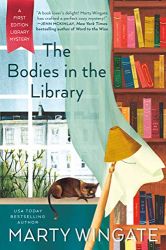
Hayley has a secret: she doesn’t know a blessed thing about Agatha Christie’s fiction. Or Dorothy Sayer’s.   Her literary expertise is all things Austen, but thanks to a friend on the board, she’s just landed a cozy position as curator at a private home turned library, the First Edition Society. She’s filled with ideas for how to help the Society fulfill its founder’s dream, to share the glories of Golden Age Mystery literature with the public,    but first there’s a slight…problem.  The dead guy, that is.   A member of an Agatha Christie fanfiction club is dead,  lying in repose in the library, and with  her job on the line, Hayley turns to reading Agatha Christie to inspire her in her quest to find out whodunit and save the library .

So…that’s a fun premise,  especially if you like Agatha Christie novels. The title of this is an obvious play at Christie’s own The Body in the Library,  and there are other references to Christie novels throughout.  Ordinarily this isn’t the sort of thing would appeal to me, aside from the books-about-books idea (always fun!),  but it’s been making the rounds at Book Bunch*,  and I thought it would be fun to try.  Ultimately that’s where The Bodies in the Library‘s virtue lies, fun; it’s an entertaining book, but not one I ever took too seriously.   Everything was a little too convenient for me – -the ease with which cops gave up information to Hayley so she could solve the mystery,  the fact that everyone seems to know each other, the speech the villain gives at the end  to revel in how they’d done it – -but those may be part of the ‘cozy mystery’ subgenre itself, I’m not sure.   I was especially underwhelmed by the murder itself and its motivations.  The premise goes a long way, though, as it did with Camino Island — another mystery filled to the brim with chat about authors and boosk.


*A group of people at my local library who meet on a weekly basis to talk about the books we’ve read in the last week, over  hot tea and baked goods.   My contribution? Science and rasberry-drizzled lemon squares.

Posted in Reviews | Tagged , , , , | 7 Comments

Prague Fatale

Prague Fatale
© 2011 Phillip Kerr
432 pages

kerr

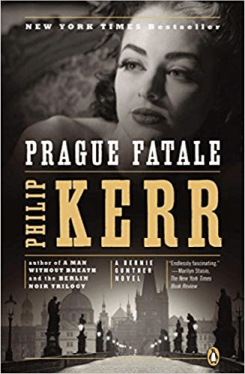
Bernie Gunther is a man contemplating suicide.  Once, in the Weimar years, he was a happily married policeman. But his wife died,  he fell into the bottle, and not long after that Germany itself became intoxicated with a dream that would prove a nightmare – one that Gunther has seen far too much of. Following Hitler’s rise to power,  Berlin’s detective corps —  Gunther included – were absorbed into S.S..  Haunted by scenes of industrial murder, Gunther doesn’t care enough about his life to even pretend to like the Nazis, and his brazen honesty,  coupled with dogged detective skills, makes him a valuable  if unwilling asset to Nazi officials whose pragmatism overpowers their ideology.    In Prague Fatale, Gunther is pulled away from a strange murder in Berlin, ‘invited’ to join General Reinnard Heydrich at his new estate outside of Prague. Someone is after Heydrich’s life, and the Man with the Iron Heart wants to know who.  When Gunther arrives, he finds himself surrounded by contemptible men, all of whom loathe one another – and when the one man he likes is murdered,  Gunther’s guard detail turns into an investigation with tragic results. 

I never fail to enjoy a Kerr/Gunther novel,  but I’ve learned over the years to take them sparingly.  Full of dark humor, historical details (including slang), and Raymond Chandler-like narration,  they would be an absolute joy to read were it not for the often-dark subject materials:  Prague Fatale introduces an extended torture scene late in the novel, and while it’s far from being as harrowing as The Lady from Zagreb,  it still requires a sunshine-and-kittens palate cleanser.  Heydrich and Gunther have fascinating exchanges, as the cynical Berliner hates the general, and the general knows it.   Although Gunther hardly cares if Heydrich dies,   Kerr gives him reasons to be personally involved in the resolution of the murder, and later Heydrich’s on-going attempts to expose a Czech spy. It’s that personal investment that makes the novel’s final act fairly harrowing.  I knew things wouldn’t end well – I’ve read too many  in this series to expect anything but a Pyrrhic victory —      but even so, I close this thoroughly entertained, but again determined to wait a few months before I read Kerr again. 


Posted in historical fiction, Reviews | Tagged , , , | 6 Comments

The Planets

The Planets: The Definitive Visual Guide to Our Solar System
© 2014 various authors (Smithsonian Institute)
256 pages

planet
I knew the moment I laid eyes on this book that we had to have it in the library.  I was given the happy task of acquiring some science books for both our circulation and reference collections, and this one proved an instant winner.   Its premise is straightforward: it’s a visually-laden guide to our solar system, with chapters devoted to each major body, or systems of bodies (in the case of the asteroid belt, the Kuiper belt, and comets).   But “visual guide” doesn’t just mean pretty pictures. It means a jaw-dropping collection of photographs and computer generated images that deliver information while simultaneously pleasing the eye.  Each planet and several moons, for instance, are given a two-page cross section that demonstrates the varying layers of the body and its atmosphere – showing Mercury’s strangely small core, for instance, and Mar’s wispy atmosphere.  Information that could be a little dry if delivered in a narrative, like a chronicle of the various satellite flybys of a given planet or moon, is given a graphical twist. Images from various satellites and landers provide an all-around treat, but this isn’t just a picture book.  Textual information is generous, and made for some fun reading.    The Smithsonian has produced another volume like this  but focused on the Universe as a whole, and I look forward to encountering it. Absolutely recommended  for reading pleasure or reference use.  


Posted in Reviews, science | Tagged , | 6 Comments

His Way

His Way: The Unauthorized Biography of Frank Sinatra
© 1986 Kitty Kelley
576 pages

sin

His Way is a gossipy biography of Frank Sinatra,  one full of drama and interest, but more tabloid-like than serious.    Most biographies of Sinatra follow the same course:  his childhood, his explosive initial popularity in the early 1940s,  his crash at the end of the decade, and then a revival with From Here to Eternity,  after which point he became – until the late sixties – the most prominent entertainer in America.   Kelly’s own account focuses much on personal drama, like Sinatra’s countless (literally) romances, and his ferocious temper, which was often expressed in the form of punched reporters and thrown objects.  It makes for fun reading, but having read James Kaplan’s magnificent two volume set on Sinatra,   I was disappointed in Kelley’s incredibly superficial mentions of Sinatra’s actual music.   Although the Voice phoned in many of his movies,  he was the serious, consummate artist where his music was concerned, and even listened to Beatles and Elvis albums to try to   understand their appeal.   Kaplan’s own’s treatment of Sinatra’s evolving musical styles spoiled me, I think,   and so while I enjoyed this review of Sinatra’s life well enough,  I don’t think it contributes anything new or substantial. Perhaps it did at one point,  highlighting Sinatra’s shortcomings, but Kaplan addressed those in addition to his other strengths.  

Posted in Reviews | Tagged , , | Leave a comment

The Complete Guide to Fasting

The Complete Guide to Fasting: Heal Your Body Through Intermittent, Alternate-Day, and Extended Fasting
© 2016 Jason Fung
304 pages

fasting
The Complete Guide to Fasting introduces readers to fasting as a health practice for weight loss, diabetes reversal, and general health augmentation. I’ve heard of fasting for health before, through the paleo/primal school of nutrition and exercise, but never took it seriously until meeting a few people at my local gym who enthused about intermittent fasting.   Jason Fung  was one of the authorities they cited, and I was intrigued by the benefits they mentioned. I began experimenting with fasting myself, found it effective,  and read this looking for more information.

Fung’s introduction – explaining his background in biochemistry, and his research into the efficacy of various diets  —   ends with an argument to the reader that hormones, not the simple math of calories and expenditures, are the key to understanding how our bodies use food as fuel or fat.   Although this book’s approach implies a radical reduction of calories,   fasting works more by minimizing the insulin spikes that make it impossible for the body to tap into its reserves, our fat, for fuel. Although he goes into the science of this, it’s covered in more detail in both his The Obesity Code and Gary Taubes’ Why We Get Fat, so I won’t dwell on it.  In addition to reviewing fasting’s role in various wisdom, faith, and medical traditions, Fung also directly addresses misconceptions relating to fasting, like the bogeyman of “starvation mode”.  Although the bulk of his argument addresses fasting’s contributions  to weight loss and controlling diabetes —  the latter of which is driven by insulin resistance, something fasting can radically diminish —   Fung also shares research hinting that fasting can reduce our risk of cancer and Alzheimers, by prompting the body to do housecleaning, cleaning up errant cells through autophagy.  Fasting doesn’t mean that a practitioner  can get away with eating whatever he or she likes during eating periods; Fung advocates the same general kind of diet advocated by the keto/low-carb/Atkins/Weston Price foundation school of thought. Meats and greens, some beans and fruit,,   nix the processed stuff.   Fung also explores various approaches to fasting;  what makes intermittent fasting so appealing to me personally is its flexibility.   Many beginners find it easiest to  start simply skipping between-meal snacks,, and then later begin dropping a meal or two;  others alternate between eating and fasting days.    A few even engage in the occasional multi-day fast, though Fung warns readers, especially those with existing medical conditions, to keep in touch with their doctors. There are people who should not fast, including children, teenagers, and nursing or pregnant women.

I found this guide a fairly comprehensive introduction to something which I’ve been exploring myself. The book’s layout incorporates graphic information for lazy reader and nutrition wonks alike.   Perhaps the book was optimized to be read sectionally, but I found it  very repetitive the further I got into the book, with the same content and phrases being recycled a page or two after they’d initially appeared.

Related:
Why We Get Fat, Gary Taubes. (Also his Good Calories, Bad Calories; and The Case Against Sugar, but the Fat one was the first I read and the science is consistent throughout all three, so I never reviewed the other two.)

Posted in Reviews | Tagged , | 5 Comments

Love, sand cranes, and civil rights

This has….not been a good week for utilities in my neck of the woods. Because of heavy rains, flooding, and thunderstormy-drama,  I’ve been without phone and DSL service since Tuesday, and the library has had to close for one day because of downtown’s own power and internet access issues.   My plans for a week of love-related reviews to celebrate the Feast of St. Valentine has thus been given the kibosh.  In the downtime, I have been reading (…and wasting time playing Game Dev Tycoon……), so consider this a “coming attractions” post.

Reviews, or at the very least comments, will be arriving for:
The Four Noble Truths of Love: Buddhist Wisdom for Modern Relationships, Susan Piver
The Four Loves, C.S. Lewis
The Courageous Eight: Hidden Figures of the Civil Rights Movement, William Waheed
The Slave Who Went to Congress,  Frye Gaillard
The Sand County Almanac, Aldo Leopold

BEN

A couple of these I can dispatch right off hand. The Slave Who Went to Congress is a children’s biography of Benjamin S. Turner,  one of Selma’s notables.  Ben Turner was already accomplished prior to the Civil War, despite being bound in slavery;   having taught himself to read, he proved an able and desired-for manager, and was able to hire himself out and retain his earnings. After the war,  he grew in influence as a businessman and entered politics, and such were his talents that he would have done well there even outside of Reconstruction, in my opinion.    I read this book mostly because the author credits the library in his forward and I needed to see what information he drew on in case  people who read it or attend his lecture here in a few weeks desired to review the same sources the author did.

votersleague

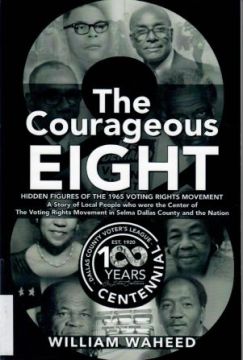
The Courageous Eight was also a book researched and written in the library, but I had some personal interest in reading it because it celebrates the 100th anniversary of the Selma Voters League, which with the Student Nonviolent Coordinating Committee was working for civil rights  before King moved in in ‘65.    I was especially interested in learning about the leaders of the 1920s.   Because I know the author somewhat personally (he and I had many talks while I was helping him find materials), it pains me to say that I found the book….wanting.   It’s a general history of the voting movement in Selma, and although the eight are often mentioned there’s virtually nothing about their actual lives; we don’t get any real sense of them as people, with the slight exception of Dole who Waheed has done other work on.  Less serious but still bothersome was the generally problematic punctuation –  far too many proper names were let without capitalization, and there were other grammar issues.   I suspect the book suffered from the desire to publish it by 2020 to celebrate the League’s anniversary.  There’s content here, to be sure;  the gold standard of Selma ‘65 books, ( Selma 1965, Chuck Fager ) doesn’t  review the founding of SNCC or the League, so Waheed’s entry is helpful there.   It seems like a missed opportunity, though. On the bright side, the cover art is most clever,  linking Courageous 8 and the 100 year anniversary of the Voters League graphically.

Posted in Reviews | Tagged , , , | 2 Comments

The Pluto Files

The Pluto Files: The Rise and Fall of America’s Favorite Planet
© 2009 Neil deGrasse Tyson
224 pages

pluto


Ordinary  citizens don’t take an interest in the fine details of scientific debate, any more than they would the fine details of debates at urban planning conferences.  And yet, when the International Astronomical Union created a formal definition for “Planet” which happened to exclude Pluto,  people lost their minds. Astrophysicist and science educator Neil deGrasse Tyson was on the front lines in 2006 of the furor, receiving thousands of letters from indignant adults and despondent children. Tyson had been the object of particular abuse because in previous years,  when he began as director of the Hayden Planetarium,  he inaugurated a new museum with an exhibit on the scales of the universe which  did not include Pluto.   In The Pluto Files, he delivers a history of Pluto’s discovery and cultural legacy, even after its demotion.  Part science, part history, and part memory, the work is a tribute to a little place with an outside importance to people’s affection, and our growing understanding of the solar system.  Although those looking for a detailed history of Pluto’s demotion would be better served by How I Killed Pluto and Why It Had it Coming, Tyson’s book works perfectly fine as the elevator version, and is  arguably worth encountering just for the cultural aspects.  I had no idea that a Holst scholar had written an addition to The Planets suite, called “Pluto the Renewer”, for instance.  Although most of Tyson’s excerpts are of scientific debate, the included letters written by those demanding  Tyson single-handedly restore Pluto to the planetary python are amusing and charming in their own rights.


Posted in Reviews, science | Tagged , , | 8 Comments

Treasure Island Game

As we headed into the weekend, a post from A Great Book Study and Marian drew my attention to a little survey or game created by Classic Reader, called “Treasure Island”.The premise is that you are stuck on a Treasure Island for a year, marooned by a parasailing accident. On the island, however, are books to spend that year with! The books are made up of the following:

8 books you have read of your choice
1 books which you have never read before.
1 ‘the complete works of’.

So, what can I come up with?

1. Eight books of my choice
Reflections on the Psalms, C.S. Lewis.   This is a twofer: my favorite Jack and the Bible.

The Meditations, Marcus Aurelius. If anyone can make me feel better about being trapped on an island  by myself, it would be the lonely stoic.

Jayber Crow, Wendell Berry.     Jayber’s tale is one I constantly refresh myself with,  either in book or audiobook form.

40 Nights to Knowing the Sky, Fred Schaaf.   I assume this treasure island will be in a dark-sky site, giving me the opportunity to stargaze – something I can never really do now, since even in the country there are blasted orange-amber lights spoiling things.

Star Trek Deep Space Nine: Millennium Trilogy,  the Reeves-Stevens.  Probably my favorite bit of Treklit, even counting Destiny.

11/23/63, Stephen King. My favorite King novel, and an interesting mix of historical fiction, metaphysical creeps, and a beautiful love story.

The Lord of the Rings, J.R.R. Tolkien.   Alone on an island, I suspect I would crave adventure,  a rich world to escape in, and a reminder of the good, true, and beautiful.

The Many Loves of Dobie Gillis.   I’ve loved this book since 2003,  but  I was torn, torn, torn between this and P.G. Wodehouse.  Wodehouse is funnier, more innocently joyful — but for years and years this book was the top of my “The house is burning and I can only grab one book” list, so I have to include it here for tradition’s sake. It was, prior to Wodehouse, the funniest one-volume set of stories I’d ever read.

My list of eight is very lowbrow compared to the others I’ve seen, but I figure — I’m an island by myself. I need to find what joys I can!

2. One book I’ve never read before

 The Shahnameh,  because it’s huuuuuuuuuuuuge. I’m hoping to read it this year across
several months, and had planned on kicking off on March 19 (the New Year celebration in Persian & broader Iranian culture),   but I’m also developing a Lent mini-series that it might conflict with, not to mention Read of England.

3. One “complete works of”
This one was the easiest, as I pick Isaac Asimov.  Asimov wrote hundreds of books, in a staggering variety of subjects. Mostly known for his science fiction, Asimov penned scores of science and history books, as well as books on various bits of literature, from Bible commentaries to poetry evaluation.   He also wrote mysteries a-plenty.  I’ve read almost all of his fiction, but his science essays are so great in number that I suspect I could build a nice shelter for myself just from them!

Posted in General | 8 Comments

The Five Love Languages

The 5  Love Languages: The Secret to Love that Lasts
Older subtitle: How to Express Heartfelt Commitment to Your Mate
© 1992, 2010, 2015  Gary Chapman
208 pages

love

What is a love language?   French is one, right? And Italian? ….no?  Oh, those are Romance languages.   Love languages, argues marriage counselor Gary Chapman, are different ways that individuals express their affection for one another —and more importantly, how they unconsciously expect others to express their own affection.   If different people express their love in different ways,  a relationship can suffer. It is therefore important, write Chapman, to understand the various ways people communicate love – to reflect on our own behavior and our loved ones to determine how they give and receive affection —  in order to build healthy lives together.   Although this is intended for married couples, the basic premise has been re-framed towards children, singles, etc, and from what I’ve heard is essentially the same and applicable to anyone who wants to nurture their relationships.

So, what are the five love languages? In Chapman’s view, they are:    words of affirmation, which might be both praise and compliments, or requests that begin in appreciation;   gifts,   which are fairly self-explanatory;  physical touch,   which needn’t be as involved as PSA, but could simply be little touches in passing;   acts of service,  or doing things to make the other’s life easier without being asked;  and quality time,  or focused time spent together —  put down that phone!     Each language merits its own chapter, and Chapman uses a case study from his work to explore how a couple could be coached from being ignorant of one another’s expectations to mindful of them.  Even a couple whose members have the best of intentions can operate at cross purposes – the man who works so much to provide that he’s  never home,  undermining his relationship with a woman who needs time spent together, for instance —  if they’re not aware of the other’s needs.  A love language is not a fixed thing;  people can learn to understand, and communicate,  their spouse’s way of love. Chapman closes the book with advice on how to discern one’s own love language.

Although I have my doubts that affection can be reduced to so simply, Chapman’s  book strikes me as most useful on the whole, in reviewing different ways of expressing love, and a reminder that different individuals from varying families can approach communication from different angles.  I’m fairly certain I encountered some of this information in a book I read as a lovestruck teen, Men’s Relational Toolbox, at least the bit about being aware that when people complain about a problem, they’re often looking for sympathy and support,  not advice.  At any rate, The 5 Love Languages is certainly worth reading for those who are serious about  investing in their relationships with others.

Some quotes
“[…]the average lifespan of a romantic obsession is two years. […] We can recognize the in-love experience for what it was — a temporary emotional high — and now pursue ‘real love’ with our spouse. That kind of love is emotional in nature but not obsessive.  It is a love that unites reason and emotion. It involves an act of the will and requires discipline, and recognizes the need for personal growth. Our most basic emotional need is not to fall in love, but to be genuinely loved by another, to know a love that grows out of reason and choice, not instinct. I need to be loved by someone who chooses to love me, who sees in me something worth loving.”  –  pp. 30 – 33

“The best thing we can do with the failures of the past is let them be history. Yes, it happened. Certainly it hurt. And it may still hurt, but he has acknowledged his failure and asked your forgiveness. […] We can choose to live today free from the failures of yesterday.”   – p. 45

“Love makes requests, not demands. When I demand things from my spouse, I become a parent and she the child.”  – 35

Posted in Reviews | Tagged , | 2 Comments