
So begins week two of ….well, whatever this is, this strange moment in time we’re all experiencing together. The library’s curbside service has been well received by the community, promoted by the paper and those of us on facebook, and so our mornings have kept us busy on the run — fetching papers to fax/scan/etc, bringing out books, that sort of thing. The library has maintained its regular hours throughout the weekday, but we’re now closed on Saturdays. They are normally a quieter day, save for peaks around lunch time (11-2), so I wasn’t surprised we’ve suspended them for the time being. We used to them as catch-up days to work on attention-heavy projects, but now most of our afternoons are that way.
Outside the library….the stores are still looking shellacked, as far as rice/flour/meat/TP go. I haven’t heard of any supply chain interruptions, so I assume we’re merely continuing to enact Kay’s Law. I can only wonder how much milk is being wasted by people who buying gallons at a time! I’m not personally stressed about this; I’m a mild prepper, so I’ve canned goods and stuff in the freezer. The crisis has prompted me to think about upping my mild-prepper game, though, after things start going back to normal. I notice the stores have put out little signs urging people to only take one (Walmart), or advising customers that buying more than one bottle of medicinal alcohol per day is now forbidden by store policy (Winn-Dixie). Of course, people will circumvent that, but if prices on those goods were raised to force people to think twice about buying three twelve packs of toilet paper, we’d scream price gouging. Both of these stores are also closing earlier in the evening — at 7 and 8 instead of 10 and midnight. According to the news, this is to allow for more time for stocking and sanitizing. I noticed on Saturday that buggies (er, shopping carts for those of you who weren’t born in the South) were being cleaned as they were returned.
On a personal note, I fail at social distancing. On Saturday I went for a walk in the park with a friend, followed by an evening of card-playing at my sister’s house, and on Sunday I spent most of the day a friend’s house, yakking and watching movies. I’ve been a proper recluse the rest of the week, though. I’m almost finished with The Beast, a book about the migrant woes in Mexico, and have been getting my Read of England books all lined up. COVID-19 may kill my Sunday breakfasts with friends, my Wednesday book bunches, my gym time — but my literary visits to England, never! So far I have a mix of history and historical fiction….more details on the first!
Are We There Yet? The American Automobile Past, Present, and Driverless
© 2019 Dan Albert
304 pages
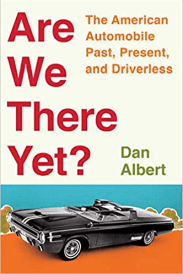
Are we there yet? I mean, at the end of the book? Because it’s not fun. Oh, sure, the author is trying to make it fun, but….there’s such a thing as trying too hard. When I picked this up, I was sold on the premise of a narrative history of American motoring which would end with a look at the prospects of autonomous vehicles. Just as in a tired, hungry mood I can be sold on a drive through burger and fries as a filling meal, though, once I finished this I was left feeling unsatisfied and annoyed at having spent money on it. At least in my case it was gift card money!
So, what’s the problem with Are We There Yet? Well, imagine being in a car listening to someone talk non-stop, someone who is so frequently distracted that they’re constantly veering into the other lane or threatening to sail into a ditch. Albert is constantly wandering off to yak about Freudian psychology, or Marxist economics, or working in as many pop cultures jokes as he can so the book will be painfully dated in a couple of years. We return to the road, moving in the expected path, from Ford to Volkswagens and Nissans and so on — but the distractions come again and again – and our distracted driver keeps jumping ahead to talk about autonomous cars, long before their time has come, and by the time the book reaches the autonomous cars section, it’s so general that there’s no real content to be had.
I read this wincing, grimacing, and sighing – and I say this as someone who loves reading about transportation history. Trains, canals, planes, the interstates, automobiles, horses, bicycles – if it moves, I’ll follow it and read a book about it! But Are We There Yet made me as bored and impatient as the child whose eternally-repeating question gave it a title. A lot of its content was as sloppy as it was irrelevant, and I was astonished to read on the back cover that the author holds a PhD in history. I’d assumed he was a car guy pretending to be an historian. I’m fairly certain I learned more about cars from Driving with the Devil, a book about Prohibition and NASCAR, than this.
Although there are useful bits of history here about the technical revolution of cars, it’s a safe bet there are better books out there – presumably the Smithsonian’s Drive: The Definitive History of Driving, or Steve Parissien’s The Life of the Automobile would serve the curious. And there are at least three books just about autonomous cars to consider beyond this one.
I aim to minimize the amount of un-commented-on books in 2020, so here follows some housekeeping!
Back in February, I read Braving the Elements: The Stormy History of American Weather. It opened with the importance of climate to the various peoples of the American southwest, shifted to the settlers’ growing appreciation of how diverse the North American continent was, and then trailed off with the growth of weather forecasting in the United States. It falls into that dreaded “Interesting, but Forgettable” category.
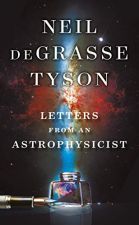
More recently, I read Neil deGrasse Tyson’s Letters from an Astrophysicist, which…boy, I’m glad I borrowed instead of bought. It’s a mix of the personal and the scientific, and though I bought it hoping for enough astrophysics commentary to justify filling my Astrophysics and Cosmology category for the 2020 Science Survey, the only piece that really stood out were his letters penned in the wake of 9/11, as he shared his experience just four blocks away from the towers. There’s other content here, but it seems the sort of thing only of interest to people who really like Tyson. I’ve read and listened to him for years, but whenever he leaves the planetarium and starts writing about history or anything else I have to grimace and bear it. I still plan on reading his book about astrophysics and the military, though!
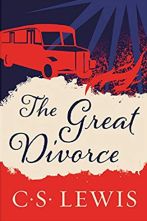
Lastly, C.S. Lewis’s The Great Divorce. Gasp, you say? Not reviewing properly something by Lewis? Well…I’ve read it before, y’see, and was reading it again for Lent. For those who’ve never encountered it, it’s an allegory about God and eternity, as a narrator finds himself wandering a grey city that is the residence of those who have not taken the hard road into paradise. Although those experiencing the lackluster existence of the grey city all have various reasons for lingering where they all, focused on their private idols, in the end it all comes down to self-worship. The intellectual who is more interested in making impressive speeches about truth instead of acknowledging it, the artist who keeps insisting his painting of the heavenly paradise would be better than paradise itself, the woman whose morbid fixation on her dead son would see her insist he be brought out of heaven and down to her — — all of them come down to the subject’s inability to get over themselves. At one point, a heavenly person who is trying to guide one of the lost into heaven asks wearily — “Could you, even for a moment, think if something OTHER than yourself?” I found it much more interesting this time around than ten years ago, largely because I’ve read a lot more of Lewis since then and frequently made connections between this and his other works. His The Four Loves frequently comments that the love we experience on Earth is merely a taste of God’s love for us — that we are seeing through a mirror only darkly, to borrow from one of Paul’s letters to the Corinthian church. That comes up again here, when people remain focused on their mortal attachments.
I’m really tempted to throw Are We There Yet? in here, because it definitely won’t be getting a full, chatty review, but I’ll give it a couple of days.
March 17, 2020
Earlier today in conversation with a priestly friend, she mentioned that she and some of her fellow clergy were keeping “Corona Diaries” to document their respective organization’s practices in the wake of the current pandemic, to monitor what worked and what doesn’t. As someone who kept a journal regularly from 1996 to 2009 or so, and as a historian, this idea appealed to me. I thought I might keep an intermittent log here to look back on in a few years and remember how things were.
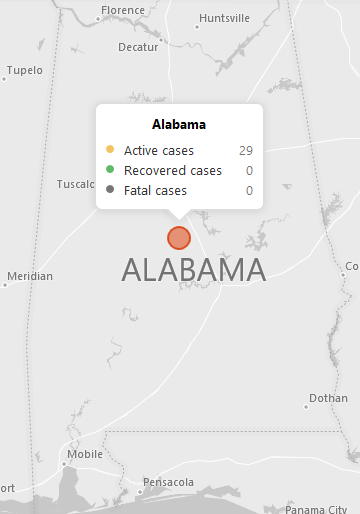
Image taken from Bing’s COVID Tracker, 3/17/2020
On Friday afternoon, just before lunch, the State of Alabama confirmed the first case of COVID-19 in the state, from a civilian working on behalf of the military who had recently returned. The entire atmosphere changed within an hour, as organizations began implementing pandemic response plans: schools and churches suspended activity for the next three weeks, the Selma Pilgrimage (a tour of historic homes that takes place in the spring) was rescheduled for late April, etc. Pandemonium erupted at the local Wal-Mart, which is the main source for most consumer goods within Selma, as people went after the toilet paper (??) and the medicinal alcohol. The library remained open throughout the day, as well as Saturday. Following Governor Kay Ivey’s declaration of a State of Emergency, however, the Library put its own plan into effect. Until April 6th, the library building would be closed to the public; staff would remain inside to serve the public as much as possible under the circumstances.
What that’s to look like is still being determined. Yesterday, we devoted ourselves to a deep cleaning of the library. Not a light switch, not a pencil, not an elevator button went un-cloroxed. We also answered phones and tried to keep the public informed. As I’ve recently taken over the responsibilities of a colleague who had to abruptly retire following some medical issues, I have an entire office of books and documents to examine, sort, etc. Today, however, I’ve mostly been kept running – literally – through our attempt at offering curbside service. As we’re the main source of scanning, copying, and faxing in our community, we’ve been directing people to come to one of our exits, meeting them down there, accepting their paperwork, then running back inside to process it to meet their needs. We’re following hygienic procedures, of course: putting on latex gloves prior to handling outside documents, and washing our hands on re-entry into the library. Needless to say, we are all getting our exercise!
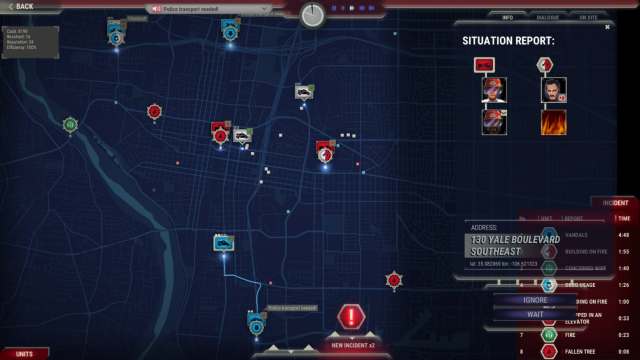
So far I haven’t heard of any serious problems as a result of the panic; Winn-Dixie was perfectly normal on Friday night when I picked up some drinks and chips for a games night party, and on Sunday when I visited Wal-Mart I noticed lean-looking shelves but no destitution. Lean-looking shelves aren’t that uncommon at the local Walmart, so nothing out of the ordinary there. Personal-wise, I have plenty of books to occupy myself with, and have started playing a new-to-me game called 9-1-1 Operator. The player takes phone calls and dispatches a limited number of police cars, fire engines, and ambulances to deal with a much larger number of incidents and emergencies. Some incidents merely appear on the map, but others are actual phone calls where information has to be interviewed-out of the caller, or picked up from background information. One ‘prank call’ is actually someone calling the police while pretending to place a pizza delivery order, for instance. There’s something therapeutic about responding to crises in the wake of one — although, when I had five fires in Albuquerque and only two engines to address them, I didn’t feel very relaxed! The Breaking Bad reference amused me to no end, though.
Anyway! I hope everyone stays safe. I’m still reading, so there will be reviews coming out soon.
“I stood looking over my damaged home and tried to forget the sweetness of life on Earth.”
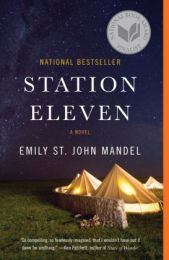
In New York City, an acclaimed actor collapses in the middle of his King Lear performance. Hours later, the world as we know it is over. Station Eleven is easily one of the most fascinating books I’ve ever read, in part because of its structure. Although it sounds like a science fiction novel, Station Eleven is a complicated book to summarize or explain. Given the current panic over Corvid-19, I thought it would be a timely read — but I suspect it would be just as absorbing during a less frantic time.
On the night the book opens, the Georgian Flu has arrived in North America: within two days, most of the population will be dead. Some of the principal characters are members of the Traveling Symphony, a caravan of musicians and actors who visit the towns in their circuit and bring back to life the beauty of the old world, if only for a night — allowing survivors to listen to Beethoven and Shakespeare. Their motto comes from Star Trek Voyager: SURVIVAL IS INSUFFICIENT. After a run-in with a strange figure known as the Prophet, several members of the company disappear, and the survivors choose to regroup at an old airport known as the Museum of Civilization, where trinkets from the time before the end have been saved. But these characters are only one of the layers of the novel; there are several planes of narrative that intersect in the lives of a few individuals who appear throughout the novel in different ages. Structurally, I was reminded of Catch-22, because there’s a lot of jumping between times and characters here, but the connections between the different stories grow and grow as the novel progresses. One of the narratives is a fictional story within the story, a SF graphic novel about humans on a space station (guess what it’s called) who escaped from Earth’s takeover by aliens, only to find themselves pining for the light of the sun again.
I imagine this book will be very popular with English professors in a few years, because there’s a lot to unravel and talk about here. One of the elements from the SF series, for instance, involves people who live in a part of the station called the Undersea, who can imagine no happiness or future for themselves until they somehow find a way back to Earth. But this waiting-for-life attitude, this sleepwalking, is also commented on in the more conventional parts of the novel: people who have done what’s expected of them, but they’ve never found their passion in life, never truly awoken and lived. One of our characters, Jeevan, was like that — until that night a man collapsed on the stage, and he found his calling.
Station Eleven is an absolutely memorable novel, one I suspect I’ll read again — if only because its structure makes absorbing the whole story in one pass unlikely. It’s unusual, but unexpectedly compelling.
American Dirt
© 2020 Jeanine Cummins
387 pages

It was the garden party from hell. One moment, Lydia Pérez was enjoying her niece’s quinceañera; the next, she and her son Luca were huddling in the shower, listening as their family was butchered by drug traffickers out to make a point. Unable to trust the police, hunted for by a powerful mobster, and afraid for their lives Lydia has no choice but to flee, joining thousands more on a northward journey in hopes of creating a better life el norte. A harrowing but timely novel, American Dirt puts human faces to issues many readers may only encounter in the news.
Lydia and her fellow migrants face not only the inherent dangers of their path — the lethal train jumps, the almost-certain threat of being manipulated and taken advantage of — but find that the violence they left behind continues to seek them. Lydia is an object of sick fixation to the kingpin in southern Mexico, La Lechuza, a man whom she befriended without knowing his true nature. From Acapulco to southern Arizona, he has eyes and willing agents who want nothing more than to capture her and claim the reward. Lydia’s traveling companions also have their troubles, and some will fall along the way. American Dirt excels as a suspense thriller, as Lydia and her son are forced to move from train to train, making overland treks on foot, weighing every stranger – are they trustworthy or treacherous? There are no authorities to whom one can turn; every rank of law enforcement and the military are corrupted, if not by the gangs than by personal viciousness. There are scenes of murder, dismemberment, and something approaching a rape scene – so reader be warned. But there is also grace — from the clergy who feed and shelter migrants, to ordinary citizens who offer advice and resources to spare the refugees as much abuse and danger as they can. But the light amid the darkness is most obvious in the relationships between Lydia, Luca, and several other travelers who they share so much of the journey with – supporting one another along the way through their respective problems.
After reading American Dirt I was surprised to find it’s at the center of a controversy; Latino authors decry it as not being authentic enough and taking attention away from voices closer to the ground. I can’t speak to that, but what I know is that it’s an absolutely gripping story, one that kept me invested throughout, and has prompted me to learn more about why so many feel compelled to take on the miseries of the trek north, as well as wonder what those of us who live in the United States and Mexico can do to respond to the needs of migrants which respects both their dignity and the two nations’ sovereignty. It’s definitely a story that will linger long in my mind, much as The Kite Runner did.
“Quotations to follow tonight,” I said. I didn’t expect AT&T to have another network outage, though mercifully this one wasn’t as long as the twelve days (you better believe I counted) of February. But enough telecom griping! On to the quotes!
=========================================================
“Intuitively, we might think, Yes, the environment matters, he explains, but the environment has become an abstraction; it’s hard to connect with because we’re not there anymore, and increasingly isolated from it. “The things that we should be concerned with are actually becoming more foreign and more unfamiliar to us,” he says. This, he tells me, is the worst consequence of all the concrete.”
“Once, he tells me, a reporter asked him how many archeological sites there are in Mexico, thinking there could be more than a hundred thousand. And Matos told him, ‘Don’t worry, there’s only one, and it’s called Mexico.'”
“That transformative power comes from the fact that when we slice and dice the ground with our roads, we weaken the ecological fabric on which life depends. Ecologists call this fragmentation, and its costs are enormous. A recent study led by Nick Haddad of North Carolina State University found that ‘fragmented habitats lose an average of half of their plant and animal species within twenty years, and that some continue to lose species for thirty years or more.‘”
“Diversity isn’t something that exists in the world; diversity makes the world. The things that regulate the populations, the things that keep the pests in check, the things that structure the amounts of the different kinds of fishes in the seas—they’re all based on biodiversity and the ecological interactions between the organisms. So if you lose it, you’re going to reshape the world.”
“In fact, simply in terms of numbers, the wilderness below ground blows the world above away.”
“But still there is a wildness in the ground that brings the prairie potholes alive each spring, for days or weeks or months at a time. Dry beds in the landscape, shapes to which most of us would be blind, are the shallow basins in which so many lives will form. The ducks that visit our city skies, that flash past in fast Vs over suburban lakes and ponds—those ducks are made of this ground. This is the fountain of energy that Leopold spoke of, rising from soil into sustenance into brown and gray-white bodies, cinnamon and emerald heads. This is that fountain rising into beaks and feet, eyes and wings. ‘What really drives the system is invisible,’ Ray says, turning the Chevy back toward the interstate.”
“I stop in the road. To my left are the gathering flocks, to my right a field of wheat. It is like being up close to something back in time. Like a secret still going on. What are we if not a creation of days and experiences, of moments we have stopped to notice the world—the faces of family before us, the beauty of distant mountains, the ground at our feet. I am made from times like these, when I follow whatever voice I heard—who knows where it comes from?—and walk out alone along dirt roads to find a scene like this.”
“As red-winged blackbirds sing, setting sunlight shines on the cranes’ gray bellies, on the plains, as though the same golden energy that fills their wings fills the ground on which their feet will land. This ground feels akin to that of the West—the dry air, the cottonwoods, the big sky—even though it’s of the plains. What has passed beneath me? A thousand thousand years of animals moving, eating, mating, dying—the bones below us we never will know. This outermost surface of the earth all the while becoming the richest soil.”
A friend recently introduced me to the terms lentic and lotic, referring to stagnant and fast-moving bodies of water, respectively. My Lenten series has so far been very lentic, as I’ve been distracted by life’s goings-on. I have done a little reading, though: The Ground Beneath Us, followed by Agatha Christie’s The Body in the Library. I’m nearly done with my first Lenten read, on fasting.

“What I feel is that if one has got to have a murder actually happening in one’s house, one might as well enjoy it, if you know what I mean.”
I obviously had to try Christie’s original after reading The Bodies in the Library, which played with its premise as well as its title. We open on a country estate, where the maid has just discovered a bottle-blonde in a cheap dress, lying in repose in the library. She’s unknown to everyone in the house, and some investigation by both Miss Marple (a friend of the family) and the county constable reveal that she’s a missing dancer from a hotel some thirty miles away. Although there are a handful of suspects, none of them have opportunity or much motive, and the truth-seekers are flummoxed until a second body is discovered – this one a young girl, left in a burning car. Although there’s no direct evidence, the investigators have a hunch that both of these senseless deaths are related, and from their reading of the facts and of human nature, the truth comes out. I found The Bodies in the Library much more entertaining than say, Hallow’een Party, with some choice quotations and a good curve at the end.
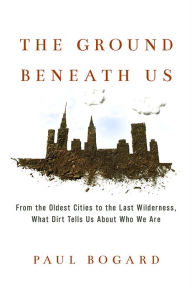
Before that, I thoroughly enjoyed The Ground Beneath Us, which proved far more varied than the expected book on the rich life of the soil. The author, Paul Bogard, has produced a fascinating piece of reflective journalism mixing history, science, nature writing, and culture together, a work so varied it almost stymies an effort to offer a general summary. As the reader would suspect, there’s plenty of material in here on the health — or rather, the dismal state of — our soil. The author offers the opinion that countries throughout the world have, on average, sixty harvests left before things are exhausted. We visit several places in this theme, including the Alaskan frontier, where melting permafrost is allowing methane previously trapped in the soil to seep into the atmosphere and accelerate global warming. But Bogard’s approach isn’t purely scientific; we spend considerable time in the Southwest, exploring Anansi religion, ponder Civil War battlefields and the concept of hallowed ground, and even visit Treblinka, a site made eerie both by the amount of death carried out there and the fact that the Nazis almost got away with concealing its existence completely; as they retreated, they carefully disassembled everything and destroyed the evidence as best they could. Such a measure is doubly disturbing, for it reveals the Nazis knew of the moral horror of their ‘work’, in the care they took to conceal it. Although Ground Beneath Us doesn’t pack as much scientific weight as I would have liked, its writing and variety of content carry their own enormous attraction. Quotations to follow tonight!
Today is Ash Wednesday, called for the service in which western, liturgical Christians contemplate the inevitability of death, and the need to focus on that which matters. The forty days of Lent will follow, and that season of preparation is typically used by Christians to adopt a discipline, or abandon something which tends to lead them away from the religious life. To mark the occasion here, I’m going to be reading a few books of Christian literature, aiming for one a week, on various subjects — history, doctrine, practice, and culture. I haven’t selected all of my reads just yet, but I’ll kick off the series with my delayed review for The Four Loves, and have three books all set up to establish momentum.
This is not remotely an appropriate hymn — it’s more of a folk-punk piece from a band who always remind me of my college days — but it always reminds me of Ash Wednesday.
Don’t fear death or your mortality
Just let it be the motivation that you need
To live the life that you want to lead
And sing!
We are nothing more than setting suns
So let’s glow glorious until the day is done
And we’ll all fall back down below the land
Together underground is where we stand

