To Build a Castle: My Life as a Dissenter
© 1978 Vladimir Bukovsky
438 pages
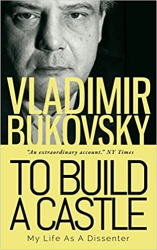
When frustrated Soviet officials asked Vlaldimir Bukovsky why he continued to provoke them, he replied that he doubted he could cause them nearly as much trouble outside the gulag system as inside. Like Natan Sharansky, Bukovsky entered prison not in defeat after his fight with the Soviets, but in anticipation of continuing it. He couldn’t do otherwise: even as a teenager he realized that life as a faithful subject of the Soviet state was impossible for him. It was an empire of lies, where truth changed by the year, where absurdities and corruption were the norm. Organizing a society of dissidents in his youth, he continued to speak the truth about the Soviet state and to demand it conform itself with its own rule of law, f nothing else — until he was at last expelled.
Having read both Sharansky’s Fear no Evil, and Solzhenitsyn’s Gulag Archipelago, there weren’t any real surprises in here as far as the universal abuses of the Soviet system go. Bukovsky’s refusal to wilt in the face of state repression was so outrageous to the Soviets that they regarded him as a mental case, and the abuse of psychiatric medicine makes this memoir stand out from those other two which I’ve read. According to Bukovsky, late in the sixties the state hit on the idea of using diagnoses of mental disorders to render individuals “unfit to plead”, which they used to prevent dissidents and prisoners from fighting oppression via the legal system. (And fight they did– Bukovsky’s favorite game was to generate mountains of paperwork for the bureaucracy by sending off hundreds of complaints a week on behalf of himself and other prisoners.)
What makes To Build a Castle truly worth reading, though, are Bukovsky’s comments on the human spirit in its eternal struggle with the Soviets. In a line that strongly reminded me of Solzhenitsyn’s observation that the line between good and evil runs through every human heart, Bukovsky comments that what he hates most is Soviet man, the mewling subordinate who is cowed by the state or the pressure of the crowd to conform. Soviet man exists in each of us, he writes, and it is our duty to fight him — to ensure that he doesn’t prevail. A man who who stands against the state fights not only for himself, but for each of us — it is by individual actions that the battle for the soul of a nation is won or lost.
Bukovsky’s memoir is a powerful account, an indictment of not only the Soviet state and its gulags, but the great lies it was built on and which extended its life past reason. I’m going to share a few quotations later, but I can’t close this without a tease.
In fighting to preserve his integrity he is simultaneously fighting for his people, his class, or his party. It is such individuals who win the right for their communities to live—even, perhaps, if they are not thinking of it at the time. “Why should I do it?” asks each man in the crowd. “I can do nothing alone.” And they are all lost. “If I don’t do it, who will?” asks the man with his back to the wall. And everyone is saved. That is how a man begins building his castle. […]
You have to learn to respect the right of even the most insignificant and repulsive individual to live the way he chooses. You have to renounce once and for all the criminal belief that you can re-educate everyone in your own image. You have to understand that without the use of force it is realistic to create a theoretical equality of opportunity, but not equality of results. People attain absolute equality only in the graveyard, and if you want to turn your country into a gigantic graveyard, go ahead, join the socialists. But man is so constituted that others’ experiences and explanations don’t convince him, he has to try things out for himself; and we Russians now watch events unfolding in Vietnam and Cambodia with increasing horror, listen sadly to all the chatter about Euro-communism and socialism with a human face. Why is it that nobody speaks of fascism with a human face?