
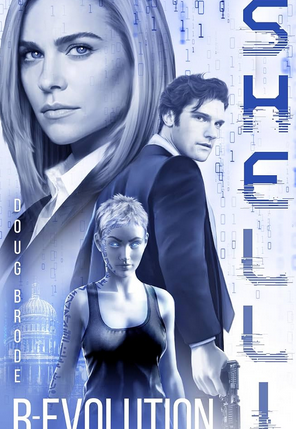
gets weirder all the time.
An experimental incubator synth, with high-octane empathy protocols, has just run off with a baby. The baby is due to be delivered soon, but it appears this unit has become attached to the baby she’s carried for so many months; she’d rather die than lose the infant. What happens next shocks both Jake and his synth partner, an illegal organic-synth bybrid named Shelli, and turns into quite a SF adventure. Imagine two partners who are given reason that they can’t trust one another’s minds, that the past has been made plastic, that things have been done which cannot be undone — and that a simple case of an apparently neurotic synth will lead to high-stakes action in the heart of DC.
The problem with reviewing some thrillers is that the twists are high-voltage enough that they will break through a simple precise. We begin with a simple incident; Shelli is not satisfied with appearances, and she wants to dig deeper. After certain evidence details bring an old case to mind, both Jake and Shelli are disturbed to realize that all records of the case are gone. In hopes of figuring out what’s happening, they go to Florida to visit the former case manager, but he gives Jake — and Jake alone — a dire warning. Drop this. There are things waiting in this Pandora’s box that should not be unleashed. Because Jake is warned about involving Shelli specifically, he goes alone, and (as one does when probing into cold cases everyone wants to remain dead as the grave) gets into trouble, and things steadily escalate. What makes the tension all the more sweeter is that at one point the reader will realize things the main characters cannot; it begins as a blip of “Huh, that’s strange” and steadily overtakes the plot.
I can’t say anything further without violating spoiler protocols, but R-Evolution contains all of Brode’s strengths from this series. Shelli is innately interesting; her bond with Jake is complex. The near-future setting allows readers to settle into a feeling of ‘the world mostly as you know it, but with synths’, and so the disasters that threaten are more real in a way than SF works that deal with wholly imagined cities and entities. Jake is grounded in the law enforcement bureaucracy of our world, just — in some near future. At the same time, this isn’t simply an action SF novel with robots; in the tradition of SF, it touches on philosophy — particularly, autonomy and sentience. While reading it, Firefly’s Serenity came to mind, as did TNG’s “Measure of a Man”. R-Evolution also touches on political philosophy, and in a way that is deliciously timed for America’s 250. Was it intentional? I have no idea, but for readers like myself who have been revisiting the American Revolution in history this year — who have sat in Independence Hall and listened (or read) Mr. Dickinson and Mr. Adams arguing whether or not our rights are inherent or fabricated, if they were writ in the soul rather simply in government edicts — it’s compelling in ways beyond “how do we stop this bad thing that is happening”. And yet at the same time, it remains Shelli’s story — Shelli, the synth who captures synths who misbehave; Shelli, the synth who became a human hybrid; Shelli, who like R. Daneel Olivaw has to live every second trying to figure out where she stands vis a vis humanity — and what she owes it, and to synths.
Great continuation of this series. I can’t believe we’re closing the sixth month of 2026 and this is only my first SF read, but hopefully the rest will be comparable!
SHELLI: R-Evolution will be released on June 19th, 2026.
Quotations
“Together again,” Jake said, sitting on a stack of boxes in the back of a utility van. “And traveling in style.”
Shelli stood, statuesque, ignoring the vehicle’s unsteady motion. “Infiltrating 2Morrow Dynamics without being detected is the goal. The aesthetics were not my concern.”Shelli had calculated the precise amount of speed and strength required to knock _________ down without causing permanent damage. However, despite her promise, she had enjoyed it.
“I’ve read your file. You’re no killer.”
“Was that profile written before or after I became a father?”


Rights are an interesting topic. MANY years ago (I’ve probably said this before) @ Uni a friend was scratching his head at the idea of writing a 2000 word essay on ‘Are Human Rights Utopian’? I looked at him as if he’d gone insane. You could write 2000 words on the definition of “Human” I said. The problem will be keeping it DOWN to 2000 words!
Oh, and the answer is ‘fabricated’…. [grin]
I think fabricated is unacceptable. If we permit the government to believe it is the creator of rights, it will violate them as it wills. Of course, as countless wars in democracies have shown, it will violate them regardless. But law and rights…I have to dig deeper.
Like much else in life, rights are cultural inventions that aid in societal stability. Framing them as ‘God given’ elevates their authority without having to explain anything. Of course, as you know, I maintain that God (all flavours thereof) is also a cultural construct, so saying that rights come from God is essentially two-stage authentication.
Oh, and governments *do* violate rights whenever and wherever its convenient for them. History is FULL of such violations…. Plus I’ve always found it ‘amusing’ that so-called “universal” rights never apply to *everyone* or in all circumstances.
Your first sentences makes me think — “If natural law/natural rights did not exist, it would be necessay to invent them”.
There is at least one natural right that anyone can agree on — the power of WILL. Governments can punish us for expressing our thoughts, but we can still mutter “It still moves”. We can still refuse to put the little placard in the window. Gandhi said — or at least Ben Kingsley playing Gandhi said”“They may torture my body, break my bones, even kill me — then they will have my dead body, not my obedience”. There’s one story about Epictetus, that his lameness owed to his master (he was a slave) breaking his leg for some kind of trivial disobedience. That is why governments spend so much time trying to distract people, or discourage them (as they do so well in 1984).
I remember reading something a LONG time ago (it might have been a SF short story) where the main character says that the most powerful thing in the universe is the word “No”.
So-called ‘Natural Rights’ has always confused me. Natural? Like, someone found them in a forest covered in vines, or in a deep cave where they had been removing coal deposits, or in some arcane mathematical formula? Or ‘natural’ as in ‘makes sense to me’….? Again its just a weak attempt to give some invented political ideas gravitas and a more solid foundation than ‘Oh, we just made it up’… Why they can’t just say: Having these in place makes things better and more stable over the long term, but we can change or add things if we need to due to changing circumstances. You know… treating people like educated adults.
I’m definitely a believer in Free Will and the power of people to push back against any kind of perceived oppression. You just have to watch the news to see that happening. The push has to be directed though in order to be effective. Simple outbursts of frustration tend not to achieve very much.