What the Robin Knows

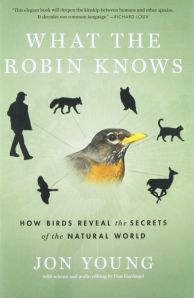
What the Robin Knows: How Birds Reveal the Secrets of the Natural World
© 2012  Jon Young
277 pages
whattherobinknows

I don’t envy people for their boats,  wardrobes, or  wine collections, but if I meet someone who can ‘read’ the natural landscape I instantly covet their knowledge.  It doesn’t matter if they’re a geologist who can interpret the deep history of a field, or the hunter who knows that deer have been in the area recently.  A richer connection with the natural world is an appetite I can never satisfy.    So it was that I found the promise of What the Robin Knows to be fascinating. Is it really possible to ‘read’ an area by listening to birdsongs?

It is possible, says Jon Young, if you’re committed.   A given species of bird may have different calls depending on what part of the country they’re in. The key, besides committing to sit every day  in the same spot listening  and observing, is to know what ‘baseline’ constitutes, so that departures from it — alarm calls — can be detected. Young  devotes the first half of this book to exploring baseline, sharing the different types of bird calls, from singing to ‘companion calls’. The latter are interesting because they’re vocal ‘nudges’ that a mating pair of birds might exchange while separated. Those who purchase the Kindle version and can read it on a Kindle Fire or an Ipad  have the additional treat of embedded audio, so that when Young refers to a call,  touching the horn symbol will have it play. This won’t work for the Android or PC Kindle approaches, however.    The concept of baseline is especially important, says Young, because animals pay attention to it, too;   one species of bird will pay attention if another issues an alarm,  or begins acting oddly, and creatures like deer are also involved in this exchange of information.

What the Robin Knows is a curious book, one that can’t convey all its explicit knowledge so much as it prepares the reader to obtain it for themselves. The cries Young shares as an example may not reflect the region a given reader is in. But this introduction to the different categories of bird calls, and its study of their alarm behavior,  is of great interest readers with any interest at all in birding.
 

Posted in Reviews, science | Tagged , , | 4 Comments

The Science of Breaking Bad

The Science of Breaking Bad
© 2019 David Trumbore,  Donna J. Nelson
264 pages

breakingbad

Yeah, Mister White! Yeah, SCIENCE! 

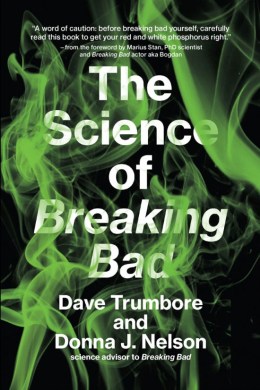
Breaking Bad remains the best-scripted, -filmed, and –acted show I’ve ever watched, and no matter how many times I watch a given episode, it never loses its compelling nature.  Breaking Bad is unusual for most television in its heavy use of science, with a main character who prides himself on his chemical prowess and technical discipline as he transforms from chemistry professor to meth king over the course of  two years. Although the show’s creators used extensive web research to begin the development of the character and show’s scientific creds, they  received a shot in the arm when Donna Nelson, a chemistry professor with an interest in using Hollywood to increase scientific appreciation and literacy, volunteered to serve as an unpaid science advisor. She fielded questions from the writers, supplied equations for Walt to scrawl on his blackboard, and informed the show’s vocabulary.   Now she and a co-author have created  a review of some of the scientific content of Breaking Bad,  encompassing meth, explosives, and the perfect cup of coffee.  Written with passion, a whiff of dark humor, and a lot of reminders not to try this at home,   The Science of Breaking Bad  is a welcome review of the show from a unique perspective,  though not one aspiring meth cooks or those who haven’t seen the show should read. (There are no recipes, but there are spoilers a plenty.)

Breaking Bad, for the uninitiated, is a crime and character drama about a chemistry professor named Walter White whose cancer diagnosis threatens to destroy his family financially,  unless he can make some quick cash on the side by using his chemical genius to produce meth. But once you start down the meth path, forever will it dominate your destiny,  Walt’s secret desire for reputation and his immense pride in what he’s capable of transform him into a lab-coated Moriarty.    Nelson’s evaluation of the show covers pretty much everything: Walt’s chemistry lectures when he’s still a high school teacher;  how the explosives and poisons worked that he used to disable (or kill, once he’d become the mask) his enemies;  how meth works on the body and the various ways it’s produced, several of which Walt used in the show.  (The filming of the meth process frequently mixed up methods, which was done to frustrate those who were trying to take notes on how to become dealers themselves.)  Nelson also departs from chemistry to discuss the psychological trauma that several characters go through (Hank and Jesse, primarily), and throws in one cybercrime reference.   Nelson includes a fair view production details beyond the science, too.

Fans of Breaking Bad  who also have a strong interest in science will find this one a fun read; although chemistry is one of the harder scientific area for me to embrace,  Murphy should be praised for using a popular show like this to try and teach a little more of it.

And if you can’t get enough BreakingBad, Melodysheep (the creator of those awesome Symphony of Science videos) has done a remix that has no spoilers:


There are two others I’m aware of not by Melodysheep; the first is a musical video based on seasons 1 and 2, the other on seasons 3-5.   These both flirt with spoiler territory and are more language-heavy,


Posted in Reviews, science | Tagged , , | 3 Comments

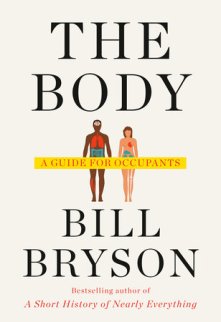
The Body

The Body: A Guide for Occupants
© 2019 Bill Bryson
464 pages

body

Bill Bryson would like to introduce you to someone: yourself.  You really are a piece of work!   Other authors have explored various aspects of the human body in detail – Mary Roach’s Gulp, for instance, on our digestive system —  but Bryson delivers a full survey, from  little bits and pieces to the body’s general options.  Drawing on academic sources and popular science books alike, The Body proves that Bryson can be most entertaining when he’s not writing his grumpy travelogues.   Bryson’s little chats about our brain or nose or whathaveyou isn’t limited to the strict biological aspects, as he also  romps quite a bit through history. I was amused to read a man’s journal and spot that he’d been self-diagnosing himself by reading medical texts,    jumping from panic to panic as people are said to do when browing WebMD.  The star of the show is the body, though, and Bryson  not only tells us all about what makes us work and how, but makes us appreciate the smallest members of our bodies —  the pituary gland, for instance,   which have an overlarge effect on the human experience. Bryson is consistently entertaining,  and I found the chapter on the brain particularly compelling,  in part for quotes like this:

The great paradox of the brain is that everything you know about the world is provided to you by an organ that has itself never seen that world. The brain exists in silence and darkness, like a dungeoned prisoner. It has no pain receptors, literally no feelings. It has never felt warm sunshine or a soft breeze. To your brain, the world is just a stream of electrical pulses, like taps of Morse code. And out of this bare and neutral information it creates for you—quite literally creates—a vibrant, three-dimensional, sensually engaging universe. Your brain is you. Everything else is just plumbing and scaffolding. 

The Body will rank as one of my favorite Bryson works.   To end, a few more highlights:

“You might have had the experience of looking at a clear blue sky on a sunny day and seeing little white sparks popping in and out of existence, like the briefest of shooting stars. What you are seeing, amazingly enough, is your own white blood cells, moving through a capillary in front of the retina.” 

“Your visual field is surprisingly compact. Look at your thumbnail at arm’s length; that’s about the area you have in full focus at any given instant. But because your eye is constantly darting—taking four snapshots every second—you have the impression of seeing a much broader area.” 

“Your brownie is sheet music. It is your brain that makes it a symphony.” 

“In 2011, an interesting milestone in human history was passed. For the first time, more people globally died from non-communicable diseases like heart failure, stroke, and diabetes than from all infectious diseases combined. We live in an age in which we are killed, more often than not, by lifestyle. We are in effect choosing how we shall die, albeit without much reflection or insight.” 


Posted in Reviews, science | Tagged , , | 2 Comments

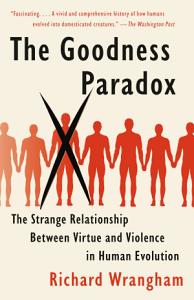
The Goodness Paradox

The Goodness Paradox: The Strange Relationship Between Virtue and Violence in Human Evolution
© 2019 Richard Wrangham
400 pages

violence

The Goodness Paradox cannot help but be fascinating, for it seeks to address one of the most pressing questions of human history:  how can a species so consistently capable of beauty and moral greatness also be capable of moral outrages like mass murder?   Why do so many invading armies, singing paeans about virtue, turn into gangs of looters,  casual butchers,  rapists, and arsonists?   Wrangham tackles that question, but first he has to address another one: why are humans so weird?  

Humans are weird in all kinds of ways, but Wrangham is chiefly interested in our oddly bifurcated relationship with violence.  Believe it or not, but we’re surprisingly peaceful creatures. While a  chimpanzee can’t go a day without being screamed at or beaten, many humans can go years without being involved in any serious violence. Place two adult chimpanzees who are strangers to one another in a room, and a fight will ensue; place two adult humans in the same context and they may do all manner of things, from sitting and staring to trying to communicate, but odds are they won’t immediately try to kill the other.  Humans have an astonishingly low amount of ‘reactive aggression’,    which is overshadowed by our intense pro-active aggression.  Why are we so much more easy-going most of the time compared to our closest relatives?  

The answer, Wrangham argues, lies in our being  a self-domesticated species.  Domesticated species display many consistent traits, like the retention of juvenile behavior and physical aspects.  Domesticated species are also much less reactively aggressive than their wild counterparts. After making a case for humans being a domesticated species, he then shifts to explore how that might have happened. The key, Wrangham suspects, is language;   once our ancestors gained the ability to effectively communicate,  it was then much easier to form coalitions against domineering individuals.  Those who were pushy, aggressive,  and adversarial could then be ambushed  and dispatched a la Caesar. Over time, Wrangham suspects that this not only discouraged reactive aggression, but that it promoted people with higher social awareness – that is, those who could anticipate how their behavior would be read by others.    This resulted in humans being more intensely tribal-oriented than other apes (who often engage in behavior that’s destructive),  and developing a strong moral sense – not simply empathy or a sense of fairness, but a judgment of behaviors being Right or Wrong.   This moral sense not only prompted people to behave, but when there were offenders, it invigorated the desire to punish them. Morality, then, is a double-edged sword:    protecting against  some violence while promoting it in other cases.  Beware the ape or army that thinks itself righteous!  

The above is a very compacted and abbreviated version of an argument that Wrangham develops far more gracefully, with many more sideroads that were equally as fascinating.  Given that the book addresses violence,   be warned that there’s a lot of it in here  —  beatings, rape, etc – from both human and other great ape quarters.  I’ve  seen bits and pieces of Wranghan’s argument before (the argument that humans are very much like juvenile apes, or the need for coalitionary violence to maintain egalitarian societies)  through books like The Righteous MindHierarchy in the Forest, etc), but  was much impressed by Wrangham’s case.  The Goodness Paradox will be one of those books I remember and think about for years to come.

Related:
Catching Fire: How Cooking Made us Human, Richard Wrangham

Posted in Reviews, science | Tagged , , , | 1 Comment

The Mustering of the Hawks

The Mustering of the Hawks
© 1972 John Harris/Max Hennessy
272 pagws

mustering

“When you consider that practically every aviator in the world’s been mustered together in France in a strip of territory some three hundred miles long by ten miles wide, it’s no bloody wonder that there’s a lot o’ pigeons among ’em and that there’s a pretty picking for them that are ’awks.’

Ira Penaluna has been in and around airplanes since he was in diapers; his father was an aviation pioneer.   Serving in the Royal Flying Corps was an obvious choice for him, even if he did have to lie about his age to get in.   The Mustering of the Hawks sees the quiet boy with a happy talent for shooting down Germans grow into manhood through four years of boredom, terror, and the constant death of friends,  ending his service as a respected flight leader with over forty kills to his name.   Combat fiction that moves throughout the western front, as the technological edge continues to shift between the Allies and Germany,   The Mustering of the Hawks  also has some solid characters and a lot of fun writing – especially when Ira and the boys are trying to chase women.  As with The Bright Blue Sky,   the main character is tortured in love, though  Dick Quinney had a much harder time of it on that front, I think.  There are a lot of similarities between the two novels,  but both were fun and I anticipate continuing to read this author.

Some kindle highlights:

“The aeroplanes hung stiffly above an earth that seemed to revolve slowly beneath them like an endless magic lantern film from childhood and the patrol was uneventful.”

“Why is it that the young Anglo-Saxon always goes into a decline the minute flowers are mentioned? Lad, you’re competing against the French, who know not only exactly ’ow many roses to take a young woman but also exactly what colour.”

“As they stopped by the front door, they heard a distant thudding – so faint it was almost like the beating of a heart. ‘It’s the guns in France,’ Nancy said. ‘We sometimes hear them when the wind’s in the right direction. Won’t it be wonderful when they stop?’”

“‘It’s no longer a simple thing of dim military types like us setting about each other,’ he said. ‘All heroic but a bit romantic with noble old-fashioned ideas. It’s political nowadays. Big business. Efficient killing done by numbers.”

“Worthing, the new major, wore the uniform of the R.A.F., which was rumoured to have been designed by an admiral and an actress, and he looked like something out of a musical comedy.”

Posted in historical fiction, Reviews | Tagged , , , | 2 Comments

Corona #7…and Flowers

keep

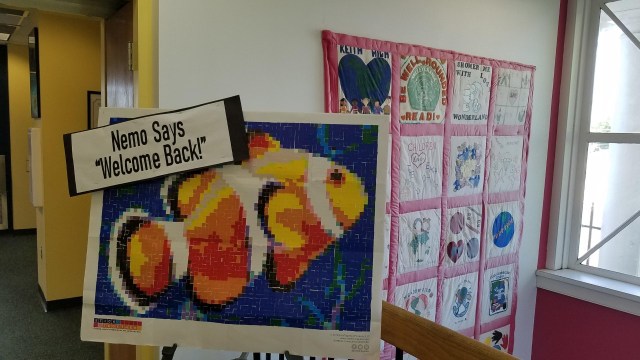
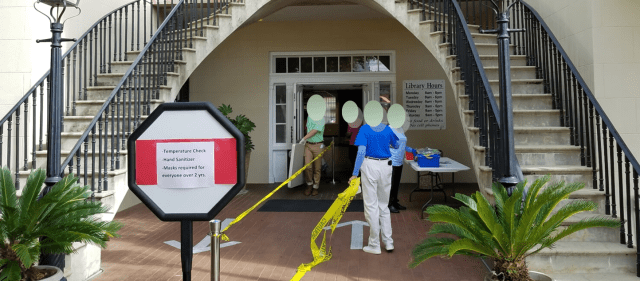
Things have been loosening up in Alabama in the last week,  though it’s not a return to life pre-pandemicmonium.  Right now we’re in a frustrating transition space, where stores are  getting increased demand at much-reduced capacity.   Nonprofits and the like continue to be closed;    one downtown church has already announced that services will continue to be suspended until at least June 7th.  The library, however, is opening the doors —  ever so slightly.

keep2

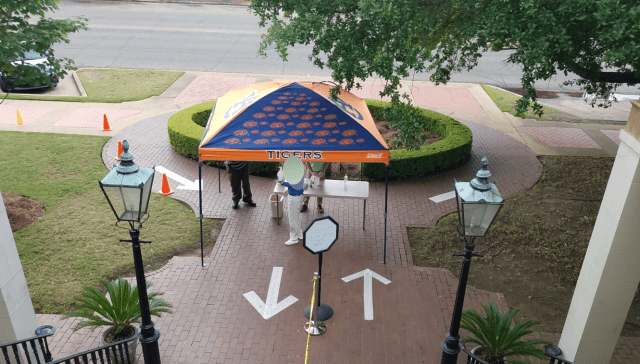
Weeks ago we began planning for what a partial reopening might look like, and our approach for the next two weeks starting Monday will be to have a split day. From 9-12, we’ll admit people into the building,  though no more than 25. All will pass through a gauntlet — first having their temperature taken, then being led to a sanitation station assuming they pass the first test.  Masks will be required, and I mentioned the equipment changes in the last update.  At noon,  the library will close to the public and switch to curbside service once again.   It’s going to be an interesting challenge, I’m sure.  Today was our first day, and we had some takers — not as many as we expected, but I imagine it will ramp up every day as the word spreads.  We’re hoping to push the open hours up week by week,  keeping a careful eye on the case numbers at our hospital.

keep3

My reading this week has been divided between three science and nature books,  one of which is done and the others of which I’m making good progress on. There’s also another WW1 aviation novel which has been my leisure reading.   I’ve not been reading on the weekends because I’ve been hiking and nature-gawping.

20200509_102952

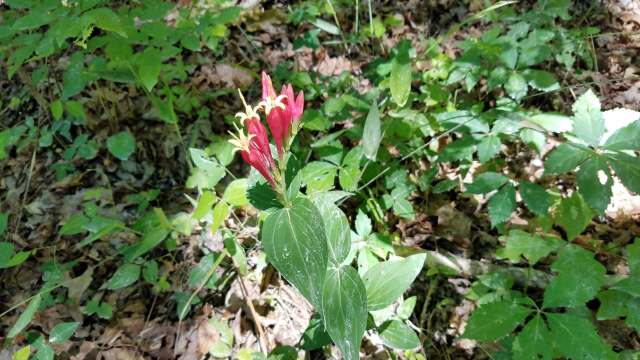
Indian pinks at the Cahaba Wildlife Refuge.

20200509_105158

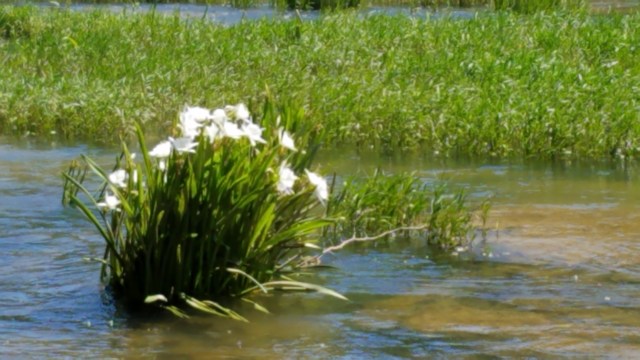
A zoomed-in shot of the Cahaba lilies beginning to bloom at the refuge

20200509_111401

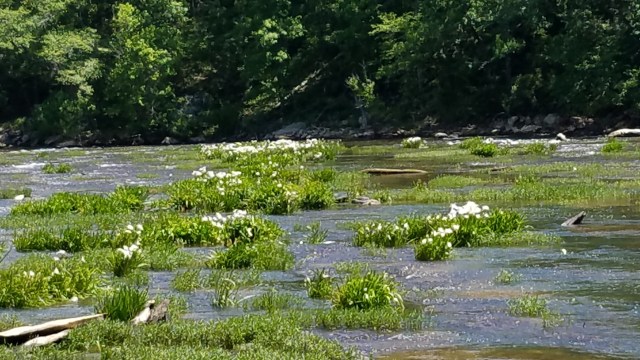
One of the lily stands

20200407_124540

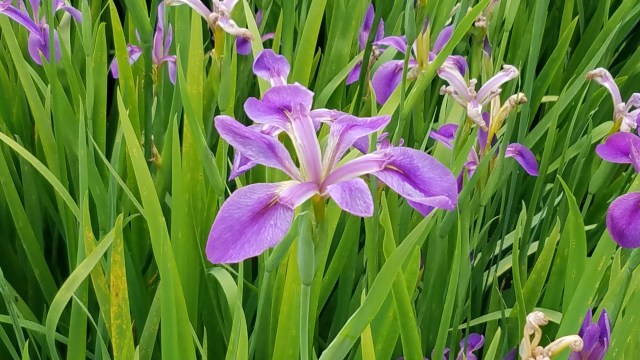
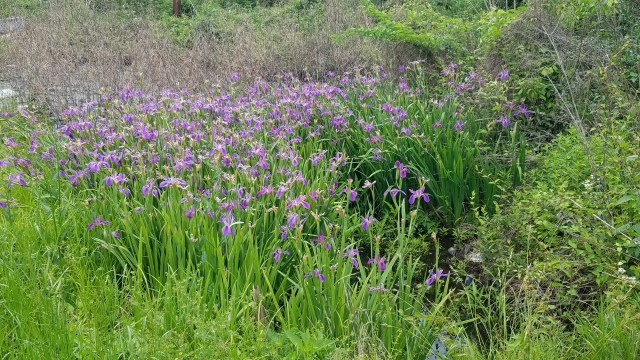
And a few weeks ago, I happened to spot an outbreak of wonderful blooms near a wetland I pass fairly frequently. I think they’re Louisiana iris.

20200407_124526

They lasted about a week.     I’m planning on investigating another splash of color nearby.


Posted in General | Tagged | 5 Comments

Offtopic but I couldn’t resist

seriously


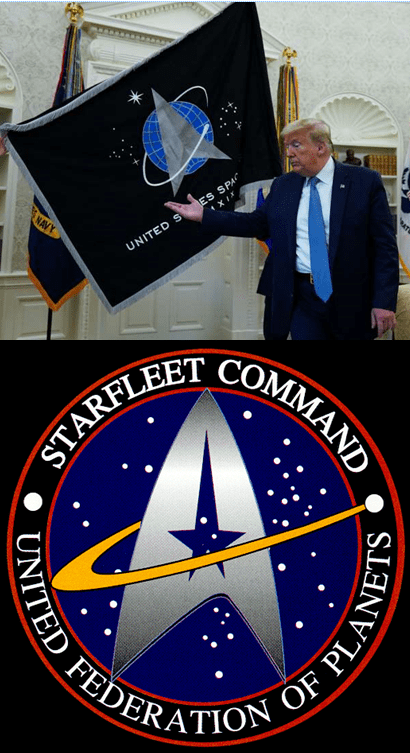
I’d lay odds that whoever designed that flag is a Trek  fan…

Posted in General | 5 Comments

Would You Rather….

Sarah of All the Book Blog Names are Taken has tagged me in a survey/game thing! I’m  tasked with answering her questions and then posing some of my own.

1. Would you have rather have been at court with Eleanor of Aquitaine during her estrangement from Henry II and chat with her on occasion, or be under house arrest with her for fifteen years until Henry II died and Richard I freed her?

If I’m stuck in 13th century England, I’d rather not be under house arrest. Court sounds more fun.   I’d be reluctant to get too chummy with Eleanor, anyway.  She’s not exactly safe!

2. Would you rather have lived at the court of Henry II or Henry VIII?

Henry II has St. Thomas Becket, but Henry VIII has St. Thomas More. It’s a hard choice, but I think I’ll go with ‘Enry the Eighth purely because I’m more familiar with Tudor England rather than Plantagenet England.

3. Would you rather have been Catherine of Aragon, Anne Boleyn, or Jane Seymour?

Definitely Queen Catherine. I’d be more likely to return to Spain than to hang around England being noble and miserable, though.

4. Would you rather be forced to read the last chapter first of every book you ever read for one year, or have the last chapter be missing entirely?

I read mostly nonfiction, so it wouldn’t matter too much — reading the last chapter first might actually be helpful, in terms of summarizing the book for me before I begin.

5. Would you rather have a friend who always loses books you lend them, or only returns them water-logged/with food or drink stains?

Oh, god. Lose the books rather than destroy them, please. At least a lost book can be found!

6. Would you rather have your favorite book turned into a movie/tv show, or your fave movie/tv show turned into a book?

I absolutely want to read Deep Six: The Continuing Adventures of L.J. Tibbs, the fictional novel that’s mentioned in NCIS, written by one of the detectives about the team’s cases. So if that counts — also, Breaking Bad would make an amazing novel.

7. Would you rather be a professional reviewer or famous author?

Famous authors make loads more money, provided they don’t pull a Jane Austen and become famous only after they’re dead.

8. Would you rather be able to visit your favorite book and talk to your favorite characters once, or visit whenever you wanted, but only as an invisible observer?

Most of the joy in visiting a place like Port William (Jayber Crow, Hannah Coulter, The Memory of Old Jack, etc) would be in the personal connections, so absolutely let me visit and talk. I could sit a spell in Jayber’s shop

9. Would you rather own a bookshop or work at a library?

I work at the library, and I imagine owning a bookshop is more stressful. On the upside, you’d get more people actually interested in books (most library visitors are after computers and services, at least here), and easier access to coffee.

10. Would you rather only read physical copies or ebooks for an entire year?

Ebooks, easy. 20 boxes of books given to Goodwill last year and they’re still all around me.


As part of the rules, I’m supposed to invent my own list o’ ten and then tag ten people.  I don’t know that many who haven’t been tagged, though,  and I can’t  think of ten questions I actually like,  so I’m just going to drop three and let Whosoever Wills answer them!


Here’s my list!

1. Would you rather read by yourself, or in a cozy crowd like at a coffee shop or bookstore?

2.  If you were imprisoned by an eccentric  and told you would only be released once you’d written a volume  for their collection, would you rather write poetry or prose?

3. If you suddenly became the main character in a novel, would you rather it be one written by Stephen King or Dean Koontz?   (Or, cheating from the format;  if you could be the main character in anyone’s novel, who would be the author?)


Posted in General | 5 Comments

18 Miles

18 Miles: The Epic Drama of Our Atmosphere and its Weather
© 2018 Christopher Dewdney
272 pages

18miles

Maybe it’s a life spent watching the skies for signs of tornadoes talking, but few everyday things strike me as more dramatic than the drama overhead  —  the goings-on of this ocean of air in which we live. 18 Miles  is an enthusiast’s guide to understanding a little of what goes on above, and its effect on us  — past, present, and future.  Dewdney begins by exploring the various layers of the atmosphere, then examines its internal drama: clouds, wind,  precipitation, storms, and more. The book wanders a bit toward the end,  reviewing moments in which weather has influenced history.   18 Miles is unusual for a science book in that its subject has been of interest to all humans, at all times and places —  and  that universal interest is expressed here through the frequent and much-appreciation inclusion of poetry and art.  The author’s own prose is artful in itself,   often stirring  the spirit as well as stimulating the mind.   When I looked up the author to see what else he’d written,  I was not overmuch surprised to see that he’s published volumes of poetry. Although it lost strength as it progressed, there’s much to appreciate in 18 Miles.
I previously shared some excerpts from the book; they may found here.

Posted in Reviews, science | Tagged , | 3 Comments

Hooked on this writing

I’m presently reading 18 Miles: The Epic Drama of Our Atmosphere and Its Weather, and loving the writing.    In advance of a review, I’m sharing some of my Kindle highlights:

anvil

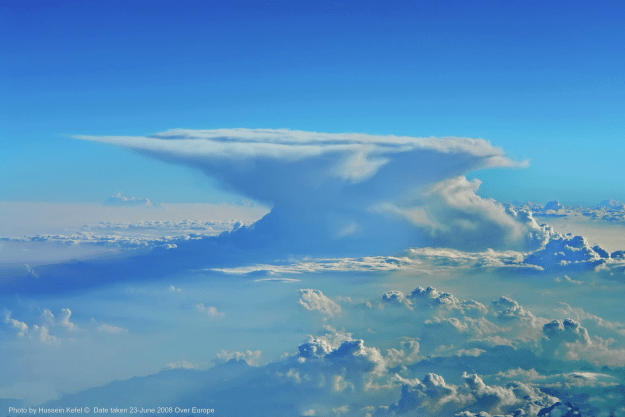
Insubstantial factories of infinite forms, clouds are both ephemeral and powerful, and though conjured out of practically nothing, out of ungraspable mist, they can shake the earth with thunder if they have a mind to.

You’d never guess it but we live in a world flatter than a sheet of paper. Shrink the Earth to the size of a basketball and our atmosphere would be as thick as a layer of food wrap. The oceans likewise. Two of the most critical elements for our survival, water and air, are relatively scarce commodities. We are like microorganisms living in an evanescent fluid film, a dampness that would burn off like morning dew if the sun increased its solar output by just 15 percent.

linestorm

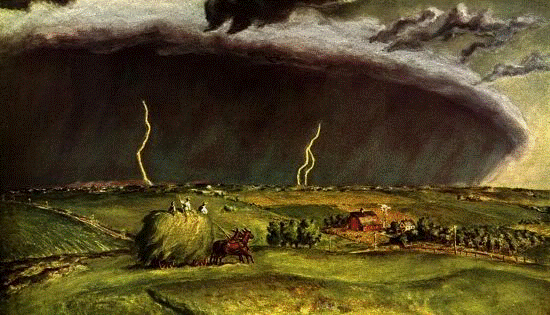
“The Line Storm”, John Steuart Curry

In fact, at any given moment, there are about 2,000 active thunderstorms worldwide, and the human population has no control over them whatsoever.

A summer thunderstorm starts life as a cumulus cloud cruising over fields and rivers and lakes. It’s a case of wandering lonely as a cloud, certainly, but a cloud with megalomanical tendencies.

FINE

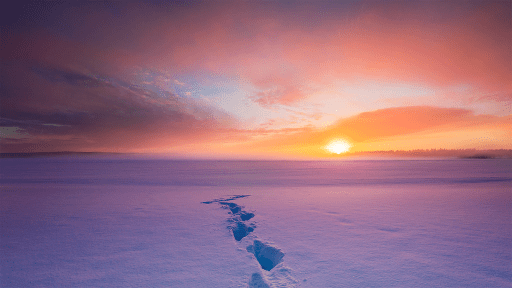
At noon in the second week of February, something spectacular happens. The sun erupts above the horizon, For the first time in months, pure, unadulterated sunlight strikes skin, floods through windows and blinds eyes in an almost painful wound of light. This first sunshine, a day lasting only a few minutes, is spring in its purest form — raw and crystalline. The ice-hoary dwellings of Grise Fiord, like buildings long-submerged under the ocean and covered with coral encrustations, glow orange in the light, and every peak of the low hills surrounding the bay also glows with the same orange fire. Apollo’s flaming chariot has arrived, and burning deep inside his golden brazier is summer itself


Posted in quotations, science | Tagged , | Leave a comment