How to Run a Drug Cartel

Narconomics: How to Run a Drug Cartel
© 2016 Tom Wainright
288 pages

fun

I only know of one rule for the drug business, and that via Scarface: never get high on your own supply.  And as Manny could tell you, the Ferengi rules of acquisition also apply, especially #113.  But drug markets often act like regular markets, albiet with distortions,  — and Tom Wainwright suggests that thinking about the economics of those markets can help us create more effective drug policies.  A fascinating look into the drugs trade, Narconomics offers a rare  perspective on a century of failed policies.

Basic economics primers tend to be huge,   and while the scope of this book is much narrower, there’s still a lot to take in.   In each chapter, Wainwright applies an area of traditional business evaluation (supply chains, human resources,  franchises) to the drug business.  We learn that drug cartels down south are much like Wal-Mart:  they don’t produce goods, they market and distribute them, and they have such a command of the market that they dictate prices.   Drug interests also mimic straight businesses in how they choose where to invest in their infrastructure (a failed state with easily-bribeable authorities is ideal),  how they’ve grown into general criminal enterprises that engage in human trafficking (both of immigrants and prostitutes),  and how they rely on brand names  to advertise.  Small-time gangsters might get permission to use a more established gang’s logos, for instance, provided they kick up money to the ‘franchise’.  Wainwright’s analysis extends to the drug market;  the flow of goods is not stopped by the drug war, only diverted. DC closed the Caribbean to trafficking?  The flow merely diverts through Mexico,  where it feeds gangs with easy access to American markets.  Online,  many of the problems of buying drugs (unpredictable prices and quality) disappear,  and the drug market acts like any healthy one:   consumers compare different products and prices, and sellers compete to deliver an enjoyable experience at the best price possible. (This according to Wainwright, anyway. I have no experience offline or online, my vices of choice being caffiene and hooch.)

At the end of each chapter, Wainwright uses his analysis to understand why a half-century of drugging on war  — I’m sorry, warring on drugs —   has proven so ineffective at curbing demand, and resulted only in failed states, profligate corruption, and insidious police militarization.  He points out, for instance, that since cartels can dictate prices, destroying marijuana fields doesn’t hurt them in the least: the farmers take the loss, because the cartel in each area will only buy at a previously-dictated price.  It would be more productive if states concentrated on preventing and rehabilitating users, Wainwright offers.  Ditto for sapping the cartels’ strength in members: throwing them in jail is counterproductive, but if cartel footmen were given vocational training, they would have options aside from the gang.

I wasn’t as interested in the advice as the look inside the narco machine, since I stopped expecting positive change out of government ages ago.   I was as captivated by this as I was reading about the number rackets of the Sicilian Mafia families when they were huge a century ago.   Definitely a memorable read, a look into an underground industry.
 

Posted in Reviews | Tagged , , , , , , | 5 Comments

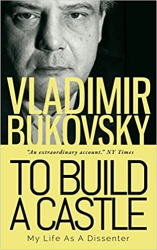
To Build a Castle

To Build a Castle: My Life as a Dissenter
©  1978 Vladimir Bukovsky
438 pages

vlad

When frustrated Soviet officials asked Vlaldimir Bukovsky why he continued to provoke them, he replied that he doubted he could cause them nearly as much trouble outside the gulag system as inside.  Like Natan Sharansky,  Bukovsky entered prison not in defeat after his fight with the Soviets, but in anticipation of continuing it.  He couldn’t do otherwise: even as a teenager he realized that life as a faithful subject of the Soviet state was impossible for him.  It was an empire of lies, where truth changed by the year, where absurdities and corruption were the norm.  Organizing a society of dissidents in his youth, he continued to speak the truth about the Soviet state and to demand it conform itself with its own rule of law, f nothing else — until he was at last expelled.

Having read both Sharansky’s Fear no Evil, and Solzhenitsyn’s Gulag Archipelago, there weren’t any real surprises in here as far as the universal abuses of the Soviet system go.  Bukovsky’s refusal to wilt in the face of state repression was so outrageous to the Soviets that they regarded him as a mental case, and the abuse of psychiatric medicine makes this memoir stand out from those other two which I’ve read. According to Bukovsky,  late in the sixties the state hit on the idea of  using diagnoses of mental disorders to render individuals “unfit to plead”,  which they used to prevent dissidents and prisoners from fighting oppression via the legal system. (And fight they did–  Bukovsky’s favorite game was to generate mountains of paperwork for the bureaucracy by sending off hundreds of complaints a week on behalf of himself and other prisoners.)

What makes To Build a Castle truly worth reading, though, are Bukovsky’s comments on the human spirit in its eternal struggle with the Soviets.  In a line that strongly reminded me of Solzhenitsyn’s observation that the line between good and evil runs through every human heart, Bukovsky comments that what he hates most is Soviet man,  the mewling subordinate who is cowed by the state or the pressure of the crowd to conform. Soviet man exists in each of us, he writes, and it is our duty to fight him —  to ensure that he doesn’t prevail.  A man who who stands against the state fights not only for himself, but for each of us  — it is by individual actions that the battle for the soul of a nation is won or lost.

Bukovsky’s memoir is a powerful account, an indictment of not only the Soviet state and its gulags, but the great lies it was built on and which extended its life past reason.  I’m going to share a few quotations later, but I can’t close this without a tease.

In fighting to preserve his integrity he is simultaneously fighting for his people, his class, or his party. It is such individuals who win the right for their communities to live—even, perhaps, if they are not thinking of it at the time. “Why should I do it?” asks each man in the crowd. “I can do nothing alone.” And they are all lost. “If I don’t do it, who will?” asks the man with his back to the wall. And everyone is saved. That is how a man begins building his castle. […]

You have to learn to respect the right of even the most insignificant and repulsive individual to live the way he chooses. You have to renounce once and for all the criminal belief that you can re-educate everyone in your own image. You have to understand that without the use of force it is realistic to create a theoretical equality of opportunity, but not equality of results. People attain absolute equality only in the graveyard, and if you want to turn your country into a gigantic graveyard, go ahead, join the socialists. But man is so constituted that others’ experiences and explanations don’t convince him, he has to try things out for himself; and we Russians now watch events unfolding in Vietnam and Cambodia with increasing horror, listen sadly to all the chatter about Euro-communism and socialism with a human face. Why is it that nobody speaks of fascism with a human face?

Posted in Reviews | Tagged , , , | Leave a comment

In Remembrance

It’s a day quickly only remembered by historians, but I can’t see June 6 without thinking of that night and morning in which young men threw themselves into darkness and death to fight against a genuine enemy of civilization.  In college, I discovered a recording of FDR reading a prayer to the American nation after announcing the onset of D-Day, and even though I was an ardent anti-religionist at the time,  it moved me.  When I listened to it today,  certain parts of it lept out as especially relevant for our time.

“Success may not come with rushing speed, but we shall return again and again; and we know that by Thy grace, and by the righteousness of our cause, our sons will triumph.

They will be sore tried, by night and by day, without rest-until the Victory is won. […..]

With Thy blessing, we shall prevail over the unholy forces of our enemy. Help us to conquer the apostles of greed and racial arrogancies. Lead us to the saving of our country, and with our sister Nations into a world unity that will spell a sure peace a peace invulnerable to the schemings of unworthy men. And a peace that will let all of men live in freedom, reaping the just rewards of their honest toil.

Thy will be done, Almighty God.”

Posted in General | 5 Comments

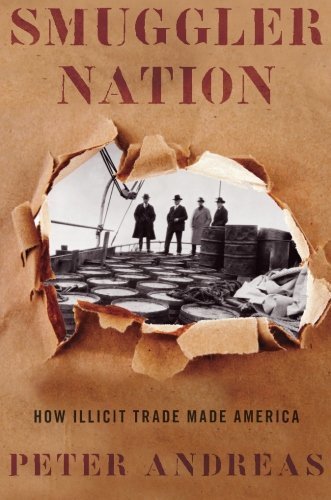
Smuggler Nation

Smuggler Nation: How Illicit Trade Made America
© 2014 Peter Andreas
472 pages

smug

What can a Governor do, without the assistance of the Governed? What can the Magistrates do, unless they are supported by their fellow Citizens? What can the King’s officers do, if they make themselves obnoxious to the people amongst whom they reside?”   – frustrated colonial customs officer


As a libertarian with bootlegging forbears, I reflexively hold smugglers in high esteem, and was eager to read about the proud history of subversive commerce in the United States, even if the author’s intention wasn’t to celebrate them.   Smuggler Nation is a comprehensive history of not only how people thumbed their noses at a state that presumed to tell them what they could and could not buy, or imposed punishing tribute on what they purchased from afar,  but an illustrative account of how the United States government was formed and strengthened by smuggling — either by gaining powers to fight it, or by gaining resources through it.  If war is the health of the state, so too is prohibition.

The story begins in the colonial past, when British subjects in North America were officially expected to conform  to mercantilist policies —  where goods were bought from, or via, England.  I say officially because customs officials were so cheerfully corrupt that little effort was made to enforce these policies until after the Seven Years War,   at which point  Britain so alienated its subjects that they bid for independence.   Smuggling supplied the rebels with arms  and resources,   allowing the rebellion to persist for so long that Parliament gave up. The fledgling American republic would impose its own customs laws — its only resource of revenue back in those halcyon days —  but find them thwarted.   Smuggling meant both evading the tribute demanded of imports, and the selling of  proscribed goods — though throughout the book it’s also used to characterize the slave trade,  illegal immigration,  and wartime blockades.  Customs enforcement would grow with the state, decade by decade, but smuggling flourished and continued to create the nation in its image —  helping open the west and establishing the industrial revolution, for instance. The Civil War was prolonged, in Andreas’ estimation, by smuggling — for it allowed a nation with virtually no industrial resources to sustain several armies for four years. As the United States drifted further from its original vision, increasingly more things became verboten and the powers of the state to police people’s everyday lives grew to extreme proportions that now one in every hundred Americans is in jail, over half of whom are there thanks to the drug war.

Smuggler Nation is a lot of fun, what with its legions of colorful characters —   rebel planters, pirates,  rogue inventors. There are fascinating side stories, too, like the heavy role Mexico played in facilitating early Chinese immigration into the United States. But there are important lessons here, too. Despite the growing march of the state in the background, I was frequently amused and astonished by the means people found to import items on the sly.  Reading this reinforced an observation from Narconomics:  prohibition doesn’t squelch demand, it merely redirects it.    When the United States stamped down hard on cocaine and marijuana imports via the Carribean, it merely redirected the traffic via Mexico  — destabilizing it further and establishing powerful gangs on the southwest’s doorstep. Prohibition led to the revival of hard liquors like whisky over beer, and  suppression of drugs like MDMA have led to far more dangerous synthetic substitutes.   If a substance truly is noxious, cultural pressure is more effective at minimizing it — as has been done with tobacco.    I daresay as the state’s powers continue to swell, more things will become forbidden.  Smuggling in the United States has had a colorful past…and presumably a long future.


Posted in history, Reviews | Tagged , , , , | 4 Comments

The Lion at Sea

The Lion at Sea
© 1977  Max Hennessy/John Harris
368 pages

kg

The atmosphere was electric and exultant. They were sailing into history at thirty knots. But what history? Defeat or victory?

Kelly McGuire never consciously intended to follow his old man into the Royal Navy, but sometimes fate has a way of dragging you along in its wake.  An efficient young officer, McGuire spends the first two years of the Great War escaping sinking ships,  evading Germans, Turks,and other enemies of the Empire,    and falling into pretty young ladies’ beds.  The battle of Jutland introduces the young lieutenant to his first command after his captain is lost, along with many of his shipmates,  and it’s clear he has a bright future to blaze.  The Lion at Sea is my first WW1 naval novel, I think, and it’s awfully exciting considering how little naval action there was.   McGuire always seems to find himself in the middle of whatever that is, for in this book he’s all over the map: the North Sea, Gibraltar, the Dardanelles, and even Egypt.   I’m accustomed to the protagonist’s friends  being introduced and killed off fairly quickly because of  Harris/Hennessy’s  aviation novels,  but here we run into a few people over and over again —  to a degree that even the main character finds it absurd.  He simply can’t escape one of his old shipmates, an odious son of privilege who reminded me very strongly of Courtney Massengale, the cynical and sly officer who made his way in the world by cultivating and exercising ‘pull’.    Readers will witness a young man very uncertain of himself become a highly-decorated, admired, and accomplished senior lieutenant —  one more than capable of sitting in the captain’s seat.    I found this one delightful all around, especially the bit in which Kelly encounters some Lawrence fellow bumming around in an office and shares intelligence with him about some promising Arab allies.

Some Kindle highlights:

‘You are a wart,’ the sub-lieutenant of the gunroom had told him firmly. ‘An excrescence. An ullage. A growth. You probably imagine that when signalled “House your topmast”, you should reply, “fine, how’s yours?” and doubtless the only time you’ll show any enthusiasm for the navy will be on full-belly nights when we’re entertaining visitors.’

Beyond the surface ships, he could see the low hulls of submarines. Despite his father’s attitude that they were a ‘damned un-English weapon,’ he had a feeling that when war came, like aeroplanes, they might prove highly important.

‘We’re at last about to offer our lives for our country!’ Kelly snorted. ‘I’d rather make the Germans offer theirs,’ he said.

‘Seems to me,’ Kelly said grimly, ‘that the naval staff in London exists chiefly to cut out and arrange foreign newspaper stories in scrap books.’

Charley sighed, then she seemed to take hold of her emotions, forcing herself to face the fact that their world – that place of warmth, security and stability they’d known as children – had started to fall apart the day the first shot of the war was fired and was vanishing now in a welter of adult unreason and misery. Young as she was, she’d reached the conclusion that all the tears that could ever be shed would never make it the same again.

He sighed. There was a great deal more to this business of living than met the eye.


Posted in historical fiction, Reviews | Tagged , , , , | 13 Comments

It’s not a problem, it’s…a…passion….?

101710129_1405612239626803_5188667552695320576_n

Posted in General | Tagged , , | 10 Comments

Wayside School Beneath the Cloud of Doom

© 2020 Louis Sachar
176 pages

sachar

I was a weekly visitor to my childhood library, always bringing home  a fresh pile of books — but some books I checked out over and over again. Sideways Stories from Wayside High and its sequels were at the top of the light.  Louis Sachar introduced kids to an absurd place; a school building with a 19th story that didn’t exist (most of the time), where it was not outside the realm of possibility that a dead rat might try to sneak in as a student, where there are kid-flavored ice creams and the bounciness of a ball is determined by its color.   Recently I revisited the first book, Sideways, and was amused by how many of the characters and stories have been etched into my mind over the years.    My visit was prompted by the announcement that a sequel would be released — a sequel to a series thirty years old!       I was eager to get my hands on it, and I was not disappointed.

When the book opens, it’s business as usual at Wayside High: both the odd and the normal are going on. Kathy is still mean, Paul is forever tempted to yank Leslie’s pigtails,  and the school doctor is hypnotizing people.  But then a cloud of doom begins to approach the school, and the general amount of chaos increases.    I’m not going to say anything about the plot, but Sachar is definitely writing to his fans, with an impressive amount of references to the original books. My favorite was in chapter 29, and involves — well,  I don’t want to spoil anything.  I was slightly disappointed that the levels of the building were called floors instead of stories, though, because it meant that my favorite gag from Sideways Stories — the missing 19th story — wouldn’t be repeated.    On the whole, though, it’s a return to an old, silly friend, and I’m glad Sachar decided to play with the series again.     Special thanks to Sarah for making me aware it was being released!


Posted in Reviews | Tagged , | 3 Comments

The Thing with the Feathers

The Thing with Feathers: The Surprising Lvies of Birds and What They Reveal About Being Human
© 2015  Noah Strycker
304 pages

boids

One of the blessings of living in a semi-rural area like myself is the daily sightings of birds — and not just the neighborhood regulars like robins, sparrows, and cardinals, but sights as grand as great egrets and red-tailed hawks.   But birds aren’t just beautiful,  argues ornithologist and avid birder Noah Styrcker:     studying them can inform our appreciation on emergent order,  altrusim, and consciousness.   The Thing With Feathers  documents exceptional  behavior in a variety of species (the nest-making of bowerbirds, say,   or the apparent dread penguins have of the dark) and then lightly explore that topic, usually with an eye to connecting it to the human experience.   The book combines nature writing and science,  though it’s light-ish fare, and the human connections are sometimes a bit of a stretch, as in the chapter on hummingbirds. Styrker  wraps up with the following reflection:

“Hummingbirds are slaves to speed, desperately fighting for control of calories, so single-minded that they don’t even partner up to raise a family. They apparently have an unusually high rate of heart attacks and ruptures, which is hardly surprising. Hummers blast through their billion heartbeats in one brilliantly intense rush, and when the engine shorts out, they fade just as quickly into aether, hardly leaving any trace to show that they ever existed at all. It seems like humans are speeding up—we strive for more gratification with fewer delays. Our fast-food culture isn’t a cliché; it’s a fact. And things are only accelerating. But do we really want to become hummingbirds?”

The avian content itself  has much to offer. There’s been considered debate and many experiments done to see if vultures could smell, for instance;  although the first round of testing indicated that they can’t (vultures would pitifully try to pick at drawings of dead animals and ignore actual ones which were covered with leaves),  some species do — and they’re so reliable at sniffing that natural gas companies use them to locate pipeline leaks.    Vultures are surprisingly picky about the animals they clean up, with a marked preference for herbivores;   they’re also reluctant to eat anything that’s been decaying for more than three days.    Less on the stinky side is the appraisal of how starlings can conduct such massive, coordinated ‘dances’ in the skies;  emergent order never fails to fascinate me,  so I was intrigued to learn that the pattern  appears so long as the birds follow three tendencies (separation, cohesion, and alignment);   at least, those are the rules employed by swarm models that replicate the behavior of starlings and similar birds.

If you have any interest in birds at all, by all means give The Thing with Feathers a looking-over; it explores a variety of bird behaviors and is an entertaining read all around.

Posted in Reviews, science | Tagged , , | 2 Comments

Never Home Alone

Never Home Alone: From Microbes to Millipedes, Camel Crickets, and Honeybees, the Natural History of Where We Live
© 2018 Rob Dunn
278 pages

boopityboo

They’re creepy and they’re kooky, mysterious and spooky — – they’re your new roomates. Or rather, your old roommates.  Turns out they’ve been around a while —  hiding in your basement,  chilling in the showerhead,  taking in the baths in your hot water heater.  You may pay the rent alone, but  you’re surrounded by squatters!    Rob Dunn introduces readers to the fauna of the average American home, from the smallest bacteria to the larger predators, and suggests that maybe they’re not as awful and parasitical as we think.     Germophobes will read with horror of the bacteria all around them, and it takes a brave soul to endure an entire chapter on cockroaches (I read it with a scowl on my face),  but Rob Dunn’s house tour has an important lesson at the heart of it, on the importance of biodiversity.     Dunn, as ever, is a compelling author whose gifts at communicating science are supplemented with frequent splashes of humor.

The average American kid spends over 90% of their time indoors,  and many adults aren’t far behind them. Considering how much time we spend inside, it’s astonishing how little we know about the creatures with live with. Not only are we effectively immersed in bacteria every day (especially in the shower),  but  we’ve unwittingly made our homes ideal places for all kinds of life to flourish – providing spaces with no predators,  plenty of food, and their choice of climates.    What’s more, many of the species living inside homes are as-yet unclassified by scientists, whether they’re bacteria or arthropods.   Dunn writes of our houseguests not to horrify us, but to drive home the fact that we’re by nature immersed in a web of life, and our attempts to disconnect ourselves from it — by making ourselves or our homes completely sterile — will invariably backfire.  When we engage in biocide to purge our bodies or fields of pathogens, we’re effectively egging on evolution.  Roaches, for instance, who were previously targeted with glucose bait traps,  developed a new population that recoiled from glucose, instead — and  since that meant they were also revolted by the glucose-filled gifts  used in mating,    asexual reproduction was encouraged.   With every new exchange of chemical warfare, the survivors — there are always survivors — get tougher and more virulent.     What’s more,  our constant attempts to make our environments completely sterile is undermining human health, as well:  regular exposure to a wide variety of bacteria is essential for keeping our immune system tuned and ready for service, among other things. (This theme is also explored in Dunn’s The Wild Life of our Bodies.) 

There are some interesting omissions from Never Home Alone; no mention of mice, for instance,    but there’s so much else considered I’m hardly complaining. It was a joy to read Dunn again. Never Home Alone succeeds in inspiring and educating simultaneously.  I’ll be sharing some highlights in a seperate post because of the sheer amount of them.


Posted in Reviews, science | Tagged , , | 3 Comments

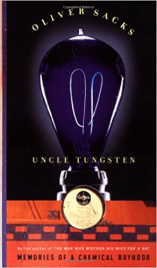
Uncle Tungsten

Uncle Tungsten: Memories of a Chemical Boyhood
© 2001 Oliver Sacks
352 pages

uncle

No future scientist was ever better primed for the life than Oliver Sacks.   You may know him as a neurologist and the author of numerous books on the brain, some with amusing titles like The Man Who Mistook His Wife for a Hat.  As a boy, though,  Sacks’ curiosity was universal – and it was fed by a generous supply of scientifically minded relatives, all of whom were willing to either train their young scion, or indulge his solo experiments by giving him equipment – and not just  worn out beakers, either, but a fume closet and a  hand-held spectroscope.  The relatives’ fields varied from botany to chemistry, but Sacks’  appetite for scientific understanding saw him develop numerous hobbies that dovetailed with the enterprise, including photography.  I could only read with astonishment as young Oliver freely bought various reagants that could have killed him, especially when he accidentally gassed his entire house!   (Hence the fume closet from his folks, and the admonition to use smaller measurments in his experients! )   Although Sacks would eventually discover the humanities, too, the gateway drug was the mathematical properties of music.  Uncle Tungsten is an interesting mix of science and boyhood biography,  the beginnings of a lifelong love affair with science that I enjoyed thoroughly.   I’m left wondering if I should hold Sacks in awe… or envy!

Posted in Reviews, science | Tagged , , | 2 Comments