Selections from “Becoming Wild”

“Until now, culture has remained a largely hidden, unappreciated layer of wild lives. Yet for many species, culture is both crucial and fragile. Long before a population declines to numbers low enough to seem threatened with extinction, their special cultural knowledge, earned and passed down over long generations, may begin disappearing.”

“WE BECOME WHO WE are not by genes alone. Culture is also a form of inheritance. Culture stores important information not in gene pools but in minds. Pools of knowledge—skills, preferences, songs, tool use, and dialects—get relayed through generations like a torch. And culture itself changes and evolves, often bestowing adaptability more flexibly and rapidly than genetic evolution could. An individual receives genes only from their parents but can receive culture from anyone and everyone in their social group. You’re not born with culture; that’s the difference. And because culture improves survival, culture can lead where genes must follow and adapt.”

“How long and rich a morning can be if you bring yourself fully to it. Come to a decent place. Bring nothing to tempt your attention away. Immerse in the timelessness of reality. Attention paid is repaid with interest.”

“Planet Earth constantly thrums with messages being sent and received by living things. Life is vibrant, and it generates good vibrations throughout the air, the sea, and the ground. But whale sounds seem particularly enchanted. Roger Payne wrote of the first time he heard a humpback whale singing: ‘Normally you don’t hear the size of the ocean … but I heard it that night.… That’s what whales do; they give the ocean its voice, and the voice they give is ethereal and unearthly.’ Payne later told me, ‘The reaction of some people to hearing whales sing is to burst into tears; I’ve seen that a lot.'”

“Social learning is huge, because it means that a dolphin or an elephant, a parrot or chimpanzee or lion, can tap into collective skills and wisdom that accrued slowly over centuries. For a young whale: Where in miles and miles and miles of ocean should I look for food? For a young elephant: Where is drinking water when everything I know has dried up? For a young chimpanzee: Now that the fruit is gone, what do I eat? For a young elk: As everything begins freezing solid, where should I go? For a young wolf: How might we hunt and eat this creature that weighs ten times what I weigh? These are all learned skills. For many creatures, they are skills learned from experienced elders.”

“To destroy a whale is a monumental denial of life and merely one symbol of the human species’ rather recent working hatred for the world. We have named one whale ‘killer.’ But that shoe best fits the species who possesses feet to wear it.”

“All of the above sums to this: a species isn’t just one big jar of jelly beans of the same color. It’s different smaller jars with differing hues in different places. From region to region, genetics can vary. And cultural traditions can differ. Different populations might use different tools, different migration routes, different ways of calling and being understood. All populations have their answers to the question of how to live.”

“Silence is not the absence of sound. It’s the absence of noise. There are reasons to love so magic an interlude. But residing deeper than reason is the felt music of such plush silence. Dawn is the song that silence sings. In a recess of the world such as this forest, you can still hear the magic. Outside such whittled hideaways, one species fills up all of the spaces between the notes. Nonetheless I am cheered by the thought that as the eyelash of daybreak rolls endlessly across the planet, a chorus of birds and monkeys is eternally greeting a new dawn.”

“Our planet spins a weave of tragedies. Life is bearable only because the warping maladies sometimes come with wefts of little triumphs.”
Posted in quotations, science | Tagged | Leave a comment

Wisdom Wednesday: Through adversity, excellence

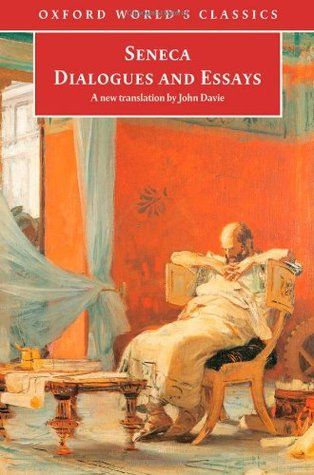
Today’s reminder is from Seneca’s essay, “On Providence”, included in the volume Dialogues and Essays. Seneca was a practicing Stoic in the Roman court, a one-time tutor to Emperor Nero (not a very good student, Nero), one whose counsel and advice were sought by his contemporaries. His insights are no less fruitful today.

We see wrestlers, who concern themselves with physical strength, matching themselves with only their strongest opponents, and requiring those who prepare for a bout to use all their strength against them; they expose themselves to blows and hurt, and if they do not find one man to match them, they take on several at a time. Excellence withers without an adversary; the time for us to see how great it is, how much its force, is when it display its power through endurance.  […]

Fortune lays into us with the whip and tears our flesh; let us endure it. It is not cruelty but a contest, and the more often we engage in it, the stronger our hearts will be: the sturdiest part of the body is the one that is kept in constant use. We must offer ourselves to Fortune so that in struggling with her we may be hardened by her; little by little she will make us a match for her; and constant exposure to risk will make us despise dangers. So the bodies of mariners are tough from the buffeting of the sea, the hands of farmers calloused, the muscles of soldiers strong to enable them to hurl the javelin, the legs of athletes agile: in each case the part of the body exercised is the strongest. It is be enduring ills that the mind can acquire contempt for enduring them.

“On Providence”, Dialogues and Essays. Seneca
Posted in quotations | Tagged , | Leave a comment

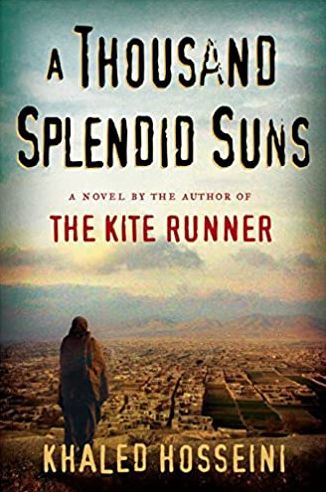
A Thousand Splendid Suns

A Thousand Splendid Suns
© 2007 Khaled Hosseini
372 pages


“There is only one, only one skill a woman like you and me needs in life, and they don’t teach it in school . . . Only one skill. And it’s this: tahamul. Endure . . . It’s our lot in life, Mariam. Women like us. We endure. It’s all we have.”

A Thousand Splendid Suns is the story of an unlikely household in Kabul, Afghanistan, one formed by tragedy as the nation veers from civil war to civil war. Mariam is the illegitimate daughter of a wealthy Herat businessman, one who loves his daughter but who cannot find the courage to embrace her; Laila is a young war orphan, pining for the loss of all she knew and loved. We follow these two women, first met in rivalry, who form a familial bond, holding on to what joy they can as Afghanistan shifts from bloody chaos to ordered brutality under the rule of the Taliban. Although full of suffering, like The Kite Runner, Hosseini’s followup has a redemptive, beautiful ending.

The Kite Runner remains one of the more unforgettable novels I’ve yet read, and I suspect Suns will find its way into that category, as well. I hadn’t the first notion what the novel was about; I only knew its author, and I was immediately struck by the sad story of Mariam, pining for a father who could not bring himself to do right by her. That made it all the more surprising when we suddenly jumped into a different girl’s story, of a slowly-blossoming romance — until the Soviets left and the struggle for power in Afghanistan consumed Kabul. There, death and tragedy follow the other in circles, and ‘poor Mariam’ appears again — as an antagonist to another young soul we’ve grown to care for. And yet the story continues, and our two women grow and face mutual battles together, until at the end theirs is a friendship as memorable as Amir and Hassan. One can almost hear Hassan’s voice ringing here: “For you, a thousand times over!”

I suspect I would have embraced this story even were it not for my interest in Central Asia, in understanding places like Afghanistan which have a deathly attraction for global powers. Here we experience the Soviet invasion, the hopeful establishment of a republic followed by coup and war and suffering piled upon suffering — though Afghanistan had decades more to come after this book ends in the early 2000s, following the American invasion. Although the reader’s attention is mostly on the personal dramas, those are inextricably bound up with these political struggles: it is the fighting that claims Laila’s brothers, her parents, and all she knew — and sends her careening into the path of Mariam and Rasheed, the book’s villain who behaves in the opposite manner to his “rightly-guided” name. One wonders what hells were released on nonfictional Mariam and Lailas in the 2000s, as DC arrogantly set about trying to build a country. And yet despite all they suffered, the characters here inspire by their ability to persevere: even Mariam, who had known nothing but isolation and rejection all of her life, is able to find some sliver of joy — and meaning.

Posted in historical fiction, Reviews | Tagged , , , | 5 Comments

Quick note

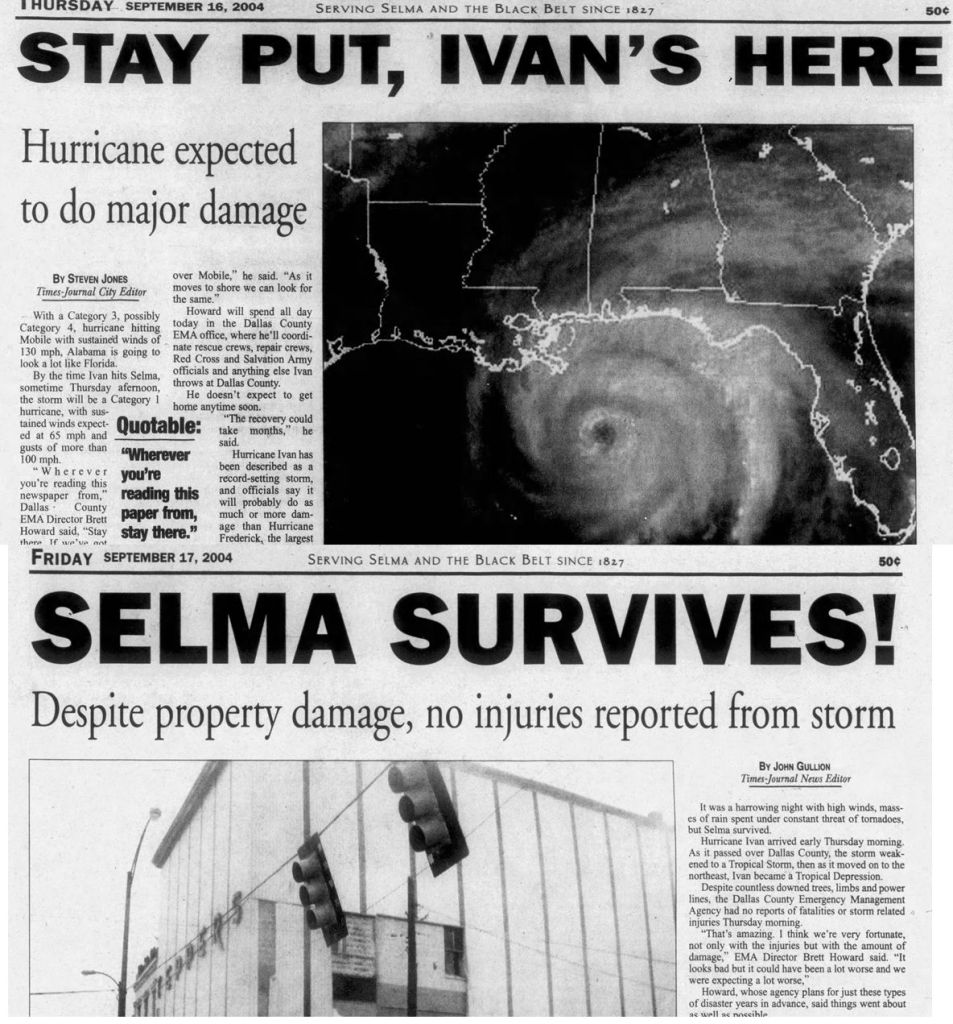
The gulf’s hurricanes have been ignoring Alabama for a couple of years now, hitting states on either side of us. I can’t say that we mind, but the windy hiatus is over. One is expected to roll in tomorrow right over the top of the Blackbelt, and flood warnings are currently in effect. I don’t think anything serious will happen, but I can’t help but note that tomorrow is also the anniversary of Hurricane Ivan hitting the state, and that one was a whopper.

I was attending the local community college, and my parents were both in California, visiting my mother’s family, and when we lost power for over a week, I was left largely to my own devices as to what to do. I’d sheltered from the storm at my grandmother’s house, along with several other family members, listening to the wind howl through the trees in utter darkness. I can still remember the bizarre popping sound trees made when they strained and fell. Radio stations were largely off the air, but a few combined services onto one channel to offer period updates. It was all very surreal.

I arrived home to find a tree on the house, I could only be relieved that it wasn’t worse. The tree was a little gumball (sweetgum) tree, and the front porch had absorbed most of its weight, sparing the house itself. Because I was the sound engineer at my parents’ church (my church, then, for another year or so) and had keys to the building, I decided to ‘move in’ there until my parents returned. The church had power — lights! — but more importantly, air conditioning. (Never underestimate the value of AC near the gulf coast.) That area of the county was rare in that it retained power: most places were without it for more than a week. The national guard or FEMA — some authority — arrived in town to distribute MREs, but I tried a couple and decided: only if I was starving. I think I mostly subsisted on what I could lug from the house to the church, lots of canned chili, soup, and sandwiches. I remember making a ‘bed’ by re-arranging six identical padded, armless chairs in the church in a 2-column, 3-row formation with the backs outward, giving me a comfy trench to place my sleeping bag in.

I don’t think Sally will do that kind of damage, but from what I’ve read it’s a slow-moving storm and so the main threat will be rain — the Alabama EMA is expecting 6-8 inches of rain, and river flooding until Saturday. Poor drainage in town is more of a threat than the river, though! If there are power disruptions, fear not…I have one review lined up for tomorrow, and if I’m able to finish Becoming Wild tonight, I may be able to schedule one for later in the week.

Posted in General | 12 Comments

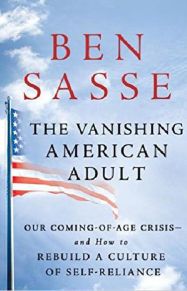
The Vanishing American Adult

The Vanishing American Adult: Our Coming of Age Crisis , and How to Rebuild a Culture of Self-Reliance
© 2017 Ben Sasse
320 pages

Why are teenagers and young adults floundering into maturity? Ben Sasse believes that much of the problem is the mass schooling system in the United States, which — he argues — promotes passivity and disengagement. Schooling is not education, he writes, and by depending on it parents have abrogated their responsibilities. He calls on parents to take seriously teenagers’ need to be guided & trained, not schooled, and proposes a course for doing so. If we continue to allow young people to languish, he writes, the consequences could be the loss of the American republic itself — for it depends on citizens who take themselves, and their conjoined rights and responsibilities as citizens seriously.

Mass schooling as an institution has been under-performing for most, if not all, of its lifetime, to the point that it has been deforming college by turning the early years of the same into catchup classes for those who high school failed. But increasingly young adults are graduating high school and entering their adult years not just unprepared for college, but unprepared for life — to the point that ostensibly sensible people call for high school classes on balancing checkbooks, cooking, etc — as if raising human beings to their full potential was an achievement possible by a bureaucracy. When could schools fit in all these lessons, when the college prep so overwhelms classes that physical education & the arts are fast on the retreat? One of mass schooling’s more formidable opponents, John Taylor Gatto, was himself a decorated teacher — until he began writing books that argued schools fomented intellectual dependency and passivity. Sasse proposes that parents develop an active program with their teenagers to help them realize their adulthood: one that involves being engaged in physical work, helping the aged and the very young, embracing limited consumption, and engaging with the world through both travel and thoughtful literature. Most of the book consists of his expanding on this course.

Sasse’s proposed course, which is not woolgathering but the way he and his wife guide their own teenagers, marks him as one of the more interesting members of Congress. It would be easy enough for a dullard to dismiss Sasse’s urging parents to help teens develop a work ethic as age-old adult complaining about the laziness of the young, but Sasse proves himself someone who has given much thought to human flourishing, especially in his chapters on overturning age segregation and consumerism. Spending time with the aged doesn’t just expose children to perspectives beyond their myopic generation; it will help them to start wrestling with the idea of mortality, to the inevitable visitors of suffering ,decay, and death, and to the universal human need to compose ourselves for them. We will not find relief from these troubles by sinking into transitory pleasures and comforts — but by investing in ourselves, in our character, by learning to practice self-awareness and control, we can live well despite our pain, and die with weary feet but rested souls. All of the ideas have merit on their own, but Sasse draws connection — as when he connects the value in work to curbing consumerism: consumption doesn’t make us happy, but meaningful labor can. That’s not labor merely as in day jobs, either, but the work we do for our homes and friends — cooking meals to share with others, helping a neighbor with a fallen tree after a s storm.

Sasse wrote this book for the same reason he later wrote Them: Why We Hate, and How to Heal: he is concerned that the American nation is actively disintegrating, being divided into what he later called anti-tribes, and the failure to raise teenagers into adults who function only aggravates this. Minds whose only interaction with literature has been to memorize trivia about it, rather than engage with it and grow, will fare poorly at trying to understand others — and people who have been told what to do and where to go and how to do this their entire lives, with no allowance for self-exploration, will not do well in becoming the actors of their own lives. They will drift into passivity and frustration, knowing they’re missing something but not knowing what, and seeking their meaning in political ideology and social media antics instead. Although this book was intended for parents, it’s worth reading for anyone concerned about the future of the American polis. I think there’s more to the question of widespread infantailization than the school system, but considering that pre-corona children often spent more time immersed in it than they did at home, it’s as solid a place to start as any.

Posted in Reviews, Society and Culture | Tagged , , , | 4 Comments

Of WW2 and alternate schools

Early last week I accidentally bought a ‘book’ called One Man Air Force, by Don S. Gentle. I say “book” because it’s only 50 pages, and I would have returned it (I was browsing WW2 books and hit the ‘buy with one click’ button), but the writing was so absorbing I had to keep going. It’s really nothing more than the account of the American-born Gentile joining the RAF in his eagerness to fly against the Germans — and then his learning to be a killer in the skies, outdoing even Eddie Rickenbacker once he’d transferred to the USAAF and begun flying P-51 Mustangs. Unfortunately, he perished soon after the war ended, while flying as a test pilot. Considering the utter joy he took in it, though, I suppose that’s probably how he would have wanted to go. A quote:

“At the rate of 700 miles an hour you can eat up all the distance there is in one gulp, but while you’re doing it it seems slow. You can think of a thousand things, and nothing seems to be happening in your life except that the plane is coming slowly toward you and you’re living a lifetime — as if it was a speed-up movie reel — and aging fast and growing old and older and looking suddenly at the end of your life in just about the time it takes to say it.”

Next, I did more damage to the TBR by reading The School Revolution, given to me a couple of years ago. In it, Ron Paul argues that mass schooling is a poor option for most students, setting them up for failure in higher education and in life. The answer is online learning, an area which is no longer the province of diploma mills: now Ivy League universities are offering free courses online. Paul advocates that parents seek alternatives to the mass schooling system, particularly homeschooling which would allow students to move at their own pace, encouraging responsibilities and initiative. Once the groundwork – -the ability to read and write — is laid — there’s no reason people can’t effect their own education with some guidance on the way. Homeschooling was growing rapidly in the United States as of the time of writing, and there are growing resources to connect parents to people in their communities who can teach at-home kids unique skills in field trips and the like. Paul discusses the economics of home education, pointing out that often the cost of one parent staying at home is recovered by removing the need for childcare during the summer. Paul is chiefly concerned with establishing a curriculum which meets students’ needs (including their growth as responsible, self-directed individuals) satisfies parents, and prepares them for the rigors of college. I read this not as a parent or as someone who may become a parent (at my age, most women have a houseful and no interest begetting any more), but as someone who believes freedom-minded people need to take positive action to undermine the state’s control of every facet of our lives, and to begin planting seeds for a rebirth of liberty and the revitalization of human-driven, not state-directed, civilization.

Posted in history, Reviews | Tagged , , , | 5 Comments

Resist Much, Obey Little

Resist Much, Obey Little: Remembering Ed Abbey
© 1996 James Hepworth & Gregory McNamee
254 pages

To the States or any one of them, or any city of the States,
Resist much, obey little,
Once unquestioning obedience, once fully enslaved,
Once fully enslaved, no nation, state, city of this earth, ever
afterward resumes its liberty.
(Walt Whitman)

Years ago I had the stupid luck to attract a visitor who suggested I try Edward Abbey’s Desert Solitaire. It was the beginning of a love affair for me, for Ed Abbey remains one of my favorite writers — of nonfiction, at least. He was he who spurred me into New Mexico and Arizona, he who put the hunger in my soul to go back there whenever our modern-day War of the Worlds panic eases away. Borrowing its title from Walt Whitman, Obey Little, Resist Much is a collection of essays about Ed Abbey’s life and work, together with two interviews and a handful of eulogies. The essays vary from middling to superb; Wendell Berry’s piece which opens the collection sets a high bar. The authors are a varied lot, with unique perspectives — one tries to connect Abbey to themes in Hindu & Buddhist philosophy. This collection reminded me of how grateful I am Abbey’s Desert Solitaire was introduced to me years ago, for Abbey was a true American character, one whose passion and voice I never tire of encountering.Abbey was fascinating, with a spellbinding way of describing the natural wonder of the Southwest, and urging readers to protect what little wilderness remains: we need it, he urges, if for nothing else than to put everything else into its proper perspective. Abbey didn’t just decry destructive development and pollution: he fought against them. Constantly hiking and camping beneath the stars, he made a habit of pulling up development stakes, destroying billboards, and engaging in other acts of resistance to forestall a dreaded corporate takeover of the last respite. Often described as a nature writer, or an environmentalist, Abbey disliked both labels — as he did the frequent comparisons to Henry David Thoreau, another fascinating American figure pigeon-holed into the nature-writer category. In my review for The Journey Home, I described him as ‘rough-hewn’, impossible to put in any box. Although I’ve read much of Abbey over the years, I found in this collection fresh glimpses of the man — whose love for classical music was matched only by his appetite for books, for instance, whose boisterous energy in books belied a far more quiet and genteel nature when he was in interviews or at dinner with new friends. Perhaps one of the more interesting pieces was written by a man who was part of the burial party that met at Abbey’s house at 3 am, then transported his body into the desert and buried him, quite illegally but very appropriately, in the terrain he’d adopted, loved, and defended.

It’s been too long since I spent any time with Abbey; I’ll have to remedy that soon!

Below is a musical tribute to Ed from a favorite musician of mine, Tom Russell. The piece ends with a ‘benediction’ from Ed himself.

Posted in Reviews | Tagged , , , | Leave a comment

Selections from The Vanishing American Adult


But across most of history, you didn’t require a grasp of the finer points of a Puritan worldview to understand the simple secular reality that if you didn’t work hard, you were going to die, soon. God is love; winter is not.

Human flourishing, in Aristotle’s term, is won through the recognition of what you ought to be and the hard work of doing the things that are fitting for you as a human to do in service of others. There’s an ancient corollary to that idea: “He dies for lack of discipline, and because of his great folly he is led astray,” the book of Proverbs warns.

This crisis of idleness and passive drift is profound for every citizen of this republic. For this nation is premised on the idea that the government exists not to define and secure the good, the true, and the beautiful, but rather to maintain a framework for ordered liberty—so that free people can pursue their happiness in the diverse ways that they see fit.

Unfortunately, centralized education bureaucrats tend to see every failure as a product of still not enough centralized bureaucracy. Most of these experts are blind to the possibility that perhaps we are still trying to spoon-feed young adults who we should instead nudge to travel and to read, to work and to become the kind of students who ask questions before being handed a three-point formulaic answer.

What’s true for marriage or for animal flight training is truer still for coming of age. Teenagers need help. Growing up is actual, hard work. I would venture to guess that most of our teens don’t need more therapy or more antidepressants. They need direction about how to acquire the habits essential for navigating adulthood, and experiences that introduce and instill those habits.

We are fashioned to redeem our time on earth. As such, we need to make our days matter, make them meaningful. Adults need to pause to reflect. We need to “escape” the tyranny of the urgent and the loud.

Unless you are dead or in the process of withering away in front of your screen the way so many millions of us do, there’s an imperative in your soul to unpack life and its endless mysteries. This is an active, not a passive, pursuit. For people who are alive, really alive, their brains are in motion.

A plea for self-discipline and self-control is the one and only dignified alternative to discipline and control from without. For in this broken world of lawless souls, there will be control; there will be government. Order-seeking and security-seeking people, as well as those in search of power for their own purposes, will invariably seek to hold back the chaos of the world. The question is whether people will control themselves or submit to the control of another.

Lincoln’s “silver frame” of Constitutionalism enables many competing pursuits of happiness. Liberty empowers individuals and local communities to make their own choices. Liberty does not mandate how you live, but it does make a grand claim about your dignity and your unalienable rights—and therefore by implication it urges you to embrace a creed affirming the dignity and natural rights of everyone across the globe.

Posted in quotations | 4 Comments

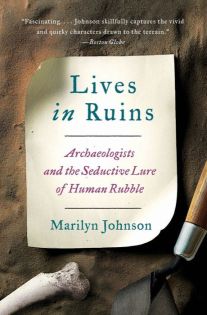
Lives in Ruins

Lives in Ruins: Archaeologists and the Seductive Lure of Human Rubble
© 2014 Marilyn Johnson
272 pages

Archaeology’s blend of history and science, topped off with a bit of danger, is a winsome combination. For those curious about it, Marilyn Johnson’s account of her time spent with field archaeologists — investigating the past in places as diverse as the Caribbean, the World Trade Center underground, and New York fields that bear the revolutionary war dead — is all kinds of fascinating fun. Johnson’s style is a bit like Mary Roach’s, but with less toilet humor. Although it’s not a comprehensive treatment of archaeology, it communicates the field’s unique appeal, challenges, and dangers in a highly readable fashion.

Although I would have read this for the subject alone, I was immediately taken in by the author’s humor and personal dedication to her subject. When visiting archaeologists studying various hominids scattered throughout Eurasia, for instance, she tries her hand at flint knapping — and even helps butcher a lamb, being tutored in the finer points of extracting the best cuts of meat while not being butchered herself by the beast’s bones. The scientists she works with are a varied lot, men and women, and their particular objects of interest range from ancient beer to undocumented burial grounds. What unites them is their passion for understanding the past, and rescuing it from being destroyed completely by the passage of time — either by nature, or by humans who never saw a pastoral scene they thought couldn’t be improved by a strip mall and a parking lot big enough to land a Cessna on. That passion has to motivate them, because most of the scientists Johnson works with are paid worse than teachers or librarians — and that’s interesting, given that their work often puts them into harsh, dangerous, and isolated conditions. There are the perks, though: archaeologists are at the forefront of human history; a day’s work might render textbooks obsolete, and those harsh conditions offer beauty in equal measure to their perils.

I found Lives in Ruins to be a delight to consider and read, with all kinds of little attractions — Johnson’s immersion in the field, practicing archaeology along with her subjects, and her inclusion of pop culture topics, like the discussion of Auel’s Clan of the Cave Bear series. It’s breezy, but there’s substance here for the casual reader, and it’s just fun. Johnson has evidently done other books on librarians and….obituary-writers, so she has a unique interest in those who work to understand and protect the past.

Posted in Reviews, science | Tagged , | 4 Comments

Classics Club Run I: Final List

  1. The Epic of Gilgamesh, trans. Danny Jackson (12/4/2016)
  2. The Aeneid, Virgil (2/20/2019)
  3. The Histories, Herodotus (10/3/2019)
  4. The Conquest of Gaul, Julius Caesar (2/05/2019)
  5. The Decline and Fall of the Roman Empire, Vol. I, Edward Gibbon (09/02/2019)
  6. One Thousand and One Nights, trans. Husain Haddawy (11/12/2018)
  7. The Three Musketeers,Alexandre Dumas (7/23/2019)
  8. The Hunchback of Notre Dame, Victor Hugo (10/13/2019)
  9. The Prince, Machiavelli  (10/28/2018)
  10. Inferno, Dante (7/16/2016)
  11. The Brothers Karamazov, Fyodor Dostoeyesky (9/7/2020)
  12. The Seven-Storey Mountain,  Thomas Merton (3/29/2017)
  13. War and Peace, Leo Tolstoy  (12/10/2019)
  14. The Gulag Archipelago, Alexander Solzhenitsyn (Vol I, Vol II, Vol III – 2/3/2018)
  15. The Hiding Place, Corrie ten Boom (8/9/2018)
  16. Dracula, Bram Stoker (10/2/2017)
  17. Frankenstein, Mary Shelley (10/9/2018)
  18. The Swiss Family Robinson, Johann David Wyss (05/21/2019)
  19. Canterbury Tales, Chaucer (4/30/2017)
  20. Sense and Sensibility, Jane Austen (4/21/2017)
  21. Emma, Jane Austen  (12/29/2015)
  22. The Picture of Dorian Gray, Oscar Wilde (3/2/2016)
  23. Brideshead Revisited, Evelyn Waugh (3/26/2016)
  24. The Vicar of Wakefield, Oliver Goldsmith (7/28/2019)
  25. Great Expectations, Charles Dickens (4/1/2016)
  26. Oliver Twist, Charles Dickens (10/19/2018)
  27. The Pilgrim’s Progress, John Bunyan (3/13/2016)
  28. Lord of the Flies, William Golding (4/3/2016)
  29. Down and Out in Paris and London, George Orwell (12/7/2017)
  30. The Federalist Papers, various (9/21/2019)
  31. The Education of Henry Adams, Henry Adams (8/22/2019)
  32. Life on the Mississippi, Mark Twain  (5/11/2019)
  33. Up from Slavery, Booker T. Washington (2/19/2017)
  34. The Red Badge of Courage, Stephen Crane (7/6/2016)
  35. Death Comes for the Archbishop, Willa Cather (6/27/2016)
  36. O Pioneers!  Willa Cather (7/1/2016)
  37. White Fang, Jack London (6/29/2016)
  38. Moby-Dick, Herman Melville (1/27/2019)
  39. The Jungle, Upton Sinclair (10/8/2019)
  40. A Farewell to Arms, Ernest Hemingway (7/2/2019)
  41. The Sun Also Rises, Ernest Hemingway (7/15/2019)
  42. East of Eden, John Steinbeck (7/4/2017)
  43. The Grapes of Wrath, John Steinbeck (7/13/2019)
  44. Catch-22, Joseph Heller (7/19/2019)
  45. The Martian Chronicles, Ray Bradbury (6/10/2017)
  46. I Know Why the Caged Bird Sings, Maya Angelou (2/24/2017)
  47. Invisible Man, Ralph Ellison (1/12/2019)
  48. Love Among the Ruins, Walker Percy (3/29/2019)
  49. The Moviegoer, Walker Percy (3/21/2019)
  50. 2001: A Space Odyssey, Arthur C. Clarke (2/12/16)
Posted in General | 11 Comments