At some point in the early 2000s, I stumbled onto a digital copy of Steal this Book and was appropriately scandalized. Because of the unique religious subculture in which I was raised, most of the TV I’d seen had been 1950s comedies, and the music ranged from the Crew Cuts to the Youngbloods and the Rolling Stones — with the curious effect that I admired both the cozy wholesomeness of the one, and the earnest ideals of the other. Nevermind that the hippies and rockers were in rebellion against the squares! It was Abbie Hoffman’s book that split the veil and made me realize how real, raw, and problematic the unrest really was.
Every time I read this book (and I’ve returned to it at least thrice in the last twenty years), I come away liking its author and his message less and less. My most recent, and probably last return to Hoffman, came from my recent encounter with counter-economics: I wanted to revisit Steal this Book to check it for possible connections to countereconomic thought. There are practically none, because Hoffman isn’t trying to drop out of society to do his own thing; instead, he seeks to take from it and offer nothing to it save his ranting condemnation of the people sustaining him. Perhaps a quarter of what Hoffman advocates is tolerable, in offering advice and resources for people wanting to unplug from the rat race and pursue a life of authenticity and value; there’s information on how to eat frugally, for instance, advice on potential hazards in communal living, and so forth. (There’s also a list of addresses to be sent the strangest things for free, like pictures of the Astrodome.) Most of the book, however, advocates self-righteous parasitism and aggression, with tricks used to steal food, clothing, goods alongside the promotion of outright violence (protests attacking people, destruction of property, how to best attack police, skyjacking, etc). Hoffman asserts and assumes the worst of his designated enemies and declares that not stealing, etc. from them is wrong. He has such a contempt for meaningful labor that even drug dealing is too much like work for him. He appears, from his own writings, to be inwardly bankrupt. and contemptible.
There is historical interest in this title, however, from the mood of the years its captures — the enormous unrest of the late sixties and early seventies — and the hints of what’s to come. Hoffman mentions that he’s heard of little machines that can be use with your phone to allow for free calls, but he doesn’t know a source for them. “The Secrets of the Little Blue Box” wouldn’t be published for a few months yet, and phone phreaking was still very covert. Hoffman’s philosophy of life has its quirks; he repeatedly advocates that his followers be armed and know how to shoot responsibly, and urges them to avoid hard drugs like speed and heroin. He’s mostly predictable, though, and at this point it sounds like he’s just throwing out meaningless cliches and rebelling for the sake of it.
This will be first of three titles in a series on the sixties: coming up are two opposing perspectives on the upheaval.
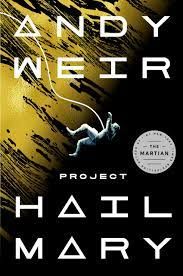
Ryland Grace just woke up strapped to a medical bed with two dead roommates. That’s not the least of his problem, though: he’s in space, and he doesn’t know why. Eventually, he’ll figure that out; his memory will return. But it won’t help….because he’s years away from Earth, and the fate of the entire planet rests in his hands. And he’s not even supposed to be be there today.
Andy Weir’s novels have yet to let me down, for their winsome mix of hard science writing and energetic humor. The plot-problem of Project Hail Mary is that the Sun’s energy is being leached away by space algae, apparently a common problem in the Local Group. It would figure that as soon as we discover other life in the cosmos, we discover it’s about to kill us. Grace and his colleagues were to investigate, and hopefully find a solution before Earth relived its Snowball years. When Grace arrives at the target location, he discovers that Elton John was wrong: it’s not so lonely out in space. Weir repeats the constant-stream-of-technical-challenges that worked so well in The Martian, and adds to it Grace’s need to figure out a way to communicate with…..well, someone else. Perhaps in response to criticisms that his last two protagonists have sounded like identical sarcastic pottymouths, Weir takes care to give Grace a distinct voice, and a secondary character who appears later is even more unique. Grace is arguably even more sympathetic than Mark Watney, in that rather than being an accomplished and cocky astronaut, Grace has to combat first his induced amnesia, and then his self-doubt when certain last-day-before-launch memories surface. Project Hail Mary was for me an absolute win of a book, SF that puts the science big and proud back into science fiction.
Some quotes:
‘I penetrated the outer cell membrane with a nanosyringe.”‘ ‘You poked it with a stick?’ ‘No!’ I said. “Well. Yes. But it was a scientific poke with a very scientific stick.’
There are many more dialogue funnies, but they’d give away a lot of the fun of the book.
Get it, loser, we’re going shopping. We’re going to use cryptocurrency and smash the state! #agora is a quickie novel about a young man named Daniel, who is dragged out of bed by his roommate Tom, too excited about the prospects of bitcoin to let him sleep. Daniel’s attempts to learn more lead him onto the dark web, there to be seduced by .pdfs of subversive texts and a growing IRC community dedicated to countereconomics. It’s arguably an unexpected romance that really leads Daniel into the heart of Berlin’s anarchist community, though, as he meets a gal with a Harley Quinn-esque energy. All of the websites, files, and films that Daniel is reccommended as he embraces agorism are all active links, and to my amusement some were books (Alongside Night) I’d already encountered. Although the novel is mostly a running how-to for modern agorism/countereconomics, there’s also fair bit of humor – -especially when Daniel debates two economists, Bob Murphy and Walter Block, so his co-conspirator can attempt to seduce Jeffrey Tucker. The book’s characters range from those who believe we can build a better society through voluntaryism, to those who regard coercive power struggles as inevitable as death, and choose instead to live the vonu way.
Some quotes:
“One thing you have to learn, young Daniel, is that it’s all in the details. They train you to obey the little things so you’ll obey the big things later.”
“But you can’t let other people define you. They will define you in such a way that you must serve them.”
“‘That’s not the point. Even if [Ron Paul] got 100% of the votes, it wouldn’t make a difference. You can’t do the right thing – that’s the point of the system. It doesn’t help to be principled or to know Austrian Economics or to wave the magic constitution. Until you show me bullet proof paper, I’m not counting on it for my safety.'”
“‘Thank you’, Block says, ‘I didn’t know we had such.. interesting readers.’ ‘Oh, Mises.org is the rave in Germany’, I say.”
“This is New York, NBC newsroom again. Men and women of the United States, this is a momentous hour in world history: this is the invasion of Hitler’s Europe, the zero hour of the Second Front. The men of General Dwight Eisenhower are leaving their landing barges , fighting their way up the beaches, into the fortress of Nazi Europe. They are moving in from the sea to attack the enemy under a mammoth cloud of fighter planes, under a ceiling of screaming shells from Allied warships. The first new flashes do not say, but a large portion of this assault is believed to be in the hands of American men. They are making this attack side by side with the British Tommies who were bombed and blasted out of Europe at Dunkirk. Now, at this hour, they are bombing and blasting their way back again. This is the EUROPEAN FRONT, once again being established in fire and blood.”
FDR’s war prayer:
“Success may not come with rushing speed, but we shall return again and again; and we know that by Thy grace, and by the righteousness of our cause, our sons will triumph.
They will be sore tried, by night and by day, without rest-until the Victory is won. […..]
With Thy blessing, we shall prevail over the unholy forces of our enemy. Help us to conquer the apostles of greed and racial arrogancies. Lead us to the saving of our country, and with our sister Nations into a world unity that will spell a sure peace a peace invulnerable to the schemings of unworthy men. And a peace that will let all of men live in freedom, reaping the just rewards of their honest toil.
In 1968, a frustrated man named Tom Marshall ventured into the woods along with his wife to conduct a living experiment. Was it possible, he wondered, to create a life for one’s self largely immune to coercion? Disappearing into the wilderness, he would occasionally send in articles under the name of El Ray or Rayo reporting his results and detailing the growth of his thinking, until he dropped off the radar entirely in 1974. And yet, there are those who know of his works, and it is thanks to them (the Vonu Podcast) that I was able to read their introduction to Rayo’s thinking, and to consider two collections of his extant articles.
“Vonu” leapt out to me as alien, a word I’d never seen the likes of before — and yet the core ideas aren’t so strange. Rayo coined vonu as an abbreviation of “Voluntary Not Vulnerable”, to describe the life that he and his ‘freemate’ wanted to create for themselves. He scorned political activism, which he dismissed as ‘crusading’, on the grounds that states were inherently unstable, that they all tilted toward coercion in the end and would corrupt those who attempted to play by their rules. His approach instead was to become ungovernable: to disappear, except when he needed to interact with society for income and supplies.
The author, Shane Radliff, here provide a precise of Rayo’s living philosophy, and then attempt to update its application to our modern day life. Although Rayo thought living in camper-trucks, vans, and busses had some promise, the focus of his research was on wilderness living, and to the like-minded he offered training in creating concealed shelters and basic survival skills. Radliff examines wilderness-dwelling’s prospects in the 21st century, but settlement patterns and technology are such that they believe van living is more practical and adaptable. Both Rayo and his updaters also ponder the possibility of cooperative vonuism, perhaps even scaling up to the size of a small city, but these are merely speculative. Radcliff appears to be far more optimistic about the future prospects than Rayo, who declared that most people are content to be serfs, so long as conditions are comfortable.
Vonuism is not a political philosophy: it is instead anti-political, shunning collective action and collective thinking. Although Rayo was in connection with many in the 1960s who shared his contempt for coercion (the agorists and Objectivists, for instance), he regarded any political action as crusading utopianism; Rayo himself scorned anything that smacked of mysticism, dismissing even the golden rule. He practiced the non-aggression principle not as a ideal, but as a pragmatic measure: aggressive behavior tends to provoke aggressive behavior in return.
Although I had never encountered Vonu proper before finding Samuel Konkin’s making a dismissive reference to Rayo over the weekend, I have seen shades of its aims before, from various flavors of worldviews: hippies, eco-primitivists, and survivalists, the latter most of all. Jack Spirko, a permaculture guide and practicioner who has also hosted a survival podcast for nigh on twenty years, has a worldview that is very to Vonu. To Spirko, preparedness and liberty run hand in hand. The more systematically dependent one is on outside help, the less liberty one has. He advocates for off-grid homesteads, multiple streams of independent income, and constantly improving one’s resilience and ability to adapt and overcome adversity and challenges, just as Rayo does. The critical difference between Spirko’s libertarian survivalism and Rayo’s vonu is that Spirko generally emphasizes that however prepared an individual is, allies are still crucial for sharing information and working together to overcome larger problems.
This is a fascinating rabbit hole to explore, and I’m halfway through reading Rayo’s extant works. I anticipate finishing early next week and will offer some follow-up thoughts on those. Although I understand the attraction of Rayo’s way, I don’t know that I’m so disaffected with society that I’d start doing a nonviolent Ted Kaczynski impression. (I’m really curious if Kaczynski ever read Rayo during the sixties when he was at Harvard/Uni. Michigan and becoming hostile toward the Machine-society.) After 2020, though, I’m definitely considering that Rayo wasn’t on to something after all.
While everyone else was honoring dead soldiers by buying things, shooting off fireworks (dear neighbors: why?), and grilling out, I was in bed all weekend with a case of food poisoning. Naturally, I wound up reading books about anarchism and watching documentaries about Chernobyl.
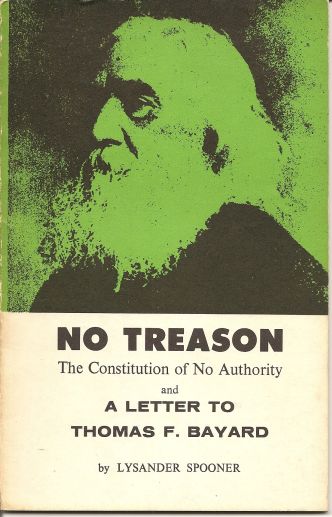
It was accident, really. I was planning on reading Lysander Spooner’s No Treason: The Constitution of No Authority for Independence Day, in honor of the American tradition of telling the state to go boil its head. But when I began sampling Spooner, I found I couldn’t stop. The man’s a menace. A Boston abolitionist, writing two years after the War Between the States, he begins by announcing that the North had not freed the slaves; in contrast, it had made slaves of us all, by declaring that consent is not necessary for political authority; only brute force. Spooner is a marvel, condemning both the North and South in the same breath with the same arguments; he will go on to dismantle claims that Southerners were guilty of treason before arguing against the Constitution as an active contract. He gets a bit into the weeds on what constitutes an active contract, but as a pro-secession anti-Confederate pro-Union anti-Lincoln southerner, I was delighted to find an abolitionist pointing out that the moral horror of compelling men to obey tainted both sides. He gets in a bit of economic argument, too, suggesting that the North went to war more to protect their financial assets than out for moral principle. Definitely going to be reading more Spooner, particularly The Unconstitutionality of Slavery.
What happens when men don’t consent to their government, but they live in a place that would imprison or shoot them if they actively resisted it? Well…they could begin subverting it, denying its control over their lives by shifting economic activity out of its realm Enter counter-economics. Anything outside the state’s purview is countereconomics: if it’s untaxed, black market, illicit, whatever. (‘Aggressive’ activity, like stealing and murder, are not countereconomic.) Bartering, using an unlicensed barber, and buying verboten goods are all counter-economic, and nearly everyone engages in it to some degree throughout the world: the more intrusive the state, the healthier its counter-economy. The command economy, through its own inadequacies, creates the demand for the counter-economy. In Counter-Economics, Samuel Konkin III begins to explore the promise of countereconomics, proposing that if enough people moved enough activity outside the state’s realm, that we could effectively starve the state to death through want of funds and political relevance. Unfortunately, Konkin died not halfway through writing this volume (which was dismissed by six publishers as too dangerous for public consumption), so all that we get is the basic idea, a review of countereconomic activity in states like Soviet Russia and Red China, a chapter on the promise of cryptography, and then an outline of what would have been one of the most interesting books I’ve ever read, ever. Alas, mortality.
Konkin’s ideas live, though — and in 1979 , they inspired Alongside Night, a SF title from an author who was a fellow traveler of Konkin. J. Neil Schulman here presents us a vision of an actively failing United States, one beset by crippling inflation, so much so that police and the military are on strike. Konkin’s counter-economy is booming, as people, regardless of political convictions, covertly begin dealing in gold, swapping services, etc. The story begins when a young man’s father disappears, presumably kidnapped or killed by the state for his outspoken criticism of their tyranny and fiscal stupidity, and the teenager is forced to seek the help of ‘the revolutionary agorist cadre’, an underground movement of anarchists/agorists/libertarians who are actively building a counter-society based on free exchange and voluntaryism, who are counting the minutes until DC collapses under its own weight. It’s a thriller doubling as an ideological novel, a bit like The Iron Heel but for a very different audience, given that that dystopia was London’s argument for socialism, using corporatism as his foil. The movie, which I saw before falling into a Chernobyl rabbit hole, had…limitations. A low-budget production, definitely, but with a curious lack of consistency in that regard: there were recognizable actors in it, and the film itself was in high-definition. The editing and writing were weaker, though, and the quality of props was hit and miss. The novel was fun, though, and I’ve got a few more like coming up. It helps that agorists, wanting to spread the word, have made a lot of their reading materials free-to-read online. I also have some…normal (for me) stuff coming up. War, classics, the science of poop…the usual.
“Ensign Kim, I do not understand you and Lieutenant Paris’ obsession with holonovels set in Old Earth. Why are we wearing these black turtlenecks to ‘smash the state’, as you said? These uniforms are most illogical.”
May has been a…weird month in my life, that’s all I can say. I’ve obsessively studying for the CompTIA A+ exams, and I started a part-time job driving for the railroad to expedite the whole “buy land and become an eccentric recluse” lifegoal. The month ended with a lot of anarcho-agorist reading. Who knows what June will bring?
Challenge Progress:
Science Survey:
6/12 categories now filled, with Drug Use for Grown Ups and Clean now filling the Wildcard slot.
She Come By it Natural, Sarah Smersh. Less a biography and more of a feminist appraisal of Dolly.
Clean: The New Science of Skin. A brief book that combines a history of soap and skincare with some of what I was looking for, science writing on how our skin is a little ecosystem and that barraging it with harsh chemicals all the time is not a great idea.
No Treason: The Constitution of No Authority, Lysander Spooner. I was planning this for a celebration of rebellion and sedition aimed around Independence Day, but from the opening page I could not stop reading. Comments to come.
Enemies: A History of the FBI, Tim Weiner. A history of the FBI that highlights its role as secret police, more obsessed with watching and arresting political dissidents than functioning as genuine law enforcement. I’ll possibly give it fuller comments.
Alongside Night, J. Neil Schulman. Dystopian novel with an anarchist bent. Heard of this while listening to a podcast over the weekend; began reading it and couldn’t stop. Review to come, possibly along with comments on the movie adaptation. The latter had….limitations.
The Newly Bought:
NONE! I was tempted, dear readers, boy I was tempted….but I looked at the pile of books behind me and said “Nope”.
June Goals
Continue reading only what I already own, supplemented with the odd library book. Read more — I’ve been eliminating competing timesinks. Right now I am in a serious SF mood, so don’t be surprised to see a little of that popping up. Toward the end of June we’ll be shifting to The American Summer, which will feature American classics, American history, etc. It’ll be an expanded version of my annual tribute to the American Revolution.
While poking around on Amazon for new releases by Weir, Scalzi, and Doctorow, I encountered the Forward collection, a series of short stories by various authors (most new to me) on near-future SF. They are very short stories, the two longest being 70 and 60 pages, and several are short enough to knock off in a single sitting. The strength of the collection may see me looking for more of some of the authors! All of them are near-future stories, with varied themes: quantum computing, genetic modification, and artificial intelligence marked three of my favorite tales. While they’re so short I don’t want to say too much for spoiling them, I will leave little summaries below.
Randomized, Andy Weir, sees a quantum physicist and her techie husband attempt a casino heist by taking advantage of quantum computing. A very quick future-crime read.
Ark, Veronica Roth. More thoughtful, this takes us to an Earth about to be devoid of all organized life: over the last few decades, humans have fled the planet in the advance of an asteroid impact, and the last ship (loaded with native Earth plants) is preparing to launch. In these last hours, a scientist makes a bittersweet discovery.
Summer Frost, Blake Crouch. Easily my favorite among the lot, it’s also the longest. A video game programmer unwittingly becomes the creator of the world’s first emergent artificial intelligence. It reminded me strongly of both Her and Ex Machina — I hope that doesn’t spoil things too much.
Emergency Skin, N.K. Jemison. And easily my least favorite, Emergency Skin starts off with a very interesting premise: a scout from a colony of human refugees has returned to Earth, to investigate the ruins of the old home planet of the Founders. Not only are there survivors of Earth’s environmental and civilization ‘collapse’, but there’s a twist waiting for the scout — several, in fact. Unfortunately, the interesting concept and worldbuilding is ruined by sanctimonious lecturing; I’ve heard sermons that were less preachy.
The Last Conversation by Paul Tremblay opens with a man waking alone in a recovery room, sans memories and sight and dependent on a comfortingly familiar female voice to guide him back to life. We learn of a pandemic that has swept their community, and which may yet kill him — but there’s a “Ooooooooooooh” twist at the end. My second favorite.
You Have Arrived At Your Destination, Amor Towles. Towles’ is the most thoughtful of the lot, following a dissatisfied man in his middle age as he visits a fertility clinic to finish up his and his wife’s pregnancy planning. The clinic alleges to be able to not only manipulate the expressed genes of their future child, but to predict their future along broad lines. This piece touches on the perennial argument over free will and determination, but it raised the question of man’s agency in a technologically-dominated world to prominence as well.
Quotations
“Why, she had once asked her mother, do you bother to keep anything alive when it’ll all be wiped out by Finis? Her mother had shrugged. Why take a shower when you’re just going to get dirty? Why eat when you’re just going to get hungry? Every flower dies eventually, Sam. But not yet.” – Ark
“She wished she could have told him that life was already full of dread, no matter who you were. That there was nothing you could have that you couldn’t one day lose. That autumn always gave way to winter, but it was her favorite time of year—those fleeting bursts of beauty before the branches went bare.” – Ark
“Well, you can’t love everything equally,” she said. “You just can’t—and if you did, then it’s the same as loving nothing at all. So you have to hold just a few things dear, because that’s what love is. Particular. Specific.” – Ark
“There’s no point in pushing our personalities uphill.” – You Have Arrived at Your Destination
“Okay, we should be ready to power it on,” said Prashant. He looked up at the ceiling. “Kind of a strange room. Were these blue lights always here?” Chen didn’t take his eyes off the computer. “I installed them yesterday. Cool stuff needs cool lighting.” – Randomize
My occasional forays into anarchist literature aside, I’m one of the squarest people you are ever likely to meet, a fellow whose idea of a good time involves comfy chairs, good company, and a cold drink or three. I’ve never consumed anything more interesting than single-malt Scotch, and yet over the years I’ve been increasingly drawn to the controversy over drug policy in the United States, largely thanks to my conviction that the people are not the belongings of the State. Carl Hart argues against the war on drugs from a different angle, however: as a professor of psychology at Columbia University, he has traveled extensively and conducted studies of the effects of various drugs upon the human body and mind. In his experience, he has concluded that appropriately-dosed drug use by responsible, healthy adults carries no risk for addiction, psychosis, etc. It’s a bold claim, and one I was eager to see argued.
Hart did not begin studying the science of drug use in order to defend a habit he had already embraced. Instead, growing up in a Miami riddled with drug use and crime, he sought to help his neighbors escape addiction by understanding drugs’ effects on the mind. Through his studies, he began to doubt the claims made about certain drugs, and in the spirit of scientific enterprise, he experimented himself. Throughout the book, we learn that Hart has used seemingly ever popular recreational drug over the sun – some regularly, some only once – almost always with positive results. (“Almost” because he purposely addicted himself to opioids in to experience withdrawal.) In each case, Hart considers the history of a given substance’s ban, the medical literature (or lack thereof) supporting bans, and then moves into his own surveys and personal experiences. He dissects sloppy studies that have been the basis of policy for years and shares others offering opposing conclusions, either conducted by himself or by colleagues. Most drug users, he argues, enjoy their substance of choice in the same way that others enjoy a drink: it’s done out of honest desire for pleasure, the moment is enjoyed, and they go to work the next morning. He frequently points out the near-identical chemical consistencies of “bad” drugs and licit prescribed narcotic, and asks: if these have the same constitution and same effects, why are some regarded as appropriate for use by responsible adults, and the others regarded a crime on the level of theft, arson, and murder?
Hart believes that a substantial part of the war on drugs, from the earliest bannings around the turn of the 20th century to the present day, stem from racism. Stimulants and opiods were present in all manner of consumer goods in the 19th century: sodas, chewing gum, over the counter medicines, etc. It was not until large waves of immigration began reshaping American cities, bringing with them new consumptive practices (opium dens, for instance) that promoted race-mixing that the force of law and order began a war against what people could put into their own bodies. Hart doesn’t connect the nascent drug war to the tides of the Progressive period, which sought to ‘clean up’ cities and society by bulldozing slums for parking lots, outlawing residential hotels, creating sanitary institutions, and imposing abstinence of all kinds on society at large: he instead focuses on race to the exclusion of everything else. Hart’s discussion of race is a substantial part of the book, as some recent death-by-cop instances have seen the shootings legally exonerated on the basis of the victim’s drug use at the time, to public outcry and mass arson.
Hart does not dispute that drugs can lead to addiction and be culpable in the premature deaths of many. Those who are in mentally fragile states to begin with – who are depressed, groping for meaning, etc – can easily abuse these substances and destroy themselves. These same people are vulnerable to addiction to substances that the state won’t imprison them for decades for holding, however: alcohol, nicotine, sex, take your pick. Because punitive drug laws force so much of the trade into the shadows, further, those seeking pain relief or a good time are forced to conduct business with questionable vendors selling dodgy products, often mixed with other materials that make it difficult to determine safe doses – if tainted dope can be considered safe to any degree. (Historically, the same was witnessed during the United States’ experiment with Prohibition: when booze was driven from the open market, bathtub gin and the like grew in the black market, and poisonings happened frequently.) Adopting an approach like Portugal or Spain, where personal-use possession is not a crime and where it is easy to test the integrity of product, would do much to diminish drug-related deaths. As we saw in Narconomics, safety and quality both increase when the black market is allowed to operate more in the light – though in that case, thanks to the anonymity of the Tor-accessible dark web than through decriminalization or legalization.
Hart’s case is stronger in its science than its presentation, as I found him increasingly difficult to take seriously. The writing is far less informal than one would expect in a book advocating science-based social policies, with gems like “That grown-ass man did not just say that. WTF?” making me wonder if he was composing a book or a tweet. Race, while a massive aspect of the war on drugs, is a particularly sensitive topic for Hart, and it makes him frequently uncharitable and obnoxious: any time a drug-related death-by-cop happens, Hart accuses the reporting citizens or policemen of subscribing to the “crazed coked up n——” myth, going so far as to put those words in people’s mouths. Hart dismisses fears that criminals under the influence of drugs are more aggressive and pain-resistant than sober crooks as mere racism, without considering all of the testable medical claims inherent in those fears, and this particular instance is repeated numerous times throughout the book. It’s cheap, needlessly belligerent, and unprofessional.
Drug Use for Grown Ups was, despite its faults, a singularly fascinating book. I was mildly scandalized when Michael Pollan revealed he had been experimenting with psychedelics (How to Change Your Mind), but will admit to a voyeuristic interest into what drug use is actually like. Pollan and Hart’s cases make me wonder if the claims pushed by the state about inevitable addiction and mind destruction isn’t as overstated as its other sweeping generalizations, misrepresentations, and outright lies. I’ve witnessed too much of the chaotic effects of drugs on vulnerable populations to dismiss safety concerns out of hand, and in the end remain where I am: an advocate against the drug war on the basis of self-ownership, rather than the argued-for harmlessness of drugs when used responsibly. I’m glad to have learned that they aren’t the equivalent for nukes for the brain, but I don’t think I’ll join him and Pollan on Tim Leary’s bus ride…
The New Jim Crow, Michelle Alexander. An analysis of the drug war’s disproportionate effect on the United States’ black population, particularly the poverty and disenfranchisement promoted by mass incarceration
Rise of the Warrior Cop, Radley Balko. A history of police militarization, largely fueled by the drug war. One of the most eye-opening books I’ve ever read, the one that convinced me to look into Waco & Ruby Ridge.
I am presently reading Enemies: A History of the FBI, and encountered this insightful comment by Associate Justice Louis Brandeis, in the Olmstead vs. US (1928) decision.
“The greatest dangers to liberty lie in insidious encroachments by men of zeal, well-meaning but without understanding. [….] Crime is contagious. If the government becomes a law-breaker, it breeds contempt for the law; it invites every man to become a law unto himself; it invites anarchy. To declare that in the administration of the criminal law the end justifies the means — to declare that the government may commit crimes in order to secure the conviction of a private criminal — would bring terrible retribution.” – Associate Justice Louis Brandeis
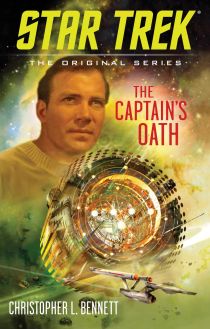
Captain Jim Kirk has just taken command of the USS Enterprise, and already he has a tricky situation on his hands. It should be simple: pick up a team of archaeologists who were investigating a site prior to an extensive terraforming project removing any possibility of exploring the ruins of a destroyed civilization. Three comets are within range of the system, and with a little manipulation they can serve to start making the planet habitable again. The lead archaeologist is a former Starfleet officer, one who served as Kirk’s science officer on his first command, but her intransigence is complicating a delicate timeline. To achieve a solution that satisfies both parties, Kirk must draw on his past experiences and accumulated wisdom, balancing passion and prudence. Bennett incorporates Kirk’s entire command experience into the story, jumping from past to present in succeeding chapters to explore the bond Kirk has with his crew, and the effect they and his previous challenges have had in molding his character. Bennett provides his customary winning mix of solid characterization, Trek adventure, and scientific plausibility.
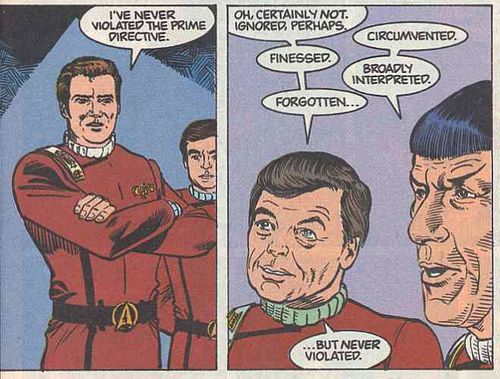
Captain’s Oath welds together two episodes of Kirk’s earlier history as a captain, fusing them with his unexpected dilemma on the Enterprise’s first voyage under his command. As the interlaced stories develop, so to does the familiar character of Kirk: the reader witnesses him becoming the man we know from the original series. The original show had a perfect trio in Kirk, McCoy, and Spock, as the captain balanced the emotional and dispassionate forces of his two best friends and ablest advisors, but young Kirk had to strike different balances — and was, in fact, the serious, focused one among his early bridge crews! The trials that Kirk endures in his first two commands, which Bennett explores here, do not have perfect resolutions; fate always seems to extract its pound of flesh. They sharpen and season young Kirk, though, giving him better judgment, more confidence in his instincts, more willingness to act beyond the rules and regulations and fulfill the spirit of Starfleet’s orders if not their letter. Kirk’s personableness remains an important part of his character and the book, as his bonds those he’s served with — even those who have left the service — push him to be the best he can be, to never fail in the face of obstacles or frustrations.
Definitely a good one for TOS & Kirk fans, and especially for those interested in the Kirk-Mitchell friendship. Michael Jan Friedman did a trilogy based on Kirk & Mitchell called My Brother’s Keeper.








 Reading Freely