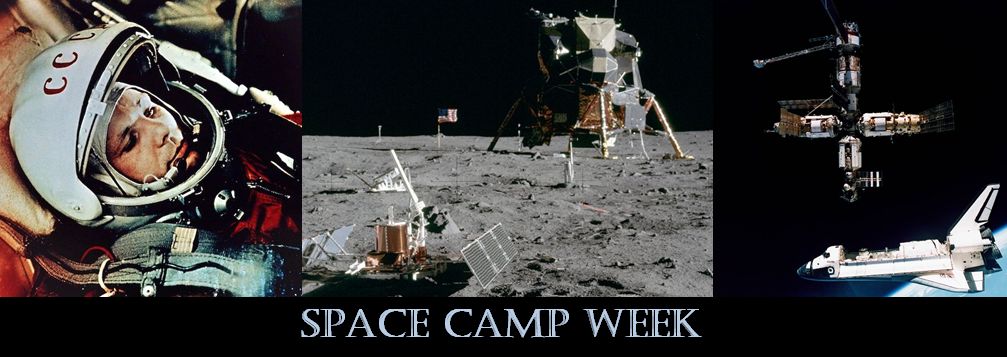
Space Camp!

It’s been ages since I went on a proper astronaut spree (Deke!, 2016), and lately I’ve been feeling the itch. With the Moon landing anniversary right around the corner (literally — it’s a week from today), why not have some fun and make fun week out of it? So….buckle up! What’s in the works? Early SF about the first men on the moon (you’ll never guess what it’s called), a history of the Mercury 7,(who had the right stuff), a modern astronaut memoir, annnnd maybe a few other things.

Previous “Space Camp” Reading


Deke! US Manned Space Flight from Mercury to the Shuttle, Deke Slayton (Mercury-Apollo and onwards)
Two Sides of the Moon, Alexei Leonov and David Scott (Mercury/Sputnik – forward)
Men from Earth, Buzz Aldrin and Malcolm McConnell. (Mercury through to the early Shuttle years.)
A Man on the Moon: The Voyages of the Apollo Astronauts, Andrew Chaikin. THE Apollo history.
Moon Shot: The Inside Story, Alan Shephard and Deke Slayton (Mercury – Apollo)
Lost Moon: The Perilous Voyage of Apollo 13, Jim Lovell (Apollo)
We Could Not Fail: The First African-Americans in the Space Program, Richard Paul and Steven Moss (Civilian/Support – Mercury onwards)
The Ordinary Spaceman, Clayton Anderson (Shuttle-ISS years)
Sky Walking: An Astronaut’s Memoir, Tom Jones. (Shuttle-ISS years)
Riding Rockets, Mike Mullane (Shuttle-ISS)

(“Space Camp” is borrowing its name from the Marshall Space Center’s juvenile and adult education and training programs of the same name…)

Posted in General | Tagged , | 4 Comments

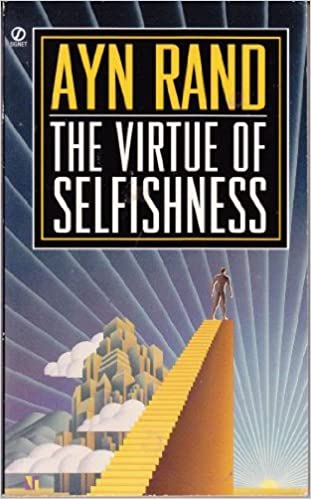
The Virtue of Selfishness

The Virtue of Selfishness
© 1964 Ayn Rand
174 pages

“It is philosophy that sets men’s goals and determines their course; it is only philosophy that can save them now. Today, the world is facing a choice: if civilization is to survive, it is the altruist morality that men have to reject.

How many books and movies have moved audiences by portraying a character who, struggling with persistent unhappiness, is pushed by their despair through to the realization that they’ve been living their life for another’s dream? That they married the man their parents wanted them to marry, even if they didn’t love him — that they became lawyers or doctors because their mom wanted them to, instead of pursuing their own dreams? The essential lesson there, the importance of honoring our inner being — our Self — is one we remind ourselves of frequently. It is in that vein that The Virtue of Selfishness puts forth a case for living in the honest pursuit of rational self-interest.

Like many readers, my initial reaction to Rand’s philosophy of ‘selfishness’ was one of surprise and contempt; based on the connotation the word carries in most cultures. My interest in Man vs State stories led me to her fiction, however, and somewhere amid the argument between Roark and Keating I found myself admitting that I’d misjudged her. Her ideas were far more substantial than expected; so too this title, which serves as a general introduction to Objectivism as a whole. She begins by establishing the importance of philosophy — particularly, epistemology and ethics, or how we come to find out what is true, and how we use it to guide our actions. Ethics, she argues, is not an artifact of human civilization, a code of behavior to keep unruly bipeds in crowded conditions from destroying one another, but the very genesis of progress. Reason is the great tool given to man by nature, our answer to the whale’s size and the tiger’s claws; without its consistent use to suss out the Truth and then act according to its dictates (ethics), we would amount to nothing but less hairy and more angsty apes.

An individual can think, conclude, and act. ‘Society’, being an abstract concept, a name for a collection of individuals, cannot. Rand therefore bases her worldview on the smallest concrete subject possible: the Individual. The Virtue of Selfishness is not a rationalizing defense for bad behavior, but rather defends the integrity of the self and reason against impulse, collectivism, and the ‘altruistic mentality ‘ — the latter being the habit of regarding one’s own existence as meaningless except when engaged in self-suppression on behalf of the tribe or even strangers. Other people do not justify your existence, Rand writes; there is no lasting meaning in identification with tribes, no reliability in following their whims. Joy is achieved through an individual’s dogged pursuit of excellence, through their successes in triumphing over challenges and their own impulses through clear thinking and hard work.

From here, Rand surveys the health of the Individual in the mid-20th century and finds it in very poor health indeed, nearly as oppressed by traditionalism, authority, and irrationality then as it was in previous dark ages. As belief in the old gods faded, the new god of the State and its collective lifeblood, The Nation, took the stage — and the new gods were far more potent than the old, coopting the tools of progress to serve instead the cause of decay. The Universities, too, having once been beacons of light allowing for the conquest of darkness, had fallen prey to postmodern confusion — and turned against the individual, especially the free exchange of economic energy between people that allowed the west to eclipse its own productivity decade after decade.

There is a savage and hard beauty in Rand’s writing, like the lines of a battleship. Far from catering to the worst of the human spirit, self-indulgence, Rand calls the Self forth to battle, summoning the best in us. Her Virtue demands the best from us — sharp thinking, hard work, constant self-evaluation. Her worldview is admirably integrated; the more I read her nonfiction, the more I realize it’s all of a piece. Even as I argued with her in my head (attempting to reconcile individualism and evolutionary psychology, as well as debating the role of the ego in well-being), I can’t help but admire her strength and consistency. She is shocking, but throws a cold and clear light on the world and I find that perspective illuminating despite its shadows.

Current plan: to continue reading Rand’s nonfiction, and then offer a response to her worldview including my reservations. Philosophy: Who Needs It will be next, followed by The Romantic Manifesto.

Posted in Religion and Philosophy, Reviews | Tagged , , | 10 Comments

The Eagle’s Claw

© 2021 Jeff Shaara
352 pages

Lastly, The Eagle’s Claw, a novel of historical fiction about the Battle of Midway.   Midway was one of the battles of WW2, the turning point of the Pacific War that, six months following Pearl Harbor, announced to Dai Nippon that its days in the sun were numbered.  The Japanese planned to seize the Midway Atoll, both as a staging area for a later invasion of Hawaii, and as an opportunity to draw the US carrier fleet into open, so that it might be destroyed and complete the work begun at Pearl.  Unfortunately for Yamamato,  US cryptographers had were reading enough Japanese transmissions to know that something was being planned – allowing US forces to position themselves to ambush the ambushers.  In The Eagle’s Claw,  Jeff Shaara takes us through the weeks before Midway and then through the battle itself, using his and his father’s signature style to put us into the minds of various American and Japanese officers and men, from the code-cracking dungeon to  the dogfights high above the Pacific.  Although the novel rightly lauds Joseph Rochefort’s crypto team for their role in allowing the US Navy to deliver proper vengeance for Pearl Harbor (the Empire lost four of their carriers),   Shaara does not omit the factor of glorious luck – of  dive bombers arriving over the Japanese carrier fleet just as the Japanese were loading ordinance for a second bombing run on the Atoll, and their fighters running on fumes.  Shaara also includes a little scene with John Ford, who had arrived on the Atoll on orders from the OSS.    Definitely of interest to WW2 fiction readers.

Posted in historical fiction, Reviews | Tagged , , , , | 1 Comment

Life, liberty, and the pursuit of literature

My reading in the last week celebrated or at least observed the memory of, the American Revolution, though the books I picked this year proved to be a mildly disappointing lot.

First up was The Return of George Washington, an entry from my Mount Doom Pile, It promised to be a rare biography of the big G, one focusing on his years as an ordinary citizen — neither General Washington nor President Washington, Father of his Country. Four of those six year years, however, were consumed by the debate within the States over the weaknesses of the Articles of Confederation, and the conventions that were called to remedy its faults — the chiefest of which Washington presided over. This is more a history of the Constitutional Convention as seen over the shoulder of ‘the indispensable man’ — a perfectly enjoyable history thereof, except that I read a few accounts of the same thing last year during my quarantine and found the revisit unexpected and repetitive. Those approaching the subject fresh would no doubt enjoy it far more than I did.

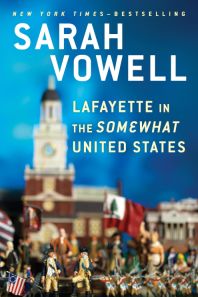
Following up was Lafayette in the Somewhat United States, a historically-inspired stream of consciousness narrative ostensibly grounded in the life of the Maquis de Lafayette, a young Frenchman who came to the States to defend the cause of Liberty against the king. It’s been nearly ten years since I read Vowell; her style mixes historical narrative, travel musings, snotty comments , and abundant political kvetching. Over the years my response to Vowell has range from amusement to annoyance, usually in the same volume; I found this one far more tedious than the rest, in part because I was genuinely interested in the Maquis and wanted to focus on him rather than say, Vowell’s opinions regarding the faux-government shutdowns that marked Obama’s last years in office. Her training in art rather than history is more on display than usual, with several breezy write-offs that had me cocking an eye and pondering if I shouldn’t just move on.

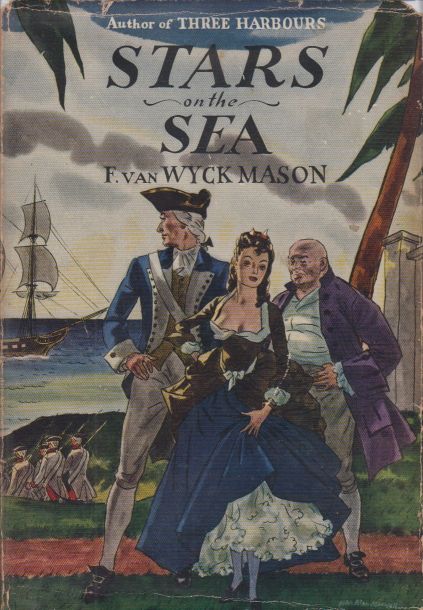
Lastly, and ending on a …well, I can’t say a high note because it’s a depressing-if-well-written novel. Ending on a strong note, let’s say, Stars on the Sea is a novella included in the Roads to Liberty anthology; originally written in the 1930s by a professor of history, it brings to the table superb detail and arresting exposition, as well as a tragic main character. Desire Harmony is a young Quaker woman who loses her family and home when the Brits burn her hometown, and in the process she’s revealed to have a British boyfriend, who knocked her up and then had the graceless luck to get shot. Disgraced, she drifts south to shift for herself, encountering disaster after disaster; meanwhile, her brother Tim joins the fledgling US Navy. The ending was unexpected and…not entirely chipper.

In the coming week, I may do a little more in this vein; The First Conspiracy, about an attempt to knock off Washington (!) , is in my TBR stack, and I’d like to read another of Mason’s books to see if it’s comparable. I’ve also finally found D-Day Girls, so perhaps I’ll finish it..

Posted in historical fiction, history, Reviews | Tagged , , | 4 Comments

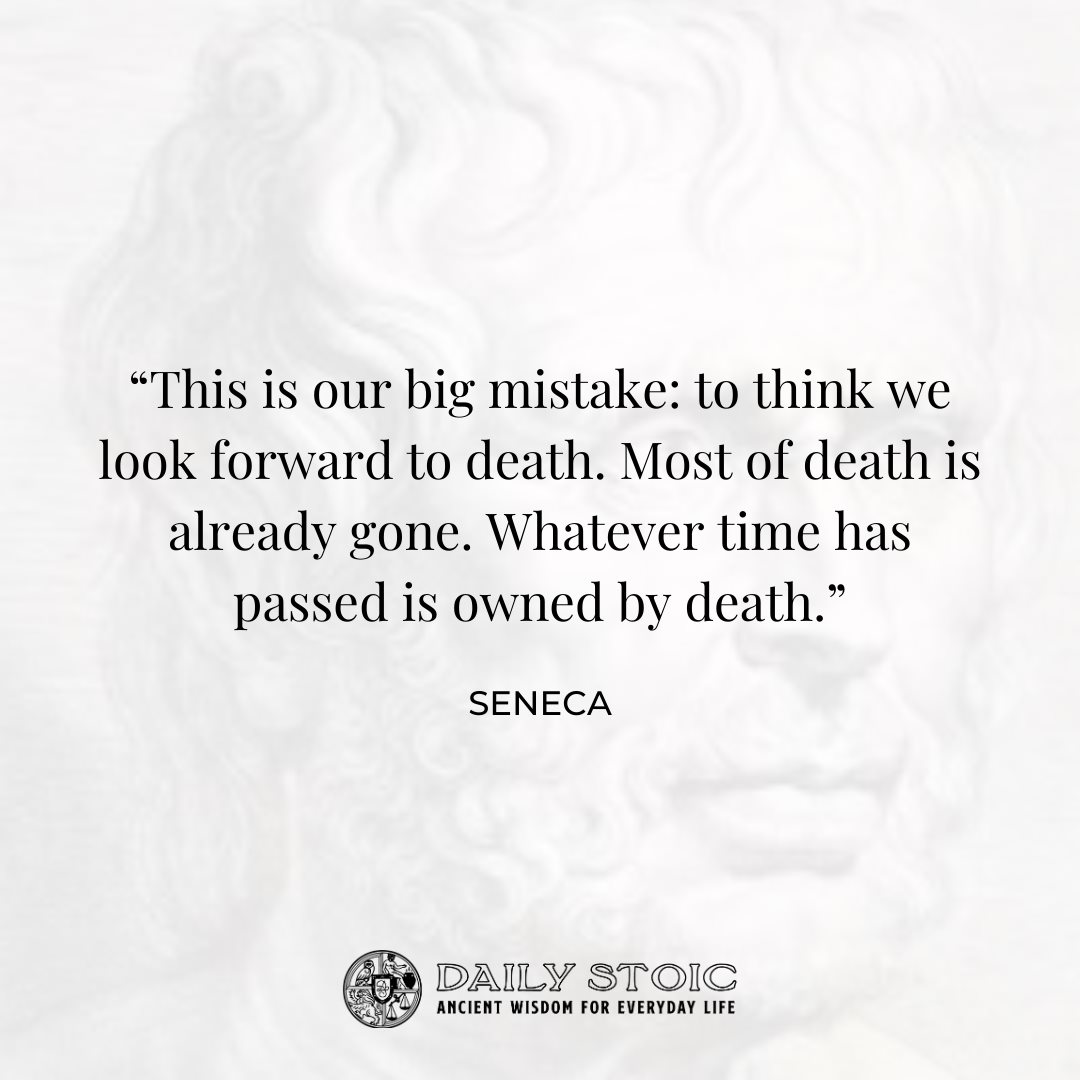
Wisdom Wednesday: Memento mori

Posted in quotations | Tagged , | Leave a comment

Top Ten Tuesday: A Reader’s Manifesto

Today’s top ten Tuesday is more of an invitation to reflect —  Jana asks us why we like to read. 

For me, that answer begins with my parents – not only were my siblings and I feted with books growing up, but our parents read to us when we were younger, and we had a family practice of sitting around reading together – my dad with his Louis Lamour, my mom and her Christian romances, my  sisters with Sweet Valley High and Fear Street, and me with…seemingly everything. I even raided my family’s collection,   save for my mom’s Danielle Steele.    

Reading was my chief entertainment:  my parents dropped television from our home in the early eighties, before I was born, and so I grew up either running around the woods,  playing outside, or reading.  I didn’t experience the rival distraction of video games until I received a GameBoy  around fifth grade,  so my childhood was marked by weekly visits to the library and piles of books read. 

In eighth grade my parents bought a computer, and it would slowly grow to dominate my time as I discovered the joys of Encarta Encyclopedia,  the internet, and PC games.  Even so, though, I remained a reader,  though mostly of histories and Star Trek novels.  I couldn’t watch Star Trek (at least until after we had a television during the last seasons of Deep Space Nine),  but I devoured its novels – and scripts, because  I bought two CDs that had all of the scripts for DS9 and TNG on them, as well as the preview trailers for each episode that aired. My Trek experience was uniquely literary: I sometimes ‘remember’ scenes from episodes that never happened, because I saw them only in my head. 

In the early 2000s, I finished high school and community college, and worked in a factory to save money for college.  My appetite for learning only grew after school, and I fed it with podcasts (then the hot new thing)  and piles of books. History, science, economics, philosophy — whatever I could find. In 2007 I started posting about what I was reading on MySpace  — a habit which has grown into ReadingFreely.  If I offer anything I’d like to think it’s the chaotic variety in the end of year pile!

Reading continued to be a crucial part of my life even once I resumed my formal education, and afterward:  I’ve been  out of academia for eleven years, with no plans on returning given the risible  disparity between tuition and value-for-money in the humanities, and were it not for the constant stimulation  and companionship of books (for the right kind invite an author into one’s head for a debate of sorts), I’d  go nuts.  Books, for me, are vital to not only learning about the world, but engaging  with it; they continue to feed my growth as a person. 

When  I die, my epitaph will say: “BUT I WASN’T DONE READING!” 

Posted in General | Tagged , | 7 Comments

HAPPY INDEPENDENCE DAY

Posted in General | 3 Comments

June 2021: Midyear

Halfway through the year,  my literary ambitions are doing moderately well. I’m on track to reach the usual 150, my science survey is keeping pace with the year, and reaching 20 classics before the year is out is still a plausible goal.   I’m mostly behaving myself as far as book purchases go, though Mount Doom is still disappointingly substantial.   July will bring American lit, my usual celebration of telling the king and Parliament to bugger off, and hopefully a return to science. I had the Best of Intentions in June, of course..

Favorites, So Far:

The Old Man and the Boy, Robert Ruark

Beyond Tenebrae: Christian Humanism in the Twilight of the West, Brad Birzer

The Last Stargazers: The Enduring Story of Astronomy’s Vanishing Explorers
, Emily Levesque

We Have Been Harmonized: Life in China’s Surveillance State, Kai Strittmatter

Project Hail Mary, Andy Weir

Challenge Progress 


Science Survey: 

Holding steady at 6/12 categories filled.
 
Classics Club Strikes Back: 


We now stand at 8/50 .
Catcher in the RyeJ.D. Salinger 
Of Mice and Men, John Steinbeck 

Expect more American classics in July. 
 
Climbing Mount Doom 


Two (very different) entries: Return of the Primitive, Ayn Rand; Solzhenitsyn: A Soul in Exile, Joseph Pearce.  

Southern Lit/History: 
My Little Town, David Tipmore.   This was written by a personal friend, so I can’t pretend to any objectivity; it’s a reflection of a Yankee transplant to “Lovelady”, a small town in the Blackbelt, as he observes and attempts to participate in the distinct culture of a small town in the Deep South. Anyone who knows the area will recognize Lovelady as Marion, though some bits of Selma leaked in. (The hotel from The Heart is a Lonely Hunter was the Hotel Albert*, and it was certainly not in Marion, harrumph harrumph.)

The Unreviewed: 

My Little Town, David Tipmore. Previously mentioned.

The Man In the High Castle, Phillip K. Dick.    I could’ve sworn I said something about this one…I read it, inspired by the Prime series, and found it less compelling and far more strange. It’s certainly artful,  integrating a lot of research into Japanese grammar and German bureaucracy alike.  

Men on Strike: Why Men are Boycotting Marriage, Children, and the American Dream, Helen Smith. Review to come; a work on why men are increasingly not to marry or pursue higher education.

Everything I Want to Do is Illegal, Joel Salatin. Full comments most likely to come this weekend..

New Acquisitions: 


Alienated America:  Why Some Places Thrive While Others Collapse,  Timothy Carney (Bookbubs deal) 
The American Way of Eating: Undercover at Walmart, Farm Fields, and the Dinner Table, Tracie McMillian. This one has been on my to-read list since it was released, and reading Salatin earlier reminded me of it.

[*] I have an unfinished history of the Albert I’ll post one day, whenever I can cajole a local family into letting me peek at their family papers that might shed light on its destruction. I’m obsessed with this building to the point of dreaming about it!

Posted in General | Tagged | 2 Comments

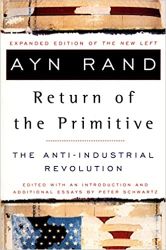
Return of the Primitive

Return of the Primitive
© 1971 Ayn Rand, The New Left
© 1999 Ayn Rand and Peter Schwartz
290 pages


The Return of the Primitive  collects Ayn Rand’s  written responses to the eruption of the student movement in the late sixties,  particularly as it meshed with the early environmental movement.   Rand largely condemned the philosophical origins and political aims of these groups, regarding them as irrational, destructive, and ultimately regressive.  Taken together, she suggests they constitute an ill-conceived rejection of industrialism, and a thuggish attack on  those who dare defend rationality and human progress. The original collection was titled simply The New Left, but here  Peter Schwartz  supplements Rand’s contents and core critique with some of his own Rand-inspired writing on multiculturalism, feminism, and  environmentalism,  arguing that they all constitute a resurrection of tribalistic and crippling mystical thinking.   

Perhaps ‘thinking’ is too strong word; Rand regarded the members of the student movement as moral and intellectual cripples, having been inwardly disfigured and held back by a generation of badly-conceived pedagogy and decaying universities, which promoted irrationality and subjectivism. The students were not rebelling against the establishment: they were its crowning glory, the perfect expression of its own feckless principles. Having thrown reason into the dustbin, they had nothing but whims and tribal identities to fall back on, seeking meaning not in their ability to comprehend and master the world, but in political theater. The pinnacle of their resignation from rationalism and productive effort, she writes, was in the raging drug culture. Although a sharp advocate for individual rights, Rand had nothing but scorn for drug users, who in her view muddled the greatest asset humanity had in its possession: the ability to reason. How sad the addled masses at Woodstock looked floundering around in the mud, wholly dependent on outside help from the squares they mocked, while that same year the power of reason was fully on display as human feet stepped foot on the Moon.

Beyond critiquing the student and nascent environmental movements directly, Rand also includes essays inspired by the era, like “The Age of Envy” or “Apollo and Dionysus” and they like no other in the collection allows her philosophy to take center stage, her focus on the Individual — on the promise and the responsibility of being an Individual. Rand and Schwartz contend that modern idealisms are regressive in that they promote tribalism and collectivism, declaring that a man or woman’s place within a group defines and determines them. Rand condemns racism as the lowest expression of collectivism, but her wrath is not discriminatory: she unloads on demands for affirmative action (choosing job & academic placement based on racial quotas) with the same cold fury she unleashed against the Klan. Either, she argues, reduces a man to a group and pretends to knowledge about individual persons based on impressions based on people who merely look or sound like him. In an age saturated with the hooting and growling of identity politics, Rand’s wholesale condemnation of this divisive and muddy thinking is a breath of fresh air.

The essays on environmentalism from both Rand and Schwartz don’t quite mesh with the treatment of the new left, though one can understand why they were grouped. Rand is driven by a vision of Man as the adventurer, the doer, the shaper of the world; she’s patently offended by the notion that we should subordinate human interests to the static preservation of nature’s present status quo. Life is progress, meaningful action, forward momentum, she writes — to merely accept the present is to begin to stagnate and die. If humanity didn’t see the Earth as clay its hands, fit to be manipulated and fired, we would only be less-hairy chimpanzees. living. Rand ultimately sees no value in the Earth itself, except in that it can fuel humanity’s material and spiritual progress: she does make some allowances for environmental protections, connected to her argument (made elsewhere) that property is the foundation of individual rights, and that environmental problems are crimes only when they destroy the the value of others or their work.

The most difficult aspect of this book was understanding her critique of 1960s academia, since I’m not familiar enough with the mid-century zeitgeist to connect her then-temporary newsletter articles to events of the day. I was reminded of a similar argument made in Harvard and the Unabomber, that the academic culture helped poison Kaczynski’s mind against industrial society. I’m acutely aware that the environment of academia helps create the social world that follows it: causes that were fringe thinking in 2010, when I graduated, are now pushed as mainstream, and people are not only indulged in irrationality but expected to support it.

Rand is a fascinating author, one whose work garners more of my interest the more I encounter her. She’s a unique thinker; rejecting tradition and heaping abuse on the medieval era, but arguing for an integrated philosophy of life that hasn’t been seen since the Scholastics. She swears by Reason alone, but despises the idea that man is merely an animated bag of chemicals, and wrote a book yearning for the return of Romanticism. She is admiringly, breathtakingly consistent in her critiques and even without having experienced her in-person charisma, I can begin to understand why she had a slight cult following. She offered to an audience which prided itself on being archly rational the same thing that many in cultic movements yearn for: clarity and purpose. Her vision of human destiny is undeniably invigorating; reading her makes a fellow want to destroy cancer, build a skyscraper, and ascent Olympus to steal fire from the gods once more. Her conception of Individualism, moreover, is demanding: only the independent thinker counts in her book. Mere contrarians, rebels without causes, won’t do. Only reasoned beliefs, defended with energy, and acted upon in furtherance of a goal, will do. Although I frequently disagree with her on particulars (she believes man to be born as a blank slate, for instance, without instincts — this is wholly false) her strident support of the Individual against the mob is sorely needed in our own day.

Definitely more Rand to come this year. I’ve delaying the posting of this until I’d finished The Virtue of Selfishness; it provided some background for understanding of Rand’s opinions expressed here, particularly her contempt for drug users.

Posted in Politics and Civic Interest, Religion and Philosophy, Reviews | Tagged , , , , | 12 Comments

Nomadland

Nomadland: Surviving America in the 21st Century
© 2017 Jessica Bruder
273 pages

America has always been a nation on the move, but some people take that more literally than others.  Nomadland takes us into the aftermath of the great recession, as the collapse of the housing market and serial firm closures crushed hopes for a secure future and reduced many to poverty.  Some took to the road, and became part of a growing migrant community, of adults who live in vans and RVs and chase seasonal employment, from strawberry harvests in the summer to Amazon holiday crunches in the late fall.  Although not everyone who chooses the Van Life is a victim of the great recession,  Bruder makes that population her focus, with eye-opening results.  

The van life has distinct advantages for those in a bind —  allowing nomads to drastically reduce their expenses, to the point that many become debt free.The constant traveling allows for daily variation, and unique recreational opportunities, including massive rallies and trade meets where RVers and van-dwellers mix with old friends. Against this there are the challenges:   the usual road hazards, of course, in addition to often punishing work, varied as it is. Vehicle breakdowns are far more serious,  as putting a van in the shop means being homeless for a few days.  For those are still financially unstable, a mechanical failure can be catastrophically disruptive.   Although many van-dwellers embrace their status as people who flit on the margins,  bidding a sweet farewell to the rat race and daily tedium,  others regard their transition into the life as a fall from grace.. Particularly sobering, when a reader visits all these stories, is the idea that this kind of poverty can happen to most everyone:   many van-dwellers held very comfortable upper-middle class positions before they encountered disaster.

Nomadland has an entertaining veer-and-lurch narrative: Jessica Bruder desperately wants to write about how the great recession and prolonged economic despair is turning millions of Americans into a perpetual migrant underclass, plug-in workers who appear and disappear at at the convenience of Big Bad Corporations’ logistics departments.  Her particular subjects are foisted into the van and RV life because of financial woes, like the recession or being looted in divorces. Something happens to these people on the road, though, including Bruder’s star subject Linda.  By necessity, they economize and minimize,   and are compelled to focus only on what’s important; the mental fog from day to day distractions disappears.  The same circumstances also compel them to become increasingly self-reliant, as they effect repairs on their own or create workarounds to various problems they encounter. The result is a growing sense of freedom and empowerment: they suddenly become not economic losers, but creative rebels who have  through ingenuity and a willingness to to take chances, found a way to escape the rat race.   Time and again Bruder returns to the poor-victims narrative, only for it derailed by the obvious pleasure and meaning that these migrants are finding in their new life, despite its challenges and difficulties.  

Howevermuch Bruder and her subjects wrestle over the story being told, there’s no denying that Bruder was seriously committed to the work at hand. She spends at least three years engaged in active research, at first living in a tent in migrant communities but then upgrading to a van of her own so she can fully participate in the life.  She knows both the first-timer’s fear at stealth-camping, and the pain of long hours at an Amazon fulfillment center.  Although she most assuredly meets van-dwellers who are markedly different from her, her compassion for the plight of those struggling to recover from setbacks never falters  — and it is that concern that makes her chronic attempts to steer the narrative back to misery and away from  the undeniable freedom these people have found, generally forgivable. Nomadland is absolutely fascinating reading.

Posted in Reviews, Society and Culture | Tagged , , , , , | 6 Comments