Purgatorio

Purgatorio
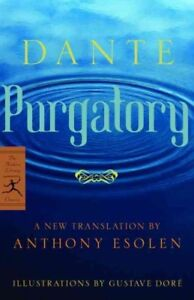
© 14th century Dante Alighieri, translated 2004 by Anthony Esolen
544 pages, including appendices and notes
When through fiery trials thy pathway shall lie,
My grace, all sufficient, shall be thy supply;
The flame shall not hurt thee; I only design
Thy dross to consume, and thy gold to refine

(“How Firm a Foundation”)

Seven years ago I descended into hell with Dante and his guide, Virgil,   and after that arduous descent into a valley of desolation and misery,   I have spent this Lent  on the rise – climbing Mount Purgatory,  that sheer ascension with trails that straighten those who remained bent on Earth, but who were not so low as to sink into Hell. As Dante traveled with Virgil, so did I travel with Anthony Esolen, a man with a magisterial command of classical western literature, whose appendices and notes make this an invaluable translation of the original. If the suffering in the Inferno was punitive, forcing the damned to bear the final consequence of their actions — not only ultimate alienation from God, but the full force of the sins themselves — the suffering on Mount Purgatory is redemptive. The slothful run, for instance, to shed their habits of indifference and inactivity to that which matters, and the prideful carry stones and contemplate beautiful sculptures depicting humility. The lower, more serious levels (closer to hell!) are for those who committed sins of the soul, and the higher for those who merely indulged in sins of the flesh like gluttony. This is a wondrous work, saturated with beauty and cosmology, and the star-filled air is frequently filled with song and prayer as pilgrims make their way upward towards paradise. Dante and the reader are immersed in drama of the cosmos at all times, the stars illumining his path and carrying mythic importance. Some of this has a direct connection to the stars we see above, but there are other wonders in the sky that Dante witnesses which remain invisible to we mortals: other times, there is an expansion of what we see, so that the Seven Sisters constellation also represents apostles of the church. We’re not just stargazing and listening to songs of the penitent, though, as the poem is filled with debate and discussion: Dante learns about the origins of Hell’s pit and purgatory’s slopes, and about the causes of sin on Earth — stemming from misdirected love, as Rod Dreher elaborated on in his How Dante Can Save Your Life. We love the wrong things, or love good things the wrong way, making idols of ourselves, of others. As with his translation of Inferno, Esolen here translates Dante into blank verse, prioritizing Dante’s original meanings at the cost of rhymes — though not at the cost of rhythm. The text is split, with the Italian original on the left page and Esolen’s translation on the right: in addition to direct footnotes important for understanding some of Dante’s allusions, Esolen also includes an ample notes section, as well as appendices that connect Dante’s writing to medieval theology and compare it against other lyric poetry at the time. His footnotes are especially useful, because Dante’s poem is itself saturated with allusion, often oblique — not so much Italian politics this time, as we saw in Inferno, but in the western mythos , from classical to Christian, including always-salient medieval astrology. This is a beautiful work and a superb translation.

Our journey continues beginning on Palm Sunday and continuing into Eastertide with Paradiso!

Related:
History Unplugged interview with Esolen on translating the Commedia
Inferno, Dante. Trans. Anthony Esolen
How Dante Can Save Your Life, Rod Dreher
Selections from How Dante Can Save Your Life
Posted in Classics and Literary, Religion and Philosophy, Reviews | Tagged , , , , , , , | 3 Comments

Tuesday Tease: The stuff of empire

From Waters of the World, by Sarah Dry, on glaciology, geology metereology, and climatology…so far.

Only with the leveraging power of certain technologies was British rule in India even thinkable. Much has been made of the importance of railways, telegraphs, and steamships in drawing the Empire together across time and space. Just as essential but often overlooked were the tools of bureaucracy itself. These took the form of central offices where information could be gathered, sorted, and acted upon. Such offices were the nodes of the great imperial network. They reached their apotheosis in London, but were necessarily to be found also in Calcutta, in Simla, and in remote field stations from which telegraphic messages were sent and received. In these small and well-organized spaces, a few workers with the ability to move information around with as little friction as possible could contribute to the governing of millions of subjects of the crown.

Posted in General | Tagged , | Leave a comment

The wretch, concentered all in Self….

“The age of Freud, the Existential Self, the Therapeutic Self, the Confessional Self, the Performing Self, the age of the memoir, the Me Generation, the Culture of Narcissism — life has become more mentalized, more inward, more directed toward the gratification of personal desire. The collapse of the family and the preponderance of people living alone are aspects of this trend: tragically, so is the shocking frequency of violence, even of mass murder, in public places. We live more in our own heads than any society has at any time, and for some people now the only reality that exists is the one inside their heads.”

Against the Machine: Being Human in the Age of the Electronic Mob, Lee Spiegel
Posted in quotations, Society and Culture | Tagged | Leave a comment

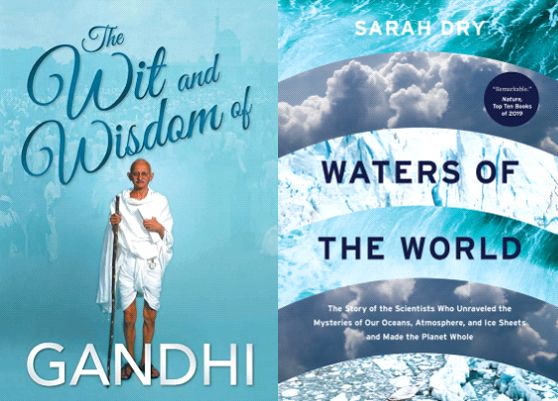
The Wit and Wisdom of Gandhi

© 2005, 2019 General Press Publishers
183 pages

The Wit and Wisdom of Gandhi is a book better judged by its cover than its title, for the title makes it sound like a collection of jokes and sage observations from a retiring politician or has-been media personality,  rather than a collection of writings from one of the 20th century’s most influential religious and political figures.   There’s no idle whimsy here, only Gandhi writing at his most intense and serious. Its ideal audience is a reader who knows of Gandhi and is curious about his work, but can’t find or hasn’t the ambition for a larger volume like The Story of my Experiments with Truth

The collection opens with excerpts on Gandhi’s religious writings, as he expresses his own sense of universalism – that God is present to varying degrees of all of humanity’s imperfect religions, and that Hinduism remains his mainstay because of its ability to assimilate the good from other traditions. From here, the collection shifts to applications of his religious beliefs, particularly nonviolence and noncooperation with evil. Given that Gandhi is known for creating and leading nonviolent protests against British policies in South Africa, and then the British presence in India, this portion takes up most of the book, but there are some interesting little remarks praising the very Empire he’s resisting, as well as observations about the rise of the Soviets. This is an idea little collection for someone who has heard of Gandhi and wants to read more into his thinking.

Kindle Highlights:

A man who aspires after [Truth] cannot afford to keep out of any field of life, That is why my devotion to Truth has drawn me into the field of politics; and I can say without the slightest hesitation, and yet in all humility, that those who say that religion has nothing to do with politics do not know what religion means.

I do not like the word tolerance…. Tolerance may imply a gratuitous assumption of the inferiority of other faiths to one’s own, whereas ahimsa teaches us to entertain the same respect for the religious faiths of others as we accord to our own, thus admitting the imperfections of the latter.

We do not need to proselytize either by our speech or by our writing. We can only do so really with our lives. Let our lives be open books for all to study.

Manliness consists in making circumstances subservient to ourselves.

Evil in itself is sterile. It is self-destructive; it exists and flourishes thorough the implication of good that is in it.

Man’s estate is one of probation. During that period he is played upon by evil forces, as well as good, He is ever prey to temptations. He has to prove his manliness by resisting and fighting temptations. He is no warrior who fights outside foes of his imagination, and is powerless to lift his little finger against the innumerable foes within, or what is worse, mistakes them for friends.

To observe morality is to attain mastery over our mind and our passions.

Truth is not to be found by anybody who has not got an abundant sense of humility. If you would swim on the bosom of the ocean of Truth you must reduce yourself to zero.

Performance of one’s duty should be independent of public opinion…. One is bound to act according to what appears to oneself to be right, even though it may appear wrong to others…. If a man fails to follow the light within for fear of public opinion, or any other similar reason, he would never be able to know right from wrong, and in the end lose all sense of distinction between the two.

Europeans themselves will have to remodel their outlook, if they are not to perish under the weight of the comforts to which they are becoming slaves.

That there is no connection between the means and the end is a great mistake. Through that mistake even men who have been considered religious have committed grievous crimes…. The means may be likened to a seed, the end to a tree; and there is just the same inviolable connection between the means and the end as there is between the seed and the tree.

Non-cooperation with evil is as much a duty as is cooperation with good.

Hatred injures the hater, never the hated.

I discovered that the British Empire had certain ideals with which I have fallen in love, and one of those ideals is that every subject of the British Empire has the freest scope possible for his energies and honor, and whatever he thinks is due to his conscience. I think that this is true of the British Empire as it is not true of any other government. I feel, as you here perhaps know, that I am no lover of any government, and I have more than once said that that government is best which governs least; and I have found that it is possible for me to be governed least under the British Empire. Hence my loyalty to the British Empire. An Englishman never respects you till you stand up to him. Then he begins to like you.

Bolshevism is the necessary result of modern materialistic civilization. Its insensate worship of matter has given rise to a school which has been brought up to look upon materialistic advancement as the goal and which has lost all touch with the final things of life.

I have no hesitation in saying that the Bolshevik regime, in its present from, cannot last long. For … nothing enduring can be built on violence.

Posted in quotations, Religion and Philosophy, Reviews | Tagged , , , , , , | 2 Comments

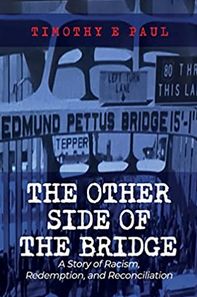
The Other Side of the Bridge

The Other Side of the Bridge
© 2022 Timothy E. Paul
124 pages

This is one of the stranger books I imagine I’ll read this year. Its title, setting, and opening disclaimer make the reader suspect that it’s a story set in 1965, perhaps viewing the political activism within the Selma from the perspective of someone who resisted it. Instead, it’s proves to be a quick story of two planned assassinations coinciding with the 30th anniversary of the Selma to Montgomery march, and neither of the then-visiting president Clinton. Instead, one intended assassination is of a black preacher who urges letting go of hate and embracing forgiveness; the other is from another black preacher, but a race-hustling demagogue. The action kicks off with the race-hustler, whom I’ll call RH, arranging to have two black men killed and left hanging from a tree in Old Cahawba, complete with a burning cross. The object is to stir up rage among the tourists swarming into town to listen to Clinton make mouth-sounds by faking a Klan hate crime. RH also wants to knock off the other fellow, Mr. Peace and Love, because RH is just an all-around baddie. RH is targeted himself by a dying and broken man named Tee who blames racial divison for the decline of Selma, and blames RH himself as a principle fomenter of said division. Ignoring the rather obvious fact that shooting RH will just make him a martyr, he aims to give RH the Kennedy treatment by using an abandoned building (the Teppers building)’s open windows. Tee will not win ‘most sympathetic protagonist of the year’, as his pain and inner conflict are released in verbal aggression against others. This being a novella, the story proceeds and wraps up very quickly, with little time for any rising drama or believable character development. There are plot twists, though. As as Selmian, I enjoyed the setting from someone who’s obviously familiar with the town, but found it a largely uninteresting read — save for the author’s claim that this was based on true events he was told about. Pardon my Old English, but like hell. Clinton visited for the 35th anniversary, not the 30th, and there was no violence associated with either one. The SS had Broad and Water Avenues completely locked down, to the degree that some people still complain about how difficult it was to live or work anywhere within eyeshot of the bridge that weekend. There just wasn’t enough story here, and what did happen wasn’t believable. I’m also unsure of the point: book’s description and blurbs make it sound like a story of racial healing through Christ, but that only appears at the very end where it’s more like a unexpected and not suitable garnish.

Posted in historical fiction, Reviews | Tagged , , , | 1 Comment

Wednesday blogging: famous book you’ve not read?

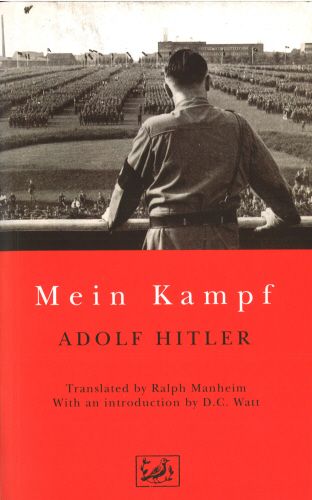
Long and Short Reviews’ blogging challenge this week is ‘A famous book you haven’t read, and why’. Immediately before college and a little during (before assignments took priority), I sought out books that had changed the world for good or ill. I read The Origin of Species, for instance, and The Communist Manifesto. I’d also planned to read Mein Kampf, and started to in connection to a German history course, but either Hitler was a tedious writer or I only had access to a marginal translation, because it was incredibly dull despite my longstanding interest in World War 2. At any rate, a hold for Harry Potter and the Deathly Hallows (then a recent release) came in, and I forgot all about trying to return to the book. I recently found a 1940s English translation in a used bookstore, so I plan to tackle it at some point, both to resume that old mission (to confront influential books) and to see what issues Hitler was using to sell himself to the German people. I’m hoping, in October, to do a little series on Germany between 1917 and 1933. The cover I’m using for this post isn’t the 1940s English edition: I chose this one because it’s one of the few without a swastika or Hitler’s glarey face. His is a prize case of the ugliness inside manifesting itself outwardly.

Posted in General | Tagged | 7 Comments

Exciting news

Eleven years ago tomorrow I accepted an offer of employment at the library, and have served as its local history librarian and computer lab manager since, growing in both technical and personal skills along the way, and taking no small measure of joy in the fact that my work makes a difference in the lives of others — finding employment, pursuing their education, growing as people. As the scope of my responsibilities has grown, I’ve realized the need for more formal training in my field — especially seeing as we are planning a major digitization project. I was delighted to receive this letter today on the eve of my work anniversary.

If I suddenly become obsessed with SEC football this fall, I can only apologize. The cult of UA football is strong and I’m predisposed to join it given being raised as a Bama fan. As a kid from a working class family, it’s overwhelming to be accepted to the State’s most prestigious university. Go Bama! Roll Tide!

Yea Alabama!
Drown `em, Tide!
Every Bama man’s behind you,
Hit your stride!

Go teach the Bulldogs to behave
Send the Yellowjackets to a watery grave
And if a man starts to weaken
That’s a shame!

For Bama’s pluck and grit have writ her name in Crimson flame!
Fight on, fight on, men!
Remember the Rose Bowl, we’ll win then!

So! Roll, roll to victory
Hit your stride!
You’re Dixie’s football pride, Crimson Tide!
Roll tide! Roll tide!


“You’re aware of this name of this ship, Mr. COB?”
“Yes, sir!”
“It bears a proud name, doesn’t it, Mr. COB?”
“Outstanding, sir!”
“What is that name, Mr. Cob?”
“ALABAMA, sir!”
“And what do we say?”
“GO BAMA! ROLL TIDE!”
Posted in General | 8 Comments

Invasion! Sie kommen!

Invasion! Sie kommen! | Invasion! They’re Coming!
© 1960, 1963 Paul Carell
288 pages

Invasion! is a German account of the D-Day landings and the battles that followed as the Allies worked to unite their separate beachheads and secure a foothold in Northern France. Given the perspective shift, readers find accounts of dogged defenders holding out an overwhelming attack force, rather than of valiant attackers dropping into darkness behind enemy lines, or hitting the beaches with visible Death there waiting for them. Oddly, Carell doesn’t mention the use of foreign nationals (including Russians) serving in the defensive line: his men are all good German boys, doing their duty and proving themselves superior soldiers on the tactical level despite mistakes made from the politicians up top (who believed for far too long that Normandy was merely a diversion from the real invasion at Calais) and Germany’s supply problems at the time, including the complete lack of any Luftwaffe support. I dislike the term ‘whitewashed’, but Carrel does clean the defenders up like they’re going to tea with the queen. Interestingly, he argues that Eisenhower was interested in striking a deal with the German military in the west: if they cooperated with the invasion and allowed the Allies to retake France, the Netherlands, etc. then a peace could be struck to protect Germany from the future threat of Bolshie domination. According to Carell, Churchill was mildly interested but deferred to the patrician Roosevelt, who was staunchly against it. This is not an aspect of the late war I’ve heard about, and I’m curious as to whether there’s any validity to it or just Carell (writing during Eisenhower’s last term in office, and amid the same Cold War mentality that led to the coup in Iran) attempting to argue that the West and Germany should present one front against Russia and the reds. Another surprise was learning that the Brits were aware of the V-1 program in 1943, and through persistent bombing were able to delay its launch until June 1944 — coinciding with the invasion! In all, this was an interesting read for the student of World War 2, but one to be read alert to biases and spin.

Related:
The Foxes of the Desert, Paul Carell. On the war in Africa.
Overlord: D-Day and the Invasion of Europe, Albert Marrin. Intended for teenagers, this is a detailed but storied history of the D-Day planning and execution.
Black Edelweiss: A Memoir of Combat and Conscience, Johann Voss. One of the more disturbing memoirs I’ve read, because it’s of a perfectly normal man from a successful, respectable family who chose to support the Nazi regime despite his criticisms of it, simply because he feared the presumed alternative — Russian-style bolshevism.

Posted in history, Reviews | Tagged , , , , | 7 Comments

Top Ten + Teaser Tuesday

Today’s Tuesday teases come from three different books: one, a collection of extended quotations from Mohandas Gandhi; a book on the study of ice, air, and oceans; and a history of D-Day from a German historian.

A man who aspires after [Truth] cannot afford to keep out of any field of life. (The Wit and Wisdom of Gandhi)

Clouds were sometimes obstructions to the visions that lay beyond—of stars, of peaks. But they were also aspects of the natural world and therefore worthy of study in themselves. They represented a particular variety of the fullness of nature, the way in which the veils that she drew across herself were themselves part of nature. The objects that obscure vision are themselves worth looking at. In this way, the atmosphere was a doubled object, both an impediment to science and an object of it. (Waters of the World)

“‘The enemy’s weakest moment is when he lands,’ said Rommel. ‘The men are uncertain, possibly seasick. The terrain is unfamiliar. Sufficient heavy weapons are not yet available. I must defeat them at that moment.'” (Invasion! They’re Coming!)

And now for this week’s Top Ten Tuesday, which is a rrrrrewind. I’m going to be cheeky and say I’m rewinding to one of the freebie days, and do “Top Ten Most Recent Books I’ve Added to my Goodreads Want To Read”.

(1) The Path: What Chinese Philosophers Can Teach Us About the Good Life, Michael Puett

(2) Vanished Kingdoms: The History of Half-Forgotten Europe, Norman Davies.

(3) A Hacker’s Mind: How the Powerful Bend Society’s Rules, and How to Bend them Back, Bruce Schneier

(4) Oak: The Frame of Civilization, William Bryant Logan

(5) Index, A History of the: A Bookish Adventure from Medieval Manuscripts to the Digital Age, Duncan Dennis

(6) Distracted by Alabama: Tangled Threads of Natural History, Local History, and Folklore, James Seay Brown

(7) The Bookshop of the World: Making and Trading Books in the Dutch Golden Age, Andrew Pettegree

(8) God’s Vindictive Wrath, Charles Cordell. A novel set during the English Civil War. I’ll probably read this one in April for Read of England.

(9) Revolutionary Roads: Searching for the War That Made America Independent…and All the Places It Could Have Gone Terribly Wrong, Bob Thompson

(10) Otherlands: A Journey Through Earth’s Extinct Worlds, Bob Halliday

Posted in Reviews | Tagged , , | 5 Comments

The Boys from Biloxi

The Boys from Biloxi
© 2022 John Grisham
453 pages

Keith Rudy and Hugh Malco were among the best of friends,   who grew up playing ball and exploring the Gulf Coast together.  Third-generation immigrants,    they both admired their fathers intensely  – both men who had grown up in humble circumstances, gone to war, and then come back to create lives for themselves in entertainment and the law.    But as Lance Malco’s investments in clubs grew into a sprawling criminal enterprise with the police in its pocket, fueled by booze, hookers, and gambling,   it created a string of violence that provoked Keith’s father Jesse into running for district attorney – a choice that would pit the fathers, and then the sons, directly against one another in a story of heroism and tragedy.   The Boys from Biloxi is not quite a return to form for Grisham, but its mix of seedy crime and the drama of friends torn apart by their diverging dreams makes it more compelling than anything Grisham has written in the last ten years.

Although I devoured Grisham’s books in the 1990s and early 2000s,   most of what he’s written since 2009’s The Appeal has proven a disappointment, with lazy writing and uninteresting characters.    The Boys from Biloxi still suffers from that, with Grisham doing a lot of telling-and-not-showing,   but at least two of his core characters are interesting, and the relationship drama between the four gives them additional strength.  Friends who are like brothers turning against one another as their fathers pursue different paths makes for a stirring story, especially after Keith’s father Jesse makes serious progress against the Dixie Mafia that Lance Malco heads and Hugh decides to strike back on his father’s behalf.  The blue-collar crime setting (an array of clubs that serve as gambling halls, illegal bars,  whorehouses, and general dens of iniquity)   adds appeal, as does the historical appearance of Hurricane Camille that makes part of the story possible.  Frankly, reading about financial fraud is boring compared to rumrunners, strip joints, and erstwhile Klansmen wandering about with plastic explosives.

The Boys from Biloxi was a welcome surprise, both for the attraction of its story and its relative ambition, as it pushes towards being a generational/family epic without growing too large. The lurid historical setting also helped!

Posted in Reviews | Tagged , , , , | 1 Comment