Humans of New York

Humans of New York
© 2013 Brandon Stanton
304 pages

If you ever needed proof that a picture is worth a thousand words, consider one shot near the end of this volume. The scene is a New York city street. A young man — a tall, strapping Marine in full dress uniform — and his tearful mother stand close together, staring at something off-camera. The caption? 9/11/2011. There is a story in that shot that we can guess at, of a father who fell, of another young man who is now following his father’s footsteps in the wars that followed from that date ten years before. Humans of New York is saturated with stories like that, but most of them are more joyful than tragic. The book opens with the photographer/editor’s own story, of how he left his job as a daytrader and began a photographic tour of the United States, where he quickly felt irresistibly drawn to the people who filled urban landscapes rather than the landscapes themselves. These photos, originally posted to his facebook group, developed a life and following of their own. The collection here shows off New York’s enormous diversity, spotlighting little babies offering toothless smiles and old men offering advice. Stanton’s eye gravitates toward ‘characters’ — people who dress or move in eccentric fashion, or who have a story to tell. Each photo has a caption, most of which add significantly to the story — and testifying to Stanton’s ever watchful eye as a photographer, as he often caught moments that were utterly fleeting. Every single one of these photos is striking in some way — often for the fashion and hairstyles, or for the setting, but more often than not for the people — caught in their feelings. Stanton sometimes took candid shots, but many of these are the result of people he’d stopped on the street and talked to, and ‘posed’ in some way — not just physically, but emotionally. In one shot, for instance, he asked a young dancer to put all of his energy into the greatest move ever, and that intensity is captured here. It’s a beautiful volume, a human mosaic full of beauty, creativity, and passion.

This video reminds me of the book.

There are no ordinary people. You have never talked to a mere mortal. Nations, cultures, arts, civilizations – these are mortal, and their life is to ours as the life of a gnat. But it is immortals whom we joke with, work with, marry, snub and exploit – immortal horrors or everlasting splendors. This does not mean that we are to be perpetually solemn. We must play. But our merriment must be of that kind (and it is, in fact, the merriest kind) which exists between people who have, from the outset, taken each other seriously – no flippancy, no superiority, no presumption.

CS Lewis, The Weight of Glory
Posted in Reviews, Society and Culture | Tagged , | Leave a comment

Log Cabin Pioneers

Log Cabin Pioneers: Stories, Songs, and Sayings
© 2001 Wayne Erbson
184 pages

Few things are more evocative of the American frontier than a log cabin. This isn’t a new thing, either: log cabins entered American iconography as early as the 1840s, when a presidential candidate was mocked for his supposedly modest background and weaponized it in response, incorporating a humble cabin  into his campaign literature to advertise his simple frontier virtues of hard work, self-sufficiency, and ingenuity. Despite growing up in sunny southern California, Wayne Erbson dreamt of living in a log cabin one day – and despite the odds, he and his wife found one for sale, in relatively good condition (minus the collapsing porch & steps). He opens Log Cabin Pioneers with an account of how such structures were originally built, pairing this with his story of restoring the old Crawford place, and building an outhouse on the property in a suitable spot. From here, Erbeson expands into frontier culture, particularly music: he has an avid interest in folk music, both traditional and modern, knowing everything from melodies that drifted over from Britain, to the songbook of the Industrial Workers of the World. Erbson laments the fall of music, which was once the province of everyone but which has become a product to be consumed, often alone.  From here we move into the labor of cooking in the frontier, with included recipes, and finally into general lore — ranging from stories about how to learn to play the fiddle from the devil, to how to forecast the weather. You may argue amongst yourselves as to where these fall between traditional knowledge and simple superstition. Almost every page has a little frontier saying on it, though what some of them mean I can only imagine. “More ways to kill a dog than choke it with biscuits”? I’m guessing that’s kin to “there’s more than one way to skin a cat”.   If you fall in this book’s niche audience — those interested in the culture of the early 19th century pioneers — you’ll find no shortage of interesting little tidbits and funny stories.  I can only end with the insightful words of Honest Abe himself, who offered as a blurb on the back of this book — “For those of you who like this kind of a book, this is the kind of book you will like.” That certainly sold me on it!  

Related:
Count Those Buzzards!, Kathryn Tucker Windham. A collection of Alabama folklore. Very small, more of a booklet with ambition.
Everyday Life in Early America, David Freeman Hawke. A social history of Americans during early colonization.

Posted in history, Reviews | Tagged , , , , , , | 1 Comment

Bing Reccommends me Books

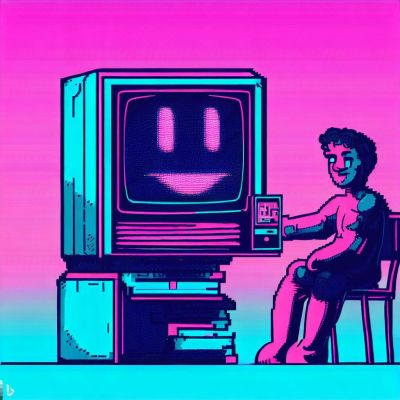
“A vaporwave illustration of an IBM computer with a simple face smiling at a human male and handing him a book to read through the screen”

I made Bing consider all of my reviews from 2007 forward and then asked it to recommend me some books. This took some doing, because it kept giving me lists that were mostly books I’ve already read,, but after repeated attempts over two week I’ve been able to glean ten original titles. On my most successful approach, I asked Bing first to check out the blog and identify the author’s biggest interests, and then recommend books on those interests. My “About” page was a bit of a cheatsheet for bing, I think. I’ve bolded the ones I’d heard of before and already interested in. When I tried the same trick for fiction, all I got back was classics, nothing I hadn’t heard of . However, last week I asked it for a list of near-future SF titles and found a few authors I’m definitely eyeballing.

The Age of Surveillance Capitalism, Shoshana Zuboff

The Madness of Crowds, Douglas Murray

The Myth of the Rational Voter, Bryan Caplan

The World Beyond Your Head, Matthew Crawford

The Culture of Narcissism, Christopher Lasch

Democracy: The God that Failed, Hans-Hermann Hoppe

Man’s Search for Meaning, Viktor Frankl

The End of Nature, Bill McKibben

The Overspent American, Juliet Schor

The Tyranny of Experts, William Easterly

Posted in General | 3 Comments

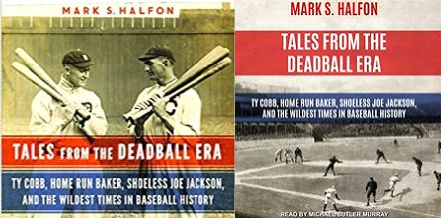
Tales from the Deadball Era

Tales from the Deadball Era: Ty Cobb, Home Run Baker, Shoeless Joe Jackson, and the Wildest Times in Baseball History
© 2014 Mark S. Halfon, narrated by Michael Butler Murray
240 pages | Audible 8 hrs 4 minutes

George Carlin once mocked baseball in one of his sketches, comparing its urbaneness with the ‘technological struggle’ of football. He couldn’t make such a sketch a hundred years before, because baseball as we know it was very different — technically professional, in that players were receiving pay and signed to contracts and the like, but far more combative, with players and fans accosting one another and often the umpire, leading to serious injuries and at least one death. Violence was more accepted as part of play, with spiked cleats giving basemen a reason to dread runners sliding at them. It wasn’t quite as bad as the old practice of tagging runners out by hitting them with a thrown baseball, but player-on-player injuries were not uncommon. A lot of rules moderating the sport did not yet exist, so fielders had considerable license to modify balls to make them unpredictable and even difficult to see — and the same ball might be used for the duration of the game, being replaced only if it was knocked out of the park. Already soft to begin with, when a misshapen ball soaked in tobacco spit and covered in dirt careened toward the plate, it had a better chance of becoming a ‘beanball’ and smacking the batter than it did making it into the outfield. The difficult nature of these balls meant that players played ‘inside’ baseball, working the infield and batting not for power but for strategy — the object was to make contact and get men on base, not to swing for the fences, so there was more bunting than we see today. Frankly, this kind of game sounds more interesting, but the grand slams that followed in the wake of Ruth and rules that reduced the amount of ball-tampering and irregular pitching proved to be popular with spectators. Violence and drunkenness were common, but so was gambling — and the cheating that followed in its wake, as pro ball players who felt shortchanged by their owners (and whose attempts at striking were always undermined) were susceptible to playing a weaker game in return for a few thousand under the table. There are a lot of big personalities here, including Ty Cobb — who Halfon is kinder to than others, detailing how the southerner was endlessly hazed by his Yankee teammates, so much to the point that he started carrying a handgun for protection. The book ends with an appraisal of the Black Sox scandal, which Halfon argues was not at all unusual for its time, and the fact that it became such a public outrage was more helpful to baseball than not, leading to increased scrutiny and better oversight to sharply reduced corruption from gambling. At any rate, following the passage of Prohibition, the gangsters bankrolling such corruption would soon have other mischief to keep them busy. If you’re a fan of baseball, this was tremendously entertaining, with a lot of strong characters at play and insight into an era where the game was very different.

Related:
The Glory of their Times: The Story of Early Baseball, Told by the Men who Played It, ed. Thomas Ritter
How Baseball Happened, Thomas Gilbert

Posted in history, Reviews | Tagged , , , , , | Leave a comment

Teesday Tuese & TT

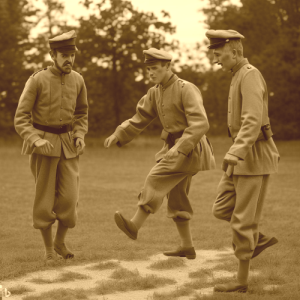
Bing’s attempt to create Civil War soldiers playing hopscotch. The sepia effect was my contribution.


Common exercises were foot racing, wrestling, boxing, leapfrog, hopscotch, quoits, and marbles. Some Rebs played tenpins after a fashion ironically unique, by rolling cannon balls at the pins, or at holes in the ground.

The Life of Johnny Reb: The Common Soldier of the Confederacy

The mind boggles at Civil War soldiers playing hopscotch. The reference sent me to wandering across the interwebs and I discovered that it was a game invented in Britain during Roman rule. Roman soldiers played it to improve their footwork.

Top Ten Tuesday: Things Getting in the Way of Reading

(1) The laundry baskets in front of my book case. As soon as I fold and put away they get filled up again.

(2) My very-real fear that if I remove one book from Mount Doom, the whole stack will collapse on me and bury me alive.

…oh, wait. Hang on. I’m getting something from the studio here…..apparently I’ve misunderstood the prompt. It’s meant to be things I keep doing instead of reading. Let’s try that again..

3)  Work, obviously. You’d think working in a library meant more reading time, but ours is a very social services oriented-library, so books are just in the background for me at work!  I spend most of my time (when not updating manuals, printing flyers, updating the website ,etc)  working directly with patrons on computers, trying to help them to get information or send information to government agencies, corporations, etc.  (Not to mention the ‘official’ work I’m responsible for, like maintaining computers and doing historical research.) I have to hang out at the local bookstore on Saturdays to get my fill of ‘time spent with booky people’. 

4) Education. I have an active Coursera account and try to watch at least an hour of content per night, always in the area of IT-related things. It might be Google Workspace management, Python essentials,  or even (currently) a history of the internet. 

5) Zoning out.  Here work comes into play, because after a long day of being constantly asked questions, I want to zone out for a bit. I’ll put on some music and play a mindless game (The Sims 4 and American Truck Simulator are favorites for this), and then switch to something more respectable like a podcast or Coursera. Howeverrrrrr, sometimes I get in a very comfortable space where I’m just listening to music/youtube for most of the evening, at least until 10 o’clock rolls around and I realize I still have to do laundry for tomorrow. 

6) PC Games. Mostly related to zoning out, but there are games that keep me thinking and engaged  — and not paying attention to the clock at all.   I like building things in The Sims 4, for instance.  One of the current things I’m fiddling around with is a minimalist high school for the game that is inspired by the School building in SimCity 3000: another is a retro cafe built over a fallout shelter turned into a bowling alley.

7) The outdoors. If the weather is nice out (which, in Alabama, means it’s April, May, or early December) ,  I’m  liable to be out hiking, exploring forgotten parts of the state, or chasing good photos or bird-sightings. 

8) Just regular ol’ adult responsibilities and activities. I’m not a husband or father, , but I actively pursue meaningful connection in my life by being engaged with church & civic organizations,  and – rule of thumb – -the busier you already are, the more attractive you are to people who need something done, because your sheer business testifies to the fact that you get things done.  I’m at the point where I actively have to orient myself with my Outlook calendar because otherwise there’s too much going on. 

9) Personal projects.   It might be a short story I’m fiddling around with, or a blog/website idea, or something for the garden. It’s possible within the next year I might be engaged in a book of local history (principally as editor – it’s more of a pictorial history with expository captions), so that might become especially competitive in the future.

10) Friends. I spent at least 15 hours a week between work and sleep spending time with friends. This often means hanging out at the Harmony Club, either swapping gossip or watching movies, or having dinner and porch-sitting with others. A lot of my friends are likeminded cranks who insist on socializing in person rather than texting, so we make time to spend with one another on a regular basis. I like spending my lunch alone reading, but if someone wants to meet up at the Coffee Shoppe to check in, I’m not saying no!

Posted in General | Tagged , | 18 Comments

Best of the Science Survey, 2017 – 2022

I recently realized that I’m in my sixth year of doing the Science Survey, and am marking the ocassion by thinking about the ten best reads of that period. For the uninitiated, the Science Survey is an attempt to structure my science reading so that I don’t binge on a few particular topics and lose my tenuous-at-best grasp on things like cosmology. As you can tell by the list below, left to my own devices anthropology, biology, and psychology would dominate.

THE BEST OF THE SCIENCE SURVEY’S FIRST FIVE YEARS

I Contain Multitudes, Ed Yong. On the complex relationship between humans and the bacteria. Survey 2017.

The Hidden Life of Trees, Peter Wohlleben. Far and away one of the most eye-opening science & nature books I’ve ever read. Survey 2019.

The Ice at the End of the World,
Jon Gertner. On the physical and scientific exploration of Greenland.

The Goodness Paradox, Richard Wrangham, on virtue and violence. Survey 2020.

Suspicious Minds: Why We Believe Conspiracy Theories, Rob Brotherton. Survey 2020.

The Storytelling Animal: How Stories Make us Human, Jonathan Gottschall. Survey 2021.

How Emotions are Made, Lisa Feltman Barrett. This deserves a re-read and proper review, because it was good. Survey 2021.

Good Reasons for Bad Feelings, Randolph Nesse. On how evolutionary psychology can help us make sense of our emotions, and (to a smaller degree) how our brains are modernity are often at cross purposes. Survey 2021.

The Last Stargazers, Emily Levesque. On how modern astronomy is done — and the adventures therin! Survey 2021.

An Immense World: How Animal Senses Reveal the World Around Us, Ed Yong. Survey 2022.

I’m hoping to complete this year’s survey in June, and know the titles I’ll be using to fulfill my remaining few categories — mostly. Thinking Scientifically is between Steven Pinker’s Rationality or Neil deGrasse Ttyson’s Starry Messenger.

Posted in General, science | Tagged | 3 Comments

Breaking Bad & Bama Baseball

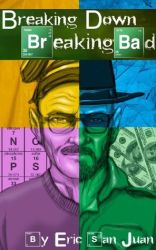
If you’re an obsessive fan of Breaking Bad — and is any fan of Breaking Bad not an obsessive one? — this little book is a quick treat, consisting of summaries with commentary of each respective season, along with character analyses and more random pieces, like a top ten list of best lines from the show. San Juan doesn’t just recap what’s happening, but comments on the character dynamics, background drama motivating characters that viewers are aware of when they watch the show, but haven’t necessarily articulated for themselves. The author’s picks demonstrate how powerful this show could be — not needing long, epic speeches but using its bench of phenomenal acting talent to create explosive scenes with just a line or two and genuine talent. (“Perhaps your best course of action would be…. to tread lightly .”) This is of great interest to BB fans. Love the cover!

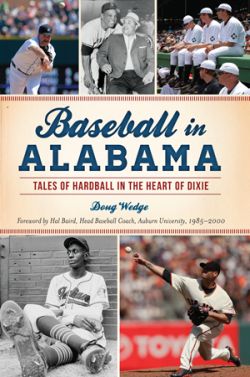
Baseball in Alabama is not a history of how America’s game came to the Heart of Dixie, but is instead a collection of profiles and stories from ballplayers who came from Alabama, some of who returned home to create foundations and the like to improve the lives of their fellow citizens. Although football is the sport most commonly associated with Alabama, thanks to UA’s Crimson Tide and Auburn University, many of the MLB’s greatest players have come from this state, including Willie Mays, Hank Aaron, and Satch Paige. Many of the stories are drawn from interviews with the players themselves, and those dating to the fifties and sixties illustrate the personal frustrations and indignities of black ballplayers, who frequently couldn’t eat in the same restaurants as their teammates. Some of the features are more general, like a tribute to Rickwood Field in Birmingham. If you’re a serious baseball reader who has an Alabama connection, this will be of interest.

Kindle Highlights:

The list of hall of famers from Mobile amazes. Five of the game’s all-time greats (Hank Aaron, Willie McCovey, Satchel Paige, Ozzie Smith and Billy Williams) call Mobile—a city with a population slightly under 200,000, the third largest in Alabama—their hometown. Put this in the context of thirteen states not having a native son enshrined in Cooperstown, and it astounds.

The pugilistic crowd provided highlights for the players, including hijinks fueled by alcohol. “The foul pole connected the lower deck and the upper deck. We look down there, and there’s a guy climbing the foul pole from the lower deck trying to get to the upper deck. Obviously, he had too much to drink. Somewhere, about halfway, he had a sobering moment and just froze. Wouldn’t climb up and wasn’t going down. Stuck. Had to call the fire department. Stop the game. The fire department got him down. It can be a crazy place.”

Posted in history, Reviews | Tagged , , , | 1 Comment

The War as the South Saw It

The Confederate Reader: The War as the South Saw It
© 1999 Richard B. Harwell
416 pages

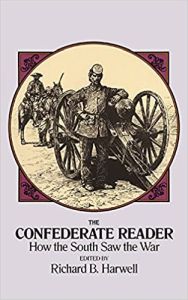
Mention ‘The War’ in the South without any context, and most anyone will understand which one  you’re referring to – the only War that has lasting import to the South,  giving it a distinct story from the rest of the country. The Confederate Reader collects a wide variety of  Southern primary source selections sourced from the War   into one relatively small volume. The collection begins with an excerpt from the original bill of secession that South Carolina adopted in reaction to the election of Lincoln,  and then rapidly expands to include everything from official military reports to letter & diary excerpts, with more miscellaneous items like comedic pieces also included.  Theaters outside the main, like naval encounters and the victories of the CSA’s Cherokee general, Stand Watie, are incorporated here as well. The pieces are organized by year,  and include introductions when appropriate from Harwell. Although he’s a southern editor & author,  Harwell’s commentary is non-partisan, regarding the breakup of the Union and the war that followed an unnecessary tragedy. (He’s also edited and released  a Union Reader which presumably mirrors this collection for Yankeedom.)   

Though I’m no stranger to Civil War primary sources,   having read excerpts from letters and diaries before,   this collection’s variety of items offered a bounty of interest.    I saw here sources often used in social histories of the war, including the recently-read Our Man in Charleston.    Although this collection has a lot of informative value for someone who has only read military histories and the like, giving some sense of what it was like to experience the war across class lines,   there’s also entertainment value – not just in the humor pieces, but through the joy of mid-19th century prose.  One reads picks up a newspaper today and finds, for the most part,  prose of the most pedestrian nature – but  the battle reports and obituaries collected here have such grace and drama in them they’re practically literature, making them a pleasure to read even when they concern something tragic, like an unexpected death or the ruin of a great city.   The collection offers surprise after surprise: the Battle of Gettysburg, for instance, was not regarded at the time as a mortal wound  that made the surrender at Appomattox Courthouse inevitable, but merely a frustratingly incomplete victory:   Lee had pushed the Yanks back for two days, but was forced to withdraw ‘in good order’ with many prisoners after realizing further reinforcements were making progress impossible.   Whether this is a case of the public receiving problematic military reports, or simply a case of the scope of the defeat not being evident until after its repercussions had time to bear fruit, I can’t say.   Some places were relatively untouched by the war, like Mobile – hosting Mardi Gras fêtes even under siege.  There’s little included for 1865, in part because most publishing had ceased at that point,  resources being unavailable. 

The Confederate Reader should be of great interest to any ACW student, offering a non-politicized bounty of primary source examples to deliver a sense of how the war progressed from exultant rebellion to ruin.

Related:
A People’s History of the Civil War, David C. Williams. A bleak but thoroughly eye-opening exposure that examines the frailties and motives of those on all sides. No one emerges with an intact halo.

Posted in history, Reviews | Tagged , , , , | 1 Comment

Our Man In Charleston

Our Man in Charleston
© 2016 Christopher Dickey
416 pages

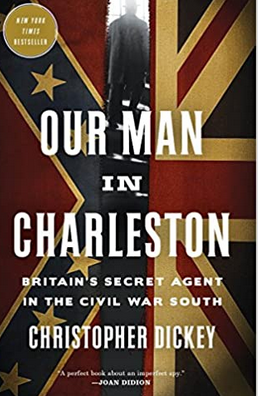
Our Man in Charleston is a fascinating history of British diplomacy in the South, 1850s-1865, about a British consul working to defend Her Majesty’s interests in the erstwhile colonies, focusing specifically on the slave trade which Britain had made its mission to destroy. Although many in the South preferred the trade stay closed, to maintain the value of their existing ‘stock’, others were married to expansion, and wanted to re-open the trade and expand the slave system across North America. The book’s subject, William Bunch, no sooner arrives in Charleston that he announces he hates its climate, its inability to match the metropolitan delights of say, London, and all of the people he meets. Of course, he’s rubbing shoulders exclusively with the patrician slaveholders, but I imagine if he met a white freeholder (poor whites only exist if we’re at war or misbehaving) no doubt he’d turn up his nose and declare English peasants far superior. At this time, those attempting to smuggle slaves into Cuba and the like took shelter behind the American flag, not because they were Americanos but because Britain didn’t want to provoke incidents with its rebellious and very-much-armed prodigal son. The US Navy, which could search American-flagged ships, wasn’t nearly as zealous or able as the Brits, so the inability of Britain to properly police the azure main was a bone of contention. Bunch took stock of many of the loudmouths in South Carolina and realized that not only were they wholly married to the evil institution, they were reckless to boot: willing to antagonize the British empire and risk war to expand their interests. Bunch’s constant coverage of these remarks went a long way, after the attempt at southern independence was underway, to prevent Britain from recognizing the South as a nation and attempting to meditate in the dispute — despite William Henry Seward apparently doing his damnedest to provoke war between the United States and Great Britain, huffing and puffing that even Her Majesty even communicating with the Confederacy was tantamount to recognizing it as a nation and therefore declaring hostilities against DC. Had he been the only element in the picture, we might now have an ironic tribute to Seward in the Confederate Capital of Richmond, hailing him as Dixie’s greatest diplomatic asset. Instead, Lord Palmerston and Prince Albert were able to sooth ruffled feathers — and Abe’s politicization of the war, declaring it about slavery despite having spent three years denying the same, made British recognition of the Confederacy a moral impossibility. Amusingly, Bunch did his job of ingratiating himself to the Southerners so well that Seward believed him a Confederate agent (despite his constant insults against them in private letters). This is a unique look at the buildup to secession and the war, a first exposure for me to the world of British diplomacy, and an interesting if frequently irritating read. I realize Bunch had the moral high ground, but he spends the entire book, covering eleven years in Charleston, doing nothing but complaining, playing secret agent man, and befriending people while amusing himself with florid insults about them in his private letters. He’s simply not fun to be around, to be frank, and the author doesn’t really do him any favors. I’m now interested in reading more about Britain’s crusade to vanquish the slave trade — not merely refraining from it, but using its temporal power to effect lasting moral change and attacking other powers who attempted to perpetuate it. This is especially interesting considering the resources and diplomatic capital this must have cost, and one can read it as a way of attempting to sanctify, not merely justify, Empire.

Related:
Review by Cyberkitten, which led me to this title.
Amazing Grace, the story of William Wilberforce and the birth of the British crusade. The movie of this stars Ioan Gruffyd as Wilberforce, and that Benedict whatshisface fellow as William Pitt.

“As Prime Minister, I must urge caution.”
“And as my friend?”
“To hell with caution!”

Next up: Baseball in Alabama, maybe, or The Confederate Reader: The War as the South Saw It.

Posted in history, Reviews | Tagged , , , , | 6 Comments

Top Ten Tuesday & Teaser

Today’s Top Ten Tuesday, hosted by the Artsy Reader Girl, is “Top Ten Books You Recommend the Most”. But first, a Tuesday Tease!

In his informal report to the President, Tom Ochiltree, aide to General Sibley, called accurately the losses on his own side but exaggerated by many score the Yankee losses. His ‘met, attacked, whipped and routed’ is Texan for ‘Veni, vidi, vici‘.”

The Confederate Reader: How the South Saw the War, Richard Harwell. A collection of military reports, letters from soldiers and civilians, etc. conveying the war as experienced.

(1)   Anything by P.G.  Wodehouse.  I’ve said it once, I’ll say it again: you don’t know how funny English can be until you’ve read Wodehouse. 

“It seems to me, Jeeves, that the ceremony may be one fraught with considerable interest.”
“Yes, sir.”
“What, in your opinion, will the harvest be?”
“One finds it difficult to hazard a conjecture, sir.”
“You mean the imagination boggles?”
“Yes, sir.”
I inspected my imagination. He was right. It boggled.

(2) Jayber Crow,  Wendell Berry.   My favorite novel, the story of a man in search of meaning finding himself in a little Kentucky town, where he becomes part of its own story. 

(3)  Selma: A Bicentennial History, Alston Fitts. This is more work-related, but whenever someone comes into the library requesting a general history of Selma, this is my go-to.


(4 & 5) Selma 1965, Chuck Fager;  Dividing Lines,  J. Mills Thornton III.   The first is a general history of the Selma movement, and the latter is a history of municipal politics and the Civil Rights movement in Selma, Montgomery, and Birmingham. Again, work-related.  I both draw on these when I’m working research requests and refer interested readers to them. 

(6) The Screwtape Letters, C.S. Lewis. I’ve read this several times over the years and reviewed it properly in 2020. Most readers are familiar with the premise, but just in case: this is a collection of letters from a senior demon to his apprentice, advising him on the best ways to subtly ensnare and undermine the spiritual health & development of their ‘patient’. I was riveted by it when I first read it as a non-Christian, and it’s since become an Advent or Lenten devotional. I posted some quotes here, but here’s a taste.

“It is, no doubt, impossible to prevent his praying for his mother, but we have means of rendering the prayers innocuous. Make sure they are always very ‘spiritual’, that he is always concerned with the state of her soul and never with her rheumatism. Two advantages will follow. In the first place, his attention will be kept on what he regards as her sins, by which, which a little guidance from you, he can be induced to mean any of her actions which are inconvenient or irritating to himself. […] In the second place, since his idea about her soul will be very crude and often erroneous, he will, in some degree, be praying for an imaginary person, and it will be your task to make that imaginary person daily less and less like the real mother.[…] In time, you may get the cleavage so wide that no thought or feeling from his prayers for the imagined mother will ever flow over into his treatment of the real one.”

(7) Amusing Ourselves to Death,  Neil Postman.  On the degeneration of public discourse into entertainment, something Postman was writing about in the eighties but which is far, far worse in the social media age. 

(8) The Meditations, Marcus Aurelius. These days I tend to recommend the Hays translation. 

(9) A Man on the Moon, Neil Chaikan. THE Apollo history, bar none. 

(10) The Only Plane in the Sky. An oral history of 9/11.   Recommended to anyone, but especially to younger people who grew up in a post 9/11 world and can’t otherwise appreciate the brutal awakening that morning was to Americans basking in the ‘end of history’.

Posted in General | Tagged , | 11 Comments