The Psychopath Test

The Psychopath Test: A Journey Through the Madness Industry
© 2011 Jon Ronson
290 pages
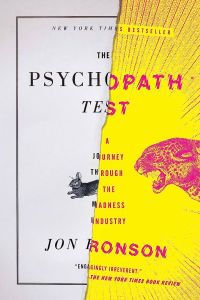
Jon Ronson’s journalistic niche is the weird, so when he learned that numerous intellectuals across the western world had received identical volumes of the same modified book — a richly bound but thin little volume that consisted of both blank pages and cryptic messages, with an identical square cut out of each volume’s page 13 — he had to find out more. The recipients found one another in their attempts to find out what on earth they’d received, and one of them reached out to Ronson to enlist his help. Ronson’s own investigation determined that the books were sent out by a particular person who he realized was a little mental, and he wondered that so much activity — including transatlantic meetings! — could result from the random activity of a crazy person. Maybe it’s not reason or love or money that makes the world go round. Maybe it’s madness. His interested kindled, Ronson then began exploring the world of being ‘crazy’: what is it? How do you know? — and then became interested in psychopathy in general after meeting someone who claimed to have faked mental illness to avoid prison, only to find himself locked up in one of Britain’s worst-case offender nuthouses.

Mental illness of varying kinds is steadily on the rise, spurred by both The Professionals’ urge to stick a label on everyone so they can sell them pills, and by the fact that 21st century American society is deeply dysfunctional, our animal brains deprived of much of what they need and saturated with so much of what they don’t. But there’s a difference between being depressed and anxious and being certifiable –– but behavior is so subject that even a normal person can get themselves in trouble, as witnessed by the Rosenhan experiment of the 1970s, in which a team of researchers faked diagnoses to get themselves institutionalized, and then learned that once a label had been appended to them, all of their behavior was interpreted to further justify and strengthen the diagnosis. This is not a problem unique to mental health, of course: as Will Storr discovered in his forays into conspiracy thinking, once people adopt a narrative our strongest tendency is to continue working anything new into the existing narrative. (For what it’s worth, the Rosenhan experiment has also been been deeply scrutinized, the publisher of the paper accused of exaggerating and cherrypicking his data.) Ronson’s time spent with someone locked up in one of Britain’s units for dangerous psychopaths intrigues him, in part because the man is utterly unlike everyone else: ‘Tony’ maintains he faked being mad using movies as his inspiration in hopes of avoiding a prison term, only to find himself stuck with an interminable sentence at a far less humane institution. The doctors maintain that Tony’s ability to fool Ronson is part of his psychopathy: he has no real emotions, but he has studied neurotypical people and can imitate and even manipulate us. Ronson is made cautious, but not convinced, especially after he goes forth to visit other people regarded as psychopaths and finds them decidedly more chilling by comparison. These include one man who was a prominent political figure in the Carribean and another who was a CEO.

The Psychpath Test is interesting and entertaining, but tends toward the disorganized.

Highlights:

“Can’t you see? It’s incredibly interesting. Aren’t you struck by how much action occurred simply because something went wrong with one man’s brain? It’s as if the rational world, your world, was a still pond and Petter’s brain was a jagged rock thrown into it, creating odd ripples everywhere.”

“Grandiose sense of self-worth?” I asked. This would have been a hard one for him to deny, standing as he was below a giant oil painting of himself.

“I think it’s rather a sad story, David,” said Belinda. “According to Messiah culture, or prophet culture, you’re making several mistakes. Firstly, you’re not taking time out to really meditate on your mission. You’re coming public far too soon. Secondly, you’re not gathering a following around you. Thirdly, you’re announcing it yourself when really it should be for other people to say, ‘He is the One,’ and start to bow down to you or whatever. But you’re coming out and throwing it at everybody. My point is, you’re not behaving in a very Messiah-like way.” David shot back that seeing as how he was the Messiah, any way he behaved should be considered a Messiah-like way.

Practically every prime-time program is populated by people who are just the right sort of mad, and I now knew what the formula was. The right sort of mad are people who are a bit madder than we fear we’re becoming, and in a recognizable way. We might be anxious but we aren’t as anxious as they are. We might be paranoid but we aren’t as paranoid as they are. We are entertained by them, and comforted that we’re not as mad as they are.

I wondered if sometimes the difference between a psychopath in Broadmoor and a psychopath on Wall Street was the luck of being born into a stable, rich family.
Posted in Reviews | Tagged , , , | Leave a comment

Top Ten Tu- um, Wednesday

I missed yesterday’s Top Ten List because I was at the hospital doing my one-year transplant checkup. Everything looks peachy on that end: they were concerned about my low white blood cell count, but a shot and changes to my medicine regimen have gotten that squared way. Since today’s WWW is definitely not my cup of tea (romance genre), I’m going to do yesterday’ TT, Top Ten Reads on my Summer TBR.

First up, let’s look at my Mount Doom priorities from earlier in the year. I’ve addressed half of them this year, but let’s choose two from there.

(1) The War of 1812, John K. Mahon. This is one of the beefier titles on the list, and I’ve wanted to dig more into the topic since 2021.

(2) The Moral Animal, Robert Wright. I’ve wanted to read this one for a decade. Not really sure why it never makes it off the shelf and into my hands.

Now, looking at ye olde classics club


(3) Democracy in America, Alexis de Tocqueville. I usually do a few books relating to American literature, early America and the war for independence in late June and early July, so don’t be surprised to see this one soon.

(4) My Name is Asher Lev, Chaim Potok. Ditto!

Relatedly, some Mount Doom titles that also fit with the American series will be:

(5) British Soldiers, American War: Voices of the American Revolution,  Don Hagist

(6) The President’s Club: Inside the World’s Most Exclusive Fraternity, Nancy Gibbs

And now, just for fun!

(7) Astounding: John W. Campbell, Isaac Asimov, Robert A. Heinlein, L. Ron Hubbard, and the Golden Age of Science Fiction. Alek Nevala-Lee.

(8) Live, From New York! An Uncensored History of Saturday Night Live, Tom Shales. Mostly reading this for information about the original cast run (seasons 1 -5), since a friend is introducing me to them. We’re midway through season 3 and I’m Jane Curtin’s #1 fan.

(9) Sons of the Waves: The Common Seaman in the Age of Sail, Stephen Taylor. Purchased for RoE.

(10) A Man Called Ove, Fredik Bachman. I recently watched the America-adapted Tom Hanks version and had to start reading the book that inspired it.

Posted in General | Tagged | Leave a comment

Teaser Tuesday posted from a phone edition

There is one drawback to not wearing a moustache, and that that if you don’t have one, you’ve got nothing to twirl when baffled. All you can do is stand with your lower jaw drooping like tired lily, looking a priceless ass, and that is what Stilton was doing now. His whole demeanour was that of an Assyrian who, having come down like a wolf on the fold, finds in residence not lambs but wild cats, than which, of course, nothing makes an Assyrian feel sillier.

Jeeves and the Feudal Spirit
Posted in General | Tagged , | Leave a comment

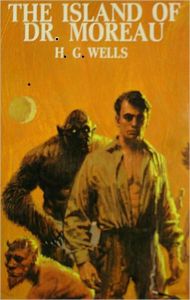
The Island of Doctor Moreau

© 1896 H.G. Wells

“It was not in eating the apple that I sinned, but in overstepping the mark set for me. ” – Adam, Paradiso.  

Adrift at sea,  a young biologist named Prendick – who had taken to natural history to relieve himself from the burden of inherited wealth and a life of ease —  is rescued by a boat carrying a menagerie of critters and some rather strange passengers.   The ship’s captain has been driven to drunkenness by the stress of these passengers, and  when the floating party approaches their destination, Prendick finds himself abandoned to the seas once more – only to be rescued by the islanders. There’s something a little strange about them, but Prendick – disoriented from his near death and the turbulent circumstances can’t quite put his finger on it. Is it just him, or does that man have….slightly pointy, slightly furry ears? The island appears to be some kind of scientific outpost performing gruesome biological experiments, and when Prendrick flees the compound to find sanctuary in the jungle, he encounters sights even more harrowing than the frenzied screams from inside the outpost. As the story develops, Prendick learns that the chief scientist, Doctor Moreau, is attempting recreate animals in man’s image via vivisection , twisting pigs and leopards into human form regardless of pain or propriety. Prendick’s sympathy for the creatures so distorted by Moreau’s experiments turns increasingly into disgust at their uncanny mix of human and beastly features, made worse after events transpire and Prendick finds himself alone with the beast-folk and quickly assuming Moreau’s detachment and disdain for them. The tale reminded me strongly of Frankenstein, though with less humanity. Were it told today, Moreau’s obscenities would have been performed in part with genetic modification, I’m sure. Prendick’s own moral fall –beginning as a principled, sympathetic man who ends up as cold to the beast-people as Moreau, and as suspicious of other men’s own beastly natures – testifies to the darkness in each of us. This is a SF-horror story of lasting relevance, making me think about the ghoulish practice of aggressive ‘affirmative care’ for people, mutilating bodies with chemicals and surgery — or the spectre of transhumanism in general, of people trying to make robotic ubermensch of themselves.

Posted in Classics and Literary, Reviews | Tagged , , , | 10 Comments

Farming for xp and fields

More short rounds today, bringing together a lite SF title and a collection of Wendell Berry’s farming essays.

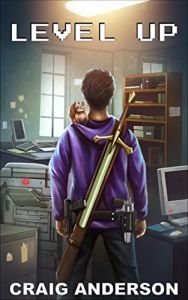
First up is Craig Anderson’s Level Up, a title in the relatively new field of ‘litrpg’ in which video game elements are part of the story. I can’t remember how I encountered the word, but I recognized the idea immediately: Ready Player One is a prime example, and Daemon is arguably a prototypical example, given that the artificial intelligence there actively recruited gamers as its initial agents, and used a leveling system to reward them for performance as it expanded. In the case of Level Up, we’re introduced to a young and unhappy business analyst named Marcus who works at a job he loathes but hasn’t left because he’s supporting his mother and continually chained to his desk with promises of promotion. He seeks escape and meaning in the world of videogames, and when an old flame wanders into town who is working on a VR rpg and needs a tester, he’s more than happy to give it a shot — if only to be around her. During the initial tests, though, Plot Things Happen and Marcus is surprised to find video game elements now present in real life. He has a health bar, for instance, and a Quest menu has suddenly appeared within his vision. Reality itself is behaving like a game: beaten-up mobs inside a bar respawn the moment he leaves and re-enters. I say “Plot Things Happen” both because I don’t want to spoil the entire premise of the book, and because it’s not deeply developed. The results are fun, though. This is not serious SF like Daemon, but it’s a light urban fantasy-adventure saturated with videogame tropes and humor, presumably aimed at younger readers (teens and very young adults) but with some easter eggs thrown in for older audiences. There’s a lot of humor here and we get to see Marcus do something like Biblo in The Hobbit, the adventure forcing him to grow beyond his passivity and learned helplessness.

Related:
Besides the aforementioned titles, One Word Kill is also in the neighborhood. It’s a mix of science fiction and RPG elements set in the eighties.

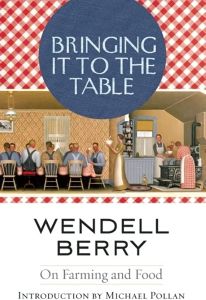
On a completely different note, reading The Dirty Life prompted me to finish Wendell Berry’s Bringing it to the Table. I’d started this a few months back after a friend gave me a copy, but I’ve read so much of Berry before that it was deeply familiar terrain and more of a reminder of what I already believe — so, I was distracted by other things. The book is a curious anthology: half farming essays, a third visits with farmers who are still maintaining traditional farming and husbandry despite the pressure to get big or get out, as the cretinous corpocrats in DC and K Street urged in the 1970s, and a dash of excerpts from Berry’s fiction in which food culture appears. The core message of Berry’s farming essays is that industrial agribusiness as reduced the integrated elements of agriculture into objects to be manipulated and used to exhaustion: the land and livestock are mere objects subject to the will and desire to maximize profits, and farmers themselves are reduced to clients. I saw this first when watching Food, Inc ten years ago and learning how chicken farmers are held in continual bondage to the big distributors like Tyson, who constantly demand equipment upgrades and perpetuate debt cycles. Here and in The Unsettling of America, Berry expands his criticism of the shift from farming to agribiz to the nation itself, pointing out that the system is becoming increasingly more fragile as it becomes more centralized, and the efficiencies of economies of scale are eaten up by the inferior quality created by mass production and the loss of attentive care. The same arguments are being made — and practiced today, with small-scale but intensive farming (like that practiced by Mark and Kristin) undermining the theory that agriculture must consist of county-sized monocultures tended to by dirt-compacting machines, or vast factories in which thousands of animals stand in their own offal, the horrors of their environment compounded by the drugs they’re continually injected with to counter those horrors. Quotes to follow.

And speaking of agribiz, up next is psychopaths!

Related:
Oh, my. Anything by Berry or Salatin, and throw in Schumacher, Sale, and Seeing Like a State to boot.

Posted in Politics and Civic Interest, Reviews, science fiction, Society and Culture | Tagged , , , , , , | 8 Comments

Billy Yank @ Johnny Reb Stadium: PLAY BALL!

That title is just a way of me combining two Civil War short rounds into one post. (Billy Yank wins the five-game series, 3 to 2, but in a show of terrible sportmanship, burned the stadium on their departure.)

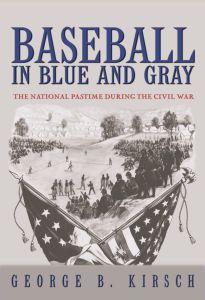
First up, Baseball in Blue and Gray: The National Pastime during the Civil War. This brief little book covers baseball in the 1860s, both at home and in military camps. Although primarily about the war years, author George Kirsch often refers to the 1850s to give better context. Baseball was not quite the sport as we know it here, but its head was definitely breaching. Kirsch offers a brief overview of the origins of baseball — the popularity of stick-and-base games in England, their migration to America and subsequent evolution of proto-baseball games with varying rules — before charting the progress of baseball through the war. The game was a popular, not professional sport back then: schools, workplaces, and fraternal organizations had their own teams of ‘nine’ that would play against one another, but no one was ‘paid’ — not officially, anyway. Despite so many men being off at war, baseball became an increasingly popular spectator sport during the conflict, possibly as people sought relief from the war news. When the Army of Northern Virginia invaded Pennsylvania in hopes of forcing a defeat on the Yankee army to end the war, Pennsylvania newspapers nontheless published article after article about Philadelphia’s team playing a series against New York squads. At this time there were still different baseball rules, but the “New York” rules that modern baseball is based on became the standard during the war years. Baseball was also a constant diversion for soldiers, both on campaign and in prison camps, and the bringing together of men from different parts of the country together helped the sport spread from the northeast and midwest where it was most popular to across the country in general. Officers supported the game, since it promoted ‘good martial virtues’, and presumably was a healthier way to keep the men entertained than drinking and gambling. Soldiers tended to use more informal rulesets than the New York approach, given the problem of supplies (especially for southerners) and the chaotic nature of war. Kirsch reports one instance of a ballgame being interrupted by an attack, in which the outfielders were shot and taken prisoner, but the infielders managed to get back to the safety of their lines. Informative but short!

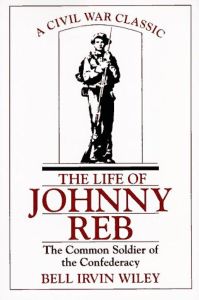
Nothing charms me more in studying history than seeing through mere text and photos and discovering the human underneath. Too often the common soldier of the Civil War, rebel or yankee, is viewed only for his part in a political story created after the fact. The humble shoulders of a working man turned soldier, whose affections are for his country, his home, and for his sense of rightness and duty, are saddled Atlas-like with notions of a great crusade in which he is either the hero or the villain. This is especially true these days, when men who fought for nothing more or less than their grandfathers fought not eighty years prior are demonized for the sins of the politicians running things, so that the current generation of politicians can score brownie points attacking the memory of men with far more integrity and honor than themselves. In such a time, it is absolutely refreshing to encounter a text like The Life of Johnny Reb, an utterly comprehensive history of the ordinary soldier, the man who fell by the hundred thousands not for politics but for matters more mundane and important, like his home. Not only does Bell Irwin Wiley draw deeply here from the letters and diaries of soldiers, but he lived in a unique and rapidly dying time when there still existed a few souls who had fought in the war, who could tell him first hand of their experiences. They could even imitate, however weakly, the ‘rebel yell’. From Wiley’s considered study we experience every aspect of a soldier’s life: his high spirits on joining up, his struggles with disease and injury and officers, his vices and diversions, his taking consolations in letters home and religion, and his endurance, adaptability, and courage despite constant want of supplies and precious little pay or respite from the front. This is one of the few Mount Doom books I plan on keeping, and I’m going to read Wiley’s Life of Billy Yank once I’ve made more headway on said pile o’ books.

Posted in history, Reviews | Tagged , , , , | 2 Comments

The Debutante

The Debutante: From High Society to White Supremacy
© 2023 Jon Ronson
Audible original, 3 hrs

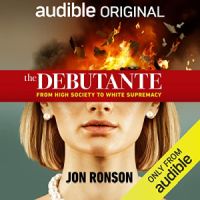
The Debutante is Jon Ronson’s investigation into the rumors and contradictions surrounding Carol Howe, a young woman who became interested in white nationalism and associated with various and sundry neo-Nazi types until she was raped by Dennis Mahon (later imprisoned for an Arizona bombing) and became a state informant against them. Her origin is especially curious because while she was a child of privilege, she was an adopted child of privilege — and one of her schoolmates interviewed here suggested that Carol embracing racial nationalism was her way of establishing an identity for herself. Carol is chiefly of interest because she claimed that Timothy McVeigh was directly connected to a community of separatists and racists called Elohim City, and that he and others were planning on attacking federal buildings. Ron’s investigation includes interviews with those who knew Howe, and those connection to Elohim City — including the alleged “John Doe #2”, Andreas Strassmeier, who was ejected from Elohim City during the McVeigh investigation. (The Strassmeier interview is especially interesting because he wants to know if Ronson buys the ‘official story’, and speculates himself as to who John Doe 2 might be — taking Ronson by surprise!) The audible version appears to have been adapted from Ronson’s BBC series, so there are a lot of clips of repeated audio — but we do get to hear his interviews with the people themselves, which is considerably more interesting than listening to him do both sides back and forth, especially given that he’s not the most pleasant narrator to listen to. (He’s a British David Sedaris — fine in short doses but grating for longer periods.) Ultimately, Ronson is unconvinced that the bombing involved anything more than McVeigh, though it appears McVeigh had attempted to approach Elohim City. It’s 4 stars for the content in general, and 3.5 for the audio. As much as I loved hearing the actual interviews, the repeated clips detract a bit. I do appreciate Ronson’s determination not to get carried away by anyone’s narratives — especially given Howe appears to have been a compulsive story-spinner — and stick to what is most plausible given confirmed facts. (At least, for this issue. He still trots out the January 6 ‘insurrection’ as though policemen weren’t actively escorting the supposed insurgents.) For my money, having read a biography of McVeigh, I’m content believing that his army background gave him more than sufficient technical knowledge to build the truck bomb. The book ends on a marginally happy note, as Ronson learns that Carol has changed her name and is attempting to recover from the mental poisons she fed herself for long.

Related:
Harvest of Rage: Why Oklahoma City is Only the Beginning. On the downfall of American farmers and a new wave of anti-government populism.
American Terrorist, aforementioned biography of McVeigh

Posted in history, Reviews | Tagged , , , , , , | 2 Comments

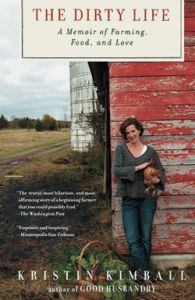
The Dirty Life

The Dirty Life: A Memoir of Farming, Food, and Love
© 2011 Kristin Kimball
287 pages

When Kristin Kimball left her cozy confines in the big city to interview a passionate young farmer in the sticks, she had no idea her life was about to change. Mark lived in a simple trailer and farmed someone else’s land, but he produced such exquisite vegetables that people came from miles around to buy food from him. His dream was his own farm, where he could go off-grid completely and develop something like a CSA on steroids – providing for the entirety of its members’ food needs. No sooner had Kristin showed up for the interview than Mark put her to work hoing broccoli. The two found themselves drawn together despite their differences in lifestyles, and before she knew it Kristin had left her apartment behind and pooled her money with Mark’s to engage in an enterprise of bringing a dormant farm back to life – learning not merely intensive gardening along the way, but animal husbandry and other diverse skills that farms demand at the most unexpected times. Most challenging, though, she and Mark both have to learn to be partners — pulling together as a team, much like their horses Sam and Silver. 

The Dirty Life is, like the soil Mark and Kristin lived on, rich in value. On a superficial level, it’s the story of their first year trying to revive Essex Farm, which would have been challenging enough for anyone without the added burden of their ambition: they wanted to be able to provide a complete diet for not only them but dozens of others, which meant developing (quickly) the knowledge, stock and fields, and material infrastructure required to provide a diverse diet. They couldn’t just buy a few hundred head of cattle and send them off to be butchered: no, they were creating a wide range of animal products, and often developing the knowledge to do so on the fly. Mark was a master gardener, but neither he nor Kristin knew the first thing about animal husbandry — and now they were not only raising cows and swine, but driving horses. As Kristin quickly learned, knowing how to ride a horse is much different than working a team across the land.  

All of this would be fascinating in itself, assuming you are interested in agriculture, homesteading, animals, local food, etc. But the soil keeps gets deeper, as Kristin continues to adapt to life on the farm. Previously, she’d lived a very comfortable existence as a consumer-creature, her life filled with ease, comfort, and pretty things. As a partner in Essex Farms, she worked long hours, abusing both her clothes and her body, and in addition to the daily demanding chores, she and Mark also had to navigate emergency after emergency. Despite frequently being sore and always being covered in dirt, blood, and…other stuff, though, the former comfy city girl found intense pleasure and meaning in this life of work, in the physical exertion itself and the satisfaction of seeing her labor immediately bear fruit. She and Mark also were not alone: from the moment they arrived in Essex, Mark and Kristin were welcomed into the local community, who were so glad to see new arrivals that they offered tools, advice, and labor freely. Like the Mendes in Better Off, and like the agricultural community portrayed in Wendell Berry’s Port William series, the Kimballs lived as members – most intimately with one another, and of their farm, but of the outside community. They saw and worked with the members of their village every day, and when they had developed to the point that offering shares was possible, the people of Essex were the first to buy in. By the first few years, they were feeding hundreds. 

I knew I’d love this from the word go, and was not disappointed. Mark and Kristin recreated for themselves a life lost to most humans, a life not only wed to the land, within the rhythms of nature, but a life in full. Gone were Kristin’s days of sitting in front of a computer, using only her mind. The farm demanded mind and body — sometimes brute labor, but more often than not strength married to experience, strength guided by intelligence. They had to solve problems never anticipated, draw on inner reserves they never dreamt existed. Reclaiming the farm from neglect and abuse required every part of Mark and Kristin’s being: their muscles, their minds, and their spirits. They lived integrated lives, putting their whole selves to use but also integrating themselves into the community of Essex, where they became a vital part of its now-growing web of human connections.   The more we descend into the brave new world of the 21st century, the more we drift from reality into some omnipresent digital construct, where we drift through as disembodied avatars with no more substance than a hologram cast in the sky, the more valuable perspectives like Kristin’s are. We hunger for substance and meaning, and she found both.

“Raw milk from a Jersey cow is a totally different substance from what I’d thought of as milk. If you do not own a cow or know someone who owns a cow, I must caution you to never try raw milk straight from the teat of a Jersey cow, because it would be cruel to taste it once and not have access to it again.”

“‘I don’t want to tell you what to do,’ Shep began. This, I’d found, was a very common statement in North Country. You’re not considered rude if you don’t return phone calls, or if you get drunk while working, or fail to show up as promised, but telling someone how to dosomething is bad form and requires a disclaimer.”

“As I patched the barn with scrap lumber, pig-tight but ugly, I was forced to confront my own prejudice. I’d come to the farm with the unarticulated belief that concrete things were for dumb people and abstract things were for smart people. I thought the physical world – -the trades — was the place you ended up if you weren’t bright or ambitious enough to handle a white-collar job. Did I think that a person with a genius for fixing engines, or for building, or for husbanding cows, was less brilliant than the person who writes ad copy or interprets the law?”

“This land had been farmed since before the American Revolution. The stock, the crops, the fence lines, the buildings, and the farmers had come and gone, passing over the fields like shadows in the course of the day. You can’t truly own a farm, no matter what the deed says. It has a life of its own. You can love it beyond measure, and you are responsible for it, but at most you’re married to it.”

Related:
Better Off: Flipping the Switch on Technology. Eric Bende. The story of a newlywed couple who join a ‘minimite’ community.
Literally anything by Wendell Berry, whose essays cover a lot of what Mark was concerned about, and who I would not be surprised to learn was an influence. The use of animals to work the farm instead of tractors, for instance.
Ditto Joel Salatin, who like Mark and Kristin took it on himself to reclaim a homestead that was not only abandoned, but largely ruined by machine-farming.

Posted in Reviews, Society and Culture | Tagged , , , , , , , , , , | 4 Comments

Teesday Toosins

Today’s “Top Ten Tuesday” is ‘bookish wishes’, or books we’d like to own. But first! Teases!

Teaser Tuesday, Or: A Buncha Quotes from Level Up That I liked

“Hell no. I don’t want to make it weird. She’s just out of a serious relationship. I’m just going to work on our friendship.”
“Congrats mate, you’ve maxed out your friend zone skill.”

I’m holding a handful of teeth. I’m not sure how many of them are mine.

I can do this. I just have to say something nice about her, a compliment, anything to break the ice. Anything at all. “You have a face!”

“You seem to be getting the hang of the combat, but you shouldn’t have let them punch you in the face so many times.”
“Thank you sensei, I shall heed your words of wisdom passed down from the ancient times.”

And now, the Top Ten Tuesday list…

…eh, just look at “Top Ten Reasons to Destroy Mount Doom“, though to it I would add:

The Atlas of Beauty: Women of the World in 500 Portraits. A bit like Humans of New York, I think, but all belles and no beaus.

The Call of the Weird: Travels in American Subcultures, Louis Theroux. If you can’t tell from my recent reading, I am definitely in a Mood for this sort of thing.

The Life We’re Looking for: Reclaiming Relationship in a Technological World.

Waco Rising: David Koresh, the FBI, and the Birth of America’s Modern Militias

Digital Madness: How Social Media is Driving Our Mental Health Crisis

The Well-Tuned Brain: The Remedy for a Manic Society

Distracted by Alabama: Tangled Threads of natural History, Local History, and Folklore. Planning to buy this as a birthday gift for a dear friend of mine, but will (naturally) have to read it first to ensure it’s as good as the title promises.

Posted in General | Tagged , | Leave a comment

Angels, barbarians, Trump, and boring Klansmen

Short rounds time!

Angels, Barbarians, and Nincompoops is a wonderful romp through a few score words in the English language. Esolen has always impressed me as a man deep in word & song, saturated by the beauty of language — and here he is like a boy, playing with his favorite words and showing them off to the reader, with too much delight to keep to himself. Given how serious Esolen’s other works tend to be, I enjoyed this both for its content, and to experience Esolen’s joy at his subject. It’s a lovely mix of etymology, history, and a dash of Esolen’s characteristic cutting wisdom. . Originally purchased for Read of England. Some quotes!

The bureaucrats who sat heavy upon the soul of Scripture, lying like lead within its bosom as they translated it from Greek into the Unglish of a certain version I dislike intensely and will not name, turned up their noses at angel or herald. They say that a messenger came from God to Abraham on Mount Moriah, which in our tongue makes him sound like a telegraph boy from Western Union. “God to Abraham: stop. Hands off the boy. Stop. Faithfulness duly noted. Stop.” Lovers of beauty in language and liturgy to such translators: STOP!

But that wasn’t the old word for fruit in general. That old word was aeppel: Modern English apple. That’s the origin, there, of the idea in English that Adam and Eve ate an apple. What they ate was a fruit. In medieval iconography, it’s usually a pear. It could have been a peach or a pear or a pomegranate—or an apple.

We also would never have had the scornful name for the late nineteenth century in America: The Gilded Age. That was when writers like Mark Twain and William Dean Howells suggested that the virtues of the newly rich industrialists were like gilt on wood or plaster: glittery and thinner than paper. If that was the Gilded Age, what is ours? We might hire for the job a sick cousin of gold and gild: The Jaundiced Age, yellow with the bile of a dying liver.

The hat gives us a clue that the French word is the same as the Italian persica, peach (cf. German Pfirsich). The word literally means the Persian thing. The peach wasn’t native to western Europe, but was brought back west by Roman traders with the Persians, who lived in modern day Iran.

My favorite related word, though, is idiolect. No, that is not the special speech of politicians. That is denoted by the technical term gibberish. Nor is it the language of bureaucrats, educationists, and people who parrot their pronouncements: that is jargon, argot, patois. It is not the language of a reasonably well-defined subgroup, like the people who live on the Orkney Islands: theirs is a dialect. Nor the words and sayings and linguistic constructions of people who share a social class (patois), or a line of work (argot, jargon). An idiolect is a form of the language peculiar to one person alone. He goes beyond the idiom of his neighbors, and says things that only he says, or that only he says in the way that he says them.

The point is that human freedom and flourishing depend not upon our having choices, but upon our having the inner freedom—a liberating virtue, hard-won—to make right choices. The wrong choices enslave. It may look like liberty to choose among one of the dishes above, but it’s a liberty to choose which stuff is going to make your gorge rise up. It may look like liberty to have your choice among fifty ways to descend lower than a beast, but that’s a liberty to choose the color of your manacles and fetters. They may come in all the colors of the rainbow, but they are still going to chain you to the post.

Man is always more than man: we must aspire to the transcendent, or we die inside.

This is…sort of a sequel to Them, in that Ronson builds off his relationship with Alex Jones (established before Jones was famous, when both were curious about the Bohemian Grove meetings and infiltrated a ceremony together) to react to the fact Jones has the ear of the man who might (and would) become el presidente. Entertaining enough, but a lot of it copies Them directly, something I only noticed because I read these back to back. It’s more of a long essay than a book, at fifty pages.

Lastly, Inside the Klavern. This is an odd book, consisting almost entirely of the minutes of an Oregon chapter of the Klan in the 1920s, so it’s chiefly of interest to those with a serious, possibly academic, interest in the ’20s Klan. As far as content goes, this is exactly as exciting as you’d expect minutes of a civic organization to be. There’s much chatter about paying dues, hosting visitors, etc. The casual reader may not realize that the 1920s Klan was much different from the 1870s Klan (which existed to attack carpetbaggers and freedmen) and the 1950s Klan (which existed to intimidate blacks and whites organizing for integration, civil rights, etc). These minutes indicate how different the 1920s Klan really was — racist, yes but more broadly xenophobic and reactionary, incorporating some moral crusades of the day like Prohibition and promoting “100% Americanism”. This was in large part a reaction to the enormous amount of immigration from Europe, which brought with it different religions (greater numbers of Catholics and Jews, for instance, who were arguably more of interest to the ’20s Klan than blacks) and political mores. The Klan of this time saw themselves as just like any other fraternal organization of the time — supporting sick members, helping each other find work supporting one another’s businesses, frequently socializing and the like — but who were ‘woke’ to the cultural and racial problems at hand. They were not wholly ideological, however: some of the later minutes here delve into a local water problem at great length, as though we were reading the minutes of the Rotary club. The Oregon chapter here doesn’t appear to engage in any violence, though the minutes do allude to people being intimidated, including their own members — for crimes like neglecting their families, drinking, or shopping in the businesses of ‘aliens’. Although a lay reader would profit better from a normal history of the ’20s Klan (I can tentatively recommend Behind the Mask of Chivalry, though it’s problematic in parts) this does offer a look into proceedings, rituals, and the like.

Next up….a Jon Ronson audiobook in which a debuntate turned swatiska-wearing pinup girl of a white supremacy movement claims Timothy McVeigh was just a mule for the real architect of the Oklahoma City bombing.

Posted in history, Politics and Civic Interest, quotations, Reviews | Tagged , , , , , | 2 Comments