Adventures with Extremists

Them: Adventures with Extremists
© 2011 Jon Ronson
338 pages

Personally, dear reader, if I were infiltrating Bohemian Grove, where the American aristocracy gathers to sacrifice children to Moloch and dance with the devil in the pale moonlight, I wouldn’t take Alex Jones along with me. He’s entertaining company, sure, but I’m pretty sure he doesn’t have a quiet mode – and when one is trying to violate the meeting of people with private armies and access to dungeons and the like, one wants to go unnoticed. Jon Ronson, however, had better ideas – and considering that he’d been outed as a Jew in front of both jihadists and Klansmen, I suppose he figured he could survive anything.   Them is an entertaining collection of Jon Ronson’s adventures in this vein, as he attempts to learn why so many people believe in a secret cabal that runs everything, whether they be lizards or Jews.  

Unlike Will Storr’s The Unpersuadables, Them was not a project undertaken to understand why people believe unusual things; instead, it’s one collection of many of Ronson’s articles about people on the fringe. As such, we’re not diving deeply into how people’s beliefs originate, but rather spending time with them through Ronson and marveling at the weird places the human mind can take itself. Easily the strangest group he spends time with is David Icke’s circle, who believe the world to be dominated by shape-shifting lizards whose numbers include most prominent politicians and celebrities. Icke gives a recap of how he came to be aware of the lizard people, but it’s very cursory and has some….story-telling gaps, shall we say. Many of the chapters are linked by Ronson’s attemps to understand what the Bilderberg group is, and he goes as far as Portugal to attempt to learn about that year’s conference there.  He is approached, confronted, and followed for mile after mile, pushing him into thinking that for an organization of perfectly respectable businesspeople talking about business and philanthrophy, they’re awfully sinister.  By far the most entertaining chapters were Ronson’s visit to the new head of one Klan organization, in which we learn of Thomas Robb’s approach to leadership, with principles drawn from self-help books and psychological profile – followed by Ronson’s infilitration of Bohemian Grove, accompanied by Alex Jones. The idea of Jones wearing preppy clothing and trying to pass himself off as an IT venture capitalist is hysterical – made all the better by his sinking into wide-eyed paranoia when Ronson and he witnessed (among other things) the bizarre Cremation of Care ceremony. (Jones filmed this during their joint incursion, and used it as part of an early ‘documentary’ which effectively launched his career. So, if you hate Alex Jones, you can thank Jon Ronson!) Inspite of its weirdness, Ronson viewed the Bohemian Grove meetup as something kin more to a college kegger given its copious drinking and drag/Elvis costume contests. Some of the stories were more miscellaneous: the opening chapter among jihadists (pre 9/11) was amusing enough, but his travel to Africa with an Irish politician-turned-preacher & militia founder appeared out of place.  

On the whole, Them made for entertaining reading, but there’s little insight here, and I wasn’t impressed with the background Ronson did, if any. He asserts that Timothy McVeigh blew up the Murrah building in Oklahoma City because it was an office of the New World Order, but I’ve never encountered that in anything I’ve read on McVeigh. McVeigh chose the Murrah building because it held offices for both the FBI and ATF, both of which  he had an especial hatred for owing to their murder of Vickie Weaver and the men, women, and children of Branch David in Waco. The book is not devoid of serious implications, though: Ronson quickly realizes how quick the media is to grab onto a narrative and marry it, facts not withstanding. He himself is repeatedly described by the media as a conspiracy theorist despite being an outside observer, and he is shocked to discover that the “fortress” that Randy Weaver “fled” to was, in fact, a simple wooden cabin that was his and his family’s house. Weaver didn’t “flee” anywhere, he simply didn’t leave his home to show up in court.  

Quibbles and occasional superficiality aside, I thoroughly enjoyed this. I’ll admit to having a soft spot for people with eccentric ideas, provided they’re not in my face ranting. Finding their blog or listening to them talk to someone else is quite sufficient. It helps, of course, that as someone with a strong libertarian bent, I’m considered ‘fringe’ myself — an object of dismay to progs and conservatives alike. (Not to mention: when you’re an anti-state type, you run into other anti-government types, and some of them are a little nuts. I’m sure some readers of this blog often wonder if I’m not a little nuts.) I think Ronson was generally fair — never mocking his subjects, and undoubtedly courageous. I plan on looking into more of his works, though judging by reviews he’s gotten more partisan and less curious over the years. His book on psychopaths looks particularly winsome….

Related
The Unpersuadables: Adventures with the Enemies of Science, Will Storr 
Suspicious Minds: Why We Believe Conpiracy Theories, Rob Brotherton 
Slanted: How the Media Taught us to Love Censorship and Hate Journalism
Every Knee Shall Bow: The Truth and Tragedy of the Weaver Family
American Terrorist: Timothy McVeigh | Why Waco | The Ashes of Waco | Waco: A Survivor’s Story
Gun Guys, Don Baum. Another fish-out-of-water journalistic  voyage
Posted in Reviews, Society and Culture | Tagged , , , , | 4 Comments

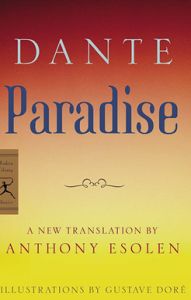
Paradiso

Paradiso
© trans. 2007 Anthony Esolen, original 14th century by Dante Alighieri
544 pages including notes & appendices

I’ve gotta hand it to Dante, at least the character Dante. I though I’d fallen hard for a woman, but against him there is no parallel. Even Menelaus, who led a fleet to Troy to reclaim Helen, must bow before Dante’s fixation on Beatrice — for in Paradise, we follow our intrepid narrator who has been into the innermost bowels of Hell, and strenuously climbed the heights of Mount Purgatory, now rising through the various spheres of heaven and meeting all manner of sainted ones, from medieval figures to the father of humanity himself. The higher he rises the more he witnesses, including the Earth itself surrounded by the celestial spheres and layer upon layer of transcendant joy, of beauty that overwhelms the soul (set to the music of the Tannhauser Overture, surely) — and yet Dante again and again is enraptured by his fair Beatrice, whose rescuing presence in the dark wood started this comedy divine. All the glory of creation is before him, and yet he can only marvel how it makes her face all the more beautiful, so much so that she rebukes him gently — “There is more to paradise than my eyes!”. (She finally departs towards the end so he can focus on contemplating the mysteries of the Creation, the Incarnation, and the Resurrection.) Paradise marks the end of the Divine Comedy, and it’s arguably the hardest for contemporary readers to tackle because it’s so overwhelmed by medieval cosmology, very much unlike our own. The Inferno and Mount Purgatory followed relatable geographies, but the heavenly realm of the medieval world almost unimaginable to we impoverished post-Copernicans, living as we do on a bit of wet rock doing circles around a larger bit of exploding gas. When Dante can pry his eyes away from his beloved, he’s engaging in theological discourse with those above — asking Adam about his sin, being grilled on the virtues by Saints Peter and James — but the author-Dante’s temporal concerns are still very much present, as we witness rebukes of the warring Italian factions who are spilling blood, or of the increasingly corrupt Dominican and Benedictine orders — the last scolding delivered by St. Benedict himself. There’s noticably more rhyming here, presumably because we have moved from the chaos of hell into the perfect harmony of heaven. As usual, Esolen’s in-text notes and notes are superb. I think it’s high time to read C.S. Lewis’ Discarded Image to better understand medieval cosmology.

Related:
How Dante Can Save Your Life, Rod Dreher. Selected quotes thereof.

Posted in Classics and Literary, Reviews | Tagged , , , , , , , | 6 Comments

Teaser Tuesday

Botanists tell us that the blossom is an evolution of the leaf–but they cannot say just why that particular bud should take from the same air and sunshine a fairer substance, a deeper color, a more permanent existence, and become something at which each passerby pauses, and goes on his way happier for the sight. Why on the sturdy stem of farmers and merchants should one girl blossom into a story-teller in pencil and in words?

Angle of Repose, Wallace Stegner

William Shakespeare’s works, not yet ‘kidnapped’ by polite society into the realm of ‘higher culture’, were popular and well known among working-class audiences. […] Many saloongoers acquainted with Shakespearean verse were fond of parodies, such as Hamlet’s lamenting ‘the slings and dregs of outrageous whisky’, or telling Ophelia, “Get thee to a brewery!. Another example spoofed As You Like It:

‘All the world’s a bar, and all the men and women merely drinkers
They have their hiccups and their staggerings..

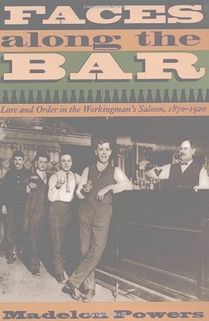
Faces Along the Bar: Lore and Order in Workingmen’s Saloons
Posted in General | Tagged , | Leave a comment

Faces Along the Bar

Faces along the Bar: Lore and Order in the Workingman’s Saloon, 1870-1920
© 1998 Madelon Powers
331 pages

Men’s thinking on this issue seems to have involved an interesting mixture of solicitude and defiance. On the one hand, decent women should be protected from the rough world of men; on the other, the rough world of men should be protected from decent women. In the saloon, according to  Hoke, ‘One ceased to be a man among women. One breasted the bar, downed a drink, and became a man among men.’ To allow women into this workingman’s world would not only cramp its style, but defeat its purpose as well. 

In the large cities of Victorian America, well-heeled men of means could often be found in gentlemen’s clubs, private associations in which important matters of industry, business, and politics could be discussed in refined settings over gourmet meals with worthy company. The working man had his answer to that, though: the saloon. Long before bars became hookup locales where young people practice seduction over loud music and sickly-sweet mixed drinks, they were places where men could close the day with a pint, a song, and some uproarious stories – but more importantly, they were places where these men could be among their fellows, imbibing not merely in drinks but in comradeship. In Faces along the Bar, Madelon Power dives into the markedly different saloon culture of the 19th century, offering a sociology not of drinking but of how saloons were effectively workingmen’s clubs – something interesting in itself, but all the more because prior studies on the working class tend to focus on their labor, and not their leisure.   Faces  draws heavily from period accounts, from nonfiction memoirs like Jack London’s to fictional renderings of bar life in Upton Sinclair’s The Jungle to offer both an engaging social history and more serious analysis of what the saloon meant. 

One of this book’s included photos demonstrates well how common saloons were in the working quarters of cities, with a dozen around one block along. Their commonness owed not just to the density of city populations, but to their diversity: given bars had affiliations with certain ethnic groups, occupations, or political leanings. Some saloons were strictly for particular unions, for instance, and ethnic divisions could be fine-grained indeed: a given saloon might not be just for Italian men, but for men from a particular part of Sicily. These ethnic bars were especially valuable in helping newcomers find jobs and places to live, as the bartender tended to collect, digest, and dispense useful information. Saloons were not merely places to drink: they served lunches that were free with a nickle beer, and these lunches were often better fare than could be found in restaurants, being subsidized by breweries who supported the expansion of saloons that they could then be the sole suppliers of booze to. Saloons were also primary source of recreation, from singing to boxing – and proper boxing, not just drunken bar brawls. Saloons were also a vital part of political organization, continuing an American tradition from the colonial days – one of the many reasons they attracted nativist attack, and one reason saloons were generally less common in the South than elsewhere. Despite the fact that many saloons were dominated by one group or another, saloons in general still aided in the American melting pot: Jewish barmen might hire assistant bartenders of another nationality to expand their clientele, and the free lunches and music offerings introduced ethnic groups to one another’s offerings. Black food & music made significant inroads in this fashion.  

These free lunches were one of the few occasions in which women were permitted to invade the masculine space of the bar, which was a place above all where a man could be with his equals – no bosses, no wives. Kids could come in to sell newspapers or to get a pitcher filled with beer for the house, but the saloon was a place for men alone – and older boys coveted their future place there, playing make-believe barmen at home and being inculcated into the traditions and mores of masculinity once they were finally of age. The spittoons and urinal trenches testified to the saloon being a place for total ease and male solidarity.  Men here groused and complained, entertained one another, shared information, or just enjoyed one another’s company . They developed elaborate drinking rituals in which they bought drinks for the fellas they were clubbing with, and received drinks in turn. Buying a drink on one’s own nickel and then leaving wasn’t just odd, it was positively antisocial. The men who claimed a bar and met there regularly had a sense of ownership in it, and when the day arrived that the bartender recognized them as a trustworthy regular who could maintain an open tab, it was a proud one.  

Ultimately, Powers writes, though the saloon culture was overtly destroyed by the forces of the Anti-Saloon and temperance leagues – Klansmen, antagonistic wives, etc — in truth the saloons were undermining themselves by their own success. The closeknit communities they were fostering inside the bar often developed into organizations outside the bar: the early 20th century abounded with civics groups and fraternal organizations that built on the bonds developed from pubs, just like a group of men who ‘clubbed’ their books together in a Philadelphia tavern gave rise to American public libraries. The squelching of bar culture during the dark days of Prohibition meant that these organizations supplanted saloons entirely: they became, as the 20th century wore on, merely a place to drink and talk, not nuclei of community.  

I thoroughly enjoyed this work, given my interests in social history of the late 19th and early 20th century, the importance of Place and community, and male society in general. I was a little suspect of this book from the start, given its female authorship, but Madelon Powers was more interested in learning about her subjects than judging them, and she appears genuinely fascinated by the rich saloon culture that was such a driving force in the late 19th century. They were genuine third places, but arguably even more than.

Related:
America Walks into a Bar: A Spirited History of Taverns and Saloons, Speakeasies and Grog Shops, Christine Sismondo
The Great Good Places: Cafes, Coffee Shops, Bars, and the Other Hangouts at the Heart of a Community, Ray Oldenberg
Last Call: The Rise and Fall of Prohibition, Daniel Okrent
Drink: A Cultural History of Alcohol, Ian Gately

Posted in history, Reviews, Society and Culture | Tagged , , , , , | 9 Comments

Sparring Partners

John Grisham is the author of scores of novels of varying quality and two collections of short stories, if memory serves. Sparring Partners is a ‘novelty’, in that it collects three novellas, ranging in time from the 1980s to the ‘present’, or at least some point when texting from cellphones is a possibility. As a collection, it’s OK — enjoyable enough reading if one needs a distraction, a bit like a sitcom. Two of the novellas are legal dramas, and the other is more of a human-interest story set on Death Row that allows Grisham to scratch his ever-present itch at sneering at the law & and order culture of the South. The first story, “Homecoming”, is the most interesting but it cheats by being set in Clanton, MS, using the reader’s affection for previously established characters (and they’re all here: Jake, Harry, Lucien, and even Reuben Atlee) get the drama off to a quick start. “Strawberry Moon”, the aforementioned Death Row story, features a man condemned to the Row as a minor for his partner in a home robbery turned double murder, one who only has one wish before he dies; and the third is about two brothers who are both stereotypes trapped in a law firm together by their imprisoned father’s contract skills, who realize a plan to relieve the old man of some of his hidden cash reserves — but things go sideways. None of the stories have real resolutions, just pregnant stopping points that indicate the way Grisham wants them to go, but can’t be bothered, and none of them appeared to involve any real effort. It’s not bad reading, it’s just not memorable or re-readable. Unfortunately, that’s a fairly common description of his stuff these days.

Posted in Reviews | Tagged , , | 5 Comments

Vein Pursuits

Vein Pursuits
© 2023 Rhett C. Bruno & Jaime Castle
322 pages | Audible version read by Roger Clark, 11 hours & change

“There are worse things than wild beasts, natives, or outlaws.” I had my own thoughts as to what he was referring to. Nephilim, demons, even people like him. But I figured I’d heard him out this far.
“Like what?”
“Bureacracy.”

Cold as Hell introduced readers to James Crowley, an undead gunman who was killed trying to protect an innocent woman and her daughter Rosa from his gang’s boss. The White Throne saw fit to spare Crowley from Hell and put his talents to use dispatching the creatures of hell who torment and prey on humanity. Authors Rhett Bruno & Jaime Castle created a unique dark fantasy / western mix, integrating southwestern mythology into a story of a bounty hunter who targeted supernatural creatures. Vein Pursuits continues the story of Crowley, who — in the events of Cold as Hell — was reunited with the rescued girl from long ago, now a mysterious and beautiful woman who attracts both mortal men and the spawn of Satan alike. Rosa saw things in Cold as Hell that she cannot explain, and she’s driven to Crescent City (a thinly veiled New Orleans) for answers. Crowley is also dispatched to the City by the White Throne, and as they travel in the company of Bram Stoker (yes, really), they quickly realize that something dark is waiting for them in the big easy. Vein Pursuits is far more fantasy-dominant than Cold as Hell, but introduces some elements that make the overall story increasingly interesting. Frankly, the coolest part of this book is one I can’t say thing about for spoilers.

First things first: if you are a fan of Roger Clark from Red Dead Redemption II, who narrates this book and who was the actor for its main character Arthur Morgan (who bears an uncanny resemblance to Crowley in terms of character & background), Vein Pursuits continues to deliver.. We open with Crowley/Arthur encountering reptilian beasts in the swamps outside of Crescent City, which can only be New Orleans given its size and the cryptids and personalities we meet there, including the Voodoo Queen, and Crowley’s contempt for the city mirror’s Arthur’s of “St. Denis”, Rockstar’s version of NOLA. At some point, I know, my brain is primed to see links where the authors did not intend them — but using the word “Chelonian” when a cult of that name has a presence in St. Denis? Crowley hunting vampires in New Orleans like Arthur can in one of the game’s many eerie secrets that players can stumble upon? The mention of Tesla, who has an obvious doppelganger in RDR2? Crowley urging someone to “Don’t look back”, just like Arthur does John? Okay, that may a bit of a reach. All the same, it’s extremely easy to see Arthur in this story, which gets extremely deep in fantasy-mythic lore. In Cold as Hell, the basic premise was that there was a gang of thieves hitting banks and using the powers of hell to aid them: here, Crowley is sent to Crescent City to hunt down The Betrayer, who we discover is the descendant of Cain and the father of all vampires — but things aren’t quite that simple. The enemies of the White Throne are not a uniform mass of coordinated villains: like mortal creatures, they fight in between themselves, and in the case of The Betrayer, have motives that go beyond merely resisting the Throne and being evil for the sake of evil. I’m really looking forward to what happens next in this series, because Crowley’s attachment for Rosa makes the Throne overtly hostile towards him, despite his being their servant, and by the end…..well, let’s just say things are never easy for a Black Badge. I’m definitely continuing in this series.

A light spoiler for those who want to know what the most interesting part of this is:

Posted in General, Reviews | Tagged , , , , , , , , | 5 Comments

America’s untouchables and baseball

Shortly after the financial implosion of the late 2000s and the beginning of the ‘great recession’, physicist & banker Chris Arnade began long walks around New York City to contemplate the ramifications of his and his ‘industry’s’ reckless speculation and general chicanery. This contemplation was not abstract and intellectual, but all too real as he strayed into parts of the Bronx like Hunts Point that everyone advised him to avoid – -being the province of whores, druggies, and hoods. Quitting his job and ignoring such advice, he began spending his days among modern America’s untouchables, becoming part of their lives even as their stories altered the way he regarded 21st century America’s narrative about itself. Becoming intimately involved with the people at the Point, seeing them as unique persons instead of a class to be dismissed or a problem to be solved inspired him to begin visiting other areas of the country that had been left behind by globalization and willfully ignored by the power-elite of DC and New York. Hanging out in dive bars, fast food restaurants, and churches — places he previously sneered at — he heard still more stories and engaged in largely deep reflection. His account of this five years project is often powerful and insightful, but it has some significant weaknesses towards the end, as part of Arnade’s reformed narrative begin telling the story more than the people themselves. Arnade realizes as his project develops that American society has been totally materialized, reordered purely to serve an economy that an increasingly rarefied few benefit from. The shifting of factories to Mexico, China, etc has not merely forced people out of work: it has destroyed the communities those places were built around. Access is controlled by credentials that are difficult for those from America’s dying places to obtain, and despite the easy advice handed out from the deracinated white-collar elite, it’s not easy to simply leave a place. Not only is moving difficult and expensive, but for those on the margins their Places provide the only support they know — not just family and friends, but the little communities that develop in churches and bars and parks where they can exchange information or provide for one another’s needs. That support isn’t just material, though, it’s emotional and personal: people hang out at the corner and smoke because the people there know and accept them, and don’t treat them as burdensome clients and compel them to navigate arcane mazes of paperwork. In addition, the migratory elite fail to realize that for some people, material goods aren’t the chief end of man. People have strong connections to their places and their people, and will persist in loyalty to them and continue trying to keep them alive. I was impressed by Arnade’s willingness to devote long hours to developing friendships with people who were completely removed from his world, and when he does devote time he develops considerable insight. That approach and level of observation is not consistent, however. As someone born and raised in Selma, Alabama, I looked forward to his visit there with great interest — only to find his time there minimal, and his conversations utterly shallow. When he visited Gary, Indiana and people there declared that all its problems were created by white flight following the first black mayor being elected, I raised a skeptical eye. When he visited Selma and heard the same exact thing, my dubiousness was confirmed — for Selma’s economic decline began long before the election of James Perkins in 2000, and its entire leadership was already predominately black a decade before that, and longstanding companies failed in Selma for the same reason they failed elsewhere: changing economies. Selma was bypassed by the interstates, and places like the American Candy Company fell prey to competition from China. Many of his interviews appeared to have taken place in Selmont, not Selma, and the picture they paint is patronizing and ignorant. Frankly, this insultingly cavalier treatment of one of the most important cities in the Civil Rights movement cast a dark cloud over not only what remained of the book, but what I’d read before. He accepted these claims without question or comment in part because he’d already developed a narrative that the psuedo-meritocratic system created by the elites is especially harmful to minorities and therefore racist. (As usual, the white working class might as well not exist, despite Arnade’s token interviews with a few men near a Trump rally.) Despite the huge pockmarks that erupted there, I still found the book compelling.

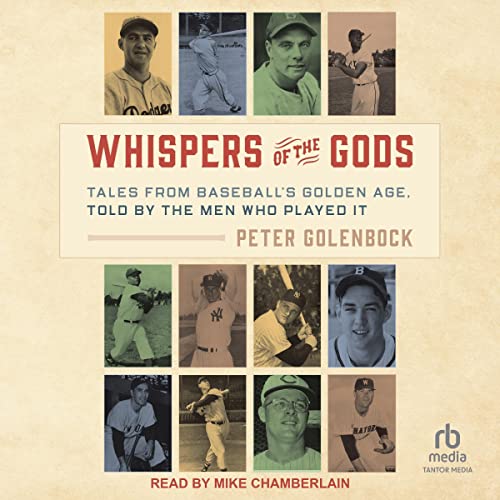
On a lighter note, I recently finished listening to Whispers of the Gods, consisting of interviews with the men who played baseball in the 1940s and 1950s. It’s enjoyable enough, but I was hoping for something like the audiobook of The Glory of their Times, which had the actual interview audio. There are few things better to me than listening to old men telling stories, except maybe watching young women sing. Whispers has the stories but we don’t get the actual men telling them, and the narrator’s use of inflection/emotive emphasis/etc is liable to be very different. The content itself is interesting, though: one player was obsessed with Shoeless Joe and (in his youth) hunted down one of Jackson’s contemporaries to get the real scoop on the Black Sox affair. The contemporary believed that Jackson was used as a scapegoat. I’d also never heard of the Mexican League, which was started by two Mexican businessmen (brothers) and tried to recruit American ballplayers from both the Negro and Major leagues in the U.S. Unsurprisingly, the MLB resisted the poaching of their players, imposing five-year suspensions on any player who tried to cross the Rio Grande. There’s also disagreement between the interviewed players over matters like the introduction of Jackie Robinson: some said there wasn’t any hazing, some said there was hazing but it was the same as any new guy would get to make him prove himself, and others who said Jackie was targeted. World War 2 is a big factor in a lot of these guys’ stories: one man said the first time he saw a major league game, he was pitching it — just a couple of months out of high school. That happened in part because so many of the players went off to war, of course. A lot of these interviews happened for the authors’ other baseball books, so it’s not the deliberately created record that Glory is. If you’re interested in mid-century baseball, this is an entertaining collection of player memories, but it’s not a patch on Glory.

Posted in history, Reviews, Society and Culture | Tagged , , , , , , , , , | Leave a comment

I have questions, Goodreads….

Posted in General | Tagged | 4 Comments

May 2023 in Review

Another month gone, and — well, I’m a little proud of this one, primarily because I FINISHED THE SCIENCE SURVEY! My previous record has been August (2022), so hurrah. The year’s science reading isn’t over, of course, but now I can run away from physics to the loving arms of Mount Doom’s science offerings, which are all about morality, blood, and music. May’s surprises were a strong showing by audiobooks (4), and the apparent arrival of Opening Day at Reading Freely, with three books on baseball read and another two started. One, an audiobook, will be knocked off tonight. I have a strong sentimental attachment to baseball, but this year I’ve had an unusual fixation on it — following the Red Sox more than I usually do, re-watching movies like The Sandlot and The Pride of the Yankees, etc. I’m sure it will fade (most of my spontaneous fixations do), but in the meantime it’s a pleasant and unexpected dish in my book smorgasboard.

Climbing Mount Doom
The Confederate Reader: How the South Saw the War, Richard B. Harwell
The Life of Johnny Reb, Irwin Bell Wiley
Log Cabin Pioneers: Stories and Sayings, Wayne Erbeson
Air: The Restless Shaper of Our World, William Bryant Logan

The Big Reads

I had wonderful intentions. The Shahnameh even rode around in the car with me all month.

Classics Club Strikes Back: Year III

I meant to read Paradise during the Easter season, but now we’re in Pentecost, so that’s a whoopsie. June & July will be all about American lit, though, so I expect this category to spring to life.

The Science Survey
Air: The Restless Shaper of Our World, William Bryant Logan.
Calculating the Cosmos: How Mathematics Unveils the Universe, Ian Stewart
The Unpersuadables: Adventures with the Enemies of Science, Will Storr
Other Minds: The Octopus, the Sea, and the Deep Origins of Consciousness

Readin’ Dixie
Our Man in Charleston, Christopher Dickey
The Confederate Reader: How the South Saw the War, Richard B. Harwell
Baseball in Alabama, Doug Wedge
The Life of Johnny Reb, Irwin Bell Wiley
Log Cabin Pioneers: Stories and Sayings, Wayne Erbeson

Unreviewed:
Johnny Reb: Review in the works.

Other Minds: The Octopus, the Sea, and the Deep Origins of Consciousness. I’d previously heard that octopods were brainy, but I had no idea how fascinating they really were, with dynamic skins which can serve as camouflage, signaling, or conveying emotional states. The author argues that octopods (fun fact: there are three accepted plurals for octopods, the others being octopuses and octopi, but the latter is linguistically inappropriate because it’s a Latin ending stuck onto a Greek word) are conscious, and that given their ancient lineage, that means the great apes were beaten to the punch rather handily. I read this for the insight into consciousness, but was completely distracted by how cool and weird octopods are.

Being Better: Stoicism for a World Worth Living In, Kai Whitling, Leonidas Konstantakos. Read by Liam Gerrard. Ehhhhh. Very basic stoicism mixed with veganism, climate change, etc. Not too long, fortunately.

Coming in June:
Marian and I are doing a buddy read of The Isle of Dr. Moreau, and I’ll start gearing up for my usual salute to the American revolution and American lit.

Posted in General | Tagged | 4 Comments

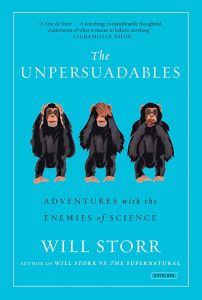
Adventures with the Enemies of Science

The Heretics / The Unpersuadables: Adventures with the Enemies of Science
© 2014 Will Storr
368 pages

Outside ideas of right-doing and wrong-doing, there is a field. Will Storr will meet you there, because at this point he’s not sure that there’s any other place to be.    We open with Will mingling with Australian fundamentalists,   listening to their views on Creationism and sexual mores with wonder and muted horror.  Though at first writing them off as uneducated, hateful rubes,    Will doesn’t cut bait and run: instead, he lingers, attempting to resolve the conflict between intelligent and loving people, and the ideas and values he finds so objectionable.    His commitment to finding out the answer to why people believe what they do  – to finding the human hiding beneath the  cardboard villain  their  antagonists reduce them to –  marks this book,  charging it with human interest even as the author’s long conversations with philosophers and psychologists invites the reader to explore deeper the mysteries of mind and belief.  This is an utterly, utterly fascinating book on multiple levels –  compelling not only in the interesting-to-horrifying range of ideas that Storr sits down and considers,  but to what he and those he interviewed have to say about how we approach the world.

When I began this book, I thought it would just be a collection of smug-tourism,  of some Poindexter cruising from seances to  neo-Nazi  kaffeeklatsches and informing us of the classical logical fallacies These People are making.    It isn’t.   Storr introduces himself as someone who is quick to judge & ghost others for not having the Right Opinions, but at the same time he’s drawn to those who are utterly marginalized, lampooned or derided for being crazy or evil.    There’s charm about their fight against the mob, even if their causes are weird or abhorrent.   Storr’s curiosity,  sympathy for the intellectually despised,  and commitment to his cause of understanding combine wonderfully here to allow the reader to spend a considerable amount of time  listening to extraordinary ideas – -and then evaluating them  with the help of  a variety of scientists better versed in the field than he.   There’s a lot of back and forth, with Storr serving as middleman: instead of two antagonists squaring off with one another and giving a public performance, we get no-theatrics-all-content conversations with Storr,  Storr then processes the conversations, and subsequently has follow-ups. It’s more intimate, revealing, and conducive to the reader seeing the humanity of all parties involved.  Although I disliked him at first brush, the more time I spent with Storr the more interesting and admirable he became –  a man willing to subject himself to days of silent meditation at a yogi’s retreat, for instance, in an effort to experience something that people kept raving had changed their lives.   Storr is no driveby debunker wheezing “Accccctualllly…..” 

Throughout the book, as readers sit and listen to Storr’s conversations with heretics and authorized agents of The Science alike,    we get deeper and deeper into how the brain constructs its models of reality,   forming beliefs and values,  and how new data are  treated –   invariably,  trimmed and adjusted to fit the existing model.  This  is understandable: the brain’s models have been created over time and at great cost, since brains consume a fifth of the body’s energy reserves. It’s more efficient to tweak what exists than to do a total rewrite:    it is by that logic all of evolution functions, which is why  animal bodies are rife with quirks.  We are storytelling creatures — not merely creatures who tell stories, but creatures who are formed by story, who live through story, who are story. Our memories make us, but they are fragmentary, our narrative knitting them together often imaginative, and the cast of that story subject to our emotional makeup at the time – and people’s stories of themselves can mire them in learned helplessness and depression, or drive them forward.  As Michael Shermer & Jonathan Haidt have both argued in their own books,   we do not begin with a clean slate and, with objective eyes, discern the Facts and build a worldview accordingly. Instead,  our brains develop with an outline of how things are in the womb, with genetic predispositions towards favoring openness or caution: that outline is  further developed  or altered by our childhood experiences, and then our ongoing experiences continue to modify the story.   Storr’s appreciation for mental models and beliefs increases as the book wears on, and his growing awareness of our universally shared weaknesses on this subject  allows him to spend time with people as noxious as say, David Irving, and stare at him not in hatred, but in earnest longing to Understand.    How did a man – a proud Briton –  from a patriotic British family, whose members served in World War 2, come to become Adolf Hitler’s chief defender in the 20th century,  who put his extensive and astonishing command of World War 2 facts to use downplaying if not denying the Holocaust, and attempting to shelter Hitler from any involvement in it?    This is the most extreme example, but throughout the book Storr meets people whose experiences sent them in unexpected ways, and he  takes the reader along to try to understand  his interviewers and  possibly bridge the gap between those who mock them from similar positions of supreme self-surety. 

I am utterly confident that this will be one of my favorite books of the year, given the overwhelming amount of Holy Cow That’s Interesting content here . The science is compelling in itself: I frequently read on the mind,  often from the same source Storr quotes here (Ramachandran & Eagleman), so some of this I was familiar with, but other aspects – like the fact that 30% of our memories are completely fabricated – was new, or had least been forgotten.  What Storr learns investigating specific claims of the heretics is also interesting. We may take it for granted that homeopathy ‘works’ purely on placebo, but when Storr is investigating the claims of homeopathists, he learns from respectable authorities that even prescribed, FDA, “real medicine” depends  partly on the placebo effect, something that sometimes effects the efficacy of name-brand versus generics despite the identical chemical composition.  In a more dramatic example, Valium only appears to work if people know they’re taking it.   Medicine shouldn’t be so flimsy: a chemical introduced to a chemical should have a predictable, reliable reaction – but the brain has its own chemistry  that throws a spanner into the works.    Storr emerges from each adventure with heretics a little altered –  not convinced, not even swayed most of the time, but made to realize that  the truth is a complicated thing. In one chapter, for instance, we meet a community of people who all experience the same thing,  the sensation of tiny little creatures inside their skins and trying to claw their way out. So intense is this sensation that people dig into their skin themselves trying to get the creatures out, and in the end the desperate and now bloody patients turn up little specks or fibers.  Industrial medicine uniformly writes them off as crazy, but  other medical investigators believe that this is a genuine nervous-system misfire issue,  not yet understood, that doesn’t get properly addressed because the victims of it are so easy to write off as nuts. 

This is a wildly interesting and thought-provoking book,  in part because of the author’s intense involvement in the subject: he’s not merely learning about why other people believe strange things, he’s learning about his own susceptibility,   his own stories he’s told himself, and the reader joins his company: we cannot help but engage in reflection right along with him.   This is an intimate encounter not only with the science of belief, but the existence of the Self,   in all its etherealness and mutability.  The Unpersuadables is unforgettable. 

Related:

The Believing Brain, Michael Shermer. 
The Righteous Mind: Why Good People are Divided,  Jonathan Haidt
The Storytelling Animal, Jonathan Gottschall 

Posted in Reviews, science | Tagged , , , , , | 10 Comments