Earlier today a disaster befell the citizens of Bedroom, when half of Mount Doom suddenly collapsed in a landslide covering not only parts of Bed, but part of the floor as well. Search parties were sent out and confirmed that no one died in the disaster. The mayor of House appeared tonight before the concerned citizenry and assured them that all citizens of Bedroom were accounted for and that the situation was well under control. “We keep the people of Bedroom in our thoughts and prayers, etc etc, and assure them that this situation will be addressed.” Mount Doom has been noticeably shrinking in recent months, and the recent landslide is thought to owe to resulting instability. The mayor assured everyone that the Mount will be dealt with as soon as possible. “No citizens of Bed Room deserve to live in the shadow of this constantly looming disaster,” said he.
That’s the news for tonight. Goodnight, and have a pleasant tomorrow.
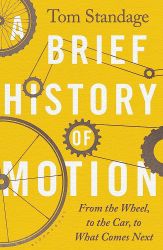
Tom, Tom, Tom. You know drinking and driving is a bad idea, but what did you do? You followedA History of the World through Six Glasseswith this A Brief History of Motion: From the Wheel to the Automobile. Granted, we did have An Edible History of Humanitybetween the drinks and driving, so it could be worse. A Brief History of Motion may not be as generally attractive to a mass audience given the subject (everyone drinks and eats, but not everyone is necessarily into coaches and cars), but it’s as fun and informative as I’ve come to expect from Standage. He begins with the wheel and the evolution of carts and coaches, then shifts into modernity with bikes, trains, and automobiles. As expected from a writer of social history, Standage focuses on the social and cultural aspects of these forms of transport. In the Roman world, for instance, we learn that men regarded wagons and coaches as a very womanly way to get about, and preferred riding horseback — a conceit that continued until coaches continuing development made them valuable as status symbols. The bicycle and automobile chapters are far more expansive, as Standage points out the ways bicycles altered courtship rituals, and how cars up-ended not only American business, but American society as a whole. General Motors business model (creating multiple brands to appeal to different layers of the market) became normative, and motoring culture created multiple new businesses around it, from fast food to shopping malls. (Jim Kunstler and Jane Holtz Kay have covered the same, though with considerably more hostility) Although I’ve read a lot about transportation over the years, Standage delivered more than a few surprises — like his argument that Hitler’s promotion of the car industry in Germany attributed more to it bouncing out of the depression than the war. He also takes down a few misunderstandings along the way, like the old canard that GM and a few car parts companies conspired to buy out street car lines and immediately close them. I believed that one myself until reading a few books on streetcars (Fares, Please! and Romance of the Rails) that made me realize streetcar lines were folding like Germany in 1945 by the time GM’s buyout if one company happened.) Standage wraps up the book with a look at carsharing apps and the like that may move us closer to a future where people don’t have to be burdened with the financial costs of a car just to participate in society, while compromising with the fact that we’re more or less stuck with all this car infrastructure for the time being, instead of getting to live in proper towns where people can get around on foot, bicycle, bus, etc. This is one I’m happy to recommend: it’s the book Are We There Yet?wanted to be but didn’t come close to being.
Highlights:
For the Romans, right-side driving also had positive religious connotations. They likened life to a forked path where the virtuous choice was always on the right, and when entering temples and other buildings, they tried to ensure that their right foot was the first to cross the threshold. This is why sinister (the Latin word for “left”) also came to mean “evil” or “unlucky.”
Facing the threat of the expanding Ottoman Empire, Hungarian commanders adopted a new tactic: arranging wagons on the battlefield in a ring and chaining them together to form a wagon fort, a mobile defensive fortification that could resist cavalry charges. The wagons, equipped with gunports, also acted as protected platforms from which men could fire a small cannon or an early form of gun called an arquebus. This cutting-edge combination of wagons and gunpowder weapons made armored knights on horseback look suddenly old-fashioned. And that may explain why men across Europe decided that riding in fancy wagons was not so embarrassing after all—provided they were referred to as coaches, a name borrowed from the country where this new idea had emerged.
This half-hour commuting distance may sound arbitrary, but an analysis of urban layouts by Cesare Marchetti, an Italian physicist, suggests that one hour is, on average, how long people are willing to spend traveling to and from work each day and has been for centuries. (Some people’s commutes are much shorter or longer; this is an average across a whole city’s population.) Marchetti suggested that this time limit defined the size of cities. No ancient walled cities, he found, had a diameter greater than three miles, so assuming a speed of 3 mph, walking to the center from the edge of such a city, or back again, took no more than half an hour. Faster means of transport, starting with horsecars, let cities expand as this half-hour average travel budget allowed people to go farther. Marchetti’s analysis found that the city of Berlin increased in size precisely in accordance with improvements to the speed of transport. Before 1800 its radius was about 1.5 miles, and as faster means of transport were introduced, starting with horsecars and streetcars, its radius expanded in direct proportion to their speed.
Next up: it’s a race between sexy medieval ladies and the moral imagination in film and literature.
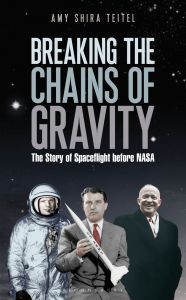
When he got the call, Kittinger knew he had enough oxygen to stay up a little longer, and he wasn’t keen to end the mission just yet. Now at ninety-six thousand feet, he had a view of the Earth that few people had ever seen, its curvature clear against a dark sky. And unlike the rocket plane pilots flying high in the skies over Edwards Air Force Base, he had the luxury of sitting and letting the view wash over him in the silence afforded by his balloon’s lack of propulsion system. The sky took on a hue he had never seen from the Earth. It occurred to him in that moment that he was the first man to spend any length of time in the near-space environment, that he was, in a way, the first man in space.
Breaking the Chains of Gravity: The Story of Spaceflight Before NASA
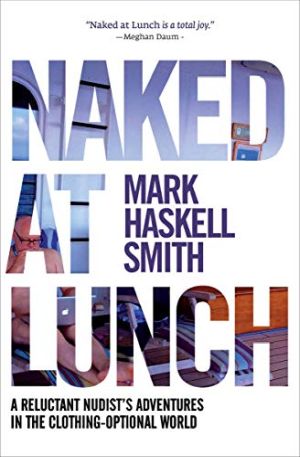
Beware all enterprises which require new clothes, Henry David Thoreau opined. Say what you will about naturism, or nudism – it’s the only hobby I can think of that doesn’t require buying anything, and especially not new clothes. Naked at Lunch is author Mark Haskell’s exploration of nudist society in the United States and Europe, beginning with a history thereof before he begins trying it for himself, from isolated nudist camps to whole communities on the Iberian peninsula where people are free to bare all. I’m personally fascinated by various cultures’ attitudes to clothing, so I found this most interesting despite the author having an obnoxious attitude towards anyone who is opposed to public nudity.
Smith assures us from the beginning that he’s not a real nudist, thank you. Sure, he sleeps au natural and, in warm months, is happy to wander about the house without any clothing – but that’s just being naked. Nudism is, Smith and those he interviews here, best understood as a social activity: it’s being naked around other people in a nonsexual way, doing ordinary things like swimming, watching shows, and yoga. When Smith decides to take his first foray into the world of naturism, it’s a nerve-wracking experience. He doesn’t help things by covering himself with so much sunscreen that when he ventures out near the pool, he positively glows, radiating like a prophet of old, sent forth to preach the gospel that clothes are a lie. Soon, however, he’s wandering around a Spanish town surrounded by naked people, and even hiking in the buff (albiet with shoes). He limits himself to the western world in both his past research and his present excursions, and reveals that nudist movements began in the west almost as a reaction to the rise of industrialism and consumerism: a rebellion of the natural against the artificial, and wedded to other health movements of the time, especially in Germany – where naturism was so popular that even Hitler’s government created a sanctioned organization, albiet one that restricted nudism to rural areas, and excluded communists and Jews. A commonality in nudist movements past and present is that the organizations always emphasize their nonsexual nature, and Smith discovers that when he spends time around naked people, the nakedness loses its sexual charge.
While I was aware of nude beaches and resorts, I had no idea how popular they were, especially in Europe, and enjoyed experiencing them vicariously through Smith – most of the time. I noticed that he transformed from being someone profoundly uncomfortable being naked in front of others into someone who mocked others for that discomfort later in the book — as he does when his naked hiking group encounters a group of minors associated with a religious school hiking in the wilderness, and their teacher hurriedly has them look away, and can’t even stir himself to be offended when he sees a couple engaged in intercourse on a balcony while touring a city with a nude quarter. (When he mentions this to a nudist group, they scowl and mutter in French that that isn’t nudism.) The author doesn’t bother digging into arguments for or against public nudity: he simply proclaims that people’s bodies are their own, man, and like you can’t just tell someone else they have to wear clothes, because that’s just not cool, dude. Smith comes off as increasingly lazy and obnoxious as the book progresses.
I enjoyed this book well enough, but disliked the author increasingly more as it went on, despite being sympathetic to the subject of the book: I’m rather enamored of the human form and don’t find nudity offensive or shameful in itself, but dislike those who abuse it to be provocative or offensive — as Smith sometimes encounters here, and dismisses with a “Boys will be boys” attitude.
June was a proper broadside, no holds barred, no quarter given! Books tumbled from Mount Doom by the day, screaming in terror and leaving behind stray bookmarks and badly-bound pages in their wake. We are halfway through the year, so it’s time to see how I’m doing with some of my goals. In 2022, 34% of my reading came from newly-purchased titles: that’s currently hovering just under 10%. I’ve made excellent progress on the science survey, having completed it in May and beating my earliest-finish date (August) by several months. Progress on Mount Doom is…proceeding. It’s not dramatic, but it’s happening. So far I’m at 45 % of goal, which means I’m a touch behind but not terribly. So far in 2023 I’ve read nine titles that earned the bold/superior favorite mark, and if that continues it’s going to be difficult to choose top ten favorites in December. Here are five I suspect will make it to the end.’
Classics Club Paradiso, Dante. Translated by Anthony Esolen.
The Big Reads: The Jewish Annotated New Testament: Serious progress made after I decided to focus on one Big Read at a time. I’ve finished the texts proper and am reading the bountiful essays.
Climbing Mount Doom: Sparring Partners, John Grisham Faces Along the Bar, Madelon Powers The Island of Dr. Moreau, H.G. Wells Paradiso, Dante. Translated Anthony Esolen. Inside the Klavern, David Horowitz The Dirty Life: Food, Farming, and Love, Kristin Kimball Nine Pints, Rose George The 99% Invisible City,Roman Mars DISCARDED: Spark Joy, Marie Kondo. There’s irony for you. DISCARDED: First Shift: Legacy. Someone gave this to me but I’m more interested in purging than finding out what it is. DISCARDED: Island of the Sequined Love Nun. Tried the first chapter, didn’t grab me. DISCARDED: Heart of Darkness, Joseph Konrad. Picked this up in a little free library at a friend’s urging but didn’t get interested in reading it.
And now, COMING UP IN JULY: Some American history-related material to coincide with Independence Day, naturally; Space Camp; and…..a special week of reviews in which I take a look at children’s literature from the 1990s, from Goosebumps to the Babysitters Club!
Today’s topic from Long and Short reviews is a song that’s been stuck in our heads recently. “A” song. A SONG? Music and song have been a part of my everyday life as long as I have memories, so I can’t just go with one. I’m going to go with three. Or four. Vive l’anarchie!
First up, something embarrassing. When this song first came out I immediately disliked it, probably for no other reason that it was pop music and I am an inveterate snob. A few weeks ago I was craving some happy music, though, and this came around, and it’s been stuck in my head since. I was listening to it in my head Sunday night while at dinner, head bobbing in the restaurant, and people were staring. Fortunately I’m too old to care these days.
Next up after googling the name Mark Ronson, I discovered he’d done an Amy Winehouse remix. I’ve listened to Amy Winehouse worshipfully since 2006, when NPR reviewed her album “Back to Black” and I had the dumb luck to be listening, and heard her for the first time. I was dubious about the merits of a remix, but this won me over.
Then, Pogo’s “Mazel Tov”, a remix of music, song, and speech from The Fiddler on the Roof. I can’t describe Pogo to you. Even if you’ve seen one Pogo remix, it’s different from every other Pogo remix.
And finally-for-realsies-this-time, I’d feel guilty if I did not include my current musical obsession, Mooooooooooooooooooooooooorgan WAAAAAAAAAAAAAAAAAADE!
Harry and I were standing outside watching the sunset when Maria-Grazia came out dragging her suitcase. She was driving back to Italy that night, but that’s not why I did a double take. She appeared to be transformed. I almost didn’t recognize her. Harry laughed and said, “You see someone naked for a week and you don’t think anything of it, and then she puts on a cute dress and some makeup and you think, ‘What an attractive girl!’” And he was right. Here was someone I had eaten dinner with in the nude, whom I had hiked with in the nude, watched doing naked yoga on the grass outside, and I never once thought of her as a sexual being. Which is odd because she is a very nice-looking woman. But something had changed and it wasn’t her. Maria-Grazia was still Maria-Grazia; she’d just put on some clothes. What changed was my perception of her. Naked she was just another naked person among a group of naked people, but in a sundress and sandals, she was suddenly sexy.
Naked at Lunch: A Reluctant Naturist’s Adventures in the Clothing-Optional World
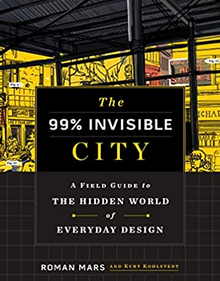
I’ve spent many hours in two of my city’s oldest buildings — one a church, the other a mixed-use Italianate beauty turned residence & bar — and have noticed, over the years, that the amount of little details contained within these beautiful structures is apparently infinite. There’s the outward big-picture stuff one notices — the loggia at the Harmony Club, the cloistered walk at St. Paul’s — but long exposures bring out other little things, like the fleur-de-lis welded onto the HC’s rain pipe, or its terazzao flooring at the landing. How staggeringly vast, then, must these little details be in an entire city? The 99% Invisible City takes as its subject mundane features that are part of the urban landscapes most of us inhabit, but often which we would not notice. This is aimed for a more general audience than something like Infrastructure: A Field Guide to the Industrial Landscape, because it looks only at little and local details.
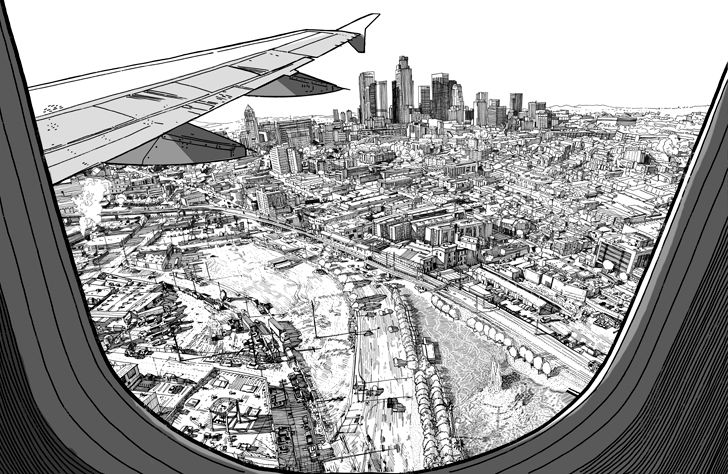
Since I’ve previously read books like Infrastructure: A Field Guide to the Industrial Landscape and The Works: Anatomy of a City, I expected to thoroughly enjoy this and was not disappointed. The book stands out from the aforementioned because of its use of art, not only to preface chapters and sections, but often to illustrate the text. The cover itself gives some indication as to the quality, but some of the interior work is far more impressive. A draftsman friend of mine did a double-take when he saw me reading the book, in part because he follows the artist Patrick Vale online.
99% Invisible does not dig into the buried infrastructure of cities like pipes and underground cables: instead, the focus is on things which are on the surface, but unnoticed by virtually everyone — except for those who remain in a given spot for a long time and have occasion to start noticing the fine details. This subject includes things like manhole cover art, which varies widely from city to city; markings on utility poles and sidewalks that enable linesmen and engineers to communicate technical details and warnings to one another in a code of their own; and components on lighting posts that enable them to pop up and then over cars when they’re struck by a vehicle driven by someone texting, drunk, or trying to pass their backseat toddler a sandwich baggie of goldfish crackers. This is not a book about infrastructure detail, though: Mars casts his eye over the city more broadly, looking at the unique boundary markers present in D.C, the history of revolving doors, and cell towers disguised as flagpoles. I was already aware of the hidden cell towers, but Mars delivers more than a few surprises — like power substations disguised as houses, and emergency subway stops/exits which empty into similarly disguised buildings.
This is one I’ll definitely recommend and pass on to friends — both for its multitude of interesting little microsubjects, and its art.
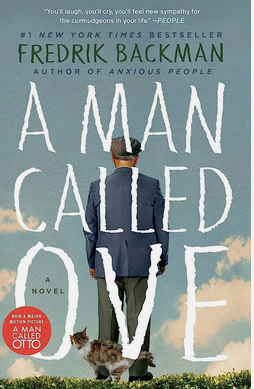
Ove is a simple man. He likes to wake early, patrol the neighborhood and look for trouble, take care of what needs fixing, grouse about people not doing things properly, and then return home for his morning coffee. And today, since his wife is still dead and he can’t think of a reason to continue puttering around, he aims to kill himself. He’s chosen his method — hanging, the old tried and true approach with no messy cleanup. Of course, he’s made preparations just in case, with newspapers covering the floor to protect them from the scruffs of lookie-loos and the like. He’s drilled a perfectly centered hole, his affairs are in order, and it’s time to go — but wait. Wait. There’s someone driving in the residential area! Cars are restricted to the parking area! IT’S POSTED! THERE ARE SIGNS! And they’re — they’ve backed a trailer over his mailbox! A Man Called Ove is a fascinating story of a man who wants to shuffle off and join the choir invisible, but whose deep-seated need to make sure things are done properly, and the persistence neediness of his neighbors and a cat that won’t go away, continues to bind him to Earth — where, eventually, he finds meaning beyond the memory of his departed beloved.
From the moment I saw the trailer for the American adaptation of this novel, I knew I wanted to see this. Not only did it feature Tom Hanks, my favorite actor, but the story-as-advertised by the trailer of a isolated curmudgeon finding friendship and meaning is one of my favorite arcs ever since encountering it first in A Christmas Carol.A Man Called Ove proved to be as serious and heartwrenching as it was funny, though. Part of the humor comes from Backman’s writing, which even in translation has a dry punch to it — but much of it is the inherent absurdity of a man seriously engaged in attempting to kill himself constantly being interrupted by his neighbor’s shortcomings and Ove’s own inability to not respond to them, because he is despite his outward grumpiness a man of moral principle. That means helping people, even if they don’t deserve it, and it also means making sure things are done The Right Way. You have to do it yourself if you want it done properly these days. Look at the new neighbors — they can’t even back up an automatic car with a rear camera, for pete’s sake.
The humor is consistent throughout the novel, but the meat of it is Ove’s growing relationships with his neighbors. He has lived in his neighborhood for decades, but was not a social person: in reading this, in fact, I wondered if Backman was attempting to create a person with Aspergers: Ove is utterly fascinated by technical matters and machinery, and uninterested in almost everyone except for his late wife Sonja, who he encountered by chance on a train platform and was completely altered by. It was as if something in him had malfunctioned: his black and white world suddenly had color in it, made all the more intense by her interest in him — a man who reflected the same virtues she adored in her father. The arrival of new neighbors, one an Iranian woman named Parvaneh whose good humor and no-nonsense attitudes combine to make her someone impossible for Ove to offend and equally impossible to ignore, completely disrupts Ove’s withdrawing into himself, into his pain and routine. As the novel progresses, he becomes increasingly more part of the neighbor’s lives’ — not just Parvaneh’s,but of a young man kicked out of his home because his father opposes his lifestyle, and of a mangy cat that needs a home, and of a woman who the State is threatening to take her house and husband away from her.
A Man Called Ove hits all the sweet spots for me, as we see characters beset by tragedy but not destroyed by it : instead, they rally, not through unfathomable reserves of inward strength because even those who might fail themselves can still support others. Backman’s story drives home the need for human connection, and its ability to overcome not just overwhelming loss, but worse evils like bureaucrats. All told, this is an utterly touching and funny little novel. I’ve already watched the American adaptation and plan on watching the Swedish movie to do a rare double feature Reads to Reels. I thoroughly enjoyed Backman’s writing, from the humor to the games he plays with tense and time, to drive home how very much alive and central Sonja’s memory is to Ove.
Highlights:
The colleague looks very happy, as people do when they have not been working for a sufficient stretch of time as sales assistants.
Her laughter catches him off guard. As if it’s carbonated and someone has poured it too fast and it’s bubbling over in all directions. It doesn’t fit at all with the gray cement and right-angled garden paving stones. It’s an untidy, mischievous laugh that refuses to go along with rules and prescriptions.
Isn’t that bloody typical, he thinks. You can’t even kill yourself in a sensible way anymore.
The cat gives him a judgmental stare, as if it’s sitting on the decision-making side of the desk at a job interview.
You go to the hospital to die, Ove knows that. It’s enough that the state wants to be paid for everything you do while you’re alive. When it also wants to be paid for the parking when you go to die, Ove thinks that’s about far enough.
He had certainly not begun this day with the intention of letting either women or cats into his house, he’d like to make that very clear to her. But she comes right at him with the animal in her arms and determination in her steps.
They stood in silence for a long time, with their arms around each other. And at long last she lifted her face towards his, and looked into his eyes with great seriousness. “You have to love me twice as much now,” she said. And then Ove lied to her for the second—and last—time: he said that he would. Even though he knew it wasn’t possible for him to love her any more than he already did.
He’s silent. And then they both stand there, the fifty-nine-year-old and the teenager, a few yards apart, kicking at the snow. As if they were kicking a memory back and forth, a memory of a woman who insisted on seeing more potential in certain men than they saw in themselves. Neither of them knows what to do with their shared experience.
“Loving someone is like moving into a house,” Sonja used to say. “At first you fall in love with all the new things, amazed every morning that all this belongs to you, as if fearing that someone would suddenly come rushing in through the door to explain that a terrible mistake had been made, you weren’t actually supposed to live in a wonderful place like this. Then over the years the walls become weathered, the wood splinters here and there, and you start to love that house not so much because of all its perfection, but rather for its imperfections. You get to know all the nooks and crannies. How to avoid getting the key caught in the lock when it’s cold outside. Which of the floorboards flex slightly when one steps on them or exactly how to open the wardrobe doors without them creaking. These are the little secrets that make it your home.”
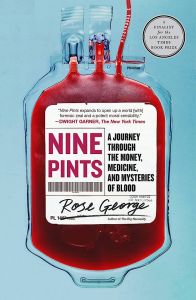
Rose George has previously shared with readers her voyages across the world following cargo ships and movements to make sanitation both more eco-friendly and readily available to poorer communities. In Nine Pints, she dips into the circulatory system. The result is my least favorite of her offerings, though it’s diverting enough, with a mix of history, science, and explorations of the British blood bank system. She delves into its origins, and into bloodletting’ history– from ancient ideas about the four humors, to the contemporary use of leeches to clean wounds. There’s a good section on bloodborne diseases like HIV/AIDs, and several sections involving menstruation — taboos about it, one man’s attempt to create cheap sanitary napkins, etc. As a childless bachelor, my interest in that subject is rather handicapped, as you might expect. What most disappointed me in this book was the complete absence of renal disease and the need for blood dialysis, which would be more substantive than a section on kooks who drink blood and call themselves vampires. She also falls into the modern error of using ‘gender’ when ‘sex’ is more appropriate, referring to the lower rate of hemoglobin replenishment in women than in men as a ‘gendered’ difference. That women wear panties and not boxer shorts is a gendered difference: that women have periods is a sexual difference.
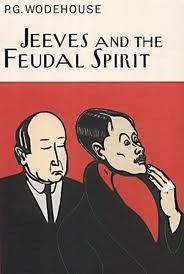
In a completely different realm, I discovered the existence of Jeeves and the Feudal Spirit upon one of my friend’s bookshelves, and naturally had to tackle it. I’ve read loads of Wodehouse before, and as usual relished Wodehouse’s way with the English language. As is the usual with a Bertie story, there are several intersecting little threads that get increasingly tangled to hilarious results: the most prominent thread is that a woman who is occasionally engaged to Bertie (he’s a popular fellow to be engaged to) is having issues with her current fiance, and Bertie gloomily suspects that she’ll come after him again if something isn’t done. The current fiance also regards Bertie as a threat to his nupitals, and keeps threatening to break Bertie’s spine in several places — especially after he catches Bertie in his fiance’s room in the middle of the night, not knowing Bertie was merely there to burgle the room on behalf of his aunt, who wanted him to steal the fake pearl necklace in her cabinet so her husband would not discover she’d pawned the real one. But that’s another thread. Anyoo, here’s some quotes:
Love is a delicate plant that needs constant tending and nurturing, and this cannot be done by snorting at the adored object like a gas explosion and calling her friends lice. I had the disquieting impression that it wouldn’t take too much to make the Stilton-Florence axis go p’fft again, and who could say that in this event, the latter, back in circulation, would not decide to hitch on to me once more?
I was appalled, and I think not unjustifiably so. I mean, dash it, a fellow who has always prided himself on the scrupulous delicacy of his relations with the other sex doesn’t like to have it supposed that he deliberately shins up ladders at one in the morning in order to kiss girls while they sleep.
“You don’t think I’m angry, do you? Of course I’m not. I’m very touched. Kiss me, Bertie.” Well, one has to be civil. I did as directed, but with an uneasy feeling that this was a bit above the odds. I didn’t at all like the general trend of affairs, the whole thing seeming to me to be becoming far too French.
“‘I say,’ I said, ‘Here’s a thought. Why don’ t you marry Percy?” “But I’m engaged to you,” she faltered, rather giving the impression that she could have kicked herself for being such a chump. “Oh, that can be readily adjusted,” I said heartily. “Call it off, is my advice. You don’t want a weedy butterfly like me about the home, you want something more in the nature of a soul-mate, a chap with a number nine hat you can sit and hold hands and talk about T.S. Eliot with. And Percy fills the bill.” “Bertie! You will release me?” “Certainly, certainly, Frightful wrench, of course, and all that sort of thing, but consider it done.” “Oh, Bertie!” She flung herself upon me and kissed me. Unpleasant, of course, but these things have to be faced.


 Reading Freely