First, a tease from God Rest Ye Merry Soldiers: A True Civil War Christmas Story. The book itself quotes a little poem published in a December 1862 paper.
This happened one Christmas, I’m sorry to write Our ports are blockaded, and Santa to-night Will hardly get down here; for if he should start The Yankees would get him unless he was ‘smart’ They beat all the men in creation to run And if they could get him, they’d think it fine fun To put him in prison, and steal the nice toys He started to bring to our girls and boys
Today’s TTT is books on our winter TBR list. Mine are drawn partially from Mount Doom but there are a couple of new ones as well.
(1) The War of 1812, John Mahon. I’m two-thirds through this and expect to finish before the week’s end. It’s an older, comprehensive history of the war that also explores its connections to the Napoleonic and Creek wars.
(2) The Commercial Revolution, 1000 – to 1500. Joseph Gies. Also a mount TBR title that I’m working through.
(3) The Sun in the Church: Cathedrals as Observatories, J.L. Heilbron. ‘Twould be fitting to read it near the winter Solstice. (Article here featuring Heilbron.)
(4) In Search of Zarathustra: The First Prophet and the Ideas That Changed the World, Paul Kriawaczek. Another TBR title that was left off the Incomplete Census posted earlier in the year. Should be a nice tip of the hat to the ‘magi from the East’ closer to Epiphany.
(5) America Calling: A Social History of the Telephone to 1940, Claude Fischer.
(6) Cool: How Air Conditioner Changed Everything, Salvatore Basile
(7) The Mind of the South, W.J. Cash. On my CC reading list. I’d started a few months back and then gotten sidetracked.
(8) God Rest Ye Merry Soldiers, James McIvor. A Civil War Christmas tale
(9) Scatterling of Africa: My Early Years, Johnny Clegg’s unfinished autobiography.
(10) A Good Man is Hard to Find and Other Stories, Flannery O’Connor. Might as well knock another of the ol’ CC.
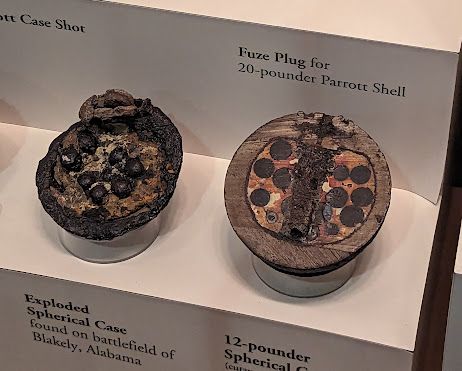
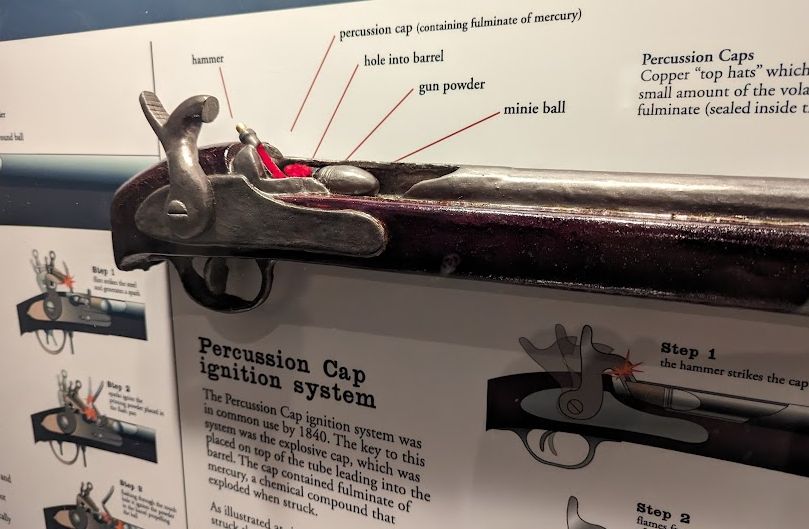
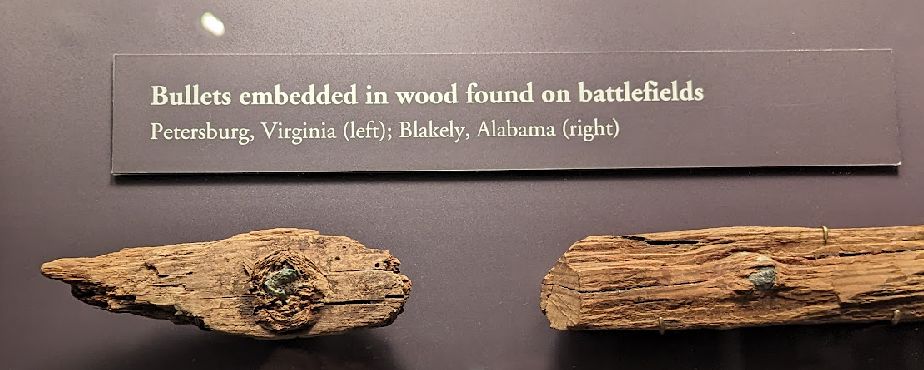
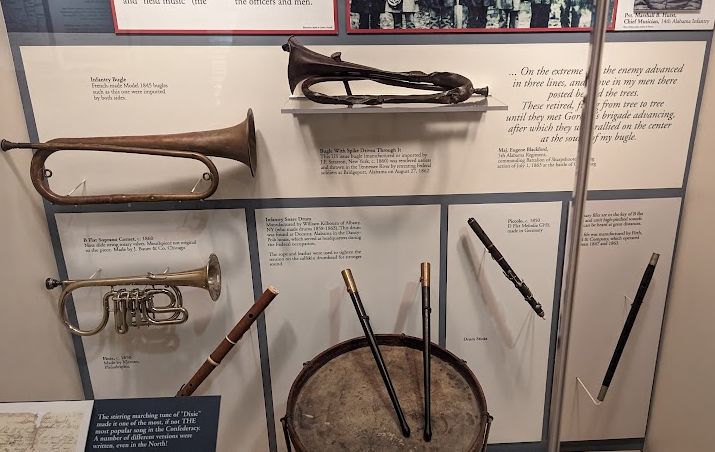
In years past I’d heard of a Confederate Memorial Park somewhere in Marbury, but assumed it was something like we have in Selma: a place where the dead were buried and a placard or statue put up. After the tornado struck, though, one of the aid workers who came into town from Boston proved to be a Civil War enthusiast who was determined to make the most of his time in the South — and discovered that the ‘park’ was a museum and library on the site of what had been a rest home for aging and indigent veterans of the War. (Or, as one visitor called them, “indignant”.) I was intrigued by the library, as my new friend was impressed by its collection, and made my way there this past Saturday to check the place out. Although I wasn’t able to access the library, it being staffed solely by volunteers who had hung up their hats at noon, I was most impressed by the museum and enjoyed my walk through the grounds. At its height, the place had 22 buildings which included communal places like a galley, as well as smaller cabins for veterans and their wives to live in. It was made possible by a donation of land by Jefferson Manly Falkner (lord, what a southern name), and donations from others — including Union veterans, who directly paid for the “Blue and Grey Cottage”. Although there are no extant buildings from the original complex, there are still foundations present as well as parts of the water and gas infrastructure that made life possible and comfortable for the aging veterans. My visit coincided with Santa holding court in the old Mountain Creek post office and taking photos with kiddies. I’m including a few shots below, but this place was loaded with rifles, shotguns, and handguns. It’s really quite the collection, the best I’ve seen in Alabama. It’s still very rural, a place of streams and piny hills, and made for quite a nice mild hike into the woods.
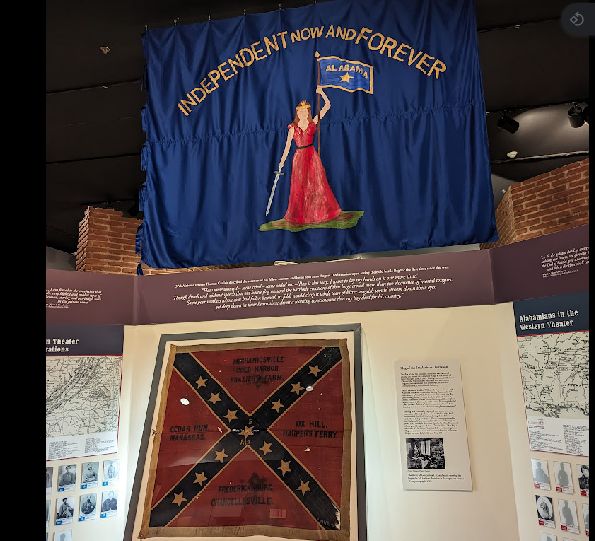
The flags in the middle intrigued me, as I’d never seen them: they were specific to Alabama regiments.
The floor of the Alabama river near Selma would have looked like this, littered with munitions, ammunition, and arms as the Arsenal was defended and then burned (along with much of town).
The battle flag at bottom was taken at the Battle of Gettysburg from Alabama regiments fighting under General Sam Hood, on the second day as Colonel Chamberlain defended Little Round top.
A VERY small part of their collection. Rifles and carbines.
Spiking artillery, I can see. But a bugle?
Had a nice conversation with Santa, who has a magic key on his belt that allows him into homes without fireplaces. This building was a general store & post office in Mountain Creek, Alabama.
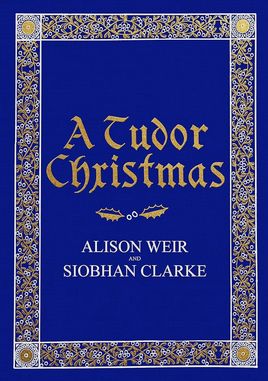
Alison Weir’s A Tudor Christmas is a short social history of how Christmas was celebrated in the days of Henry VIII and his daughters. (And, ever so briefly, his son.) After some background information on the different cultural traditions that a medieval English Christmas would constitute — a bit of Christ here, a little pagan Rome there, some Scandinavian traditions there– Weir then takes us through the Twelve Days of Christmas, which begin on Christmas Day itself and continue until the Feast of the Epiphany on January 6th. Contra today’s prolonged period gorging and splurging that begins sometime in October and ends shortly after the New Year when bills come due and medical scales sag under the weight of too many pies and plates of stuffing, Christmas was traditionally prefaced by a period of fasting that began in mid-November. The Orthodox still practice the Nativity Fast, but even those who observe Advent these days aren’t aware that it’s deliciously counterculture in the modern context. After this background, we go through each of the Twelve Days of Christmas, which had specific bits of lore and tradition attached to them. My favorite, I think, is the Feast of the Holy Innocents, in which the day would begin with children being playfully whipped and then allowed to run amok the rest of the day. Weir incorporates a lot of medieval verse into the text, and she points out allusions to Christmas traditions present in Shakespeare that all who are not scholars almost assuredly miss. I enjoyed this thoroughly, and excerpted twelve fun facts from it to share with friends — find them below! I read this mostly while listening to “Christmas in a Medieval Tavern“, which is utterly anachronistic but set the mood.
The traditional Anglo-American Christmas has its origins with King Alfred the Great, the father of England who commanded there should be a holiday on Christmas Day and the twelve that followed. The first use of the word “Christ’s Mass” was in 1038.
The Midnight Christmas Mass dates to at least 423, when Sixtus III celebrated one in the Christmas Chapel (containing a reliquary that is said to hold the remains of the Manger). It was originally known as the Angels’ Mass.
Christmas creches became popular after 1223, when St Frances created a life-sized manager scene on the hill above the village of Greccio, and preached the Gospel story.
The modern season of Christmas parties would horrify Christians of centuries gone by, who regarded the season of Advent as one of fasting — the feasting began only on Christmas Day. The eastern Orthodox still preface Christmas with a Nativity fast that begins in mid-November. Specifications vary by tradition, but rich foods like meat, oil, butter, and wine are usually abstained from.
Have you ever wondered why Charles Dickens had one ghost story set at Christmas, let alone an entire volume of them? Medieval Europeans believed that the veil between the natural world and the spiritual world was at its thinnest as the Winter Solstice approached, and that ghosts could freely wander the wintry landscapes in late December. Telling ghost stories on Christmas Eve became an English tradition.
An English Christmas favorite (among those who could afford meat) was ‘brawn’, or fatty cuts of pork cooked in wine and served garnished with rosemary, bay leaves, fruits, and a sprig of yew whitened with egg or flower to give the appearance of a dusting of snow.
Christmas pies in medieval England were cut with spoons, as it was believed unlucky to cut them with knives. The first piece went to the youngest member at the table, who made a wish as they ate it.
On Twelthnight, trees were treated to a tipple from the wassail bowl, ale being poured over their roots to ensure a bountiful harvest. The practice still endures in the West Country.
The Fourth Day of Christmas was known as the Feast of the Holy Innocents, and for adults was a day of fasting as the Herod’s massacre of infant boys was remembered. Children were allowed greater licenses on this day after being awakened with a playful whipping.
The Spirit of Christmas or the season was an ancient one: the Saxons referred to a King Winter, and the Norse believed that the god Woden visited mortals during the season and feasted, leaving gifts and accepting offerings (like cookies and milk?). St. Nicholas of Myra, the patron saint of children, would eventually prevail as the embodiment of Christmas in the west, despite his feast day being held during Advent, December 6. St. Nicholas Day celebrations do NOT (alas!) involve punching heretics in the face, as St Nicholas was famous for doing.
At court, the Christmas season (after Christmas Day itself) was also one of plays, hunting, sports, and outside tournaments, followed by feasting and drinking. Children’s games like hide and seek, blind man’s bluff, and “fox in the hole” — which was a bit like tag mixed with hide and seek, with a ‘fox’ chasing and looking for the other players and catching them one by one, the last to be caught becoming the fox next round — were popular for all ages. One potentially dangerous game involved attempting to snatch candied fruits, almonds, etc from a bowl of warm brandy that was set on fire — without the players getting their fingers burned.
Nativity plays were part of the feast of Christmas as part of a larger tradition of ‘mystery’ plays, put on with heavy contributions from grade and crafts guilds. These were all based on Biblical stories, and Nativity plays would typically envelop everything from the angel’s first visit to Mary, to the Massacre of the Innocents. This tradition faded after the reformation, the plays often banned for being too Catholic. Another theatrical tradition involved catching “mummers plays”, in which bands of traveling actors would regale communities with traditional folk plays that involved a lot of easy entertainment — stage fights, bawdy humor, and fantastical creatures like the Dragon that England’s patron saint, St. George, killed. Resurrection was a common theme in these plays.
Allison Young and the Bygones are appearing in my music end-year wrapup, but they did an original sound that’s right out of the 1940s so I wanted to share it for those who might appreciate it. Stumbled on Allison in the dark year of 2020. Starts out slow, but just wait.
“It is truly like living in a Kafka novel. Nothing makes sense. People touted as experts on TV repeatedly tell you things you can disprove with three mouse clicks, and most people act as if this is normal.”
Tom Woods is a historian and podcast host with a daily newsletter which (in part) analyzes issues of the day from a libertarian point of view. From February 2020 forward, both the podcast and the newsletter were largely oriented toward making sense of COVID — at first the virus and its effects, but then the broader effects of attempts at containment measures. Diary of a Psychosis is a selected collection of those COVID-related newsletters, beginning in February 2020 and moving forward until spring 2023. As you might guess from the title, Diary is highly critical of the way governments and public health agencies across the world, but especially within the United States, reacted to the pandemic. It is so not because of Woods’ libertarian scruples, but from the enormous human suffering that followed in the wake of a prolonged ‘health’ measures. Draconian lockdowns and dehumanizing mask mandates would be poor responses even if they were proven to be efficacious, Wood argues, but the worst part is that they were never proven as such.
The core of the book is Woods responding to news of various measures, and wrangling with data, especially as he and everyone else paying attention began realizing something screwy going on. Despite the confidence of The Science, imposed measures repeatedly don’t correlate to results: states with similar demographics have similar COVID waves despite imposing different levels of masking, supposed surges after events like Thanksgiving 2020 or Superbowl 2021 don’t appear, inexplicable spikes appear that no one can explain, deaths decline in states giving up on containment measures and increase in states that maintain them, etc. A running theme in this is Woods using his newsletter to monitor moving goalposts and compare predictions against actual outcomes, something The Authorities would rather us not do. Why can’t they simply admit when they don’t know why what’s happening is happening?, asks Woods. Why the continuing masquerade of confidence and certainty? And why, when we are sailing into uncharted waters in which no one has authoritative experience, are dissenting voices not only being ignored but actively suppressed (by twitter and facebook) despite coming from people with medical pedigrees just as robust as those dominating the news? Reportage and commiseration are another strong part of the book: Woods continues to travel throughout the lockdown period, reporting on areas that are both opening up and doubling down on their coronatainment measures, and shares letters from readers who see in his newsletters a rare breath of fresh air keeping their hopes alive despite being cut off from loved ones and overwhelmed by the culture of fear. Part of why Woods is offering this book (as well as Collateral Damage: Victims of the Lockdown Regime Tell Their Stories) is so that the cruel foolishness of the past three years is remembered next time — and those who abused the public’s trust and their perceived authority are brought to some manner of justice, if only by being sacked. The consequences of coronamania will be far-reaching: young people whose educations were derailed, children whose social development was marred by isolation and the spectre of facelessness, teens who are mental wrecks because they came of age amid multiple “We’re Doomed” cults etc — but there are other ramifications Woods touches on, like the bankrupting of public trust in health institutions, whether they acted out of honest and well meaning ignorance, or vanity in their own imagined self-importance. There will be pandemics in future, and if amends and corrections are not made, then public reaction based on the often irrational and inhumane COVID measures will undermine appropriate response to threats that don’t have a 99% survival rate for the majority of the population.
Today’s blogging prompt from Long and Short Reviews concerns Christmas holiday traditions. Christmas, for me, always began the day either after Thanksgiving, or when I came home from school, and saw the shed door open. Although it was a lot of work — and dirty work, too, given the amount of spiders and the like in that shed — that open door always got me excited given what it led to. Not the shed, but Christmas! The leaves were all gone from the trees by now, covering the yard like a crinkly brown rug, and we’d troop back and forth across them lugging in box after box of Christmas stuff. My mother was and remains an absolute nut for decorating. One of the boxes was always the tree, which we assembled and tried to repair. After that came the ornaments — tangled Christmas tree lights, balls that were invariably broken from transit, and then the few keepsake ornaments like a tattered little Santa Claus who used candy canes for arms and legs. We’d decorate together, listening to Christmas music from the radio. My second-grad teacher Mrs Walker gave that to me, and despite its raggedy nature I loved it. Once the insides of the boxes had been disgorged and filled our house, things just settled in until the 24th. Then, on Christmas Eve, we’d pile into the family vehicle that year and go looking at Christmas lights, listening to music on the radio. The one I remember most vividly was the year we didn’t have a working vehicle except for my dad’s truck, which didn’t have a working heater, so we all piled into the single front seat bundled up and smooshed together — which no one complained about, because at least we were warm. I vividly remember a long evening of driving around in that old truck and coming back through town that evening, listening to “Christmas in Dixie” and looking at the lights on shotgun house, feeling warm and so very, very content. Once we got home, we were given one present to open — always a book — and then it was off to bed. I’d barely managed to sleep, brimming over with excitement, and then as soon as I awoke (at the ungodly hour of five am, probably — how do kids manage that?) I’d race into the living room to see what “Santa” had left on the couch. My sisters and dad always slept in, so usually in those dark hours it was just my mom and myself. Breakfast was invariably “sausage rolls”, at by mid-morning we were packing up to go to my grandmother’s where we’d be for the next twelve hours. My dad had four siblings, all of whom had litters of kids, so I’d see hundreds of people throughout the course of the day. We had a set lunch time, but after that it was open grazing. The day was made complete by the adults participating in a gag-gift night, the humor of which they’d often find hysterical but we kids mystified by. Invariably, some uncles or cousins would be absent hunting, but they’d roll up in the evening wanting to show off the deer they’d bagged. At long last we were back home, and the next day brought the dreadful spectre of…..putting everything back in the boxes. Oh, brother.
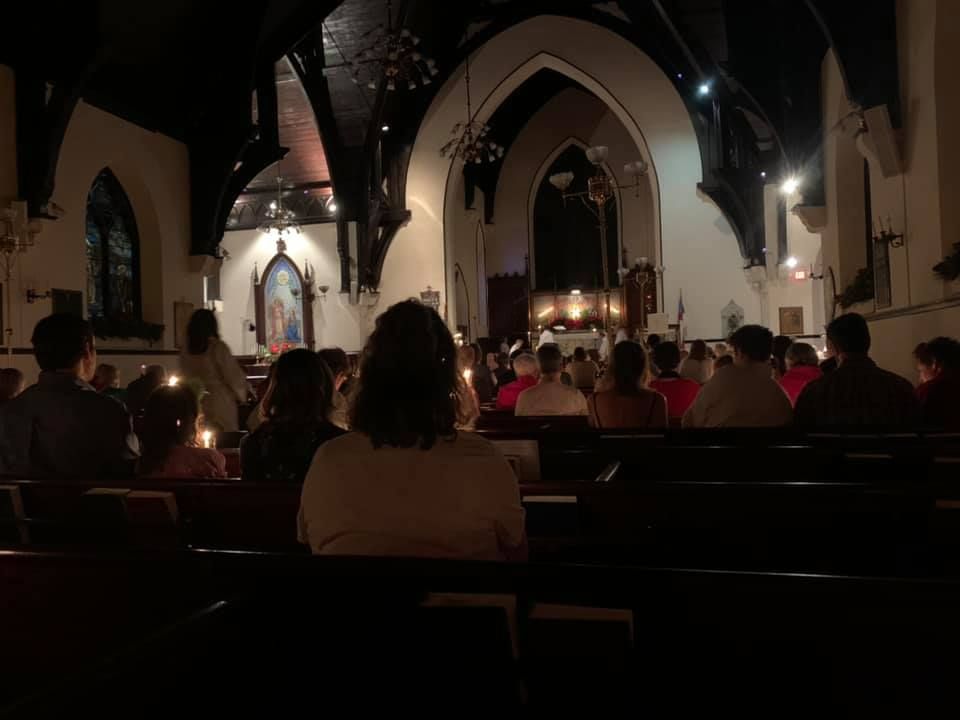
These days things are more low-key, at least for me. My sisters and parents decorate, but I’m not involved: I like a small tree that fits on my chest of drawers and a little circle of Advent candles, but that’s about it. As the years have passed I find I dislike the consumer side of Christmas more and more: my nieces and nephews are all adults now, so there’s no magic in watching anyone open anything, except on the rare years when I’ve had an idea for a gift that someone will actually need and want. It’s usually just us exchanging clothing and random objects from the store that “I thought you might like”. (Or, you know, at least accept and acknowledge that yes, I tried.) To my annoyance, even though everyone else in the family expresses the same discomfort about the gift grudge, no one is willing to just….not do it. We have to give gifts, it’s not Christmas otherwise! Humbug. To me, Christmas is still a family day — but more importantly, over the years, I’ve oriented myself toward the original intent of the day — Christ’s Mass, and the annual Christmas Eve service has become a keystone part of the year for me. There is nothing quite like a church darkened save for a few hundred people holding candles and singing “Silent Night” together. One of my very best friends — before I met her — was invited by someone to experience the service and was so moved by it that she’s never stopped coming. I also love going to the Christmas service proper, though unless it’s a Sunday it’s a very low key affair and peopled only by the priest and people like myself who really want to be there. One of my favorite traditions in recent years is popping by a friends’ house who lives downtown: he and his wife have an all-day open door policy that begins with grits and tomato gravy at 10:00, and culminates in a big spread of ham, turkey, and homemade egg nog in the evening. Regrettably, the days of the Epic Family Gathering are over: my grandparents are both passed, and now their kids are the nucleii of their own smaller gatherings. However, my day is still filled with the warmth of friends, family, and faith regardless of the outside chill.
Years ago when the History Channel was more interested in Hitler than aliens and ice road truckers, I happened upon a documentary there about German-Americans in the United States who supported the “New Germany” from their adopted country. I was young and had never thought about how immigrants’ native cultures could influence their politics, so it was fascinating. Hitler’s American Friends revisits that subject to some degree, though it examines the pro-German or pro-Nazi sympathies of various factions within the United States, not merely ethnic Germans. They include members of economic and political schools of thought sympathetic to various aspects of fascism, from its economic policies to institutionalized antisemitism; Americans who were studying in Germany to take advantage of its technical programs; corporate magnates whose business interests in Germany made them eager to work with the new regime and sharply critical of anything that would lead to war; and Americans of any stripe who opposed intervention.
The book is a mixed bag: it dwells on a lot of interesting characters like Father Charles Coughlin, and has many interesting revelations, like the fact that American car manufacturers kept trying to keep business as usual going in their European plants even after France had fallen and the war begun in earnest. I was not impressed, however, with the casual lumping of non-interventionists in with American fascists: Venn diagrams exist for a reason. Related and more substantial is the lack of context: Hart refers to fascism throughout the text, but never defines it and never explores why people might be attracted to its manner of political and economic organization, so he leaves the unlearned reader with the impression that there were just gogs of people in 1930s America who wanted to strut around in Hugo Boss uniforms and build death camps like Levittowns. This is most obvious in regards Father Coughlin, who was the 1930s version of a superinfluencer: he could command a fifth of America’s ears at any one time, and had his own ideas about politics and economics that made him a force against the New Deal, with a sixteen point plan that inspired a political party. Hart quotes one source dismissing these points as identical to fascism, but even a 1965 critic of Coughlin, Tull, described them as ‘mild socialism’ or ‘reform capitalism’. The closest thing I can find that shares the sixteen points is a list from the Holocaust Encyclopedia, and the most interesting part of the list is his attack on the public-private corrupter of American money, the Fed. Frankly, Hart tends to push every critic of Roosevelt and the New Deal into the “Hitler’s American Friends” camp, which is inaccurate. He likes to write with a bit of clickbait energy: at one point he declared that within a year of one man’s speech, his “scattered remains would be recovered in a Virginia field”, with mysteries remaining to this day. That sounds like a hell of a story, but when I did some digging I discovered that the fellow died in a plane crash. Fortunately, the book is salvaged somewhat by the many outrageous characters it covers, including one Hupa tribe member who went around calling himself Chief Red Cloud and giving pro-Hitler speeches. (He was under the influence of one Silver Legion fellow named Pelley, who argued that the Bureau of Indian Affairs was run wholly by Jews.) There were so many big personalities in the German-American Bund, Silver Shirts, and similar organizations that they continued creating drama and falling apart, so much so that Hitler and German consuls were actively disavowing connection with them and urging good Germans in the United States not to associate with them. Hart’s treatment of Charles Lindbergh is surprisingly charitable, treating him as someone who was naive, overly impressed by his experiences with modern German aviation, and who listened to entirely too many anti-Semitic friends.
This was an interesting if flawed read, but it did make me do some digging around some of the bizaare characters involved, and I suspect I shall be researching more into Coughlin: I’ve ILL’d a book on him and Huey Long to compare their particular brands of populism, and their policies compared against one another and Roosevelt’s own economic re-ordering.
Highlights:
“One cannot always be certain of what Pelley favors, but one is seldom left in doubt as to what Pelley opposes, and he opposes many things. The Jews, of course, are his chief objects of hatred. To Pelley, the Jews are the root of all evil. Whenever he is against anything, it is because Jews are connected with it, and if he can’t find Jews, he creates them. Thus, his chief objection to Communism is its alleged Jewishness.”
Pelley’s sudden interest in Native Americans stemmed from a supposed divine realization that the Bureau of Indian Affairs had been taken over by Bolsheviks. Native Americans were therefore natural allies for his political movement because they too were supposedly victims of the Jewish conspiracy Pelley saw everywhere. Among the many problems with this eccentric plan was the fact that Pelley did not actually know many Native Americans. His efforts to reach out by referring to himself as “Chief Pelley of the Tribe of Silver” and writing articles in prose that could have been lifted from the stock characters of Hollywood Westerns gained few supporters.
One Native American ally Pelley did manage to recruit was a mixed-race Portland attorney named Elwood A. Towner who soon took on a bizarre role. Adopting the “Indian title” of Chief Red Cloud, Towner began attending legion and Bund meetings up and down the West Coast and drew sizable crowds as he wore a stereotypical feather headdress and clothing covered in swastikas.
With a higher degree of personal discipline, Pelley might well have become the leader around which the far right could coalesce. With his ideological flexibility, flair for the dramatic, and ability to harness religious language (even in his own unique way), Pelley could have been formidable. As it turned out, he was merely a flash in the pan who ended up being exposed as an unscrupulous fraudster.
American businessmen with holdings in Germany had a vested financial interest in making peace, especially with the Royal Air Force starting to bomb German factories that might soon include their own. Remarkably, even after the war’s start American corporate bosses tried to maintain a sense of normalcy in relations with their German divisions. Ford’s Dearborn office continued to communicate with its Cologne factory, and even sent new equipment to the plant in 1941 to boost production for the German military.
(ahem) Sorry. ‘Tis the season. Here’s a tease and then the top ten.
In order to become a swordsmith, Kevin had to be something of a Renaissance man: equal parts historian, artist, scientist, mathematician, and detective. Some of his replica swords are not just visual swords; they are authentically produced with metals that are scientifically accurate to their era. He will replicate the ancient process by digging his own ore out of the ground and smelting his own iron in an early type of charcoal furnace. History is not just the final object but the steps and processes that lead to it.
The Craftman’s Legacy, Eric Gorges
Today is a freebie and I was going to do my favorite substacks but it was hard to pick betwixt them. I may do that one randomly in the future. Going to go with “My Favorite New-to-Me Movies Watched in 2023”. I had trailers and moving scenes all embedded, but YouTube decided to be a total grinch and only allowed one.
A Man Called Otto. Based on the Swedish novel, Otto is about a widower named Otto (spoiler alert) whose punctiliousness and despair at the world has led him to trying to destroy himself. Connections with new neighbors keep preventing this.
Falling Down, 1993. Kirk Douglas plays a frustrated man who slips over the edge and tries to get ‘home’ to his ex-wife and child, taking out his frustrations with modernity along the way. Instant favorite, and one to rewatch.
American Graffiti, 1978. It’s like Dazed and Confused, but set in the 1960s. GREAT soundtrack, solid acting from Richard Dreyfuss and co. Enjoyed seeing Harrison Ford as a singing hick with a penchant for drag-racing.
Mr. Holland’s Opus, 1995. I’ve been wanting to watch this for ages, and knew I’d love it because I’ve watched clips from it on youtube so often. MHO begins with an aspiring composer taking a gig as a high school music teacher to keep bologna in the fridge while he’s pursuing his dreams. Instead, he finds Time and Responsibilities growing around him, in addition to the enormous challenge of raising a son who is hearing impaired. The challenge is both practical and emotional, as Mr. Holland is at a loss with how to relate to someone who can’t hear the music that so possesses his own soul. Very emotionally-laden film that ends with an appropriate crescendo.
Mon Oncle, 1958. An interesting French film about a young boy being raised in a brutalistic modern house by materialistic parents, who much prefers time spent with his uncle, a cheerful chap in a comfortable suit who lives in the old town. Loved the “modernity is inhumane” theme, as we frequently switch between the flawed but lovely to the perfect, clean, and brutal.
The music from it has been stuck in my head for months.
Stand by Me, 1985. A coming of age story about four young boys who hike into the woods trying to find the body of a kid their age who had gone missing. Interesting relationship between Will and Gordie, reminiscent of Ben Affleck and Matt Damon’s characters in Good Will Hunting – in that the ‘dumb, tough’ friend is extremely supportive of his friend’s intellectual/creative gifts and urges him to look for a life beyond where they grew up. There’s a lot of emotion in the boys’ relationships, which is unusual – I don’t know of many movies in which children, especially boys, get their souls plumbed the way we see here.
Umbrellas of Cherbourg, 1964. A beautiful French musical about young love, heartbreak, and human resilience. Everything is sung.
The Founder, 2016. A story about the origin and expansion of McDonalds, fueled by Ray Croc. I think he’s meant to be the villain. Great acting, loved the classic cars. Nick Offerman’s presence is an automatic 4 stars.
Mr. Right, Anna Kendricks. Watched for Anna Kendricks. Anna stumbles upon her boyfriend doing the tango with another woman and has a meltdown, but then meets a clown-assassin. It’s hilarious and it has Anna Kendricks. (And Anson Mount, if you’re nuts for Strange New Worlds like me.)
Cry-Baby, 1990. Another John Waters film, this one resembling a low-budget Grease. The nice square/soc girl fall and the drape/greaser boy fall for each other. The soundtrack has a lot of rockabilly, and has cameos from Iggy Pop and David “Yes, Ozzie and Harriet’s Son, David” Nelson.
If October was a fun month, November was more of a …work month, as I was focused either on school projects (powerpoint presentation done tonight, final paper due Tuesday, yaaay) or tackling TBR titles. Presently, I need twelve more TBR titles down to hit my soft goal of 80 TBR books for the year, which is the majority of the pile: what remains is a solid foundation for next year’s Mount TBR to accumulate upon should be fairly easy to finish off in 2024. Last month I mentioned that I was thinking about sacking books I own, but have access to via libraries (obtaining grad school access to a university library has greatly expanded my options). I decided to go ahead and do that, and the titles are denoted with an asterisk.
Climbing Mount Doom: The Outlaw Ocean, Ian Urbina Hellfire, James Holland Devil’s Pact, James Holland The Moral Animal, Robert Wright The Pilgrim’s Regress, C.S. Lewis The Color of Law, Richard Rothstein The Excluded Americans: Homelessness and Housing Policy, James Tucker Asimov’s Inferno, Roger Allen. If I couldn’t get into this while spending 3 weeks recovering from a transplant, I ain’t gonna. Asimov’s Paradise. Likewise. *Life after Google: The Fall of Big Data and the Rise of the Blockchain Economy, George Gilder *Teaching as a Subversive Activity, Neil Postman. *Tucket’s Travels: Francis Tucket’s Adventures in the West, Gary Paulsen *The Sunne in Splendour, Sharon Kay Penman *The Secret Chord, Geraldine Brooks
The Unreviewed: Uhtred’s Feast, Bernard Cornwell. This is largely a book of medieval-esque recipes, with three short stories involving Uhtred. The short stories were enjoyable, especially the one set during Uhtred’s youth before his family was killed and he captured by the Danes.
The Moral Animal, Robert Wright. This one will probably get a review, as it’s one of my favorite topics — evolutionary psychology. The problem is that I read this slowly and piecemeal and didn’t take notes, and I’ve read into evo-psych so often previously that there weren’t many new ideas for me to fixate on and dive into.
Feminism against Progress. Review for this one is pending: I’ve just been fixated on a big social media, activism, and democracy project the last few weeks that limited my TBR progress and reading in general.
anti-social media: how facebook disconnects us and undermines democracy. I may give this one a full review, but coming on the heels of Chaos Machineand The People vs Tech, it was a bit redundant for me. (I read the three back to back instead of spread out because of a class project on social media and activism.) I had very high hopes going in because Siva Vaidhyanathan was mentored by NEIL POSTMAN, but Vaidyanathan had a tendency to go off on irrelevant political tangents — devoting most of a page to explaining a reference to ‘The Alamo’ to a history of it that sounds like it was written by the dictator Santa Anna’s Ministerio de Propaganda. I think I may try more of Vaidhyanathan, at least his Anarchist in the Library, which…er, sounds like me.
Coming up in December…. The final assault (for 2023) on Mount Doom will begin. Once more into the breach, dear friends, once more, or close the wall up with our unread! Given that Advent starts Sunday, there may be a book or two on consumerism — something that started with Waste Away. I do like the fact that amid the superficial commercial whoring-out of Christmas there stands Advent in reproach.
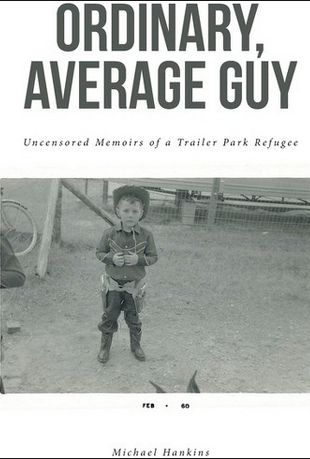
Ahh, boyhood. A time for digging out forts in the sides of hills, running from water moccasins at the creek, and repeatedly bashing .45 ACP rounds to see what’s inside. I stumbled upon this book while researching a Selma suburb for a patron: it’s the childhood memories of an Air Force brat who lived everywhere from Florida to Alaska, including several years just outside of Selma in a trailer park near the now-defunct Air Force training base, Craig Field. Although I initially bought the book to experience the Selma stories, Hankins experienced life all over the country, from the Texas desert to the wilds of Alaska. He wrote this, he says at the outset, to prove that the average Joe has something to say, and to give his kids and grands some idea of their family’s life from the 1950s to the 1970s. The stories are presented largely chronologically, delivered in a personal tone, and run the gamut. Early on, it’s boyish antics: exploring, setting off explosives, building, tinkering, and getting into fights over girls with guys who will later become best friends. After the move to Alaska, where Hankins comes to maturity, we switch to stories about outdoors adventures (and misadventures, like escaping floods and moose), cars, guns, etc. He also includes one story written about his father and mother crash-landing a small plane into the mountains and then having to spend a bitterly cold night waiting for rescue. This is an easy read and enjoyable for me, but I’ll admit to be being predisposed to like it: my father worked at the same Air Force base, and my first six years of life were spent in a trailer park not a mile away from Hankins’ home, so I both knew the area and was utterly fascinated by seeing it differently in better years through his eyes — something he makes even better by including photos from the period!
Highlights:
Many kids, including myself, found M-80s the perfect propellant for homemade mortars. I’d take a piece of pipe then hammer a good portion of it into the ground. A lit M-80 would be dropped in the open end with a round rock to follow. With a loud explosion, the projectile would go flying completely out of sight. I always pointed my mortar into the woods to avoid hitting anyone, forgetting all about the resident moose, bear, and porcupines.







 Reading Freely