Basic Economics

Basic Economics: A Common Sense Guide to the Economy
© 2010 Thomas Sowell
789 pages (4th edition)
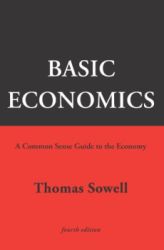
Basic Economics is a sweeping introduction  to the fundamental principles of market economics and their application to  constituent elements of the local and global economy like insurance, banking, trade, labor, and housing.  Although the principles chosen emphasize Sowell’s value of free markets, Sowell maintains that certain principles  such as the role of incentives, are basic to every economic approach. Drawing from business and political history, Basic Economics is an argument by way of education, one simultaneously impressive and suspicious.

 Its scope is grand, but the  text coherent: though Sowell offers the reader a girth of data to consider, it is presented in a narrative form. Graphs and charts very seldom intrude on what is more often histories of clashes between competing companies, interest groups, and economic ideologies. Sowell first establishes his principles of economics (his working definition of that being, the study of how scarce resources with alternative uses are allocated) , then working from the general to the particular, demonstrates them in action with the aforementioned data. Most of Sowell’s examples are drawn from American business or political history, but comparisons between it and the planned  economies of the Soviet Union and pre-1990s India are rife, and he sometimes plucks illustrations from Asia and Africa as well. Each section, containing multiple chapters, concludes with an overview that summarizes the essential points and provides further commentary. After establishing how prices work to moderate demand — items being demanded less at higher prices, and more at lower prices — he examines the concept at work in the housing market, demonstrating cases in which rent controls destroyed the market for affordable housing by increasing the demand for cheap housing., and discouraging developers from building further out of fear that regulation will forever squelch any hope they have of profit. By the same factors, Sowell writes, the gas lines in the 1970s were caused not by  the oil crunch, but by the government imposing price controls to keep prices lower than the market would have set them, and thus inflating demand by encouraging people to take advantage of the lower-than-market price.

Though Sowell’s argument is mighty, given his reputation as a pundit one wonders if all the facts are in evidence in this ‘scientific’ approach to economics. Sowell examines history on the basis of his economic principles, and nothing else: he recounting the Bank of America’s rise, he asserts its founder succeed because if his local knowledge and intimate ties with the Italian immigrant community, something no central bank or governing authority could do well.  What Sowell doesn’t recount is that the  Bank of America prospered because the Great San Francisco earthquake and fire of 1906 consumed so many of its competitors. Sowell’s arguments about the consequences of rent and price controls have heft, but economic transactions do not contain all of life;  there are outside circumstances  and greater contexts to consider — despite the spirit of vae victus, success is its own justification that reigns here. Basic economics is too simplistic: humans are not specimens of Homo economicus,  weighing incentive in our heads and acting rationally in our pure self-interest. In one section on brands, Sowell describes them as a substitute for particular and local knowledge: that is, while you have no idea  how healthy the burgers at a greasy spoon diner in the middle of nowhere are, or how they taste,  upon seeing the Golden Arches towering above the road you can rest easy, knowing that inside is a product that is perfectly predictable, right down to the shape of the fries — it is food held to  overriding, national standards of safety and appearance  But for Sowell, that’s all the brand is: a guarantor of standards.  As true as that may be,  it ignores the psychological aspect of brands on the mind, aspects the commercial firms are themselves aware of and capitalize on,  working overtime to implant affection for their brands in the minds of children so that when tykes grow up to be adults, they will be loyal customers.

Basic Economics offers a great deal of food for thought, but like the offerings of McDonalds which it hails, there are limits to its nutritional value. It is most valuable in explaining the elementary concepts of economics and educating citizens as to why public policy decisions relating to the economy have the unexpected consequences that they do: if the minimum wage is raised, why would companies not seek to  employ fewer works?  Something as complex as an economy, consisting as it does of an infinite number of transactions between buyers and sellers over a similarly uncountable number of goods and services, is perhaps too unwieldy to plan as we hoped. It does not, however, ease concern of what we then ought to do, and Sowell’s detachment here, while welcome in explaining the problem, leaves one wondering if in the cold world of economics there is room for more humane considerations.
Posted in Reviews | Tagged , , , , , , | 6 Comments

Bookshelf Scavenger Hunt

This was posted on a forum, so I thought I might post it here to see if anyone else wanted to play along.

1) Name a book you own that is written by someone with a Z in their name
Howard Zinn’s A Power No Government Can Suppress.

2) Name the oldest book in your bookshelf
I have a history of German music that dates to the 1880s, written in German. My German-language professor presented our class with a box of books and said “Pick one!”.  I chose that one because it was in the old Gothic script.

Oh, and I have several Bibles, including a King James Version translation. That could technically date to the 17th century.

3) Do you have a book that is a diary (real or fictional)? If so name it. 
I have Anne Frank’s diary, naturally, but have also held on to a favorite series from middle- and high- school, California Diaries, featuring journals from four teenage authors — Dawn, Sunny, Maggie, Amalia, and Ducky, all of whom had separate issues, ranging from suicidal friends to alcoholic and abusive parents.

4) Name the fictional book on your shelf which takes part in the earliest time period
That would probably be Roma, by Steven Saylor…which follows one patrician family in Rome, from prehistorical days to the rise of the Empire.

5) The five commonest surnames in the USA are Smith, Johnson, Williams, Brown and Jones. Name a book you own that is written by someone with one of these surnames.
Bitterly Divided: the South’s Inner Civil War, by David Williams.

6) Name the book that you own that you have read the most times.
The Many Loves of Dobie Gillis, by Max Shulman.

7) Do you own a book that is written by an author you have a love-hate relationship with? If so, name the author/book.

I own one book by Harry Turtledove, who I can’t seem to stop reading despite the fact that I haven’t really enjoyed anything I’ve read by him in recent years. That book is the first I ever read by him, Guns of the South. It has Robert E. Lee on the cover, holding an AK-47.

8) Name an author who you own more than 10 books by. 
I have an entire bookcase, five shelves worth, of nothing but Isaac Asimov. That includes the Robots, Empire, and Foundation books,  numerous essay and short story collections, science and history texts, and a few odd novels like A Whiff of Death.

9) Excluding textbooks, what book on your bookshelves did you pay the most for? 
I don’t think any item in my collection was purchased for more than $30, though my Deep Space Nine companion may have been $35 or so.

10) Name the latest book you purchased.
Either The Righteous Mind: Why Good People are Divided by Politics and Religion, or Religion for Atheists, by Alain de Botton.

11) Name a book you own that is set in your state, province, county etc
I don’t believe I own any southern fiction. Shame, shame…

12) If your house was on fire and you could only save one book, which book would it be?
Glimpses of World History, Jawaharlal Nehru. I checked ebay and amazon on a regular basis for three years to find a copy of that book that wasn’t selling for $80 or more.  I might mention The Complete William Shakespeare, but I keep it in my automobile, so it doesn’t exactly apply..

Posted in General | Tagged | 1 Comment

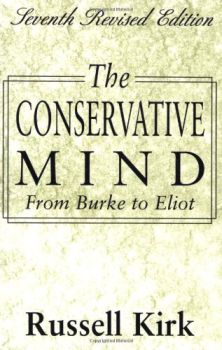
The Conservative Mind

The Conservative Mind: From Burke to Eliot
© 1953 Russell Kirk
534 pages (7th Edition)

For most of human history, change has been a glacier — slow to move, retreating as much as it advances. Since the scientific and industrial revolutions, however, change is  less a glacier and more a snowball, moving with rapidity, becoming ever more drastic, and picking up speed. Russell Kirk would remind modern readers that snowball modernity is moving, like other snowballs, downhill. In The Conservative Mind, he collects and comments on the thoughts of those who, since the Pandora’s box of revolutions was opened, have tried to clap it shut again.  It is a large, thought-provoking work, often melancholy considering its authors are ever lamenting the loss of order, privilege, and the ‘permanent things’ against the advance of equality, democracy, and ideology. It attempts to demonstrate an intellectual conservativism, one based on more than an instinctual aversion to change. It succeeds in part, but its ideal audience is the half-converted, for modern readers who do not share its views are unlikely to be convinced by, or even warm appreciably to, authors who spend so much time attacking concepts like democracy, individual judgment, and equality which we hold dear.

The Conservative Mind begins with Edmund Burke, writing against the French Revolution, and continues to leapfrog between Britain and the United States for a century and a half thereafter, as the world continue to change beneath the feet of those who yearned for stability. Such changes were first material, then cultural, and finally political: as industry and commerce eroded the base of the old agricultural economy,  farmers displaced by mechanization streamed into the cities, becoming ‘proletarians’ in the process — landless, resourceless men whose skills, along with those of artisans, were no longer needed, and whose only strength was in their numbers.  Converting those numbers into political power, they pressed on the reigning powers and pressed for changes that might relief their burden — for if they had been denied the ability to provide for themselves, the state could be turned to do it for them; and if the new economic powers wanted to oppress them, they would turn the tables and put into force laws that checked the excesses. As the great tug of war pulled the national fabric hither and on, the men featured here fretted that said fabric was coming apart at the scenes.

Though I have scorned conservatism in the past for being bereft of its own ideas, incapable of doing anything other than resisting any kind of change at all, what I take for weakness, Kirk posits is a strength, and one of the themes uniting his authors’ work. Conservatism is not an ideology, he writes; it is an exercise in pragmatism, of recognizing that rapid changes in anything as complex as society or the economy will have unexpected consequences, and if experience is any guide, most of those consequences will be unfortunate. His ideal conservatism is or should be the voice of rational prudence, keeping passion from doing anything too silly.  But while some of his featured authors’ complaints can be appreciated as being sensible (not necessarily correct, but a perfectly rational view given the facts at hand), others are firmly in the camp of irrational reaction. One English author protests the 1832 Reform Bill for eliminating a handful of ‘rotten boroughs’, or election districts which no longer held populations worthy of seats in Parliament, or populations at all: these granted certain M.P.s a say in the nation’s doings without their having any person at all to be responsible to.  The writers’ protest was that one such seat had been the home of many a distinguished M.P, and to abolish their seat to fulfill some ideal of efficiency was outrageous. The starting point of the French Revolution is an ideal example of the value and limits of this conservative approach: while the Revolution was in many respects a catastrophe for France and Europe’s stability, it did unleash positive forces. It gave lie to the fact that the people of Europe had to remain subjects to self-serving lords and priests; it gave them a reason to believe they could take command of their own fortunes, and better them in the process. As lamentable as the fire of revolution that destroys everything in its path is, so to is a conservatism that squelches all flames before they cause any kind of disruption. Superior would a flame of change that puts a fire under the seat of reactionary forces and prompts them to get out of the way of  ‘progress’.

At the same time, a criticism of conservatism as being nothing but a break or a nay-voice is not quite right, for Kirk maintains that his impaneled authors do believe in certain things, in protecting or restoring them. They believe, for instance, in the principle of prescriptivism, that people by and large ought to defer to the received wisdom of their elders and institutions, for the great reservoir of experience passed down from generation to generation is a far better guide to truth than any one individual, regardless of their belief in the power of objective Reason.  It’s an argument one can find sense in — collected knowledge will surely outweigh any individual knowledge, and reason without evidence  can fall into debates over how many angels can dance on the head of an Ideal Form of a pin —  but an individual may be in possession of facts that collected knowledge simply does not know.  If an astronomer identifies a source of light in the sky and posits that it is is approaching the Earth rapidly, the fact that the collected wisdom of the ancestors contains no accounts of astronomical bodies flying into the Earth does not negate the possibility. Collected beliefs are no more removed from the prospect of error than any new thought formed of reason. This is why science is such a valuable tool, for it combines free reason with the experience of evidence.   But scientists obtain their knowledge through trial and error, by performing experiments that rule out certain ideas and support others. The conservatives in this work, so keenly engrossed by the idea of man as a fallen creature who had to be kept from chaos and barbarity by stern rules and moral authority, would doubtless oppose experimenting with anything as volatile as human society, especially given that they consider some of the values of humankind to be valuable in their own rights, apart from us. Religion is at the heart of Kirk’s conservatism, and he maintains that those who see it as simply a convenient curative to fix moral failings of people are doing it wrong. Religion is a dedication to Higher Things, and if people do not acknowledge the supremacy of God over the world, if they do not submit entirely to Divine Will, they will err time and again.

This is not a happy book. It is a work of reproach and lamentation, of distress, argument, and grievance. I think it valuable in terms of  the history of political philosophy, for it  offers the perspective of those who fought against changes like universal suffrage that we take for granted. Barring the collapse of civilization, it is unlikely that universal suffrage will reversed; at the same time, I find it useful to ponder the consequences of said acts, and to wonder: did they live up to the expectations of progress, or did they diminish the body-politic by putting power into the hands of people who have neither the time nor the inclination to gather facts, reflect upon them, and decide on the wisest course of action.  What has expanding the power of central governments done to the effectiveness of those governments, and to the engagement of citizens?  Do we live up the the ideal of the self-empowered Citizen, contributing to the well-being of our nations while pursuing our own individual interests, or are we simply consumer-citizens,  our only act of participation being which product we choose to buy in the election booth: Blue or Red?  The conservative mind is too damning of the species, too quick to defer to the tyranny of tradition and authority, but all the time…perhaps it is a mind that ought to be considered, if only to ward off  the possibility of modern hubris with a little humility.

Posted in Reviews | Tagged , , , , , , , , , , , | 7 Comments

This week at the library: airborne chivalry, unschooling, and cool, cool, considerate men

The week’s reads: A Higher Call, Adam Makos | The Unschooling Handbook, Mary Griffith | Hannah Coulter, Wendell Berry | 1632, Eric Flint

This week I’ve been reading from two larger works, both challenging: Russell Kirk’s The Conservative Mind and Thomas Sowell’s Basic Economics. I finished Kirk’s anthology over the weekend, and am still collecting my thoughts on it.  I managed to get through the section on labor in Basic Economics without quitting the book in indignant rage, which I consider personal growth.  I decided to start both works to challenge my thinking and learn about views which I’ve long avoided.

My fun reading this week will consist of Your Inner Fish, which I’ve happily settled back into, and it will be followed in short order by The Making of the Fittest: DNA and the Ultimate Forensic Record of Evolution, by Sean B. Carroll. The last time I tried reading one of his works (Endless Forms Most Beautiful), the sheer amount of details was too much for my pansy humanities-focused brain. Pehaps this time I’ll be more successful — Goodreads reccommended it. Speaking of book sites, LibraryThing is sending me a copy of Breach of Trust: How Americans Failed Their Soldiers and Their Country as part of its early reviwers meeting.

The United States has been “at war” for more than a decade. Yet as war has become normalized, a yawning gap has opened between America’s soldiers and the society in whose name they fight. For ordinary citizens, as former secretary of defense Robert Gates has acknowledged, armed conflict has become an “abstraction” and military service “something for other people to do.”

In Breach of Trust, bestselling author Andrew Bacevich takes stock of the separation between Americans and their military, tracing its origins to the Vietnam era and exploring its pernicious implications: a nation with an abiding appetite for war waged at enormous expense by a standing army demonstrably unable to achieve victory. Among the collateral casualties are values once considered central to democratic practice, including the principle that responsibility for defending the country should rest with its citizens.

That sounds positively chipper.  On a happier note, I’m expecting Righteous Mind: How Good People are Divided by Politics and Religion for Atheists in the mail.  Alain de Botton never fails to enthrall.

Posted in Reviews | 2 Comments

1632

1632
© 2000 Eric Flint
608 pages

Tremble, lords of Germany. A new breed has come into the world.


What happens when you throw a small American mining town from the 20th century into the middle of Germany…during the 17th-century’s Thirty Years War?  Chaos — and fun.  One morning out of the clear blue, the town of Grantville, West Virginia, suddenly found itself picked up and plopped down into one of the worst wars in history.  Left to fend for themselves  in an era of disease, ignorance, and marauding armies, they decide to rebuild the American vision from scratch, in the middle of Europe. 1632 is the start of a large and not-very-orderly series of novels that depict the evolution of Europe following the sudden infusion of 20th-century knowhow and American bravado,  and it’s a ball to read.

The novel’s premise is largely fantastical, and subject to a handwave in the introduction. What matters is not how the Americans came to be thrown back into time, with their library of knowledge and modern tools.  The store explores what that knowledge and tools does to Europe’s fiendishly complicated political scene.  In 1632,  Europe’s multitude of powers were involved in a technically religious war between Catholics and Protestants in which some Protestant powers were fighting on the Catholic side, and vice versa.  Cardinal Richileu, the diabolical chessmaster running France and  working fiendishly to keep the balance of power in Europe favoring himself,  is busy moving armies and juggling two sets of Hapsburgs (some in Spain, some in Germany) as well as the plucky Swedish nation.  The sudden takeover of part of Germany by a mouthy, irreligious Republic is a matter of some concern — especially as the Americans begin moving outward.

Grantville is not the typical American town: it is a mining town, and a unionized one that. It is led by intelligent, technically-savvy men who are used to a fight and determined to stick together, who know how to break a jaw in defense of principles. Mike Stearns, president of the local United Mine Workers of America, becomes the city’s de facto leader, for he and his men have the energy and toughness to stand against whatever brigands Europe throws at them. Although it may look primitive by their standards, 17th century Europe is a dangerous place. Its armies carry muskets, and while rumors of witchcraft abound, its leaders know technology when they see it.  They won’t be scared off for long. Realizing how overwhelming the odds are against them, Stearns decides against isolation. To survive, Grantville is going to have to build on what it has already — and expand. But not as an empire: as the idealistic Republic they were once members of, and now constitute. Their goal is to start winning the hearts and minds of their neighbors, and from the downtrodden German folk create a shining city set upon a hill, amidst the forests of Thuringia.

1632 covers Grantville’s first year, and much happens — raids and battles, politicking between the American factions over the city’s future and between the warring powers of Europe, America  now included —  and a great deal of character development.  Idling teenagers who spend their days throwing dice are forced into responsible manhood:  schoolteachers and engineers now govern a nation. But the Americans are not alone, for the cast of viewpoint characters steadily expands to includes ‘downtime’ Europeans (some Jewish refugees, some Germans) who become citizens of the new republic, beguiled by its tolerance, high (if charmingly native) ideals, and liberties.  These characters are standouts, especially the women of both cultures. One woman grows from a rape victim-concubine hiding her family in a cesspit to a lady of war who terrifies grown men with her stare and strikes the characters as being a creature out of legend.

Although the chronology of the books that follow this is bewildering, I may have to try, for 1632 is such a delightful novel I’d like very much to see what develops from it. The insertion of 20th century knowledge and mores into the middle of early industrial Europe is fascinating enough — what will become of the Dutch Republic, I wonder? will it make common cause? —  but the storytelling is exuberantly fun. Despite being alone in the middle of deadly chaos, the Grantville townsfolk seize the danger as an opportunity. They’re full of bravado, flying around in pickup trucks and shotguns, rescuing damsels in distress and killing hordes of evil raping mercenaries with an M-60 while screaming “‘MERICA!”. They aren’t hicks — just country folk used to fighting for what they believe in, and what they believe in most is equality and liberty.  I’d wager European readers might be a touch turned off by the notion of cheerfully confident Americans remolding the continent in their own image, but for Americans, the first book at least should find a broad audience in anyone who can gamely tolerate speculative fiction, as it supplies a little of everything, from politics to romance to combat. This first book is available for free on Kindle, no doubt a nefarious plan on Amazon’s part to hook readers like myself into wanting to read the dozen or so that follow it..

Posted in Reviews, science fiction | Tagged , , , , , , | 1 Comment

Hannah Coulter

Hannah Coulter
© 2005 Wendell Berry
190 pages

This is the story of my life, that while I lived it weighed upon me and pressed against me and filled all my senses to overflowing and is now like a dream dreamed. […] This is my story, my giving of thanks.  p. 5

Hannah Coulter is a coming of age story, the tale of a young woman who becomes a widow twice over, raising children through wars and hardship, strengthened by her family and extended community of Port William. Like Jayber Crow, it is less a story that is told in a straight line, and more an experience which is shared by the reader, a tale that meanders with purpose. The novel is a collection of stories and reflections, knit together by the life of Hannah into a literary quilt, one beautiful to behold and comforting to snuggle under. The prevailing themes are of love and loss,  family, enduring faith (not limited to religious, but faith in life and in one another), and communion — communion with one another, with the land, and Providence.

Agrarianism is the backbone of Hannah and her kindred’s lives: it establishes the cycles of life, provides a means of self-reliance, and offers the “joy of achievement, the thrill of creative effort”.  The manifest importance of the land makes itself known even in the way characters orient themselves: they do not live on this road or that, but  take their directions from topography. Families live in this hollow, or on on those hills, or off that branch of the river: the people who inhabit Port William know the land as intimately as any deer or hawk. To them, their world is not limited to narrow strips running alongside lanes, a grid that people occupy as dots. The land and place of Port William are whole, connected, and rambling. But the lives of the city are not linked just by physical presence; they’re tied together too by their common experiences. Hannah and her second husband both lose loved ones in World War 2, and that shared loss is the impetus of their relationship. When they settle in, they join an informal ‘membership’ of neighbors, who despite occupying separate farms, work together as one, helping to mend one another’s fences, or gather in the harvest.  They do for one another whatever “needs doin'”, and receive in the same spirit.

As said, this intensely thoughtful work combines stories and reflections.  The stories are sometimes tragic, other times uproarious, often charming, and always demanding —  Berry’s stories have a way of hovering off the page and floating right in front of a reader’s eyes and mind, impossible to ignore. Closing the book does not help. Although the reflections tend toward the melancholy — Hannah begins her life losing one parent, promptly loses her first husband, and will see her children be scattered to the wind by ambition  — the work is, as she says, a story of giving thanks, even in the midst of trouble. This is her abiding faith — “rejoice always”.  For though the years are not kind to Port William, as its way of life is paved over by asphalt and “developed” and the sons and daughters of the community are brought low in war or move away to make better lives for themselves in different places — lives that prove to be not as good as they thought —  the book ends in hope.

I continue to be astonished by the beauty of Wendell Berry’s prose

The living can’t quit living because the world has turned terrible and people they love and need are killed. They can’t because they don’t. The light that shines into darkness and never goes out calls them on into life. It calls them back again into the great room. It calls them into their bodies and into the world, into whatever the world will require. It calls them into work and pleasure, goodness and beauty, and the company of other loved ones.

p. 57

Posted in Reviews | Tagged , , , , , , | Leave a comment

The Unschooling Handbook

The Unschooling Handbook: How to Use the Whole World As Your Child’s Classroom
© 1998 Marry Griffith
240 pages

What does it mean to educate a child? In the United States, schooling is dominated by standards, by regular exams that force educators to teach the test. But is forced memorization a means of teaching our children well?  Mary Griffith thinks not. A practitioner and advocate of “Unschooling”, she believes children ought to be free to learn the way adults do: autonomously, pursuing their own interests with the support of their family. In The Unschooling Handbook, she explains the unschooling philosophy, elaborates on how children can pursue understanding of reading, math, science, art, and even history by themselves,  and offers parents who are considering the prospect resources to make the leap. Intriguing and smartly organized, it’s a welcome perspective in reflecting on education.

What happens to destroy the natural curiosity of children, corroding kids who delight in learning about anything into reluctant attendees who look on the schoolroom as if a drilling dentist were waiting for them there?  The answer is the decidedly unnatural approach of compulsory education, making children to rise early and spend all day under the authority of adults they neither know nor trust,  and forcing them memorize a variety of facts about a series of subjects that may not interest them. If a subject does not hold a child’s interest, Griffith writes, why do we expect them to retain any knowledge at all?  The information may be held long enough for the test, and then promptly dumped.  The children are not improved by having been forced to memorize it, and the public is not better off for having used resources to make them do it.  That Griffith is concerned with the quality of her child’s education is something of a relief: other criticisms of the public schooling systems I’ve encountered all had ideological roots,  with the parents being paranoid about the prospect of Other People influencing their children, zealously guarding their progeny’s craniums like Gollum guarding the Ring.  Griffith doesn’t complain about the Government trying to turn her child into a socialist minion, or a docile sheep for the new world order.  Her philosophy does run counter to the state’s approach to education, though, and borders on libertarianism: she does not believe in making her child learn anything. She instead trusts that children will eagerly want to learn about a wide variety of subjects, if provided with the right tools. The parents’ job is to guide kids through the world, showing it off, and then helping them investigate whatever catches their interest.  It may be Anglo-Saxon mythology or geology; it may be Candy Crush.  

The potential for abuse is a notable limitation of the unschooling approach, for children are not known for being moderate souls. What is to keep a child becoming obsessed with one subject, and learning nothing at all about mathematics?  Griffith’s permissive streak seems a vulnerability in a world full of addictive, ever-accessible smartphone games: her technological references stop at 1998, which limits the section on the uses of television and the Internet in education for modern readers. (YouTube is a fantastic resource for learning, but it’s also a fantastic way to waste time perusing funny kitten videos.)  The author’s answer is that children will, in time, grow bored  even in these indulgences. Trust them.  It’s a nice thought, but I’d rather err on the side of discipline. The permissive-parenting argument is a separate argument from that concerning unschooling, though, and that I rather like. I like it because I have learned more reading popular science texts on my own than I ever learned in school, and because the comprehensive variety of information I absorb through my own studying is infinitely more useful than memorizing a few rote facts that pass into oblivion.  The greatest weakness of unschooling is that parents’ lifestyles may not allow for it: when living costs such that both parents have to work to support families, who can stay home to attend to the children? Reflection is warranted: perhaps a superior education for children, and a closer relationship between parents and children as a result of more time spent together, and less fighting with them to conform to school’s regimented schedule and curriculum, would justify a family deciding to downshift so it could afford to run on only one salary.

The unschooling approach demonstrated here makes learning a family experience. Education is not something children endure while mom and dad go to their jobs in the ‘real’ world; instead, education is part of exploring that real world. The core of The Unschooling Handbook is its section illustrating how kids and parents can learn together about the world. Some subjects, like art, music, and science, are naturally entertaining, and those which require more discipline aren’t too difficult to pursue, either:  children will gravitate to learning to read if they see their parents reading, and if they are read to.  This kind of education requires care on the parents’ part, as they are the cultivators of their children’s minds.  Although all children find the natural world awe-inspiring and fascinating, many adults find science dull, probably because their experience with it has involved more the memorization of facts and less hands-on experience that seduces them into learning more about the subject, and eventually to adopting the tools of science to learn even more. A child can be taught botany from a garden and chemistry from the kitchen.  What parents can do is help guide learning from the reactive ‘wow’ to the ‘Eureka!’ that follows dogged research. A key seems to be relevance:  children may squirm if made to memorize the dates and names of English kings (unless they find the recent birth of the latest prince interesting, as so many Americans inexplicably do), but if history is used to awe children with the fact that the places they see around them, and their family, have a greater story than what is presently seen, it may take root.  This approach hearkens to our species’ ancient practice of oral traditions: being engaged by history is in our blood.

The Unschooling Handbook is both thought-provoking and useful, if dated.  I will assuredly be reading more about this subject — for I believe learning ought to a result of our enthusiastic attempt to understand the world, and not a forced exercise in training.

Related:

Posted in Reviews | Tagged , , , , , , , , , | Leave a comment

A Higher Call

A Higher Call
© 2012 Adam Makos and Larry Alexander
400 pages

“You follow the rules of war for you — not your enemy. You fight by rules to keep your humanity.”

The Eighth Air Force operating over Germany in the early 1940s did not fly the friendly skies. They operated in skies black with clouds of flak, and buzzing with angry German fighters, intent on bringing down the bombers that were destroying Germany’s ability to make war and its cities in the process.  But at least on one occasion, the fury of war gave way to mercy – for on (date), the beyond-crippled bomber Ye Olde Pub was followed by a German fighter who not only spared it, but escorted it wingtip to wingtip over his own nation’s most formidable anti-aircraft installations and safely to the sea. Years later, as  aging veterans, each man pondered in his soul a question. Charlie Brown wondered why he had been spared, while Franz Stigler wondered if his attempt at chivalry had worth the risk of the Gestapo’s wrath. The work is based in part on pilot interviews before their deaths in 2008, and follows their journeys as airmen, from the time they were boys playing with models to their attempts in later years to find the man with whom they’d shared a moment of grace. A Higher Call is an encouraging story of humanity rising above war, one which offers readers a rare memoir of a German fighter pilot’s experiences in Africa before the action moves to Europe.


Posted in Reviews | Tagged , , , | Leave a comment

This week at the library: France, airborne chivalry, and Wendell Berry

Dear readers:

This past week saw the conclusion of my annual tribute to France after reading An Outline of French History, by Rene Sedillot. The work is translated from French, but bears no weakness on that account: it is as said before, ‘oddly personable’. The author endeavors to soar high enough above his subject that he can comment on happenings without sounding partial, and he is generally true to his hopes of nonpartisanship. Though it’s narrative history, there are no heroes or villains here; the author is equally hopeful and suspicious of whatever party is ruling at the moment, whether it be the king or ‘the people’.  I found it enjoyable, just not particularly remarkable. It is storied history weakened only by the fact that it was written in the late 1940s, and the status of France has changed considerably since then…though there is some amusement to be had in the fact that the author bemoans how strained France’s ties with her good old colonies in Africa and Indochina are becoming.

I also finished Hannah Coulter, an enchanting novel by Wendell Berry about a  young widow’s coming-of-age, for which comments are pending, and A Higher Call, a nonfiction work about two opposing pilots (one, an American bomber, the other a German fighter) who have a chance encounter in the skies that ends in mercy. Comments will be posted for it as well.

I am cheerfully undecided on what this week’s reading shall be. I have a set of essays by Wendell Berry, whom I’m increasingly fond of, entitled What Are People For?, and am fairly itching to get back to a couple of my science reads,  starting with Neil Shubin’s Your Inner Fish.  I also received Fighting Traffic, by Peter Norton, so there’s a good chance I’ll be starting it.

‘Til then, happy reading!

Posted in history, Reviews | Tagged , , , | Leave a comment

French Kids Eat Everything

French Kids Eat Everything: How Our Family Moved to France, Cured Picky Eating, Banned Snacking, and Discovered 10 Simple Rules for Raising Happy, Healthy Eaters
© 2012 Karen Le Billon

320 pages

Upon landing in France to spend a year with her husband’s family, Karen Le Billon noticed something peculiar about French kids’ behavior at the dinner table. First, they were at the table, not in front of the TV: they were sitting politely there, as though they were actors in a 1950s film on table etiquette; and they were eating their vegetables.  Not pizza-declared-a-vegetable-by-Congress, but actual vegetables. And it wasn’t just one French families, but entire  cafeterias and villages full of them!  Spooked, but slightly envious, Le Billon committed herself to figuring out how the French created such well-mannered eaters. In French Kids Eat Everything¸ she documents her exploration of French food culture, and distills it into ten rules which can apply just as easily  to American families.

Those rules are partially sourced in both French parenting and in French gustatory culture. Her account gives further evidence to the lesson of French Women Don’t Get Fat and Sixty Million Frenchmen Can’t Be Wrong: the French take food very seriously. It is to be eaten at the table, in special dishes, preferably with a tablecloth, and at ordained times.  In Bringing up Bebe. Pamela Druckerman called attention to well-behaved French kids as well, and attributed it to the fact that the French expect their children to act like little adults. Le Billon’s French husband concurs, guffawing at the notion that children are innocent.  Children are untamed animals who must be civilized. Food culture is part of the education that refines selfish, noisy babies into that most elite specimen of mankind, the French person. The manners of the table teach children manners for life: the importance of spending time with family, of slowing down and disengaging from the hubbub of life outside,  of participating in little rituals that imbue the ordinary with meaning, of honoring your community by eating local produce.  Although the education is intended to groom children and open them to a life richer in experience and pleasure, the grooming itself requires discipline: French parents tend toward the authoritarian, insisting that their children try various foods time and again. Their authority is moderated by wisdom: they don’t insist or expect that children eat a new food completely up, only that they try it. “You didn’t like it this time? That’s ok; maybe you’ll like it next time,” Le Billon learns to teach her children.  Although children may pass through a period where they are adverse to trying new things, persistence will see them through, as it will adults:  people can learn to enjoy any food if they try it enough times.

The book records Le Billon not only divining out these rules by observing French families eat and talking with them about food, but her efforts to teach her mini-barbarians, her oh-so-American children, how to be civilized. In the end, the fact that she’s living in France is a tremendous aide: the lessons she flounders at teaching because she’s just learning herself are zealously enforced by her children’s teachers, friends, and family. When the Le Billons return to America, her girls are anomalies, and Le Billon has to figure out how to apply the lessons of French epicureanism to America’s fast food  mentality. That helps the  book become more than a romanticized paen to French dining, or an entertaining account of cultural exploration. There’s nothing in the ‘rules’ Le Billon notes that can’t be applied to every culture, or any:  most, indeed, is simple discipline. The trick for American parents reading will be applying those lessons while living in a culture which prides itself on being ‘real’, instead of mannerly.

French Kids Eat Everything is most enjoyable, especially for people interested in the simple pleasures. The rules, for the curious:

1. Parents are in charge of food education
2. Avoid emotional eating (no food rewards, bribes, etc)
3. Parents schedule meals and menus — kids eat what adults eat.
4. Plan family meals together — no distractions
5. Eat a variety of vegetables
6. You don’t have to like it, but you do have to taste it
7. No snacking!
8. Slow food is happy food.
9. Eat mostly real food.
10. Remember — relax. Eating should be joyful.

Related:
Bringing up Bébé: One Mother Discovers the Wisdom of French Parenting, Pamela Druckerman
French Women Don’t Get Fat: the Secret of Eating for Pleasure, Mireille Guiliano
Sixty Million Frenchmen Can’t Be Wrong,  Jean-Benoît Nadeau & Julie Barlow

Posted in Reviews | Tagged , , , , , | 5 Comments