This week at the library: economics, law, and the truth about living like cavemen

The previous week’s reads:  The Making of the Fittest, Sean B Carroll | Save the Males, Kathleen Parker | The Righteous Mind, Jonathan Haidt

Dear readers:

This past week I read Trains and Lovers, a short novel in which four men and one woman recount stories of their lives’ great loves to one another. Because of the age of the characters, the stories run from the late 19th to the late 20th centuries. The stories tend toward happy endings, and impart the general idea that love at first sight happens, it makes us do irrational things, and is worth taking chances for.  The tales also incorporate travel into them,  either because people leave their homes behind in pursuit of romance, or because love takes them on unexpected metaphorical journeys.

I’m currently in the middle of Radicals for Capitalism, which I bought because it seemed interesting and was something of a value: 800 pages for $20?, retail?  I’d been hoping to learn more about men like F.A. Hayek and Murray Rothbard, whose names surface a lot in American libertarian writing.  They appeared earlier, but Radicals for Capitalism could carry the subtitle “Ayn Rand in Context”. There’s a distressing amount on her.  The chapter I’m on now is called “The Objectivist Crackup”, so maybe she’ll go away soon.  At work, A People’s History of the Supreme Courtis my lunch-time reading, and when my soul starts flat-lining from all of the economic policy, I’m enjoying Marlene Zuk’s Paleofantasy.  I have two more science books on order: Frans de Waal’s Good-Natured: the Origins of Right and Wrong in Humans and Other Animals, because it was selling $1 used on Amazon and I justified buying it on that and the fact that I have no de Waal in my personal library.  I’m also expecting Two Sides of the Moon,  a collaborative memoir of the Space Right penned by cosmonaut Alexei Leonov, the first man to walk in space, and David Scott, an astronaut who walked on the moon.  A friend lent me Bart Ehrman’s Misquoting Jesus, which I plan on getting into as soon as I’ve wrapped up with Zuk.

Comments are still pending for Neil Shubin’s Your Inner Fish.

Well, happy reading!

Posted in Reviews | Tagged | Leave a comment

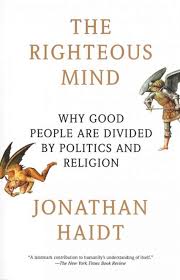
The Righteous Mind

The Righteous Mind: Why Good People are Divided by Politics and Religion
© 2013 Jonathan Haidt
528 pages

The Righteous Mind begins with a question, seriously posed: why  can’t we all get along? To find the answer, Jonathan Haidt delves into the nature of morality, following the pursuit of it from philosophy to evolutionary psychology. Haidt produces three core ideas: one, David Hume was correct in positing that people are more intuitive than rational; two,  moral concerns don’t have a singular source, but fall along six separate axes,  each derived from our natural history, despite being couched in flourished religious and philosophical language; and finally, that morality is double-edged sword, binding us with one another as well as against others. Haidt’s work is impressive in its breadth, drawing on sources as diverse as Plato, Emile Durkheim, and E.O. Wilson, and in its delivery. Though he covers a lot of territory in a compact book, Haidt constantly works to keep readers aware of how all of the ideas discussed connect together.

The grand idea underlying all this is that morality is neither an objective truth that can be deduced via logic by anyone old enough to reason, nor is it completely subjective, an artifact of culture that is deposited into a blank slate of our infant minds. It is instead a product of evolution. Our instincts for morality are kin to our sense of taste:  there are different flavors of moral concern, and each of them played a part in our species’ development. The natural basis for morality is being eagerly explored by scientists like Frans de Waal, who has demonstrated how chimpanzees can empathize with one another, and sense when others are being treated unfairly.  Caring for one another is a mammalian strength, but there is more to morality than care and fairness. There are also senses of loyalty and deference to authority useful to tribes competing against other tribes, and a sense of ‘sanctity’ that buds off our natural feeling of disgust that keeps us away from unhealthy influences. Our instincts may be strengthened by rationalistic arguments or ritual, but neither can conceal their source,  nor operate independently from it.

Haidt sees our moral-political instincts as particularly far-developed as compared to other primates, though. Although alphas in chimpanzee troops do have a political role in mediating disputes, they are not kings: they do not command the tribe to go here or there, or make plans for its future well-being. Haidt believes natural selection has favored our ‘righteous’ (political-religious-moral) instincts in this regard  out of necessity, because for thousands of years we’ve had to regularly deal  with so many of our own numbers:  instincts which promoted order and cooperation were favored, and those populations which most exhibited them flourished, while populations that didn’t disappeared. Religion, too, played a powerful part. In Haidt’s view, we are not merely instinctive creatures who one day stumbled upon culture and started happily passing it down to the next generation like a good stick. We have evolved to be dependent on culture, and this is why religion is such a universal and powerful  trait of human kind.  Religion is first and foremost about morality and keeping the tribe together:  ideological religions like Christianity and Islam are fairly novel.  

These instincts are not part of the past; they are present, with us now.  Haidt examines US political parties by this six-taste model and concludes what while liberals depend strongly on the Care and Fairness feelings, and Libertarians are somewhat obsessively fixated on the Liberty-Oppression axis (which is a ‘new’ taste that developed fully after we’d become tool-users), conservatives draw marginally from each ‘taste’ equally across the spectrum.Like all products of evolution, our righteous instincts are a trade-off. A dog with long legs runs fast, but loses heat more quickly than a short-legged rival — and morality which evolved in the atmosphere of inter-population competition is all about Us vs. Them.  When we rally towards an ‘us’, we draw away from a ‘them’.  In light of that, Haidt ends the book by offering ways people of varying political opinions can argue more constructively. He first asks readers to keep in mind that people who disagree with us may simply be drawing on another set of instincts and beliefs:  you are not the center of the universe, and those who are different from you are not the Evil Villain set against you in some colorful psychodrama. We must labor to discern where people are coming from if we intend to communicate. Secondly, he draws on his own experience as an idealist-turned moderate to detail what liberals, conservatives, and libertarians can learn from one another: markets are magic, but not perfect — and if something isn’t  good for the beehive, it can’t be good for the bee.

The Righteous Mind is  astonishing:  the argument masterfully organized and sympathetically voiced from an author who distills a wide range of research from across the intellectual spectrum into a reflective, wise work.  This is very much recommended.

Related:

Posted in Reviews | Tagged , , , , , , , , , | 9 Comments

A Quick Book Survey

From the Broke and the Bookish:

1. The Book I’m Reading:
I’ve just started Paleofantasy by Marlene Zuk, which casts a critical eye toward arguments that we should live more like pre-agricultural man. I’ve read Zuk before, in Sex on Six Legs, about insects. At lunch I’m reading from A People’s History of the Supreme Court.

2. The Book I Just Finished:
 I last finished  Save the Males, by Kathleen Parker. I found it while looking for books on males and masculinity on Amazon, and it turned up while I was shelving recently returned books at the library. Obviously, Fate wanted me to read the book. I wasn’t too much impressed by it. Better luck next time, Fate.

3: The next book I want to read:
Power, Inc — the Epic Rivalry Between Big Business and Government, David Rothkopf.

4. The Last Book I Bought:
Radicals for Capitalism: A Freewheeling History of American Libertarianism, Brian Doherty.

5. The Last Book I Was Given:

I haven’t gotten it yet, but will receive it next week: Lost Scriptures: Books That Didn’t Make It Into the New Testament, Bart Ehrman.


Posted in General | Leave a comment

Save the Males

Save the Males: Why Men Matter and Why Women Should Care
© 2008 Kathleen Parker
215 pages

It’s not a man’s world any more. Far from it, Kathleen Parker writes: in America, men have not only been dethroned but imprisoned by a culture hostile to them.  In Save the Males, Ms. Parker elaborates on the many ways in which the nature  and contributions of men are scorned, abused, and discouraged by the prevailing culture, influenced as it is by ‘third wave feminism’.  The first wave feminism gave women the vote, second wave got them careers and divorces, and the third wave made them porn stars.  Save the Males is less about men and more about the abuses of that third wave, which the author sees as not pro-women, but anti-male, and by virtue of the sexes’ interrelatedness, anti-human.  She raises a series of fair points, but the book’s focus is wobbly.

Parker doesn’t detail a campaign against men, but rather has a list of complaints about the various ways men are emasculated. Education is entirely girl-focused, she says:  boys are forced to spend all day listening to soft-spoken women and denied rambunctious games of tag at recess. Women can merrily abort babies without ever consulting the fellows who contributed to the cause, divorce and child custody laws are outright malevolent to the male sex, and then there’s porn!  It…puts pressure on them to perform, or something.  The list of attacks against men drifts into a list of ways society is degrading midway. As wretched as porn can be (and if you have doubts, read Chris Hedges’  Empire of Illusion),  the fact that it hurts men is somewhat tangential.  More thoughtful are her remarks about women in the military: despite the fact that women can push buttons as well as men, we have yet to civilize warfare, which — after plans go to hell —  is still an area where brute strength, testosterone-fueled ax-crazy risk-taking are needed.  The desperate, primal struggles which erupt in Afghanistan and Iraq need frenzied, mighty men to deal with them.  Even when women are tucked away into noncombat roles on the front,  the unpredictable nature of war means they’ll still get caught up in it — and that’s just not right. Regardless of our well-intentioned idealism, men and women at war are still men and women. Even if women weren’t so physically inferior to men, says Parker, injection of sexual tension into combat zones would suggest keeping the military from being feminized.  The tribal mentality that resurrects itself so mightily in combat will derail combat units’ effectiveness when the men start worrying about their ladies being shot and raped.  Given that the  US has recently done away with its barring women from combat roles, that tension is worth pondering.

I’m not particularly convinced by Save the Males that we of the beard are in great need of saving, though Parker does raise a lot of points worth thinking about — divorce, military policy, and to a degree, parenting. (Parker’s assertion that boys need men to teach them to be men, and girls need women to teach them to be women, and thus that test-tube babies born to single mothers are deprived of half of their necessary gender acculturation, is at first glance intriuging: I’d never considered the idea  that fathers teach boys how to act appropriately around women, and vice versa, but then I realized they don’t, really, at least not outside 1950s sitcoms.  And besides, who says we need to be taught to be men or women?  If there are authentic gender roles, shouldn’t they be as natural to us as breathing?)  These ideas deserve more serious consideration, however, than they find here, in a book which contains one chapter on nothing but how women worship their vaginas.


A book dedicated to men, with a woman on the cover, and which is mostly about women.  
Alrighty then.


Posted in Reviews | Tagged , , , , , , | 1 Comment

The Making of the Fittest

The Making of the Fittest: DNA and the Ultimate Forensic Record of Evolution
304 pages
© 2006 Sean B. Carroll

Sean B. Carroll’s The Making of the Fittest examines the genetics of evolution, relating to readers not only how changes come about and are transmitted to the next generation, but how our genes demonstrate the passing of an evolutionary river out of Eden with the same surety that the flattened plains of the midwest testify to the passing of glaciers eons ago. After detailing the myriad ways in which genetics illuminates the inner workings and history of evolution, Carroll casts a critical eye against proponents of intelligent design and creationism.  In the stressful, chaotic world which all organisms inhabit, where circumstances and relations between prey and predator are in a state of constant flux, there is no room for grand designs:  only on-the-hoof and on-the-fly jury-rigging to respond to a given moment’s crisis will do. Making of the Fittest supplies readers with both broad principles (the evolutionary arms race, in which no species is ever the ‘perfected’ winner, only carrying temporary momentum in the battle for survival) and specific practices, like how complex organs are formed by cobbling together smaller ones.  Though a short-enough work, it seems more technical than many other works on biology, probably because it focuses on the nitty-gritty details of genetics: one chapter is called “The Everyday Math of Evolution”, and concerns mutation rates. Though of interest to general science readers, a little genetic refresher might be helpful before starting in.  

Posted in Reviews, science | Tagged , , , | 3 Comments

Teaser Tuesday (20 August)

It’s easy to be foolish, he thought. It’s dead simple, really. All you have to be is human and to allow yourself to do the human things, like fall in love with somebody when you know there’s no point and when you know, too, that it’s just going to make you unhappy. It’s better to be stoic — to be one of those people who manage to keep themselves to themselves, who manage to avoid letting go and becoming entangled in something they know from experience is going to cause unhappiness. Or is it?

p. 87, Trains and Lovers,  Alexander Maccoll Smith

Posted in General | Tagged | 3 Comments

This week at the library: genes, love on a moving train, and war

Dear readers:

This past week I finished two books on meaning and morality and a bit of natural history. I enjoyed Shubin’s Your Inner Fish, but de Botton’s work on religion and Jonathan Haidt’s The Righteous Mind were both extraordinary. Comments for it and Shubin will follow in the next few days. This week I’ll be wrapping up The Making of the Fittest, which examines the genetic evidence of evolution, and I’m supremely proud of myself for not having run away screaming when the author introduced  coefficients into the discussion.   For leisure reading, I’ve just started a novel called Trains and Lovers, wherin four strangers on a train ride in Britain from London to Glasgow share their stories with one another. I’m also entertaining the prospect of reading Stephen Ambrose’s Citizen Soldiers to scratch an itch for adventure, explosions, and excitement.  I think it’s been ten years since I last read Ambrose, in his Nothing Like it in the World: the Making of the Transcontinental Railroad.   I also have Betrayal, on how citizens betrayed the military, or how the military betrayed the country. Someone betrayed something, that much I know. (I’ve only gotten to the introduction.)

I recently found out that my university library still allows me to check out books despite being a graduate. I was so giddy to realize that enormous wealth of books was still open to me that I paid my alumni pledge early.  I’m planning my first visit ‘home’ in a couple of weeks, and already have a list of books to check out there. Turns out they have a lot of the authors whose works I’ve become interested in since graduating.  Actually, my copy of The Making of the Fittest is from my university library, checked out via interlibrary loan.  Checking them out personally will mean an excuse to revisit my old stomping grounds, harrumphing at whatever changes have transpired in my absence.

This Saturday I picked up Radicals for Capitalism: A History of American Libertarianism, the title of which caused the barista who checked me out to abruptly frown at me when she saw it. I can’t blame her: it has a chapter on Ayn Rand, which makes me feel positively dirty. But it’s an enormous book, and was offered at a low price, so I was seduced. I’m going to try refrain from reading it until I have something that will balance it out, like Power, Inc, or The Shock Doctrine: something to get my old progressive indignation fired up. 

Happy reading!

Posted in Reviews | Tagged | 3 Comments

What Are People For? (Comments & Selections)

What Are People For?
© 1990, 2010 (2nd Edition) Wendell Berry
210 pages

Did the Lord say that machines oughta take the place of livin’? (“John Henry“, Johnny Cash)

Wendell Berry is a softly outspoken critic of the triumph of inhumanity. What are People For? collects essays both literary and critical, with topics ranging from poetry to economy, but settling most around the meaningful life and obstacles to it. Before locavorism and community-supported agriculture, Berry preached the diverse benefits of local, organic agriculture: before James Howard Kunstler, he talked about the value of Place, and mourned the destruction of it by the expansion of sprawl. But Berry is no progressive prodigy: he is, in fact, a traditionalist, who sees great value in a nation of small agriculturists and great danger in one of big agribusiness corporations and consumers. Berry sits in judgment of a modernity that destroys families, communities, people’s connection to the land, and their ability to derive pleasure and independence from it. He has little regard for economic arguments for Free Markets that allow tumorously huge food-factories to drive out the little farmer: he moved by a man of flesh and blood, more concerned with his “fellow humans, neighbors, children of God, and citizens of the Republic” than economic principles and statistics that prove people are better off even as their places are destroyed by progress.  You can’t stop progress, Berry might say with a sigh, but you can wish mightily for it to choke on its own exhaust.

One need not agree with Berry in entirety to appreciate his work, and I have found this collection of his essays, the first I’ve read (aside from “Health is Membership” in The Plain Reader), to be full of a great many humbling, gracious, and troubling thoughts. Below are a few excerpts.

———————————————————————————————–

“Waste”
The truth is that we Americans, all of us, have become a kind of human trash, living our lives in the midst of a ubiquitous damned mess of which we are at once the victims and the perpetrators, but we must count ourselves among the guilty nonetheless. In my household we produce much of our own food and try to do without as many frivolous ‘necessities’ as possible — and yet, like everyone else, we must shop, and when we shop we must bring home a load of plastic, aluminum, and glass containers designed to be thrown away, and ‘appliances’ designed to wear out quickly and be thrown away.

I confess that I am angry at the manufacturers who make these things. There are days when I would be delighted if certain corporate executives could somehow be obliged to eat their products. I know of no good reason why these containers and all other forms of manufactured ‘waste’ — solid, liquid, toxic, or whatever — should not be outlawed. There is no sense and no sanity when objecting to the desecration of the flag while tolerating and justifying and encouraging as a daily business the desecration of the country for which it stands.”

“Economy and Pleasure”
In the right sort of economy, our pleasure would not merely be an addition or by-product or reward; it would be both an empowerment of our work and its indispensable measure. Pleasure, Ananda Coomaraswamy said, perfects work. In order to have leisure and pleasure, we have mechanized and automated and computerized our work. But what does this do but divide us ever more from one another and the world?

“The Pleasures of Eating”
“Like industrial sex, industrial eating has become a degraded, poor, and paltry thing. Our kitchens and other eating places more and more resemble filling stations, as our homes more and more resemble motels. ‘Life is not very interesting,’ we seem to have decided. ‘Let its satisfactions be minimal, perfunctory, and fast’. We hurry through our meals to go to work and hurry through our work to ‘recreate’ ourselves in the evenings and on weekends and vacations. And then we hurry, with the greatest possible speed and noise and violence, through our recreation — for what? To eat the billionth hamburger at some fast-food joint hellbent on increasing the ‘quality’ of our life? And all this is carried out in a remarkable obliviousness to the causes and effects, the possibilities and the purposes, of the life of the body in this world.”

“Word and Flesh“
“Our understandable wish to preserve the planet must somehow be reduced to the scale of our competence — that is, to the wish to preserve all its humble households and neighborhoods. […]
We must achieve the character and acquire the skills to live much poorer than we do. We must waste less. We must do more for ourselves and each other. It is either that or continue merely to think and talk about changes that we are inviting catastrophe to make.”

“Why I Am Not Going to Buy a Computer”
I should give my standard for technological innovation in my own work. They are as follows:
1. The new tool should be cheaper than the one it replaces.
2. It should be at least as small in scale as the one it replaces.
It should do work that is clearly and demonstrably better than the one it replaces.
4. It should use less energy than the one it replaces.
5. If possible, it should use some form of solar energy, such as that of the body.
6. It should be repairable by a person of ordinary intelligence, provided that he or she has the necessary tools.
7. It should be purchasable and repairable as near to home as possible.
8. It should come from a small, privately owned shop or store that will take it back for maintenance and repair.
9. It should not replace or disrupt anything good that already exists, and this includes family and community relationships.

Do engines get rewarded for their steam? (“John Henry“, Johnny Cash)
Posted in Reviews | Tagged , , , , , , , , , , , , , , , | 1 Comment

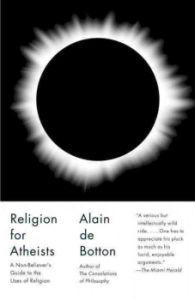
Religion for Atheists

Religion for Atheists: A Non-Believer’s Guide to the Uses of Religion
© 2012 Alain de Botton
320 pages

What were we doing when we unchained this earth from its sun? Whither is it moving now? Whither are we moving? Away from all suns? […] Do we not feel the breath of empty space? Has it not become colder? Is not night continually closing in on us? Do we not need to light lanterns in the morning?   (The Parable of the Madman, F. Nietzsche)

Three years ago, former Baptist minister and now-agnostic Biblical scholar Robert M. Price posed a question to his audience of skeptics on Point of Inquiry: is the Bible  Mein Kampf?*  He asked the question to prompt religious critics to consider their animosity toward the Bible, which though flawed or offensive to them in part, still contained in it  beautiful stories and reflective wisdom; to reject the Bible because it had become the tool of fundamentalists to harp and rule over everyone else was folly, Price said; a loss to human art. It would be as if we were to spurn The Iliad because Achilles was a brute and the gods were fickle tyrants.  In the same spirit,  here agnostic Alain de Botton offers an appraising look at religion, and suggests that abandoning it entirely because we no longer believe its creeds is likewise folly, the willful abandonment of cultural adaptions humans created for their own benefit. In Religion for Atheists, he examines why religion worked for us for so long, assessing its strengths and weaknesses, then suggests ways in which skeptics, humanists, and so on can recover the strengths of the old permanent things without the witch-burnings. It is a profoundly thoughtful and wise book, which will no doubt annoy both the orthodox religious and anti-religious,  but offer  more moderate souls in and out of belief new ways to appreciate religion, and think about it seriously.

After enough glasses of wine, even the most antagonistic of atheists might admit that religion has a few redeeming virtues, mostly in the creative realm — music, architecture, and art. Who would deny the beauty of the Sistine Chapel or the Parthenon? de Botton incorporates discussion of these into his work (with the astonishing absence of music), but his appreciation of them is linked to greater moral concerns. What does art do for us?  In de Botton’s view, art should be not viewed as mere decor, as distracting prettiness: his view of art is one fully grounded in higher meaning,and he advocates using art in ways to provoke thought about the human condition. He practices this himself,  skillfully employing pictures throughout the text to truly illustrate his meaning: one plate shows a father at the end of his youth, beginning to bald as he enters his thirties, holding his toddling son and gazing upon a portrait of an elderly man in diapers:  a reflection on the realities of age.

de Botton’s more broad appreciation for religion stems from the fact that life is difficult, and living a meaningful and moral life within it ever moreso. The actual beliefs of religion are irrelevant to the fact that as institutions, they provide places for people to escape from societal norms and find community among other people who have taken time to recognize that they, too, are troubled;  these same institutions constantly remind  and push their adherents to practice compassion and strive for moral excellence while giving them a broad sense of cosmic perspective. We need those reminders and encouragement, de Botton writes, because we are forgetful. Even if modernity wasn’t actively pushing us into behaviors which are detrimental to our happiness and general well-being, our very nature incites us to wrath against those we love, our minds constantly bedevil us with worries that we then fixate on.  Although philosophy is an able guide and ally, as de Botton’ own writings have demonstrated (see The Consolations of Philosophy, for instance),  we are at root social creatures, and find our best strength among one another: there is a reason Epicurus included companionship as part of his holy trinity of happiness (along with economic self-reliance/independence and mindfulness).

de Botton’s goal is not to make extant religions attractive to nonbelievers, however much he may admire Christianity or Judaism or Buddhism. Instead, after divining out what makes them so successful and useful, he suggests ways for the nonreligious to capture its advantages.  This means changing existing ways secular progressives have sought to improve the human condition, art and education, by taking a note from religion and making them more meaningful, and thus more effective at communication.  Instead of organizing the study of art or literature by historicity or methods, why not arrange them by emotional theme; he inserts the layout of an existing London museum which exhibits have been reorganized into Galleries of Love,  Self-Knowledge, and Suffering, among others. University curriculums, too, could do with some priority-adjustment, as academics spend their lives studying increasingly esoteric questions, and devote no attention at all to figuring out what attitudes and practices best serve human relationships, or how to teach people to deal with the reality of Death.  From there de Botton’s ideas broader support: he suggests temples to human virtues like Tenderness. Some of the ideas are fanciful, like a yearly recreation of the Feast of Fools, in which people are free to indulge with great abandon every passion and impulse of the flesh. (The illustration provided shows wanton public sex in the Agape Restaurant, which in a prior chapter had been the setting for relaxed conversations between people who were otherwise strangers, encouraged to talk about their lives and intimate hopes and fears.)  According to de Botton, this was an old medieval tradition, but it reminds me of nothing so much as a Star Trek episode, “The Return of the Archons”, in which Kirk and co find themselves in a society filled with dour zombies who, once a week, go absolutely mad.

Most of the author’s gentle suggestions would take a great deal of popular support and concern to institute, and so I imagine the book is more useful to skeptics trying to understand the power of religion than to humanist communities trying to create a more structured way of cultivating values and meaning. Those who attack religion should realize that it is these strengths they are attacking, not a simple, fervent belief in childhood credos. True or not, the great religions of the world deliver something of value to the world. To attack them is not only threaten people by going after sources of comfort and strength, but perhaps to succeed in doing so, and leave a vacuum to be filled with malignant consumerism or worse. Even if nonbelievers succeed in spreading the gospel of irreligion, those with any regard for humanity ought to be cognizant of the consequences, and go in knowing that we must give back more than we destroy.

Religion for Atheists is the best de Botton I’ve read in a long time, and a definite recommendation.

 How shall we comfort ourselves […]?  What water is there for us to clean ourselves? What festivals of atonement, what sacred games shall we have to invent?  (Ibid)

Related:

* Price now hosts ‘The Human Bible’, which examines the Bible as literature, history, and philosophy, his intention being to coax skeptics, freethinkers, and co into appreciating it for its own human merits, instead of recoiling from it as the tool of dogma.  The show is on temporary hiatus while a new producer is found, but Price also independently creates The Bible Geek, in which he fields questions about biblical and religious history.
http://www.pointofinquiry.org/robert_m_price_is_the_bible_mein_kampf/
http://www.robertmprice.mindvendor.com/biblegeek.php
http://www.thehumanbible.net/

Posted in Reviews | Tagged , , , , , , | 9 Comments

A reading on your mind

The brain is like a book, the first draft of which is written by the genes during fetal development. No chapters are complete at birth, and some are just rough outlines waiting to be filled in during childhood. But not a single chapter — be it on sexuality, language, food preferences, or morality — consists of blank pages on which a society can inscribe any conceivable set of words. Marcus’ analogy leads to the best definition of innateness I have ever seen: Nature provides a first draft, which experience then revises….’Built-in’ does not mean unmalleable; it means ‘organized in advance of experience’ 


– Jonathan Haidt in The Righteous Mind: Why Good People are Divided by  Politics and Religion, paraphrasing and then directly quoting Gary Marcus.  Though Haidt is not Marxist,  I couldn’t help but think of this line:

Men make their own history, but they do not make it as they please; they do not make it under self-selected circumstances, but under circumstances existing already, given and transmitted from the past. 

Marx’ context was completely different (for starters, he was referring to society’s self-justifications and not individuals), but  both communicate an essential truth…there are limits to how far we can reinvent ourselves. Even as babies, we are carried by the inertia of our genes’ intent, and as adults, by the customs and culture of the society and times in which we live.

Posted in quotations, Reviews | Tagged | 2 Comments