The Choice

The Choice: A Fable of Free Trade and Protectionism
© 2006 Russ Roberts
128 pages

 Imagine that George Bailey in It’s a Wonderful Life had wrestled not with the impulse to throw himself off of a bridge, but with the decision whether or not to endorse a protectionist presidential candidate whose platform promised to bar all imports from American shores – and that he was guided not by Clarence, but by the ghost of a long-dead economist, who showed him two different versions of America: one with free trade, and the other with barriers to imports. This is the premise of The Choice: A Parable of Free Trade and Protectionism, which is like two of Roberts’ other works, a policy argument in the form of a novel.

Like The Price of Everything, it’s short on narrative despite having the most ‘storied’ premise. Instead, the work is a series of debate dialogues about economic issues that join together to constitute one larger argument for tree trade and against protectionism. Some points ring more true than others, for instance Russell’s/Ricardo’s demonstration of how total economic self-sufficiency impoverishes a society. He uses the example of a household that chooses to ‘bar the import of bread’ and begin manufacturing its own bread.  Certainly, this has advantages: homemade bread is of a far superior quality and can be made to suit one’s own tastes. But the time involved in making bread to satisfy constant demand for it will take away from other activities, even if the household chooses to consume less bread.  Other points don’t fly nearly as well, like Roberts maintaining that though American jobs will be through free trade, other opportunities will be created. In the book, an auto plant closes, and the children of that plant’s workers thus look for new opportunities in a pharmaceutical company that opens to sell drugs to Japan. If the plant hadn’t moved to Japan, not only would those children have taken the same job as their parents (bo-ring!), but Japanese people wouldn’t have had money to buy American drugs.  Yes, it sucks to be the parents, but life balances out in the aggregate. I don’t like this argument, and ironically just yesterday I heard Roberts saying he doesn’t like it much either*, as it stinks of utilitarianism.  It’s of poor consolation to the auto workers who lost their livelihood, but – life is change.  Roberts hasn’t quite convinced me, though now I understand more fully the reasoning behind free trade arguments. I balk at embracing the book enthusiastically, however, because Roberts uses such an extreme example to argue with: his choice is between free trade America and an America totally without imports. Pardon may be granted in that it’s difficult to make much of an argument between two more moderate stances, as distinctions are blurred.

Be forewarned: though a work of interest to those thinking on the merits of free trade, or attempting to understand  the economics of such,  this is on the dry side. Lively as Roberts’ writing is, policy debates about systemic interaction can only get so exciting.

*http://www.econtalk.org/archives/2013/07/michael_lind_on.html

Posted in Reviews | Tagged , , , , , , | 1 Comment

It Can’t Happen Here

It Can’t Happen Here
© 1935 Sinclair Lewis
400 pages

The Great Depression sent the entire western world reeling, destroying faith in the existing order and creating opportunities for charismatic, forceful leaders with vision to sweep into power and create societies anew in their image – but their new orders introduced us to the nightmare world of the totalitarian state, which arise in Germany, Japan, Italy, and in Sinclair Lewis’ cautionary tale, the United States. It Can’t Happen Here is the story of the rise of American fascism,  beating the bible and waving a cross.

The tale is told through the eyes of Doremus Jessup, a solid liberal who amuses himself by rubbing shoulders with staunch conservatives at the Rotary Club, and then scandalizing them by penning editorials sympathetic to communists. He’s manifestly horrified by the rise of one Berzelius “Buzz” Windrip, a folksy dope whose radical plan for transforming America manages to unite rich and poor, traditional and modern, together in a schizophrenic platform.  He was not always horrified, though – he once though Windrip a comic buffoon, who could not possibly be voted in in a respectable election

The Windrip plan includes, among other things,  strict income limits, a $3000 handout to every citizen of the land,  boosted defense spending, the forbidding of women and Negroes from ‘inappropriate’ occupations, the barring of labor unions, and whatever constitutional amendments or acts of Congress are needed to allow the President, hereafter known as The Chief,  to give the nation a strong, guiding hand without being tied down by Congress.   Such a broad and sometimes self-contradictory platform  is similar to that of the “National Socialists”, and as Windrip’s reign commences, Lewis takes inspiration from Hitler’s reorganization of Germany.  That organization is literal, for Windrip breaks down state and county boundaries and imposes his own set of numbered provinces and distracts, each headed by a loyal minion. Instead of the SS,  Windrip has his ‘MM’s: the Minutemen, whose garb  hearkens to western pioneers.  As much as Windrip’s reign reminds students of European history of the Nazification of Germany,  it is a distinctly American kind of fascism, hearkening to the American mythology of the Founding Fathers, but still reactionary and anti-modern, even in its embrace of modern tools and the modern state. The idea is the same: America has gotten soft, decadent, and corrupt. It needs a kick in the seat of the pants, and Windrip is the main to give it: he’ll make America mighty again, he’ll take on the rich Jews and put the economy to work for Americans, not a few bankers; he’ll revitalize the Old Time Religion and maybe spread it to a few heathen Catholics down in Mexico.

The account follows the relatively quick corruption of the American republic into the empire, and though bleak at times, it is satire, and ends on a relatively happy note.  Although such overt, drastic actions seem unlikely today, and are jarringly unexpected turns of event even in the book, the context of the thirties makes the rise of Windrip more plausible, especially given the success of Huey Long, who was a political boss with a kindred platform until his assassination.  Although the spectre of totalitarianism is alive and well,  it is far more subtle: no marching boots, thank you, just constant surveillance and algorithmized scrutiny. Readers of alt-history and those with an interest in politics will doubtless find this fascinating, if not as potent a warning as it once was.

Related:

Posted in Reviews | Tagged , , , , , | Leave a comment

This week at the library (7/22): free trade, American Hitler, and French food

Dear readers:

This past week has been on the quiet side. I finished yet another book by Russ Roberts, this one proclaiming the virtues of free trade (The Choice),  and resumed reading Sinclair Lewis’ It Can’t Happen Here, a novel set and published in the late 1930s, featuring the rise of an American Hitler – a ‘corn pone Nazi’, to borrow from James Howard Kunstler.  That work first attracted my attention during the 2010 election cycle when the rise of the bible-thumping Tea Party and its constant allusions to the Revolution, brought to mind the quote: when fascism comes to America, it will wrapped in the Flag and carrying the Cross. Turns out that quotation is sourced to this very novel!  Comments for both will follow in the next couple of days.

My current reading consists of An Outline of French History, which is enjoyable enough though not particularly remarkable,  and French Kids Eat Everything, which I’m loving.  These constitute my belated Bastille Day reading, intended to celebrate the French Revolution and French culture in general. I’m expecting a few titles in the post this week, including a collection of essays by Wendell Berry (What Are People For?) and — at long last! — Fighting Traffic, by Peter Norton.  I’ve been waiting for two years for that book to be offered at a price lower than $30. The timing is perfect, as the book will complement Getting There rather nicely. While one examines the competition between highways and cars and the rails over intercity transportation, Fighting Traffic is an account of how cars came to take over the streets, turning residential neighborhoods into traffic sewers.

The tyranny of this dictatorship isn’t primarily the fault of Big Business, nor of the demagogues who do their dirty work. It’s the fault  of Doremus Jessup! Of all the conscientious, respectable, lazy-minded Doremus Jessups who have let the demagogues wriggle in, without fierce enough protest.
“A few months ago I thought the slaughter of the Civil War, and the agitation of the violent Abolitionists who helped bring it on, were evil. But possibly they had to be violent, because easy-going citizens like me couldn’t be stirred up otherwise. If our grandfathers had had the alertness and courage to see the evils of slavery and of the government conduced by gentlemen for gentlemen only, there wouldn’t have been any need for agitators and war and blood.
“It’s my sort, the Responsible Citizens who’ve felt ourselves superior because we’ve been well-to-do and what we thought was ‘educated’ who brought on the Civil War, the French Revolution, and now the Fascist Dictatorship. It’s I who murdered Rabbi de Verez. It’s I who persecuted the Jews and the Negroes. I can blame no Aras Dilley, no Shad Ledue, no Buzz Windrip, but only my own timid soul and drowsy mind. Forgive, O Lord!
“Is it too late?”

p. 169, It Can’t Happen Here.

Posted in Reviews | Tagged | Leave a comment

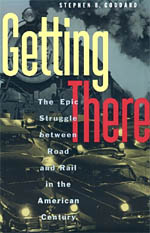
Getting There

Getting There: the Epic Struggle  between Road and Rail in the American Century
© 1996 Stephen Goddard
366 pages

Regardless of the status of George Washington, Napoleon Bonaparte, and William Pitt, each man of power traveled at the same speed as the people they governed: no faster than a running horse. But in the early-mid 19th century, the industrial revolution began producing modes of transportation that would shrink continents, reducing journeys of months into a solitary week. Trains first shriveled the distance and their spans allowed for unprecedented economic growth. That growth produced rail’s first rival, the automobiles — and the highways they drove on.  Their competition produced a clear winner in the American  20th century: while the rail lines withered in neglect and passenger service vanished almost entirely,  highways covered the landscape.  But their struggle was not a fair fight between equals, as both looked for government support and the highwaymen’s superior politicking created a fixed game. Getting There is a history of how the rail barons squandered public trust,  failed to unite in the face of potent opposition, and continued to flounder as they were supplanted in the lobbying court by a coalition of highwaymen and automobile manufacturers.  The status of the great highways as money pits, however, and the fracturing of that opposing coalition present an opportunity for rail to rally, in Goddard’s view.

Goddard begins with a brief history of rail transportation’s origins before the struggle between the two ensued, a history pitched toward demonstrating how the rail companies’ early success led to abuses of the public, and thus to opposition —  — both by popular movements, like the Grange movement of farmers protesting high rail prices in the midwest, then by the Interstate Commerce Commission, the first government institution designed to oversee any part of the economy. The ICC proved first tepid, then tyrannical, and for most of the book plays the part of a ‘bad ref’ or crooked umpire, working the game against  trains and for the highwaymen. While regulations forced  rail companies to quote the same price for hauling freight regardless of circumstances, unregulated truck drivers could change their rates at their own discretion: rail companies were forced to write to D.C. for permission, and by the time said clearance arrived, the opportunity for hauling would have already vanished.  Ironically, the rail companies were partially complicit in their troubles: they promoted the first ‘good roads’ measures so that trucks would take unprofitable short runs off of their balance streets — and so that automobiles would relieve the burden of passengers. Those measures would prove to be another unearned advantage  for the automobile industry and highways: while rail companies created and maintained their own lines and stock, car companies, and later car drivers, were given such infrastructure, the funds coming from American taxpayers.

Although the history of American rail is checkered with self-serving episodes, the automobile industry fares no better, as their deliberate campaign to destroy trolley lines in the city and replace them with buses demonstrates. Forcing the rails’ decline and letting the infrastructure fall into scrap would be egregiously unwise, in Goddard’s view. He outlines the problems of our highway-and-auto dominated system: destruction of cities,  the financial albatross of maintenance, and pollution among them.  While he doesn’t launch into an extensive plea for a rail renaissance, he sees one as inevitable — if government will get out of the way and stop propping up the trains’ competitors.  Getting There proves an expansive history — brimming with detail, but never plodding, and covering social life as well as business and politics.

Related:
Waiting on a Train: A Year Spent Riding Across America, James McCommons
Straphanger: Saving Our Cities from the Automobile, Taras Grescoe
The Great Railroad Revolution: A History of Trains in America, Christian Wolmar
Asphalt Nation, Jane Holtz Keay

Posted in history, Reviews | Tagged , , , , , , , , , | 1 Comment

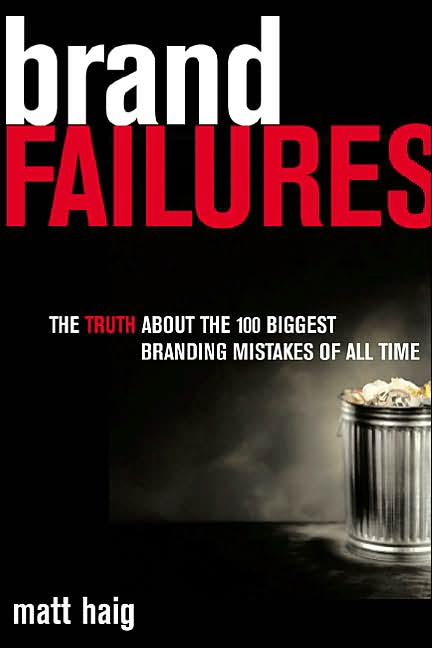
Brand Failures

Brand Failures: the Truth about the 100 Greatest Branding Mistakes of All Time
© 2003 Matt Haig
310 pages


        What helps a brand succeed – or makes it fail? Brand Failures attempts to divine out the secrets to success by examining one hundred products or companies which have tanked. Some were new, others ancient, still others new ventures backed by established titans – but failure comes to all.  Each of the book’s one hundred sections features a different American or British brand. The sections vary in length: New Coke, which starts the work off, features a history of Coca-Cola and Pepsi’s competition, setting the stage for why Coca-Cola made the decision it to rework its product, but the book’s midpoint is taken by a series of paragraph-long sections which are more a list of humorous advertising mistranslations than proper chapters. The longer chapters end in list of lessons learned, from the patently obvious (“Advertising is important”) to the more insightful (“Don’t clone your competitors”) .  Some of the lessons conflict: while the author asserts at the start that in the Age of Branding,  actual products matter little compared to the power of the brand, the way it makes people feel.  Hence, while people in blind taste tastes may have preferred New Coke to classic coke and Pepsi,  when the actual product was rolled out, people acted poorly: it wasn’t the coke they had been brought up with. They had been told “Coke is It”, and were now expected to believe that Coke wasn’t It.  

         Despite the author’s deemphasizing the value of a product, numerous examples demonstrate that it can’t be ignored, either.  Haig uses Beta-Max and VCR to back up his belief that quality isn’t particularly important: while he stresses the audio and video quality of the Betamax tapes,  his account also mentions the fact that whole movies could not fit on such tapes.  The quality of the picture doesn’t equal the quality of the product overall.   To whom these lessons are to be imparted is uncertain. While they’re ostensibly aimed at business personalities attempting to launch or expand a brand, would such personalities really be reading a work written for popular audiences?  Wouldn’t marketing executives be paying more attention to marketing journals?  I’m particularly interested in the way marketing works so I can evade its tricks, but I found the work more entertaining as one of business history, for some of the products released were truly weird. In the 1950s, for instance, Dodge produced a car marketed for women: called La Femme and covered in pink inside and out, with floral patterns on the seats, it looked like something even Mattel would  be reluctant to foist on Barbie. (The lesson of this section: don’t patronize customers.)

            This breezy and entertaining book may be of use to budding entrepreneurs, but I suspect most readers who be those wanting to be amused by business misadventures, which it certainly provides.

Posted in Reviews | Tagged , | Leave a comment

This week at the library: politics, Star Trek, a Cold War fantasy for kids, and trains

Last week’s titles: 
The Price of Everything, Russell D. Roberts  | What It Means to be a Libertarian, Charles Murray |  Star Trek Silent Weapons, David Mack |  Day of Reckoning, Pat Buchanan | Getting There, Charles Goddard
Dear readers:
This week has seen some grappling with politics, with Star Trek, fantasy, and trains for relaxation.  Both The Price of Everything and What It Means to be a Libertarian  were on the…well, libertarian side, with Roberts exploring how prices work and vouching for markets as a better way of arranging things than government fiat. Murray was more philosophical, starting off by establishing that libertarianism is fundamentally against coercion of any kind, whether physical force or taxation. After a strong start, he then attempts to explore what a libertarian society would look like: it’s one with courts and interstates, and not much else, though allowances can be made for government control of ‘natural monopolies’ like infrastructure that requires an enormous amount of capital and coordination (hence, highways). As much as I like his philosophy in theory, its widespread application depends entirely too much on the hope that things will sort themselves out for me.  I prefer concrete evidence, not idealism — even Murray’s very attractive kind, which posits that the government putting citizens’ responsibility for their lives will suddenly witness a rebirth of civic virtue. a rebirth I’d delight to see. 
I resumed reading the Cold Equations trilogy by David Mack,  which actually took a potshot at libertarianism by putting the action on crime-ridden Orion, where the government stays out of business and out of most everything else.  I didn’t plan Mack as a counter to Murray, so it must have been Fate. Obviously. The book was a fantastic mystery-turned-political thriller, which sees the powers within the Typhon Pact vying for dominance, while keeping a close eye on NATO the Khitomer Accord, which consists of the Federation, the Klingon Empire, the Cardassians, and a few other races who were not quite all the way evil.  The Typhon Pact strife seems to hint that the Downfall series of books being planned for autumn will see the Evil League of Evil, not the Justice League of the Federation, disintegrate. 
Speaking of self-defeating evil, Pat Buchanan thinks the United States has become that, invading everyone while simultaneously letting cheap goods destroy American manufacturers and American jobs. He rails against a handful of ideas — imperialism, the triumph of ideology, the decline of Anglo-Americans, the glorification of free trade —  but only the first two really piqued my interest. Buchanan is called a paleoconservative, and they seem to  differ from ‘neoconservatives’ on the key issues of invading people and free trade.  Buchanan believes we shouldn’t invade people, but should have the ability to do so if need be, and we should raise protective tariffs to keep other people’s stuff from invading us. We should have an export surplus, not a trade deficit.  Out of self-interest I’m given to agree, but if the other fellows take the same stance it seems we’ll have  a lot of nations with trade walls up, with the ships of commerce unable to pass them. This seems a story with a sad ending. You could invade people and force them to buy your stuff (he’s all for mercantilism), but invading people is out, so…..
On the subject of strife between nations, I recently read a fantastically funny Cold War fantasy about a middle-schooler named Jane whose parents flee McCarthyist witch hunts to live in London, where Jane immediately complicates their lives further by getting involved in a battle between intelligence agencies and an ancient order of chemists. But really, how often do you make friends with someone who just happens to be heir to arcane knowledge passed down through uncountable generations, knowledge that can heal the body, turn it into a bird, and even — maybe — squelch an atom bomb of the earth-shattering kaboom sort?  Soon enough Jane and her friends (a trio, naturally) are on the run from both the British government and the Soviets. The resulting shenanigans make for hilarious light fantasy, the only fly in the ointment being the fact that the kids are expected to read a book composed in ancient Greek and Latin by means of their grammar school Latin primer.  I can’t even read Der Spiegel on my uni-Deutsch, let alone a technical journal.
So! Next week! Today being the 14th, I should be concluding a series of French reads right about now. I am not. Call it poor planning, but my interlibrary loan books haven’t arrived, so today I’ve been reading an oddly personal survey of French history called The Outline of French History.  I’ll be continuing that this week, along with (perhaps) The Body Electric, the last in the Cold Equations trilogy. After that, who knows?  Once I’ve paid honor to France there are a few essay collections I’m itching to read, from Wendell Berry to Bertrand Russell.  I also have a book on airplanes checked out, because airplanes are fun.  Not as much fun as trains, but fun still. Oh, and speaking of trains — I also read Getting There, about the struggle between railroads and highways for transportation dominance. Remarks will be posted later in the week.
Posted in Reviews | Tagged , , , , , , , | Leave a comment

The Price of Everything

The Price of Everything
© 2009 Russell D. Roberts
224 pages

The Price of Everything is an economics novel about the virtues of prices and markets, explaining how they work to maximize efficiency and spread goods out among those who need them and are willing to pay. Like The Invisible Heart, it is a policy treatise in novel form. There, an economics professor fell in love with a liberal English professor and slowly worked his dark-side libertarian magic on her. Here, another economics professor, this one the provost of a university, takes a passionate youth leader with a social-justice agenda under her wing.  Roberts is harder on his ideological opponents here than in The Invisible Heart, possibly there because his doppelganger there was trying to seduce his opponent, while his professor is only trying to turn her target into the man who will bring the free market to Cuba.

The kickoff issue in The Price of Everything is a minor earthquake which causes a run on supply stores. Home Depot and like stores quickly sell out, but Big Box, a megacorporation which makes Wal-Mart look like a mom and pop operation, doubles its prices to take advantage of the uptick in demand. This causes outrage among customers, who are catalyzed by the presence of a pregnant woman who is unable to afford her groceries and led by young Ramon Fernandez, who condemns the store in a speech and then takes up an offering to allow the lady to meet her need.  Having discovered a knack for impassioned rabble-rousing, Fernandez decides to hold a rally on his university campus, protesting the fact that a new building is named after the Big Box corporation, who are donors. That attracts the attention of the professor, who chatting with Fernandez under the pretense of grooming him to be a more effective youth leader, engages him in questions and discussion.In reality,  she’s ever-so-slightly steering him toward her point of view. Look at it this way, she says:  before the earthquake, both Home Depot and Big Box had the supplies on hand. After the earthquake, Home Depot maintained its price (fair to the consumer) and Big Box doubled its own.  But from whom did the lady find her supplies? Big Box, because it ensured that the only people taking the supplies were those for whom they were most important.  Had Big Box maintained its normal prices, all the supplies might have been bought up by whoever happened by first and decided to grab some extras. Home Depot’s approach might be ‘nicer’, but  who served the lady’s needs? (Well, the crowd did, but that’s not the point she wanted to make.)

Roberts’ arguments make a horrible kind of sense, though it goes against the grain to hear a defense for ‘price gouging’.  More palatable is his attempt to convey the ‘genius’ of prices as regulating agents, ensuring that everyone looking for lead (his example of choice) gets enough, but not too much, the balancing being set by competition between firms trying to acquire supplies. This argument is especially convincing because the counter is so weak: if markets don’t set prices, what will? Who can acquire and process all of the information needed to decide whose needs are greater than anyone else’s?  (Maybe Google and the NSA, if they joined forces…) And by what standard are they using? Who plans for whom?

The Price of Everything is not quite as potent as The Invisible Heart, but it’s still a fun little way to digest economic arguments from an author who is passionate, but not obnoxious; bold, but altogether pleasant.

Posted in Reviews | Tagged , , , , , | Leave a comment

Day of Reckoning

Day of Reckoning: How Hubris, Greed, and Ideology are Tearing America Apart
© 2009 Patrick Buchanan
309 pages

What’s wrong with America? Change, brown people, and wars, judging by Day of Reckoning.  Published in 2009, presumably to capitalize on the election, Day of Reckoning puts forth Patrick Buchanan’s vision for America: less war, stronger borders,, protectionism, and more white babies, especially the good Anglo kind.  (Nothing is said about Saxon babies, but one assumes they’re OK.)  Although marred by stupefying sketchiness at times, and more a thought-dump than a coherent argument, Reckoning makes a couple of good points about imperialism and the perils of ideology. Even so, I would have probably passed on it had I not been curious about the ‘paleoconservatives’.

Pat Buchanan might not find the lack of one dominating theme tying his book together a bad thing: coherent worldviews, especially forceful ones, are his target. Ideology has ruined politics, he writes, encouraging people to interpret everything that happens through the lens of their particular system of belief, and motivating them to change everything to fulfill their dream – whether the ideology is Leninism or Free Trade. Change is bad.  This is at the heart of Buchanan’s writing. Things that cause change, like energetic politics and mobs, are to be avoided. It doesn’t matter if Yugoslavians want to break up, or that Chechnyans want freedom from Russia: stability is god.  Although I found some of his grousing sympathetic (I’m still mulling over global free trade, but much prefer a United States with factories to one without),  the evidence he presents in favor of his causes isn’t exactly convincing. Did the early American and British empires, when they were strong and rising, have free trade? No, Ergo, free trade destroys empires.  Isn’t that a good thing? Again, Mr. Buchanan isn’t consistent. He’s an impassioned critic of American misadventures in nation-building and wars on terror/drugs/etc, but he protests them not out of the principle that imperialism is malevolent, but  because these badly-managed affairs have sapped American strength.  Glory, power, empire — all good things, but they have to be managed with great efficiency. He is a grim pragmatic: whatever is working now, keep it.

Although a healthy respect for the destructive power of ideology is warranted (witness the French and Russian revolutions),  the author’s revulsion for change on principle strikes me as more reactionary than thoughtful,  and his conservatism as more or less self serving: he’s fine with democracy among fine white western folk, but generic eastern Europeans and Arabs? Best to let them be managed by reasonable strongmen, like that Saddam Hussein fellow who kept Iraq in such good order until our tanks mucked things up. I’d give points for brazen self-interested honestly had he been consistent there, but in cataloging America’s imperial wars, he managed to completely skip the invasion of Mexico, a fact worth nothing considering that he’s staunchly against immigration.

Day of Reckoning is a book that I should have left on the shelf, I think. I will say this, though: unlike so many other political works, it doesn’t feature the author on the cover, a marketing tactic I find particularly obnoxious.

Posted in Reviews | Tagged , , , | Leave a comment

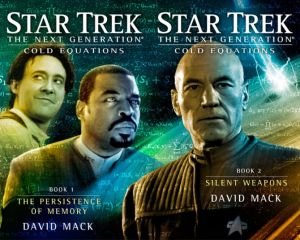
The Persistence of Memory – Silent Weapons

Star Trek TNG Cold Equations, Books 1 & 2: The Persistence of Memory and Silent Weapons
© 2012 David Mack
400 and 352 pages

The last time David Mack penned a Trek trilogy, billions upon billions died (Destiny), the Borg were vanquished, and thousands of readers’ minds were blown by the intensity of it all. Now he’s at it again with Cold Equations, set in the era of the Typhon Pact. A half-score of the Federation’s most chronic enemies have their own confederacy, and the two states have been engaged in a cold war of sorts for the last couple of years, vying for power through covert missions. The Persistence of Memory opens with an attack on one of the Federation’s most important research laboratories, one housing the deactivated bodies of B4, Lore, Lal, and various other Soong-type androids…the deceased Commander Data’s family, as it were.  A cloaked ship, later to be revealed Breen, raids the lab and nicks the bodies…and as the Enterprise-E is conducting its investigation, a man is spotted on the streets who looks very much like Data. The man is none other than Noonien Soong, Data’s inventor-father — a man who was supposed to have died years ago.  But there he is, and looking rather young to boot — what gives? The Persistence of Memory is largely his story,  the tale of one slightly-mad scientist to achieve immortality while watching the drama of his offspring from afar, with some political drama tacked on at the end.

That drama takes on a life of its own in Cold Equations, where Breen intrigue threatens to disrupt a delicate negotiation between the Federation president, Naniette Bacco, and the Gorn Hegemony. Shenanigans from a Soong-type android lead to Data’s arrest (did I mention? he’s back), and then come explosions and assassinations.  The Enterprise is on the scene, attempting to solve the mystery to both get their friend exonerated and to prevent their president’s untimely demise, but something is screwy.  Their mystery-solving works all too well, aided by a series of anonymous tips that raise Worf’s hackles (and Klingons have very big hackles), and lead him to suspect that someone, somewhere, is pulling the strings, manipulating the Enterprise, the Federation, and even the Gorn into playing parts in a bigger scheme. Thus a murder mystery becomes a massive political drama in which the struggle for power between Typhon Pact members proves to be more interesting than the Cold War-like tension between the Federation and Space-Moscow.  Unlike the Federation, which is more or less united (forgetting for the moment the angsty Andorians), the Typhon Pact members all have separate agendas, and they view one another as temporary expedients to their eventual nationalistic supremacy than actual partners.

After the epic-beyond-words achievements of Destiny,  poor David Mack has a lot to live up to. Cold Equations doesn’t feature thousands of Borg cubes running willy-nilly, eating planets and inspiring mesmerizing speeches from doomed civic leaders, it’s still a fantastic trilogy so far. The Persistence of Memory not only brought Data back (sort of), but gave his, Lore’s, and other androids’ stories utter cohesion: what Christopher Bennett did for time travel threads, Mack does with robotics, linking not only the Soong family but episodes from the original series.  Soong’s perspective on watching his sons grow up is captivating, and then right behind that comes an intelligent political thriller that doesn’t simply throw two entities against one another, but has  at least five participating in a tangled web of self-interest and lies.  I already purchased the finale, The Body Electric, and look forward to reading that soon.

Related:
Cold Equations on TvTropes

Posted in Reviews | Tagged , , , | Leave a comment

This week at the library: Independence Day, simple living, cities, and the digestive tract

Last week’s titles: 
American Creation, Joseph Ellis | Gulp, Mary Roach |  Jayber Crow, Wendell Berry |  His Excellency, Joseph Ellis | Edens Lost and Found, various authors

Dear readers:

This past week I finished up my Independence Day tribute with a biography of no less than George Washington. His Excellency by Joseph Ellis was a fitting capstone to the series this year, as it would be in any year. I had planned on reading a primary document of the American Revolution, like Tom Paine’s Common Sense.  Since my revolutionary readings in the last couple of years  have favored the conservatives and nationalists, I think next year I might try a biography of romantic, idealistic, avowedly anti-federalist Thomas Jefferson.

A few days ago I read through Simplicity: Essays, a collection of essays on minimalism. Divided into three parts, the essays invite readers to consider their relationship with their things, create a meaningful life,  practice habits that make themselves happier and better, and offer advice on getting friends and family to realize, no, you’re not crazy because you’re getting rid of all your stuff. It fits comfortably within the realm of self-help, with less philosophy than I’d hoped. The authors write a great deal about themselves, mentioning with frequency how they left their high-powered six-figure jobs behind to focus on helping other people, and how much happier they were without all the baggage.  I purchased it as a $1 e-book, but it has a ‘real’ counterpart. I don’t think I’m giving the book its fair due because it was so similar to Disrupting the Rabblement in terms of its advice, and I was looking for something more in the neighborhood of The Plain Reader, that invites us to think about a wide variety of areas of our lives that could do with grooming. The authors here only looked at owning things and mental habits.

I recently finished the gargantuan task of bringing my Shelfari and GoodReads accounts completely up to date: not only is most every book found here to be listed there, but they’re complete with reviews and labels.  There were some books that didn’t get full reviews here, so I didn’t  crosspost them.  That work done,  my intention is to keep those far more current than they usually are. In the process of adding labels to some two thousand books, I created a few  there that I think would serve the blog here nicely as well: “praxis” and “direct action” among them.

This next week:
– Star Trek Cold Equations, book 2: Silent Weapons Another Cold War in Space political-action thriller, this picks up from The Persistence of Memory which I read  a few months back but (embarrassingly) forgot to review. I seriously didn’t realize that until last week when I combed every post in the last year looking for any mention of the book. Oops. Turns out there’s a half-finished review in my drafts folder..
–  Someone has suggested I read a novel called The Apothecary, by Maile Meloy.
– I also have Getting There, the story of the rivalry between roads and rail in the 21st century. Go trains!
–   Seeing as Bastille Day is a week away, I should read something French. Alas, the interlibrary loan request I put out hasn’t come in yet, so I may not get to read French Kids Eat Everything until after the 14th.  I’m sure my library has something appropriately French in the meantime.

Posted in Reviews | Tagged , , | Leave a comment