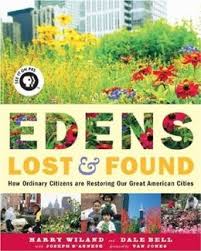
Edens Lost and Found

Edens Lost and Found: How Ordinary Citizens are Restoring Our Great American Cities
©  2006 Harry Wiland, Dale Bell,  Joseph D’Agnes
285 pages


I can hear Atlanta crying loud as she looks for hope and change / but we can’t count on a government to create a life we want to see.. (“Our Cities”, The Wild)

The 20th century was not kind to American cities, and the challenges of the 21st, resource scarcity and climate change among them, seem hardly more favorable, especially as the national government continues to flounder. But across the country, citizens are taking challenges for opportunities, and effecting positive change in their own cities.  In Edens Lost and Found, the authors share stories from all stripes of people in Chicago, Los Angeles, Philadelphia, and Seattle who are doing their part to make their cities more ecologically-savvy, resilient, and overall better places to live.

Adapted from a PBS series, the book is divided into four larger chapters, each containing a half-dozen or so sections of stories about individuals or groups making a difference. The chapter starts off with a history of its host city, one which briefly details the city’s unique challenges and strengths: Los Angeles, for instance, is or was in the strange spot of simultaneously stressing about flooding and having to import water for its citizens’ needs. The citizen-actions range from the small-scale (a man stubbornly removing trash from an abandoned lot so that his daughters could have a clean place to play) to the somewhat larger, as when citizen actions catch the government’s attention and it decides to fund their efforts, as it did when  Chicagoans attempted to safeguard the prairies from further development.  Not every action is done by an individual person: one section in Seattle, for instance, covers the decision of one sporting-goods store to become environmentally friendly and more compelling at the same time by catching rainwater and channeling it to safety in the form of a waterfall. Their actions address a variety of needs, all adding value but in different areas. There are artists here, who transform empty walls into murals,  as well as those who convert an abandoned building into a hydroponics garden that doubles as an urban farmer’s market.  The editor-authors also add sidebars for those who want to recreate  the actions celebrated her: one such column offers advice on creating a nature trail.

Although the individual stories didn’t mesh together well beyond sharing the same setting, the authors’ attempt to create cohesion with an introduction to each city, and the marginal use of shared themes (managing watersheds, for instance),  serves the book well. It succeeds less on narrative and more on substance: these accounts of citizens engaging in direct action and rebuilding their cities are most inspiring,  giving reason for hope.

Posted in Reviews | Tagged , , , , , , , , , , , | Leave a comment

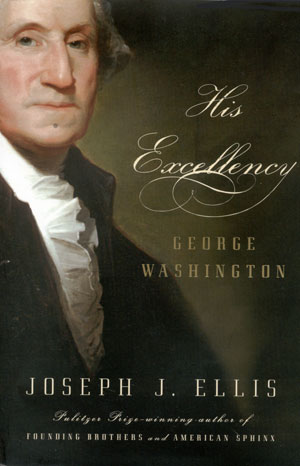
His Excellency

His Excellency: George Washington
© 2005 Joseph Ellis
352 pages


Most of the Founding Fathers are exalted, but not quite divine. They are icons not without blemish: John Adams had his temper,   Benjamin Franklin his shameless lechery. But George Washington towers above the rest; in the American mythos, he is more divine than Jesus — Jesus, at least, was tempted. Joseph Ellis’ admitted attempt in His Excellency is to capture the demigod and bring Washington down to Earth. His biography succeeds in making Washington more of a human character, one who in his own time recognized he was being made into a legend and did his best to fulfill the reputation, both for the sake of the nation and his quiet sense of pride.

With precious little material to inform historians about his early years, Washington seems to spring into the world in the manner of Athena: fully-formed, and already in the thick of things as an inexperienced officer who accidentally set off the French and Indian War — making American history without even trying. His military service, marriage into a wealthy family, and natural air of authority led him to early prominence in Virginia, especially as ties between Britain and her colonies became increasingly frayed. He would be first president of the Second Continental Congress, then commander in chief of its army, and still later the first president of the American union.  His adult accomplishments are well known to most, at least their particulars. What motivates Ellis is a desire to understand what made His Excellency tick.  The biography subsequently takes the form of a character study.

From Ellis’ account, control is the presiding theme of Washington’s life:  control over his passions, his finances, his legacy. Though idealized, he emerges here an intensely pragmatic man who expects the worst and works to minimize risks. This is why he prefers a professional army to one composed of militia-men: though a force of citizens which comes together in times of crisis has great romantic appeal, Washington’s own experience saw nothing in a republican fyrd to commend them. Untrained militia melted away in combat, or lost interest in the war. Only discipline and strength could meet adversity. In the face of the challenges the early Republic faced, Washington wanted those values in the saddle, not Jeffersonian hopes.   Of course,  his opponents might argue that decentralized power mitigated the risk of abuse moreso than a strong state, but Washington distrusted a passionate mob more than he did corrupt aristocrats, possibly because he regarded corruption as self-defeating.  Though held as a champion of American liberty, Washington was thus very conservative in his way: he worked for American independence out of practicality, believing that Britain literally could not govern from a distance, and people needed to be governed, both by a government that prevented them from doing harm to one another and by self-imposed limits.  The limits on Washington were all self-imposed: Ellis sees him as pursuing virtue for the practical reasons: not only would he be happier, but his name would be more gloriously remembered. Posterity would judge him not by the power he held, but by the power he refrained from using, and so Ellis places great emphasis on the numerous times Washington voluntarily surrendered power, moves that not only protected him from the charge of monarchism, but gave the American people a legend to idolize: behold, the philosopher-president, the noble Cinncinatus who governs wisely and then retires, avoiding being stained with the purple dye that Marcus Aurelius cautioned himself against being touched by.

I found His Excellency  to be a most…appropriate biography, in that it reveals the Father of his Country to be a man with vices (like a lust for land), but whose pursuit of self-interest led to him becoming an exemplar of civic virtue. It’s the American dream.  Both those who want to learn about his human side– his errors and frailties — and those who want to learn more about his life without the shining armor being tarnished will find His Excellency a solid contribution to their understanding.

Related:
Nehru: the Invention of India, Shashi Tharoor

Posted in Reviews | Tagged , , , , | 1 Comment

Jayber Crow

Jayber Crow: the Life Story of Jayber Crow, Barber of the Port William Membership, As Written by Himself
© 2000
363 pages

“Telling a story is like reaching into a granary full of wheat and drawing out a handful. There is always more to tell than can be told.”

Jayber Crow is many things. It is one of the most agonizingly beautiful and moving novels I have ever read. It’s a lyrical testament to the power of love,  the richness of community, and the pleasures of a life lived close to the rhythms  of nature.  And it’s also the story of a man named Jonah, called Jayber, who once thought he had the call to preach, but left the seminary to practice barbering to live out the questions that the seminary had no answers for. It is the story of a man twice orphaned, who went on a journey, a pilgrimage, and found himself. It is a work of art.

I should acknowledge from the start that I am biased to like — to adore — this book, for the author’s narrative voice is the kind I like best; gentle, wise, and slyly witful. I was unable to simply read the book; it had to be read aloud. Slowly. Multiple times.  The text is swollen with sentences that, like fruit hanging from a tree, demand to be plucked and savoured; they have body, being something beyond ordinary words.  Jayber Crow isn’t an action drama with a clearly defined Conflict, Rising Action, Climax, and Conclusion; it’s a coming of age story, in which the gracefully maturing subjects are both Jayber and his adopted home of Port William.  Jayber is a child of the Great Depression, and arrives in town shortly before the outbreak of World War 2.  That war and those that follow  will hurt his fair city, but the pain of them brings his characters to life all the more. It is a deeply reflective novel, in which Jayber will begin to wax poetic about one topic or another — the decline of ecologically-savvy family farms and the advent of debt-based agribusiness, or the damage automobiles do to one’s sense of place — for a spell before returning to telling the story of Port William as it attempts to survive the 20th century like a little skiff tossed in a turbulent ocean.

For a long time then I seemed to live by a slender thread of faith, spun out from within me. From this single thread I spun strands that joined me to all the good things of the world. And then I spun more threads that joined all the strands together, making a life. And when it was complete, or nearly so, it was shapely and beautiful in the light of day. It endured through the nights, but sometimes it only barely did. It would be tattered and set awry by things that fell or blew or fled or flew. Many of the strands would be broken.  Those I would spin and weave again in the morning. 

p. 330

I think the only words that do Jayber Crow justice are the words of the author himself, so plea  peruse some of the quotations for this book listed at GoodReads or even Tumblr. One selection which I posted on facebook:

One Saturday evening, while Troy was waiting his turn in the chair, [he said] “They ought to round up every one of them [war protesters] and put them right in front of the communists, and then whoever killed who, it would all be to the good.”
There was a little pause after that. Nobody wanted to try and top it. I thought of Athey’s reply to Hiram Hench.
It was hard to do, but I quit cutting hair and looked at Troy. I said “‘Love your enemies, bless them that curse you, do good to them that hate you.'”
Troy jerked his head up and widened his eyes at me. “Where did you get that crap?”
I said, “Jesus Christ.”
And Troy said, “Oh”.
It would have been a great moment in the history of Christianity, except that I did not love Troy.

If I could only ever read one novel for the rest of my life, Jayber Crow would be it. The idea that it has only been in existence for thirteen years is staggering. It seems ageless.

Posted in Reviews | Tagged , , , , , , , , , , , , | 14 Comments

Gulp

Gulp: Adventures on the Alimentary Canal
© 2013 Mary Roach
352 pages

Mary Roach is no stranger to delving into topics which others find icky — like corpses. Even her more conventional works flirt with taboo, and in Gulp she embraces disgust whole-heartedly, by treating readers with iron stomachs to a discussion of all things digestive. Gulp is not, strictly speaking, a book about the digestive system. Instead, it’s a history of the odder means scientists through the centuries have fashioned to study it, though some of the questions themselves are startling enough (how many cellphones can you pack into a rectum?) Its intent is more entertaining than educational, but readers will glean an understanding of how our body works regardless, and perhaps learn more than they wished they knew. The body’s own structure gives Roach an organizational structure her other books might lack: her record of experiments follows the ‘alimentary canal’, an older name for the digestive tract, from our tongue right through the intestines and out the other side, pausing for a great many fart jokes.  Roach is definitely a ‘popular’ science writer in that she writes for the lowest common denominator, appealing to as many readers as can be possibly found who are willing to read about spit and constipation.  This is not a work that takes itself seriously; it is disgusting, funny, and informative in that order. Largely entertaining,  but a touch on the gratuitous side.

Posted in Reviews, science | Tagged , , , , | Leave a comment

American Creation

American Creation: Triumphs and Tragedies at the Founding of the Republic
© Joseph Ellis
304 pages

In Founding Brothers, Joseph Ellis used a series of nonfictional ‘stories’ about the founding fathers of the United States to illustrate how their personal relationships with one another shaped the struggle for independence and later the creation of the Republic.  In American Creation, he uses the same approach, a series of vignettes, to explore moments which defined the course that Republic would take. Most occur after the revolution is won, and demonstrate how differently the founders dreamed from one another despite their accomplishments working with one another.  The result is what I’ve come to expect of Joseph Ellis: colorful narrative history that doesn’t begrudge sympathy to any founder and leaves the reader with a fuller appreciation for the Revolution — one which sees the founders as men, not demigods, who struggled against not only the prejudices and foibles of third parties, but against one another and their own inner demons.

The titular triumphs are well known, like the Declaration of Independence and  the miraculous survival of the Continental Army after Valley Forge, which was effected by both the persistent support of the people for the struggle and Washington’s adoption of a strategy that played to his strengths: avoid battle and focus instead on controlling the countryside. Even so, Ellis may pass along new information to students of the period: for instance,  months before the storied Declaration of Independence was presented and signed,  each American colony drew up a constitution for itself in preparation for the impending separation from England, asserting self-rule in a fashion with immediate practical effects and much less bombast.  Of the tragedies, there are three: the failure to strangle slavery, the lack of any effective and just “Indian policy”, and the birth of vicious parties. All three have the same mother: the interests of Southern planters, asserting the sovereignty of their individual states and dismissing the authority of any central government influenced by merchants and bankers.  Although Ellis is not a partisan historian,  the verdict of his pen is more for the Federalists than the Republicans.  The closest he comes to outright favoritism is in the chapter on party politics, “The Conspiracy”, in which he attempts to answer the question: why were Thomas Jefferson and James Madison so paranoid about the Federalists, acting as though men who had lead the assault against tyranny would become tyrants themselves?  Adam’s authorization of the Alien and Sedition acts hadn’t yet come into being, nor had Hamilton suggested to Adams that South America could do with a proper invasion, but both make the student of history wonder if maybe Republican concerns weren’t justified to some degree. Jefferson emerges from the section seemingly like an ambitious lunatic, however  — which, perhaps he was. Though regarded as a man of science, his romantic attachment to the French Revolution, which he devoted service to at the expense of the American government, reveals how profoundly irrational he could be.

None of the founders emerge from this narrative unscathed: even the divine Washington is revealed as only human, unable to will a perfect treaty with a native nation (the Creeks, here) into being:  not are the Creeks cleverly led by a man who is treacherous as any Congressional politician, but American settlers have the damndest habit of not doing what the government would wish them to do. They keep flooding into Creek territory without a care in the world for foreign policy. Parliament would no doubt sympathize — and just wait until you try taxing them, George. Oh, wait — the whiskey rebellion is also covered. Men who occupy lesser roles in most Revolution narratives get to shine more here, like Roger Livingston, the Forrest Gump of the revolution, always somehow in the middle of the biggest moments of American history.  American Creation is a fitting read for the Fourth, one which offers a vision hopeful yet sober of what was created, and what may yet be restored: a nation of the people, by the people, for the people.

Posted in history, Reviews | Tagged , , , , , , , | 1 Comment

GoodReads is *Weird*

Witness:

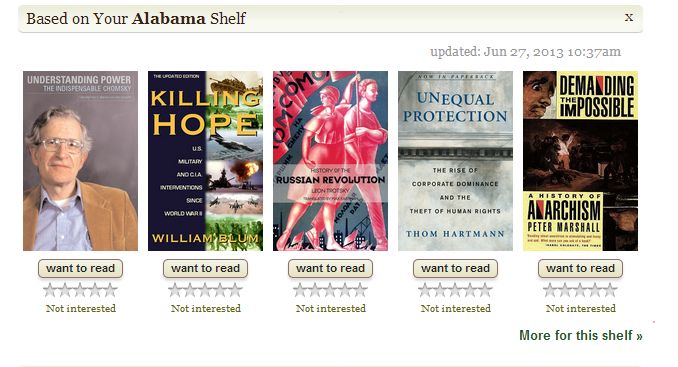
Based on my “Alabama” shelf, it is recommending I read Understanding Power, by Noam Chomsky; Killing Hope, a history of CIA operations; a history of the Russian Revolution; a work detailing how human rights have been destroyed in the rise of corporate power; and a history of anarchism.

Because each of these things reminds me so much of Alabama.  On another page, it is insisting I check out an anthology of wisdom literature based on my Transportation and Urbanism shelves.

Posted in General | 3 Comments

The Story of My Experiments with Truth

The Story of my Experiments with Truth
 © 1927 Mohandas K. Gandhi
480 pages


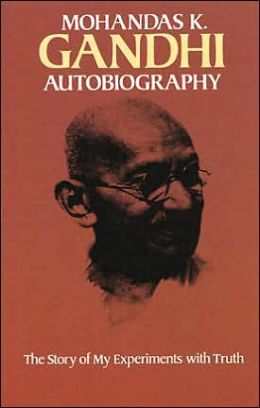
Dover Press cover

The Story of my Experiments with Truth is a piecemeal autobiography of Mohandas Gandhi,  who earned acclaim by leading India to independence from the British Empire through nonviolent means. It includes only the early portions of his life, ending in the 1920s long before the most famous incidents of the Indian movement.   Gandhi establishes early on that he chose to downplay much discussion of his political activism in this work on the grounds that he had already written a history of his early struggles in South Africa, and that his later battles were so widely known they needed no further coverage from his pen.  Despite that intention, politics peppers this story of his life, as he viewed public service as inseparable from any other portion of his being, and especially from his sense of spirituality, the pursuit of truth. Politics was simply a means of acting on the truth, of proclaiming it to the world.

If not politics, what then is this autobiography?  Released in sections through a newsletter, it has no central focus;  his search for truth is at best a recurring theme. There’s politics here, interwoven with the accounts of legal cases and the epic quest to find his ashram a hand loom (this merited two chapters), but his reflections on religion, spirituality, and ethics give the work most of its substance. The work allows readers to see the legend of the Mahatma slowly emerge from the life of a passionate Indian lawyer who seems beset by scrupulosity, constantly ashamed of his wretched failings, recoiling in horror from the great sins of marriage and drinking goat’s milk.  Gandhi is not a moderate: after encountering a concept and deciding it worthy of an effort, the effort given is mighty: he adopts practices whole cloth. After being introduced to the concept of economic self reliance, he arranges for his newspaper staff to join him at a communal farm. When he became convinced of the spiritual and medical effects of total abstinence, he became celibate and began sleeping in a separate bed from his wife. Period. His ability to make radical changes in his life increased with practice: as a young man, avoiding meat seemed a terrible burden, one difficult to take up — but a decade later, with much experience, he could declare war against his libido by refusing to engage in so much as an amorous thought, and developing a diet that wouldn’t lead to excess ‘interest’. (Meat and milk lead to sexy thoughts. Fruit, not so much. )  At the same time, he records some of his religious explorations, his reading of other sacred texts and comparing them to his own.  This was only a minor portion of the content, however.

Those interested in the formative years and experience of Gandhi may find this book of interest; it is also marginally useful to those seeking information about his South African years, in which he fought to help Indians relegated to indentured servitude reclaim their dignity before the law and before themselves.  It is not a cohesive work, however, and doesn’t contain any extensive, in-depth writing on any given subject: instead, one sees the big ideas slowly developed over the course of his early life,  coming together year by year, a worldview given life one practice and one belief at a time.  Gandhi is at once inspiring and unsettling in the extremes of his life, dedicated to truth.

Related:
Nehru: the Invention of India; Shashi Tharoor
The Confessions,  St. Augustine (who was also given to literary self-flagellation)

Posted in Reviews | Tagged , , , , , , | 1 Comment

This week at the library..money, Gandhi, and the American revolution

This week at the library, I am in the middle of my Revolutionary War reading, having finally finished the massive biography of Alexander Hamilton. I found it lived up to the recommendation as an antidote to the anti-Hamilton bias of other Revolutionary books I’ve read. Next in the series is American Creation: Triumphs and Tragedies at the Founding of the Republic, by Joseph Ellis who I read so much of last year.  After that, if there’s time, I’ll be reading his take on George Washington, His Excellency. (That’s the book title. I’m going to guess it’s somewhat sympathetic, but then any biography of Washington written by an American would have to be.)

I just finished off an interlibrary loan book called The History of Money by Jack Weatherford, which is just as it says. It’s not nearly as comprehensive as Niall Ferguson’s The Ascent of Money, which tracked money and finance from coins to paper to bonds to credit and securities.  Weatherford’s work doesn’t touch on bonds and securities:  the focus is on  ordinary money, which appeared first as a commodity, became coins, then paper backed by specie, then paper backed by nothing, which he finds alarming, and then completely electronic. It’s a bit dated at this point; he offers (in 1997) that while the Internet’s online marketplace once deem poised to wreak havoc on conventional merchants, it seems that it will remain catering to niche markets.  After all, you can’t download a shirt from your computer! (You can get it on your doorstop within two days, though, and you can download books..)  The author is at his best when commenting on how money effects human culture: at one point he offered an analysis of Dorothy and the Wizard of Oz, writing that it was a commentary on the debate over gold-backed currency vs. silver-backed currency.  Dorothy, the average American citizen, marches off to fairlyland to confront the sinister financiers, backed by the American farmer (Scarecrow), the American worker (the Tinman), and William Jennings Bryan (the…Cowardly Lion).  

In the post this week I’m expecting the rest of a Star Trek trilogy I began in February (Cold Equations: the Persistence of Memory) but forgot to review (oops). I didn’t realize that ’til today, when updating GoodReads and Shelfari (they’re almost completely current, save for this week’s reading), and noting I couldn’t find that Geordi-Soong cover.  It’s been too long since I got my Trek on. I’m also expecting Getting There: the Epic Struggle Between Road and Rail in the American Century, since I haven’t read any train books recently.

Reviews and/or comments are pending for Jayber Crow and The Story of my Experiments with Truth.

Posted in history, Reviews | Tagged , , | Leave a comment

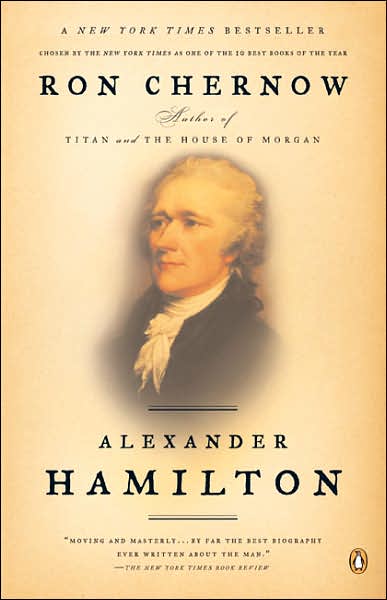
Alexander Hamilton

Alexander Hamilton
© 2005 Rob Chernow
832 pages

Who is  Alexander Hamilton? The greatest founder save George Washington, or the Antichrist?  The latter is the view of Hamilton one may derive from the accounts of John Adams and Thomas Jefferson, whereas Rob Chernow’s biography views him in a far more sympathetic light. Though not quite a hagiography, it rings a tribute to a man whose accomplishments are impressive, even to his critics. Hamilton’s life is the story of a boy twice orphaned (losing not only his parents, but two sets of guardians), who emigrated to the American colonies and became not only a leading member of the Revolution, but an architect of its destiny, whose power and influence rivaled and even surpassed that of some of the early presidents. His opinions and policies were at the heart of the controversies and feuds of the early Republic, and though shot down in a duel, his legacy is all but dead, and this grand treatment of his life is a powerful aid to understanding the first decades of the United States’ life.

 Unlike most of the founding fathers, Alexander Hamilton was not born in the American colonies, at least not the ‘proper’ thirteen. He hailed instead from the isle of Nevis, in the West Indies, growing up amid scenes of the sugar trade, of ships from various nations plying the Caribbean routes, hauling trade goods and slaves hither and yon, between islands baked by the sun and hit alternatively with bouts of hurricanes and disease. Orphaned early on, Hamilton found employment as a clerk in a trading firm, and his success there led him to New York, working first on the firm’s behalf and then on his own, as he became involved in the colonies’ struggle for independence. After completing his education there, Hamilton put his mind to work outside the exchequer’s office, engaged as a lawyer and putting his pen to work arguing for independence. During the Revolutionary War, he served first as a captain of artillery, and then as George Washington’s attache, a position which forged his destiny. By war’s end, he had become Washington’s de facto chief of staff, and when ‘his excellency’ became president,  their long relationship and the strength of Hamilton’s writings on politics and economics (including most of The Federalist Papers) earned him a seat in the first cabinet, as Secretary of the Treasury.  There, he helped to create a nation, pushing forward a much-hated plan for the new union to absorb the debts of the old, a move that established the young country’s credit and strengthened the position of the federal government over the states.  Hamilton’s belief in a strong, efficient central government made him the foe of states-rights proponents like Jefferson, who saw in him the antithesis the revolution. Hamilton and they engaged in ferocious battles of words, railing against one another  in the press. When Washington retired and John Adams became president, it was Hamilton, and not Adams, who led the Federalist party against the attacks of Jefferson and the anti-federalist Republicans. (Such a fact was very much not appreciated by John Adams, whose cabinetmen stayed in constant correspondence with Hamilton and forwarded his advice as their own)  Although Hamilton accomplished his dream of a strong union backed by a strong currency (backed by a strong, national bank), his reputation fell into disrepute through his constant bickering with others, especially after he engaged in a no-holds barred assault on then-president John Adams, splintering the federalists and allowing for decades of Republican domination. His highly colorful career — festooned with accomplishments and embarrassment — came to an end in 1804, when he engaged Vice President Aaron Burr in a duel and was shot down, dying in the same fashion as his son a year prior.

 So, the story of Alexander Hamilton is something kin to a rags-to-riches tale, or it would if he actually died rich.  His ascent is stupefying, and Chernow’s admiration is hard for a reader not to share. Although I’d expected the book to sing Hamilton’s praises, Chernow chronicles the man’s persistent faults faithfully. He does couch the criticism in such a way as to soften the blows, frequently mourning over dear Hamilton’s all-too frequent lapses in judgment the way readers might tut-tut over their grandparents’ foibles.  Chief among them was Hamilton’s ability to hold a grudge, and the power grudges held over his opinion, moving him to rail against  opponents so scathingly that even John Adams was taken aback.  Chernow doesn’t fault Hamilton’s basic approach to governance, which tended toward the cautious: Hamilton was the anti-Jefferson, and promoted more a strong, centralzied government run by ‘cool, cool, considerate men’, rather than a republic of states run by the mob, which is what he imagined democracy to be.  Although Jefferson & company’s skepticism of Hamilton’s strongman approach is warranted (as is skepticism of Jefferson’s own approach),  his fiscal accomplishments seem to validate them. Chernow goes to bat for his chosen subject, engaging in little arguments to defend claims that Hamilton was corrupt or intending to replace the government with the rule of some Hannoverian scion. Of course, considering he once entertained ideas for conquering South America in the event of a French victory during the Napoleonic wars, maybe his enemies’ paranoia was justified. The degree to which Jefferson and others engaged in conspiracy theories with Hamilton at the center is baffling , but Jefferson is as much the villain of the piece as Hamilton is the hero. If Chernow is fair with Hamiliton, being honest with his faults, he is less so with the man’s foes.  John Adams receives the kindest treatment,  notable given how hostile he became toward ‘that Creole bastard’ during his adminstration.

Alexander Hamilton is quite the biography. Not only was his a life fascinating to behold — an orphaned turned national puppetmaster — but through it, readers get a glimpse at how debates over the fate of the nation were enacted. Hamilton’s personal life is included, but shoved to the side: this is a work about the relationships between Hamilton and other founders, especially George Washington and their relation to the first decade of American politics: it emphasizes policy more than cozy scenes of family life.  Chernow is an able storyteller, and proved to be more fair than I gave him credit for.  This is a massive piece, but I found it very much worth my while, given how anti-Hamiltonian my previous Revolutionary War reads have been. I think next year I shall have to read a biography of Jefferson, since he’s much abused in both treatments of John Adams’ and Alexander Hamilton’s lives.



Posted in history, Reviews | Tagged , , , , , | 1 Comment

Disrupting the Rabblement

Disrupting the Rabblement: Think  For Yourself, Face Your Fears, Live Your Dreams, and Piss off some Zombies
© 2012 Niall Doherty
~138 pages

There are those who live, and those who simply exist. The majority of people, the rabblement, simply exist, and it’s Niall Doherty’s mission in life to wake them up, or failing that, to at least ruffle their feathers. Looking to live life more abundantly, Doherty left the trappings of ordinary living behind: he’s traveling across the world with his every possession in a 42 liter backpack, and occasionally posts from internet cafes to ask provocative questions and offer advice for better living. Disrupting the Rabblement is an extension of his blog; more than a collection of posts, but not quite a book in its own right. It reads more like an anthology than a cohesive book, but one certainly of interest.

In Disrupting the Rabblement, Doherty calls for readers to ask themselves probing questions to suss out what they really want out of life, to establish their values and then to boldly compare the life they live now, their actions, to their ideals. He suggests practices, like freethought and minimalism, that help people to sort out what is real and what is important from what is assumed, and what we only think is important. This is followed by advice on how to begin creating a more fulfilling life, and here Doherty draws partially from Stoicism, with frequent references to Buddha; he suggests people reflect on and engage their fears.  There are proper reasons to be afraid, of course: it is probably wise to resist that urge to pet the jaguar at the zoo. But why not say hello to the astonishingly interesting girl at the bar?  Sure, people may not respond to us as we wish, but most of the time, the potential rewards far outweigh the potential consequences. One of the more useful sections here is his guide to establishing habits that allow people to learn new skills and wean themselves off of destructive behaviors while establishing healthy ones.

Although I wouldn’t go so far as to call Disrupting the Rabblement a book, its informality doesn’t diminish from the accuracy of Doherty’s observations or the usefulness of his advice, especially considering that he really does practice what he preaches: while writing this, Doherty was a vegetarian, something he adopted after a thirty-day trial. In recent months, however, he has left the vegetarian diet, and done so after subjecting some of his assumptions to scrutiny. He’s not afraid to court unpopularity (one wonders if he’s ever read the Cynics):  his recent blog and video on quitting vegetarianism have caused quite a stir.

If these ideas interest you, I would suggest  watching some of his videos (like “What would it take to change your mind?”)  or reading his posts to get an idea as to whether or not they would be worth your while. I found Doherty accidentally, while looking for videos on simple living, I discovered his “What Minimalism Is Not“.  I enjoy his videos, and so figured the $3 ebook would be worth it; and, though I wish it was meatier, worth it it was.  It’s not offered as a ‘real’ book.

Posted in Reviews | Tagged , , , , , , , | 1 Comment