This week at the library: bikes, Arab sheikhs, Christian urbanism, and marriage

What kind of car would Jesus drive? And he certainly would have to drive, were he to initiate a ministry in 21st century America, for it is an place impossible to navigate otherwise.  The Space Between: A Christian Engagement with the Built Environment explores the spiritual, religious aspects of …urban planning.  A book that quotes liberally from both the Judeo-Christian bible and authors like Jane Jacobs makes for a decidedly odd and manifestly intriguing combination, at least for someone like myself, for whom the built environment is a dear subject.  Although authors like urbanist authors like Jim Kunstler often address the way the built environment affects the human spirit — speaking of a building as honoring and comforting people , or distressing and demeaning us —  this is a distinctly religious spirituality explored here.  A key concept is that of shalom: while a common meaning of it is simply ‘peace’, author Eric Jacobsen writes that it has a fuller meaning, one that refers to a state of being where all is right with the world, essentially, where relations between people and relations between people and the divine are as they should be.  This idea allows him to explore ‘secular’ concepts like walkability and mixed-used  environments for their religious value.

Relatedly, I just finished Kate Braestrup’s Marriage and Other Acts of Charity, a memoir about love and marriage. The love in question is agape love, and Braestrup — a Unitarian Universalist minister — muses on marriage as a spiritual experience.  I read it for the author: her Here if You Need Me  lives on in my memory, despite having only read it once some three years ago. She writes with such naked, intense honesty, and her reflections stir one to both bliss and sorrow. Marriage is similar in that regard, allowing her to build off her background as a widow who became a minister (and chaplain to game wardens) after her first husband died in a car accident. Throughout the book Braestrup explores the theme of agape, through relationships between lovers,  families, and perfect strangers, mingling the sacred with the profane. As with Here if You Need Me, her second memoir is both profoundly moving  and sometimes hilarious.

More extensive comments are pending for Pedaling Revolution: How Cyclists are Changing American Cities and On Saudi Arabia: Its Past, People, Fault Lines, and Future.

Upcoming reads…oh, who knows? I recently received a book called Alabama Railroads, and have People with Dirty Hands, a tribute to gardeners, checked out as well.

Posted in Reviews | Tagged , | 2 Comments

Railroad Stations

Railroad Stations: the Buildings that Linked the Nation
© 2012 ed. David Naylor
336 pages

For the past couple of weeks I’ve been slowly enjoying Railroad Stations: the Buildings that Linked the Nation, a collection of photographs of the United States’ wide variety of railroad stations, from humble one-room shacks in the desert to astounding works of art that must rival even the cathedrals of Europe with their grandeur. It was released just last year, and appropriately timed given that Grand Central Station in New York is celebrating a hundred years of service.  The book is a feast for architectural admirers and railfans alike: after an opening section that gives a history of rail in the United States, and stations’ role in public and economic life, a tour of the US’s depots, stations, and terminals follows.  The photos range from the beginnings of rail days to the early 1980s, and while the majority portray the stations at their best (with crowds, families included, waiting to go on a trip, dressed in their Sunday best…including straw boaters for the men), a few in the southwest section offer a sad look at roundhouses and tracks overgrown by weeds.  Aside from the southwest and Alaska, though, the buildings are magnificent, and often connected to other forms of transit. In New York, for instance, a train station also had ferry landings, and quite a few were visibly part of a trolley (“light rail”) network. The photos included often cover a given site from multiple angles, building plans, and offer views of fine details, like a GC mongram emblazoned on the  doorknobs at the Grand Canyon station.  The editor sources the photos as well, so those curious can look for the original collections.

The four-page treatment of Union Station in Montgomery especially delighted me. I only discovered that the station was still standing a few weeks ago, and immediately took a trip there.

Click to enlarge.
Far more humble is the Old Depot, like Union Station part of the Louisville & Nashville line. I took this photo several years ago on an overcast day. 

Posted in history, Reviews | Tagged , , , | Leave a comment

Selma

Selma: A Novel of the Civil War
© 2008 Val McGee
396 pages

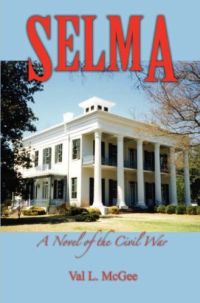
On the cover: Sturdivant Hall, a local home-turned-museum.

Today, Selma, Alabama is a small town on the Alabama river, largely forgotten save for its role in the Civil Rights movement. But once it was a great city, a commercial boomtown whose city fathers boasted of its many rail connections and steamboat landings. During the Civil War, Selma was an industrial powerhouse — and Val McGee has produced a story set during those years, one which follows a father and son team of attorneys and their friends through the war and beyond, on the stage that was the Queen City of the South.

Years ago, the curator of the local history museum (Jean Martin) produced a pictorial history of Selma under the name Selma: from Civil War to Civil Rights.  McKee could have very well used that as a subtitle, for he uses his characters to explore issues within slavery (its role in the war, its legality, its effect on the economy) and ends with an epilogue set in 2000, where President Bill Clinton visited the city to observe its storied role in the Civil Rights movement. The lead characters are as sympathetic as can be believable: anti-slavery unionists who believe slavery should be phased out. They rarely voice these views, however, for fear of disrupting good relations with their neighbors. As much as they dislike the path Selma takes, it is their home; for that reason, the son joins the Selma Rifles to fight against the Union which he would  would prefer to see kept intact. The other characters run the gamut, from businessmen and aristocrats to freedmen and slaves.

Selma’s greatest appeal for me, as a native son, is imagining life on its streets when it was a much more successful city. In my walks through its streets, I often imagine them as it were — my mind’s eye can see the trolleys on Broad Street, the lights in the upstairs windows of now-abandoned buildings, suddenly by my imaginings restored to life, full of people living and working in them.  The Selma of McKee’s story is a young, energetic city, where cotten bales slide down the long ramps from the bluff to the landing, where back streets are thick with  trade carts,  where men in suits and ladies in massive dresses boarded carriages for Sunday picnics out in the country, enjoying the fresh air where is now a rather large parking lot in front of an abandoned Winn-Dixie.  (Some of this romanticized, of course…I doubt anyone would want to return to wearing so much clothing these days, especially given the life-sucking humidity around here in August.)   But the rose of history has thorns, and in Selma’s case that’s slavery.  Those bales crashing down to the landings were picked by slaves. Dallas County was then and is now predominately agricultural, and owned by the cotton trade, and that dominates its destiny.  The townsfolk eagerly embrace the planters’ revolt — and pay the price when the Union army arrives to burn the foundry.

I suspect the book’s primary audience is Selmians themselves, though it was received poorly, and probably because McKee doesn’t romanticize the Old South, Gone with the Wind style. The culture of slavery was brutal, and that’s not shied away from here. Slaves are beaten and raped, abandoned in their age while the ‘good Christians’ of town champion slavery as an institution sanctioned and favored by God as a way of civilizing Africans. The lead characters are against secession, against slavery, and against the war — and while they may hide this from their contemporaries, their arguments between themselves are in full view of 21st century Selmians who don’t like being reminded of the dark side of history.  Like most people, we prefer to imagine our ancestors as noble, not base. But history is what it is, and every city has its sewers.  As a lifelong scalawag who nevertheless owns being ‘southron’, I found the book’s greatest weakness to be the stiltededness of the dialogue between characters. I don’t know if McKee went for the loquaciousness of Austen and came off sounding inauthentic (rather like Mr. Collins), but his characters sound like ideologues in their back-and-forth exchanges.  They don’t speak in ways that anyone in reality ever would: when a society man is hinted at as having fathered several children by slaves, a young socialite remarks that it’s a shame, but an unavoidable side effect of the socio-economic system in which they live — sounding rather like King Arthur’s noisy peasants.   I also wish he’d paid more attention to Selma during the war years: the book is set in 1860-1861, and then 1864-Reconstruction, jumping over most of the war after throwing Selma’s sons into an opening battle or two.

Selma is an enjoyable book, for the most part, and a treat in its author imagining the city in more prosperous days.

Posted in historical fiction, Reviews | Tagged , , , , , | 1 Comment

BTT: Libraries

BTT asks: How often do you visit a library? Do you go to borrow books? Do research? Check out the multi-media center? Hang out with the friendly and knowledgeable staff? Are you there out of love or out of need?

I visit the library every day. Of course, I work there, so it’s expected. But even before I began working at my hometown library, I visited it on a weekly basis. (Hence…this week at the library.)  It probably goes without saying, but I love libraries. “Love” is not hyperbole, because to me they’re community centers as well as places wherein the culture of our societies is preserved –rather like medieval monasteries, but without waking up at three a.m. to pray. I like seeing people come together in the library, whether it’s old friends chatting as they read newspapers together downstairs, or listening to a little girl read aloud to her sister. I still use the library heavily for my reading, and lately I’ve begun research in its microfilm room. Visitors frequently marvel at the library’s size, relative to the town it serves, and the friendliness of the staff.  Recently a retired couple touring the country in their RV paid us a visit, and shared several photos of the library’s insides here. Because of its location at the heart of downtown, the library is imminently accessible to virtually everyone: children and teenagers often arrive on foot or by bike.

This is part of an aerial photo of downtown Selma taken sometime before 1969. The library occupies the site which is circled above; the white building is the Wilby Theater, which burned. Alas, the grand building behind the site, the Hotel Albert, was lost to ‘progress’ in 1969. That site is now occupied by City Hall and a convention center. 
Our website is here.

Posted in General | 2 Comments

Pride and Prejudice and Zombies

Pride and Prejudice and Zombies
© 2009  Seth Grahame-Smith
319 pages

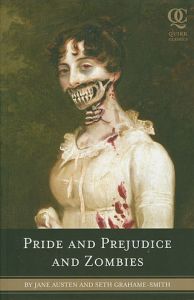
Pride and Prejudice and Zombies is the old story of girl meets boy, girl declares boy to be Worst Man in the World and humiliates him, girl and boy fight off horde of drones from hell together and decide the other’s alright after all. And there’s dancing, lots of dancing.

Hearing about this book some many months ago scandalized me at first. The idea of modern people, taking a Classic and sullying it with their infantile obsession with monsters and sparking vampires! — and yet after I read the  Classic, the idea of Elizabeth Bennet dispatching zombies with a musket was too good to pass up. (It was a bit silly of me to defend the honor of a book I hadn’t read, anyway.) Pride and Prejudice and Zombies is in a word, hilarious, largely because the author has managed to take most of Austen’s text and set it against a completely bizarre background, one in which England is suffering under a prolonged plague of zombies.  The dead refuse to stay properly buried, and insist on shambling around trying to nibble on people’s heads — and being bitten can cause the transformation of the living into the undead.  In this world, families who can afford it send their sons and daughters to the East to learn martial arts, and children spend their time learning musketry instead of the pianoforte.

The woes of Mother Bennet in trying to marry off each of her five daughters are now complicated by the fact that every trip into the countryside between homes is perilous  attacks on  carriages by zombie bands are common, and solitary travelers are suicides. It’s not as if she’s rich enough to support a security force of ninjas, not like Lady Catherine de Bourgh.

Those who have seen the Leonardo de Caprio version of Romeo and Juliet may have been amused, as was I, by the combination of Shakespearean language and modern scenery, wherein the Capulets and Montagues fight not with swords in a plaza, but with pistols at a gas station.  That kind of contradiction is here: the archness of Austen’s writing and the dignity of her characters stand against the absurdity of zombies and ninjas. For the most part, Grahame-Smith makes subtle adjustments: Mr. Bennet is cleaning his musket while Mrs. Bennet prattles on, Mr. Darcy admires Elizabeth’s martial poses rather than her piano playing, and so on. He also adds to the plot; characters in general are much more aggressive here, with Mr. Bennet and Darcy both threatening violence against chatterbox women who won’t leave them alone.  Some alterations are more substantial, like the fates of Charlotte, Mr. Collins, Lydia, and Wickham. At its best,  the tension between Austen and Grahame-Smith is wildly funny, as when a ball is interrupted by a zombie attack and Elizabeth’s impulsive plan to follow Darcy outside and kill him for insulting her (it’s the warrior code, doncha know) falls apart.  Other times, it’s a bit too absurd.The Bennet sisters being warriors, renown for their expertise in slaying the walking damned, that’s hilarious — (“Girls! Pentagram of Death!”). But ninjas? That’s just silly. At its worst, Graham’s brief additions can be gratuitously vulgar:  one character becomes lame and incontinent in the course of the story, and the humiliation of their constantly soiling themselves becomes a running joke for the final third of the novel — a tasteless display which dampened even my enjoyment of the Epic Duel between Lady Catherine and Elizabeth.

I would have like Pride and Prejudice and Zombies a lot more were it not for the toilet humor.  The zombie plague almost makes the book like a western, with lots of action and the wilderness being a dangerous, hostile place.  Unlike in the original novel, here the blue-blooded characters have use: they’re not sitting around gossiping, they’re out defending the realm against the ‘sorry stricken’. And the invisible ‘other’ characters, the legions of servants  and laborers who were nonexistent int the original, make quite a few appearances here. Usually they’re beating eaten, but they’re there.   I don’t know that I’ll be reading any more of the “Quirk Classic” series, but this is definitely a work I’ll remember, and it met the yearning in me for more of Pride and Prejudice.

Posted in Reviews | Tagged , , , , | 3 Comments

Reads to Reels: Pride and Prejudice

Pride and Prejudice has been subjected to several dramatizations, but the 2005 movie starring Kiera Knightly is my first.  I only finished the book a day or two before watching the movie, and indeed looked for the movie because I wanted to experience the story again — and it was a success in fanning the flames of my enjoyment.  Liberties are taken, of course: quite a few lines are added, and areas of the book are squished. The scene in which Mr. Darcy is rebutted by Jane is a prime example. After he declares his love and proposes (woodenly so, an exception to most of the scenes), Jane  refuses him and then tells him why, in no uncertain terms. In the novel, Darcy sends a letter to answer her condemnations of his character, but here he tries to argue with her. The letter is still used, but doesn’t dump as much information at once.  The letters in general are integrated into the story well, with the most potent bits being used as narrative, read aloud by one character during transition scenes — like a carriage ride between estates. Lydia’s transgression is truncated: the family learns she’s run off and is shacking up with a dandy, they’re scandalized, and the next moment they receive word that she’s married, and all is well. The tension should have been stretched out a bit there, I  think.

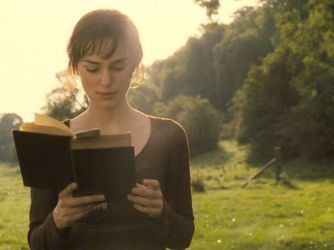
Visually and musically, this is a most attractive film. Jane and Elizabeth Bennet are supposed to be right beauties, and the casting captures that. Elizabeth’s first scene charmed me immediately:  little can match the allure of a woman walking through a beautiful countryside, caught up in a book. Mr. Darcy is a bit rough around the edges for a polished blueblood, always tromping in from fields with a five-o’clock shadow.  The music is wonderful, from a piano piece that echoes throughout the film to the ballroom dancing scene. I’m biased, of course: dancing always captivates me, and if a period movie involves it, the dancing scenes will rank among my favorite — as they did in the Patrick Stewart version of A Christmas Carol.  The only negative point for me was the spottiness of Matthew Macfadyen (Mr. Darcy)’s acting: although his character is supposed to be emotionless and reserved, when Darcy makes his anguished declaration of love, he sounds…bored. Fortunately that’s quickly forgotten when he’s memorably rebuked by Jane.

A memorable and fun movie — definitely a keeper for me.

Posted in Reviews | Tagged | 1 Comment

Booking through Thursday: Bibliophilia

This day, Booking through Thursday asks….what do we love most about reading?

In picking up a book, I can throw back the curtain of time and communicate with a person long dead. My mind can engage with their arguments, study their convictions — connect with their soul, as it were. This is just as true in reading a novel as reading a philosophical or scientific treatise.  To read is to explore, to contemplate, and there’s no thrill like reading words penned centuries ago and having them resonate just as if they were being spoken by someone living right now, in our present circumstances. Regardless of how drastically we alter the world around us, the human experience at heart doesn’t really change, and there is strength to  be found in communing with the ages, as we can through books.

Posted in General | Tagged | 7 Comments

The Seven Wonders

The Seven Wonders
© 2012 Steven Saylor
332 pages

A few years ago, I read through the Roma sub Rosa series in which a first-century Sherlock Holmes named Gordianus the Finder made his living investigating murders and other sundry mysteries which were in great supply during Rome’s transition from republic to empire.  The Seven Wonders marks the return of the Finder, or rather his beginning as a freshly-togaed young man touring the world with his tutor, Antipater of Sidon — a poet who fakes his own death, and not just to get out of town. Although Gordianus will encounter mysteries in every city he visits, the greatest intrigue is in his own camp. The stars of The Seven Wonders are the wonders themselves, as Saylor’s story is a fictional travelogue of the ancient world. Today, of course, only one of the “Seven Wonders of the Ancient World” remains standing, the Great Pyramid. The others have been lost to natural disasters or human neglect. In Gordianus’ day,  most of them dominate the landscape of their cities. The Colossus of Rhodes has already fallen from earthquakes, but even partially submerged it’s magnificent — and the Hanging Gardens, though largely a pile of rubble, are a very impressive pile of rubble protected by the staggeringly beautiful Ishtar Gate. Gordianus invariably arrives in each city just as something special is going on: the Olympics, for instance, or a fertility festival.   The Seven Wonders is a cultural tour of the classical world punctuated by death, theft, and skirt-chasing. (Gordianus was a responsible family man in virtually every other Roma sub Rosa series, but here he’s young, knows no fear, and is randy as a goat in springtime. He even manages to be seduced by a goddess while sleeping in the Great Pyramid.)   I daresay the novel is more enjoyable for the setting than the actual mysteries, since most of the time the reader is kept clueless until Gordianus reveals what he’s been noticing and mulling over without letting the reader know. Had the work been longer, the mysteries might have been more enticing — but 300 pages is brief considering the scope of his travels.

The Seven Wonders is enjoyable enough, though nothing on the order of Roma or Empire.

Posted in Reviews | Tagged , , , , | Leave a comment

Pride and Prejudice

Pride and Prejudice
© 1813 Jane Austen

Pride and Prejudice is the old story of girl meets boy, girl declares boy to be Worst Man in the World and humiliates him,, girl’s family is saved from social and financial ruin by boy and she decides he’s alright after all. And there’s dancing, lots of dancing.

It’s more serious than that, of course. Pride and Prejudice has “~Classic~” status, which means it’s a book you’re liable to have been assigned in school, and which literate people expect you to have read. I’ve never explored the world of Austen, though, because – well, didn’t she write romances? But the 200th anniversary of the book’s publication passed recently, and since I’d been intrigued by descriptions of Mr. Darcy as a model for gentlemanly behavior, I decided to explore it.   Romance and marriage do dominate the story, which is largely one of the efforts of the main character’s mother, Mrs. Bennet, to get her five daughters hitched. But dashing young gentlemen are fickle,  and it’s so hard to imagine how plain Mary or silly Lydia could attract a man –  not to mention Elizabeth, who is stubborn and opinionated and not at all interested in settling for the first propertied fellow who wanders into the family estate.

Published in 1813,  Pride and Prejudice‘s language has all the frills and ruffles of a stylish hoop skirt. It’s a ball to read, but considerately more challenging than the simple staccato of modern prose. Spending time with Elizabeth Bennet is well worth the effort, however:  she’s a strong spirit, quick to speak her mind and stand up for herself against pompous individuals who try to belittle her for her sex or social status She’s wonderfully sarcastic to boot. Despite being praised for her keen intelligence, however, she’s easily contented with hearsay, and passes quick judgment on those she’s introduced to. The aforementioned Mr. Darcy finds her dismissal of him intriguing  and despite the fact that she’s less gently born than him, she ensnares his attentions.  She thinks him at first the worst snob she’s ever met, but he’s given competition in that category by other characters — like the boorish Mr. Collins, her pompous cousin who was born into poverty but who has become wealthy thanks to attracting the favor of an aristocratic lady — a lady who happens to be the aunt of Mr. Darcy.  The world of the landed gentry is small indeed.

Pride and Predjuce is a lovely story, full of grace and humor but sometimes difficult to take seriously, which may be deliberate.  Worrying about romance seems to be the chief occupation of most of the characters, who spend their days talking and their nights dancing. The work that produces the money they’re obsessed with is done by invisible Other People — the kind Dickens wrote novels about. I’ll definitely be tempted to read more of Austen, but first I want to poke my nose into Jane Eyre. But before that, I’ll be reading a book that’s very much like Pride and Prejudice, but with a  rather deliciously funny twist.


Posted in historical fiction, Reviews | Tagged , , , | 5 Comments

The Bloody Ground

The Bloody Ground
© 2001 Bernard Cornwell
398 pages

In the fall of 1862, Robert E. Lee took the initiative after a string of triumphs over the bungling Union army and launched an attack into the north, aiming to bloody the Federal army’s nose in its own territory and provoke the people of the United States into pressing for peace– for how many people would support a distant war against the south when the shells were falling in their own fields, with their own homes used as quarters for wounded soldiers?  Despite a record of impressive incompetence, McClellan managed to intercept Lee’s army on September 17th, resulting in the bloodiest day of combat in the entire war.  McClellan didn’t lose disastrously  and that for him was a triumph…but the victory owed more to the Union officers who found Lee’s battle orders wrapped around a few cigars not far from their lines — and The Bloody Ground is the story of how they got there.  The likely end of the Starbuck chronicles,  Bloody Ground is wet with death both triumphant and tragic.

‘Til now,  every battle involving Nathaniel Starbuck — who chased a girl into Virginia right as the war erupted and decided to fight for the south to anger his abolitionist father —  has been a victory for the Confederacy, largely thanks to McMilquetoast,  with some assistance from the stunning heroics of Starbuck’s company. Here the streak ends, though the Union victory owes more to the actions of secondary characters, especially Starbuck’s counterpart — his best friend Adam, who despite being the son of a southern aristocrat, fights for the north, and here becomes involved in the murky world of intelligence. Adam is a tragic character, far more sympathetic than Starbuck but so earnest that Cornwell prefers to punish him instead of reward him; rewards are for scoundrels and brigands in Cornwell’s world. But perhaps the scoundrels deserve the rewards more: Starbuck, after all, has to cope with being Enemy #1  to Washington Falcouner, who has seen fit to “promote” him to the leader of a punishment battalion known encouragingly as “The Yellowlegs”.

The Bloody Ground‘s intensity is fitting for the bloodiest day of the war, though combat takes a backseat to the espionage threads; there are spies everywhere, including a man pretending to be a southron in Starbuck’s ranks to avoid capture as a Union raider who, Iago-like, starts turning his company against him.  Considering that Starbuck’s company will be present in some of the battle’s bloodiest moments — the skirmish in the cornfield and the orgy of death that was the Sunken Road —  you’d think his life is in peril enough from the Union army, without adding murderous subordinates into the mix.  Starbuck is at his most likable in The Bloody Ground, though; while his motives for fighting may have been petty, he is admirably devoted to his comrades-in-arms, especially those scorned by officers, and a protector of underdogs. (“I am Starbuck, defender of whores!”)

Quite a fun read, but the ending is rather distressing. The bloodletting doesn’t stop with minor characters, and I’ll leave it at that. It seems a shame this series has been discontinued, but if Cornwell had to choose between Starbuck and Sharpe, I’m glad he chose Sharpe. Speaking of whom, I think I left him about to invade France…

Posted in historical fiction, Reviews | Tagged , , , , , | 3 Comments