Armada

Armada
© 2012 John Stack
400 pages
It is the 16th century, and a crisis looms for England.  Spain, who thanks to the plunder of the New World and its Hapsburg connections, is Europe’s heavyweight and the declared enemy of England, threatens war. Spanish armies stand just across the Channel, occupying Holland, and a massive fleet has sailed from Iberia to help cover and transport that invading army to a land which has not known a conqueror’s boots in five hundred years.  The force from without may have assistance from within, as persecuted Catholics look to Madrid for salvation. In the center of this drama is Robert Varian, a secret Catholic whose father was said to have died in exile following defeat in a rebellion decades ago.  Robert’s father Nathaniel is quite alive, however, and from Spain he has helped organize the forthcoming invasion.  If Robert could be convinced to aide his father and provide intelligence on the gathering English fleet,  he could very well pave the way to Spanish victory and the restoration of the Faith in England.  But matters are far from simple.  A recusant Robert may be, but he is an Englishman who loves his Queen — but does he love her more than his father?  As the hours draw the two massive forces closer to conflict, desperate attempts in England to root out a potential spy dot the landscape with death, and two missions converge in the same running battle as the English fleet and a fickle wind fight fiercely against the armed might and brazen ambition of the Dons.

Robert Varian dominates the lead here in a way  John Stack’s other hero, Atticus, never did. Although there is an ensemble of other viewpoint characters, one of whom is his principle Spanish rival, this is Robert’s story.  Happily, then, he’s a likable fellow; conflicted, but devoted to his faith, his country, and the memory of  his father. He thrives as a warrior in an age of changing seamanship; sailors might pack primitive muskets and fire cannons instead of cutlasses and arrows, but cannons have begun their conquest of the naval scene. While the Spanish still rely heavily on boarding and hacking away,  the English have begun to experiment with using cannon alone to wear down the enemy. It is a tactic that will serve them in good stead during the battle itself, and give the Spanish captain Morales no end of grief. He wants desperately to take down Varian, a man who took his ship but spared his life in a raid, but how can he if the English do not consent to letting their graceful gunships be bludgeoned down by massive galleons? So Varian wrestles with both his conscience and the Spanish, working out the question of how he can be true to his faith, his father, and his country.  His love for both England and the church contrasts with the fanaticism of those on either side working against him, both Puritans in England and holy warriors in Spain.

The story of the Armada’s protracted fight against the English fleet, unfolding over the course of several days, is told largely through the repeated brawls between Varian and his Spanish counterpart’s ships, climaxing with a frantic duel aboard a burning ship.  It’s a strange story, both because of the in-flux state of naval war, transitioning from ancient to modern methods, and because of the way it ends. The Spanish Armada is not destroyed, and neither is the English fleet;  they fight and go home. Stack’s historical note comments that it was fortunate for England that the Spanish regarded themselves as spent, for the English fleet was driven to exhaustion as well, and this attitude reflects itself in the story, in that the Spanish lead is driven to despair over his loss even as the English captains are worrying about what the morrow will bring.  Varian, at least, gets most of his ends tidied up, though parts of the ending seem to be begging for a sequel.  It’s a slight blemish, however, and if Stacks does more work in this period, so much the better off are we readers!
Posted in historical fiction, Reviews | Tagged , , , , , , , , , , | 13 Comments

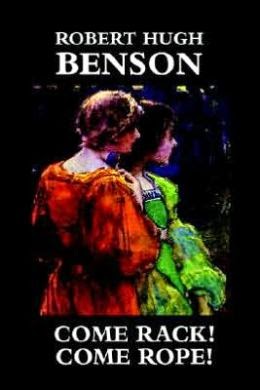
Come Rack! Come Rope!

Come Rack! Come Rope!
© 1912 Robert Hugh Benson
424 pages

Dear Miss Manners:
      My father, having long been both a leader of resistance against religious tyranny and an inspiration to his countrymen, has surrendered most abjectly and is pestering me into joining him. Whatever shall I do?
Doubtful in Derbyshire

Dear Doubtful:
          Flee to Rheims and become a priest, or marry me.  Your pick!
XOXO
Miss Manners

Young Robin Audrey becomes an enemy of the State when his father forces him to choose between Caesar and Christ. The Audreys are, or were, recusant Catholics; that is, Catholics who refuse to convert to the increasingly Protestantized Church of England.  For years a gentle truce held in Derbyshire:  its squire,  Robin’s father, absented himself from church but paid fees for doing so. Thirty years into Elizabeth’s reign, however, times are changing. her reign imperiled by rumors of palace revolt and am impending invasion from Spain,  the Virgin Queen wages war against her own people  to maintain distance from Rome, going so far as to hunt down and execute any priest of the Catholic church.   Fees and fears piling up,  Old Audrey finally surrenders: but his son cannot. Raised in the ancestral faith of Europe, he cannot abandon it for mere convenience’ sake. Seeking moral support and advice from his secret fiance, Marjorie Manners,  he realizes a call to the priesthood. Retreating to France to take on holy orders, he thus becomes a hunted foe of the crown – and so begins a tragic romance and a stirring tale of resistance against religious persecution.

Our heroes here are of course Robin and Majorie, who sacrifice their own happiness out of devotion to higher deals. A Catholic priest, of course, cannot marry, and even if they could  there would be little domestic bliss to be found when one party is constantly in hiding and the other constantly doing the hiding. Both resist the Crown’s intrusion into matters of conscience in their own way; Robin, by  traveling and ministering to the hidden faithful, and Marjorie by helping hide other priests who are engaged in the same business. In an ideal world, perhaps the Queen would have let her  Catholic subjects be, but the English Reformation was far from ideal. Not only has the Pope issued a bull absolving Catholics from fealty to Elizabeth, thus casting a treasonous light upon them in her eyes, but there are serious threats of assassination to contend with. Who but Catholics would want to drive the Protestant prince of England out, and replace her with Mary, Queen of Scots? And who but Catholics would welcome an invasion of England by Catholic Spain?  Robin and Mary are not violent insurrectionists, and certainly no sympathizers to any Spanish invasion —  indeed, they urge their countrymen against rash actions. But war would not be the horror that it is if it did not  consume the lives of innocents, and so it is that virtually every character introduced after the opening chapter will be executed at the hands of the State.

But where sin abounds, there grace does much more abound — and there is grace to be found here. Robin lives a life of grace,  risking torture and death so that he might offer comfort to the hounded – – even listening to the confession of Mary, the imprisoned Queen of Scots. Some of the tragic beauty here comes from the relationship between Marjorie and Robin; even though they cannot marry,  love still unites them. It is not an erotic love, but they are very much partners in the same great enterprise. Another of the tale’s wrenching aspects is the relationship between Robin and his father, who have become enemies: in the last hour, it is the father’s unwitting signature on the warrant which damns him — and yet  there is absolution. The finish is heartrending, but fitting.

Posted in historical fiction, Reviews | Tagged , , , , , , , , , | 1 Comment

The Inimitable Jeeves

The Inimitable Jeeves
© 1923 P.G. Wodehouse
225 pages

Bertie Wooster is something of an imbecile, but his preference for the quiet life would keep him out of trouble were it not for the fact that his relations and idiot friends are constantly getting him into scraps. If his domineering Aunt Agatha isn’t constantly trying to get him married, or worse, employed, his friend Bingo Little is plotting some elaborate scheme to win the heart of the girl-of-the-week. (Even if she is a socialist revolutionary, and Bingo a contented member of the Idle Rich.) Fortunately for Bertie, he has Jeeves, the epitome of an efficient and clever valet. Jeeves hasn’t yet encountered a predicament too difficult, no Gordian knot too tangled, to  finesse.  The Inimitable Jeeves  collects a series of escapades, colorfully and hilarious rendered, in which Jeeves pulls Bertie’s chestnuts out of the fire. This particular set of stories is more or less pulled together by the many love affairs of Bingo, who doesn’t think twice about introducing  Bertie to his uncle as an acclaimed author, so that Bertie might better influence the uncle into giving Bingo more of an allowance. The scenarios are  absurd in themselves, but what truly sells  Wodehouse’s storytelling is the narrative voice.  Bertie tells these stories personally, and his delivery is a riot — so earnest, so energetic, so full of quaintly charming slang. Bertie never walks anywhere, no, — he legs it.  And while Bertie is catastrophically throwing himself into whatever obstacles come his away, Jeeves is hovering in the background and working his magic. He is unflappable, and I have rarely been so delighted by any set of stories.
At any rate, now I know why Isaac Asimov constantly referred to Wodehouse writing his Black Widower series!

Posted in Reviews | Tagged , , , | 1 Comment

The Chosen

The Chosen
© 1967 Chaim Potok
288 pages

Danny and Reuven are two Orthodox Jewish boys who take one thing very seriously: baseball.  When their rival schools meet on the baseball diamond, religious passion turns play to war, and an accident hospitalizes Reuven. Thus is born an unexpected friendship, one that matures throughout their adolescence.  The two come of age in a difficult era; the book begins in World War 2, and takes them through the discovery of the Holocaust, and the turmoil that surrounded Israel’s creation. Making matters still more interesting is the boys’ religious identities and their respective desires:  Danny is a Hasidic Jew being groomed to succeed his father, while Reuven’s dad is a somewhat more secular professor.  Both boys are intellectually-oriented themselves, serious students of both their tradition and respective interests:  one is fascinated by logic, the other by Freud.  Their passion frequently causes them to bump heads with one another, and not necessarily over religious matters. Reuven’s rationalism threatens not Danny’s religion, but his passion of Freudian psychology.  Their most serious break has nothing to do with either of them, but with their fathers’ respective politics: the professor is a passionate supporter of the nascent Israeli state, while the rabbi believes an Israel led by secular Jews is an obscenity, utter anathema to any devout follower of Torah.  This is mid-20th century America, a place utterly recognizable…but many of the characters live within a culture that is utterly exotic to the American mainstream, and The Chosen is simultaneously the story of boys becoming men and an education in Hasidic Judaism. There are five principle characters in this novel: the boys, their fathers, and the Talmud. Thousands of years of Jewish practice and biblical commentary are contained in its various volumes, and its demands and wisdom both guide our characters and fill their lives with reverent dread.  The Chosen is utterly fascinating with a strong redemptive finish.

Posted in Reviews | Tagged , , , , , , , | Leave a comment

Little Women

Little Women
© 1868 Louisa May Alcott
528 pages

“But you see, Jo wasn’t a heroine, she was only a struggling human girl like hundreds of others, and she just acted out her nature, being sad, cross, listless, or energetic, as the mood suggested. It’s highly virtuous to say we’ll be good, but we can’t do it all at once, and it takes a long pull, a strong pull, and a pull all together before some of us even get our feet set in the right way.”

Last year I began a course of American literature, purposely reading classics I’d heard of my entire life but never read. Little Women resumes that effort, and like A Scarlet Letter and Uncle Tom’s Cabin, I found it a genuine surprise.  Originally written as a story for girls, it features the four girls of the March family — Meg, Jo, Beth, and Amy — as they grow up in America’s 19th century. Aside from the odd jaunt to New York or Europe, this is domestic fiction, set in or around the March home, and filled with the quiet little episode of childhood. The sisters chatter endlessly as they see to their responsibilities, they run about outside having wild adventures in their minds, they piece together bold plans and see them fly apart — they fight, they love.  The home life is punctuated with minor drama throughout — a little scarlet fever here, a near-drowning there — but there’s no great quest, no calamitous struggle to overcome. There is merely the challenge of living life day to day, of growing as a result of its challenges and not giving into them.  Is it exciting? Well, no, but it’s cozy, and even entertaining.  I read this to strike it off a list, but Alcott’s sense of humor won me over. The book’s gushing wholesomeness can be gathered from the fact that the girls interpret their lives according to John Bunyan’s Pilgrim’s Progress, but there’s too much snark here for it to be saccharine. Jo and her neighbor-friend Laurie are especially fun: the word ‘mischief’ appears twenty times in the text, and every time they are getting up to it.  It’s not that they’re scheming, but Jo in particularly doesn’t respond well to having to stuff her into a box of propriety, as she does when she and her sister go to make social calls at an overly pompous house. She doesn’t desire an ordinary life, but yearns to write, and so she does — but eventually becoming an aunt, she finds all the pleasures of ordinary family life besides. The relationships between the characters have especial appeal because they are developed through the years; the full book covers over a decade, and in it the characters mature from children to adults with children of their own. Though the voices of the characters alter as they increase in maturity, still there are the spots where childlike abandon erupts through. This is a tale full of warmth, good humor and more than a few one-liners.

Posted in Reviews | Tagged , , , , , , | Leave a comment

Read of England 2015

In previous years I have done a bit of reading devoted expressly to England around St. George’s Day on April 23rd. This time around, however,  I’m going whole hog — April belongs to England!  The majority of what I read in the next four weeks will be English literature, English history, fiction set in England, books about English culture, biographies of famous English-types, books written in English — okay, maybe not that broad, but you get the idea. I’m essentially carving out some space to read more Dickens or Austen.  There may be one or two non-English things sneaking in, but on the whole it will be a very English month.What to expect? Well,  The Armada by John Stack is sailing my way, so that’s one at the very least,  and there are a couple of classics I want to poke my nose into.

And awaaaaaaaaaaaay we go! 
Posted in General | 1 Comment

The Adventures of Henry Thoreau

 The Adventures of Henry Thoreau: A Young Man’s Unlikely Path to Walden Pond
© 2014 Michael Sims
384 pages

Shortly before retreating for two years to his self-built cabin at Walden Pond, Henry David Thoreau accidentally started a forest fire. A simple attempt at having fish for lunch reduced 300 acres of woodlands to charcoal, and very nearly ignited Concord.  The village pariah would eventually be pardoned, for the town had known him before his attempt at civic ignition;  they knew his reputation as the nice if odd boy from a respectable family of teachers and pencil merchants. Before Henry David Thoreau loomed large over American literary history,  eventually helping inspire the environmental and civil rights movements, Henry was that nice if odd boy. The Adventures of Henry Thoreau examines Henry’s life outside of Walden,  giving a history of his life as he lived it — as a boy, as an awkward, courting teenager, as a adventure-thirsty young man who explored the whole lengths of rivers with his brother.

Michael Sims puts a human face to the man who has cast such a long shadow over American history. Here, Henry is no icon, but a frequently distracted student who barely gets into Harvard and who itches to escape it. Throughout his life, his abiding passion is the outdoors. Raised a Unitarian, Henry was already predisposed to look askance at traditional religion. For him, spirituality was an individual journey, and he communed with God best in the outdoors, skipping church to take long walks in the wilderness. He idealized Nature, and revered the native Americans as having lived more closely connected to it. But his lust for the natural wasn’t limited to getting “moony-eyed over mountains”;  his mind also had a scientific cast, and those long hours of meticulous study resulted in one work of technical import.  These aren’t solitary quests, either; young Henry is companionable. He takes long walks into the woods with  remarkable friends, like Ralph Waldo Emerson and Nathaniel Hawthorne;  spends weeks on a river with his brother, and even takes classes of children into the wild to teach them how to observe,  investigate, and come to understand the world around them. As the books wear on, however, these connections fall away; he leaves his work as a teacher, his brother dies, and his object of affection rejects him on the advice of her father that Henry’s prospects are too dismal to make him a fit husband. Throughout, he escapes increasingly more into solitude, and though he dies at home, with family watching over him, he seems a lonely figure sometimes substituting philosophy for people. He sought an authentic life free of distractions, and produced extraordinary work as a thinker — but in light of the ordinary happiness of his early years, one wonders if the later monkishness was truly necessary.

Related:
I to Myself: from the Journal of Henry David Thoreau, Henry David Thoreau
Walden, Henry David Thoreau
On Civil Disobedience“, Henry David Thoreau

* “moony-eyed over mountains”, as a skeptical professor of mine once described those who identify as spiritual, but not religious

Posted in Reviews | Tagged , , , , , | 1 Comment

Born Fighting

Born Fighting: How the Scots-Irish Shaped America
© 2004 Jim Webb
384 pages

Born Fighting is a family story of the Scots-Irish, a clan of forgotten men. Beginning with the Celts, author Jim Webb moves swiftly through British history to the establishment of the Ulster Plantation.  Faced with continued resistance to the British crown by the feisty Irish, who were even more suspect by their frequent fraternization with Catholic powers like France and Spain,  King James hit on a novel solution: move in their equally feisty, but virulently Protestant, Scottish cousins.  As anyone remotely familiar with Irish history can guess, that didn’t end well;  northern Ireland was a warzone even throughout the 20th century.  But the Scots of the Ulster Plantation didn’t stay there;  they emigrated to the United States in large numbers, where they continued being…lively. Constitutionally incapable of bending a knee to a king,  they pushed into the American interior,  driving the frontier of colonization forward, provoking the natives into war and prompting a revolution.  Although  some would eventually make it to the west coast, the hills of Appalachia and the American South were settled in large number by these rebellious Presbyterians.  Settling down didn’t change too much, though; when  Abraham Lincoln called for troops to suppress the secession of South Carolina, the size of the nascent Confederacy doubled as the distant descendants of Robert the Bruce closed ranks to defend their land and kinsmen from invasion. Although they were defeated in battle, they continued to shape American history, swelling the ranks of the soldiery and producing country music.

Although Born Fighting has the scope of a historical survey, it’s much more personal. As mentioned, this is a family story, and it’s framed by Jim Webb’s journey into the Appalachian mountains to find his family’s bones, and the quest that ends at an ancestral graveyard  causes him to ruminate on how his people came to be in that land, so far removed from the hills of Britain and Ireland. It’s thus quite romanticized, its characters assuming airs of heroism or tragedy as the story waxes on. The rough, ornery wildness that Webb celebrates here as an antidote to tyranny is the same ‘cracker culture’ that Thomas Sowell condemned in Black Rednecks, White Liberals as completely-self defeating.  Webb doesn’t completely overlook  his kinsmen’s flaws; his defense of the South  owns up to slavery as the cause of secession, but he rightly distinguishes that from the motive for fighting. Slaves, like private jets and palatial estates today, were not owned by most southerners;  most, in fact were owned by a few dozen elite families. The country boys wearing grey weren’t fighting to keep their slaves, they were fighting because fighting rule from on high is a family tradition. The Scots-Irish, Webb writes, could respect authority from men who literally led them in battle, but never from enthroned men who dictate from afar, whether they be Caesar and Pope in Rome, or the president in D.C.

Born Fighting makes for fun reading, and it’s not immaterial: there are reasonable arguments here, taken from completely respectable surveys like Churchill’s History of the English Speaking Peoples, and WJ Nash’s The Mind of the South.  There’s always more to the story, though, and southern whites have not always been completely opposed to authority on principle. The New Deal that Webb mentions resistance to was much beloved by the poor South, black and white alike. In fact, a song mentioned in Webb’s section on country music refers  to Roosevelt “saving us all”, creating programs like the TVA that put the singer’s family back on its feet. Taken as a fond retelling of family drama, however, its weaknesses can be forgiven. There are other works for the serious readers. Like Cool Hand Luke, this is a celebration of a man, of a people, who can’t be told what to do and won’t give up going their own way, no matter how many times they’re beaten.

Related:
Poor but Proud / Dixie’s Forgotten People, Wayne Flynt
The Redneck Manifesto, Jim Goad. Similar in intent, but much more vulgar.
A Renegade History of the United States, Thaddeus Russell

Posted in history, Reviews | Tagged , , , , , , , | 8 Comments

The Importance of Being Earnest

“The Importance of Being Earnest”
© 1895 Oscar Wilde
The truth is rarely pure and never simple. Modern life would be very tedious if it were either, and modern literature a complete impossibility! (Algernon, Act I.)
         Algernon and Earnest are two pals who have more in common than they realize. When Earnest visits Algernon, planning on proposing to Algie’s cousin at a family lunch,  a mystery is waiting for him. Algernon has recovered a lost cigarette case, one he knows to belong to Earnest, but which for some reason is inscribed to an Uncle Jack from his adoring niece Cecily. Who is Jack?   
            Who is Jack, indeed?  That’s a three-act question.  Jack, it turns out, is the real name of Earnest.  In real life, he’s a respectable gentleman in the country with a young ward, for whom he must be very proper and upright. When it gets too much, he likes to escape to the city to see after his libertine brother, Earnest.  Algernon isn’t in the least bothered to learn that he knows his friend under an assumed name –  Algy likes to pretend he has a sick friend in the country, Bunbury, who occasionally needs help. (The occasion invariably coincides with party invitations from Algernon’s aunt.)  When Algernon decides to visit Jack’s country estate pretending to be the scoundrel brother Eanrest, hilarity ensues. 

            Strictly speaking, hilarity was ensuing long before that.  Wilde once equipped that nothing succeeds like excess, and this play’s abundance of witty dialogue may hint at truth in the saying.  Part of the humor comes from Wilde turning social conventions on their head; his rich characters complain that the lower orders aren’t setting a good example for the uppers, characters despair of hypocrisy in a good man who pretends to be naughty,  and at least one woman proclaims that men’s proper place is in the home, and once they leave it they become altogether too feminine.  It’s a very silly play, and even a little meta: towards the end Aunt Augusta complains that contrived coincidences like this simply have no place in ‘good’ families like hers.  This is a topsy-turvy plot, wherein characters are alternatively sparring and then defending one another, traveling from  sobs to shrieks of joy at a moment’s notice. It’s magnificent fun, especially in the hands of talented actors. 
Posted in Reviews | Tagged , , , , | 2 Comments

Selma 1965

Selma 1965: the March that Changed the South
© 1974, 1985, 2015 Chuck Fager
257 pages (2nd edition),

Last weekend, my hometown suddenly became host to two presidents, a hundred members of Congress, and enough people to see it swell over ten times in size.The event was the 50th anniversary of the Selma march. In 1965 over half the population of my hometown couldn’t vote; its black populace. Though guaranteed suffrage by the US Constitution,  local registrars threw up impediments in the form of extensive literacy tests and limited registration times to keep the vote restricted. Although  these tests limited poor blacks and whites alike, the effects were especially manifest in the black community: less than 1% of the same were registered to vote. The greatest obstacle in the face of full citizenship, local voting-rights activists thought, was not the scheming of the elite or even the lack of concern of the city’s white population: it was the utter resignation of the city’s poor blacks, who seemed to have given up hope.  With the aim of inspiring the same, local voting rights leaders, working with national organizations like the Students Nonviolent Coordinating Committee, invited Martin Luther King, Jr. to add his energy and talent to the campaign. That invitation put Selma at the center of a national crisis on Sunday,  March 7th, when King’s strategy of provoking responses drew the wrath of the Alabama State Troopers onto a peaceful mob marching towards Montgomery.   Weeks later, another far larger march crossed the bridge and trekked three days to the Capitol, and among its numbers was young Chuck Fager. His history of the Selma movement covers the road from despair to jubilation in a manner respectful of the fact that Selmians, black and white alike, had found their city as the site of the American nation’s final attempt to work out its salvation from a history of racial strife.

King, following the dictium of Gandhi that the function of a civil resister is to provoke a response,  launched a series of actions designed to thwart being ignored.  The status quo would be strained, the establishment would be pushed, and either it would give way or fight back in such a way that the sin within could not help but be exposed. A series of increasingly aggressive displays, including night marches on the courthouse, followed.  City leaders fumbled for an appropriate response; they knew pushback was exactly what King wanted, but something had to be done. Nothing good would come of mobs wandering about at night.  Under such stress, rationality proved a poor opponent for human nature; thoughtful indecision gave way to the unfortunate authority invested in Sheriff Jim Clark. Clark was a swaggering lawman whose bellicosity was such that the Council was attempting to divert away his power into a new public safety manager, but in that late winter of  ’64-’65, he still had his teeth — and he knew how to respond to any challenge, with the baton.

On March 7th, the growing movement within Selma began what was to be a march to Montgomery to plead for the Governor to intercede. It didn’t matter that the registrar’s office and the city council were making timid attempts to appease the movement; this was a drive gaining power, and only sweeping changes would satisfy.  Across the bridge, in Selmont, were waiting a formation of Alabama State Troopers, and a roughneck posse led by the the sheriff. What followed was war, pure and simple. While King had wanted to expose the violence inherent in the system, he awoke the violence inherent in the human animal at war. When the six hundred marchers were ordered to turn back and refused, horror was released. There were no peace officers subduing unruly subjects that day, only Mongols in police uniforms,  striking into the mass with the ferocity of a warband and routing them. Not content to simply turn back the march,  the State’s troopers chased the gas-stricken crowed across the bridge and into the city, block after block, hunting down and beating any man, woman, or child on the street around the movement’s epicenter within the projects, Brown Chapel.

The horror of that day is remembered  as Bloody Sunday, but it is what followed afterward that makes it one of the pivotal movements in American history. The black people of Selma were beaten, but not broken, by the State’s retaliation. King and other leaders upped the ante, calling for ministers and volunteers throughout the nation to join them.  And they came, by the hundreds. Fager places particular importance on the swelling numbers of white ‘outside agitators’ who joined Selma’s black community in fighting for full voting rights:  taking their perspective, Fager writes that the black populace was astonished and moved by so much white support. Here at last was hope that racism  need not forever exist.  Eventually they marched again, though it took several weeks: an immediate attempt on March 9 (“Turnaround Tuesday”) was stopped by the State troopers again, but by March 26th the Federal government had moved. It couldn’t help but do so:  scenes from March 7 had been broadcast throughout the country which was now demanding action. With National Guard troops  present and the eyes of the nation upon them, King led a third march across the bridge, this time to Montgomery.

Selma 1965 succeeds wonderfully in bringing together two dramas; the struggle of the city’s poorer classes to claim the franchise that was their right, under the law, and the culmination of the national Civil Rights movement, being its last and best publicized campaign. Although it began as a local movement, and King aside was being maintained by Selma’s own black leaders, after Bloody Sunday it became the object of national attention. Crowds formed in other American cities to ‘march with Selma’, and three of the four people who lost their lives in connection with the Selma campaign were out-of-state visitors who answered King’s call. Some were accidents —  While transporting protesters and supplies,Viola Liuzzo  had the luck to encounter a carload of Kluckers from Birmingham, who seized the opportunity to shoot her down. Other casualties included Jonathan Daniels, a seminarian who defended a young girl from an aggressive lawman in Haynvesville, and another young man named Jimmie Lee Jackson in Marion who shielded his grandmother from the constable’s bullets. Only James Reeb died in Selma those dark hours; another clergyman,  he took a wrong turn and was beaten in the streets outside a roughneck bar.  These deaths increased the tensity, and slowly control trickled out of the hands of local governance and into federal courts.

The original version of this work was a triumph, I think, an impassioned history of the Selma march which managed to be fair to its citizens, whose own failures were not extraordinary and who certainly did not ask to become the poster children for racial hatred. The city fathers were just as contemptuous of the Kluckers following King to stir up trouble their way as they were of him stirring up trouble his way.  They were raised in a tradition that was wrong; the bridge forced them to own up to the injustices. Fager notes in his original version that the progress that followed the violence was extraordinary. The additional sections added for the 50th anniversary, however, are not not nearly as strong, dedicated as they are to the noisy fight between  two lawyers and a special interest  group over the placement of a Civil War bust in a cemetery that can only be seen if you go looking for it. It’s an ugly fight on the margins, one the city’s people are utterly sick of seeing publicized regardless of skin color. This was certainly a worthy read for me, connecting stories I’ve heard since childhood into a coheisve hole, and filling my home’s streets with historical actors.

Related:
A Power No Government Can Supress, The Zinn Reader; Howard Zinn

Posted in history, Politics and Civic Interest, Reviews | Tagged , , , , , , | 3 Comments