Science: the Index

This list includes most of the science books I’ve read since 2007, omitting  titles that received only scant mention.

Brane and Brane! What is Brane?!- Cosmology and Astrophysics*

The Milky Way: Local Astronomy

Space: the Final Frontier

Third Rock from the Sun: Geology and Planetary Science

Weather and Climate

Chemistry and Physics

Flora and Fauna

Biology

Anthropology, Archaeology, and Paleontology:

Neurology and Psychology

History of Science


Thinking Scientifically

Misc

* I actually use this as a shelf label on Goodreads. I live in hope that anyone will recognize it. Ten years, no luck so far.

Posted in science | Tagged , | 6 Comments

D’oh!

Posted in General | 3 Comments

The Planets

The Planets
© 2003 Dava Sobel
288 pages

Like Lives of the Planets, Sobel’s The Planets is a flyby through the solar system. The inclusion of the Sun and Moon give this a classical feel, since those bodies were considered by the Greeks to be wanderers as well. This is most likely intentional, because Sobel steeps her descriptions of the planets’ exploration in the language of mythology and poetry, sometimes to a distracting level. A discussion of Holst’s suite, “The Planets”, is also included; although Sobel mentions a growing fascination with the scientific understanding of the solar system, the music was mostly inspired by the planets’ astrological import. Astrology also features heavily in one chapter, which will raise some hackles — it did mine. Mythology and poetry can be used for literary effect, but astronomy fought too long and too hard to escape its mooney-eyed cousin to sudden be thrown back into relations again. For the lay person, there is actual content here, just not a great deal — don’t expect tables of comparative volume, or probe photographs. There’s discussion of Venus’s greenhouse effect, of course, and Mars’ past life as a livable planet, and the curious relationship between Mercury’s rotation and revolution. Some of the information is delivered in…well, let’s say unconventional ways. In the chapter on Mars, for instance, the reader is given a lecture by a rock on its life history. This book is interesting if limited; for someone who has expressed mild curiosity about the lives of planets, sure — give it go. There’s lot of poetry and history to ease you into the waters before being surprised with ruminating on Jupiter’s cloud activity. The seriously interested reader has probably encountered the majority of the usual information before, however, and considered its datedness would probably be better off elsewhere.

Posted in Reviews, science | Tagged , | 3 Comments

The Deep: Extraordinary Creatures of the Abyss

The Deep: the Extraordinary Creatures of the Abyss
253 pages
© 2007 Claire Nouvian

I’ve been enjoying a gallery book devoted to the extraordinary creatures of the deep sea these past two weeks.  Edited by Claire Nouvian, The Deep collects  some of the best photography produced by the study of the ocean floor in the last decade, along with pieces by marine biologists and geologists commenting on the submarine ecosystem.  The sheer abundance of life on the surface of the Earth boggles the mind, but more than 90% of the planet’s estimated biomass is within the oceans.  The Deep is first and foremost a collection of photographs, presented in full-page or two-page spreads.  They are a marvel; while some creatures have vaguely familiar shapes, resembling weird fish or weird octupi, the majority are…sights into themselves.  Some are transparent, others string themselves with organic lights, putting bacteria to work.  They exist in a world without light. While some only live in the deep seasonally, ascending to warmer and brighter waters when there’s more food for the taking, others never leave the seafloor. Some feast on the remains of the upper level of the ocean, like the vast carcasses of whales; others life off of chemicals seeping from the sea floor or being expelled.    New species are constantly being discovered here, and many do not even have names; they exist as images that astound the mind with their alienness.  What a treasure Earth is!

Posted in Reviews, science | Tagged , , , , | 5 Comments

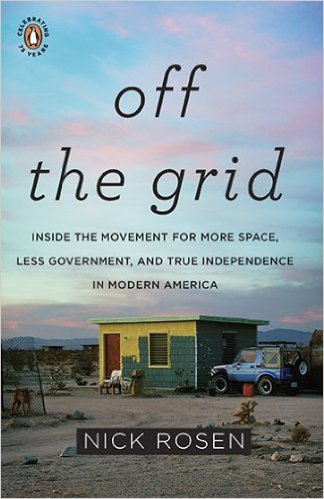
Off the Grid

Off the Grid:  Inside the Movement for More Space, Less Government, and True Independence in Modern America
© 2010 Nick Rosen
292 pages

When Nick Rosen put up a website to help his fellow Britons find resources and land reduce their carbon footprint by living off the grid, he was astonished at all of the interest his site received from the United States. He had more American readers than English readers, in fact,  and decided to investigate.  Off the Grid records his visits with various communities which operate outside the electrical grid. Although its subtitle refers to a coherent movement, there is nothing like that actually here. Rosen’s account includes many people who simply happen  to be without power, like the homeless and the residents of a small Florida key (“No Name Key”) who balked at the enormous cost of electrifying their island. Some of the persons included are positively dull, like the numerous wealthy types who maintained a ‘vacation home’ off the grid when they needed a retreat from their busy lives.  There are far more interesting characters present, though: an aging woman introduced as the founder of the 2nd Maine Militia, who has a working relationship with a local commune of anarchists,  and another woman who gave up PBS videography to teach SCUBA diving and drive trucks, instead.

 The majority of these interviews take place in the Southwest, where land is cheap and the population sparse. While some of the people included here are gridless because of poverty or remoteness, most have chosen it  while trying to find a more meaningful life. They want freedom from the constant distractions, simplifying their lives to the point of being free from utilities: they aim to put to rout all that was not life.  Another element present in these interviews is fear, of people withdrawing from a system that they view as either criminally exploitative or doomed to failure by its excesses. (While Rosen’s grid-free interest mostly stems from environmentalism, he has a contempt for power monopolies that gives him plenty of common ground with this last category.)  Most of the people interviewed have a shade of…quirkiness to them, a possible consequence of living either in their heads or in echo chambers. Rosen brings to life quite a few tangential topics like microcurrencies, the pot economy, and the ins and outs of living in cars during these interviews.

Although I found several of the characters of interest, ultimately Off the Grid disappointed me. Far too many of the subjects just happen to be without power, rather than deliberately choosing to live ‘outside the system’.   Those who remain don’t share a worldview, and the groups that would (that anarchist cult, for instance, or the hippie commune) aren’t explored in a great deal of detail.   Practically nothing is mentioned of how they’re getting along, aside from the constant mention of solar panels and a one-paragraph visit to a composting toilet,  and Rosen is a grating narrator who makes fun of his subjects to the reader while he’s talking with the people.  He does offer some thoughtful commentary though, especially in discussion with one man who lived by himself until he realized he had it wrong: it’s not about self-sufficiency, it’s about nurturing healthy and self-sufficient communities.   In connection with others, there is meaning —  off the grid or on.

Related:

  • Desert Solitaire, Edward Abbey. Kind of like Walden, but in the Southwest. 
  • Better Off: Flipping the Switch on Technology, Eric Bende. This is one I read a couple of years ago and should review, as it’s the thoughtful work of a married couple who decided to live for a year with a Mennonite community to ponder the role of both technology and labor in their lives.
  • Folks, This Ain’t Normal, Joel Salatin. Read three years ago, and is also about  humans, tech, and the right balance. I also need to re-read- and review this one.
Posted in Reviews | Tagged , , , , | 1 Comment

On the Grid

On the Grid: A Plot of Land, an Average Neighborhood, and the Systems That Make Our World Work
© 2010 Scott Huler
256 pages


If modern humans have retained a penchant for magical thinking, little wonder. Our homes accomplish marvels seemingly by the force of will. We want light, we flip a switch.   Thirsty? We turn a knob. Bored? Open a laptop, and hey presto – there’s the complete series of  Kenneth Clark’s Civilisation!  All of civilization is literally at our finger tips, but it’s not magic – it’s a mindboggling array of wires, pipes, routers, and other infrastructure,  put to work by a multitude of engineers.  On the Grid opens the door on the miracle that is the 20th century home. Through it, Huler follows pipes, wires, and garbage men to find out where they go, investigating the operations of water supply, sewage, road construction, traffic control, electricity, waste management, telecommunications, and – for good measure – bus stops and train stations.

The adventure is both social and technical; while  at the beginning he literally stalks a recycling truck and  pokes along in sewers, nearly being run over by a backhoe at one point,  most of his information is gleaned from guided tours by a variety of engineers. Getting inside a nuclear plant, let alone getting a handle on their operation, would be difficult without a guide! By and large the men consulted are enthusiastic about talking about their work, and as Huler learns the ins and outs of more systems, he begins to see commonalities.  Not only do some systems rely on the same infrastructure – power, cable, and telephone all being mounted on a shared utility pole – but the ‘hub and spokes’ model of distribution is commonplace.   This is a wonderfully varied book, in part because of Foley’s respectable ambition. His documentation, however, mixes  science, history, engineering, and a little politics.   He ends with a salute to all of the engineers whose constant vigilance and labor keep the wires buzzing, the pipes open, and the pavement smooth, and a warning to readers not to undervalue infrastructure when it comes to thinking about taxes and leadership.   If, like me, you have a fascinating for knowing how something as complex as a city – or even an ordinary house – operate from day to day, Huler’s sweep offers a beginning spot, and draws on numerous histories  that go into more detail.

Related:

* Included in Huler’s bibliography

Index

Posted in history, Politics and Civic Interest, Reviews | Tagged , , , , , , , | 7 Comments

Iran and the United States

Iran and the United States: An Insider’s View on the Failed Past and the Road to Peace
© 2014 Seyed Hossein Mousavian
368 pages

The United States and the Islamic Republic of Iran have not been on speaking terms since the hostage crisis of 1979 – 1981,  in which students drunk on revolution seized the American embassy in Tehran and held scores of American workers captive for well over a year.  This was not a random outburst of anti-American violence, but a carefully planned demonstration designed to spurn the United States’ foreign policy in Iran.  The revolution in which these students played their part  had before thrown a US-installed dictator out of power — and they would not accept his return.  The old relationship having been rejected, neither American nor Iranian leaders have been able to establish a new one — but, according to this briefing by Sayed Mousavian, it’s not an impossible task.  Both sides have attempted to come to some level of rapprochement, but misunderstanding, inconsistency, and timing problems have destroyed every trial balloon.  Iran and the United States reviews the whole of Iranian-American foreign relations, identifies the issues which are most problematic, and finishes by proposing a path to concord.

Once upon a time, the United States government was not a world power, but an idealistic Republic that held to a path of nonintervention. The Persian people looked at America as the shining light of the west: unlike the British and Russian empires, the Americans had no desire to  manipulate or force their will on the middle east. Even when Iran attempted to stay out of the West’s way, as it did by declaring itself neutral during the Great War, the imperials insisted on dragging Iran into it — as they did when Britain and Russia used Iran to attack the Turks, turning Iran into a warzone and reducing many of its people to refugees or worse.  During the Second World War, Iran became even more important for the west as a route for supplies to the Soviets, and a source of oil to power the legions of airplanes, tanks, ships, and service vehicles that supported a global war.   WW2 cost the United States the last vestiges of its innocence: it landed troops in Iran and thereafter would take a very active interest in Iranian politics.  When the Iranians attempted to resume control over their oil from Britain in the early 1950s, Britain and the US worked together to throw out the Iranian government and replace it with one that would do their bidding.

That government, the Shah’s, was the one the Iranian revolution so forcefully rejected — and not merely because he was foreign-imposed and allowed imperial powers to harvest the majority of Iran’s oil wealth, but because he used brutal methods like the secret police to support his reign.  After the revolution, an overtly Islamic  government was installed, and thereafter relations with the outside world went steadily downhill. The Islamic nature of the government was in part religious, and in part a defense of Iranian traditions which had been supplanted by western mores.  The nuclear program that Britain and the United States had once encouraged in Iran was now forbidden, in part because of Iranian’s militant rebuke of the decades of coercion endured from Britain, Russia, and now the Americans.   The new government’s hostility extended to Israel, as the creation of the west in response to its own tragedy.  Iran would support militias fighting against Israel in Syria and Lebanon, and thereby earn a reputation for itself as a sponsor of terrorism — even though some of the attacks attributed to it were actually perpetrated by the same Saudi terrorists who would later attack the United States.  The Islamic Republic had been founded on rejection of foreign meddling, and would spend its first decade fighting for its very life against Saddam Hussein — a man who opportunistically invaded Iran, aided and armed by the Americans.  Although Iran was able to take back land stolen by Hussein’s army, when it began an offensive into Iran it was warned discretely that the west would never allow it to ‘win’ the war by sacking Hussein, and the west has continued low-level hostilities since: destroying an Iranian fleet during the Iraqi invasion, assassinating its nuclear engineers, and even inaugurating cyberwar to disable its reactors.  Little wonder Iran regards the west with deep suspicion.

  Previous attempts at restoring connections have been marred by the gap between American and Iranian culture:  when a hostile American media sneers at Iranian leadership,  this is perceived as being the opinion of the American president.  When Congress and the president take opposing stances on the subject of Iran, this is seen not as a quirk of the American political process, but deliberate misleading on the part of the president.  On the other side, Americans fail to understand how deep the scars of the early 20th century go:  the Islamic Republic’s entire raison d’être is reaction against western humiliation. Iran would rather perish than cave to the threat of violence. If concordance with the Iranians is to be achieved, it must be by appealing to their interests. One especially potent source of collaboration is counter-terrorism.  While Americans might include Iranian leadership in the ranks of ‘Islamic extremism’,  Iran’s status as the center of Shi’ia Islam makes it an target to Sunni groups like ISIS.  Iran’s leaders have acute interest in developing their economy further,  the sort of interest that makes stabilizing parts of the middle east a potential shared goal as well.  Other past attempts at patching together a peace have been hindered by misalignment between the nations’ respective leadership: when the Iranians feel chatty, the Americans are bellicose, and vice versa. The Bush-Ahmadinejad years were a perfect combination of idiot dancing, as both men sent messages indicating they wanted to talk, then referred to the other party as the Great Satan the next week.

This is a fascinating volume, in part because it’s by an Iranian who, until his arrest for treason by Ahmadinejad, faithfully served the Iranian government as its ambassador to Germany and on the nuclear negotiation team. He is not hostile toward the United States, despairing of both governments’ talking past one another, and is able to understand the American side of the story.  The combination of his amiability and his experience as a journalist (later editor for the Tehran Times)  results in a thorough but approachable history and analysis of Iranian-American relations.  There certainly seems to be reasons for hope,  though the ramifications of the nuclear deal arrived at with the Iranians just recently are has yet unclear. The White House is very proud of the deal ,but the White House is also very proud of the ACA website.  Hopefully what little progress made can be sustained through the next president, though this is stretching it given that a proven warmonger is most likely to win.   At any rate, for Americans and Europeans attempting to get a handle on Iran, this is a commendable beginning.  The fact that we continue to attempt to control mid-east politics when every previous attempt has backfired and created larger problems is awe-inspiring in its historic obliviousness.

Posted in history, Reviews | Tagged , , , , , | 1 Comment

American History: the Index

Across the Bering:  Native America


The Age of Discovery and Colonization

The American Revolution

Early American Republic

Sectional Division and Civil War


Reconstruction and the Gilded Age

Early Modern

American Zenith

          =============== Special Topics =============

Constitutional History

Ethnographies

Intellectual and Social Movements

Social History

Surveys


Posted in history, Reviews | Tagged , , | 3 Comments

World War 2 Index

This index includes only books read during the tenure of the blog, omitting those consulted but not read completely, like Walter Boyne’s Influence of Air Power Upon History,  as well those given only marginal comments, like Primo Levi’s Surviving Auschwitz.  Because this index will help guide my future reading, I have included empty categories.

Past is Prologue:  Weimar, Depression Politics, and the Rise of Japan

Hitler’s Autobahn: The Road to War


Axis-Soviet Expansion

War in Asia

Duel of the Devils: Hitler v Stalin

The African Front

War in the Pacific


Espionage and Resistance


The Holocaust


Towards Victory

Combatant Memoirs

Special Interest – WW2 Tie

Posted in General | Tagged , | 4 Comments

This week: science, the middle east, and a duel

Dear readers, I’m beginning to suspect books are a racket.  Today I began reading one and within fifty pages, I’d already written down four  more titles that I wanted to investigate.  No wonder people read fiction — it’s far less addictive.  Anyhoo, May is off to a promisingly interesting start, with more science and middle-eastern politics coming up.  Speaking of —

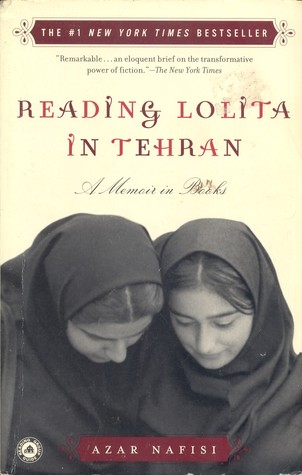
 A few weeks ago,  I read Reading Lolita in Tehran, and apparently didn’t mention it.  It’s a curious mixture of literary discussion and revolutionary memoir, as the author, Azar Nafisi, discusses great books of the western canon (and Lolita) with her classes in Iran as the country heaves with revolution.  Ms. Nafisi was a leftist revolutionary in her youth, at least during her time in America: imagine her surprise when she returned to Iran and got one, just not the one she expected. While opposition to the Shah’s regime drew from both the secular-Marxist left and the reactionary-Islamic right, it was the latter which prevailed.  Feeling irrelevant by the new regime, and appalled by its puritanical culture,  Nafesi would seek sanctuary first in her classroom, and then in a private class taught from her home, teaching to a select group of girls.   Throughout their discussions they sought to apply the themes engaged by Nabokov,  James, Fitzgerald, and Austen: for instance, as Humbert from Lolita turns a young girl into an object of his own interests, to be molded by his own proclivities, so the government of Iran has turned them into objects to be molded by its desires.  While I haven’t read most of the books discussed by Nafisi’s class or her reading group,  I found it very interesting as a memoir of the revolution. I’m particularly interested in following up with The Republic of the Imagination,  as Nafisi — having fled Iran  — seeks her true city via the literary world, engaging with minds across the ages.

 I’ll also be having a little fun with titles later. You may remember when I read Into Thin Air, followed shortly by Into Thick Air,  or my reading two books entitled Kobayashi Maru back to back.  Well,  another dueling duo arrived in the mail today, and the only thing preventing me from diving right in is…all the other books I’m intent on reading. We’ll have to see what  I cram in where…

Posted in Reviews | Tagged , , | 7 Comments