Big Box Swindle

Big Box Swindle:  The True Cost of Mega-Retailers and the Fight for America’s Independent Businesses
© 2006 Stacy Mitchell
336 pages
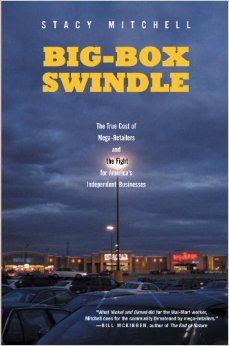
What happened? Where did America go? ..everything’s Wal-Mart all the time, no more mom & pop five and dime..

(Merle Haggard, “Where did America Go?)

Growing up in Selma, I was aware of two different ‘cities’:  one was a coherent downtown core that consisted of attractive if decaying and inactive buildings; the other was a twelve-mile stretch of parking lots, boxes, and neon signs running north of the city proper. We went downtown for the library and courthouse; we went down Highland Avenue for everything else.  Millions of towns across the United States, but especially in the Southeast, have a similar brokenness. They were broken by shining lights, promises of jobs and prosperity, and the lie that this kind of ‘progress’ is inevitable. Big-Box Swindle exposes the seeming triumph of corporate colonialism not as an inevitable result of market economics, but a  product of tax and  zoning policies pitted against widespread public apathy.  In Swindle, Stacy Mitchell argues that accepting and promoting big-box development is economically self-defeating, and shares the stories of citizens who have taken action to push back.   While unashamedly hostile toward the chain stores, it invites political interest from across the spectrum — whether from progressives, who fear depressed wages, libertarians who object to the public’s money being handed over to private corporations, and conservatives who see  the big-box bulldozers as a threat to community life.

Although the first chain stores appeared in the late 19th century, it wasn’t until the federal government began taking a heavy interest in playing with development and transportation that they really took off. From the very beginning, big boxes were supported by big government — and not just in expected ways. To be sure, when Uncle Sam built interstates out into the country and fixed mortgage practices so that loans inside cities were depressed, and loans outside the city proper encouraged, they benefited — but that’s been covered by all kinds of books, especially Suburban Nation.  Another practice that Mitchell shares is that of the government allowing developers to  write off forty years of building depreciation in only seven to ten years. This urged developers to throw up sites, and abandon them once the tax write-off was no longer available. (This is presumably one reason why Wal-Mart stores have a planned life cycle of sixteen years.) Developers enjoyed (and enjoy) a banquet of political favor: cities buy land for them and sell it to them on the cheap, or better yet seize it under eminent domain and turn it over to development;  most states allow large companies to play tax games with subsidiaries and holding companies, the kind that mean annual tax bills under $300.  And for all that help, these boxes are still propped up by public tax subsidies and  infrastructure  —  roads, power, and water  — that stress city budgets to the point of bankruptcy, especially when the chains move on and leave a vast parking lot whose wastewater still has to be corralled and treated.

Why did cities do this to themselves? Mitchell argues that most of the reasons offered rarely stand up to scrutiny. The chains’ prices aren’t particularly lower than their competition, at least not after they’ve established themselves. At the outset prices are low, mostly to build a customer base.  What is lower are wages, because these stores experience high employee turnover and have zero interest in investing in them.  Because independent stores operate on a margin, even losing 10% of their business is enough to send them reeling into bankruptcy. What’s worse, because the chains are part of a national network, they don’t bother integrating themselves into the local economy. They’re not buying products from local factories,  using local ad agencies,  law firms, and banks. Home Office handles that.  They don’t even provide jobs, so much as claim existing ones — just as they claim the existing demand for their wares.    People’s communities become nothing more than dots on a map to be conquered by a national strategy: Wal-Mart, for instance, likes to saturate an area with stores and then close redundant ones once it has become the apex.

Mitchell’s concern isn’t merely with the local economy and the private use of public money; she has a passionate interest in the communal welfare of people, of the ties that bind us to our neighbors and enrich our lives. Independently owned businesses and their employees are invested in the local community; their taxes support the services, and if their parking lot poisons the water, their owner’s kids are drinking it.  At times, she borders on the romantic, bringing to mind You’ve Got Mail: the small business owners love their customers and carefully choose what they might offer, and have long heartfelt conversations with everyone. The box stores leave you to read labels by yourself, and if you’re not buying then get out already.   Mitchell’s overt hostility toward the chains means they can do nothing right: at one point, she scolds Wal-Mart for being discriminatory about its stock, choosing not to carry gangsta rap cds;  several pages later she gripes against Blockbuster for not discriminating, and carrying dozens of copies of the latest Hollywood production regardless of its quality, while offering only a few copies of an independent film. Well, dear author, should they be picky about what they stock, or shouldn’t they?

Big Box Swindle offers a lot of room for thought, and I approached it with caution. I knew I would be predisposed to agree with the author on some points, being a locally-oriented person, but that same small-is-beautiful stance also made me wary what she might declare as the solution:  federal legislation.  They’re the ones who helped create the problem, so my suspicion is that corporations will happily co-opt whatever legislation comes down the pike.  D.C. is their city, not the people’s. Happily, however, she doesn’t. Oh, she mentions D.C. as a redoubt against the worst of corporate abuses, but the ‘solutions’ third of her book is almost wholly citizen-politics. There she recounts people organizing to protect their communities against outside colonization, either by changing zoning and tax laws to discourage big-box development, or by banding together in business cooperatives to compete with the boxes’ economy of scale.  The closest she comes to urging for national legislation is calling for the states to work together to close off certain tax loopholes.  The focus on local activism means a true empowerment of local communities — of people becoming the primary actors within their own lives, and not just content to let some bull-in-a-china-shop federal agency try to do it for them.

Related:

Now the stores are lined up in a concrete strip
You can buy the whole world in just one trip
Save a penny cause it’s jumbo size
They don’t even realize
They’re killin’ the little man
Oh, the little man…
(Alan Jackson, “The Little Man“)
Posted in Politics and Civic Interest, Reviews | Tagged , , , , , , | 2 Comments

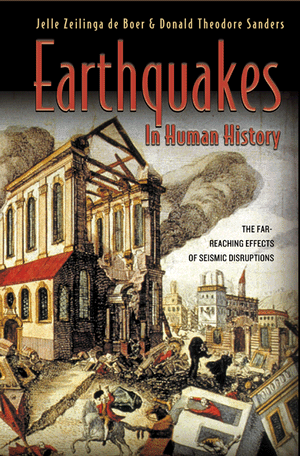
Earrthquakes in Human History

Earthquakes in Human History
© 2005 Jelle de Boer, Donald Sanders
304 pages

de Boer and Sanders’ “Earthquakes” is exactly what it says on the tin: a quick survey of how earthquakes have affected human history.   An initial section explains the basic causes of earthquakes, and subsequent chapters reflect on activity in the middle east, England,  Greece,  Japan, South America, the American midwest, and the Pacific Coast.  The authors lead with a retelling of the quakes’ immediate effects, like the days of fire consuming San Francisco in 1906; this is followed by material on how seismic activity has shaped the local geology, and finally thoughts on the long-reaching effects. The long-reaching effects are the weakest point of the book, with the authors giving credits to earthquakes for everything from the collapse of states like Sparta and Portugal, to the rise of the scientific revolution. That last is overdoing it, methinks.    Take it as a narrative account of some of the Earth’s deadliest earthquakes, strengthened by explanations of how quakes occur where they do,  and it succeeds.

Related:
Disaster 1906, Edward F. Dolan

Posted in history, Reviews, science | Tagged , , , | Leave a comment

Trojan Horse

Trojan Horse
© 2012 Mark Russinovich
336 pages

Something sinister is developing in the depths of the dark net. There are inexplicable power outages in Washington, and misinformation filtering through the systems of the United Nations. Jeff Aiken and his partner Daryl Hagen, having previously unmasked an al-Queda cyber attack against the United States, suspect this is more a technical conspiracy than buggy software — and one that spans all of Eurasia.

Trojan Horse is a cyberthriller that leads with Jeff and Daryl’s computer forensics before shifting into a more conventional action thriller once the government that authorized the cyberattack against the United Nations realizes their software is being sniffed out. The first half of the novel is more thoughtful and detailed than CSI-style cyber mysteries; there’s no guy-staring-at-computer-typing-furiously, but a lot of trouble shooting and mulling over how the software intrusion might work.  Interest in cybersecurity  helps to take it on, but the last half is far easier going: the  malicious agents attempt a street abduction,  and much action follows, culminating in a car-and-airplane chase from the Czech Republic through Turkey into Iran.

I especially enjoyed Trojan Horse for its characters.   The men  conspiring against the interests of the UN/US, and on behalf of China and Iran, are antagonistic without being diabolical.   The Americans, Iranians, and Chinese are all cold professionals, working on behalf of their respective nation-states. The Iranian lead, Ahmed,  and his Turkish girlfriend/courier Saliah, are no slogan-screaming jihadists; they’re practically lapsed, religiously.. After abducting the sleuths to find out what they know, Ahmed instructs his men to dispense with their guns – they’re not gangsters, and weapons are no longer required. Daryl, Aiken’s partner in work as well as romance,  is similarly complicated. When she and Jeff are abducted,  it is her cold fury that the Iranians fear more than Jeff. Physically, he’s a threat…but she is, by Ahmed’s estimation, utterly deranged.

Trojan Horse is a thriller far more relevant than the kind previously unreleased, because the sort of cyber intrusion detailed here happens every day. Both the American  Department of Defense and American corporations are constantly attacked by sources within the Chinese state. A tool the Chinese use to follow the main characters’ cell phones sounds like the Stingray device employed by American intelligence agencies, and more frequently ordinary law enforcement:  it mimics a cell tower, then tracks phones which connect to it – the phone’s owners are completely in the dark.  If nothing else, a thriller like this is worth trying just to see what we’re in for in the 21st century.

Related:

Posted in Reviews | Tagged , , | 3 Comments

The Return of the TBR

Dear readers:

A couple of days ago I received a book in the mail and a little alarm bell went off in my head, the subconscious recognition that yep, I’ve not another stack of unread nonfiction books: at least twelve. I toyed with the idea of re-instituting the To-Be-Read Takedown Challenge , but realized this lot was mostly politics, philosophy, and history. Not especially varied, that, so I bought three tech books. Problem solved!   I’m definitely fixed for June: from the library, I have books on the Great War, volcanoes, earthquakes, and animals; and from my own stack, I’ve got cybersecurity, internet infrastructure, politics, political philosophy, science, and Asian history.

Below are ten items on the new TBR list, though the full number is more like fifteen.

To Be Read Takedown Challenge II: Bigger and Better! 
1. The Obstacle is the Way, Ryan Holiday. Yet another neo-Stoic offering, I believe, and a recent acquisition.
2. Trucking Country: The Road to America’s Wal-Mart Economy, Shane Hamilton. Bought this in December, but my interest petered out when I realized it was more about politics and economics than driving.
3. 10% Human, Alanna Collen. Also starring on the science TBR list! Purchased in January. 
4. The Great Debate: Edmund Burke, Thomas Paine and the Birth of Right and Left, Yural Levin. Purchased last June. 
5. The Big Box Swindle: The True Cost of Mega Retailers, Stacey Mitchell. 
6. Don’t Hurt People and Don’t Take Their Stuff, Matt Kibbe.  An intro to the non-aggression principle, I’m guessing.
7. Domesticated: Evolution in a Man-Made World,  Richard Francis. Another feature from the science TBR. 
8. The Orthodox Church, Kalistos (Timothy) Ware. A history of the Eastern Orthodox. 
9. Saving Congress from Itself, James Buckley
10. Cyberwar: The Next Threat to National Security, Richard Clarke
For the record: the last TBR ran from May 2nd, 2014, to December 26th, 2014.   I’ll make better time this go-round, I’m sure.  
Posted in Reviews | Tagged | 7 Comments

Memorial Day

Memorial Day
© 2004 Vince Flynn
407 pages

“And if they manage to get this thing into Washington and end up killing the leaders of America, Great Britain, and Russia?”
Rapp shrugged. “At least there won’t be any more ambivalence about the war on terror.”

Suspicious activity from some shady financial institutions hints that something big is about to hit the United States, and an investigation — followed by a black ops abduction job in Pakistan — reveals the scheme. On Memorial Day, as the entire US government gathers with the leaders of Great Britain and Russia to christen a new World War 2 monument,  militant jihadists intend to set off nuclear explosions along the eastern seaboard, beginning with D.C.  Only Mitch Rapp, an assassin in the employ of the CIA, stands in their way.

Memorial Day is an early War on Terror action thriller that has little patience for those who view the Patriot Act as a threat to civil liberties, and features a main character who abducts jihadists not only from Pakistan, but from the Justice Department’s own holding cells.  He has no compunction against shooting terrorists to coerce confessions from their brain-besplattered comrades, or slipping a man a drug to make him terrified, then repeatedly holding him underwater.   At least no one can say he murders in cold blood, because Rapp spends the entire book enraged. He’s at war not only with every AK47-wielding beard in the middle east, but his own government, riven with softies. If he’s not yelling or shooting at jihadists and politicians, he is on his way to do one of the two.

Memorial Day is an action movie in book form. The main character stands out because of his sheer bloodlust (he almost doesn’t care if D.C. is turned into a radioactive crater, because it means the entire Arabian peninsula will be glass shortly thereafter), but no one else is worth paying attention to.  If a character emerges who is sympathetic, they are immediately killed off — like the poor Mexican truck driver who was hired to haul a trailer into Atlanta,  never knowing that the mysterious trailer held an unstable radioactive core that was slowly poisoning him.  All he wanted to do was make it home in time for his son’s baseball game. Why do you hate baseball, terrorists?  The villains are, as you might aspect from a book written so early after the 9/11 attacks, complete caricatures of the “They hate us for our freedoms” variety.   They’re seriously in the United States because its teenage girls wandering about in malls in skimpy outfits are dragging the world into a cesspit of moral decadence.  Seems like fighting moral decadence in Riyadh would be easier on the gas. (The suggestion that the terrorists object to D.C.’s foreign policy is dismissed as blaming rape victims.)  

In terms of sheer action, Memorial Day works very well:  it opens with Chinooks deploying company of rangers in Pakistan, and later there’s action on the high seas as various agencies try to intercept container ships, and towards the end we have car chases and even a boat chase.  Flynn reveals several interesting technical details, like D.C.’s plan for continuity of government in the event of an attack, and the existence of a large Soviet nuclear testing range in Kazakhstan, where duds are literally just abandoned in the desert for any lunatic with a deathwish to dig up.  (A New Jersey-sized field in Kazakhstan actually exists, but from what I’ve read, various international agencies  were secretly cleaning the site all throughout the 2000s,  with all detritus secured by 2012.)   While the villains are wholly uninteresting, Flynn does admit for a little blowback: one of the attackers was formerly used by the CIA to fight the Russians invading Afghanistan,  He also doesn’t regard Saudi Arabia and Pakistan as reliable allies in the war of terror because the Saudis are in fact financing some of the extremist groups.

Memorial Day is a fun action thriller, though not a seriously interesting geopolitical one.

Related:
The Last Patriot, Brad Thor.  A blend of this and The Da Vinco Code. Very silly.

Posted in Reviews | Tagged , , | 2 Comments

All the Shah’s Men

All the Shah’s Men: An American Coup and the Roots of Middle East Terror
© 2003 Stephen Kinzler
272 pages

On one  dismal  night in 1953,  a conspiracy destroyed both Iranian democracy and American honor.  At the dawn of the 1950s, Iran was struggling to free itself from British domination, a  precursor to the bloody colonial revolutions that would mark the mid-20th century.   Despite being a product of colonial rebellion itself, the United States would betray its own history and one of amiable relations with Iran to  assert itself on the world stage.  All the Shah’s Men is an admirably executed mix of espionage, history, and politics,  brimming with passion.

Iran arrived at the 20th century in a sorry state;  ruled by monarchs who were either corrupt or incompetent, it fell under the influence of both Russia and Britain, whose great game of tug-of-war used Iran as the rope, plundering its resources. While Russia would collapse into civil war in 1917, Britain proved a far more formidable opponent, securing a long-term monopoly over the harvesting of Iranian oil and natural gas, and virtually taking over the country in the 1940s during World War 2.  For fifty years, Iran’s mineral wealth was literally siphoned out and shipped away:   Iranians were denied the opportunity to learn and master the industry,  granted only menial labor and a token share of the profits.

The forced abdication of the shah in 1943 meant that the Iranian parliament and its democratic offices were free to grow in legitimacy and authority. Increasingly, the parties running for office called for an end to British imperialism in Iran, and one Mohammad Mossadegh was particularly famous for his attack on the Anglo-Iranian Oil Company.  He called for better working conditions for laborers, the inclusion of Iranians in the engineering and administrative aspects of the oil business, and a more equitable division of profits between the British company and Iran.  Britain would have none of it.

Mossadegh achieved office several times championing the cause of an independent Iran as the Truman administration gave way to Eisenhower’s.  The change of American leadership was important, for while the British government wanted to take action in Iran, it wanted American support, in part because of D.C’s previous help in securing Iran against German interests.  Truman had no interest whatsoever in going to bat for British petroleum, but Eisenhower had witnessed the fall of China to Communism and the unraveling of Korea, and — with help from Winston Churchill, no stranger to mideast debacles —  he was sweettalked into seeing red in Iran.   There would be no Persian Mao, not on Ike’s watch.    While Britain considered and dismissed the idea of simply invading Iran, this was decided to be more trouble than it was worth. Far better to take the country from within, by using the lingering authority of the shah’s successor-prince to dismiss Mossadegh, and back him with the Iranian and Allied militaries as need be.

Although the coup initially seemed to be failing disastrously — arrests of conspirators were made, followed by the fleeing of the shah  to Iraq — the American man on the ground was able to turn things around. Kermit Roosevelt was the son of Teddy Roosevelt,  one of the first American executives to dream of the United States having a ‘place in the sun’, stretching its wings across the globe.  Using the economic depression that followed Britain’s economic war against Iran, Roosevelt  stirred up dissent and paid people to form an anti-Mossadegh mob that would march on the man’s house.  He was arrested, his  government fell, the shah returned, and– well, things just went downhill from there. Emboldened by outside support, the shah grew ever more tyrannical against his own people, until he was ousted by a religiously authoritative regime that was hostile to Mossadegh for its own reasons.

  
All the Shah’s Men succeeds brilliantly in part because of the connections Kinzler draws to broader Iranian history. The Iranians had thrown off another resource monopoly sixty years before,  and in the process they established a constitutional government. While weak against the traditional authority of the shah, and his control of the military,  it steadily acquired its own moral authority — increasingly seen as more legitimate than the shah, who was a creature of the outside world, forcing its designs on Iran, from control of Iranian resources to the forced adoption of Western suits and hats.   Mossadegh’s championing of Iranian independence was not merely freedom from outside manipulation, but freedom from the unjust and arbitrary rule of the shah.  The coup didn’t simply topple Mossadegh’s government: it and Anglo-American support  of the shah thereafter sabotaged and reversed the trend toward Iranian self-government.

The coup not only derailed Iran’ development as a democratic and humane society, but has caused no end of trouble for both Britain and the United States, mostly the Americans who did the dirty work.  When the shah was ousted in 1979 and sought refuge in the United States, Iranians who remembered 1953 thought they were about to re-witness history. Hadn’t the shah fled  before, only to be returned under the aegis of the Americans?   Such was the spark of the hostage crisis, leading to decades of hostility and cold fury between the powers in which Iran and the west continue to wage war against one another’s interests;  in Iran’s case, this has taken the form of funding terrorist organizations.

All the Shah’s Men is one of the more outstanding books I’ve ever read; though  principally about the conspiracy,  Kinzler does a terrific job in explaining the historical context.  But the book doesn’t read like a lecture; at times it has the feel of investigative journalism or a spy thriller. Kinzler isn’t just summarizing news articles, but relies on interviews with those who remember Mossadegh, for whom the man is a memory of a time when Iran’s destiny seemed its own to make, when the law was being strengthened as a redoubt against arbitrary authority instead of being used to execute it.

Related:

Posted in Reviews | Tagged , , , , , | Leave a comment

The Grid

The Grid
© 1995 Phillip Kerr
447 pages

Some modern architecture might make you want to kill yourself. Other modern architecture might try to kill you directly. The Yu Corporation’s newest project in Los Angeles, derisively called “The Gridiron” by everyone except for its starchitect, is an example of the latter. The Grid is the pinnacle of not only the kind of architectural brilliance it takes to make viewers wish fervently for a good disaster to remove the eyesore, but of integrated computer technology. It is the world’s first wholly “smart” building, in which every supporting system of the building — even the physical structure of the building itself — is controlled by a computer. It is a technocrat’s greatest hope: people can’t even use the elevators or enter doors without being authorized by the computer as having legitimate business within the building. And if they try to attend to their own ‘personal’ business — using the restroom, for instance — their leavings are automatically scrutinized, subjected to not only a drug test but health screenings. A system this complex is bound to go wrong, and it does: with less than a week to go before the grand opening, people start dying. At first it seems like a rash of bad accidents, but then the characters realize the building itself is trying to kill them — but why? Did a deranged ex-employee sabotage its programming, or has it developed intelligence and decided to remove its internal carbon-unit infestation?

For someone accustomed to Kerr’s historical mysteries set in Germany, this is startling different work. In terms of literary craftsmanship, Kerr has grown by leaps and bounds since penning this. Much of the dialogue is forced, like canned lines from a television show. The increasing tension itself carries the novel forward, as the true source behind the mysterious deaths is revealed. Of interest to modern readers is the technology, which — astonishingly — within our grasp if not already achieved today. No one can read this today without thinking of the rising “internet of things”, although we have more to fear from outside sources hijacking those devices and using them against us than we have of our house trying to kill us. Readers from the 1990s may remember the Sandra Bullock movie, The Net: at times, the book has that feel, of the building being an entity that can do anything — even interfacing with a police department’s internal network and suspending two officers to keep them trapped in the building — and the futurism has the occasional short-sighted pockmark, like the fact that people use film cameras despite living in a world of holograms. The increasingly frequent trips inside the ‘building’s brain grew tedious because of their weirdness, but on the whole I enjoyed this. It’s not stellar, but still topical. Too bad Kerr has never tried to revisit techno-thrillers — I’d like to see what a more experienced hand produces.

Related:
The Fear Index, Robert Harris

Posted in Reviews | 6 Comments

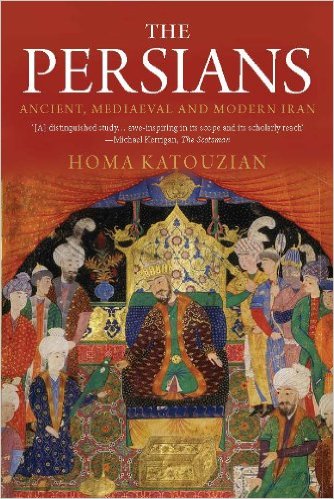
The Persians

The Persians: Ancient, Mediaeval, and Modern Iran
© 2009 Homa Katouzian
452 pages


Come, let us sit upon the ground and tell sad stories of the death of kings. It’ll take a while, because there’s been a lot of them.The Persians: Ancient, Mediaeval, and Modern Iran is a sweeping  political history of Persia, and of the modern Islamic Republic of Iran. The author quotes a Persian proverb which asks — six months from now, who alive? Who dead?  —  and argues that Persian history is established proof of the thin line between arbitrary authority and chaos. While technically  a survey, its density and focus on a list of rulers rather than the general trends within Persian history makes it a formidable challenge to the beginning student.

The Persians is largely modern, reaching the 20th century in less than two hundred pages.  What follows beforehand is essentially a long list of men killing men.  It’s nearly biblical – just replace “begat” with “who was killed by”, and you’ll get an idea. Oh, there’s some variety; sometimes the potentates settle for blinding one another instead of killing, which does get passé, and some Turkic and Mongolian fellows are offed, too.   Although Persia looms in the background of western history, invading Greece and lopping off Roman consuls’ heads, even marching on Jerusalem,   those episodes of strength seem to be the exception rather than the rule.   The tediously recorded butchery may actually be intentional, for the author’s main contention is that arbitrary tyrants have been the norm of Persian history, and that not until the 20th century has any work been put into creating a state beyond the will of one man, in forming a civil society that checks the ambitions of a solitary tyrant.

Even once the text moves to the 20th century and becomes more fulsomely detailed and varied, it’s still a little odd in what it dwells on. The author mentions, for instance ,that the 1953 coup has been studied in detail, and so…he bypasses it. If you didn’t know that coup was executed by Britain and America to shore up their client-king’s absolute authority over the the Iranian people, too bad. If you’re in the dark, you’re staying there, because one minute Mossadegh is in power and the next he’s in prison. Trends within Iran which bear significant fruit, like the  development of the Shiite clergy,  are barely present, or are  like the poetry buried under the mounds of executed kings.

That’s not to say there isn’t material of interest in here. I didn’t realize that Alexander the Great is actually claimed by the Persians as one of their own, a half-Persian lord who appears in the Shahnameh, a massive work of legendary history.  The Great War and World War 2 take on a different light from Iranian eyes: because Britain and Russia spent the late 19th and early 20th century playing tug-of-war with an increasingly frayed Iran,  Iranians admired and sympathized with the Germans in both conflicts. The closer the author draws toward the present day, the more communicative he is about Iranian culture in general:  in the final hundred pages there is a good section on the evolving role of women in Iranian society, which — while not as good during the Shah’s forced modernization — is not as bad as it was in the early 1980s.  

While there’s no shortage of useful information to be mined here, beginners should probably look for something less mountainous and less dry.

Related:

Posted in history, Reviews | Tagged , , , , | Leave a comment

8.4

8.4.
© 1995 Peter Hernon
393 pages

San Andreas? You want a real earthquake, son, you come to Tennessee.  In America’s heartland lies a currently-quiescent fault, the New Madrid Seismic Zone. In the early 19th century a series of three massive earthquakes  rolled the Mississippi River region, the most powerful quakes recorded in American history.  In 8.4., it happens again…..but instead of scaring the coon-skin caps off of hunters and making the cows go crazy in the frontier, it devastates cities. It doesn’t just give them a bad day, knocking the electricity offline and collapsing interstate bridges: it levels the area, with a preliminary death toll of over a hundred thousand.

The novel is a genuine science fiction tale, as most of the viewpoint characters are seismologists who are frantically trying to figure out what’s happening; as they argue between themselves and attempt to convince the authorities that the worst is yet to come, the reader is treated to not only explanations of tectonic geology,  but graphics that give some idea of what is happening below — illustrating the different kinds of faults, for instance.  Key to the drama is the fact that New Madrid activity doesn’t consist of one big quake with minor aftershocks, but that its powerful tectonic activity erupts in clusters.   The characters spend most of the book in mortal danger: if they’re not fleeing the consequences of the quakes, like floods in Kentucky after a dam collapses, or urban riots as people raid stores for supplies, they’re actively courting it by  crossing rivers transacted by the faults, rappelling into open breaks in the Earth’s surface, or probing deep into abandoned mines to collect data.    There’s even a little outbreak of civil war at the end, when the President decides the best thing to do is stick an A-bomb in the Earth’s innards and blow it up, and the Kentucky governor realizes the White House is out of its ever-lovin’ mind.

8.4 leads with science, and follows with disaster-movie thrills. The endgame is bonkers, frankly, but maybe it’s hard to sell 20th century readers on the idea that not everything can be solutioned or bombed away.

Related:
Supervolcano: Eruption, Harry Turtledove.

Posted in Reviews, science fiction | Tagged , | 2 Comments

In God’s Path

In God’s Path: the Arab Conquests and the Creation of an Islamic Empire
© 2015 Robert Hoyland
303 pages

A Roman author referred to the Roman and Persian empires as the two eyes of the world — but they didn’t see the Arabs coming. In the span of a hundred years, a people from the desert wastes between Egypt and Mesopotamia had traveled from Spain to the Indus, bringing together a diversity of nations under one banner and laying waste to empires. History texts usually present a map of expansion as the sudden creation and explosive growth of Islam, but Hoyland argues that’s premature.  Instead, he examines the Arab conquests as…the Arab conquests, in which Islam is first the means of an alliance between Arab tribes that allows them to sack two ailing realms, and then is the means of forging their own empire that transcended tribal bounds.  Instead of merely attributing the Arab spring into empire as one motivated by religious zeal, Hoyland examines the Arabs as actors on the historic stage, and dwells on their political skill.

The result is a history that overturns elementary assumptions.  For instance, conquest and conversion were two completely different processes: even a province absolutely integral to the nascent Islamic civilization, Persia, was not majority-Muslim until the 14th century.  (Islamic provincial governors were by no means eager to force conversion:  non-Muslims were taxed by the government.) By preserving the structure of the societies they were conquering — relying on Christian and Persian scribes, civil officers, etc to retain their roles —  and offering completely secular benefits for joining the Arabs on their globetrotting campaigns, what began as a local city-state quickened into a global phenomenon.  Eventually, the religion of the Arabs, who had become the ruling class, would become the religion of a multitude, evolving along the way. Towards the end Hoyland dips into religious history,  reflecting on how the century of war, mixed defeats and triumphs, and the assimilation of various cultures shaped it. For instance,  he views the bar against images as a way for the Arabs to distinguish themselves against the decadent empires they had supplanted, but especially against the Romans, whose Constantinople twice defeats sieges here.   While there were some brief spots in the strictly historical narrative that rivaled Numbers for being a list of names and places without story to them, Hoyland’s insightful commentary more than makes for it, This is a history that illustrates not only the beginning of the Islamic world, but shows some of the shared machinery of empires in general. For a book on conquests, there’s comparatively little about the actual execution of battles; for that, a source like Crawford’s War of the Three Gods might prove a complement.

Related:

Posted in history, Reviews | Tagged , , , , , , , | Leave a comment