Bratva

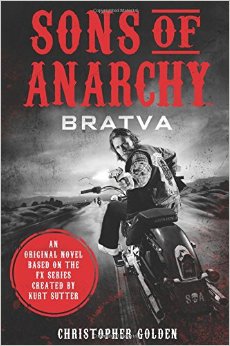
Sons of Anarchy: Bratva
© 2014 Christopher Golden
256 pages

For Jax Teller, the Sons of Anarchy motorcycle club has always been his family, its members his brothers. His father started the Sons, with a philosophy directly inspired by Emma Goldman. But over the years they became little more than another gun-and-drug-running biking gang,  and now they’re not the only family in Jax’s life. Not only does he have two boys to protect, but in the process of rescuing one from kidnappers, he discovered a half-sister in Ireland. Now that sister, Trinity, has gotten herself in bed with the Russian mob, who are falling apart in civil war.   In Bratva, Jax and two of his brothers ditch their colors to find out where one Russian kingpin is holed up, while not being killed by another.  It’s the first unexpected foray into licensed fiction for the Sons series, not counting graphic  novels by the same artist.  Most of the characters are new (Russians and a slew of north Vegas residents destined for cemetery plots), but the three Sons in play (Jax, Chibbs, and Opie) sound in character. Gemma Teller-Morrow certainly does. The plot is fairly reminiscent of one of the episodes, with criminal politics, corrupt or complicit authorities, and a bloodbath at the end. The only thing that’s missing is the show’s soundtrack, which alternates between furious and melancholy rock.  It’s fun enough if you’re in the mood for lots of plotting, biking, and shooting,  and has enough background info that you don’t need to be a viewer of Sons to roll with the plot.

Related:

Posted in Reviews | Tagged | Leave a comment

Reads to Reels: Roswell

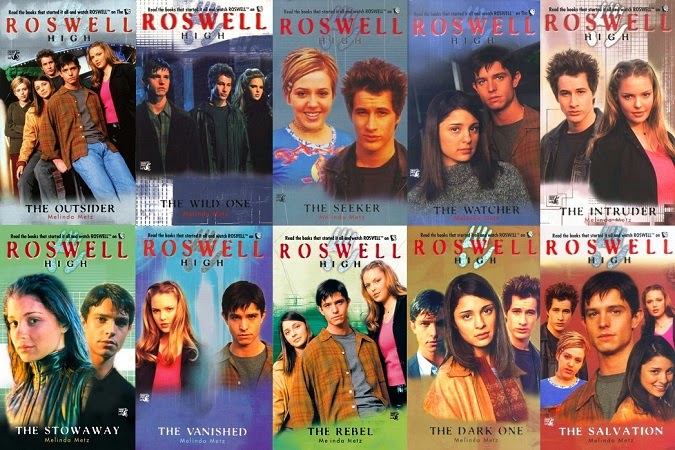
In 1998, Melinda Metz introduced a new series of young-adult science fiction: the story of three teenagers whose earliest memories were of climbing out of incubation pods in the desert outside of Roswell, New Mexico.  When they emerged, they appeared to be human children, and — wandering around in the desert — were scooped up by the local authorities and adopted by various families, oblivious to their origin. Max, Isabel, and Michael likewise had no clue where they came from…but they knew it wasn’t New Mexico.   In The Outsider,  the trio’s lifetime of mutual secret-keeping is derailed when a stray bullet nearly claimed the life of the girl Max loved. A sheriff is soon sniffing around, but he’s not any sheriff — he’s an agent of a secretive government agency whose task is to conceal and contain the threat of the Roswell Incident.  There are other aliens out there…and what follows for the three and their friends (Liz, Alex, and Maria) is nothing but trouble. 

I adored this series in middle school. My best friend and I discovered it together, feeding our mutual addiction.  I was confused and appalled when, midway through the series, the cover art abruptly changed to feature some random-looking teenagers who were nothing like the characters I’d grown so fond of.  Roswell High had been made into a television show!    I wouldn’t be able to watch that show for another six years, when it appeared on DVD, and when I did I realized it wasn’t so much an adaption of the books as a completely different story. The television show and book series are so completely different, in fact, that they only share the setting of Roswell, and the names of most of the main characters. (I say most, because Liz Ortecho becomes Liz Parker;  Isabel is the only character whose character is recognizable in both, but she’s something of a trope,being a blonde ice queen.) The origin stories are utterly different: in the  books, the kids are the children of alien scientists whose ship was sabotaged, who are concealed by the lone surviving crewman.    In the television show, the kids are…cloned reincarnations of alien rulers killed in a civil war, whose personalities have been made manifest in human bodies.
 The television’s drama was a story that could never decide where it wanted to go, and as science fiction it was far inferior.  The original books had an overarching and integrated plot;  for instance, the second villain is leading a revolution against the third villain, the teens’  home planet’s social order, and while he’s psychotic the history books will pretty him up if he wins.   The television show was almost random in the baddies.  (The less said about “The Skins”, the better. ) But as much as I regard the plot of the books and the development of most of the characters inferior, I am still a fan of the show — I’ve watched all three seasons through perhaps four times in the last ten years. Why?  
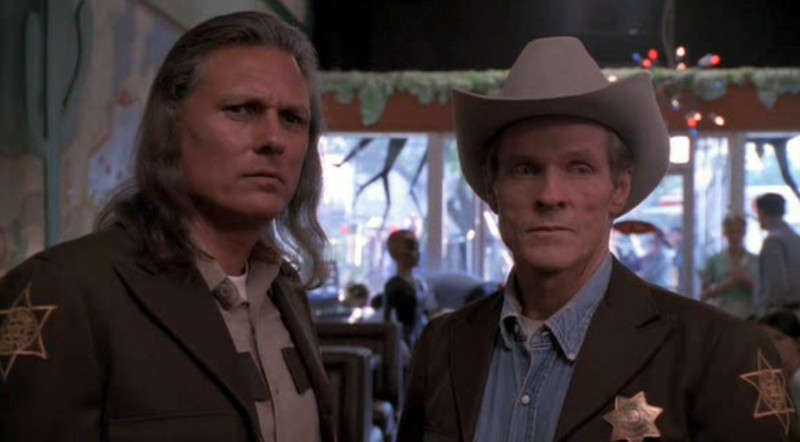
It’s all about William Sadler, who plays Sheriff Jim Valenti. (You may recognize him as Agent Sloan from Deep Space Nine, or Chesty Puller from The Pacific)  In the books, the sheriff is nothing but evil incarnate. He is misery wearing black shades, a grey man who silently stalks and kills. His son Kyle has slightly more personality, being an obnoxious jock with a penchant for evil, but both creatures are beyond redemption.  In Roswell, Valenti is the best character in the series. He begins as the aliens’ antagonist, trying to figure out what happened in that restaurant when Max saved Liz,but by the second season he is their ally — and he pays for it. His son Kyle likewise starts an obnoxious jock, and  while he’s never as gloriously redeemed as his father, he is utterly sympathetic…and, hilariously, Buddhist. (There is a “I Love Kyle Valenti” tumbler.)  Valenti’s character is written far more humanely here, but Sadler’s acting is what really sells him.   I’ve never liked clean-shaven and professional heroes; Sadler is more weathered — craggy, even.  He wouldn’t be out of place in a western.  Sadler is given some of the same threads as the teenagers in Roswell — relationships, trying to find his place in the scheme of things — but his acting outclasses the stars, giving the drama an earnestness.   Sadler gives a show of teen drama a level of adult seriousness; it is he who loses his job and nearly his son trying to protect the aliens, and it is he who breaks the news to them when one of the show’s main characters is abruptly killed off. 
While Sadler’s acting and Valenti’s storyline are the main reason I found the show  appealing, it has other aspects going for it.   The supporting characters are a good lot;  Agent Delco from CSI Miami appears here as Jesse Ramirez, another solid addition. There are a few novelty episodes, like Isabella fantasizing that she is in a wacky 1960s sitcom called I Married an Alien, or using the characters in a retelling of the Roswell incident.   Personally, I enjoy the first season the most, skipping around on the second and third. The show was cancelled and ends abruptly, but it has its moments.  As far as book-to-box adaptions go,  Roswell remains the furtherest from the source…if enjoyable in its own ways. 
(And if nothing else, there’s Katherine Heigl,  in character as Isabel, whose fears are hidden by aloof superiority…)
Posted in Reviews, science fiction | Tagged , , | 4 Comments

Celebrating America: Independence Day Reading

Every year since this blog’s inception I have committed part of June and July to Independence-Day reading. The number and variety of the books has grown every year, and usually includes material on the colonial period, the revolution, and the early Republic. This is an election year, however, a season full of rancor and ambition. Politics is so pervasive that I want to get away from it, so this year I am tacking a course away from that bitter port. Instead of war and debate,  the last week of June and early July will instead be a period of American literature — of revisiting or learning anew American stories.   I had also planned to seek refuge in books on small-town America, reading Bill Bryson’s tour of backroads and visiting Wendell Berry’s Port William again, but that will wait until the TBR hits five or less.  Expect Willa Cather, Mark Twain, and Jack London.

Posted in Reviews | Tagged | 9 Comments

Tubes

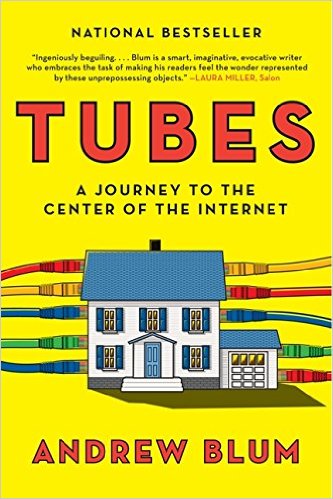
Tubes: A Journey to the Center of the Internet
© 2012 Andrew Blum
303 pages

It turns out Ted Stevens was right: the Internet really is a series of tubes, connecting large boxes, and usually in nondescript warehouses that look like self-storage units.  Inspired by a squirrel depriving him of Internet by nibbling on his wires, Andrew Blum decided to investigate the physical infrastructure of the Internet.  The journey took him across the United States and into Germany and Britain, where he discovered that the internet is corporeal. Across the world are businesses devoted solely to housing space where regional networks can directly tie into one another.  Tubes gives a slight sense for how the internet developed, visiting the university where the first connections were made, and then the first commercial network center.  However ethereal the internet may seem to regular users — a mysterious force that binds and penetrates our computer?  — it is given life by not just the creative energy poured into it, but the physical substructure — routers, wires, warehouses, tubes, and cables.  It’s awe-inspiring to think that there are companies whose physical property literally wraps around the world, providing redundant connections in case of an earthquake, although after reading it I’m still a foggy how on all this is done. How do routers know where to send information?   At some level, even the people running the networks aren’t fully aware of their mechanics because there’s so much information to channel. When it comes to data storage, for instance, different bits of a given video could be posted in multiple data centers. It’s rather like the hydro engineers in On the Grid not being able to tell exactly how water got to a specific neighborhood; there are too many possible paths   Blum’s goal of visiting ‘monuments’ of the internet, some of the most pivotal spots —  Google’s data centers, treated with Area 51-type secrecy, the point where the first cable connected New York  and London, the aforementioned networking warehouses — provides general milestones, but they’re disjointed.  If you’re really into the internet and its history, it makes for mildly entertaining reading, but the pieces remain disconnected.

Posted in history, Reviews | Tagged , , , | 7 Comments

TBR Progress Report

A few weeks into the new TBR Takedown Challenge (Bigger! Better!), I’m making excellent progress:

Taken down!

Liberty, Defined, Ron Paul
Big Box Swindle, Stacy Mitchell
Saving Congress from Itself, James Buckley
Cyber War: The Next Threat to National Security, Richard Clarke
When Asia Was the World, Stewart  Gordon
Tubes: A Journey to the Center of the Internet,  Andrew Blum

“Six! Wowzers! You’re  halfway home!”   Well, not quite. The ‘full’ count will be seventeen, but we’re a third of the way in and going strong. There are a couple of reviews pending.

Still to come:

 The Obstacle is the Way, Ryan Holiday.
 Trucking Country: The Road to America’s Wal-Mart Economy, Shane Hamilton.
10% Human, Alanna Collen.
The Great Debate: Edmund Burke, Thomas Paine and the Birth of Right and Left, Yural Levin.
Don’t Hurt People and Don’t Take Their Stuff, Matt Kibbe.
Domesticated: Evolution in a Man-Made World,  Richard Francis.
The Orthodox Church, Kalistos (Timothy) Ware. A history of the Eastern Orthodox.

And more!

Also, I’m all but finished with the planned series into early Islamic history that’s been ongoing since the beginning of the year. So far, we’ve had Destiny, Disrupted;  After the Prophet; and In God’s Path, with unplanned works sprinkled in. It’s become more of a series on the middle east in general, and has been especially heavy on Iran, and only one remains in the ‘planned’ reading — a work on Islam and Central Asia.  There will be more ME stuff than that, however, as I intend on doing one book each for Turkey, Egypt, and Saudi Arabia.

Annnnnnnnnnnd I’m almost done with my Cybersecurity sweep! This year we’ve had Data and Goliath, Future Crimes, and more recently, Cyber War plus a couple of extras. No Place to Hide will follow later in the year, after the TBR challenge.  So,  halfway into the year, things are looking good.

Posted in General | Tagged | 3 Comments

Lights Out

Lights Out: A Cyberattack, a Nation Unprepared
© 2015 Ted Koppell
288 pages

In Lights Out,  investigatory journalist Ted Koppel comments on the vulnerability of the United States’ power grid to a cyber attack,  and reviews the way government agencies, private citizens, and other organizations are attempting to prepare for a grid-down scenario.

The story begins with the integration of the internet and the electrical grid, which allows for an efficient market but at the cost of vulnerability of outside attack. The threat doesn’t come from nation-states like China and Russia, however;  although they almost certainly have hooks deep inside energy’s cyber infrastructure, they have too much to lose from reprisals. Entities like North Korea and Isis have no such qualms.  The most dire attack would be one similar to that which the United States and Israel employed in Iran: a viral program introduces commands into their centrifuges which slowly undermined their functionality.  If the large power transformers which are the backbone of the electrical network are destroyed or seriously damaged,  widespread and prolonged outages would follow. Not only are these massive machines custom-built for each location, they require special rail cars for transport; replacing one would take anywhere from six months to two years.

After establishing the problem, Koppel moves to attempts a solution. Although various government agencies, including the White House, have expressed concern over the vulnerability, plans at redressing the situation are slow in coming. Washington’s stance toward cyber attacks against civilian infrastructure seems motivated by a conviction that the United States can and will strike first, as though cyber shocks can be predicted.   There is a growing awareness of the problem, but response has been marginal at best. Not only  is the American government not ready to defend against a pointed cyber attack on its electrical grid, it is not ready to deal with the chaos that would ensue from widespread power outages. Without electricity,  the constant production and shuttling of goods and services would shut down completely; major cities would exhaust commercial supplies in less than days, and after that — what social hell would follow?   FEMA’s plans seem to involve evacuating major cities like New York, but to what end?  Keeping supplies for that many people is problematic, considering that if there’s no emergency, the supplies simply go to waste. The agency is far more prepared for regional disasters than it was after 2005’s Katrina, but that’s a fairly low bar.

 In the last third of the book, Koppel examines communities like the Mormons and the prepping community which steel themselves for emergencies. The Mormons are motivated by a series of nasty altercations — small-scale wars, even — between themselves and state militias in the 19th century, but their entire church structure seems engineered for resilience.  Likewise impressive are rural communities in Wyoming, who acknowledge that in the event of a grid-down scenario, they would be left to their own devices while D.C. prioritizes places like New York City. People in sparsely-settled states like Wyoming are more kin to their pioneer forebears  than they are the naked urbanite, who is at the mercy of complex systems working as planned.

Lights Out is a most interesting book, with at least three subject areas: energy, cyberwar, and emergency preparation.  Given Koppel’s name recognition, I could see this book as one introducing a lot of citizens to the general idea of cyber attacks, or even the importance of electric infrastructure — subjects that few people would be willing to pick up a book about.   It’s not exactly complete —  Koppel doesn’t mention, for instance, that there are three grids in North America, so damage wouldn’t necessarily be continent-wide. (The three grids are the eastern seaboard, the western seaboard, and Texas. The publisher’s cover actually hints at the segmentation, though) It succeeds at isolating the key points about abstract systems and distilling them into a warning, however.

Related:
Cyber War, Richard Clarke. Clarke is quoted extensively.

Posted in Politics and Civic Interest, Reviews | Tagged , , , , , | Leave a comment

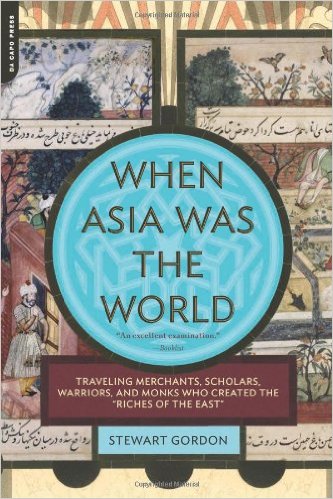
When Asia was the World

When Asia Was the World: Traveling Merchants, Scholars, Warriors, and Monks Who Created the ‘Riches of the East
© 2009 Stewart Gordon
256 pages

When Asia was the World revisits, through the lives of traveling monks, traders, and warriors,  the extraordinary vistas and cultures of greater Asia from 500 to 1500 A.D.   It is not a conventional history of Asia before the ascendancy of Europe,  but allows the reader to play the part of historical tourist, tagging along with various men traveling circuitous routes from Iran to China. Some are traders, bringing to life a robust economy that nearly covered a hemisphere,  Others are pilgrims — Buddhist monks, traveling from China to India and back, visiting every monastery they can and soaking in wisdom — Muslims, too, made treks to learn from courts afar. These men circulated not only spiritual insight, but secular knowledge, connecting courts across the continent.  Others are Mongolian raiders,who don’t bask in civilization so much as incinerate it.  This is ideal reading for someone who has a vague interest in Asia, or in global history in general, but who doesn’t want to deal with an actual history book. Here, the history is absorbed through men of zeal and ambition, willing to transverse epic mountains, forbidding deserts, lush forests, and pirate-filled sea planes to see what’s beyond the horizon.

Related:
The Spice Route, John Keay
A Splendid Exchange: How Trade Shaped the World, David Bernstein

Posted in history, Reviews | Tagged , , , , , , | Leave a comment

Cyber War

Cyber War: The Next Threat to Our National Security and What to Do About It
© 2010 Richard Clarke, Robert Knake
320 pages

Soon, the ultimate tool will become…the ultimate enemy! So said the 1982 trailer for Tron, a heavily dated computer film that comes to mind with every mention of “Cyber Warrior” here.  The word sounds like a teenager flailing around in a 1990s mall wearing a bulky VR helmet.  Whatever the awkwardness in adapting military terminology to the brave new digital world, however, the threat posed by war in cyberspace is real — both because of multitude of potential attack vectors, and because the United States has been such a boundlessly optimistic first-adopter that no nation on Earth is as exposed to digital attack.  In Cyber War: The Next Threat to Our National Security,  long-time security official Richard Clarke  reviews how hacking can be used to utterly cripple the United States’ elaborately interconnected electrical and telecommunications infrastructure and  briefs readers on how the military and government are attempting to get a handle on what to do next — and, given his status as an adviser to four presidents, he has suggestions of his own.   Cyber War is filled with horror stories and dire predictions, but at root is a useful introduction to how increasingly fragile our digital world is becoming.

Although the United States has led the way in the adoption of the internet for military purposes — the internet was created for military purposes –the enthusiastic embrace of net integration by civilian infrastructure has made the United States one of the most vulnerable targets for cyber attack.  Especially problematic is the fusion of the power grid and the internet;  while it allows for convenient remote management ,  the connectedness of the grid itself means it is possible to disable one  subsystem and force cascade failures on either the west or east coast.  The absence of power doesn’t mean a few hours of going without the television, either, because a carefully-planned attack could cause physical damage to the generators themselves….and they are monstrous machines that would have to be laboriously rebuilt. Another vulnerable target is the financial system; not only could a disruptive attack aimed at that quarter destabilize the economy, if the public lost trust in digital dollars, outright paralysis might ensue.

Cyber attacks aren’t theoretical, either. Although China receives the most attention as a digital threat, Clarke contends that the Russians are (circa 2010) ahead of the pack, and points to havoc wreaked in Estonia and other Warsaw escapees when they  courted Moscow’s wrath.   Because the United States offers so many soft targets, both military and civilian, cyber warfare has an asymmetrical nature:  America has a lot more to lose from cyberattacks and reprisals than either North Korea or China –-  the former,  because it has little in the way of functional systems to begin with, and the latter because they have a firebreak that can separate China’s internal internet from the global web.  In a democratic system like the United States, that’s not an option.

Clarke proposes a cyber triad:  secure the ‘trunks’, the main ISP lines through which everyone connects, using a filter to automatically scan for and deep-six malicious code; harden the power grid by distancing it from the main internet;  and shore up the vulnerabilities of the military and government networks.   The ISP security would be a private-public venture, with administration of the filter left to the ISPs themselves to head off the aspect of censorious abuse. Cyber War is only six years old,  but the future is arriving more quickly these days. There is very little said about the danger of data collection, for instance, and cybersecurity firms are far more skeptical about the conventional viral-definitions approach Clarke endorses here.   Cyber security is definitely a red-queen arms race..

The datedness aside,  for those who have never considered the subject his review of how the internet basically works, highlighting its weak spots,  will be most useful. There is the added attraction of watching successive governments become aware of and attempt to respond to the problem of  IT security; Clarke had an inside view, serving in several administrations crossing party lines.He also proposes diplomatic action, a cyber version of SALT. The core of Clarke’s argument – that our systems, particularly our electrical grid, are vulnerable – remains intact, if not the particular defense he proposes — holds good, and the authors’ largely-jargon free if doom-laced style makes it an easy if alarming read.  One thing that isn’t dated is the danger: a recent study indicated that the US government is still far behind in the realm of cybersecurity when ranked against IT firms, and to make matters worse it is in the same tier as the energy and telecommunicatons companies.

Related:
Future Crimes, Marc Goodman
The Grid, Phillip Schewe
@ War, Shane

Posted in Politics and Civic Interest, Reviews | Tagged , , , , , , | 3 Comments

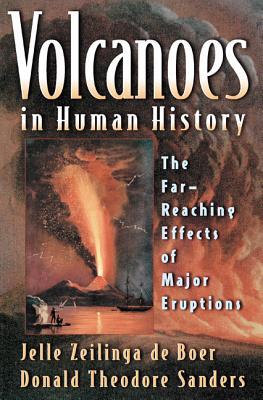
Volcanoes in Human History

As with Earthquakes in Human History, this is exactly as it describes itself. A mix of science and history, the authors begin with an explanation of volcanic activity before moving on to cover a few key eruptions. Volcanoes illustrate that the world is constantly remaking itself, forming and destroying islands as the years go by. Like “Earthquakes”, “Volcanoes” is most commendable as a collection of the immediate impact of various eruptions, supplemented by scientific explanations. The most ‘far-reaching’ effect of a volcanic explosion documented here are the disruption of weather patterns across the northern hemisphere; twice in the 19th century, ‘summer’ practically never came, with famines ensuing.

Posted in history, Reviews, science | Tagged , , , | 2 Comments

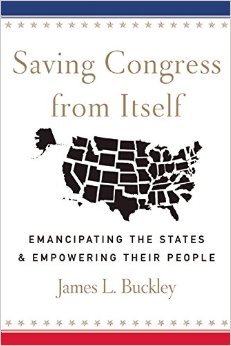
Saving Congress from Itself

Saving Congress from Itself: Emancipating the States and Empowering their People
© 2014 James F. Buckley
120 pages

According to the latest Gallup poll, only 11% of Americans approve of Congress’ job performance, but virtually every senator or representative who runs for reelection will receive it.  Americans want Congress to do more, even as the institution proves itself incapable of doing much of anything.  The problem lies not merely in entrenched partisanship, but in misplaced priorities.  James Buckley argues that Congress is overworked —   not with its own responsibilities but of those of governors, state legislatures, mayors, and city councils.

The core problem is the existence of “grants in aid” programs, which transfer money to the states as assistance, and which carry with them stipulations for their use.  This allows Congress to  directly influence the policies of the states by offering money, and then explaining it can only be given out if the States follow Congress’ wishes.  The creation  and administration of these grants has become a major devourer of Congressional time.   Because the number of programs granting aid has multiplied several times over since the 1960s, there are more committee reports to listen to than there are hours in the day. Buckley, who prior to serving as a federal judge was a member of the Senate, offers a sample  daily agenda as illustration. Of the fifteen items spanning 9:00 a.m. to 10:00 p.m, only three had a national-interest scope, being items like reports from the US Army Corps of Engineers and a briefing on Iran. The rest were grant aid reports and requests, and so numerous were they that nine of the fifteen scheduled events had schedule conflicts with one another.  Congressional members either skip meetings altogether, or dash from one to the other to put in an appearance, relying on aides to fill them in on the substance.  Where is the time to read legislation, let alone pore over and discuss thousand-page bills?   (A bill forcing Congress to read the bills it passes has yet to make it out of committee consideration.)

Congressmen use their time in this fashion because it pays, at least for them.   While a national body should not be spending its time arguing and administrating local affairs,  this is the sort of thing local citizens actually expect their Congressmen to do.  When Mr. Smith goes to Washington and returns to townhalls with his constituents, they complain about bus routes and schoolrooms – and he, if he is able to finagle some funds for the locals, has an easy in come election day.   That’s not chump change, because when they’re not missing meetings or voting for bills without reading them, congressmen are constantly working to get themselves reelected, spending hours on the phone to beg for money.

This is a situation that must be altered.  Not only has Congress become patently dysfunctional, ceding every Constitutional prerogative to the executive branch,  but the weight of ever-multiplying grants is fiscally unsustainable. The United States government doesn’t generate money; it either takes it from citizens, issues bonds that future generations will have to pay for, or prints more and weakens the value of the currency.   Not only has the national government ceased to be effective, but the stipulations attached to these grants often compromises the aid as the funds are leached away on both ends in administration and in hiring lawyers who can interpret the Talmudic policy requirements.  The number of agencies is such that many have redundant — and sometimes even conflicting — goals, with fuzzily-defined metrics for success.  Aid can be done better, and so can government.  A constant theme in Saving Congress from Itself is that of subsidiarity, that in matters of politics, responsibility should remain at the level most capable of dealing with it. A city should take care of its own infrastructure; outside grants only prop up poor planning, like low-density sprawl,  and the ease of spending other people’s money means the funds won’t be put to their most productive use. (There’s no ‘skin in the game’, to borrow Nassim Taleb’s way of putting it.) The national Congress, with an entire world of challenges in front of it, certainly should not be deliberating on local issues.

 Buckley ends the argument with several propositions that would serve to end this legislative torpor.    To curb the amount of time officials spend working on their reelection campaigns, he suggests we (1) restrict Congressionals to two terms, and (2) limit the president to one six-year term.  More drastically,  he proposes that federally-issued grants end altogether, being phased out. Initially, money would simply be issued with no stipulations, and after a pre-fixed number of years to allow state governments to adjust their budgets,  the grants would be no more.  Buckley cites the example of Rhode Island, which was given an opportunity: if it agreed to receiving less money, there would be no rules whatsoever attached to the use.  With no outside pressure, Rhode Island was allowed to tailor its own plan to its own particular need, with effective service increasing and costs declining.  If Congress does not admit or pass the necessary legislation, a convention called by the States could also propose and pass amendments.

Saving Congress is a short little book, and Buckley doesn’t waste a word.  I was aware of political corruption in regards to military contracts, but had  little idea for how Congress conducted its business.  Truth be told, I generally imagine Congress-folk to spend their time golfing, eating, and conspiring against the public.  Buckley’s argument is valuable in form as in substance. He approaches this from a nonpartisan observation that Congress is simply not performing. He doesn’t deny that people still need help, but the current approach isn’t doing it — and it”s costing local cities who keep looking to Congress, and distracting Congress from its actual constitutional responsibilities.  If nothing else,  Saving Congress illustrates why the American public continues to elect their senators despite loathing Congress altogether: it’s only pork on the other guy’s plate.: One senator’s wasteful spending is another’s putting ‘tax dollars back to work for you’. How about we dispense with the middle man and put our dollars to work for ourselves?

Related:
Thoughts on Building Strong Towns, Chuck Marohn.

Posted in Politics and Civic Interest, Reviews | Tagged , , , , | 2 Comments